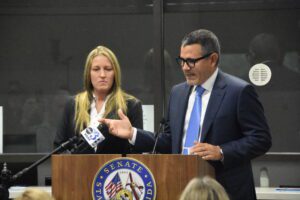




On Aug. 25, Walton County commissioners voted to end the use of Flock cameras on county right of way. Chairman Brad Drake passed the gavel to Commissioner Tony Anderson to make the motion, saying he did not agree with them.
The motion was seconded by Commissioner Dan Curry, who initially brought the item to the meeting for discussion.
According to Walton County officials, the Walton County Sheriff’s Office operates roughly 106 of the 130 cameras found in the county. County Attorney Clay Adkinson said the board’s authority stops at the right of way, meaning cameras in city limits and along state highways will not be affected.
Santa Rosa County Commission Chairman Colten Wright said in a text message Aug. 26 that the cameras have produced arrests in serious cases and that abuse of the system by individual officers elsewhere should not decide the question locally.
“I believe license plate readers have been effective in apprehending dangerous criminals and saving the lives of women and children being trafficked,” Wright said. “I won’t let a handful or rouge law enforcement officers who’ve illegally abused the system to dictate what happens in the future and how the public is kept safe.”
Santa Rosa County Commissioner Kerry Smith, who has in the past questioned the Santa Rosa County Sheriff’s Office budget, drew a line between criticizing what the agency spends and limiting how it operates.
“I’d never be a commissioner that stood in the way of a law enforcement agency’s ability to fight crime,” Smith said.
Wright said the technology is not new, noting that cameras have been in use for years along highways, at bridge toll booths and on patrol cars.
“When traveling on a public roadway, motorists have no expectation of privacy,” he said.
Wright also compared the cameras to other law enforcement tools, saying officers have been found to have used force, firearms and Tasers without justification without those tools being taken from officers who use them properly.
Curry said his concern in Walton County was that the cameras will not stay license plate readers, citing reports on Flock expanding use of artificial intelligence and the possibility of pairing the cameras with facial recognition.
Santa Rosa County Commissioner-elect Dean Light, who will be replacing current Commissioner Ray Eddington, says he is willing to look at the issue.
“I can see where the use is for the sheriff’s department. If there’s a case going on or something like that, where they need some surveillance. But just general, out there? No,” Light said.
In Okaloosa County, Commission Chairman Trey Goodwin offered a statement on the issue. Godwin was the only commissioner to respond to the question.
“Okaloosa County is continuing to focus its attention on removing automated traffic enforcement cameras because they impose penalties on the registered owners without first establishing who was actually driving the vehicle.
Flock cameras present a different policy question because they are used as investigative tools to assist law enforcement in solving crimes and responding to emergency situations. The Okaloosa County Sheriff’s Office has adopted strict safeguards and procedures for using that technology.”
On Aug. 26, Gov Ron DeSantis also weighed in on FLOCK cameras at a press conference at Florida International University in Miami. DeSantis called for the Florida Legislature to take action.
“I think these cameras, the license plate readers, I think it’s out of control,” he said.
DeSantis’ main point during his remarks was the he believed the cameras would threaten civil liberties and lead Florida to become a “surveillance state.”
For law enforcement to access the system, searches require a case number and repeated searches are flagged.
Automated license plate readers photograph passing vehicles, converting the plate to text and stamping the photo with a time and location. Flock Safety, based in Atlanta, says images and footage are deleted after 30 days unless local law enforcement says differently.
City Manager Jessica Leavins told the council the city has fielded repeated questions from residents about home-based businesses as the style of business has picked up popularity in recent months. She said staff wanted direction before writing an ordinance amending the city’s land development code.
Under the guidelines Leavins presented, a stand could be no larger than 20 square feet and no taller than 8 feet. Customers would park in the seller’s driveway rather than on the right of way or in yards, and stands could only operate during daylight hours any day of the week.
The time restriction mirrors existing rules regarding yard sales.
“We’re not trying to discourage small business, while at the same time we want to make sure that there are regulations to keep everyone safe,” she said.
The city cannot regulate what is sold, as that is determined by the state. Leavins said the only thing the city can influence is what she described as “home occupation.”
After a question posed by Mayor Pro Tem Doug Capps on whether the businesses face outside review, such as from a health department, Leavins said state rules govern health and safety concerns.
As to who handles complaints, Leavins said those would be dealt with by code enforcement officers.
Councilman Shannon Hayes said his main concern was stands lingering, comparing them to yard sales that stretch past a weekend.
“They’ll start Friday and they’ll still be there next Friday,” Hayes said. “It’s not just sitting out their side of the road until the next morning.”
Councilwoman Dusty Allison said many of the sellers are stay-at-home mothers adding to household income and noted that she is glad that the city’s role would be small in scope.
After a question from Councilman Sylvester Echols, Leavins said the city’s ordinance would not overrule current regulations set by a homeowners association.
Mayor JB Whitten asked whether the council was comfortable with having staff return at a later date with a draft ordinance, and members agreed. Any ordinance would first go before the Planning and Development Board before returning to the council.
The agreement divides operating costs for animal control and shelter 50-50. A new shelter will be built in one of the city’s existing buildings, with the county covering 65% of the costs. Crestview is contributing the land and structure, according to Deputy County Administrator Craig Coffey.
Coffey said the building was constructed in 2020 and is about 7,500 square feet.
The county’s animal control budget had been slated to rise to about $900,000 this year, and county officials say the partnership will reduce that ask to $450,000. Coffey said Crestview currently spends $600,000 a year on animal control, meaning the county’s half would be $300,000.
The city will still need to provide officers and vehicles.
The move follows the county moving to stand up its own animal control operation this summer after the Panhandle Animal Welfare Society declined to renew a service agreement with the county it held for more than 20 years.
Commissioners in June chose a scaled-back model, known to county officials as animal control light, that only responds to bites, cruelty and neglect cases and loose livestock over strays and owner surrenders.
Coffey said Crestview provides higher services than that, falling somewhere between a full-service animal control model and the county’s limited model.
Coffey said the county will initially operate the limited version in the unincorporated areas and then grow toward the city’s service levels as resources grow.
Commissioner Trey Goodwin noted that the final cost remains unsettled.
“It just reminded me how expensive this venture is probably going to get,” he said.
“In my tenure, we’ve never had in house animal control,” he added. “In fact, I’m not sure anybody sitting up here has ever worked with Okaloosa County running its own animal control, so this is new.”
Crestview City Manager Jessica Leavins told commissioners the partnership would help both governments respond more effectively.
Coffey said the agreement would also allow county inmates to work at the facility.
Before the issue came up, commissioners voted to add an item to the agenda to approve the purchase of two fully assembled animal patrol vehicles for no more than $44,000, including shipping, with advance payment.
Public Safety Director Pat Maddox said the county first tried to reuse three low-mileage F-250s, but the animal control beds cost up to $20,000 each and would take up to 10 months to build.
The assembled vehicles, which have air conditioning in the animal compartment, can arrive in two weeks.
Finance Director Julie Perry walked school board members through the proposed budget on July 27. The upcoming budget has a proposed millage rate of 5.372, down 0.05 mills and below the rollback rate.
One mill is $1 for every $1,000 of a property’s taxable value. If a home in Crestview is worth $200,000, that equates to about $1,065 a year for schools.
Most of that rate isn’t up to the school board. The Florida Department of Education sets the rate, and districts have to charge it. If Okaloosa County decided not to enforce it, it would lose the $145.5 million the state sends it.
However, the state-imposed rate has been falling for decades, down from 6.53 mills more than 30 years ago.
The issue is that Florida pays districts by enrollment. District officials expect about 1,200 fewer students to be enrolled in the district this year, resulting in $11.1 million less in funding.
Enrollment has been falling statewide, mostly because of the Family Empowerment Scholarship, which is open to any student regardless of income. Perry explained that the district made cuts to save $4.8 million by cutting teacher positions tied to enrollment.
However, that still left a $6.3 million gap.
Additional costs, including Pineview School coming online, new textbooks and rising insurance costs, increased the district’s projected shortfall to $17.6 million.
New state money helped offset some of that shortfall. Perry explained that the $6.1 million the district received is slightly less than what the Florida Legislature discussed. Another $1.9 million is already earmarked for tenured teachers.
That brought the remaining gap to $12.1 million.
The district then tried to close that gap by cutting teacher positions, closing Mary Esther and Longwood elementary schools, reorganizing staffing at the central office in Niceville, cutting department budgets, and paying for facilities staff and bus drivers from building repair funds.
Those measures left $1.8 million to spare, mostly money Perry said is for any remaining salary increases or unanticipated costs. Further adding to the headache is the possibility that funding for the school resource officer program might go away.
First discussed at an Okaloosa County Commission workshop on July 21, commissioners rejected a proposal by Commission Chairman Trey Goodwin to stop funding the SRO program in favor of a reduced tax rate.
Perry explained that since the Parkland school shooting in 2018, the county and the district have split the cost of the SRO program nearly 50-50. Goodwin questioned whether that split was fair because the district covers nearly half of its share with Safe Schools funding, to the tune of $2.9 million, with another $1.4 million coming from its own operating budget.
School board members said that money was never a bonus. The state never sent that funding until 2018, Perry said. It took money out of general per-student funding and reappropriated it.
“They didn’t give us any more money,” Board Member Brett Hinely said. “They just said you will now have to spend it on mental health or hardening, or whatever you’re going to do in your district. So it’s not a grant.”
According to state records, Okaloosa County schools have spent $5.37 million on SROs, with other funding going toward middle and high school correction programs and behavior programs. None went toward bullying or suicide prevention, according to expense reports from the 2017-18 through 2020-21 school years.
Superintendent Marcus Chambers laid out the worst-case scenario. The SRO program costs about $8.4 million, and the county pays $4.4 million. If the county walked away, a district placeholder of $1.6 million would become $4.4 million, or an extra $2.8 million on top of the $17.6 million it already absorbed.
The district has $1.8 million in reserve.
Board Member Lamar White recalled former Sheriff Larry Ashley telling the board that students in Okaloosa schools are residents, too, and deserve protection.
“I think the last place the general public wants to find us a way to balance the budget is going to be on the protection of children,” Board Member Parker Destin said.
Chambers said deputies are only one layer of school security, with other layers being paid for with building funds. He has spoken with County Administrator John Hofstad and expects more conversations going forward.
The proposal would eventually eliminate property taxes on homesteaded properties under $250,000 by 2028, phasing out ad valorem revenue that cities rely on for public safety, infrastructure and quality of life services.
Destin Mayor Bobby Wagner said his city, which already has one of the lowest property tax rates in Florida, would lose roughly $937,000 per year, a 6.28% reduction. He noted that 51% of Destin’s homesteaded residents currently pay an average of $197 per year to the city, meaning most homeowners would see their bill drop to zero under the full exemption.
“It’s easy to say yes to lower taxes,” Wagner said. “The harder decision for the voter and for us in office will be if income is lower, what outputs are we going to cut?”
Wagner said Destin’s financial standing, with a “rainy day” fund twice the state requirement, gives the city some cushion, but cautioned against treating the measure as a cost-free win for taxpayers.
“No taxes is a great bumper sticker,” he said. “But as an elected official, I have to live withing the reality of a balance sheet.”
Wagner also dismissed the Legislature’s stance on local government waste at a time when the state recently paid $84 million for Norriego Point when it was sold for a fraction of that price.
In October 2025, the State of Florida acquired four acres of land on Norriego Point, land built by dredging Destin Harbor, from Pointe Mezzanine LLC. The land was owned by Bobby Guidry, an Okaloosa County megadonor who was convicted in the largest riverboat gambling fraud in Louisiana history in the mid-90s
“Those that are doing the right thing and being accountable to the taxpayers of their districts are getting impacted for something they didn’t do,” Wagner said.
In Crestview, City Manager Jessica Leavins said the impact would be steeper. With 41% of the city’s property homesteaded, Crestview stands to lose $2.7 million in the first year, about 20% of the general fund, rising to nearly $3.9 million by 2028, a loss of around 30%
Leavins
“$2.7 million is a lot of money,” Leavins said. “20% of any budget is going to be a substantial number, and that’s just the first year.”
Leavins said the city is already exploring creatives solutions but acknowledged that some service reductions are likely unavoidable.
“We’re looking to minimize that as much as possible,” Leavins said.
She also raised concerns about a provision in the bill’s final language, Section G, which allows municipalities some flexibility in how they spend their remaining property tax revenue beyond core services, but that language is vague and open to interpretation.
“If it’s broad and we are allowed to continue to fund those services, we are going to do our best to find a way,” Leavins said.
Leavins added that the city will take a more conservative approach to this year’s budget cycle, avoiding new positions or projects that might need to be cut in the future.
Florida League of Cities Vice President, and Shalimar Mayor, Mark Franks said the proposal, regardless of its intent, moves the decision-making process away from local communities and puts the purse in Tallahassee.
“A proposal this significant warranted more time and a comprehensive fiscal analysis before moving forward,” said Franks. “Eliminating property taxes doesn’t eliminate the cost; it just shifts the burden, and no one has shown how the math works.”
Franks said Florida’s cities remain partners in the success of the state, but need tools, like property tax income, to care for the wellbeing of their residents.
“When you remove the ability for communities to fund their own services locally, those decisions inevitably move further from the people they affect,” said Franks.
All three officials emphasized the importance of voter education ahead of November’s election. Leavins invited Crestview residents to attend budget workshops, the first scheduled for July 15, and urged them to contact their council members directly if concerns arise.
Wagner said his focus between now and election day will be ensuring residents understand the trade-offs before they cast their vote.
“If you want lower taxes, what are you willing to give up?” Wagner said. “As long as we have an educated vote on what we’re willing to give up, then the will of the people must be. Because that’s what democracy is supposed to be.”
$15,000 for a new K-9 dog, including training and equipment
$15,000 for crime scene photography 3D scanning equipment
$7,000 for a tactical pole-mounted camera system
$2,583 for GPS tracking and mapping systems, including software and equipment
The forfeiture funding stems from the department’s participation in a multi-agency drug task force that coordinates with federal law enforcement. In cases that result in convictions, assets tied to criminal activity may be seized. The federal government then redistributes those funds to participating local agencies, with spending restricted to specific law enforcement purposes and subject to local governing body approval.
Police vehicles are parked in the Crestview Police Department’s lot. Recently, the Crestview City Council authorized the use of forfeiture funds to purchase new equipment and fund training programs. (Photo by Lindsey Stroud)
Crestview Police Chief Stephen McCosker said the proposed purchases represent “a good use of the funds.”
McCosker noted that Crestview’s Police Officer of the Year was assigned to the task force responsible for generating the forfeiture revenue.
“These funds are coming from his efforts in that role,” McCosker said.
He also emphasized the value of K-9 units in past investigations and the need to maintain a balanced program with dogs at different stages of service.
“Some of those funds were collected because of the use of K-9 programs,” McCosker said. “We don’t get all the dogs at the same time … we need different dogs at different stages of their work life.”
McCosker also highlighted the department’s SWAT team, which recently executed five simultaneous search warrants, underscoring the need for enhanced safety equipment.
“A pole camera is not something that would be fixed in a location – it’s used for officer safety during high-risk search warrants,” he said. “We can extend that camera further than a person can safely go.”
He added that the department had previously sought funding for GPS tracking and mapping systems, but available grant funding had fallen short.
The total cost of the requested items is $39,583, below the approximately $43,000 currently available in forfeiture funds. McCosker said the department also expects to receive an additional $30,000 in future forfeiture revenue.
The City Council approved the request in a 4-0 vote, with one member absent.
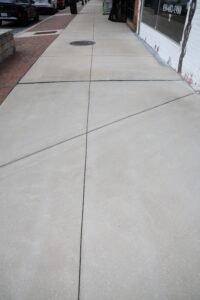
The city of Crestview first published a bid in January, soliciting proposals for the cleaning, staining and sealing of concrete sidewalks along Main Street and several intersecting side streets.
At the CRA meeting, city staff requested approval to amend the sidewalk staining project and redirect the allocated funds to another initiative: a multi-use path that will connect Main Street to Twin Hills Park.
Current sidewalk in downtown Crestivew. (Photo by Lindsey Stroud)
The sidewalk staining project was originally part of the broader Main Street streetscape improvement plan.
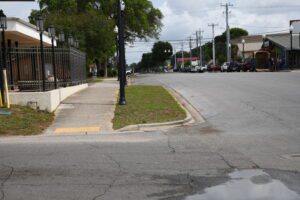
In 2024, the City Council approved a contract with Bullard Excavation Inc. to improve downtown Crestview, including widening sidewalks to meet ADA standards, adding benches and creating new parking spaces, among other updates. Not all of Main Street’s sidewalks have been updated.
Sidewalk that has not been completed on south Main Street. (Photo by Lindsey Stroud)
However, city staff recently determined it would be “more efficient and economical” to clean the sidewalks periodically rather than stain them.
Staff also noted that future sidewalk repairs could “disrupt the consistency of stain appearance and detract from the aesthetics of the district, rather than enhancing them.”
Crestview City Manager Jessica Leavins said that “due to the lifespan of the staining and sealing, and the increased events we are having downtown, (the stained sidewalks) would actually have a shorter lifespan.”
Leavins encouraged members to redirect funding toward the multi-use path, stating the city “could either stain the existing sidewalks or build a new multi-use path.”
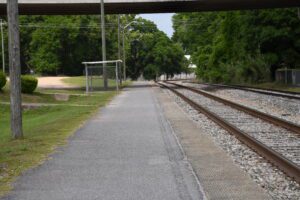
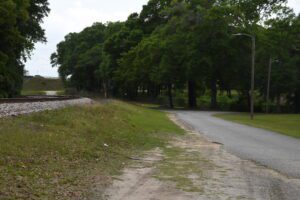
The multi-use path is being funded in part through federal dollars from the U.S. Department of Housing and Urban Development and will run adjacent to Industrial Drive and the railroad tracks.
Main Street opening of multi-use path. (Photo by Lindsey Stroud)Twin Hill Parks opening of multi-use path. (Photo by Lindsey Stroud)
City officials expressed support for the project.
“I’m just excited about this multi-use path,” said Councilwoman Dusty Allison.
Councilman Sylvester Echols added that he believed it “was the best use of the funds.”
Leavins reaffirmed that the city will continue to maintain the downtown area, stating that staff will keep “Main Street sidewalks clean and updated” and work to “protect and preserve” existing infrastructure.
The resolution, sponsored by Commissioner Trey Goodwin, passed in a 4-1 vote, with Commissioner Paul Mixon dissenting, after commissioners rejected a proposed amendment that would have narrowed the ban’s application outside municipal boundaries.
The resolution targets two categories of devices: traffic infraction detectors, commonly known as red-light cameras, and speed detection systems deployed in school zones. According to county officials, the county does not currently have either type of camera on county rights of way, but staff have received requests from cities to install them there.
Goodwin said the issue was prompted in part by a ruling from Broward County Judge Steven DeLuca, who found the statutory framework governing traffic camera citations violates constitutional due process. DeLuca ruled in a case involving the city of Sunrise that the camera enforcement system improperly shifts the burden of proof onto the accused.
“The cameras don’t identify a person, they identify a vehicle,” Goodwin said. “Instead of the government bearing the burden to prove the driver, it puts the onus on the accused to prove their innocence, and that violates all fundamental principles of procedural due process.”
He said the ruling does not directly bind the county but called it a likely preview of more legal challenges to come. The resolution applies only to county rights of way and does not affect camera programs operated by municipalities on their own roads or rights of way.
The board also said the resolution is unrelated to license plate reader systems, commonly known as Flock cameras, used by the Okaloosa County Sheriff’s Office.
During public comment, speakers offered differing views.
Okaloosa resident Tim Bryant told the board he supported the ban, arguing camera-based enforcement bypasses Florida’s driver’s license point system, meaning dangerous drivers are not identified or removed from the road.
“The cameras don’t make us safer, they just collect money,” Bryant said.
Crestview Mayor JB Whitten, who voted against red-light cameras in the past, said he supports speed zone cameras in school zones despite his general opposition to traffic cameras. Whitten said he approved the speed cameras after data showed persistent speeding near schools.
Whitten said a 30-day test phase at a middle school on Old Bethel Road recorded 847 violations, including one driver clocked at 56 mph in a 20-mph zone. He also said 89.1% of drivers issued tickets last year received only one, suggesting the cameras were changing driving behavior.
“The intent is not to make money, the intent is to change driver’s patterns,” Whitten said. He urged the board to vote against the resolution or, at minimum, to table it until the state determines whether to appeal DeLuca’s ruling.
During deliberations, Mixon proposed a “friendly amendment” that would have restricted the ban to county roads outside municipal boundaries, arguing the county should respect the home rule authority of its nine municipalities. Goodwin rejected the amendment, saying the existing resolution already preserved city and state authority over their own roads.
“I will live and die on due process,” Goodwin said. “It is dangerous to use safety as an excuse to override our Constitution.”
The board also noted past incidents in which private vendors working for municipalities placed cameras on county rights of way without board approval, requiring Public Works staff to remove and store the equipment after vendors did not respond to removal requests.
“We need someone to step up and fight for this country,” Chico said. “That’s why I’m here.”
Chico was born at Naval Hospital Pensacola and traces his family’s roots in Northwest Florida to the 1800s, when his ancestors helped settle Walton County. His father attended the Naval Academy and flew as a Marine pilot. Chico followed him to Annapolis and later served as a Navy supply officer, with his first duty station back in Pensacola.
His naval career took him to the USS Iwo Jima, where he served as lead supply officer during the response to Hurricane Irma in 2017. He said his ship provided the only fresh water available in Key West for roughly half a day following the storm. His final assignment was as deputy staff logistics officer for Naval Training and Education Command, where he oversaw contracting, property management and hurricane evacuation.
Chico said his decision to enter the race traces directly to the rollout of Flock Safety, an AI-powered license plate reader system, in Pensacola late last year. After seeing news about the system, he said he called the mayor’s office three times and received no response.
“When I dug in, I realized this is a nationwide surveillance system,” he said. “There are between 56,000 and over 90,000 AI-powered cameras that scan all of our vehicles, every dent, every scratch, every unique identifier, and it reports to a national, centralized database where federal agencies, about 5,000 local police departments and state governments can pull that data and track everyone, without a warrant, without any oversight.”
Chico called the system a clear Fourth Amendment violation and said it represents the kind of government overreach he wants to take on in Washington. He has been sounding the alarm on the issue before announcing his candidacy, including a speech at the University of West Florida that he said drew thousands of attendees.
The issue has drawn attention across the region. Residents in Okaloosa County raised similar concerns when Flock cameras were introduced there, with records showing roughly 100 law enforcement agencies gained access to the system through the Okaloosa County Sheriff’s Office.
Chico’s answer to what he describes as an alliance between government surveillance and big tech is a federal Digital Bill of Rights, a legislative framework he says would extend constitutional protections into the digital age.
“Our founders were brilliant, but they could never envision AI, biometrics, facial recognition and modern surveillance,” he said. “We need to bridge that gap.”
He said the legislation would go beyond free speech protections to address how federal agencies collect and retain personal data. Among other things, he said Americans should have the right to know which federal databases hold their information, why it is being stored and for how long.
“How many databases have your information right now?” he asked. “You should have the right to request that — which federal databases is my information being stored in, why, and what’s the duration?”
“Whether it’s going after the right or going after the left, we shouldn’t be surveilling innocent American citizens unless they’re a real threat,” he said. “This is something Americans, whether on the right or the left, need to come together on.”
He extended his opposition to federal age verification laws being advanced by both parties, which would require social media platforms and websites to confirm users’ identities, in some cases through driver’s license uploads or facial scans. Chico called the measures a backdoor digital ID program that would hand government more censorship tools while delivering tech companies a database of verified users to monetize.
“It’s a holy alliance between big brother and big tech,” he said.
Chico has been sharp in his criticism of Patronis, who was elected to the seat in 2025 after serving as Florida’s Chief Financial Officer.
Chico accused the congressman of failing to pass legislation, alleged he voted to keep sexual harassment records in Congress sealed, a charge Chico said is funded by taxpayers, and faulted him for not securing military resources for the district.
He also criticized Patronis over a bill the congressman has proposed targeting social media liability protections under Section 230, which Chico characterized as an attempt to censor online speech. He has taken to calling the incumbent “Censorship Jimmy.”
On military matters, Chico pointed to reports of air wings departing Hurlburt Field as evidence that the district’s congressional representation has faltered on a core issue. He said the departure of military units translates directly to lost jobs and diminished economic opportunity throughout the region.
“District One relies on our military,” he said. “When we have military units leave the area, that’s taking away jobs, that’s taking away economic opportunity for everyone in the district.”
The Santa Rosa Press Gazette reached out to Patronis’ office for a statement on several accusations against him
In an email on March 18, Patronis only responded to claims about his bill to remove Section 230, saying, “Ending the special legal protections for Big Tech is a top priority. These companies are targeting our kids and making billions in the process. Children are losing their childhoods, and the tech cartels know it. We’ve heard from our own constituents’ stories of kids harming themselves, being exploited, and having their lives forever changed because of Big Tech.”
Navy veteran and Northwest Florida native Doug Chico is an American First candidate looking to win the Republican primary for Florida’s First Congressional District this August.
“Yet under current law, these companies can’t be held accountable,” Patronis added. “Social media may be free, but their business model depends on keeping kids hooked, and that’s wrong. My bill would repeal the special carve out that shields the tech giants.”
On foreign policy, Chico said he does not support what he described as unilateral, preemptive military strikes that fall outside the protection of clear American strategic interests. He acknowledged the Iranian government has been responsible, directly or indirectly, for the deaths of U.S. service members, but said military action requires a higher bar.
“I don’t support unilateral preemptive military strikes, especially if they don’t represent protecting our strategic interests,” he said.
He said he supports defending American allies when genuine U.S. interests are at stake but did not offer a blanket endorsement of NATO obligations, framing his foreign policy view around whether a given commitment serves the American people.
If elected, Chico said he would spend the final two years of the Trump administration focused on defending the Constitution and pushing back against what he called threats to civil liberties from both parties. He also called for a full immigration moratorium, saying unchecked both legal and illegal immigration needs to be brought under control.
Beyond surveillance policy, Chico’s platform centers on affordability and housing, federal infrastructure funding, protecting agricultural land from development, and addressing veteran homelessness.
On housing, he tied the affordability crisis to Federal Reserve monetary policy and government spending, arguing that inflation driven by deficit spending has robbed younger generations of purchasing power. He said he supports ending the Federal Reserve and called on Congress to prioritize affordable housing for millennials and Gen Z — a demographic he said he is uniquely positioned to speak to as the likely youngest candidate in the race.
“I can relate to the struggles of millennials and Gen Z in terms of affordability,” he said. “I have to feed my daughter. My food bill has increased dramatically. My cost of fuel has increased dramatically.”
“We need affordable housing for Gen Z and millennials,” he added. “I don’t want to sacrifice their futures just to please the donor class.”
On roads, Chico said federal dollars need to flow more directly to communities struggling with rapid growth. He cited a conversation with the Midway fire chief in Gulf Breeze, who told him his department cannot keep pace with population growth due to flat budgets — a problem Chico framed as a consequence of prioritizing foreign aid over domestic needs.
He also spoke to concerns from farmers and ranchers in the district, saying unchecked development threatens both the region’s agricultural heritage and its water supply. Chico said he supports halting new AI data centers in part to prevent further strain on the regional aquifer and electricity costs.
“We can’t allow this continuous development to eat up old Florida,” he said.
On veteran homelessness, Chico called it a moral failing and said housing and social services should prioritize Americans, particularly veterans, before other spending commitments.
He also said he would work to end civil asset forfeiture, calling the practice, in which law enforcement agencies can seize property from individuals without a criminal conviction, a form of government theft, citing Institute for Justice data showing $68 billion seized from American citizens and legal residents between 2000 and 2019.
On legislative process, Chico said Congress should abandon omnibus spending bills in favor of single-issue legislation, arguing the current practice allows both parties to attach what he called anti-freedom, unconstitutional provisions to must-pass bills. He also called for shortening the federal campaign cycle to reduce the influence of super PACs and corporate money in elections.
Chico described himself as his own largest donor by a wide margin, saying he has invested tens of thousands of dollars of personal funds into the campaign. He said that independence from outside donors is central to his pitch to voters.
He resists traditional political labels, saying he cannot be put in a box. He identifies as an “America First patriot” with libertarian leanings but said he is willing to cross the aisle when constituents would benefit.
“If a Democrat comes up with a good idea and it’s a net positive for most Americans, I’d be willing to support that bill,” he said.
Asked why voters should choose him in a crowded primary field, Chico leaned on roots and record.
“I’m not going to sell out to a corrupt political machine,” he said. “I’m a sixth-generation Northwest Florida family. I’m a former Navy officer. Unlike censorship Jimmy, my family’s actually from this area.”
The Republican primary for Florida’s 1st Congressional District is scheduled for August. The district, which covers Escambia, Santa Rosa, Okaloosa and Walton counties, has been reliably Republican for decades.
The item is on the board’s agenda for its March 24 meeting. The Community Project Funding Congressionally Directed Spending application was submitted to the U.S. Department of Transportation through the office of U.S. Rep. Jimmy Patronis. Because County Administrator John Hofstad submitted the application under an emergency provision before the meeting date, commissioners are being asked to ratify the submission retroactively.
The project targets the section of SR 85 running from Live Oak Church Road to PJ Adams Parkway, a stretch that has earned the nickname “Miracle Mile” for its role as the primary gateway connecting Eglin Air Force Base to north Okaloosa County.
The proposed improvements would include adding a northbound and southbound lane, multimodal and pedestrian facilities and stormwater management upgrades. County officials say the project would improve daily commutes for residents, reduce risks to military readiness and enhance hurricane evacuation capacity.
If the federal grant is awarded, the $5 million would offset local funding already committed through the county’s Infrastructure Surtax program. The overall project budget carries a match amount of $50 million, a combination of state and county funds, with $13 million designated as a cash match. The county has committed $10 million in direct funding and has transferred ownership of specific parcels valued at approximately $3 million to the Florida Department of Transportation for the project’s execution.
In a letter to Patronis dated March 16, Board Chairman Trey Goodwin outlined the urgency of the improvements and the county’s financial commitment to the corridor.
“The next critical step to improving traffic efficiency is to widen the lone roadway that feeds these segments,” Goodwin wrote, pointing to recent improvements including the widened PJ Adams Parkway and the forthcoming Southwest Crestview Bypass, expected to open this spring alongside a new FDOT interchange between PJ Adams Parkway and Interstate 10.
The board is also being asked to authorize Hofstad to serve as the Authorizing Official for the grant application, a designation that would be formally communicated to the U.S. Department of Transportation.
The project is managed through the county’s Public Works Roads and Bridges department under Director Scott Bitterman, with Roy Petrey serving as project manager.
The grant application carries a risk rating of “low” based on the county’s prior experience with federal funding programs, available staffing and the project’s alignment with the county’s strategic infrastructure priorities. The project would run from Oct. 1, 2026, through Sept. 30, 2027, if funding is received.
County officials note that the Miracle Mile widening represents one piece of a longer planned expansion of SR 85 from SR 123 to Interstate 10. Any award of grant funds would require separate board approval before the county enters into a formal agreement with the federal government.