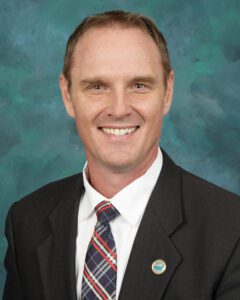







Navy veteran, sixth-generation Northwest Floridian enters crowded GOP primary for Florida’s 1st Congressional District
“We need someone to step up and fight for this country,” Chico said. “That’s why I’m here.”
Chico was born at Naval Hospital Pensacola and traces his family’s roots in Northwest Florida to the 1800s, when his ancestors helped settle Walton County. His father attended the Naval Academy and flew as a Marine pilot. Chico followed him to Annapolis and later served as a Navy supply officer, with his first duty station back in Pensacola.
His naval career took him to the USS Iwo Jima, where he served as lead supply officer during the response to Hurricane Irma in 2017. He said his ship provided the only fresh water available in Key West for roughly half a day following the storm. His final assignment was as deputy staff logistics officer for Naval Training and Education Command, where he oversaw contracting, property management and hurricane evacuation.
Chico said his decision to enter the race traces directly to the rollout of Flock Safety, an AI-powered license plate reader system, in Pensacola late last year. After seeing news about the system, he said he called the mayor’s office three times and received no response.
“When I dug in, I realized this is a nationwide surveillance system,” he said. “There are between 56,000 and over 90,000 AI-powered cameras that scan all of our vehicles, every dent, every scratch, every unique identifier, and it reports to a national, centralized database where federal agencies, about 5,000 local police departments and state governments can pull that data and track everyone, without a warrant, without any oversight.”
Chico called the system a clear Fourth Amendment violation and said it represents the kind of government overreach he wants to take on in Washington. He has been sounding the alarm on the issue before announcing his candidacy, including a speech at the University of West Florida that he said drew thousands of attendees.
The issue has drawn attention across the region. Residents in Okaloosa County raised similar concerns when Flock cameras were introduced there, with records showing roughly 100 law enforcement agencies gained access to the system through the Okaloosa County Sheriff’s Office.
Chico’s answer to what he describes as an alliance between government surveillance and big tech is a federal Digital Bill of Rights, a legislative framework he says would extend constitutional protections into the digital age.
“Our founders were brilliant, but they could never envision AI, biometrics, facial recognition and modern surveillance,” he said. “We need to bridge that gap.”
He said the legislation would go beyond free speech protections to address how federal agencies collect and retain personal data. Among other things, he said Americans should have the right to know which federal databases hold their information, why it is being stored and for how long.
“How many databases have your information right now?” he asked. “You should have the right to request that — which federal databases is my information being stored in, why, and what’s the duration?”
“Whether it’s going after the right or going after the left, we shouldn’t be surveilling innocent American citizens unless they’re a real threat,” he said. “This is something Americans, whether on the right or the left, need to come together on.”
He extended his opposition to federal age verification laws being advanced by both parties, which would require social media platforms and websites to confirm users’ identities, in some cases through driver’s license uploads or facial scans. Chico called the measures a backdoor digital ID program that would hand government more censorship tools while delivering tech companies a database of verified users to monetize.
“It’s a holy alliance between big brother and big tech,” he said.
Chico has been sharp in his criticism of Patronis, who was elected to the seat in 2025 after serving as Florida’s Chief Financial Officer.
Chico accused the congressman of failing to pass legislation, alleged he voted to keep sexual harassment records in Congress sealed, a charge Chico said is funded by taxpayers, and faulted him for not securing military resources for the district.
He also criticized Patronis over a bill the congressman has proposed targeting social media liability protections under Section 230, which Chico characterized as an attempt to censor online speech. He has taken to calling the incumbent “Censorship Jimmy.”
On military matters, Chico pointed to reports of air wings departing Hurlburt Field as evidence that the district’s congressional representation has faltered on a core issue. He said the departure of military units translates directly to lost jobs and diminished economic opportunity throughout the region.
“District One relies on our military,” he said. “When we have military units leave the area, that’s taking away jobs, that’s taking away economic opportunity for everyone in the district.”
The Santa Rosa Press Gazette reached out to Patronis’ office for a statement on several accusations against him
In an email on March 18, Patronis only responded to claims about his bill to remove Section 230, saying, “Ending the special legal protections for Big Tech is a top priority. These companies are targeting our kids and making billions in the process. Children are losing their childhoods, and the tech cartels know it. We’ve heard from our own constituents’ stories of kids harming themselves, being exploited, and having their lives forever changed because of Big Tech.”
“Yet under current law, these companies can’t be held accountable,” Patronis added. “Social media may be free, but their business model depends on keeping kids hooked, and that’s wrong. My bill would repeal the special carve out that shields the tech giants.”
On foreign policy, Chico said he does not support what he described as unilateral, preemptive military strikes that fall outside the protection of clear American strategic interests. He acknowledged the Iranian government has been responsible, directly or indirectly, for the deaths of U.S. service members, but said military action requires a higher bar.
“I don’t support unilateral preemptive military strikes, especially if they don’t represent protecting our strategic interests,” he said.
He said he supports defending American allies when genuine U.S. interests are at stake but did not offer a blanket endorsement of NATO obligations, framing his foreign policy view around whether a given commitment serves the American people.
If elected, Chico said he would spend the final two years of the Trump administration focused on defending the Constitution and pushing back against what he called threats to civil liberties from both parties. He also called for a full immigration moratorium, saying unchecked both legal and illegal immigration needs to be brought under control.
Beyond surveillance policy, Chico’s platform centers on affordability and housing, federal infrastructure funding, protecting agricultural land from development, and addressing veteran homelessness.
On housing, he tied the affordability crisis to Federal Reserve monetary policy and government spending, arguing that inflation driven by deficit spending has robbed younger generations of purchasing power. He said he supports ending the Federal Reserve and called on Congress to prioritize affordable housing for millennials and Gen Z — a demographic he said he is uniquely positioned to speak to as the likely youngest candidate in the race.
“I can relate to the struggles of millennials and Gen Z in terms of affordability,” he said. “I have to feed my daughter. My food bill has increased dramatically. My cost of fuel has increased dramatically.”
“We need affordable housing for Gen Z and millennials,” he added. “I don’t want to sacrifice their futures just to please the donor class.”
On roads, Chico said federal dollars need to flow more directly to communities struggling with rapid growth. He cited a conversation with the Midway fire chief in Gulf Breeze, who told him his department cannot keep pace with population growth due to flat budgets — a problem Chico framed as a consequence of prioritizing foreign aid over domestic needs.
He also spoke to concerns from farmers and ranchers in the district, saying unchecked development threatens both the region’s agricultural heritage and its water supply. Chico said he supports halting new AI data centers in part to prevent further strain on the regional aquifer and electricity costs.
“We can’t allow this continuous development to eat up old Florida,” he said.
On veteran homelessness, Chico called it a moral failing and said housing and social services should prioritize Americans, particularly veterans, before other spending commitments.
He also said he would work to end civil asset forfeiture, calling the practice, in which law enforcement agencies can seize property from individuals without a criminal conviction, a form of government theft, citing Institute for Justice data showing $68 billion seized from American citizens and legal residents between 2000 and 2019.
On legislative process, Chico said Congress should abandon omnibus spending bills in favor of single-issue legislation, arguing the current practice allows both parties to attach what he called anti-freedom, unconstitutional provisions to must-pass bills. He also called for shortening the federal campaign cycle to reduce the influence of super PACs and corporate money in elections.
Chico described himself as his own largest donor by a wide margin, saying he has invested tens of thousands of dollars of personal funds into the campaign. He said that independence from outside donors is central to his pitch to voters.
He resists traditional political labels, saying he cannot be put in a box. He identifies as an “America First patriot” with libertarian leanings but said he is willing to cross the aisle when constituents would benefit.
“If a Democrat comes up with a good idea and it’s a net positive for most Americans, I’d be willing to support that bill,” he said.
Asked why voters should choose him in a crowded primary field, Chico leaned on roots and record.
“I’m not going to sell out to a corrupt political machine,” he said. “I’m a sixth-generation Northwest Florida family. I’m a former Navy officer. Unlike censorship Jimmy, my family’s actually from this area.”
The Republican primary for Florida’s 1st Congressional District is scheduled for August. The district, which covers Escambia, Santa Rosa, Okaloosa and Walton counties, has been reliably Republican for decades.