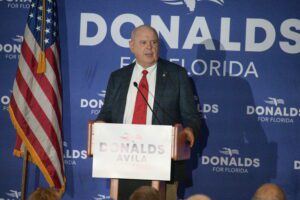
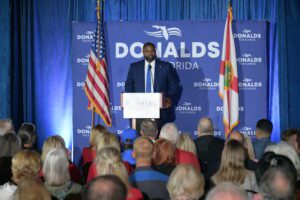
“We are going to continue to have an economic powerhouse in the great state of Florida, its going to have jobs for people who want to build dreams, its going to be about our children being prepared for the future so they can live the Florida dream, but its also about affordability, so our seniors can enjoy their golden years in the best state in America,” Donalds said.
Part of his plan to make things more affordable is to lower property insurance premiums by 20 percent through modifications to the Florida Hurricane Catastrophe Fund and by making post-disaster rebuilding permits automatic.
He also wants to trim other state fees.
Property tax amendment
Amendment 3, which would increase the homestead tax exemption up to $250,000 if passed, has been a prominent topic throughout the state as counties prepare to potentially lose millions in future tax revenue.
Donalds, who supports the amendment, said it would require public safety spending to take priority for counties and other entities that take in property tax revenue. While many counties will have to prepare for a tighter budget, he said the state does have a role to play in assisting some counties.
“For fiscally constrained counties, I agree with the governor that is when the state can step in,” Donalds said. “We want to set up a funding formula for those counties with small tax bases, so they can get the resources they need in order to make sure law enforcement can do their job.
“The larger counties are already having many conversations about how this is going to work if Amendment 3 passes, but frankly, the voters are going to decide this.”
Donalds said no matter what happens with Amendment 3, he intends to use the Florida Taxation and Budget Reform Commission to review state taxes and bring tax relief to Floridians.
He hopes the use of the TBRC can keep more money in seniors’ and working-class families’ pockets.
“Government has to have restraint and respect the pocketbooks of the people of our state,” Donalds said.
State Rep. Patt Maney introduces Byron Donalds and other speakers at a campaign rally for Donalds in Fort Walton Beach Sept. 30.
Data centers
Donalds also gave an answer to the question of where he stands on data centers, which are facilities that house and run large computer systems. They have been a point of controversy for many communities across the country due to water usage and utility rate hikes for nearby residents.
“When it comes to permitting, local governments are going to have the final say,” Donalds said. “We are empowering local jurisdictions to make that decision.”
According to Donalds, there are now 27 counties and municipalities with a moratorium or outright ban on data centers.
In Northwest Florida, Escambia and Walton counties have passed bans, Okaloosa County commissioners voted to regulate data centers rather than ban them and Santa Rosa County passed a 12-month moratorium on data centers.
On Monday, Sept. 28, the city of Crestview passed a ban on large-scale data centers within city limits.
He said state law requires companies to pay for their utility usage themselves and said any increases in utility rates have to be approved by the state’s Public Service Commission. The state law, passed this year under Senate Bill 484, states that data centers with an anticipated peak load of 50 megawatts or more must pay their own way through tariffs regulated by the PSC.
“It is very clear in Florida’s law that utility rates will not go up because of a data center,” Donalds said.
Gubernatorial candidate Byron Donalds spoke about affordability during his Northwest Florida campaign stop and took questions from residents.
School choice
On the matter of school choice, Donalds supports continuing to give parents the ability to send their child to the school, public or private, of their choice.
In Florida, a certain amount of money is allocated per student. This money follows the student and is given to the school they attend.
While the idea has allowed parents to send their child to private and charter schools in an affordable way, there are issues with how the money is transferred.
Some students who decided to go to a charter school have later come back to the district. Santa Rosa County District Schools Assistant Superintendent of Finance Katherine Jones told a local NPR affiliate that while the money is supposed to follow the students and go back to the district, there are times when the district hasn’t received the money.
According to Donalds, the current student survey system, which is done three times a year, is to blame and needs an update.
“We have to change the way we do student surveys,” Donalds said. “This is where the state department of education has to modernize that process.
“We went to universal school choice but the background payment system still revolved around three surveys a year. It’s not flexible enough.”
Donalds also said the charter schools his wife, school choice advocate Erika Donalds, has been involved with are no longer under her management. He said there won’t be a conflict of interest with his wife’s business ventures.
“There is going to be a very clear wall between her interests as a businesswoman and what we are going to do for the state of Florida,” Donalds said.
Donalds faces Democratic nominee and former congressman David Jolly in the Nov. 3 general election.
Gov. Ron DeSantis’ response was essentially to say, ‘fine, we won’t appeal,’ and Attorney General James Uthmeier, whom he appointed to the job, is already on the rewrite.
In a technical win for a trio of groups that challenged Amendment 3 on the November ballot, Leon Circuit Court Judge David Frank on Monday ordered the title and ballot summary to be redrafted.
“Voters are entitled to a fair, clear, accurate and non-misleading ballot statement to assist them in making their critical determination,” Frank wrote in his 18-page ruling. “The present ballot language would deprive the voters of the opportunity to make a meaningful decision.”
Amendment 3 calls for the non-school homestead exemption to be increased from $50,000 to $150,000 in 2027 and raises it to $250,000 in 2028. Another provision reduces the annual cap on assessment increases for non-homestead properties from 10 percent to 5 percent.
In his ruling, Frank detailed specific changes that should be made to the ballot summary.
For example, after stating “this amendment benefits Florida taxpayers by:” the ballot summary uses the phrases “exempting homestead properties from taxation,” “ensuring funding for core services,” “protecting small businesses” and “ensuring fairness for Florida residents.”
Those opposed to the measure argued that if approved by 60 percent of voters in November, cities and counties could lose up to $12 billion annually. They also said tax burdens will be shifted to renters and businesses, which isn’t reflected in the ballot language that is under the amendment’s title of “Save Our Homes From Excessive Property Taxes.”
DeSantis said Thursday that Uthmeier, his former chief of staff, was already working on the new language.
“I’ve actually seen some of the draft. It’s a great draft. It is going to be very good. (It will) be very clear for voters what’s on there,” DeSantis said during an education event in Lehigh Acres.
DeSantis added that he and Uthmeier didn’t “necessarily agree” with the ruling, but that the revision will be more than acceptable.
“It’s fine. It’s going to be a very good summary, very straightforward,” DeSantis continued. “People are going to know they’re going to get tax relief. You’re going to get an increased homestead exemption if you’re for it. So that’s going to happen.”
“It’s definitely different than my time on the Okaloosa County Commission,” Boyles said. “Learning how to navigate that process, I think, is a big part of your first session.”
Boyles entered the House mid-cycle with brief exposure to the chamber before his first full term began, a distinction he said should benefit his constituents by giving him an extra session of experience before his formal freshman year.
This session, Boyles filed about nine bills as a primary sponsor and co-sponsored about 10 others. Of those he led, three are expected to reach the governor’s desk — two local bills and a measure limiting where land application of septic waste can occur.
Among the most closely watched locally were HB 4051 and its companion, HB 4053, which address fire district assessment fees charged to churches and other religious institutions in the Pace and Avalon fire districts, respectively. The legislation drew support from faith leaders in Santa Rosa County, including Pastor Jeremy Holly of Emmanuel Baptist Church.
Boyles said the bills put him in an uncomfortable position early.
“I’ve joked a little bit about being caught between the preachers and the firefighters, which, as a politician, is not exactly where you want to be,” he said. He credited the resolution to a willingness by both faith and public safety leaders to compromise, saying the bills corrected problems created by prior legislation rather than assigning blame to any local party.
The session has also thrust Boyles into one of the most high-profile and contentious debates in Tallahassee this year: whether to eliminate or significantly reduce property taxes statewide. The regular session ended last week without a budget deal or resolution on the property tax question, and an extended session appears likely.
Boyles said the ultimate shape of any property tax proposal will be decided by officials above his rank, with the governor and legislative leadership likely to drive the outcome. He said he expects something to be put before voters this fall but cautioned that a policy workable in South Florida may create significant problems in Northwest Florida.
“Northwest Florida is not like many other parts of Florida,” Boyles said. He noted that millage rates in unincorporated North Okaloosa County are about 4.5 mills and in Santa Rosa County about 6.5 mills, a fraction of the 18-mill rate he pays on a home his family recently purchased in Tallahassee.
“You can understand why there is the need to have a conversation about how we bring back some common sense to local government revenues. At the same time, an approach that might work in Miami-Dade or Tallahassee may not work very well in Milton or Santa Rosa County.”
Boyles also pointed to the challenges of representing a region that holds relatively little influence in a chamber dominated numerically by Central and South Florida representatives.
“There are other members of the Legislature that have no idea there’s a Central Time Zone in Florida,” he said. “It’s a process of saying, hey, did you know this is kind of how it is for us in our part of the state?”
One of the more notable outcomes of Boyles’ session came not through a bill he sponsored outright but through a strategic amendment.
His legislation targeting stormwater standards for solar farms, prompted in part by a July 2025 washout at the Kayak Creek FPL facility in Okaloosa County that caused erosion, failed in the Community Affairs Subcommittee as a standalone measure (SB 200/HB 193). Boyles said he then persuaded a Broward County representative, state Rep. Chip LaMarca, R-Fort Lauderdale, who was carrying the Department of Environmental Protection agency bill, to accept his solar farm language as an amendment.
The result: Future solar farms in every jurisdiction governed by the Northwest Florida Water Management District will be required to meet a 100-year storm design standard rather than the current 25-year standard, mandating more robust stormwater infrastructure.
“Part of being a freshman representative is learning those tips and tricks of the trade — how you can take policy and put it into place, even if it may not be in the traditional form of here’s my bill, I sponsored it, the governor signs my bill,” Boyles said.
“We need someone to step up and fight for this country,” Chico said. “That’s why I’m here.”
Chico was born at Naval Hospital Pensacola and traces his family’s roots in Northwest Florida to the 1800s, when his ancestors helped settle Walton County. His father attended the Naval Academy and flew as a Marine pilot. Chico followed him to Annapolis and later served as a Navy supply officer, with his first duty station back in Pensacola.
His naval career took him to the USS Iwo Jima, where he served as lead supply officer during the response to Hurricane Irma in 2017. He said his ship provided the only fresh water available in Key West for roughly half a day following the storm. His final assignment was as deputy staff logistics officer for Naval Training and Education Command, where he oversaw contracting, property management and hurricane evacuation.
Chico said his decision to enter the race traces directly to the rollout of Flock Safety, an AI-powered license plate reader system, in Pensacola late last year. After seeing news about the system, he said he called the mayor’s office three times and received no response.
“When I dug in, I realized this is a nationwide surveillance system,” he said. “There are between 56,000 and over 90,000 AI-powered cameras that scan all of our vehicles, every dent, every scratch, every unique identifier, and it reports to a national, centralized database where federal agencies, about 5,000 local police departments and state governments can pull that data and track everyone, without a warrant, without any oversight.”
Chico called the system a clear Fourth Amendment violation and said it represents the kind of government overreach he wants to take on in Washington. He has been sounding the alarm on the issue before announcing his candidacy, including a speech at the University of West Florida that he said drew thousands of attendees.
The issue has drawn attention across the region. Residents in Okaloosa County raised similar concerns when Flock cameras were introduced there, with records showing roughly 100 law enforcement agencies gained access to the system through the Okaloosa County Sheriff’s Office.
Chico’s answer to what he describes as an alliance between government surveillance and big tech is a federal Digital Bill of Rights, a legislative framework he says would extend constitutional protections into the digital age.
“Our founders were brilliant, but they could never envision AI, biometrics, facial recognition and modern surveillance,” he said. “We need to bridge that gap.”
He said the legislation would go beyond free speech protections to address how federal agencies collect and retain personal data. Among other things, he said Americans should have the right to know which federal databases hold their information, why it is being stored and for how long.
“How many databases have your information right now?” he asked. “You should have the right to request that — which federal databases is my information being stored in, why, and what’s the duration?”
“Whether it’s going after the right or going after the left, we shouldn’t be surveilling innocent American citizens unless they’re a real threat,” he said. “This is something Americans, whether on the right or the left, need to come together on.”
He extended his opposition to federal age verification laws being advanced by both parties, which would require social media platforms and websites to confirm users’ identities, in some cases through driver’s license uploads or facial scans. Chico called the measures a backdoor digital ID program that would hand government more censorship tools while delivering tech companies a database of verified users to monetize.
“It’s a holy alliance between big brother and big tech,” he said.
Chico has been sharp in his criticism of Patronis, who was elected to the seat in 2025 after serving as Florida’s Chief Financial Officer.
Chico accused the congressman of failing to pass legislation, alleged he voted to keep sexual harassment records in Congress sealed, a charge Chico said is funded by taxpayers, and faulted him for not securing military resources for the district.
He also criticized Patronis over a bill the congressman has proposed targeting social media liability protections under Section 230, which Chico characterized as an attempt to censor online speech. He has taken to calling the incumbent “Censorship Jimmy.”
On military matters, Chico pointed to reports of air wings departing Hurlburt Field as evidence that the district’s congressional representation has faltered on a core issue. He said the departure of military units translates directly to lost jobs and diminished economic opportunity throughout the region.
“District One relies on our military,” he said. “When we have military units leave the area, that’s taking away jobs, that’s taking away economic opportunity for everyone in the district.”
The Santa Rosa Press Gazette reached out to Patronis’ office for a statement on several accusations against him
In an email on March 18, Patronis only responded to claims about his bill to remove Section 230, saying, “Ending the special legal protections for Big Tech is a top priority. These companies are targeting our kids and making billions in the process. Children are losing their childhoods, and the tech cartels know it. We’ve heard from our own constituents’ stories of kids harming themselves, being exploited, and having their lives forever changed because of Big Tech.”
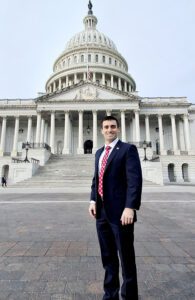
Navy veteran and Northwest Florida native Doug Chico is an American First candidate looking to win the Republican primary for Florida’s First Congressional District this August.
“Yet under current law, these companies can’t be held accountable,” Patronis added. “Social media may be free, but their business model depends on keeping kids hooked, and that’s wrong. My bill would repeal the special carve out that shields the tech giants.”
On foreign policy, Chico said he does not support what he described as unilateral, preemptive military strikes that fall outside the protection of clear American strategic interests. He acknowledged the Iranian government has been responsible, directly or indirectly, for the deaths of U.S. service members, but said military action requires a higher bar.
“I don’t support unilateral preemptive military strikes, especially if they don’t represent protecting our strategic interests,” he said.
He said he supports defending American allies when genuine U.S. interests are at stake but did not offer a blanket endorsement of NATO obligations, framing his foreign policy view around whether a given commitment serves the American people.
If elected, Chico said he would spend the final two years of the Trump administration focused on defending the Constitution and pushing back against what he called threats to civil liberties from both parties. He also called for a full immigration moratorium, saying unchecked both legal and illegal immigration needs to be brought under control.
Beyond surveillance policy, Chico’s platform centers on affordability and housing, federal infrastructure funding, protecting agricultural land from development, and addressing veteran homelessness.
On housing, he tied the affordability crisis to Federal Reserve monetary policy and government spending, arguing that inflation driven by deficit spending has robbed younger generations of purchasing power. He said he supports ending the Federal Reserve and called on Congress to prioritize affordable housing for millennials and Gen Z — a demographic he said he is uniquely positioned to speak to as the likely youngest candidate in the race.
“I can relate to the struggles of millennials and Gen Z in terms of affordability,” he said. “I have to feed my daughter. My food bill has increased dramatically. My cost of fuel has increased dramatically.”
“We need affordable housing for Gen Z and millennials,” he added. “I don’t want to sacrifice their futures just to please the donor class.”
On roads, Chico said federal dollars need to flow more directly to communities struggling with rapid growth. He cited a conversation with the Midway fire chief in Gulf Breeze, who told him his department cannot keep pace with population growth due to flat budgets — a problem Chico framed as a consequence of prioritizing foreign aid over domestic needs.
He also spoke to concerns from farmers and ranchers in the district, saying unchecked development threatens both the region’s agricultural heritage and its water supply. Chico said he supports halting new AI data centers in part to prevent further strain on the regional aquifer and electricity costs.
“We can’t allow this continuous development to eat up old Florida,” he said.
On veteran homelessness, Chico called it a moral failing and said housing and social services should prioritize Americans, particularly veterans, before other spending commitments.
He also said he would work to end civil asset forfeiture, calling the practice, in which law enforcement agencies can seize property from individuals without a criminal conviction, a form of government theft, citing Institute for Justice data showing $68 billion seized from American citizens and legal residents between 2000 and 2019.
On legislative process, Chico said Congress should abandon omnibus spending bills in favor of single-issue legislation, arguing the current practice allows both parties to attach what he called anti-freedom, unconstitutional provisions to must-pass bills. He also called for shortening the federal campaign cycle to reduce the influence of super PACs and corporate money in elections.
Chico described himself as his own largest donor by a wide margin, saying he has invested tens of thousands of dollars of personal funds into the campaign. He said that independence from outside donors is central to his pitch to voters.
He resists traditional political labels, saying he cannot be put in a box. He identifies as an “America First patriot” with libertarian leanings but said he is willing to cross the aisle when constituents would benefit.
“If a Democrat comes up with a good idea and it’s a net positive for most Americans, I’d be willing to support that bill,” he said.
Asked why voters should choose him in a crowded primary field, Chico leaned on roots and record.
“I’m not going to sell out to a corrupt political machine,” he said. “I’m a sixth-generation Northwest Florida family. I’m a former Navy officer. Unlike censorship Jimmy, my family’s actually from this area.”
The Republican primary for Florida’s 1st Congressional District is scheduled for August. The district, which covers Escambia, Santa Rosa, Okaloosa and Walton counties, has been reliably Republican for decades.
The resolution, introduced by Commissioner Trey Goodwin and placed on the commission’s March 24 agenda at the request of the board chairman, would strictly prohibit the placement and installation of traffic infraction detectors and speed detection systems on county roads and rights-of-way. If approved, the ban would take effect immediately upon adoption.
In a written order, Broward County Judge Steven P. DeLuca dismissed a red-light camera citation issued to Kayla Erin McFadden and ruled that part of Florida’s Mark Wandall Traffic Safety Act, the law authorizing cities to issue citations based on red light camera evidence, violates due process protections guaranteed under the United States Constitution.
DeLuca concluded the law improperly presumes a vehicle’s registered owner is responsible for a red-light violation. In his order, the judge wrote that under the red-light camera system, “the actual violator is never identified.”
The order also raised concerns about accountability under Florida’s driver discipline system. Violations issued through red light cameras generally do not add points to a driver’s license, meaning repeated violations may not affect a person’s driving record if fines are simply paid. DeLuca noted that Florida’s point system was designed to identify drivers whose behavior may warrant license suspension or additional oversight.
While DeLuca’s decision applies only to McFadden’s case, the legal fight may not be over. McFadden’s attorney, Bret Lusskin, said the case could have broader statewide implications if appealed. If that occurs, the case would likely be reviewed by the Florida Fourth District Court of Appeals and could ultimately reach the Florida Supreme Court. A higher court ruling upholding DeLuca’s order could affect how red-light camera citations are enforced across Florida.
Sections 316.0083 and 316.0776 of Florida Statutes authorize the Florida Department of Transportation, counties and municipalities to deploy traffic infraction detectors and speed detection systems within their respective jurisdictions. Under those statutes, the registered owner of a vehicle is presumed to be the driver and is held liable for a violation unless the owner can prove someone else was behind the wheel.
When a registered owner receives a violation by mail, they have several options: pay the civil penalty, contest the violation in court, or submit an affidavit identifying another person who was driving at the time. If paid within the required timeframe, the violation is treated as a civil penalty and generally does not add points to a driver’s license under Florida Statute 322.27. If the owner contests the ticket or fails to respond, the violation can be converted into a uniform traffic citation and challenged before a judge.
Okaloosa County currently has limited exposure to the camera enforcement system. The city of Crestview operates two red light cameras along State Road 85, at the intersections with U.S. Highway 90 and Redstone Avenue, the only two such cameras in Okaloosa County.
The commission’s staff recommendation is to approve the resolution. Commissioners may also choose to disapprove it or provide other direction.
Supporters of automated enforcement say the cameras help reduce dangerous red light running at busy intersections. Critics argue the system issues penalties without identifying the driver responsible for the violation — a concern DeLuca echoed in his ruling.
The Okaloosa County Commission meeting is scheduled for 8:30 a.m. March 24.
Patronis was sworn into office April 2, 2025. Although he hasn’t served a full year in the U.S. House, Patronis has introduced six bills, three resolutions and an amendment to a bill as of Jan. 1.
Several bills he has filed deal with veteran or active-duty military issues, including infrastructure both on and near military installations.
Patronis said he is interested in addressing local military concerns in the 1st District, which is home to NAS Pensacola, NAS Whiting Field, Hurlburt Field and Eglin Air Force Base.
One issue on his mind is ensuring the 180,000-square-mile Eastern Gulf Test and Training Range remains free from oil drilling. Currently, President Donald Trump’s administration plans to open portions of the range to oil drilling leases. This is a departure from Trump’s 2020 policy, which enacted a moratorium on drilling in the eastern Gulf.
Although Patronis is normally a staunch supporter of the 47th president, he believes the administration’s current plan does not factor in the region’s importance to military operations.
“The economy that our military provides to Northwest Florida, I mean we are talking about over 200,000 jobs being affected if there are noncompatible industries in the Gulf range,” Patronis said. “This is one of those issues where the whole state has unified.”
“It’s not over yet,” Patronis added.
Another need Patronis sees is infrastructure around military installations.
Last year, Patronis filed the Blue Angels Act (H.R. 5029), which aims to codify the mission and location of the Navy’s Flight Demonstration Squadron at NAS Pensacola. He said funding is needed to address hurricane damage to the hangars where the Blue Angels are kept.
“These are multimillion-dollar hangars,” Patronis said. “You don’t assemble the funds to rebuild them overnight.”
Another bill introduced in 2025 was the Warrior Road Act (H.R. 5886), which is currently in committee. It would prioritize military-related infrastructure needs in each state.
According to Patronis, his goal is to address infrastructure issues not only on bases but around them. One issue he hopes to play a role in fixing is the U.S. 98 corridor around Hurlburt Field. Col. Mark Hamilton, commander of the 1st Special Operations Wing, recently said traffic issues outside the base were a “threat to national security.”
Patronis hopes one of his committee assignments will help ensure he has a voice in decision-making for upcoming infrastructure projects.
In 2026, the House Committee on Transportation and Infrastructure will work on a surface transportation reauthorization bill. The bill, which is currently being planned, will replace the expiring authorization, which ends in September 2026.
“Our role on that committee can be of assistance to U.S. 98’s military corridors that are having challenges with ingress and egress,” Patronis said. “That’s important to me.”
Changing committees
Patronis said he isn’t sure exactly what committees he will be serving on in 2026. He entered Congress after most representatives were already assigned to committees. In 2026, he will have the opportunity to be assigned to committees at the start of the new Congress, which generally happens in late January or February following elections.
The Northwest Florida congressman currently serves on the House Committee on Small Business, in addition to the Transportation and Infrastructure Committee.
“That is the status quo, but there are some things that’ll change,” Patronis said. “With the announcement that Marjorie Taylor Greene is leaving Congress, now that creates vacancies on committees she was on.”
Patronis compared the House to a neighborhood, where people move in and out.
“The anticipation of getting on an armed services-related committee is one of my priorities,” Patronis said. “Whether it be Armed Services or Appropriations. Both of those are giving me a lane to help our military missions in Northwest Florida.”
2026 legislation plans
Patronis said he expects to file or co-sponsor a bill related to social media usage, particularly among youth.
“I think different members, whether it be Congress or the state Legislature, a lot of times the policies they advocate for are driven by what’s happening at home,” said Patronis, who has two teenage boys.
While he does not want to go as far as Australia, whose government recently banned social media for children younger than 16, Patronis said he wants to see social media companies and smartphone device makers be more proactive about making their devices less addictive to children.
Patronis referred to these smart devices as “digital fentanyl.”
A variety of medical journals and publications have compared excessive social media usage to addiction, highlighting how it can release dopamine, a chemical in the brain that makes people feel good and can contribute to reinforcement of behaviors.
Patronis hopes future action on social media usage can empower parents and give them more opportunities to help their children navigate online spaces.
“We don’t need AI becoming the best friend of some 15-year-old who is at a turning point in their life because they just got rejected by their girlfriend and they seek out guidance from a device that can only scrape information off the internet,” Patronis said. “Normal childhood development is very important, and I get concerned about manipulative technology.”
Government efficiency is also a concern for Patronis.
On Monday, Dec. 9, citizens within the first Congressional district will get the opportunity to hear directly from the candidates at a campaign forum hosted by Republican Executive Committees of Escambia, Santa Rosa, and Okaloosa counties. The event will be held at Emerald Waterfront (formerly known as The Grillehouse) on Highway 98 in Navarre (8491 Navarre Parkway) from 11 a.m. to 3 p.m.
All Republican congressional candidates have been invited. National and local media have been invited. News outlets such as The Hill, Epoch Times, New American, Veronica Live! and Action Radio have committed to participation and coverage. The event is free and open for the public. A buffet and beverage service will be provided.
The candidates who have announced they are running for the seat in Congress:
On X, the app formerly known as Twitter, Gaetz expressed his desire to see a successful transition into a Trump presidency without a “protracted Washington scuffle.” His statement read:
“I had excellent meetings with Senators yesterday. I appreciate their thoughtful feedback – and the incredible support of so many. While the momentum was strong, it is clear that my confirmation was unfairly becoming a distraction to the critical work of the Trump/Vance Transition. There is no time to waste on a needlessly protracted Washington scuffle, thus I’ll be withdrawing my name from consideration to serve as Attorney General. Trump’s DOJ must be in place and ready on Day 1. I remain fully committed to see that Donald J. Trump is the most successful President in history. I will forever be honored that President Trump nominated me to lead the Department of Justice and I’m certain he will Save America.”
Controversy arose over the nomination of Gaetz for Attorney General as he has been under investigation by the House Ethics Committee.
It remains to be seen whether Gaetz will be able to retain his seat or if he will be interested in running for his old seat in a potential special election. Multiple candidates are already lining up to replace Gaetz should he step aside.
A date for the special election to replace Matt Gaetz, who recently resigned after being selected as President-Elect Donald Trump’s choice for U.S. Attorney General, has not been announced by the Florida Secretary of State yet. Other potential candidates who have expressed interest in running for the vacant seat include State Rep. Michelle Salzman and Florida Chief Financial Officer Jimmy Patronis.
Navarre Press will have more on the special election as information becomes available.
Rep. Gaetz announced his intention to introduce the legislation at Turning Point Action’s 2023 Action Conference. The bill has not been formally introduced into congress as of Aug. 10.
In June 2022, the United States Supreme Court ruled in favor of religious freedom and sided with a football coach who was fired by his school district for embracing his First Amendment right before games. Rep. Gaetz’s legislation will enforce the Supreme Court’s ruling to allow every person the ability to engage in prayer in school.
“God’s reach does not stop at the schoolhouse gates. Our country’s education policy forbids students and faculty from praying while endlessly promoting degenerate LGBT and anti-White propaganda,” Gaetz said. “My legislation unlocks religious freedom once again so that in every classroom in America, there will be time for students to pray if they choose.”