Please ensure Javascript is enabled for purposes of website accessibility
Skip to main content
Advertisement

Foreign Air Attachés visit AFSOC

During their visit, the Air Attachés were provided with a comprehensive briefing on several key aspects of AFSOC. This included an overview of the command’s history, which dates back to its establishment in 1990. This historical context was provided to the Air Attachés, offering them a deeper understanding of the command’s evolution and the critical role it has played in operations across the globe.

Later on, Lt Gen Tony Bauernfeind, AFSOC commander, engaged with the Air Attachés and introduced them to the AFSOC mission and capabilities. 

The Air Attachés had the unique opportunity to delve into AFSOC’s array of aircraft and mission sets visiting static displays and learning from subject matter experts.  

The United States Air Force Special Operations School also gave a briefing highlighting the school’s mission. The Air Attachés were provided insights into AFSOC’s joint and combined training efforts as well as special operations best practices. 

“Our enduring relationships with allies and partners are a cornerstone to our enhanced readiness,” said Bauernfeind. “Engagements like these help educate our allies and partners on the unique capabilities and opportunities that our command can provide and strengthen our connections for future combined operations.”

This visit served as a valuable opportunity to enhance international cooperation and understanding. By sharing insights into AFSOC’s history, mission sets, and collaborative training efforts, this visit contributed to strengthening the bonds between allied and partnered nations, furthering our collective commitment to global security.

Go Blue, Stay Blue: Fostering a diverse force

Many new recruits are affected by family. According to a survey from Joint Advertising, Market Research & Studies, 86% of recruits have a family member who served in the Armed Forces. In Watkins’ case, both of her sisters served, one in the U.S. Army and one in the U.S. Marine Corps.

During the time that Watkins debated whether to join the service, she received some perspective from her older sister.

“When my sister first came in, there were not a lot of military chaplains that were women, especially not women of color,” Watkins said. “Sometimes you want to talk to a chaplain that you can relate to. When you don’t have that option, it can be difficult.”

Understanding the need for diversity gave Watkins the inspiration she needed to make the jump and join the Air Force Reserve as part of the Individual Mobilization Augmentee program. The IMA program assigns reservists to active-component units, and allows them to create a custom duty schedule that helps meet mission requirements.

Despite some sisterly disputes over which military branch is better, Watkins said her family provided the utmost support, along with some important advice.

“They did talk to me about making sure that this is something that I really wanted to do because being a chaplain is a heavy task, especially when you are there to serve the men and women who serve this country,” Watkins said.

After joining, Watkins was pleasantly surprised by the level of diversity within the Air Force. Between all three bases where Watkins has been stationed, she has grown an immense appreciation for all uniformed members and their diverse backgrounds.

According to the 2021 Demographics Profile of the Military Community, 29.4% of Air/Space Force members identify with racial minority groups. Female Airmen/Guardians make up 21.3% of the force.

“Representation matters,” Watkins said. “We should see men and women of all races and ethnicities with different religions. My expectation [for the Air Force] is to keep increasing the diversity.”

After nearly four years of service, Watkins has realized how the possibilities provided by the Air Force have exceeded her expectations. Through the IMA program, she has been able to spend her summers serving at Beale while maintaining a teaching job in the civilian world.

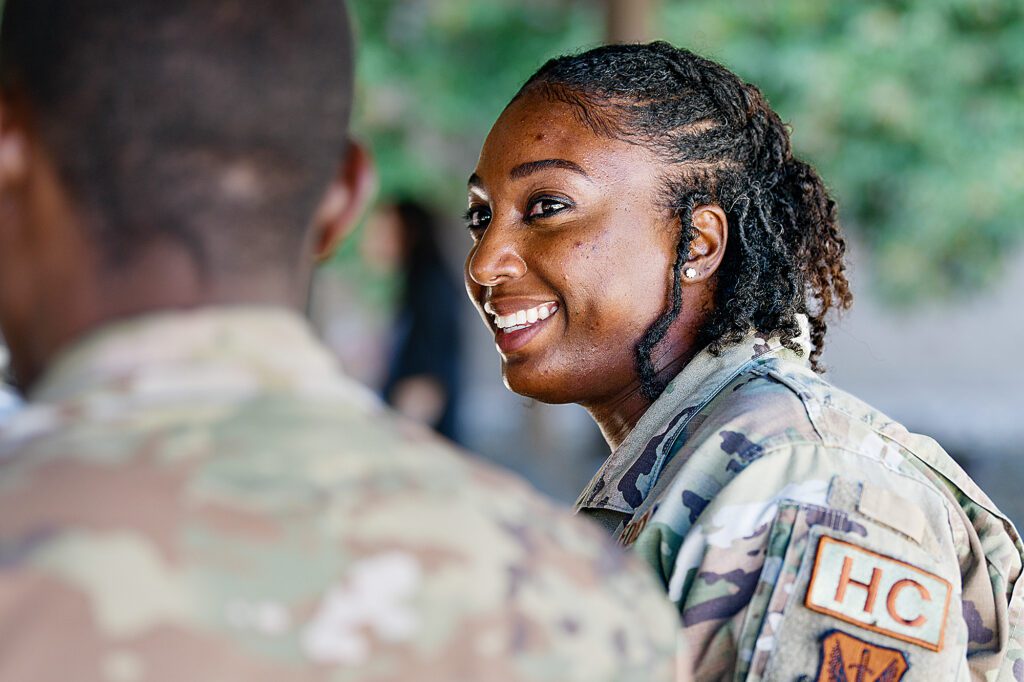
U.S. Air Force Capt. Donsha Watkins, 9th Reconnaissance Wing chaplain, interacts with another Airman on Beale Air Force Base, California, Oct. 19, 2023. Chaplains are confidential counselors who often guide Airmen facing life challenges. (U.S. Air Force photo by Tech. Sgt. Samuel A. Burns)

After experiencing all the benefits that the Air Force has provided her, both personal and professional, Watkins now reflects on the years she spent deciding on her military future.

“There were so many opportunities that I didn’t know about when I first considered joining,” Watkins said. “Maybe I would have joined earlier. At first, I wanted to join just because it was a family thing, but now I realize that this has changed my life in a lot of ways.”

Watkins describes her experience as a chaplain as “transformational,” while she remains authentic to who she was before joining the Air Force.

Chaplain Watkins’ story exemplifies tailoring your Air Force career to your needs. Regardless of how one serves, there is no limit to how much impact one individual can have on the service members around them. The dedication of each Airman is a step toward a stronger, more inclusive and compassionate force.

AFSOC embraces Extended Reality (XR) to enhance readiness

The XR Training Program’s mission is to provide Air Commandos the ability to conduct repetitive readiness training anyplace at any time through secure, autonomous learning distribution and reporting across all command disciplines. The vision is equally ambitious: to be a training program that employs virtual, mixed, and augmented training methodologies, producing warfighters with greater skillset competencies and proficiency in a more realistic environment, at a reduced cost, and on a shortened timeline.

In the beginning of FY23, AFSOC established an XR cross-functional team dedicated to creating an XR Training Framework for the entire command.

“Our first step as a command was to admit we had fallen behind in the evolution of training technology,” said Capt. Kyle Schoonover, Chief of AFSOC XR Training Program. “In true AFSOC fashion, in just a few months we went from this realization to producing a MAJCOM-wide framework capable of incorporating all existing XR technologies as well as charting a path forward for future development in the years to come.”

This framework operates on a crawl, walk, run strategy, composed of four distinct lines of effort (LOEs):

LOE 1: Virtual Hangar

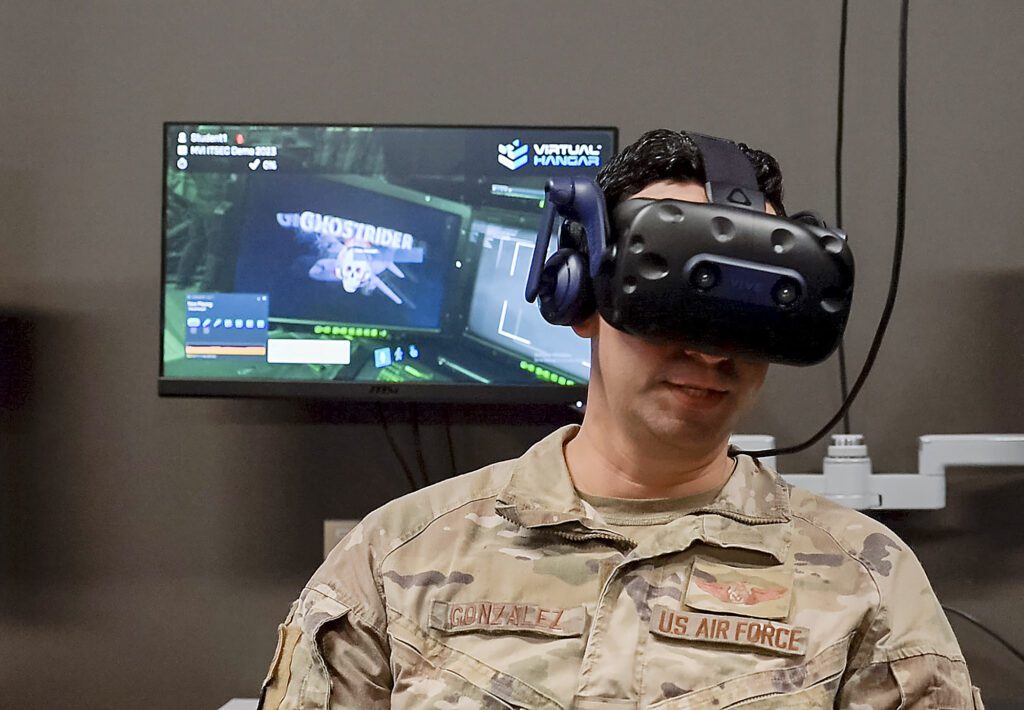
The foundational effort for XR in AFSOC focuses on initial qualification academic training for all aircrew support and mission support personnel, including maintenance and Mission Sustainment Teams. A prime example of this is the “Virtual Hangar” initiative by AFSOC A4. This innovative program leverages VR to enhance AC-130J, MC-130J, CV-22 and munitions maintenance workforce training. The “Virtual Hangar” offers comprehensive Instructor Tools and custom-built Learning Modules, ranging from checklist execution to 3D-modeled schematic overlays.

LOE 2: NexGen Instructor

AFSOC plans to incorporate VR into all Flying Training Units (FTUs) responsible for training AFSOC aircrew. Training modules will cover the academic phases of the FTU syllabi such as academics on aircraft systems and mission equipment. Collaborative partnerships with other Major Commands (MAJCOMs) will be pursued when appropriate, and pathfinding will be the norm when required.

LOE 3: Fusion & Integration

The integration of XR into operational units is a pivotal aspect of AFSOC’s strategy, with a particular emphasis on mission events. These events can range from emulated flight of AFSOC aircraft, to special tactics, to our medical community across the entire continuum of patient care.

LOE 4: The Future Fight

The pinnacle of AFSOC’s XR Training Framework envisions the utilization of Augmented Reality (AR) for aircrew and special tactics teams. Imagine a CV-22 pilot flying over Melrose Air Force Range in New Mexico while their visor displays real-world terrain from distant locations like the Indo-Pacific region. Meanwhile, the pilot’s visor reveals a digital wingman controlled by a ground-based XR device. The goal is to replicate any battlespace via XR technology back at the home station.

TSgt Daniel Gonzalez, an AC-130 Special Missions Aviator Training Manager, tests out an AC-130J module of the “Virtual Hangar” technology. With a comprehensive XR Training Framework in place, AFSOC is poised to transform its training methodologies, ensuring that Air Commandos are better prepared and equipped for strategic competition.

“AFSOC’s XR framework provides every unit in the command with a readily digestible and easily repeatable strategy to modernize their training through next-generation methodologies of instruction,” said Schoonover.

The AFSOC XR Training Framework’s implementation is ongoing. While teams across AFSOC continue to work through LOE 1 by immersing in virtual reality and “Virtual Hangars”, LOE 2 is on the horizon with small group XR testing sessions with the AC-130J FTU planned for Summer 2024 and the C-146 FTU planned for Fall 2024. As investment into the training program framework continues, the line of efforts will gain momentum.

“AFSOC is heavily invested in enhancing readiness and training through initiatives like XR,” said Lt. Gen. Tony Bauernfeind, AFSOC commander. “The use of XR in training allows Air Commandos to experience highly realistic simulations of complex scenarios, missions, and environments they may encounter in real-world operations. This practice is paramount as we prepare for current and future operating environments. I’m excited to see where this program goes and we will be ready to build upon each line of effort as resources become available.”

With a comprehensive XR Training Framework in place, AFSOC is poised to transform its training methodologies, ensuring that Air Commandos are better prepared and equipped for strategic competition.

Resiliency message emphasizes community importance

Christy grew up in an Air Force family.  She learned the importance of community as her family transferred to different duty stations in the U.S. and overseas.

“My parents taught me and my brother to imbed in our community, everywhere we lived,” she said.

Christy experienced her first resiliency test at age 15, when she suffered a stroke in November 1983 while in Germany.

“The prognosis was if I lived, I would never walk again,” she said.

Her stroke happened six days after the bombing attacks in Beirut, Lebanon Oct. 28, 1983.  The injured personnel were sent to military bases in Europe for treatment.  As a result, there were no neurosurgeons available to operate.

Christy’s community connections led her to a top neurosurgeon in Texas.  She was air evacuated there, underwent surgery and endured the long road to recovery.           

Through self-determination, therapy and help from family and community, Christy learned to walk again in a year-and-a-half.  Later, she walked across the graduation stage unassisted to receive her high school diploma.

“My faith and the superpower of my community played a huge part in my recovery,” she said.

More major resiliency tests followed into Christy’s adult life.

She met and married Don Christy, an Air Force officer, while they were in college.  The couple taught their two children to imbed with their communities at every duty station, as she did through childhood.

Don joined the Air Force Reserves and deployed to Iraq in 2003.  It was there that things changed for him, she said.

“When Don came home from deployment, what drew me to him in college was gone,” she said.  “Through circumstances during the deployment, he became a different person.  I tried to give him the time and space he needed, but things were never the same.”

Don never recovered from his deployment experiences and committed suicide in 2008.

“His choice has everlasting effects on our family,” she said.

Christy said she made one phone call, and her home was filled with community members helping her and her sons Ryan and Ben, who were 15 and 12 respectively, at the time of the tragedy.

She said they were diagnosed with secondary post-traumatic stress disorder. She added that community members guided her family to counseling services to help them through their emotional trauma.  

Their youngest son, Ben, later attempted suicide but is now doing well.  Ryan, diagnosed with bipolar disorder after his father’s death, went missing in 2015 and was never found.

Christy shared what made her resilient through her painful life tragedies.

“Resilience is something you learn and get better at,” she said.  “Life is a cruel, tough teacher.  We get the test first and then learn the lesson.  Don’t be afraid to reach out to your community for help.  With help from your community, you can grow stronger through the adversities you go through.”

Marine Corps Valkyrie completes first flight

This joint-collaboration with the 40th Flight Test Squadron marks a key milestone in the Marine Corps’ Penetrating Affordable Autonomous Collaborative Killer – Portfolio program. Future test flights inform XQ-58A Valkyrie requirements for the Marine Air-Ground Task Force Unmanned Aerial System Expeditionary Tactical Aircraft.

“This XQ-58A test flight and the data collected today not only help to inform future requirements for the Marine Corps,” said Scott Bey, an OUSD prototyping and experimentation portfolio manager. “It fuels continued joint innovation and experimentation opportunities and demonstrates the agility that can be achieved through partnership.”

The aircraft performed as expected. The XQ-58A has six planned test flights with objectives including intelligence, surveillance, and reconnaissance missions; autonomous electronic support to crewed platforms; AI augmenting combat air patrols; and maturing other manned-unmanned teaming capability objectives.

The Marine Corps received the first of two XQ-58A unmanned aerial systems in March to support platform prototyping and integration efforts for the PAACK-P program.

“The Marine Corps constantly seeks to modernize and enhance its capabilities in a rapidly evolving security environment,” said Lt. Col. Donald Kelly, Marine Corps Aviation Cunningham Group and Advanced Development Team. “Testing the XQ-58 Valkyrie determines requirements for a highly autonomous, low-cost tactical UAS that compliments the need for agile, expeditionary and lethal capabilities in support of both the Marine Corps’ stand-in force operations in austere environments and the joint force.”

Special operations commander arrested after alleged drunk driving incident

According to the offense report, at approximately 4:42 p.m., Shalimar Police responded to a call that a blue Toyota Tacoma was driving recklessly along State Road 85. In the offense report, witnesses described the Tacoma’s driver, Christopherson, as driving “erratically.”

Christopherson’s Tacoma, according to the offense report, continued until it collided with a vehicle at the intersection of SR 85 and Old Ferry Road. According to the offense report, the crash involved two other people, a man and a teenage girl, in a white Kia sedan. The report states that the Kia sedan was stopped at a traffic signal when it was hit by Christopherson’s truck.

There was no indication of injuries to any of the people involved in the incident, according to the report.

After the collision, Christopherson allegedly drove away from the scene, continuing northbound on SR 85. The responding officer located the vehicle at the intersection of SR 85 and Lewis Turner Boulevard, where a traffic stop was conducted.

Upon finding the vehicle and investigating, law enforcement found an open container of Jim Beam in the front passenger side floorboard, according to the offense report. In the comments section of the open container potion of the report, the responding officer noted that there was “spilled fluid on (the) passenger front seat.”

According to the offense report, Christopherson was observed being “unsteady,” “staggering,” and “swaying” while standing and as being “zoned out” and “apologetic” in his attitude. When asked to get out of his vehicle, Christopherson lost his balance and nearly fell to the ground, according to the offense report.

The offense report states that Christopherson was unable to stand for multiple field sobriety tests. He was then detained.

Later, while in custody, Christopherson reportedly refused to answer questions without a lawyer and declined a Breathalyzer test, per the report.

Christopherson was booked into Okaloosa County Jail around 10 p.m. Feb. 18 and was released Feb. 19 at around 1:30 p.m. He posted $15,000 bond.

Christopherson was removed from his post as commander a few days after the incident occurred. Tech Sgt. Michael Charles, a spokesman for the 1st SOW, told another publication that the Air Force has a strict zero-tolerance policy for illegal activity conducted by its members, whether on or off base.

According to Charles, Christopherson was commander of the squadron for nine months.

Council approves resolution on drilling restrictions

“I think it’s very important that the municipalities in the region are also on board,” said Councilman Andrew Rencich, who served as mayor pro tem for the meeting due to Mayor JB Whitten being away on other business. “The military mission is what … gives us the abundance of economics coming from Eglin, and that’s one reason I do think it’s important to support this resolution.”

The Eglin Gulf Test and Training Range covers roughly 120,000 square miles of the eastern Gulf of Mexico stretching from Northwest Florida to Key West and is used in numerous military training missions, including the recent hypersonic weapons testing, air combat training and space launches.

In 2006, the Gulf of Mexico Emergency Security Act was passed, which prohibited any oil or gas drilling off the coast of Northwest Florida. In 2020, there were two presidential memorandums that were signed that extended that protection through 2032.

Unfortunately, said Crestview City Manager Tim Bolduc, the signing of the Inflation Reduction Act earlier this year actually removed those protections that had been in place for all that time. Rep. Michael Waltz (R-FL) introduced H.R. 8980 in September of this year, which would return those drilling protections to the Gulf of Mexico if approved and signed into law by the president.

“From time to time, we get the opportunity to either support or oppose initiatives that could have an impact on us,” Bolduc said. “The reason I think this is a reasonable one to take up is it has a direct impact on not only our beaches, not only protecting our environment, but it also has an impact on our economic stability.

“The way our rate of growth is right now, if there are changes with the (military) mission, that could have a drastic impact on the city of Crestview,” he added. “So, I do think there are some consequences that can reach beyond this that are beyond just philosophical.”

The council unanimously passed the resolution 4-0 to support the approval of H.R. 8980 and restore the drilling restrictions to the eastern Gulf of Mexico.

Duke Field Airman makes strides with community policing

By Senior Airman Dylan Gentile
Steam rises off the pavement on a rainy Wednesday morning when a police vehicle pulls off the street. A homeless family sheltering from the early downpour under the overhang of an old church structure were startled by the police car until Officer Bhagwatsingh stepped out with a smile and a wave.

Staff Sgt. Gerard Bhagwatsingh, 919th Special Operations Security Forces Squadron Bravo Flight 2nd in charge, works for the Fort Walton Beach Police Department as a community-policing officer. He knows a U.S. Army veteran and local homeless man takes shelter in the old church building when it rains. He has worked with the man over the past month to get him into a housing and detox program. Bhagwatsingh checks on him daily to make sure he’s attending his medical appointments and making progress with the housing program.

“I really want our community to know that I care about them,” said Bhagwatsingh. “I’m not just here to enforce the law, I’m here to help.”  

He joined the Air Force Reserve in 2009 with the intention to carry his skills as a defender into civilian policing, said Bhagwatsingh. When he first joined the FWBPD, he started as a patrol officer, but always wanted to do more to help the community. When a position in the Community Policing Unit opened in 2021, he jumped at the opportunity to become part of the team.

“Most interactions people have with law enforcement happen at traffic stops or calls to their homes when they are often having a bad day,” said Sergeant Charles Pettis, FWBPD community policing division superintendent. “Community policing balances this out with positive interactions and deals with the more abstract safety needs facing the community.”

The Department of Justice defines this approach to policing as using partnerships and problem-solving techniques to proactively address the immediate conditions that give rise to public safety issues.

In practice, Bhagwatsingh’s days change depending on the needs of the department. He organizes community events, works with the local homeless, speaks with business owners about their security concerns, directs school traffic and maintains a varied schedule of other tasks to build relationships with local citizens.

“Residents I’ve worked with in the past know me by name,” said Bhagwatsingh. “Sometimes they’ll reach out to me directly when facing a problem because of our familiarity. Building that rapport helps us resolve problems before they escalate by creating trust with our citizenry.”

One way the officers in the community policing division make themselves visible is by participating in local events. Bhagwatsingh and his counterparts read to children at the local library, make lunches for students, and invite the public out to share meals with them. They often work with local churches, veteran organizations, and homeless advocacy groups to create solutions for security issues.

“We’ve seen recent reductions in crime as we have intensified our efforts and commitment to more individualized services,” said Pettis. “Our officers are able to spend more time resolving an issue and investing themselves into the community, preventing later problems that could emerge.”

Each officer in the division represents a district in the city, where they work to create positive relationships with residents and business owners. Bhagwatsingh represents District Two, comprised mostly of downtown and adjacent neighborhoods.

While he is able to represent the police department positively through his work, he also further solidifies local ties to the 919th Special Operations Wing by getting involved in the community, said Bhagwatsingh. His background with the Air Force Reserve often garners him respect from the people he’s interacting with. 

“It definitely paints both the police department and Air Force in a positive light when the community knows they’re also interacting with a military member,” said Bhagwatsingh. “Most people in our area often have some kind of relationship with the military directly or indirectly.”

The FWBPD leverages the Air Force influence in the area to collaborate on training and community events. The community policing division often leans into these relationships to help connect with local residents. Bhagwatsingh’s role in the 919th SOSFS allows him to live between both these worlds.

“I’m thankful that Bhagwatsingh is able to fulfill both roles serving his community and serving his country,” said Pettis. “I’m very proud of my officers and the work they’re able to accomplish.”

error: Content is protected !!