Please ensure Javascript is enabled for purposes of website accessibility
Skip to main content
Advertisement
Advertisement

JAG announces law school programs for Air Force officers

HURLBURT FIELD — Applications for the Funded Legal Education Program, or FLEP, and Excess Leave Program, or ELP, are  being accepted through March 1. Interested officers are encouraged to compete. The number of FLEP and ELP applicants selected in any academic year is determined based on the needs of the Air Force.

“Our Air Force missions are constantly changing, and commanders deserve to have access to legal advisors with a broad background of military experiences,” said Lt. Col. Rebecca Vernon, Staff Judge Advocate, 1st Special Operations Wing Office of the Staff Judge Advocate. “The FLEP and ELP will ensure that we can continue to maintain a Corps of officers whose military experience complements their legal training providing commanders with the highest caliber of legal support.”

According to Vernon, Air Force Judge Advocate Generals do more than just provide legal assistance. In addition to prosecuting and defending clients brought before courts-martial, JAG officers routinely participate in nearly every facet of the Air Force mission including developing and acquiring weapons systems, ensuring availability of airspace and ranges where those systems are tested and operated, consulting with commanders about how those systems are employed in armed conflict, and assisting commanders in the day-to-day running of military installations around the world.

The FLEP is a paid legal studies program for active-duty Air Force commissioned officers and is an assignment action. Participants receive full pay, allowances, and tuition. FLEP applicants must have between two and six years active duty service, enlisted or commissioned, and must be in the pay grade O-3 or below as of the day they begin law school. The FLEP is subject to tuition limitations and positions may be limited due to overall funding availability. The Air Force Institute of Technology, or AFIT, establishes the tuition limit and in academic year 2012 was set at approximately $16,000 per year. While in 2012, due to unfortunate budgetary constraints, the Air Force was unable to offer any FLEP seats, the Air Force has secured a handful of seats in 2013 and encourages all eligible officers interested in becoming a member of the Air Force JAG Corps to apply.

The ELP is an unpaid legal studies program for Air Force officers. ELP participants do not receive pay and allowances but remain on active duty for retirement eligibility and benefits purposes. ELP applicants must have between two and ten years active duty service and must be in the pay grade O-3 or below as of the first day of law school.

Applications for FY12 FLEP and ELP will be accepted from Jan. 1 through March 1. Both the FLEP and ELP programs require attendance at an American Bar Association (ABA) accredited law school. Upon graduation and admission to practice law in the highest court of any state, commonwealth, or territory of the United States, candidates are eligible for designation as judge advocates.

To be considered for FLEP or ELP, applicants must complete all application forms, apply (acceptance is not required at the time of application for FLEP/ELP) to at least one ABA accredited law school, receive their Law School Admissions Test, or LSAT, results, and interview with a Staff Judge Advocate by Feb. 15. Officers must provide a letter of conditional release from their current career field. Selection for both programs is competitive.

A selection board goes over the applications in early March, and selections are made based on a review of the application package using a “whole person” concept. The total number of applicants selected for any academic year is based on the needs of the Air Force. AFI 51-101, Judge Advocate Accession Program, Chapters 2 and 3, discuss the FLEP and ELP.

For more information and application materials, visit http://www.airforce.com/jag, contact the base legal office at 884-7821, or contact Maj. Sean Elameto, HQ USAF/JAX (sean.elameto@pentagon.af.mil or 1-800-JAG-USAF.)

This article originally appeared on Crestview News Bulletin: JAG announces law school programs for Air Force officers

General calls sex assaults a 'cancer' in oversight committee meeting

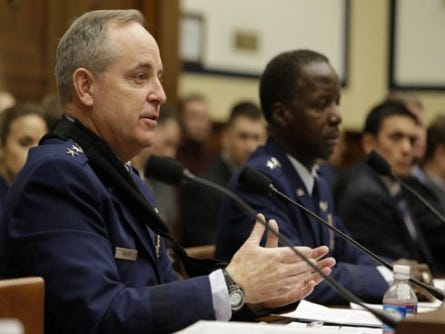
Air Force Chief of Staff Gen. Mark Welsh III, left, and Air Force Gen. Edward Rice, Jr., testifies on Capitol Hill in Washington, Wednesday, Jan. 23, 2013, before a House Armed Services Committee hearing on sexual misconduct by basic training instructors at Lackland Air Force Base.

But Gen. Mark Welsh, the Air Force chief of staff, underscored the challenge by telling a House oversight committee that the service recorded a disturbing number of reports of sexual assault last year even as it worked to curb misconduct in the wake of a sex scandal at its training headquarters in Texas. Dozens of young female recruits and airmen at Lackland Air Force Base near San Antonio were victimized by their instructors who sexually harassed, improperly touched or raped them.

Most difficult, Welsh said, is transforming a culture in which victims are often reluctant to report what happened because of guilt, shame or fear they won't be believed.

"Why, on what was undoubtedly the worst day of a victim's life, did they not turn to us for help?" Welsh said during testimony before the House Armed Services Committee. "We are missing something fundamental in the human-to-human interaction that will allow them to feel safe enough to come to us and report."

An Air Force veteran who was sexually assaulted while serving — but not at Lackland — described how intimidating it is for young enlisted personnel to speak up.

"You're stuck," Jennifer Norris told the committee. "If you want a career, you don't want to say anything because you get retaliated against." Norris, who said she medically retired in 2010 with post-traumatic stress disorder, said the Air Force and the other military branches have a sexual assault epidemic and a broken system of justice.

The scandal at Lackland, now known as Joint Base San Antonio-Lackland, continues to unfold nearly two years after the first victim came forward. All U.S. airmen report to Lackland for basic training. The base has about 500 military training instructors for about 35,000 airmen who graduate every year. About 1 in 5 recruits is a woman; most instructors are men.

The initial results of Air Force investigation released in November described abuses of power by instructors who took advantage of a weak oversight system to prey on young recruits.

The inquiry has found that 32 military training instructors allegedly engaged in inappropriate or coercive sexual relationships with 59 recruits and airmen at Lackland, according to the Air Force. Three of the most recent alleged victims are males.

Six instructors have been convicted in courts-martial on charges ranging from adultery, rape and conducting unprofessional relationships. Nine more instructors are awaiting courts-martial. Two more received nonjudicial punishments. Fifteen 15 instructors remain under investigation.

The Air Force has changed the way it selects officers and instructors who train new recruits and reduced from four to three years the amount of time they can spend as instructors, said Gen. Edward Rice, head of the Air Education and Training Command. Rice, who testified along with Welsh, said more women are being placed in supervisory roles within the training command. The Lackland scandal has not affected recruiting, Rice said.

"I'm not in any way ready to declare victory," Rice said.

The preliminary figures for 2012 show there were nearly 800 reports of cases, ranging from inappropriate touching to rape, according to Welsh's testimony. That would be a nearly 30 percent increase from 2011, when 614 cases were reported. The number could be much greater, Welsh said, because many cases are never reported.

"It's astonishing, really," Welsh said. "Eight hundred is not acceptable, 600 is not acceptable. 300 is not acceptable. Zero is the only answer."

The 2012 figures are being audited and reviewed before being included in a report the Defense Department will submit to Congress in April, according to Welsh.

Welsh said he has stressed to the Air Force's officer corps and senior enlisted ranks the importance of eliminating sexual misconduct. As part of that effort, Welsh issued a "Letter to Airmen" this month that said images, songs and stories that are obscene or vulgar are not part of the Air Force heritage.

Not everyone who commits sexual assault is a predator, but there are predators in the ranks and they have to be found before they act, Welsh said.

The Air Force also has to identify and stop the activities that can lead to inappropriate actions.

"A young man who routinely binge drinks and loses control of himself is going to conduct bad behavior," Welsh said. "That bad behavior could result in sexual assault. Let's stop the binge drinking."

This article originally appeared on Crestview News Bulletin: General calls sex assaults a 'cancer' in oversight committee meeting

Women in combat: Good to go if they meet standards

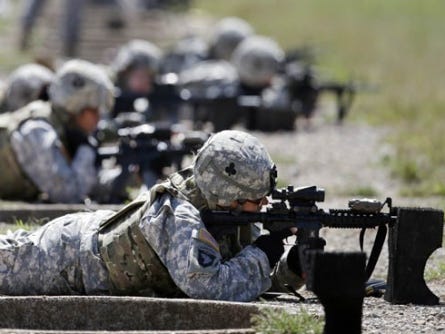
In this Sept. 18, 2012 file photo, female soldiers from 1st Brigade Combat Team, 101st Airborne Division train on a firing range while testing new body armor in Fort Campbell, Ky., in preparation for their deployment to Afghanistan. The Pentagon is lifting its ban on women serving in combat, opening hundreds of thousands of front-line positions and potentially elite commando jobs after generations of limits on their service, defense officials said Wednesday, Jan. 23, 2013.

As Defense Secretary Leon Panetta and Gen. Martin Dempsey, chairman of the Joint Chiefs, signed an order wiping away generations of limits on women fighting for their country, the military services said they would begin a sweeping review of the physical requirements. At the same time they acknowledged that women have been fighting and dying in Iraq and Afghanistan for more than a decade.

Women make up about 14 percent of the 1.4 million active U.S. military personnel. More than 280,000 women have been sent to Iraq, Afghanistan or neighboring nations in support of the wars. Of the more than 6,600 U.S. service members who have been killed, 152 have been women.

The leaders said no physical standards will be lowered just to send more women closer to the battlefront.

"I fundamentally believe that our military is more effective when success is based solely on ability and qualifications and on performance," Panetta said at a Pentagon news conference.

"Not everyone is going to be able to be a combat soldier. But everyone is entitled to a chance."

It won't happen quickly or easily. But in the end, he said, the U.S. military and America will be stronger for it.

Dempsey did not rule out women serving even as members of elite special operations forces, including the Army's Delta Force and the Navy's SEALs, whose members killed 9/11 mastermind Osama bin Laden.

Dempsey said that because of the particularly punishing physical standards and training required for those teams, it might be years before they include women.

But he added: "I think we all believe that there will be women who can meet those standards."

Recent surveys and experiences suggest the transition may not always be easy. When the Marine Corps sought women to go through its tough infantry course last year, two volunteered, and both failed to complete the course. And there may not be a wide clamoring from women for the more intense, dangerous and difficult jobs, including some infantry and commando positions.

Representatives of the military services said they will look at each job and military specialty that is currently closed to women and examine the requirements that troops must meet. In some cases — because of equipment upgrades, new technology and automation — the requirements may change, but in no case will they lower the standards in order to allow women to qualify.

As an example, a loader on a tank crew must be able to lift a 50-pound, two-foot-long artillery shell, spin 180 degrees and load it into a tank's cannon. Because of space constraints in the tank, it requires a great deal of upper body strength to hoist the shell.

Troops asked about the change said they just want comrades who can do the job.

"This gives us more people to work with," said Sgt. Jeremy Grayson, assigned to field infantry at Fort Bliss, Texas. "But they would have to be able to do the physical stuff that men do. Like in some jobs in infantry you're out there for a long time, or in artillery there is heavy work. And they have to be able to pull their own weight."

As a graduate of the U.S. Military Academy at West Point two years before women were admitted, Dempsey said he has seen the changes over time.

In 2003, when he went to Baghdad as commander of the 1st Armored Division, Dempsey recalled that he jumped into a Humvee on his first foray out of the forward operating base.

"I slapped the turret gunner on the leg and I said, 'Who are you?' And she leaned down and said, 'I'm Amanda.'"

"And it's from that point on that I realized something had changed, and it was time to do something about it."

But Dempsey cautioned that no one knows where future conflicts will take place. That's why the military needs time, he said, to review and possibly revise standards for combat jobs. The historic change overturns a 1994 rule prohibiting women from being assigned to thousands of front-line artillery, infantry, armor, special operations and pararescue jobs.

The Navy also announced that it is opening jobs for female sailors on smaller attack submarines — ships that had traditionally been closed to women largely due to privacy concerns in extremely close quarters.

There long has been opposition to putting women in combat, based on questions of whether they have the necessary strength and stamina for certain jobs, or whether their presence might hurt unit cohesion. But the Pentagon's announcement was largely hailed by lawmakers and military groups. There were only a few offering dissenting views.

Spc. Jean Sardonas, who works as a lab technician at a hospital at Fort Bliss in Texas, said she considered joining an Army team that faces combat situations. But since she's had children, she said her perspective had changed.

"If you see the enemy, well, that's the enemy, but now if you see a kid with a gun you're going to think twice" about shooting him, she said.

Sen. Jim Inhofe of Oklahoma, who will be the top Republican on the Senate Armed Services Committee, said he is concerned about the possible impact of completely ending the ban, adding that he suspects legislation may be needed to stop changes that would be detrimental.

Under the new memo, military service chiefs will have until May 15 to develop plans for allowing women to seek the combat positions. Some jobs may open as soon as this year, while assessments for others, such as special operations forces, may take longer.

The services will have until January 2016 to argue that some positions should remain closed to women.

Thursday's move fits into the broad agenda President Barack Obama previewed for his second term during Monday's inaugural address, which focused in particular on issues of equality. It also comes on the heels of a presidential election in which Obama won the majority of female voters following a campaign that focused heavily on women's issues, though not women in combat specifically.

The change also comes as Panetta wraps up his tenure as defense secretary. The order expands the department's action of nearly a year ago to open about 14,500 combat positions to women, nearly all of them in the Army.

Under the 1994 Pentagon policy, women were prohibited from being assigned to ground combat units below the brigade level. A brigade is roughly 3,500 troops split into several battalions of about 800 soldiers each. Historically, brigades were based farther from the front lines, and they often included top command and support staff.

The necessities of combat in Iraq and Afghanistan, however, propelled women into jobs as medics, military police and intelligence officers that were sometimes attached — but not formally assigned — to battalions. So while a woman couldn't be assigned as an infantryman in a battalion going out on patrol, she could fly a helicopter supporting the unit, or move in to provide medical aid if troops were injured.

Dempsey suggested that eliminating the ban on women in some combat roles could help with the ongoing sexual assault and harassment problems in the military.

"When you have one part of the population that is designated as warriors and another part that's designated as something else, I think that disparity begins to establish a psychology that in some cases led to that environment." said Dempsey. "I have to believe, the more we can treat people equally, the more likely they are to treat each other equally."

___

AP National Security Writer Robert Burns, White House Correspondent Julie Pace and AP Broadcast reporter Sagar Meghani in Washington and AP writer Juan Carlos Llorca in El Paso, Texas, contributed to this report.

This article originally appeared on Crestview News Bulletin: Women in combat: Good to go if they meet standards

error: Content is protected !!