“I think it’s very important that the municipalities in the region are also on board,” said Councilman Andrew Rencich, who served as mayor pro tem for the meeting due to Mayor JB Whitten being away on other business. “The military mission is what … gives us the abundance of economics coming from Eglin, and that’s one reason I do think it’s important to support this resolution.”
The Eglin Gulf Test and Training Range covers roughly 120,000 square miles of the eastern Gulf of Mexico stretching from Northwest Florida to Key West and is used in numerous military training missions, including the recent hypersonic weapons testing, air combat training and space launches.
In 2006, the Gulf of Mexico Emergency Security Act was passed, which prohibited any oil or gas drilling off the coast of Northwest Florida. In 2020, there were two presidential memorandums that were signed that extended that protection through 2032.
Unfortunately, said Crestview City Manager Tim Bolduc, the signing of the Inflation Reduction Act earlier this year actually removed those protections that had been in place for all that time. Rep. Michael Waltz (R-FL) introduced H.R. 8980 in September of this year, which would return those drilling protections to the Gulf of Mexico if approved and signed into law by the president.
“From time to time, we get the opportunity to either support or oppose initiatives that could have an impact on us,” Bolduc said. “The reason I think this is a reasonable one to take up is it has a direct impact on not only our beaches, not only protecting our environment, but it also has an impact on our economic stability.
“The way our rate of growth is right now, if there are changes with the (military) mission, that could have a drastic impact on the city of Crestview,” he added. “So, I do think there are some consequences that can reach beyond this that are beyond just philosophical.”
The council unanimously passed the resolution 4-0 to support the approval of H.R. 8980 and restore the drilling restrictions to the eastern Gulf of Mexico.
By Senior Airman Dylan Gentile Steam rises off the pavement on a rainy Wednesday morning when a police vehicle pulls off the street. A homeless family sheltering from the early downpour under the overhang of an old church structure were startled by the police car until Officer Bhagwatsingh stepped out with a smile and a wave.
Staff Sgt. Gerard Bhagwatsingh, 919th Special Operations Security Forces Squadron Bravo Flight 2nd in charge, works for the Fort Walton Beach Police Department as a community-policing officer. He knows a U.S. Army veteran and local homeless man takes shelter in the old church building when it rains. He has worked with the man over the past month to get him into a housing and detox program. Bhagwatsingh checks on him daily to make sure he’s attending his medical appointments and making progress with the housing program.
“I really want our community to know that I care about them,” said Bhagwatsingh. “I’m not just here to enforce the law, I’m here to help.”
He joined the Air Force Reserve in 2009 with the intention to carry his skills as a defender into civilian policing, said Bhagwatsingh. When he first joined the FWBPD, he started as a patrol officer, but always wanted to do more to help the community. When a position in the Community Policing Unit opened in 2021, he jumped at the opportunity to become part of the team.
“Most interactions people have with law enforcement happen at traffic stops or calls to their homes when they are often having a bad day,” said Sergeant Charles Pettis, FWBPD community policing division superintendent. “Community policing balances this out with positive interactions and deals with the more abstract safety needs facing the community.”
The Department of Justice defines this approach to policing as using partnerships and problem-solving techniques to proactively address the immediate conditions that give rise to public safety issues.
In practice, Bhagwatsingh’s days change depending on the needs of the department. He organizes community events, works with the local homeless, speaks with business owners about their security concerns, directs school traffic and maintains a varied schedule of other tasks to build relationships with local citizens.
“Residents I’ve worked with in the past know me by name,” said Bhagwatsingh. “Sometimes they’ll reach out to me directly when facing a problem because of our familiarity. Building that rapport helps us resolve problems before they escalate by creating trust with our citizenry.”
One way the officers in the community policing division make themselves visible is by participating in local events. Bhagwatsingh and his counterparts read to children at the local library, make lunches for students, and invite the public out to share meals with them. They often work with local churches, veteran organizations, and homeless advocacy groups to create solutions for security issues.
“We’ve seen recent reductions in crime as we have intensified our efforts and commitment to more individualized services,” said Pettis. “Our officers are able to spend more time resolving an issue and investing themselves into the community, preventing later problems that could emerge.”
Each officer in the division represents a district in the city, where they work to create positive relationships with residents and business owners. Bhagwatsingh represents District Two, comprised mostly of downtown and adjacent neighborhoods.
While he is able to represent the police department positively through his work, he also further solidifies local ties to the 919th Special Operations Wing by getting involved in the community, said Bhagwatsingh. His background with the Air Force Reserve often garners him respect from the people he’s interacting with.
“It definitely paints both the police department and Air Force in a positive light when the community knows they’re also interacting with a military member,” said Bhagwatsingh. “Most people in our area often have some kind of relationship with the military directly or indirectly.”
The FWBPD leverages the Air Force influence in the area to collaborate on training and community events. The community policing division often leans into these relationships to help connect with local residents. Bhagwatsingh’s role in the 919th SOSFS allows him to live between both these worlds.
“I’m thankful that Bhagwatsingh is able to fulfill both roles serving his community and serving his country,” said Pettis. “I’m very proud of my officers and the work they’re able to accomplish.”
Airmen across the 919th Special Operations Wing may have seen badge-clad inspectors roaming their squadrons and interviewing their wingmen as the wing underwent a Unit Effectiveness Inspection this past drill weekend.
“With a unit as highly-tasked as the 919th SOW, there’s a good chance that something could be dropped or missed,” said Brig. Gen. Michael Schultz, Air Force Reserve Command Inspector General. “When leadership and troops run as hard as they do here, it’s critical to us to make sure any blind spots are covered.”
Schultz and his team of inspectors arrived Aug. 4 ahead of the drill weekend to set up shop and prepare for their roles in assessing the Reserve’s only special operations wing. The team conducts the UEI on each unit in the command every four years. They evaluate the wing in the four major graded areas of executing the mission, leading people, managing resources and improving the unit.
“These unit inspections ensure that commanders are managing their responsibilities properly and Airmen are doing the jobs they’re tasked with,” said Lt. Col. Christa Machado, 919th SOW Inspector General inspections director. “We do these to detect and prevent any problems that could put our mission or people at risk.”
Wing-level IG teams ensure required procedures are followed to maintain the safety and readiness of the unit regardless of whether an inspection is underway. They work with major command-level IGs to maintain the mission function of the force.
Inspectors from AFRC with specializations in respective career fields, in conjunction with the IG team, worked with agencies and squadrons across base as subject matter experts.
“Our team is small but very high-functioning,” said Schultz. “We expect very high performance out of all our inspectors.”
While the teams can help the wing ensure its units are ready and operating during a UEI, leadership throughout the organization self-reports any deficiencies or roadblocks through an online system called Mission Internal Control Toolset, which allows the IG team to continually inspect wing missions throughout the year. The primary purpose of the UEI is to find undetected noncompliance, or unreported deficiencies.
“So long as organizations do their jobs and do it well, they have nothing to worry about during inspections,” said Machado. “The inspection is basically just somebody coming in and verifying that we’re doing the right thing.”
The inspectors are here to help the wing stay on track, not just write reports, said Machado. There are two phases of the UEI, the black hat and white hat phase. The black hat phase is when inspectors search for undetected noncompliance. The white hat phase is when they attempt to educate on or provide solutions for the discrepancies.
The white hat phase is when we work to optimize mission processes to prepare the Air Force for the conflicts of the future, said Schultz.
“Leadership at AFRC has a new theme and tempo of being ready now, not just normal readiness,” said Schultz. “Part of my job is ensuring that all units carry and understand this intent.”
As Air Force Special Operations Command and the 919th SOW undergo changes to stay relevant and capable in the future fight, Schultz and his team want to remind Citizen Air Commandos that they’re here to help during the transition to new and future requirements. “I know there are some mission changes going on in the wing, the Air Force is constantly going through changes to figure out where we need to be for the next conflict,” said Schultz. “I need Airmen to understand that we value them and want them to stick with us as we adapt.”
While the wing continues to ensure the mission and personnel remain compliant and ready in the face of these changes, inspectors remind the 919th SOW and its counterparts across the force to stay diligent and prepared.
It’s hard to imagine today, but just over 100 years ago the coastal plains of America from Virginia to eastern Texas were covered by about 92 million acres of longleaf pines. Fortunately, we have folks like Vernon Compton who care about preserving and restoring the 1.3 million acres left in Northwest Florida and South Alabama.
Compton, who works with the Longleaf Alliance as their director of the Gulf Coast Plain Ecosystem Partnership, said that the Alliance is a voluntary public and private land partnership formed in 1996 to preserve and restore these forests.
“Today we only have about 12,533 acres of virgin old-growth longleaf left in this area, and most of it is on Eglin Air Force Base,” he said. “Quite possibly all that spared these acres was the inability to get a railroad spur there.”
According to Compton, a lot can be learned from these remaining forests. Some of these things include diverse flora and fauna that once existed on the forest floors that look nothing like the dense brushy thickets associated with pine forests today.
“Over 170 species of herbaceous plants are native to these ecosystems, with over 6,000 plants found only in the longleaf ecosystem of the Coastal Plains,” he said. “Where the forest floor today is choked out with invasive woodies like Chinese privet, it was once covered with low-growing native shrubs and wildflowers that reveled under the canopies of the trees. The groundcover is the most important part of the ecosystem and without the pines, the groundcover disappears.”
The trees themselves were home to many endangered animals that are at risk of becoming extinct. “The red cockaded woodpecker is an example of an endanger bird that we are working diligently to restore habitat for,” he explains. “They thrive only in these coastal pines and nowhere else in the world.”
Vernon Compton of the Longleaf Alliance. Contributed photo
Local residents are no strangers to the smoky skies of forest fires, and Compton explains the role that fire plays in keeping these forests healthy.
“Many local people get angry about the smoky skies and think we’re destroying forests, but the public needs to be educated about the role fires play in forest health,” he said. “Longleaf is a ‘fire forest,’ meaning that without it, the forest floor would be choked with hardwoods and woody shrubs, leaving no room for the native plants and animals.
“Since we live in the ‘lightning strike’ capital of the world, lightning used to take care of this problem. Then man intervened. For many years, the federal forestry department believed that fire was bad, and today we frequently see on the news how this thinking has worked out for California. These days, very detailed plans allow controlled burns to do the work nature once handled. When the thickets are burned, the forest thrives again,” he added.
The Longleaf Alliance strives to ensure a sustainable future for this ecosystem through partnerships, landowner assistance, and educational and outreach opportunities. “Without this work, we’d still look like the early 1900s when the logging industry had cut down every pine in site and the vestiges had been ravaged by the turpentiners and wild hogs,” Compton concludes.
“While the longleaf was a huge component in building much of America, we’ve come a long way in understanding the value of leaving portions of our forests undisturbed and replanting and restoring what we need to use.”
With selections ranging from Renaissance marches and “Amazing Grace” to The Muppets and Willy Wonka, Freedom Brass’s Crestview debut swept the gamut of genres and time periods, handling any seeming complexity with aplomb.
The brass ensemble of the U.S. Air Force Band of the West, stationed at Joint Base San Antonio-Lackland, Texas, is comprised of two trumpets, French horn, trombone, tuba and percussion, and played to a full house at Warriors Hall on a cold, rainy Friday evening.
However, newly enacted Department of Defense COVID-19 restrictions limited available seats to 50, making a “full house” a lot smaller than the hall’s usual 200-seat capacity.
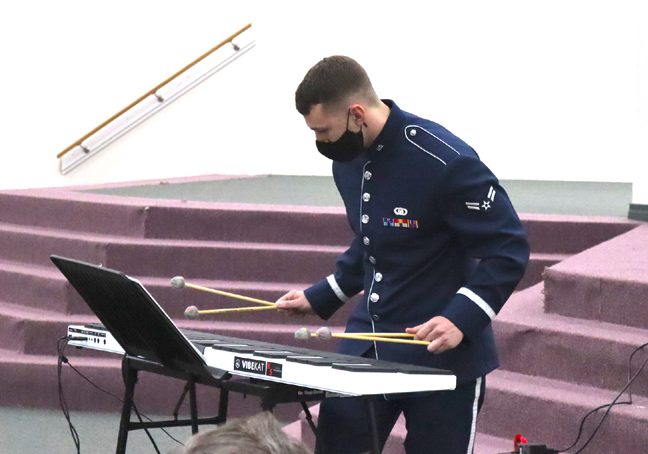
Percussionist Airman First Class Austin Pierce performs “Rainbow Connection” from “The Muppet Movie” on an electronic vibraphone during Freedom Brass’s Crestview concert. Photo by Brian Hughes, Cultural Services Specialist, City of Crestview
“Next time we can hopefully put out more seating,” Mayor JB Whitten said after the concert as he helped fold up chairs.
Freedom Brass’s appearance drew a diverse audience, including several middle and high school band students, who welcomed the opportunity to see professional musicians at work. Many military veterans also speckled the audience, receiving applause as the band played a medley of service branch anthems and each stood for his or her branch’s anthem.
The band earned laughs as they introduced the new U.S. Space Force’s interim anthem, which is based on John Philip Sousa’s 1901 march, “The Invincible Eagle,” with Master Sergeant Eric Proper inviting trombonist Senior Airman Evan Drumm invited to play it “as you’d hear it in space.”
Airman Drumm then proceeded to play the number. Without sound.
At 73, John Porter has been everywhere he ever wanted to be, from flying former President Gerald Ford in Air Force 1 to spending 46 years at the side of a woman he describes as magical.
“Look at her eyes,” he says, showing off the tiny picture on Ann Porter’s driver’s license.
They had money, homes and credit card debt. He had adventures. He met important people, like the King of Saudi Arabia, and taught them to fly. The couple lived “high on the hog,” he said.
They had it all and he has lost it all.
Now, he’s living in a homeless shelter in Crestview and appears to be staying, despite staff finding him apartments several times and offering to provide support while he gets on his feet. He told the media last week that he’d been kicked out, but he’s still there, according to Ann Sprague, president of the Crestview Area Shelter for the Homeless.
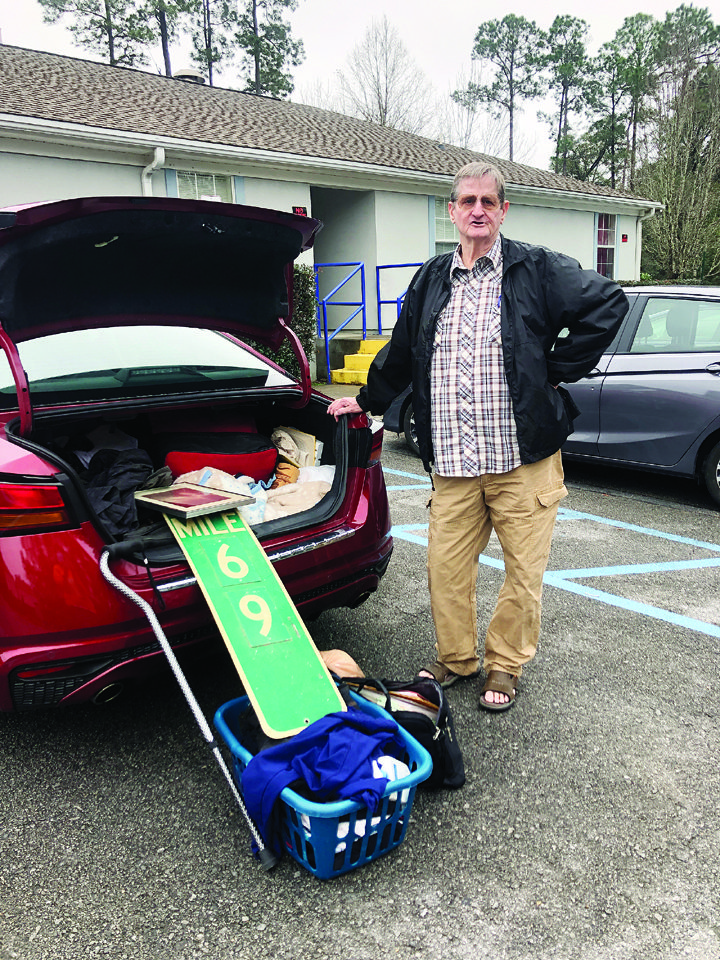
John Porter had a big life before losing his wife, his house and his life savings. Now, this new car, cosigned by a friend, is all that connects him to that former success. Photo by Wendy Victora Rudman
“He has never been kicked out and where did he sleep last night? In the shelter,” Sprague said.
Porter gets $2,300 a month in Social Security and Veterans Administration disability. A friend helped cosign on his new Nissan Altima, which gleams in the handicap spot at the shelter on Duggan Avenue.
Sprague said that because of Porter’s income, she’d been able to find him apartments that he could afford and that they would continue to subsidize him in an apartment while he got himself sorted out.
He refuses, turning down three so far. She said she has never had anyone turn down an apartment before.
“Usually when I find someone an apartment to rent, they either cry or jump up and down,” Sprague said.
Porter isn’t easy to decipher. He was in the Marines for 10 years, has a VA disability and a bad leg, had a successful career as a pilot and flight instructor, and a good marriage, he said. He and his wife were “inseparable,” except his job kept him away from home 300 days a year.
Ann died in April 2016 while they were sitting in the living room watching television. She was still working at the time, leaving him with credit card debt that now totals $30,000.
She wanted to live an afterlife, if there is such a thing. So, he spent money to have her cremated and fly her over several states, disposing of a little bit of her over each one. He then used his former connections in the aerospace industry to get a small amount of ashes taken up in a space shuttle, he said.
“Part of her is in orbit,” he said.
Within three years of Ann’s death, their house was gone and so was their life savings. He stayed with a friend for several years, and tried staying with his adult son, from whom he is now estranged.
He has also lived in his car, staying at the rest area at mile marker 59 on Interstate 10 until officials told him he was limited to eight hours a day and 24 hours for a week.
Around Halloween, he moved into the shelter and is in no hurry to leave. His car makes him a target of envy, he said. It’s a source of pride.
John Porter spent 10 years in the Marines, which included stints in Vietnam. Now he lives at a homeless shelter. Photo by Wendy Victora Rudman
“Everybody else in here has nothing,” he said. “They’re tapped out. I, on the other hand, have a new car.”
The car is what connects him from his former life to this one. What he used to be, instead of what he has become.
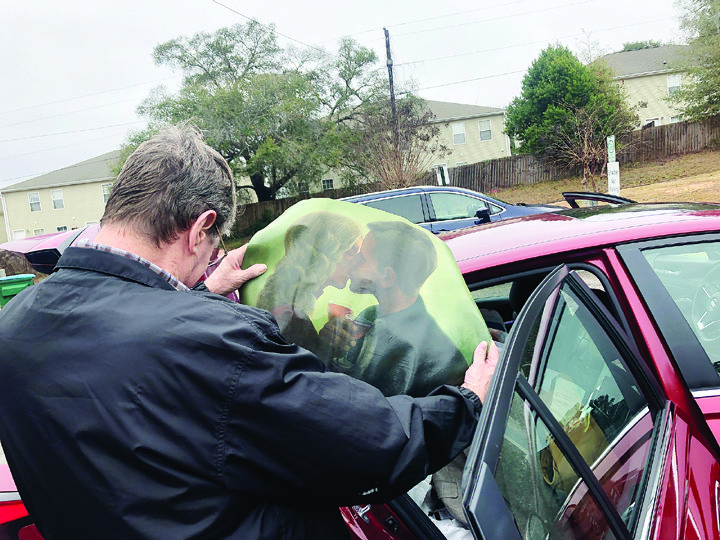
The items inside, while a seeming jumble even to him, mean something. There’s the painting of him and Ann on their wedding day, painted from that moment captured on Polaroid. He finds it in the back seat and gasps sharply, turning his head away to hide the pain of recognition.
In the trunk, amidst a laundry basket and garbage bags filled with possessions, he finds a broken table leg. His wife made him buy that table, he said. This stick of wood, ending in a jagged separation, is a treasure to him.
There’s also a random can of tuna fish, which he tosses back in, calling it and the other objects the debris of life.
He’s had a series of strokes and admits to some “senior issues,” saying his memory isn’t as sharp as it once was.
It’s clear he views the offers of an apartment as an attempt to get him to leave. His response is that he needs more time to save money. If is forced to leave before he’s ready, he won’t be able to pay for the car.
It’s ego, he admits. But it’s important for him to die someday with some semblance of prosperity. It’s where he draws the line.
“I will not allow that to be the postscript on my life,” he said.
Congressman Matt Gaetz (FL-01) and several community leaders recently announced the final passage of resolutions supporting an increase in the Basic Allowance for Housing (BAH) rate for military service members in Florida’s First District. The resolutions were introduced and passed in Escambia County, Okaloosa County, Santa Rosa County, and Walton County.
In 2021, it was identified that the BAH rate, due to rising inflation and other factors, was insufficient to cover the cost of housing for service members in our district.
Upon learning of the discrepancy, Gaetz drafted and supported the resolutions, signaling to the Department of Defense that the BAH rate increase is unanimously supported by the people of Northwest Florida.
The deficiency also prompted his office to add a provision in the FY 2022 National Defense Authorization Act requiring the DOD to produce a report on housing and BAH rates in Northwest Florida due by spring 2022.
Gaetz thanks the following individuals and organizations for their exceptional contributions towards enhancing the military mission in Northwest Florida:
Commissioner Jeff Bergosh, District 1 Escambia County
Commissioner Bob Cole, District 2 Santa Rosa County
Commissioner Danny Glidewell, District 5 Walton County
Commissioner Mel Ponder, District 3 Okaloosa County
Grey Burge, Pensacola Association of Realtors
Mike Dollen, Pensacola Association of Realtors
Dan Gullahorn, Pensacola Association of Realtors
Chuck Michaels, Pensacola Association of Realtors
John Waas, Pensacola Association of Realtors
Melissa Allegretto, Emerald Coast Association of Realtors
Sound the trumpets! Freedom Brass, the U.S. Air Force Band of the West’s brass ensemble, will make its regional debut when it presents a live performance at Warriors Hall on Feb. 4.
Freedom Brass, stationed at Joint Base San Antonio-Lackland, Texas, is generally comprised of two trumpets, French horn, trombone, tuba, and percussion, but for its Crestview concert, two more musicians will be added, trumpeter Staff Sgt. Justin Weisenborn said.
“It will be eight of us now instead of six, as we are bringing two new members to work them in to the rotation,” he explained.
According to its website, Freedom Brass “is dedicated to presenting to its audiences the total spectrum of today’s musical literature,” which means the Crestview audience can expect a diverse program of music, including pieces from a repertoire that stretches back hundreds of years.
The Freedom Brass performs one of its more than 100 annual concerts. Photo by SSGT. Justin Weisenborn, Freedom Brass
The group travels more than 20,000 annually, performing more than 100 concerts and clinics around the United States as well as performing at military ceremonies.
“The members of Freedom Brass bring to the United States Air Force many years of professional experience with symphony orchestras, chamber ensembles, touring shows, and today’s popular artists,” the ensemble’s website states. Past performances include the New York Brass Conference and Boston University’s Tanglewood Music Center.
The concert is a program of the City of Crestview Cultural Services Division.
WANT TO GO?
What: Freedom Brass concert
When: 7 p.m. Friday, Feb. 4
Where: Warriors Hall, Whitehurst Municipal Building, 201 Stillwell Blvd.
How much: Free
Notes: Due to Department of Defense recently issued COVID-19 safety protocols, admission will be limited to the first 50 attendees.
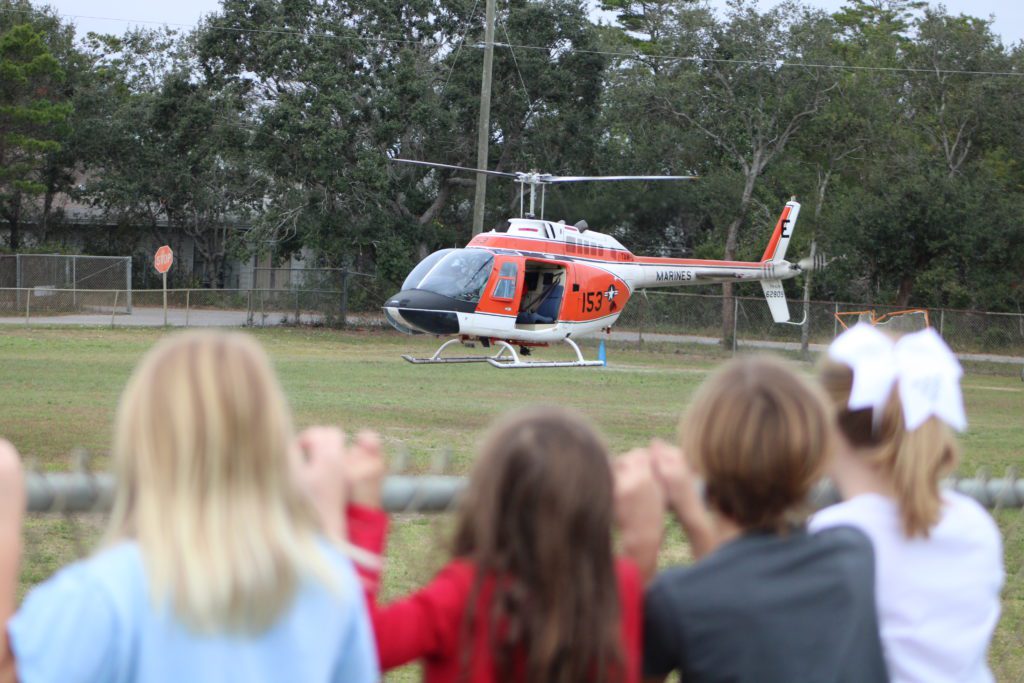
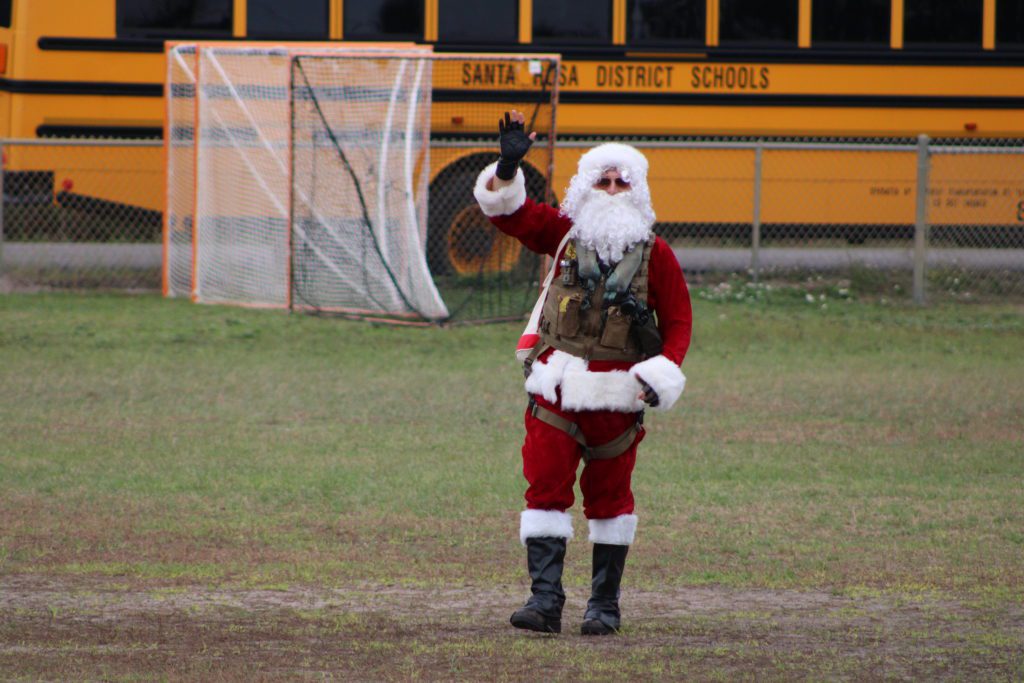
After circling the school multiple times, the Bell 206 “Sea Ranger” touched down in the middle of the school’s auxiliary field. Santa then made his appearance to cheers from dozens of young students. Sporting a big red sack full of candy canes, Santa greeted the children with high fives and festive peppermint treats.
Santa Claus arrives at Gulf Breeze Elementary in style thanks to the HT-8 Eightballers, a helicopter training squadron assigned to Training Wing Five at Naval Air Station Whiting Field. Photo by Nick Acevedo
According to Assistant Principal Kim McChesney, the helicopter training squadron reached out to the school first. Lt. Cmdr. J.T. Kadz, the “Ops Boss” of the HT-8 Eightballers, helped bring this event to fruition after some phone calls and numerous emails to school officials, local police and the fire department.
“We fly over this area every day and that’s one of the things I said to Principal Stevens,” Kadz said. “I said, ‘Hey, I’m sure you guys see our helicopters flying overhead a lot. How would you like us to land and bring in Santa?’”
Kadz got the idea to bring St. Nick to Gulf Breeze Elementary after some friends from his church suggested it. He originally wanted to land at his children’s school, but they’re desensitized to helicopters from being around them so often, he said.
After circling the school a few times and enjoying a smooth landing, Santa waves to the dozens of cheering elementary students while carrying a big sack full of candy canes. Photo by Nick Acevedo
“I’ve got four boys and I asked them if they wanted me to fly to their school and they were like, ‘No, we’re OK. We’ve seen enough,’” Kadz said, laughing.
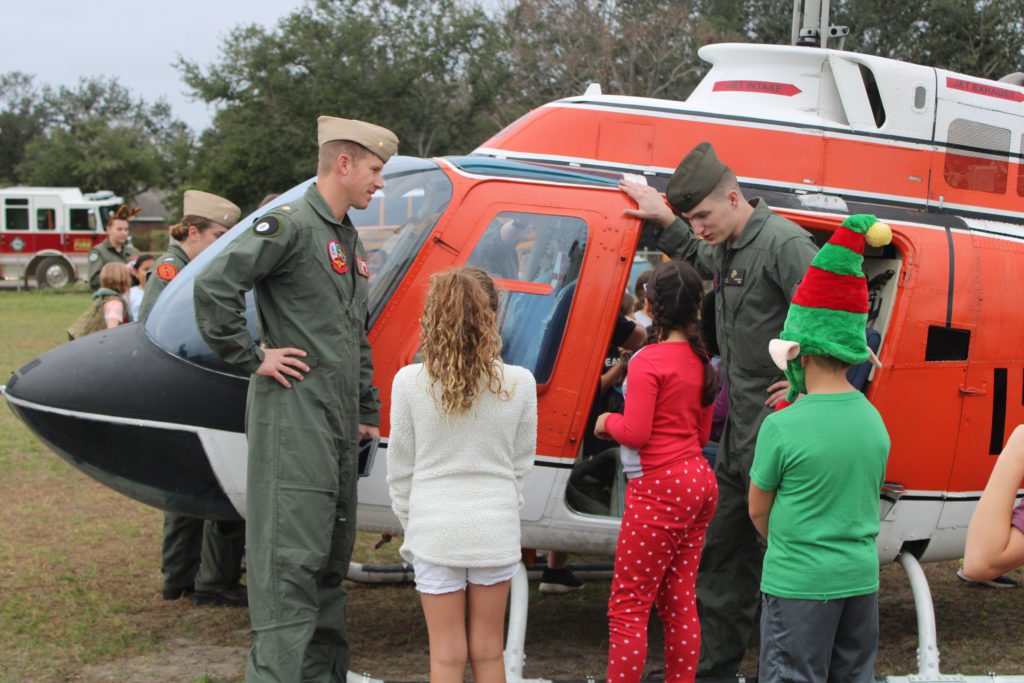
According to Santa, the flight from the North Pole was excellent, but cold. The helicopter was flown by two instructors, while student naval aviators waited on the ground to help answer questions from hundreds of children.
“This is our training helicopter. We train Navy, Marines, Coast Guard and international students. This is the first helicopter they fly,” said Lt. Cmdr. Jim Mazel of the United States Coast Guard. Mazel oversaw everything on the ground, ensuring a smooth landing by the helicopter team.
“It’s fun for us, it beats working for the day, right?” Mazel said, smiling.
Lt. Cmdr. J.T. Kadz, the “Ops Boss” of the HT-8 Eightballers and 1st Lt. First Lieutenant Dan Konieczny, a student aviator with the United States Marine Corps, answer questions from dozens of elementary students. Photo by Nick Acevedo
Dan Konieczny, a first lieutenant and student aviator with the United States Marine Corps, arrived at the unit earlier this month, and is already getting involved with the local community.
“It’s cool to see them all get so excited about this. I volunteered to come out and do this just because I was one of these kids once,” Konieczny said.