Eglin was selected for the award, which highlights the conservation efforts and impacts of the collaboration among the DOD, the Service, and other partners, for its proactive and innovative approach to conserving a variety of native fish and wildlife and the habitats on the installation where they live.
“We honor Eglin for their commitment to preservation and the resources they’ve invested showing that conservation and military training and testing can work well together,” said Mike Oetker, regional director of the Service’s Southeast Region.
A gopher tortoise gets used to its new habitat Nov. 9 at Eglin Air Force Base, Fla. Approximately 831 gopher tortoises were released into a new habitat on the Eglin range in the month of October. With another 30 relocated Nov. 9, the population is more than 4,300. (U.S. Air Force photo/Samuel King Jr.)
The 96th Civil Engineer Group commander, Col. Jeremiah Hammill, thanked the base’s natural resources team for their dedication to environmental stewardship and their strategic management of the base’s natural resources.
“This team’s diligence, collaboration, and conservation plans prioritized wildlife, fire, and forestry management activities to ensure the operational capabilities of the complex water and land resources that support Eglin’s test and training missions,” he said.
The UAS software aims to provide users with a standardized heads-up-display for multiple styles of UAS, all using simple off-the-shelf equipment and training. This display can also be shared via the internet, allowing multiple users to see what the same UAS is doing.
Sky Pad currently tours their system highlighting the usefulness of it for security forces with gate overwatch, search and rescue and emergency response.
The demonstration was part of the Air Force Chief Data and AI office’s Autonomy Data and AI Experimentation proving ground effort, which aims to accelerate development and experimentation in programs like the Sky Pad.
The 96th Test Wing hosts the ADAX program at Eglin.
The goal of the celebration is to highlight the importance of transportation infrastructure, services and innovation while addressing challenges and promoting collaboration across various sectors of the logistics enterprise.
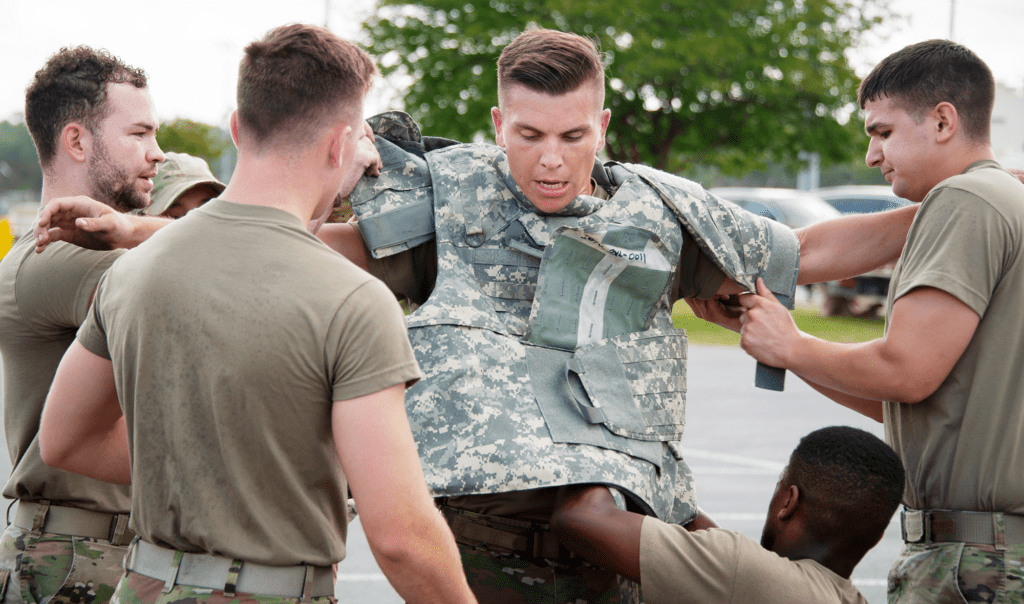
96th Logistics Readiness Squadron Airman help a teammate don a body armor suit, at the obstacle course events during National Transportation Week May 8 at Eglin Air Force Base, Fla. The week’s events celebrated the evolution of transportation and logistics within the Department of Defense. (U.S. Air Force photo/Kevin Gaddie)
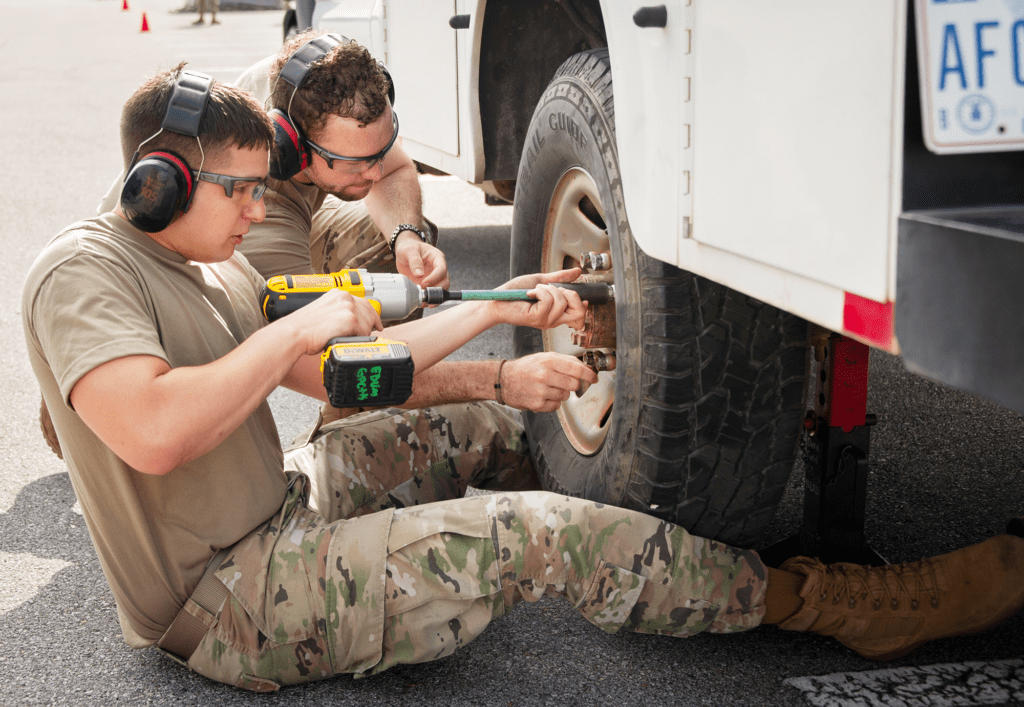
This year’s activities included: a 3.6-mile ruck march; a squadron reveille formation; a truck pull and obstacle course event; a resilience workshop and a panel where Team Eglin members shared personal stories.
Additionally, the squadron hosted an Open House and a Touch-a-Truck event, to demonstrate to families how they impact the mission.
96th Logistics Readiness Squadron Airmen secure lug nuts while changing a tire at the obstacle course events, during National Transportation Week May 8 at Eglin Air Force Base, Fla. The week’s events celebrated the evolution of transportation and logistics within the Department of Defense. (U.S. Air Force photo/Kevin Gaddie)
“Transportation is an important part of the mission,” Harkin said. “Our transportation efforts help to allow the mission to happen at Eglin.”
The group of officers and innovators, known as Black Phoenix, created a goal for themselves to design, create, build, and fly an unmanned aerial system within 24 hours. Around the 22.5-hour mark, the team secured the tail pieces and lastly, the propellers. The final step on a journey that started more than six months prior was to put the UAS in the air.
The officers began the project as part of their Blue Horizons fellowship. Blue Horizons is an Air Force Center for Strategy and Technology mission that is part think-tank, part incubator that promotes unconventional thinking and processes to Air Force problems with strategic impact.
The Black Phoenix crew is one of five teams wrapping up those projects after year-long fellowships.
Their three-person team took on the task of evaluating how to rapidly adapt small UASs, their technology and payloads based on the need and environment.
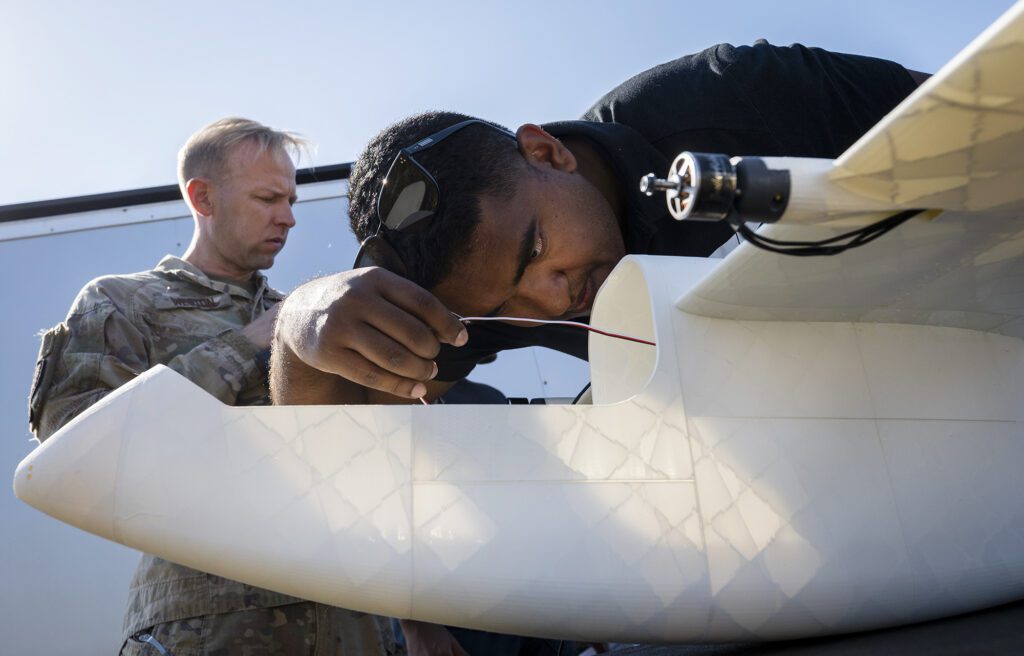
Mohammad Adib, Titan Dynamics founder and CEO, prepares a 3-D-printed unmanned aerial system for flight during a Blue Horizons demonstration April 25, 2024 at Eglin Air Force Base, Florida. The goal of the demonstration was to create, build and fly a UAS within 24 hours. The team spent the week at Eglin creating UASs for various designs and mission specialties. (U.S. Air Force photo by Samuel King Jr.)
“Small UASs are becoming a new warfighting capability,” said Col. Dustin Thomas, a Blue Horizons fellow and Black Phoenix team member. “However, the Air Force can’t rapidly change these aircraft based on the threat environment or quickly use new technologies to meet the needs of a specific mission. Our project aims to find ways to change that.”
To take their project from the theoretical to practical, the team turned to Titan Dynamics, a small aerospace company focused on rapid and cost-effective UAS designs and development.
“We went in search of a young, smart, new start-up company, who was willing to take on a big risk.” said Lt. Col. Jordan Atkins, Black Phoenix member. “We couldn’t be more impressed with their ability to yield a miracle like this in only two months.”
The team used Titan’s software automated design software to create an aerodynamic UAS body based on weight, power, dimensions, and payload in less than 10 minutes. That design code gets fed into 3D printers to create the lightweight UAS body parts. Once all the pieces are printed, the team builds the newly-created UAS designed specifically for its mission parameters.
Black Phoenix took this method and first tested it in Southwest Asia in March with Task Force-99 with some success.Then, they brought that test data and lessons learned to Eglin for their final in-the-field tests. They sought out the Air Force Chief Data and AI office’s Autonomy Data and AI Experimentation proving ground, which aims to accelerate development and experimentation in programs like the Black Phoenix project.
“Eglin is trying create a space to test small UASs and new technological capabilities very quickly,” said Thomas. “Historically, the Air Force is relatively slow in adapting and testing these technologies, and Eglin is trying to change that paradigm. We wanted to partner with them and be a part of that paradigm shift.
In support of the ADAX proving ground, the 413th Flight Test Squadron’s Autonomy Prime flight flies autonomous UASs regularly, and new aircraft and autonomy customers come to Eglin to test their technologies.
Noah Benton, Titan Dynamics chief technology officer, launches a an eight-pound, 3-D-printed unmanned aerial system during a Blue Horizons demonstration April 25, 2024 at Eglin Air Force Base, Florida. The goal of the demonstration was to create, build and fly a UAS within 24 hours. The team spent the week at Eglin creating UASs for various designs and mission specialties. (U.S. Air Force photo by Samuel King Jr.)
During Black Phoenix’s week at Eglin, the team tested six autonomous aircraft using the quick create, build, fly method for various missions including an eight-pound personnel recovery UAS that would deliver supplies to a simulated Airman behind enemy lines.
Sometimes the aircraft flew successfully and other times, when pushing the boundaries, they crashed. The successes and failures were all part of Black Phoenix’s goal to gather research on the feasibility of the rapidly created UASs idea.
What they did discover was regardless of flight or crash, the internal autonomy hardware and the payload within were virtually unharmed. To build back and try again meant only reprinting the outer UAS structure at a cost of around $20 to $50.
“We’ve taken big risks this week in flying so many new aircraft for the first time, but the risk is also low because these entire aircraft are built from commercial off-the-shelf items, so the financial investment is small,” said Lt. Col. Peter Dyrud, Black Phoenix team member.
After the test, the Black Phoenix team will put together their findings and present their study evaluation to the Air Force Secretary and Air Force Chief of Staff in May.
The annual memorial ceremony, in its 55th year, took place at the Kauffman EOD Training Complex on Eglin.
The schoolhouse’s commandant, Navy Capt. Steven Beall, welcomed guests and explained why they return to the memorial on the first Saturday of May each year. This specific Saturday is designated National EOD Day.
“We’ve been guided here from different places, different generations and services, united in purpose, driven by conviction and a promise that we remember,” said Beall. “We will never forget those who gone before us. We will never forget their bravery, courage and sacrifice.”
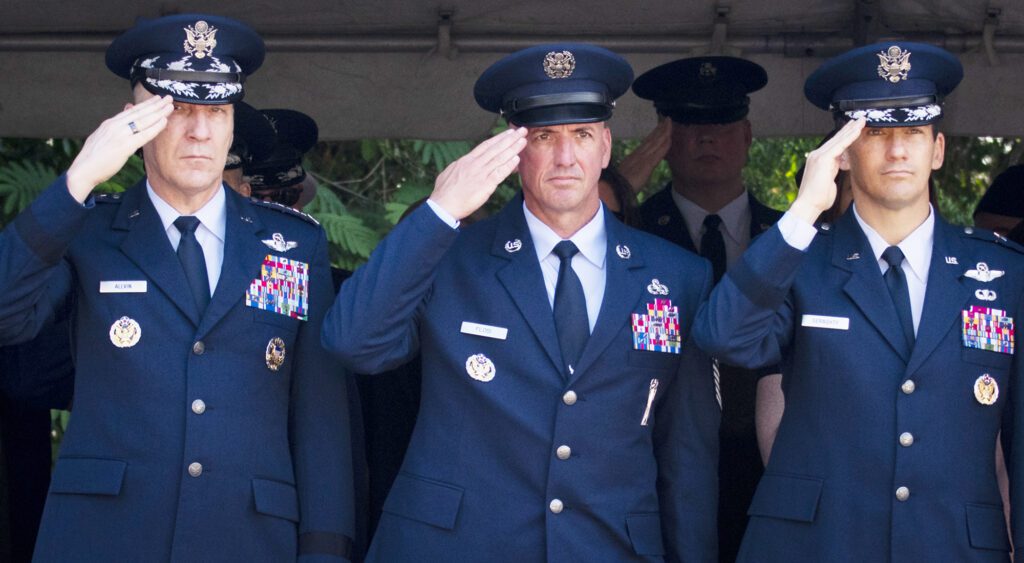
Air Force Chief of Staff Gen. David W. Allvin, Chief Master Sgt. of the Air Force David Flosi, and Brig. Gen. Jeffrey Geraghty, 96th Test Wing commander, salute during the 55th Explosive Ordnance Disposal Memorial ceremony May 4, 2024 at Eglin Air Force Base, Florida. Names of recent fallen and past EOD technicians are added to the memorial wall and flags presented to their families during a ceremony each year at the Kauffman EOD Training Complex. The all-service total now stands at 344. (U.S. Air Force photo by Samuel King Jr.)
The significance of the Memorial brought the Department of the Air Force’s top leadership to the event. Air Force Chief of Staff David W. Allvin and Chief Master Sgt. of the Air Force David Flosi were in attendance. Allvin was the keynote speaker.
So moved by the reverence of the ceremony, Allvin said instead of delivering his planned speech, he’d rather speak from the heart about the honor he felt to be there.
Allvin said he didn’t feel right sitting in the ceremony’s place of honor but would rather be among those currently wearing the EOD badge and hearing their stories. He also said he’d rather be among the gold star families and understand the hardships that came with their loss.
“You have a wound that never really heals. Every first Saturday in May it opens up again,” said the general. “You may dread this, but you do it because it’s a commitment to the memory and honor of those whose names are on this wall.”
Allvin continued saying even if he’d attended the ceremony and sat by himself, he would not have felt alone. He said there’s a shared experience among those in attendance of reverence, honor, commitment and selfless service.
“I could be sitting anywhere, and I’d have the same sense of gratitude, respect, and absolute admiration for those in the EOD profession,” Allvin said. “Ceremonies like this remind us we have something in this country worth fighting for and we should recommit ourselves to the effort.”
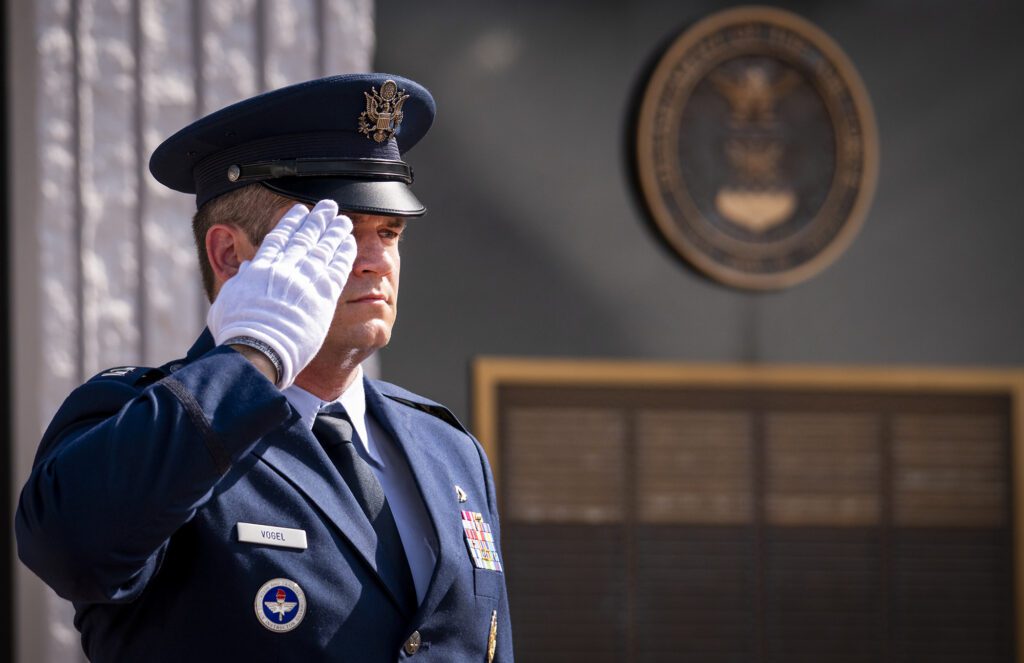
Capt. Thomas Vogel, 366th Training Squadron, salutes during the 55th Annual EOD Memorial Ceremony, May 4. Names of recent fallen and past EOD technicians are added to the memorial wall and flags presented to their families during a ceremony each year at the Kauffman EOD Training Complex at Eglin Air Force Base, Florida. The all-service total now stands at 344. (U.S. Air Force photo by Samuel King Jr.)
Each service then presented a wreath with the banner “We Remember” in front of their specific memorial as each name is solemnly read aloud. This year, no new names were added to the Memorial Wall. The all-service total stands at 344.
At the ceremony’s conclusion, the area around the Wall got very quiet. The only sounds came from the sandy grit beneath the joint-service color guard’s tapped shoes as they marched toward the Memorial to retire the colors. The next sounds blasted away the quiet as Eglin’s honor guard performed a three-round rifle volley. As the rifle echoes settled and the smell of gun powder filled the air, Taps played to end the ceremony.
Afterward, families and EOD technicians both past and present descended upon the Wall for pictures, to touch the engraved brass name or just remember a fallen hero.
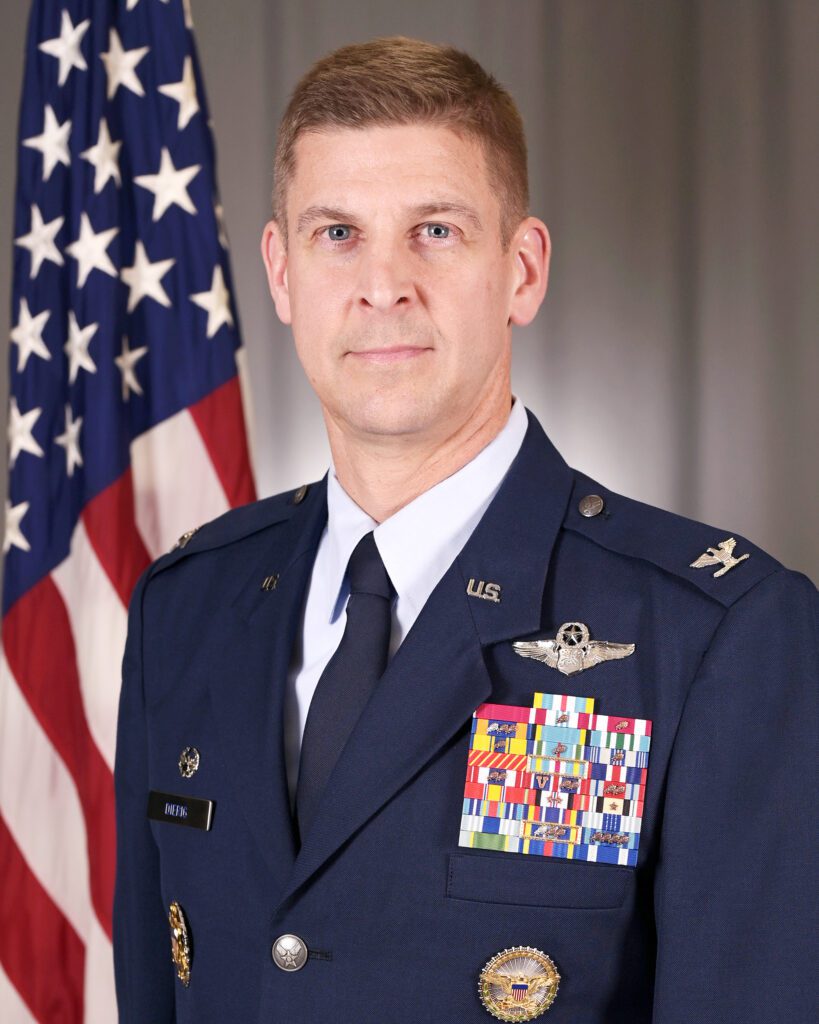
On its own, being installation commander is a tall task. Add in being the face of the base for the broader northwest Florida community and you have a plate that’s not only full, its overflowing.
Dierig said he is committed to bridging the divide between the military and civilian worlds without sacrificing the base’s mission, to train, plan and execute special operations warfare for the Air Force.
“A big thing you will see is continued community engagement,” Dierig said. “Mostly (that will be) our young airmen going out in the community.”
Recently, the Hurlburt Field Air Park has been opened to a wider civilian audience. Thanks to a parking lot and air park entrance, there’s no need for civilians to get passes at the gate. The park is surrounded by fencing allowing civilians into the park but not the larger base.
Dierig hopes the park’s opening will educate civilians about the work and sacrifice that Hurlburt Field airmen do and inspire future generations to serve in the Air Force. Dierig himself was inspired to serve while watching an air show as a child in Ohio.
“Now we can share (our story) with our local community,” Dierig said. “I think the Air Park is going to give us some opportunities to hold events here. We are looking at expanding the air park, maybe expanding it into a museum. We are still just looking.”
Although a commander for just over two months, Dierig is no stranger to northwest Florida. In December 2001, Dierig arrived at Hurlburt as a student training on an AC-130U gunship. He and his family stayed at Hurlburt Field until March 2008. Later, in 2016, Dierig returned to Hurlburt Field and left three years later. He has been at Hurlburt Field on and off again for over 10 years.
“Growing up in the 1SOW, this is now my third assignment here, I have a reverence for this base,” Dierig said. “I’m part of the community, my wife and kids have lived here for roughly 14 years. We had a baby here. My wife teaches in the local community — this is home for us.”
In that time, he lived both on and off base. Some of the same issues he saw as young airmen around the base remain. According to Dierig, there are three areas he would like to address during his time as the top brass of 1SOW: traffic, housing and childcare.
“The number one (priority) is the mission, number two is to make Hurlburt Field a world class installation, not just for the mission but for quality of life, for our airmen” Dierig said.
Col. Dierig
Traffic
As far as traffic is concerned, Dierig favors a “whole of government approach,” meaning a collaborative effort between local, state and federal entities to get a secondary east-west corridor parallel to Highway 98.
At a recent Florida-Alabama Transportation Planning Organization meeting, Hurlburt officials spoke of their concerns with traffic affecting readiness. Currently, Hurlburt has between 22,000 and 23,000 working on base and many live off base in Navarre or other parts of Santa Rosa County.
Delays in traffic could mean delayed air support in case Hurlburt’s airmen are called on. Dierig suggests a connector road between the base and Highway 87, which will likely take money from all levels of government (including the DoD). It may lead to the creation of a western gate.
“This is not about convenience, it’s about readiness,” Dierig said. “I never want to call Gen. Bauernfeind and say, ‘the hostage is dead because of a traffic jam.’”
With the Air Force still combing through its options, Dierig said the traffic situation will not be fixed during his tenure, but he hopes to get “milestones in place” for future 1SOW commanders.
Housing
With over 22,000 people working on base and housing costs being high, housing for airmen is critical.
According to Dierig, there are about 500 houses on base, 400 of which have been recently constructed. Currently, the housing units on base are “near 100%” occupied, and there is a waiting list.
Dierig said they are working on renovating 100 homes in the Live Oak neighborhood. There are also plans to add 100 homes in the Live Oak section on base. Another solution is to incentivize the construction of private housing outside the gate.
Childcare
Dierig said Hurlburt Field has two childcare development centers (CDCs). Of the CDCs, one was recently renovated as part of a goal to accept more children for on base childcare. There is currently a waiting list, especially for infants.
“The challenge we have is hiring teachers,” Dierig said. “I know that is a local issue.”
A solution to the waiting list issue, according to Dierig, is to allow on base spouses to open their own daycares within their homes. After being credentialed and vetted, that person would be allowed to create that childcare business.
“We create a small business, and we provide a safe home for a number of kids who can be watched,” Dierig said. “Our family readiness center will help this family with their business startup, and you will be reimbursed by the Air Force for a number of items.”
Dierig said Hurlburt is in contact with Eglin Air Force Base about possible joint solutions. Due to the proximity of the bases, Dierig said there are many examples of airmen who have spouses who are stationed at Eglin or vice versa who need childcare.
The idea of a shared CDC would be entertained by Dierig, but there are no confirmed plans as of April.
The Air Force Civil Engineer Center began procuring F3 from the qualified products list in 2023. Qualified F3 products meet stringent firefighting performance standards set forth in a military specification that ensure the product is suitable for military use. The MILSPEC establishes performance requirements for how quickly and how effectively products need to extinguish a fire, which ensures the safety of servicemembers and firefighters in an emergency. AFCEC plans to replace AFFF, among the Air and Space Forces, in all non-tactical fire vehicles by October 2024.
“The new foams do not contain fluorine, and therefore do not contain PFAS. We understand PFAS, when released into the environment, is very persistent and does not break down easily,” said Robin Shaw, AFCEC Fire and Emergency division chief. “While its predecessor relied on fluorinated chemicals to create a barrier over the fuel, F3 operates by smothering the fire with a physical foam barrier, effectively preventing the ignition of fuel by depriving it of oxygen.”
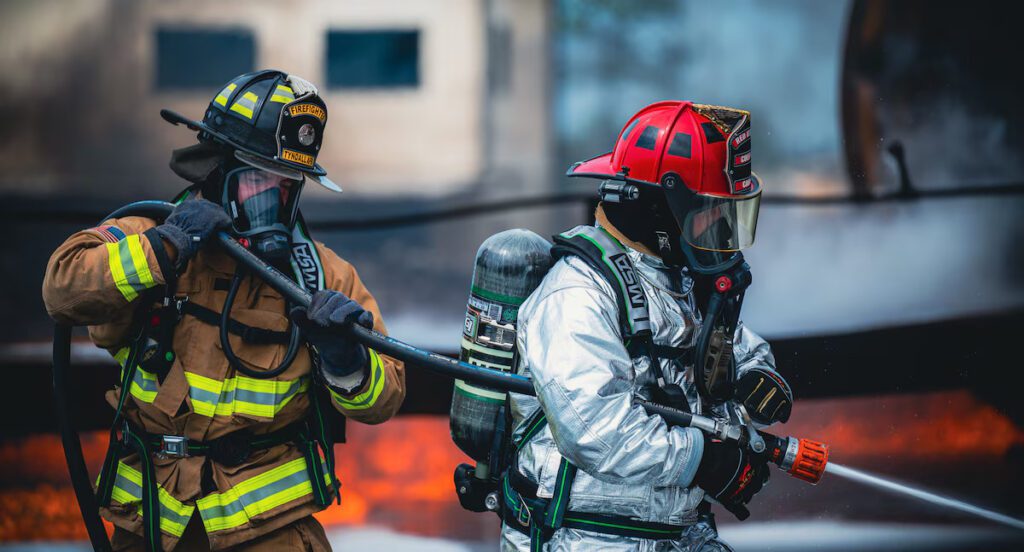
U.S. Air Force Staff Sgt. Christopher Collier, left, 801st Rapid Engineer Deployable Heavy Operational Repair Squadron Engineers Training Squadron fire protection cadre, and Airman 1st Class Jaremy Wright, 325th Civil Engineer Squadron fire protection firefighter, extinguish a controlled fire during a Fluorine-Free Foam training exercise within the Silver Flag burn pit at Tyndall Air Force Base, Florida, April 9, 2024. The chemical differences in the new foam caused significant changes in firefighting techniques with the transition. Rather than firefighters employing a “rainfall” technique to deploy foam and water through a hose at an arching angle, they now shoot directly at the base of the fire. (U.S. Air Force photo by Airman 1st Class Zeeshan Naeem)
The differences in how the new foam operates in fighting fire generates change in firefighting techniques. With AFFF, firefighters employed a “rainfall” technique to deploy foam and water through a hose at an arching angle. Now, with F3, firefighters shoot the foam directly at the base of the fire.
With new techniques comes a need for new training, and Tyndall is home to the 801st Rapid Engineer Deployable Heavy Operational Repair Squadron at its Silver Flag exercise site. This is the only dedicated training facility within the DoD that can use Jet A1 fuel to create a live-fire simulation of aircraft fires.
“We have a research center that we work with meticulously to provide training opportunities for service members who come to Silver Flag to witness the difference in effectiveness, as we transition to F3,” said Staff Sgt. Adam Van Lange, 801st REDHORSE fire protection cadre.
The switch from AFFF to F3 will ensure that the safety of service members and the environment is prioritized and is a significant step for the Air Force. Tyndall will continue to play an important role in training service members and leading the charge in an ongoing effort to eventually transition to F3 across the DoD.
The 96th Test Wing commander was one of approximately 20 test pilot volunteers to try out the electric aircraft with the 35-foot wingspan during its three-week field trip to Eglin.
Geraghty complimented the aircraft, the quiet flight and how lightweight the Electro turned out to be. Instead of towing the 1000-pound aircraft, Geraghty pushed it out to the flightline himself before the flight. He also added it was much easier to get in and out of than an F-16 to its list of benefits.
Geraghty along with other Eglin test pilots flew the twin-seat Electro with an instructor for approximately 45 minutes each consisting of pattern work, area maneuvering, and stalls. Afterward, they provided specific feedback and observations about the flight called qualitative evaluations that drew from their unique test experience.
The information gathered from the QEs, which will happen throughout the year, will clarify and validate expectations about electric aviation usage.
These flights were part of another 413th Flight Test Squadron and AFWERX partnership. The 96th TW unit provided the location and logistics, while AFWERX funded the operation.
“Eglin offers a unique blend of airspace, test pilots, charging infrastructure, and prior electric aircraft experience that swayed a QE deployment to the Florida panhandle,” said Lt. Col. John Tekell, AFWERX’s Agility Prime.
AFWERX, the Air Force’s innovation arm, has four different aircraft types it plans to deploy for QE analysis at various Air Fo.rce bases throughout this fiscal year to gather more QE data about electric airplanes.
Garrett Fox, who is a technical sergeant in the Air Force, was given a new unit from Mills Heating and Air, which services Bay, Walton, Okaloosa and Santa Rosa counties. This is the third year the company has given a free unit away to thank a veteran for their service, but this was the first time the recipient was from Crestview.
Fox and his family received the new unit at their home on Krest Drive in Crestview.
“This is something my brother and I are very proud to be able to do for this community,” said Mills Heating and Air co-owner Chris White, referring to his brother Marty. “He’s a 20-year military veteran himself. He spent 20 years in the Marines. So, it’s something that’s near and dear to our hearts, taking care of families, and taking care of the people who take care of us.”
Fox is an electronic warfare craftsman, maintaining radar jammers.
“My catchphrase is we put the miss in missiles,” Fox joked.
Fox said he and his family were Tyndall evacuees after Hurricane Michael. He said since many were moving at that time, it was difficult to find a home.
“I didn’t make the best choice when buying this house. It’s had a lot of surprises over the years, and the AC has been one of the biggest ones that has caused us a lot of headaches,” Fox said. “We’ve been trying to upgrade as much as we could to fix all of our problems, and this one was a huge relief when we got notified. I don’t even know how to express how much we appreciate it.”
The old unit had a rock on top of it, to “keep the top from flying off,” Fox said. White called that “military ingenuity.”
But that wasn’t the only issue. It had also had several problems over the years, which Fox said always seemed to occur in June when temperatures are very high.
He’d seen the nominations that Mills was taking, and he joked to friends and co-workers that he needed a new AC unit. However, he never expected to actually get selected.
“I was really surprised because I don’t have good luck, so I wasn’t expecting it,” Fox said.
Mills partnered with Trane and Air Engineers to provide the free unit. The company is currently celebrating its 40th anniversary by doing 40 acts of kindness in the community. The unit would cost around $10,000, not counting ductwork and installation. The company was also installing an air purifier for the Fox family.
“We’d do a lot more if we could,” White said. “It means the world that we are able to give back and that be part of who we are as a company … Our identity involves being involved in the community as much as we can, not just through giving things away but through service and acts of kindness throughout the year.”
To celebrate this month, Tyndall held a proclamation signing, a child sneaker ball, a wave parade at Tyndall Academy, Honor Guard colors and more. Beyond April, the base continues to promote programs, resources and services to support the welfare of military children and teens.
“It’s not just the military parents who serve, it’s also the children who serve as well,” said Mallory Gross, 325th Force Support Squadron school liaison program manager. “Military children don’t volunteer like their parents do; they just tag along with their parents’ career. These kids can move up to every two to four years with some of them going up to six to nine schools. That is why it is important to support them and recognize the sacrifices that they make with being a military-connected child.”
Currently, there are an estimated 2,311 military-connected children who attend schools in Bay County. This number is expected to rise with the increase of personnel at Tyndall in the coming years. Additionally, 18 school districts surrounding Tyndall have been awarded the purple star delegation, a program that supports military-connected children who relocate to new schools due to their family’s change in duty station.
“We have a lot of community support surrounding Tyndall, and it’s very important to let that be known and show that the community supports the military,” Gross said. “This year we’ve had local mayors for the first time sign proclamations and write letters in their newsletters recognizing April as the Month of the Military Child and really continue to show that overwhelming support.”
When it comes to representing MOMC, individuals are often told to “Purple Up,” which means to wear and highlight the color purple. Purple references the joint environment of all service branches, including active duty, reserve, national guard and veterans, with signifying the combination of each branch’s colors into one. The Air Force, Navy and Coast Guard utilize various shades of blue, the Army uses green and the Marines use red.
“As Tyndall continues to grow in the next three to five years, we’re expecting a lot more military children to arrive,” Gross said. “This is why it’s important to maintain our relationships with the local community and continue having special days and resources to recognize the sacrifices that they make by being a military child.”
To learn more about Tyndall’s School Liaison Program, please visit the following link: https://www.tyndallfss.com/slo.