




Please ensure Javascript is enabled for purposes of website accessibility
Skip to main content
Advertisement
Advertisement

Reserve special operations wing welcomes new commander

By Lt Col James Wilson

Col. Scott Hurrelbrink will take command of the only special operations unit in the Air Force Reserve in front of fellow citizen airmen, community partners and other distinguished guests.

Hurrelbrink became commander of the 919th SOW by order of Maj. Gen. Regina Sabric, 10th Air Force commander. He replaced Col. Jason Grandy who had been the commander since 2021.

“These are two of the best commanders we have in the Air Force Reserve,” Sabric said. “Scott, serving as wing commander at a place like Duke Field will likely be the best job you will ever have. The wing’s in great shape. Jason’s done an absolutely phenomenal job. You have achieved many successes in your career and are well versed in issues facing the 919 from your time at [Air Force Reserve Command] headquarters.”

Sabric went on to say the 919th has undergone a lot of changes, and he is excited by the new opportunities that are on the horizon. The general also said members of the wing know how to lead and implement change while still remaining combat ready.

“I am humbled and proud to be part of this wing,” Hurrelbrink said. “The 919th is not just any wing. It is the Air Force Reserve’s hardest working, most successful and highly-decorated group of warriors. I’ll give everything I have to lead with integrity, uphold the proud history of the 919th, and further build the next generation of combat wings.”  
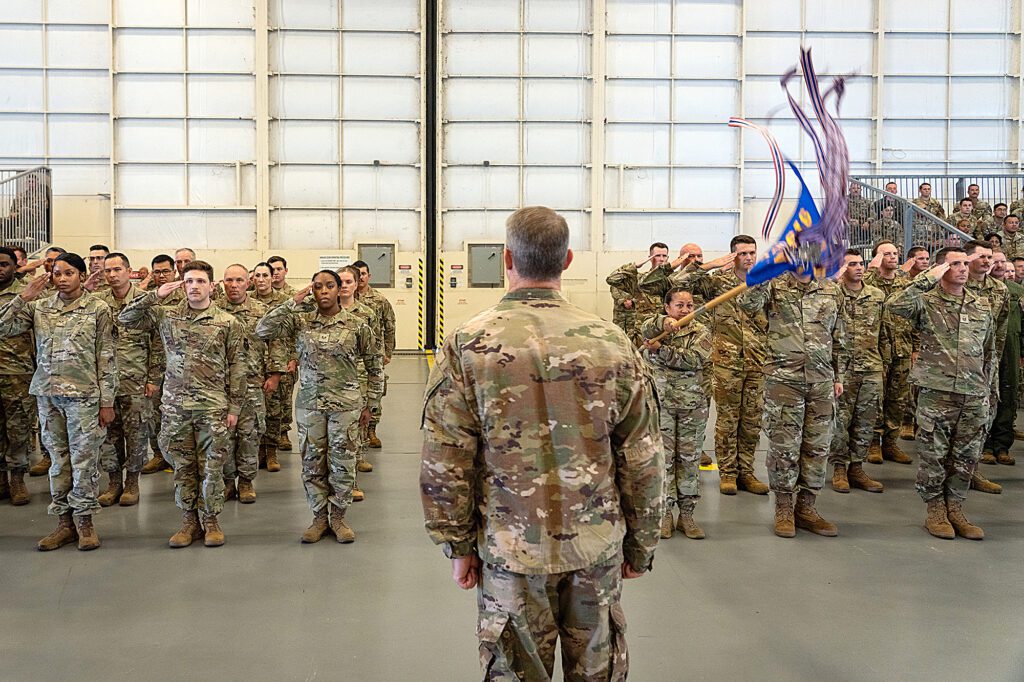
Members of the 919th Special Operations Wing render a salute to their outgoing commander during the wing’s change of command ceremony July 13, 2024, Duke Field, Florida. Airmen assigned to the wing conduct flight instruction and deploy as required in the U-28, PC-12, AC-130J and C-146A aircraft. (U.S. Air Force photo by Staff Sgt. Dylan Gentile)

Hurrelbrink received his commission from the Reserve Officer Training Corps Program in Bowling Green, Ky in 1994. He completed Undergraduate Navigator Training at Naval Air Station Pensacola, Fla., and was late selected for Undergraduate Pilot Training which he completed at Columbus Air Force Vase, Miss. The colonel has held positions throughout the wing, major command, combatant command and with the North Atlantic Treaty Organization.

Hurrelbrink also addressed the 1,600 Citizen Air Commandos who comprise the Reserve’s only special operations wing.

“To the men and women of the 919th, I cannot wait to roll up my sleeves and get to work with you,” Hurrelbrink said. “I assure you I will uphold the tradition and culture of the Citizen Air Commandos. In return, I ask that you be loyal to the mission and take care of each other. Lead with respect, empathy and support. If we do these things, nothing or no one will stop us.”

The mission of the 919th SOW is to provide Citizen Air Commandos any time, any place in support of Air Force Special Operations Command. The unit is the only Air Force Reserve special operations wing and has a long and distinguished history of valor in combat since its inception at Duke Field in July 1971.

Hurrelbrink’s previous assignment was as the deputy director of operations for Air Force Reserve Command Headquarters, Robins Air Force Base, Georgia.

Grandy who has several tours with the 919th SOW before taking over as commander, now departs for a position in the current operations division in the Pentagon.

General Conley takes command of Air Force Special Operations Command

Presiding over the ceremony, Air Force Chief of Staff Gen. David Allvin praised Bauernfeind’s past accomplishments and Conley’s future potential as the commander of AFSOC. Allvin said the image that came to mind when he thought of the transition to a new commander was the passing of a baton in a race. 

“Races are won or lost by fractions of a second,” he said. “The stakes are high for our Air Force, our special operations community, and our nation and we can’t afford to take a pause. Mike Conley is up to speed. He’s ready. He brings a breadth of experience working with the Air Force, major command and joint staff. He also has a depth of experience in the AFSOC mission.” 

During the ceremony, four formations of Air Commandos stood at attention to represent the Airmen of AFSOC. The military formation, comprised of 85 Airmen, represented the five active-duty, one Reserve wing, and two National Guard wings; and more than 20,000 active duty, Air National Guard, Air Force Reserve and civilian Airmen who serve across AFSOC. 

U.S. Army Gen. Bryan Fenton, commander of United States Special Operations Command, also provided remarks during the ceremony, as AFSOC is the Air Force component of USSOCOM. Fenton welcomed Conley as AFSOC’s new commander and praised the command for its spirit of innovation. 

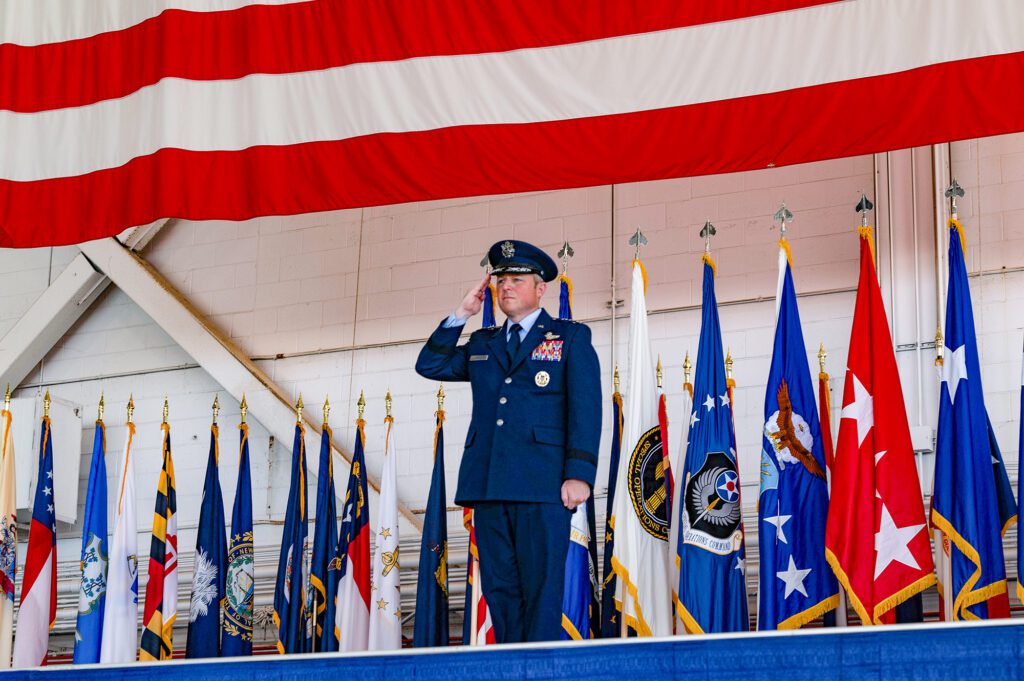
U.S. Air Force Lt. Gen. Michael Conley offers his first salute as he assumes command of Air Force Special Operations Command during a change of command ceremony at Hurlburt Field, Florida, July 2, 2024. Conley was previously the director of operations for Headquarters AFSOC. (U.S. Air Force photo by Senior Airman Ty Pilgrim)

“Mike, welcome aboard,” he said. “You are taking charge of an exceptional team. You know this already because you’ve been a key part. You’re inheriting an incredible organization that is not only pathfinding and trailblazing for SOCOM but equally for our Air Force and on top of that, the Department of Defense. And they are doing it at lightning speed. You’re exactly what AFSOC needs to continue that transformation.” 

Lt. Gen. Michael Conley assumed command of Air Force Special Operations Command after previously serving as the director of operations for Headquarters AFSOC. He was responsible for implementing and directing operational command policy for AFSOC’s worldwide special operations units including 20,800 personnel, approximately 300 aircraft and $17 billion in assets. He also served as the vice commander for AFSOC’s 27th Special Operations Wing and the commander of the 1st Special Operations Wing. 

“I am honored and humbled for this opportunity,” he said. “I am committed to making this command the best it can be in ensuring we are ready to go whenever you need us to. 

Bauernfeind was awarded the Distinguished Service Medal as well as the USSOCOM ceremonial colors for his accomplishments as commander and then received the final salute from the Air Commandos. He will depart AFSOC to become the next Superintendent of the United States Air Force Aca

Air chiefs from across Americas convene in display of continued cooperation

By Tech. Sgt. Rachel Maxwell

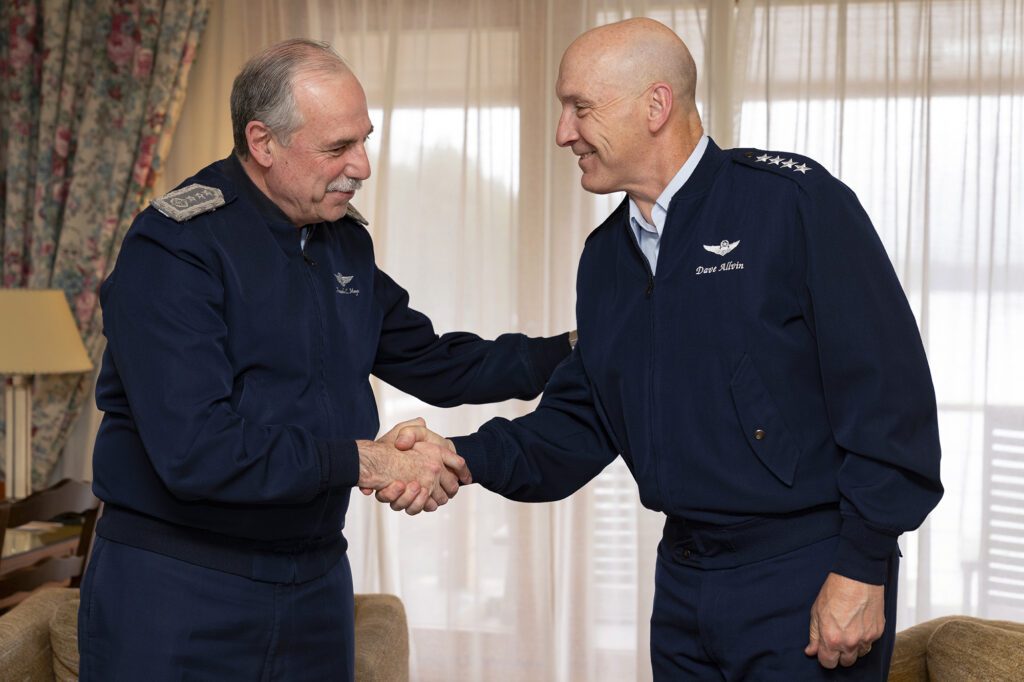
Argentinian air force Chief of Staff Gen. Fernando Luis Mengo hosted the event, which was attended by U.S. Air Force Chief of Staff Gen. David Allvin.

The senior Air Force leaders of 19 nations took part in discussions concentrated on readiness needs to meet a collective vision and laid plans for future exercises together.

“The Conference of American Air Chiefs is a unique opportunity to learn from and build partnerships with our neighbors in the Western Hemisphere,” Allvin said. “It is also an exceptional forum for enhancing our shared security objectives while generating mutual trust and understanding. I was honored to engage my counterparts firsthand and look forward to improving our collective ability to meet complex global challenges.”

The 3-day conference was sponsored by the System of Cooperation Among the American Air Forces, an apolitical institution established in 1961, now sitting at 23 member nations with a purpose to be an efficient organization in cooperation and mutual support between the American Air Forces and their equivalents.

“CONJEFAMER is the medieval roundtable for the American Air Forces today,” said Brazilian air force Col. Bruno Pedra, undersecretary general for SICOFAA. “Which makes it imperative to maintain and strengthen an environment of trust and professional cooperation.”

Much of the value gained during the annual conference can be placed on the relationships built among the air chiefs to aid in emergent situations when a rapid response is needed.

U.S. Air Force Chief of Staff Gen. David Allvin, right, shakes hands with Argentinian air force Chief of Staff Gen. Fernando Luis Mengo, left, during the 64th Conference of the American Air Chiefs meeting in San Carlos de Bariloche, Argentina, June 19, 2024. Senior air force leaders and representatives spanning 19 nations took part in discussions concentrated on the collective readiness needs of the Western Hemisphere in order to meet shared visions and lay plans for future exercises. (U.S. Air Force photo by Tech. Sgt. Rachel Maxwell)

This year alone Colombia experienced devastating wildfires and Brazil encountered unprecedented flooding, bringing discussions of humanitarian assistance and disaster response efforts to the forefront of remarks amongst some leaders.

“In the world we live in today there are two irrefutable truths,” said Colombian air force Deputy Commander and Chief of Staff, Maj. Gen. Carlos Fernando Silva Rueda. “The first is that there is a climate change that will potentially produce natural disasters at any time. The second is that there is nothing like having friends to lean on when you need it most. Our brothers, the air forces of Argentina, Brazil, Chile, the United States and Uruguay, through our system, answered our call, giving us a hand, providing their capabilities so we could sort these fires.”

“CONJEFAMER is where lessons learned are reported and activities to be developed are decided,” Pedra noted. “Congruently, in Argentina, the wildfires in Colombia and floods in Brazil were both addressed in a framework of the pre-coordinations mediated by SICOFAA.”

Pedra also hinted in the potential expanding influence within similar organizations outside the Western Hemisphere.

“Studying SICOFAA in its entirety, it becomes clear that SICOFAA’s future includes a systematic relationship with homologous systems in Africa and the Indo-Pacific region,” he said. “In this way, the maximum benefit for its members will increasingly depend on the diplomatic capacity of their representatives either among themselves or with their respective governments.”

Formal proceedings came to a close when Mengo relinquished the SICOFAA ceremonial bell into the hands of next year’s host, Paraguayan air force Commander Gen. Julio Rubén Fullaondo Céspedes, symbolizing the beginning of next year’s activities.

Test wing welcomes new commander

By Kelley J. Stewart

Maj. Gen. Evan C. Dertien, Air Force Test Center commander and former 96th TW commander, presided over the ceremony.

“I’m so happy to return to Eglin,” Massaro said. “While it’s fantastic to return as a previous member of the test wing, and it’s comforting to be back as a Florida native, even in July, what causes me to smile the most is getting to contribute to this mission again.”

Massaro, a command pilot with more than 2,200 combat hours, began his test pilot career in 2007. His first duty assignment as an F-16 experimental test pilot was with the 40th Flight Test Squadron at Eglin.

He joins the wing after commanding a data masked organization where he led military, civilian, and contractors and managed more than $10 billion in resources across multiple locations.

“[Gen. Massaro] congratulations. I am confident you will lead the 96th TW with the same passion and dedication you have shown in your previous assignments,” Dertien said. “I look forward to the future of the 96th TW under your leadership as you continue the distinguished legacy of this organization.”

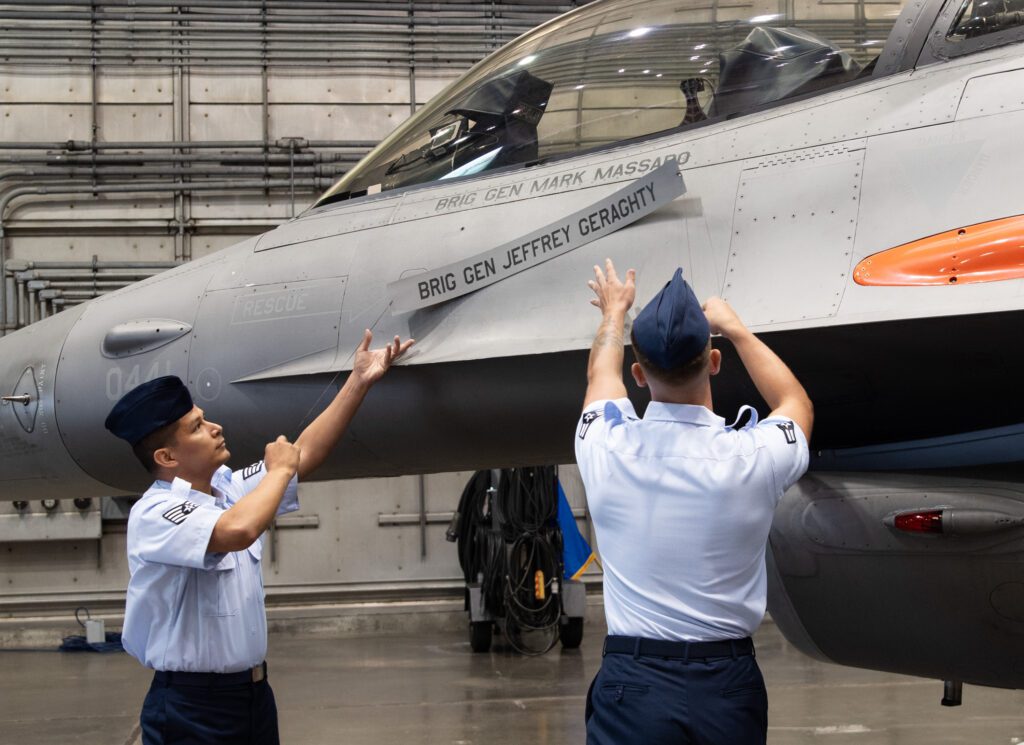
U.S. Air Force Staff Sgt. David Olmeda and Airman 1st Class Jack Lutz, 96th Aircraft Maintenance Squadron, reveal Brig. Gen. Mark Massaro’s name on his F-16 Fighting Falcon during the 96th Test Wing’s change of command inside the McKinley Climatic Lab at Eglin Air Force Base, Fla., July 3, 2024. Massaro assumed command from Brig. Gen. Jeffery Geraghty during a ceremony presided over by Maj. Gen. Evan Dertien, Air Force Test Center commander. (U.S. Air Force photo by Kelley J. Stewart)

As the new commander, he leads more than 10,000 military, civilians and contractors who conduct developmental testing and evaluation of conventional munitions, command and control systems, aircraft avionics and guidance systems, and radar cross section measurements. Massaro will also manage a 120,000 square mile over-water test range plus facilities in six states and direct all base operating support, infrastructure and services support for Eglin.

“In this time of significant change as we reoptimize our Air Force for Great Power Competition and develop imperative operational capabilities that increase lethality and effectiveness and enhance command and control in a multi-domain peer adversary environment, I know that while there’s a lot for us to do, our Nation can absolutely count on the 96th TW and our Team Eglin mission partners to get it done,” he said. 

“As commander, my priorities are simple but essential – execute the mission, take care of our people, and partner for success,” Massaro said.

Geraghty, who assumed command of the 96th TW in June 2022, departs to become Air Force Material Command’s director of International Affairs, and the Air Force Life Cycle Management Center director of Air Force Security Assistance and Cooperation at Wright-Patterson Air Force Base, Ohio.

Goodbye Grey Wolf

By Samuel King Jr.

The lift-off June 27 marked the last aircraft out and official end of the new helicopter’s time at Eglin and its flight forward to a future as an Air Force Global Strike Command combat capable asset.

The MH-139 arrived at Eglin in December 2019 and was officially named Grey Wolf shortly after. For its first two years, testing was limited for the then Boeing-owned aircraft. The 413th Flight Test Squadron teamed up with AFGSC’s Detachment 7 to manage, fly and crew the test missions with Boeing flight crew during the aircraft’s time at Eglin.

In August 2022, the Air Force took ownership and testing began quickly with as many as six aircraft located at Duke Field, one of Eglin’s many auxiliary fields.

The Air Force ownership coincided with the arrival of Palka, a helicopter flyer or Rotorhead as they are known, just out of test pilot training at the Naval Test Pilot School, NAS Patuxent River, Maryland, who joined the 413th FLTS MH-139 test team.

Although new to Air Force developmental test, Palka wasn’t completely new to the aircraft. He piloted the Grey Wolf’s civilian counterpart, AW-139, in simulator training and then delivered one of the test aircraft to Duke Field.

“(At USNTPS) you are always short on time and frequently fly aircraft you don’t know a lot about, so it was nice to have the time to deep dive and get a comprehensive understanding of the aircraft and its systems,” said Palka, who flew the UH-1N Huey at Yokota AB, Japan, and FE Warren AFB, Wyoming before becoming a test pilot. “I got to use a lot of what I learned at TPS here at Eglin. My timing was lucky, and I am grateful for it.”

When flying a brand-new aircraft like the MH-139, the test pilots and special mission aviators didn’t have the military safety procedures, manuals and operating instructions honed from years of flights. They were the airmen creating those critical documents that the Grey Wolf’s aircrews use going forward.

The role of the test pilot is critical in the early life cycle of these new aircraft, according to Palka. They act as liaisons, translating engineer lingo to pilot-speak. They plan and execute tests, potentially on unfamiliar aircraft, which are sometimes challenging, sometimes benign and provide useful data and recommendations to the user.

“Data is really only useful if you can relay how your findings are going to affect the end user and make recommendations accordingly,” Palka said.

A 413th FLTS mission statement is “to safely deliver independent, decision-quality information on time.” Palka said the word independent is so important in that statement.

“Test is specifically separated from the program office’s chain of command to avoid biases or influence that could result in inaccurate data, driven by things like cost or schedule pressure,” said Palka, who’s served as the leader of the MH-139 operations team.

Being new to the 413th FLTS and its testing procedures, Palka teamed up with someone very familiar with the rotary-wing developmental test process, the squadron’s resident test pilot, Tony Arrington.

Arrington has been a 413th FLTS employee for 20 years through its various iterations and a rotary-wing pilot for approximately 38 years as both active duty and in Air Force civilian service. The two pilots sat across from each other both in the office and often in the cockpit for the duration of the MH-139 testing at Eglin.

Remembering the fallen

On the night of June 25, 1996, 19 Airmen lost their lives while over 400 U.S. and international military and civilian members were injured during the Khobar Towers attack in Dharan, Saudi Arabia; 12 of the fallen were Nomads.  

On June 26, over 200 attendees from the 33rd Fighter Wing and local community gathered in remembrance of the men and women who made the ultimate sacrifice on the 28th anniversary of the Khobar Towers bombing.  

This year’s memorial included a guest speaker, the traditional wreath-laying, recitation of names, and the playing of “Taps.” The recitation of names was carried out by 19 current Airmen from the 33rd FW who were chosen to stand on behalf of the fallen, deliver the fallen member’s name, and render a salute. 

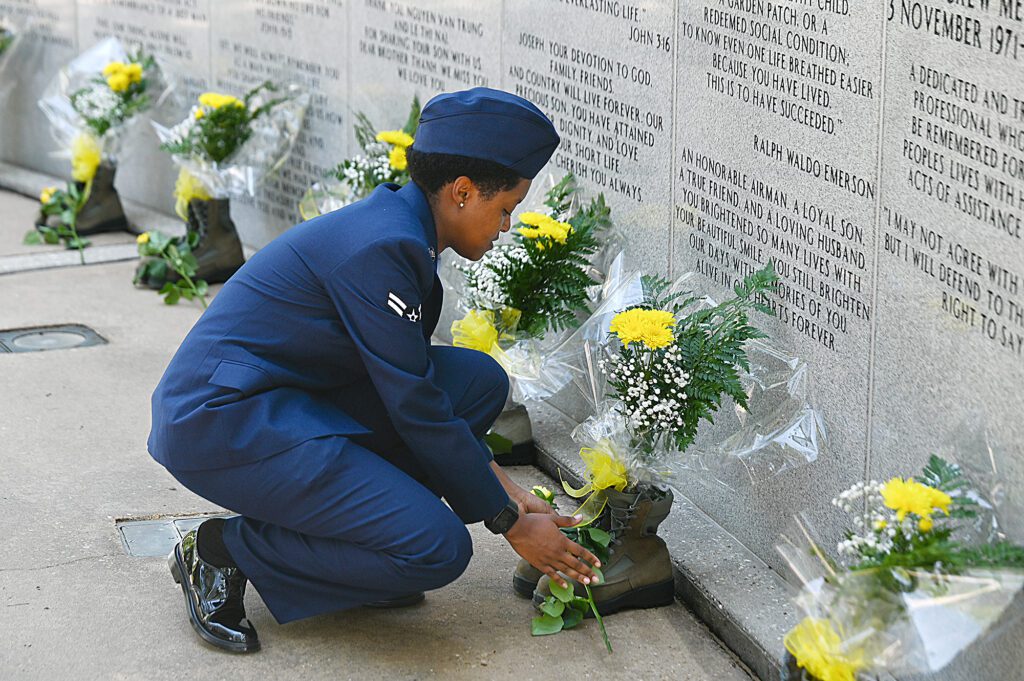
U.S. Air Force Airman 1st Class Bobbie Mills, 60th Fighter Squadron aircrew flight equipment apprentice, places a rose to honor a fallen airman during the Khobar Towers memorial ceremony at Eglin Air Force Base, Florida, June 25, 2024. Placing the flower over the toes of the uniform boots is a tradition that honors the lives lost. (U.S. Air Force photo by Senior Airman Briana Beavers)

“As we reflect on this tragedy, we are reminded of the incredible acts of courage and camaraderie that emerged from that fateful night,” said Col. Dave Skalicky, 33rd FW commander. “Many of our Nomads exemplified selflessness and courage in the face of unimaginable danger. Their actions that night continue to inspire us and serve as a poignant reminder of the personal costs of service.” 

Following Skalicky’s remarks, Zach Sutton, a survivor of the attack, Catalyst Church of Panama City pastor, and ceremony guest speaker, spoke of the wounds that remain. 

“I was 23 years old when I showed up in 1996 to Khobar Towers,” Sutton said. “I stand here today 28 years later still wounded by this event. Like most of the survivors today I have physical scars, but even more than that I have unseen scars … almost every survivor you meet today has the same struggles, and to them I stay ‘Keep going, don’t let the hard days win’.” 

The wing’s emblem, the flaming sword, stands at the center of the memorial, where an inscription reads: “This monument is dedicated to the brave warriors who were killed by a terrorist bomb at Khobar Towers, Saudi Arabia, on June 25, 1996. They made the ultimate sacrifice as guardians of this grateful nation. We shall never forget them.”  

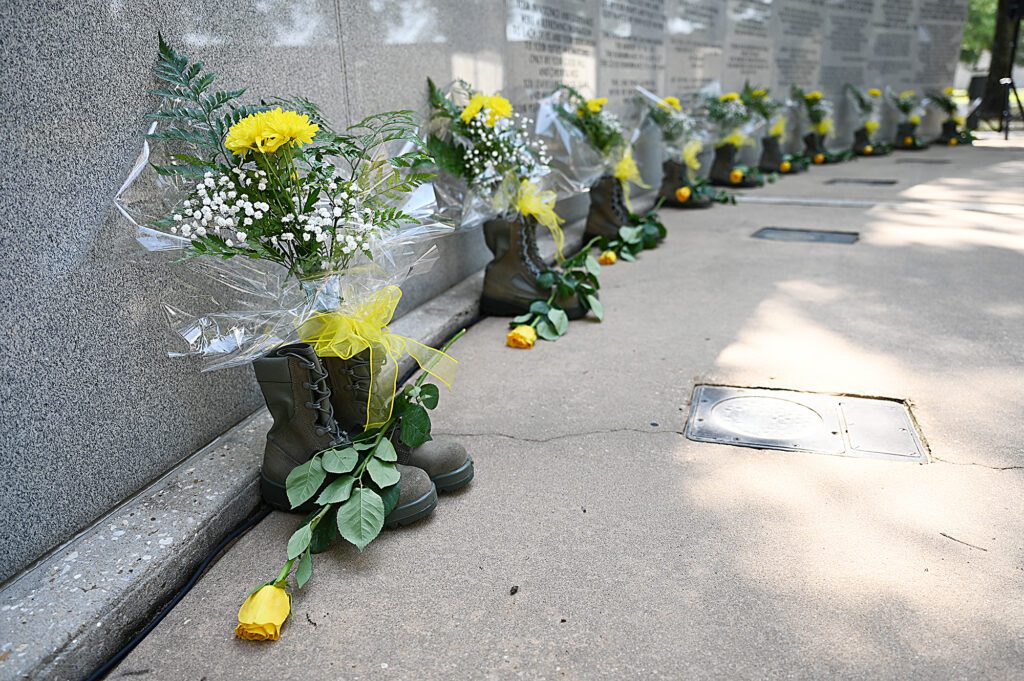
Combat boots and yellow flowers representing those who lost their lives are displayed during the 28th Annual Khobar Towers Memorial Ceremony at Eglin Air Force Base, June 25, 2024. Every year, friends, families, survivors and former Nomads unite to pay tribute to those who were killed during the terrorist attack at Khobar Towers in Dhahran, Saudi Arabia on June 25, 1996. (U.S. Air Force photo by Senior Airman Briana Beavers)

The names of the fallen are below: 

58th Fighter Squadron: 

Master Sgt. Kendall K. Kitson, Jr. – Yukon, Oklahoma 

Tech. Sgt. Daniel B. Cafourek – Watertown, South Dakota 

Staff Sgt. Millard D. Campbell – Angelton, Texas 

Senior Airman Earl F. Cartrette, Jr. – Sellersbug, Indiana 

Airman 1st Class Brent E. Mathaler – Cambridge, Minnesota 

Airman 1st Class Brian W. McVeigh – Debary, Florida 

Airman 1st Class Joseph E. Rimkus – Madison, Illinois 

Airman 1st Class Joshua E. Woody – Corning, California 

60th Fighter Squadron: 

Tech. Sgt. Patrick P. Fennig – Greendale, Wisconsin 

33rd Logistics Group: 

Tech. Sgt. Thanh V. (Gus) Nguyen – Panama City, Florida 

33rd Operations Support Squadron: 

Airman 1st Class Peter J. Morgera – Stratham, New Hampshire 

33rd Maintenance Squadron: 

Senior Airman Jeremy A. Taylor – Rosehill, Kansas 

 Patrick Air Force Base: 

Capt. Christopher Adams – Massapaque Park, New York 

Capt. Leland Timothy Haun – Fresno County, California 

Master Sgt. Michael Heiser – Palm Coast, Florida 

Staff Sgt. Kevin Johnson – Shreveport, Louisiana 

Airman 1st Class Justin Wood – Modesto, California 

Offutt Air Force Base: 

Staff Sgt. Ronald King – Battle Creek, Michigan 

Wright-Patterson Air Force Base: 

Airman 1st Class Christopher Lester – Wyoming County, West Virginia 

Cadet to cadre: Marine returns to Junior ROTC program at Hurlburt Field

In front of him, a group of Junior ROTC cadets moved together as a unit, scanning the shoreline of Santa Rosa Island, near Hurlburt Field, Florida. With the sounds of simulated gunfire closing in on them, they spoke quietly amongst themselves to make their next move.

The students, participating in a Junior ROTC summer leadership school program at Hurlburt Field, were tasked with a training personnel recovery mission.

“Airstrike, airstrike, airstrike!”

Again, their instructor shouted to warn them of incoming danger.

Reacting to Caldwell’s message, they hurried to avoid the mock airstrike.

From there, they located a simulated injured patient, performed basic first aid procedures and worked to move him to their extraction point: a boat parked on the southern end of the small island.

As they headed for the boat, Caldwell continued to shout toward the cadets, warning them of incoming threats.

Years before, Caldwell stood in the same place as the students – as a participant in the first-ever SLS class in 2011. Much like his role as an instructor today, Caldwell recalled that he was far from quiet during his time at SLS.

“I was more in a leadership position,” he said. “I wanted to be able to help make people better.”

Looking back, Caldwell said that when he first joined Junior ROTC in high school, he wasn’t particularly interested in joining the military. However, just one year after he went through the program, he enlisted and left for Marine Corps boot camp on Parris Island, South Carolina.

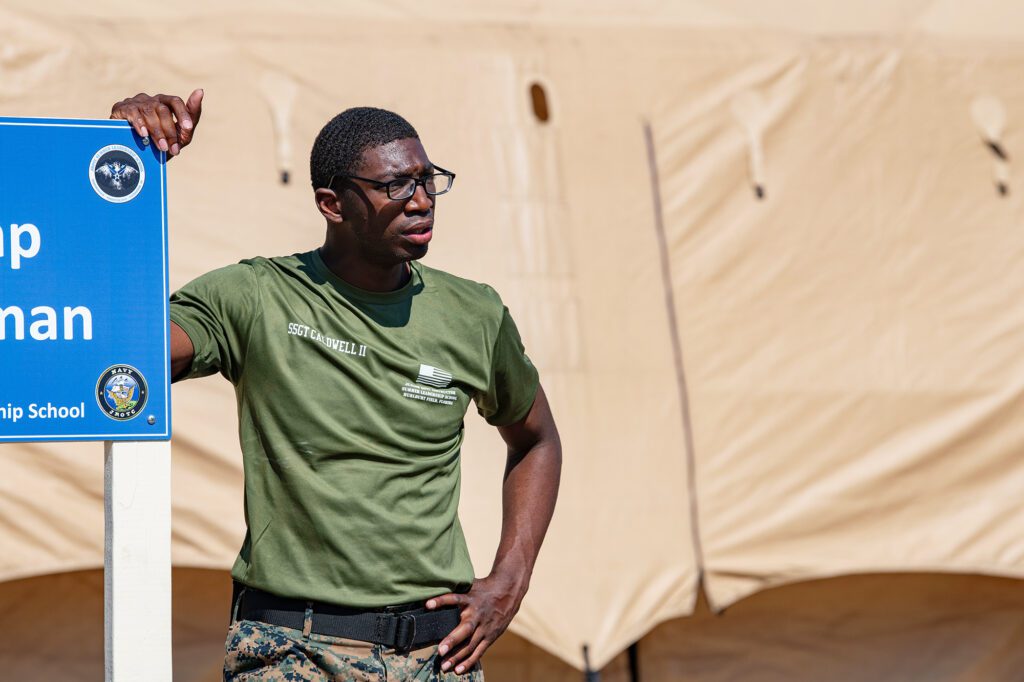
U.S. Marine Corps Staff Sgt. Bryan Caldwell prepares for briefing during a Junior ROTC summer leadership school program at Hurlburt Field, Florida, June 14, 2024. Caldwell, a former SLS Junior ROTC student, now volunteers as an instructor for the annual program. (U.S. Air Force photo by Senior Airman Natalie Fiorilli)

He added that returning to SLS as an instructor for the past several years has been an opportunity for him to be someone with whom the cadets can relate.

“I try to give them pointers on life, not just on the military,” Caldwell said.“I try to share my experience with them and help them really see the bigger picture.”

Held in partnership with the 1st Special Operations Wing, the SLS program at Hurlburt Field began in 2011.

Retired U.S. Air Force Col. Kenneth Rodriguez, SLS director, explained that the program has grown and matured over the years.

This year, SLS took place June 10-14 and included more than 60 Junior ROTC students from seven local and regional high schools near Hurlburt Field. Throughout the five-day program, the students slept in tents, ate meals at the base’s dining facility, participated in daily physical training and classroom training sessions – an experience similar to that of Air Force basic military training.

Additionally, the students experienced an orientation flight on board an MC-130J Commando II, repelled down the side of a wall, learned land and water survival skills and tactical combat casualty care and participated in several team-building activities.

“These experiences at SLS can be life-changing,” said Rodriguez. “The kids get so much exposure to phenomenal role models and they can see themselves in their shoes one day.”

Eglin celebrated Juneteenth National Independence Day

The official end of slavery was June 19, 1865, when the Emancipation Proclamation was read to enslaved blacks in Galveston, Texas. Texas was the last Confederate state to surrender to the Union Army.

President Joe Biden signed the Juneteenth National Independence Day Act into law June 17, 2021, making June 19 a national holiday.

Sabu Williams, Okaloosa County NAACP branch president, Air Force veteran and retired civil servant, was the guest speaker.

“Juneteenth didn’t just happen, to end slavery,” he said. “Freedom comes at a price. From the moment enslaved people reached these shores, to the time they were informed they were free, countless sacrifices were made. But there is still work to be done.”

Williams encouraged the audience to remain vigilant on protecting and preserving freedom.

Karen Brown, an Army veteran and local entrepreneur, shared why Juneteenth is a federal holiday.

“Juneteenth acknowledges not only black history, but also military history,” she said. “The many challenges enslaved people faced, and the many battles our miliary members fought to free the slaves, makes Juneteenth worthy of being a federal holiday.”

Dale Marks, 96th Test Wing Director, gave closing remarks. 

Juneteenth is a holiday for all of us,” he said. “When we forget to remember our history, we lose sight of who we are. This is an incredibly important day, and I’m glad we have this opportunity to reflect and commemorate it.”

Department of the Air Force launches NIPRGPT

DAF senior leaders are focused on maximizing competitive advantage, recognizing that Airmen and Guardians need advanced technologies at the speed of relevance. To that end, the DAF is launching NIPRGPT, an experimental bridge to leverage GenAI on the Non-classified Internet Protocol Router Network while continuing to explore maturing industry solutions.

“Our recent GenAI Roundtables with industry and academia have shown us this is an actively growing field,” said Venice Goodwine, DAF chief information officer. “Now is the time to give our Airmen and Guardians the flexibility to develop the necessary skills in parallel. There are multiple modernization efforts going on right now across the federal government and within the DAF to get tools in the hands of the workforce. This tool is another one of those efforts.”

NIPRGPT is part of the Dark Saber software platform developed at the Air Force Research Laboratory Information Directorate in Rome, New York. Dark Saber is an ecosystem of Airmen and Guardians from across the DAF that brings together innovators and developers and equips them to create next-generation software and operational capabilities deployable to the Force at a rapid pace.

At no additional cost to the unit or the users, NIPRGPT is an AI chatbot that allows users to have human-like conversations to complete various tasks. The CAC-enabled GenAI tool can answer questions and assist with tasks such as correspondence, background papers and code, all within a secure computing environment.

“Technology is learned by doing,” said Chandra Donelson, DAF acting chief data and artificial intelligence officer. “As our warfighters, who are closest to the problems, are learning the technology, we are leveraging their insight to inform future policy, acquisition and investment solutions.”

The experiment is an opportunity to facilitate real-world testing, focusing on key metrics such as computational efficiency, resource utilization, security compliance, etc., to understand GenAI’s practical applications and challenges and ensure that future implementation is effective and efficient. The platform includes user feedback opportunities to help develop governing policies and enable informed conversations with vendors as the DAF works to incorporate these tools into its operations.

“NIPRGPT is a critical bridge to ensure we get the best tools we have into our team’s hands while larger commercial tools are navigating our intense security parameters and other processes,” said Alexis Bonnell, AFRL chief information officer. “Changing how we interact with unstructured knowledge is not instant perfection; we each must learn to use the tools, query, and get the best results. NIPRGPT will allow Airmen and Guardians to explore and build skills and familiarity as more powerful tools become available.”

Civilian and uniformed Airmen and Guardians, as well as contractors who are CAC holders, can register for NIPRGPT access here: https://niprgpt.mil.

A black lettered send off

The 943rd MXS has proven their effectiveness at not only achieving the mission standards but by attaining perfect marks during inspections.

“A ‘black lettered’ aircraft indicates that there is nothing wrong with it,” said Capt. Anthony Laporta, 943rd MXS director of operations. “I personally have been in the Air Force 19 years and have only seen it one other time. Most of these models have always carried a discrepancy.”

Throughout its service, A6224 has accumulated over 7,204 flight hours. The aircraft has participated in over one thousand successful real–world rescue missions. These missions range across the U.S. and supported evacuation efforts during Hurricane Katrina.

The helicopter was used in training over 300 pilots and other aircrew, directly impacting D-Ms mission. It has supported countless TDYs and 15 deployments to locations such as Turkey, Afghanistan, Somalia, Jordan, Syria, and Djibouti. The squadron’s creed is “anytime, anywhere” and has proven this through its record of operations.

This history is a testament to and reflects the work of the 943rd MXS. The quality assurance review took place weeks before the official retirement of the aircraft, emphasizing the squadron’s commitment to mission operations and standards.

“Our maintainers strive daily for excellence,” said Senior Master Sgt. Benjamin Wells 943rd MXS section chief. “The black letter on A6224 shows how hard they work, making sure a safe and well-maintained aircraft is always ready to support the 943rd Rescue Group combat search and rescue mission: ‘Conduct combat rescue operations to prevent the exploitation of isolated personnel and ensure their return.”

With the retirement of A6224 to the 309th Aerospace Maintenance and Regeneration Group, the team is prepared for the operational use of the HH-60W Pave-Hawk helicopters. The team will take their skills and standards developed over the years and execute their future mission with the same efficiency.

“With the induction of HH-60W models, leadership is confident in our maintainers to continue to strive for excellence in maintenance,” said Wells.

The effective training and professionalism of the Airmen at the 355th Wing play a role in the
many different organizational components of Rescue and Attack here at D-M.

error: Content is protected !!