That’s how Maj. Gen. Scott Cain, Air Force Test Center commander, began his speech as the guest speaker of Eglin’s Air Force Ball Sept. 13. The event was the culmination of his three-day 96th Test Wing immersion as the new AFTC commander. It also served as a homecoming visit for Cain, a former 96th TW commander from 2019 to 2022.
During his immersion, Cain caught up on Eglin’s mission developments like weapons, artificial intelligence, modernization, interoperability of forces, large force test events like Emerald Flag and community challenges among other topics.
Cain praised Eglin’s expanded use lease program with the Freedom Tech Center, a multi-use development area with housing, hotels and restaurants. The land is community-developed but leased by the Eglin AFB. He said it is a great example of community and base coming together for mutual benefits.
Also, part of his visit was to layout AFTC priorities and how Eglin will play a role in those plans.
Cain’s main priority is to find out what test needs to do to reoptimize. That priority ties directly to the Air Force’s efforts to reoptimize for Great Power Competition.
“We must operate as an enterprise in order to meet those GPC priorities,” Cain said. “Many of those challenges are multi-domain. They require all the competencies of the wings in the test center, and we have to work together to accomplish that task.”
During his return trip, Cain reflected on how he evolved to see the much larger Air Force Materiel Command picture and how his last two positions prepared him for command in the test and evaluation space.
After leaving Eglin, Cain moved to an AFMC headquarters position. He said he experienced first-hand what it is like to organize, train and equip the command, which in turn informed how he plans to lead at the center level. As the Air Force Research Lab commander, he saw test in its earliest form in the science and technology development phase. He said this deepened his perspective for the test mission and better prepared him for his new command.
Cain said he was grateful to have a second opportunity to lead Eglin in his new AFTC role, after shepherding the wing through the difficulty of the pandemic.
“I’m as motivated as ever to take care of the mission and people of Eglin so that we can ultimately win the next fight,” Cain said.
The library’s interior transformed to resemble a modern retail bookstore.
“Our library is more open, more modern and has a timeless flavor to it,” said Brig. Gen. Mark Maasaro, 96th Test Wing commander, at the re-opening ceremony.
Keri Trippel, wife of Master Sgt. Justin Trippel, 350th Special Warfare Group, reads a book with her daughter, Elexa, at the Eglin Community Library Aug. 27 at Eglin Air Force Base, Fla. The library was transformed to resemble a modern retail bookstore.
The new design concept included replacing the Dewey decimal system with a new library book cataloging system called Semper FindIt, started by the Marine Corps in 2018, according to Tiffany Fidler, supervisory librarian.
“Semper Findit organizes books into thematic categories, allowing users to navigate through layers of topics efficiently,” she said.
Private 1st Class James Barrow, 73rd Ordnance Battalion, searches for information on an Eglin Community Library computer Aug. 27 at Eglin Air Force Base, Fla. The library was transformed to resemble a modern retail bookstore.
Among other new features, the library now has clear sightlines to bookshelves, lower shelving, more signage, and space for each age group. Feedback led to installing more seating, more electronic device charging spaces, and lower tables in the study pods for easier entry and exit.
“We want our library to be not only welcoming, but easy to use,” she said.
Members of the 859th Special Operations Squadron used the venue to illustrate its mission is agile, accessible while still flexible enough to work with military and civilian entities during times of crisis. Aircrew from the squadron welcomed the opportunity to demonstrate skills in events across multiple domains.
“Not only were we challenged by having to contend with a drastically different environment, living up to its reputation as the land of fire and ice with storms and an active volcano, but we also benefited from working with other U.S and NATO forces,” said Capt. Jason Brown, 859th SOS pilot and lead planner for squadron’s participation in the exercise.
“Our primary mission remains SOF focused, but there will always be a need to work with those who have differing requirements, missions or purpose. Northern Viking gave us an opportunity to work under a Navy and Marine Corps command structure with seven other NATO nations over a 10-day period.”
The multination exercise, led by U.S. Naval Forces Europe and executed by the U.S. Sixth Fleet, brought together naval, air and land components from NATO allies including Iceland, Demark, France, Norway, Poland and Portugal.
The unit, and its active-duty partners in the 524th SOS, provide the Air Force’s only Non Standard Aviation capability transporting SOF members and equipment to some of the world’s most austere locations. This was the first opportunity for the 859th SOS to train with the Icelandic quick reaction force and joint partners in a range of crisis response scenarios including a volcanic eruption and other humanitarian disasters.
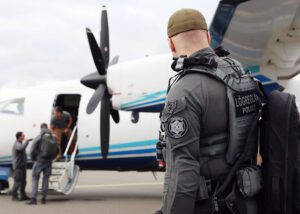
A member from the National Icelandic Police prepares to embark on a C-146A Wolfhound attached to the 859th Special Operations Squadron from Duke Field Florida, in preparation for a training evolution during Northern Viking 24 (NV24) on Keflavik Air Base, Iceland, Aug. 29, 2024.
“The greatest challenge we faced initially was figured out how we would fit into a naval exercise,” Brown said. “Our focus was on doing what we do best — moving people and cargo from one airfield to another while being flexible enough to adjust to constantly changing needs from the users. As the environment continued to evolve, our flexibility was key in being able to save quite a few scenarios form having to be cancelled or rescheduled.”
Throughout the exercise, Allied forces practiced a variety of operations to enhance their cooperation while evolving into taskings and requirements that progressed in complexity throughout the exercise. The teamwork between the Icelandic Coast Guard, U.S. Naval Forces Europe and the 859th SOS was on full display throughout the exercise. Not only did the unit provide vital airlift for an Icelandic Quick Reaction Force, it also supported an medical evacuation mission allowing Navy medics to provide triage and treatment on the versatile C-146A aircraft.
“The flight with the C-146 aircraft helped us to simulate a fixed wing transport as well as a simulated longer evacuation to a higher level of care and treatment,” said Lieutenant Commander Clyde Martin, U.S. Navy Medical Officer in Charge of Combat Logistics Batallion 8. “It enhanced our readiness as there are problems within medicine that only occur during transport. Simple things like communication can become a challenge during transport which isn’t easy to simulate. From our perspective, the range and carrying capacity of the C-146 makes it a very useful aircraft for patient transport.”
Members of the 859th SOS agreed and saw the unique training as mutually beneficial.
“This aircraft is well suited to the casualty evacuation mission as it can reach smaller airfields in a short amount of time, bringing in medical teams and supplies while transporting ambulatory patients along with their medical attendants,” Brown said. “This is especially useful in situations such as were presented in Iceland for us when evacuating patients from the other side of the island by road would be a 10-hour drive or four hours by helicopter. A 45-minute flight that can carry far more than a helicopter could literally be a life saver.”
Brig. Gen. Mark Massaro, a native Floridian and a previous 40th Flight Test Squadron Airman, also explained his vision for the wing as well as possible changes ahead for the unit. Massaro broke down his leadership philosophy into three basics:
Execute our mission
Take care of our people
Partnering for success
“We have to maximize the value of each person we have available to us to execute the mission,” said the Clearwater native in his 26th year in the Air Force.
Those philosophies rolled into Eglin’s support of the national defense strategy and specific areas that are part of the base’s daily missions such as electromagnetic spectrum operations and munitions.
“We need to develop new capabilities,” Massaro said. “These areas are the programs and operational capabilities we need to get after. They will come from program offices and developmental test organizations to move them to a point where they are combat capabilities. Once they reach that stage, we hand them over to the warfighter. Then they become what we as Airmen and Guardians use to execute the mission.”
Brig. Gen. Mark Massaro, the new 96th Test Wing commander, talked about what it meant to come home during his first all-call on Aug. 29.
The commander then moved onto the Air Force’s reoptimization efforts and the reorganizing and structural changes that may come with that. Currently, the 96th Test Wing is considered an institutional wing, which means the unit’s test mission isn’t seen as deployable from a traditional combat perspective. Although, the wing’s Airmen are still subject to deployments individually.
He addressed the possibility under this new construct of splitting the operations and support functions into separate wings like the base’s former structure of 46th Test Wing and 96th Air Base Wing prior to 2012.
“There are discussions right now with Air Force Chief of Staff and Air Force Materiel Command level about this specific topic,” he said. “We will communicate more information as we get it when its clearer what an institutional wing and a base command will look like as how it affects unit of action.”
Massaro finished by providing action items in the form of questions for his Airmen to take away and think about. They were:
Why we serve
How we make it happen
What we do
“Think about how these apply to you and your wingman,” he said. “Each one of us, active-duty, civilian, contractor, are all critical to this mission. You all have value to this organization throughout whatever changes that may occur in the next few years.”
The goal of the rodeo is to provide several days of challenging training scenarios intended to give Air Force medics tactical combat casualty care training.
Objectives at hand were directly relevant to the Air Force-wide Medic-X strategic initiative that drives proficiency in 52 skills for every Air Force medic — including those not directly involved in patient care. These skills are especially critical to ensure the Air Force’s readiness for the next fight.
“You can tell what we are doing with our TCCC is paying dividends,” said Col. Melissa Dooley, Air Force Special Operations Command Surgeon General. “That inspires confidence when I think about the future fight and great power competition.”
Eglin’s team along with others were tested in a variety of scenarios and missions, from car accidents to choking incidents. They practiced medical skills on simulated burn patients, traumatic brain injuries, and amputations.
Deployed scenarios were segmented into care under fire, tactical field care and prolonged field care.
Once the competition was over, one final challenge was thrown at the medics – a chaotic mass casualty exercise intended to see the various teams work together to save lives. The exercise took place in a dark hangar with nearly 50 casualties to assess, treat and save.
At the end of the event, 96th MDG claimed victory. This isn’t the first time Eglin’s team won the competition. Eglin medics claimed the prize two years in a row in 2016 and 2017.
The 68th EWS is an Air Force center of Electronic Warfare excellence, focused on increasing the lethality and survivability of the U.S. and its strategic partners by developing, testing and delivering full-spectrum Electromagnetic Warfare support.
Both Ukraine and Russia’s militaries heavily rely on unfettered access to the electromagnetic spectrum to achieve commander objectives and both sides have continuously engaged in EW through techniques such as jamming and spoofing throughout the war to achieve spectrum superiority.
With the third-party transfer of F-16s by Denmark, Norway and the Netherlands to Ukraine, another EW capability is joining the fight for Ukraine.
To effectively integrate the F-16 into the Ukrainian Air Force, its EW subsystems required reprogramming to be effective against evolving Russian threats in the spectrum. The 68th EWS took this challenge head-on given the urgent priority it represents to the U.S. and its partners.
The problem set the 68th EWS faced was two-fold: the system used on the soon-to-be delivered F-16s is one that the U.S. doesn’t possess in its inventory and the timeline needed to optimize these EW systems to meet the delivery date of the aircraft.
“Most reprogramming centers would have said ‘no way’ when approaching this challenge; it’s uncharted policy,” said the 68th EWS chief engineer. “We looked at each other and we said, ‘If not us, then who? We’re the best people to do this.’”
The 68th EWS assembled a dedicated team comprised of a mixture of seasoned experts and bright, young engineers to approach the reprograming challenge. Their first task was to understand the unfamiliar EW system and how to reprogram it.
Relying on data provided by Denmark and Norway, then adapting new processes and approaches to the usual process, the team was able to understand the system and start their work.
After understanding the system, the 68th EWS deviated again from normal methods and sent its members overseas to a partner-nation lab to collaboratively develop and test the system alongside coalition teammates.
“This is not our standard operating procedure,” said the 68th EWS director. “The fact that the team was able to figure out the system in two weeks, go in country with a partner to develop a best-ever mission data file is unheard of and is thanks to the talent here in the squadron and the wing.”
By working alongside partner nations, the 68th EWS was able to test and verify the unique elements required by the Ukrainians and even improve the reprogramming processes by all parties.
“Without combining efforts, this would not have been possible,” said the 68th EWS lead equipment specialist. “Working together as peers on a project is the only reason this happened.”
With Ukraine now being onboarded as an official foreign military sales case for the 68th EWS, the unit will provide reprogramming capabilities based on feedback from the Ukrainians. Traditionally, feedback from FMS cases is derived from training environments; this case will provide combat-tested data to improve capabilities.
The 68th EWS hopes to soon add Ukraine to its portfolio, bringing the number of partner nations it supports to 31, furthering the ability of the U.S. and its allies to fight in side-by-side in the spectrum.
“When you’re talking about a near-peer conflict, you need all of your coalition partners to operate with the same playbook so you can achieve spectrum dominance,” said the 68th EWS director. “One F-16 with a reprogrammed pod won’t achieve air dominance alone, but it may give you a pocket of air superiority for a moment’s time to achieve an objective that has strategic importance and impact.”
The C-130 Hercules officially entered into active service in 1956 and primarily serves in the tactical portion of the Air Force’s airlift mission. With a range of 2,500 miles and a max speed of 380 mph the Herc can transport up to 92 combat troops with their compliment of gear, or 42,000 pounds of cargo. The flexibility of the aircraft allows it to deliver a variety of cargo by parachute or by low altitude ground-cable extraction without having to land. It can also take off and land on unimproved dirt landing strips.
The pictured aircraft was one of 28 C-130s that were initially converted to side-firing gunships used primarily for night attacks against ground targets. The AC-130A modifications occurred in the 1960’s at Wright-Patt by the 4950th Test Wing’s Aircraft Modification Division.
Besides serving as a gunship some of the other roles the Hercules has performed over its 65+ year service life includes, radar weather mapping and reconnaissance, mid-air space capsule recovery, search and rescue, aeromedical missions, aerial spray missions, firefighting support missions, drone launching, helicopter mid-air refueling, hurricane tracking, scientific research support at the north and south poles, among others.
Specialties across the 919th Special Operations Wing fought brutal summer heat, logistical challenges, and terrain across a range of scenarios they might encounter in a future fight.
“There were a lot of moving parts to this dual hat exercise and a substantial amount of planning that went in to making it happen,” said Maj. David Hornsby, 711th Special Operations Squadron chief of training. “It highlighted some areas in which the Wing did really well, and a few in which there is some room for improvement.”
Responding to scenarios that demanded an efficient and organized response for a notional country amid chaos and upheaval required exceptional planning and logistics across numerous capabilities.
These challenges allowed the wing to complete the required certification of their Special Operations Task Group and a Special Operations Task Unit in the simulated response.
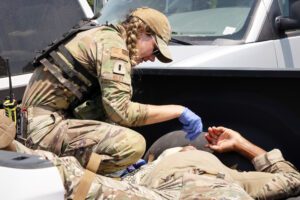
First Lieutenant Amy Wiley, 919th Special Operations Medical Squadron dental technician, performs tactical combat casualty care on a simulated casualty during a wing wide exercise Aug. 7, 2024, Camp James E. Rudder, Florida. Trainers from the 711th Special Operations Squadron placed mission sustainment Airmen in a variety of scenarios and then assessed the effectiveness of their response. Some of the situations Airmen faced included unrest outside the compound, medical emergencies, and engagements with regional media. (U.S. Air Force photo by Staff Sgt. Dylan Gentile)
The SOTG functioned as the command component of the response, tasking the SOTUs with providing specific capabilities to help mitigate the ongoing crisis. The 859th Special Operations Squadron utilized the C-146 A Wolfhound to move two Special Operations Mission Sustainment Team (SOMST) elements and their equipment between airfields.
SOMST members used the exercise to refine their skillsets, equipment, and procedures. Challenges such as heat and coordinating career specialties provided insight on how to further develop sustainment capabilities.
“It was important for us to have this integrated support team thrown into an unfamiliar environment together,” said Tech. Sgt. Michael O’Callaghan, 919th Special Operations Security Forces Squadron resource and training manager. “In a real-world scenario they would need to combine their skills in less-than-perfect conditions to accomplish the mission.”
Sustainment Airmen narrowed down their footprint by reducing the size and scope of equipment, utilizing portable items that could be hand-carried. They opted for tents, air conditioners, and other tools that are smaller than what would traditionally be used and occupied less space on the aircraft.
“We’re pressurizing the system to see where we can improve. We were able to identify needed improvements to our SOMST organization, training, and equipment that will help shape the capability moving forward,” said Col. Olivia Nelson, 919th Special Operations Mission Support Group commander. “Perhaps most importantly, we leaned into the weather and gave our Airmen a chance to experience what deployment in the heat and humidity of the INDOPACOM theater would really be like. We identified the need for greater levels of personal fitness and an emphasis on hydration and work-rest cycles that will make us more ready if called upon to face a peer threat.”
The mission support Airmen stayed in-place overnight throughout the exercise. Controller Observers from throughout the Wing placed them in a variety of scenarios and then assessed the effectiveness of their response. Some of the situations Airmen faced included unrest outside the compound, medical emergencies, and engagements with regional media.
“The team handled everything from small inconveniences like dealing with customs to larger problems like medical crises,” said O’Callaghan. “The differing levels of difficulty and engagement challenged them and encouraged them to be mindful of how they deal with adversity.”
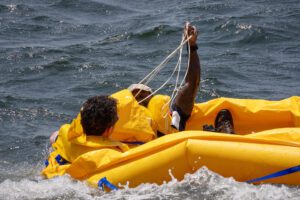
Aviators from the 859th Special Operations Squadron wrangle components of their raft during a water rescue as part of a wing-wide exercise across the Eglin Range, Florida Aug. 8, 2024. A C-146A Wolfhound crew coordinated rescue of the “downed aircrew” with the U.S. Coast Guard. The team surveyed the bay to provide details on the rafts location and maintained communications between the raft and the Coast Guard vessel. (U.S. Air Force photo by Staff Sgt. Dylan Gentile)
While the SOMST maintained their encampments, the SOTU aviators also faced challenges that could parallel real-world scenarios. A simulated aircraft down left four aircrew members stranded aboard a raft in the Choctawhatchee Bay.
A C-146A Wolfhound crew coordinated rescue of the castaways with the U.S. Coast Guard. The team surveyed the bay to provide details on the rafts location and maintained communications between the raft and the Coast Guard vessel.
By the end of the exercise, the 919th SOW successfully completed various aspects of Air Force Special Operations Command warfighting model. Organizers coordinated the SOTG, SOTU and mission support elements in a way that could be reflected in real-world scenarios.
“The amount of work and time that went into all the unseen portions of the planning of this exercise, going back months, was significant,” Hornsby said. “Everyone on the planning cell did a commendable job. The [exercise] was successful and provided an excellent bellwether as to where the wing’s combat capability currently stands. It should help to provide the command a good direction in which to move forward.”
Rocket League is a video game in which players compete in an arcade-style soccer match using vehicles. The tournament featured teams of three playing in a double elimination bracket.
Streamed to over a thousand people on Twitch, a video-streaming platform that allows users to watch and broadcast live content, the tournament saw the Air Force team take first place. The Air Force’s winning team comprised of Airman 1st Class Alex Tuttle, Airman 1st Class Logan LeJuene, and Airman 1st Class John Cunningham.
To be on the three-person team, the airmen had to try out and get selected to represent the Air Force’s gaming team. This was true for each branch’s team.
According to USO’s Barry Morris, the tournament is held each year at the USO Gaming Center on Eglin. This was the fourth year the tournament was put on.
First opened in April 2022, the USO Gaming Center is a video gaming center and café used for recreational activities and special events. According to the USO, it’s the largest gaming center they manage.
Morris said video games play a significant role in maintaining morale and providing connections to home for service members.
“The USO Gaming Program has become a crucial resource providing a unique avenue for recreation, social connection and stress relief for the people who serve and military families. The recent USO Commanders Cup Gaming Tournament highlights the program’s impact on military morale and community,” Morris said. “Research conducted by the Department of Veteran Affairs shows that video games can help service members relieve stress, relax after a long day of duty, connect with loved ones who are thousands of miles away and decompress following a deployment. Additionally, the same study revealed the benefits from gaming stemmed more from the connections the service members and veterans made with other video game players. That’s exactly why, over the past several years, the USO has continued to expand its USO Gaming Centers, programs and events.”
The tournament is a part of the mission to build connections. By various branches competing with one another, the overall military community is strengthened, Morris claims.
“Service members from different backgrounds and ranks interacted freely, united by their love of gaming,” Morris said. “This sense of community is crucial for mental health and resilience, especially for those who spend long periods away from their families.”
Aside from the Gaming Commanders Cup, the USO Gaming Center on Eglin hosts Coffee Connections, where military spouses come together as a community while enjoying refreshments provided by the USO. Upon request, the center also hosts birthday parties for local military children.
Later this year, the center will host the Air Force Team again, this time for a Call of Duty Modern Warfare 3 Tournament.
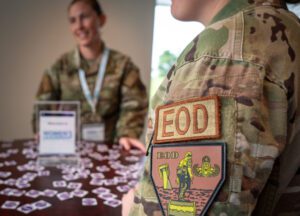
The event brought together service members from across the globe for two days of leadership, mentorship and camaraderie.
“We’ve never had an EOD forum like this with a focus on women’s leadership and mentorship,” explained Master Sgt. Giselle Irr, one of the event organizers. “[In the past,] we didn’t have a means to gather all the women together.”
More than 75 service members attended the summit –not just female EOD technicians, but also men and women from across career fields.
Linda Cox, the first woman to graduate from EOD school in 1974, and the first EOD woman to pin on chief master sergeant in 1994, was a central figure in the event. Reflecting on her journey, Cox shared, “I had no idea what EOD was. When I went through, they didn’t even have a uniform for me. Now, we have women running teams and shops.”
Despite the progress, women remain a minority in EOD. In the Air Force, only 38 women serve as EOD technicians out of 1,337 Airmen, making up less than 2% of the career field’s population. Additionally, of the 50 Air Force instructors at the EOD schoolhouse, only two are women.
A participant wears the explosive ordnance disposal patch that honors Linda Cox, the first woman to attend and graduate EOD school and the first woman EOD Chief in the Air Force. The patch is presented to women when they graduate EOD school. (U.S. Air Force photo/Jaime Bishopp)
Chief Master Sgt. Diana Rogers, the second woman EOD Chief and the only one currently serving, spoke about the challenges and progress women have made in EOD.
When Rogers spoke at the summit, she recalled being told, “Women don’t belong in this career field.”
Despite this, she rose through the ranks and now serves as a role model for others.
“I hope to see more ladies rise to leadership positions. I firmly believe the next three female chiefs are sitting in this room today,” Rogers said.
Over the course of the two-day event, the conversations from participants and speakers expressed a determination to continue blowing up barriers and paving the way for future generations.
“When I went through school, they could have just let one woman slip through,” Cox said. “But when [the women after me] came along, they were the proof we belong and maybe we could do this job after all. Now, we’re to the point where we can drop that word maybe, because we are the bomb techs.”
The event culminated in a 5K ruck march, a symbolic gesture honoring the history and resilience of women in the field.