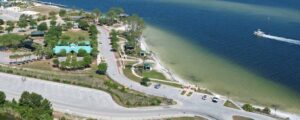
Beasley Park, 1550 Miracle Strip Parkway, currently has 203 parking spaces, and Marler Park, 1275 Santa Rosa Blvd., currently has 79 parking spaces, as well as 24 boat trailer spaces.
County officials plan to have 151 parking spots added to Beasley Park, bringing its total to 354, and 134 parking spots added to Marler Park, raising its total to 213.
Construction of all the new spaces will begin in about a year, county Public Information Officer Nick Tomecek said today.
Marler Park. (Photo courtesy of Okaloosa County)
At its regular meeting today, the Okaloosa County Commission approved paying HDR Engineering almost $183,000 to provide engineering services, construction bid documents, permitting services and related work for the parking lot expansion projects. Last year, the county paid the Omaha, Nebraska-based engineering firm $22,790 for a task order to investigate the feasibility of adding and/or expanding parking at multiple locations, including Beasley and Marler parks.
“From that task order, viable parking options were identified and staff would like to move these concepts forward to construction,” county Tourism Development Department Director Jennifer Adams said in a report to the commission.
Adams
County tourism development tax money will be used to pay for the nearly $206,000 total cost of HDR Engineering’s services.
Currently, Beasley Park is completely full at certain times of the year and is expected to see more visitors when the county’s Bridge to Bridge Multi-Use Path opens, according to Adams.
The 4-mile path, which could officially open in mid-to-late September, runs along the south side of Miracle Strip Parkway (U.S. Highway 98) and between the Brooks Bridge over the Santa Rosa Sound and the Marler Bridge over the East Pass next to Destin.
The path, which contains photoluminescent stones that glow in the dark, is meant for walkers, runners, and bicycle riders only. Unfortunately, county officials continue having to ask motorists to stay off the path.
Adams said the additional parking areas at Beasley Park will be located between Miracle Strip Parkway and the existing parking lot, as well as the area between that lot and the Welcome Center.
“Vehicular access to these new parking areas will be from within the existing parking lot,” she said. “The addition of pedestrian walkways, re-orienting the existing parking to 90 degree (perpendicular) parking, and minor modifications to the existing parking lot pavement are also proposed to in crease parking between these areas. There is no proposed impact to the nearby dunes.”
Adams noted that the existing parking lot at Marler Park is often full.
Construction of the new Brooks Bridge, which could be completed in mid-2027, has tempered use of this park somewhat, but once the new bridge opens the park “will be a center of activity with a new large playground, family picnic area, beach area, and vicinity to the convention center and boat ramp,” Adams said. “This additional parking will support current demand at the park and support the new playground, a new splash pad and integrations into the trails. Vehicular access will be from within the existing internal roadway.”
The addition of a pedestrian walkway has also been proposed for Marler Park, she said.
The Okaloosa County Commission today approved spending almost $800,000 in federal money on the construction of 5-foot-wide sidewalks along Stillwell, which runs past properties in the city limits of Crestview and in unincorporated Okaloosa County.
In a project expected to last 5 1/2 months, Chavers Construction Inc., of Cantonment, will build sidewalks on the south side of Stillwell, which extends 1 1/2 miles between State Road 85 to the west and Monterrey Road to the east.
The sidewalks will be built along a 0.9-mile section of Stillwell between SR 85 and Valley Road and a 0.2-mile segment between Monterrey Road and the east side of Walker Elementary School. Existing sidewalks run along a 0.4-mile portion of Stillwell between Valley Road and the school’s east side.
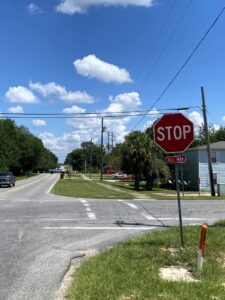
Looking eastward, from the Stillwell Boulevard-Valley Road intersection, at an existing sidewalk along Stillwell. (Photo by Tony Judnich)
County officials have received $796,732 in federal funds via a Florida Department of Transportation grant for the construction of the sidewalks. Among seven companies that submitted bids for the project, Chavers Construction provided the lowest responsive, responsible bid.
In a separate but related vote, the County Commission approved spending up to a little more than $229,000 in county half-cent infrastructure sales tax money for other aspects of the overall sidewalk project. This money will pay for a construction contingency, help cover Construction Engineering & Inspection costs, and pay for repairs to a wooden pedestrian bridge by Walker Elementary School.
The bridge, which is located on the existing sidewalk section between Valley Road and the school, has fallen into disrepair since the FDOT grant application was submitted several years ago, according to interim county Public Works Director Scott Bitterman.
The Arts & Learning Center will stand in a leased space that is next to Desi’s Downtown Restaurant and previously housed a Connect With Flowers store.
During a recent survey, Hub City residents indicated a desire for more opportunities that feature family activities downtown. In addition, Crestview Public Library officials have expressed a desire for additional space for classes and programs, such as English as a Second Language classes and pre-school story time, according to city information.
The space for the Arts & Learning Center has room for displays and a dedicated classroom area, which could be used by entities such as the nonprofit, Fort Walton Beach-based Emerald Coast Science Center.
On Monday, the Crestview City Council approved paying $126,650 to Shepheard Development LLC, of Crestview, to renovate the space and make it ADA-compliant. The council also approved paying $43,000 to Colson’s Electric, of Crestview, to provide electrical services for the renovation project.
Mayor Pro Tem Doug Capps had an excused absence from the meeting.
The renovation project is expected to begin this month and be completed by mid-October.
City Community Redevelopment Agency money, a contribution from the building’s owner, Crestview Investment Corp. LLC, and a city Public Services Department in-kind contribution will cover the total project cost.
After the council meeting, City Manager Jessica Leavins told the News Bulletin that a financial institution has offered to pay the $66,000 total cost of a three-year lease of the space at 189 N. Main St. She said the name of the institution will be publicly shared at the Aug. 25 City Council/CRA meeting, which starts at 5 p.m. at City Hall.
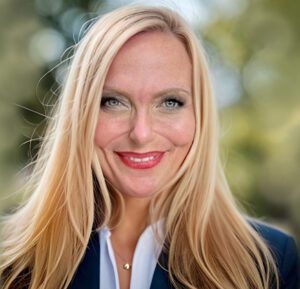
Leavins
In other business on Monday, the council approved paying $752,176.84 to Chapel Branch and Lagniappe LLC, of Chipley, to expand the parking lot and make other upgrades at the Blackwater Golf Club, 4927 Antioch Road.
During the project, which is expected to last about seven months, the parking lot will receive a net gain of 75 parking spaces. The overall project includes clearing and grubbing, asphalt and concrete paving, drainage and curb and gutter work, new striping and signs, landscaping and irrigation work, and construction of a new cart barn.
Okaloosa County Tourist Development Tax and city General Fund money will be used to pay for the overall project.
Besides erecting other roadblocks, Senate Bill 180, which was recently passed by the Florida Legislature and signed into law by Gov. Ron DeSantis, prevents Okaloosa County from implementing any of the recommendations from the nearly $1 million North Okaloosa Planning Study.
Last October, the Okaloosa County Commission acknowledged receiving the study’s final report. The study, which was conducted by Inspire Placemaking Collective, of Orlando, and is also known as the Inspire study, aimed to help guide growth in the unincorporated area north of the Eglin Air Force Base reservation.
Early in the study process, then-county Growth Management Director Elliot Kampert said the county intended to use the study’s final report as the basis of substantially updating the county’s comprehensive plan, which serves as a blueprint for growth.
“When it comes to future development, “There is a glaring need for clarity in the existing comprehensive plan about what’s allowed and what’s not,” Inspire President George Kramer said last August at a town hall session on the planning study.
While the commission acknowledged receiving the study’s final report, it did not vote on going forward with any of the report’s recommendations, such as phasing out conditional density allowances within the county’s Agriculture and Residential Rural land use designations.
Because of SB 180, action on such recommendations will not occur anytime soon.
Analysis of the bill
On Friday, Watkins, who lives just north of Crestview and is a passionate advocate for protecting the north county’s rural and agricultural areas, shared an analysis of SB 180 by Richard Grosso, a land use attorney in the Broward County city of Plantation.
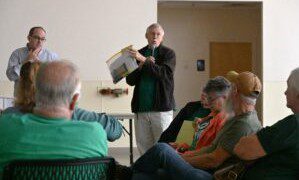
At a North Okaloosa Planning Study town hall meeting in Crestview last August, Crestview-area resident Lane Watkins, holding the mic, encouraged people to help improve the county’s comprehensive plan. (Photo by Tony Judnich)
Grosso prepared the analysis for the Tallahassee-based nonprofit, smart-growth advocacy organization called 1000 Friends of Florida.
The new bill “has an immediate and drastic impact on the authority of local governments to amend their comprehensive plans and land development regulations, or issue development orders with conditions opposed by any person or entity,” Grosso said in his analysis. “This new law, which went into effect on July 1, 2025, is extremely limiting. Section 28 of the law, citing federal disaster declarations for Florida counties from Hurricanes Debby, Helene and Milton, immediately renders ‘more restrictive or burdensome’ comprehensive plan and land development code changes adopted by every local government in the state of Florida after July 31, 2024, subject to judicial invalidation, and precludes local governments from adopting such measures until October 1, 2027.”
He said all 67 of Florida’s counties were identified in a federal disaster declaration for at least one of Hurricanes Debby, Helene and Milton, which struck Florida last year.
“Each of those 67 counties, and every city within every county, is subject to the Section 28 prohibition,” Grosso said. “Going forward, whenever a future hurricane makes landfall, the law’s prohibition on new substantive restrictions or procedures that are more restrictive or burdensome will kick in for any counties within 100 miles of the track of the storm (and their cities) and last for a year.”
A ‘bad bill’
Watkins said by approving SB 180, the state took away the power of residents and their local government officials “to control planning and zoning as well as your opportunity to provide input on development and planning during the public review process on such matters. This was a bad bill and needs to be repealed or modified.”
Watkins urges residents to “talk this over with your state representative and senator to make sure they support either repealing this bill or at lease making major modifications to the worst parts.”
At an Okaloosa County Commission meeting in March, District 3 Commissioner Sherri Cox told residents the commission did address the Inspire study.
Cox
Because of the Bert Harris Private Property Rights Protection Act “and the restrictions that it gives us on how we can implement the Inspire study legally, we had asked collectively to put this on our (2025 state) legislative priorities (list) so that we could put it before the Legislature,” Cox said.
SB 180, however, prevents the county from implementing the study until at least Oct. 1, 2027.
It’s part of the city’s Community Development Block Grant 2025-2029 Consolidated Plan. The city has received a total of $164,652 in CDBG money for projects in the first year Annual Action Plan.
The funding is provided by the U.S. Department of Housing and Urban Development and used for projects designed to benefit low- and moderate-income people or areas, or aid in the prevention and elimination of slum and blight.
City staff worked with Crestview’s Citizen’s Advisory Committee and the public to develop the action plan. The City Council on Monday approved the following allocations of CDBG money:
$43,878 for the design of a paved multi-use recreational path that would run adjacent to Industrial Drive and the railroad tracks and extend between Main Street and Twin Hills Park. The proposed path would provide safer, more accessible multimodal connectivity between downtown and the park.
$32,930.40 for planning and administration: Among other duties, the city Community Development Services Department administers the CDBG Program and is responsible for conducting all public hearings and meetings, advertising for and accepting applications, reviewing applications, staffing the Citizen’s Advisory Committee, administering funds to sub-grantees, and preparing the Annual Action Plan.
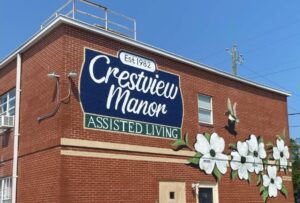
$32,000 for improvements to the nonprofit Crestview Manor assisted living facility on North Pearl Street. The upgrades include replacing ceiling tiles and ceiling fans throughout the facility and repairing/repainting parts of the facility’s exterior, such as a back door.
The Crestview Manor mural. (Photo by Tony Judnich)
$31,145.80 for security cameras at downtown city facilities, such as the Community Redevelopment Agency office building on Main Street, Wilson Street Park, and the future Arts and Learning Center at 198 N. Main St.
$12,348.90 toward the operational costs of the nonprofit Crestview Resource Center on Martin Luther King Jr. Avenue. Among other types of help, the center provides counseling, legal, and veteran services, HIV testing, and training in financial literacy, job readiness, and basic computer skills.
$12,348.90 to buy equipment, such as tables and chairs, that is necessary for instruction, and to pay for specific types of instruction at the future Arts and Learning Center.
The City Council approved the funding allocations in a 4-0 vote. Mayor Pro Tem Doug Capps had an excused absence from the meeting.
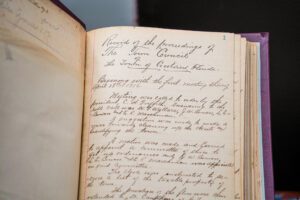
Book 1 contains meeting minutes and city ordinances from 1916-1923, and book 2 contains minutes and ordinances from 1937-1948.
These significant records, which suffered water and fire damage over the years, particularly after the fire that destroyed the old City Hall, have been restored.
The restored books. (Photo courtesy of the city of Crestview)
“Recognizing the importance of preserving our city’s history, Girard sought guidance from Matt Lutz, the city of Tallahassee’s director of records management,” Crestview officials said in a news release. “Lutz had mentioned to Girard during the Florida Association of City Clerks annual conference that they had successfully restored old record books and recommended a hand-bookbinder conservator, Paul Sawyer, located in Daytona Beach.
“Sawyer conducted a thorough restoration process on Crestview’s historical books, which involved cleaning, de-acidifying, and hand-sewing the books. As a result of his efforts, books 1 and 2 are now in significantly improved condition and are once again legible.”
A page in one of the restored books. (Photo courtesy of the city of Crestview)
“As part of future records management initiatives, our restored historical books will be digitized and made accessible to the public via the city’s website, cityofcrestview.org, ensuring the preservation of our city’s historical records for future generations.” Girard said.
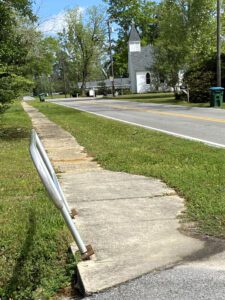
During the project, ADA-compliant, 5-foot-wide sidewalks will be built on the west side of 4th Street from Sunnyside Avenue to State Road 85 and on the north side of Sunnyside from SR 85 to 4th Street, connecting via a crosswalk to the existing sidewalk in front of the school.
Most of the new sidewalk on the west side of 4th Street will replace an existing, narrower sidewalk that’s damaged in various spots.
A segment of the existing sidewalk on the west side of 4th Street and north of Sunnyside Avenue. (Photo by Tony Judnich)
On Tuesday, the Okaloosa County Commissioner awarded the overall sidewalk project to the Tampa-based LAS Contracting Corp., which rose to the top over two other qualified companies by submitting the lowest responsive and responsible bid.
County officials plan to use a “Safe Routes to Schools” grant administered by the Florida Department of Transportation to pay for the $540,543 construction project.
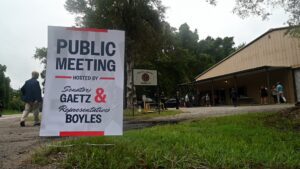
“I believe FPL dropped the ball” by allowing the solar farm breach to occur, Gaetz said at the meeting, which took place at Holt Fire District Station 21, 490 U.S. Highway 90.
“We’re going to make sure FPL doesn’t fail at making it right,” state Sen. Don Gaetz said of restoration work that began after the Kayak site breach. (Photo by Tony Judnich)
The Kayak site, which has significant slope, encompasses about 500 acres south of Interstate 10 and off Trawick Creek Road. The breach occurred on June 8 after 7 inches of rain fell in a three-hour period.
The largest of the ensuing sediment discharges occurred along the Kayak site’s east boundary, where the east berm and embankment of a stormwater conveyance swale eroded.
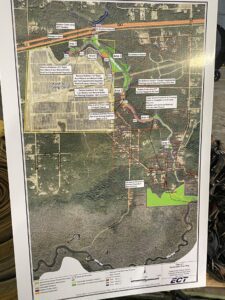
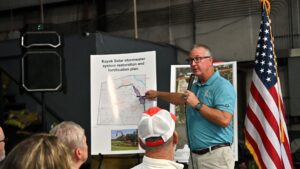
The overall Kayak Solar Energy Center site and adjacent areas affected by the breach. (Photo by Tony Judnich)
Among other areas of concern, up to 5 feet of sand interspersed with red clay from an uncontrolled release of stormwater was found in a wetland nearly spanning the Wilkinson Creek valley.
“This sediment discharge completely filled and covered the channel of Wilkinson Creek to the extent its original course was difficult to visually discern,” officials said in FPL’s wetland and stream restoration plan for the Kayak site.
Gaetz, R-Niceville, and District 3 state Rep. Nathan Boyles, R-Holt, hosted Monday’s meeting, which focused on what led to the breach, what FPL is doing to fix it, and what the company will do to prevent another breach from occurring.
“We’re going to make sure FPL doesn’t fail at making it right,” Gaetz said.
Boyles, whose property in Holt was impacted by the runaway sediment, said the overall issue “is just as important to me, both personally and as your state representative.”
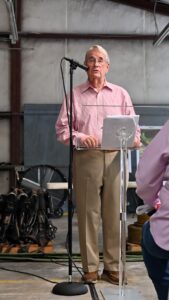
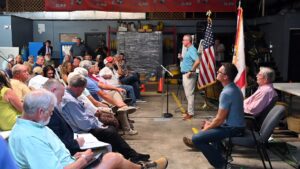
District 3 state Rep. Nathan Boyles, at the podium, discusses the FPL solar farm breach with Holt residents. (Photo by Tony Judnich)
Later during the meeting, he said, “There were zero other stormwater ponds that failed in northwest Florida the day we had this rain event.”
Boyles added that he thinks FPL gets the message that it doesn’t receive a pass by chalking up the massive June 8 rainfall to “an act of God.”
J.T. Young, vice president and general manager of FPL Northwest Florida, and Mike Sole, FPL’s vice president of environmental services, answered questions from many of the more than 80 residents who attended the meeting.
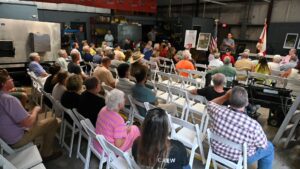
The meeting took place at Holt Fire District Station 21. (Photo by Tony Judnich)
“We are certainly focusing on making this right by strengthening and restoring our stormwater system at the Kayak Solar Energy site,” Young said.
The June 8 breach wasn’t the first time that residents living near the Kayak site had to deal with runaway sediment from the site.
In early 2024, when the solar energy center was being built, heavy rains led to large amounts of sediment being pushed into adjacent creeks and wetlands. An FPL official apologized for that particular mess and said the company would clean up the affected areas and continue to implement its stormwater management practices.
At Monday’s meeting, Young and Sole said that after the June 8 breach occurred, FPL crews began working seven days a week to remove sediment from affected areas, repair the Kayak site’s stormwater system, restore Wilkinson Creek, and make other improvements.
“It is unacceptable for these types of events to occur,” Sole, who once served as the secretary of the Florida Department of Environmental Protection, said of the breach. “We acknowledge that.”
He said crews have restored the Kayak site berm that failed and have placed sod to help stabilize it. Work continues on the installation of 2,000 linear feet of 24-foot-long sheet pile along the berm that failed “to ensure and give you the comfort that you’re not going to have that kind of breach again.”
The sheet pile goes 20 feet underground, and only 4 feet above grade, resulting in “a very strong, armored berm,” Sole said.
Mike Sole, FPL’s vice president of environmental services, talks about ongoing improvements at the Kayak site. (Photo by Tony Judnich)
He said crews have also begun creating more capacity in the site’s existing stormwater ponds so more water can be held back and have installed more outfall structures along the site’s northern pond to improve the controlled release of water after a major rainfall.
A copy of the Kayak Solar Energy Center Wetland and Stream Restoration Plan is available at fpl.com/kayakrestoration.
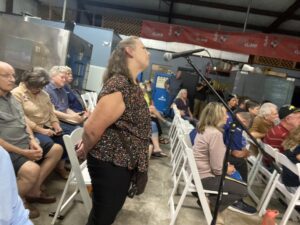
Holt resident Julie Marler took issue with Sole’s definition of ‘a significant weather event.’ (Photo by Tony Judnich)
In addition to other completed and ongoing interim improvements, the Kayak site’s overall stormwater system will undergo a complete redesign, which will be reviewed by an independent engineering firm, Sole said. The firm is HDR Engineering, which is based in Omaha, Nebraska and has offices in Crestview and Pensacola.
“Once the third-party engineer finishes their review, they’ll give us the results,” Sole said. “We will make any final changes to that final stormwater design, and we will then submit it to the DEP for their review and approval. Hopefully this will happen in a very quick period of time.”
Sole, holding the mic, listens to a resident’s question while standing near Gaetz and Boyles. (Photo by Tony Judnich)
Sole thanked residents at the meeting for their patience.
“None of you asked for this,” he said of the solar farm breach. “None of you deserve having this disturbance in your life. Again, we thoroughly apologize but appreciate your patience as we move forward to try to make this right.”
Near the end of the meeting, Gaetz encouraged residents to contact him or Boyles if FPL fails to give the residents straight answers to their questions about the restoration of the Kayak site and adjacent areas.
“We will hold FPL accountable and get a straight answer,” Gaetz said.
District 3 Okaloosa County Commissioner Sherri Cox, who was unable to attend the meeting in Holt because of a personal matter, said at Tuesday’s commission meeting that residents also can contact her with any concerns they might have about the restoration work.
Cox
Cox said she has visited the Kayak site several times and has talked with several homeowners who have been affected by the breach.
“I’m pleased to say that, by my best estimates and the hundreds and hundreds of dump trucks and (pieces of) earth-moving equipment that are out there, they do appear to be making their best effort and being a good community partner in this,” Cox said of FPL. “It will take time and patience.”
Batteries (AA-cell, AAA-cell, C-cell, D-cell, 6-volt, or 9-volt)
Fire extinguishers
Insect repellent
Life jackets
Portable gas or diesel cans (5 gallon maximum)
Portable generators
Smoke detection devices and carbon monoxide alarms
Waterproof tarps (1,000 square feet or less)
Sunscreen
Ground anchor systems and tie-down kits
With peak hurricane season near, now is a good time to make sure your emergency kit is complete, Okaloosa County officials said in a news release. Sign up for local emergency alerts at AlertOkaloosa.com.
Assembling an emergency kit now can help you make sure you and your family have what you need in an emergency.
After stepping outside to wash the ice cream shop’s windows, Shutt was almost hit by an e-bike that was whizzing by. Shutt recently told the Crestview News Bulletin that he was able to avoid a collision, but he’s concerned about the safety of his customers.
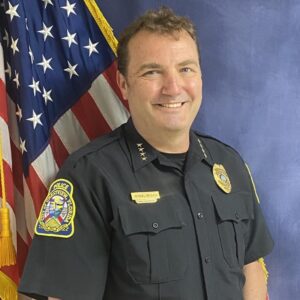
“We’ve had some complaints about that,” Crestview Police Chief Steve McCosker said on Tuesday about e-bikes being ridden on Main Street’s recently widened sidewalks.
McCosker
Many of the street’s sidewalks were broadened during the city’s nearly $5.7 million Main Street renovation project that was completed this past spring. The overall renovated area spans a six-block portion of Main, generally between Industrial Drive and U.S. Highway 90, and includes parts of adjacent streets.
E-bikes, which have an electric motor that assists with pedaling, have “definitely increased in popularity” in Crestview in recent months, McCosker said.
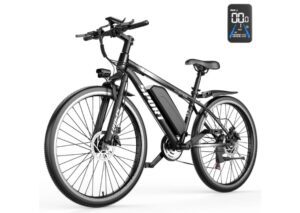
An electric bicycle that costs $379 at Walmart.com. (Photo courtesy of Walmart)
When asked whether some e-bike drivers had lost their license to drive a car because of a DUI, the chief said, “I don’t know, but I would not rule that out.”
With increased safety in mind, McCosker said he is working with city staff to develop a proposed ordinance that, with City Council approval, would limit the use of e-bikes on Main Street and elsewhere.
Florida Senate Bill 462, which allows cities and counties to set their own rules on regulating e-bikes, took effect on July 1 as a new state law. It allows local governments to set a minimum age for e-bike riders, require riders to carry a government-issued ID, and offer or require safety training classes.
Amy Koger, who is the executive director of the nonprofit Main Street Crestview Association and the owner of Baby and Me Boutique on Main, said today that she has seen standard bicycles being ridden on Main Street sidewalks but has not seen, or heard any complaints about, e-bikes being ridden on them.