Since many of the volunteers dedicate their time year-round at the shelter, the holidays are when they take the much-needed time away to be with friends and family. This leaves the remaining team members in the area to do twice the work they normally do.
“We are asking for any volunteers to help us out this holiday season and hope they will stick around after,” said Michael Raat, Pet Welfare adoption publicity director. “We always appreciate the help; it is incredibly beneficial.”
The non-profit, no-kill adoption center helps rehome pets for military members when it is unfeasible for them to continue ownership of their family pet, due to permanent change of station or other circumstances.
“Our goal is to ease the hardship and transition for military families who need to surrender their pets at the welfare center,” said Raat. “While it’s rare, sometimes things do work out and military members come back and reunite with their pet.”
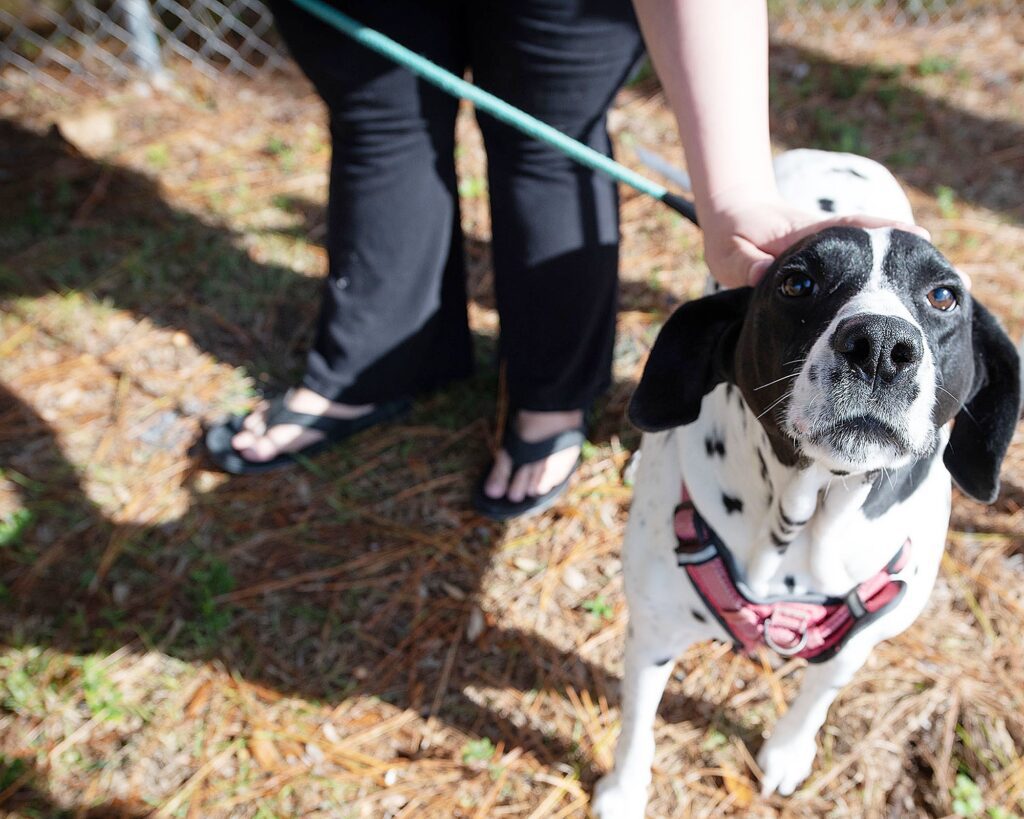
Aries stands for a photo outside the Pet Welfare adoption center on Eglin Air Force Base, Fla., Dec. 6, 2023. Aries is a dalmatian mix available for adoption at the center. Pet Welfare is non-profit, no-kill shelter that places anywhere from 100 to 300 surrendered and homeless cats and dogs very year since 1982.
Pet Welfare has a no paid staff and receives no monetary support from the government. All financial support comes directly from donations, grants, adoption fees, fundraisers, and Combined Federal Campaign contributions.
“The people who know we are here are really good to us,” said Judy Novak, 20-year volunteer with Pet Welfare. “When I first started volunteering here, we didn’t even have windows in the building. In the winter we placed blankets over the openings to make it a bit warmer for the animals.”
The donations help provide a safe and healthy environment for the animals until they are adopted into their forever home. Donations include food, toys, cleaning supplies, bedding, leashes, and cages. Besides the donations, the human interaction through volunteer work provides the animals with much needed love and care.
“I think when you see the pets and their personalities, you just fall in love with them and you want them all,” said Laura Lizcano, Pet Welfare’s new chairman. “All of us who volunteer here have the same love for pets. I feel it’s very rewarding and many of us enjoy fostering too.”
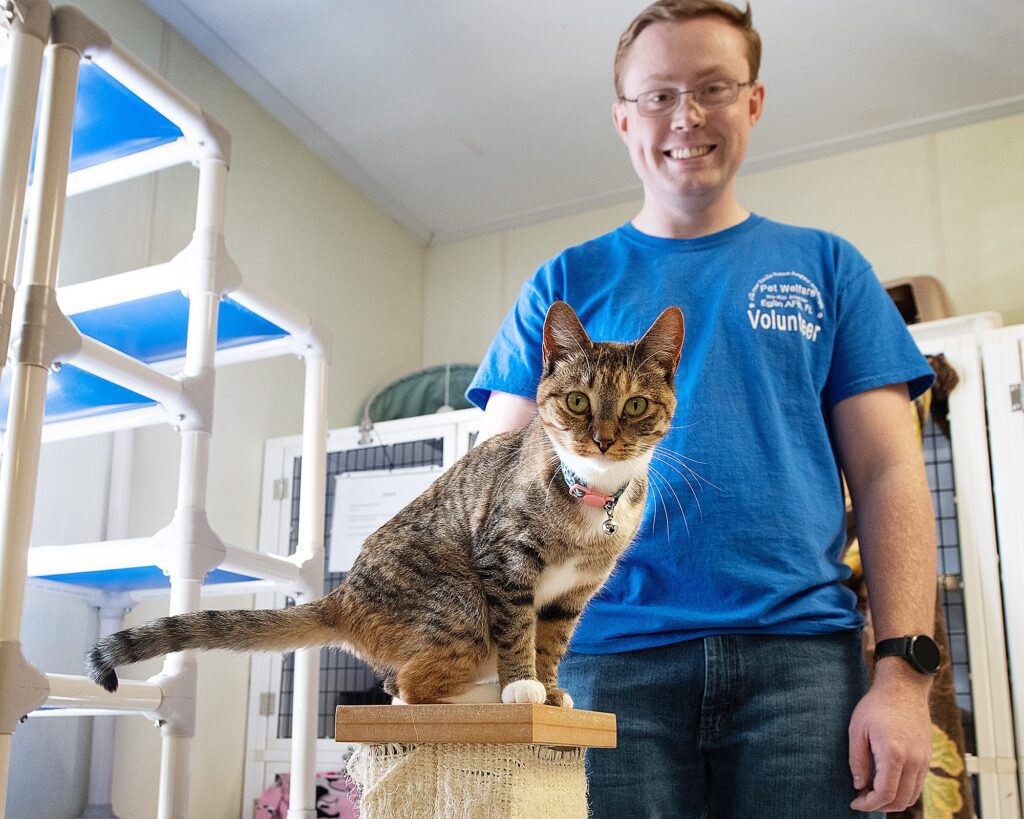
An available cat for adoption poses for the camera in front of Michael Raat, the Pet Welfare adoption center publicity director at Eglin Air Force Base, Fla., Dec. 6, 2023.
Volunteers assist in various roles, ranging from office tasks such as handling phone calls and managing the facility. They also engage in hands-on duties, such as washing laundry and assisting with shifts for the cats and dogs, which involve cleaning, medicating, and socializing with the pets.
Anyone interested in dedicating their spare time to help with the furry four-legged pals may stop in at the Pet Welfare adoption center to fill out a volunteer application.
To adopt, visit the website at petwelfare.net to view upcoming adoption events and available pets.
Bass visited the world’s premier fighter wing at Luke Air Force Base, Dec. 1. The 56th Fighter Wing is dedicated to training the world’s greatest fighter pilots and combat ready Airmen.
Bass and her support team, Team 19, began the workday with her customary morning workout at 5:00 a.m.
After PT, Bass had breakfast at the Hensmann Dining Facility, where she spoke with Luke AFB Airmen about multiple subjects including China as the United States’ biggest pacing challenge.
“Our most sophisticated and pacing challenge is China,” Bass said. “We need to make sure our Air Force is equipped with the right talent certainly today, but also 5 and 10 years down the line.
During the tour, Bass toured premier fighter squadrons and base facilities including the 56th Communications Squadron, 308th Fighter Squadron and the Luke AFB Chapel Team.
At the 308th FS, Bass engaged with international partners, discussing collaboration improvements for allied nations at Luke AFB and participating in a group photo.
Throughout the day, Bass met with noncommissioned officers, base leadership and international partners, while also recognizing multiple Airmen around the 56th FW for their outstanding accomplishments.
Under a sunny Arizona sky, Bass visited the 308th Aircraft Maintenance Unit, where she was briefed on bundled maintenance and the theory of constraints.
After hosting a discussion with the 308th AMU Airmen, Bass and her team met the Luke AFB Chapel Team. The chapel hosted 126 resiliency events in 2022 for Airmen, and briefed Bass and her team how it was made possible through community partnerships.
Bass continued engaging with the enlisted force by holding a lunch with NCOs from Luke AFB. During this meal, the group discussed innovation, readiness and change.
“We have to be willing to accelerate and innovate moving forward,” Bass said. “Change can be tough, but losing is unacceptable.”
After lunch, Bass arrived at Explosive Ordnance Disposal Pro Range for a demonstration of EOD and Android Team Awareness Kit capabilities.
Finally, Bass held an all-call, where instead of talking to Airmen, Bass preferred to talk with Airmen, creating an open dialogue where Airmen could not only gain insight from the CMSAF, but also so the interests and concerns of the enlisted force could be heard and addressed.
The discussion occurred beneath a towering American flag backdrop in Hanger 999 touching on a range of topics, including mental health, education benefits and leadership qualities.
“What advice do you have for growing female leaders in the Air Force?” asked Airman 1st Class Kennetta Acquaah, 56th Comptroller Squadron budget technician.
In response to the question asked by Acquaah, Bass said that her advice for future leaders in the Air Force was the same for both men and women.
“If you want to be a successful leader in the Air Force,” Bass said, “do your job and do it well.”
Never missing an opportunity to engage with Airmen, Bass concluded the all-call with a photo-op with any and every Airman that wanted a photo with the voice of the Air Force’s enlisted corps.
While many headed home for the conclusion of their duty day, it continued for the CMSAF. Bass went on to visit the Fighter Country Foundation building to attend a dinner with her fellow Chiefs on base, before finally retiring for the day well after dark.
The following morning, Bass and Team 19 would rise at the crack of dawn to fly back to Joint Base Andrews in Maryland. In addition to base visits, Bass serves as the personal adviser to the chief of staff and the secretary of the Air Force, attends ceremonial events and advocates for Airmen in policy discussions.
Whether it is traveling across the globe or working at her home base, the chief master sergeant of the Air Force leads by example. Bass serves her Air Force with a resilient passion for improving the lives of Airmen and a diligence for innovation, working before the sun comes up and after it comes down.
The car accident, which occurred on Oct. 24, 2022, tragically claimed the life of Airman 1st Class Tyler Fajardo and left Sharp with severe injuries and casting doubt on his ability to walk again. The other two Airmen involved sustained only minor injuries.
Matthew has been steadily defying the initial grim prognoses over the past year under the dedicated care of his parents, Jorge and Lorena Sharp, of Homestead, Florida. His progress has been a journey of physical recovery and a testament to the unyielding human spirit in the face of adversity.
Sharp’s recent visit to the Homestead Air Reserve Base’s Honor Guard team was pivotal in his recovery. He participated in practice sessions there, rekindling his deep-rooted passion for the Honor Guard and provided a significant morale boost.
Senior Airman Latavious Cunningham, a Base Honor Guard member at HARB, facilitated this engagement during Sharp’s visit.
“It’s moments like these that remind us of the extraordinary capabilities and courage of our Airmen.” said Cunningham reflecting on his time spent with Sharp.
Following this meaningful experience, Lorena Sharp spoke on her son’s incredible progress.
“Matthew has improved so much within the last year,” she said. “Doctors doubted he would be able to walk again, but look at him now.”
Against all odds, Sharp has made remarkable strides, surpassing expectations and inspiring those around him.
As the first anniversary of the accident passes, the Sharp family’s focus remains on Matthew’s ongoing recovery.
His story of emerging from tragedy to triumph has become an inspiring portrayal of hope, strength, and the human capacity for healing. The support from his family and the Air Force community, particularly the Honor Guard team at HARB, continues to play a crucial role in his remarkable journey.
The exercise practiced deploying 99 personnel, representing 10 Air Force Specialty Codes, and aimed to conduct real-world scenarios in a controlled environment to fortify the squadron’s capability to meet challenging manpower-heavy requirements, specifically focused on force-generation models and mission support team needs.
Tyndall’s environment allowed the team to simulate diverse operational challenges, from construction and infrastructure projects to rapid response and combat scenarios.
“We’re out here to improve career-specific skills, whether it’s tent construction, airfield lighting or anything of the sort,” said 1st Lt. Corey Cecil, 1st SOCES chief of operations, engineering. “It’s also to increase the multi-capable skills of the folks out here, so they are ready to go for the next fight.”
A U.S. Air Force Airman assigned to the 1st Special Operation Civil Engineer Squadron participates in an annual bivouac training at Tyndall Air Force Base, Florida, Nov. 7, 2023. More than 99 personnel, representing 10 different career fields, participated in the training. (U.S. Air Force photo by Airman 1st Class Ty Pilgrim)
Cecil explained that the 96-hour timeframe added an element of urgency to the training, simulating conditions the squadron might encounter in a rapidly-evolving operational theater. This time-sensitive approach aimed to cultivate quick decision-making, effective communication and efficient execution of tasks, all crucial components of successful operations.
“This was a great experience to get in touch with the more rapid pace side of the military,” said Senior Airman Turek Taylor, a 1st SOCES structure shop specialist. “I’m usually doing work order to work order, but during the exercise we’re constantly training to be field ready.”
The exercise also underscored the importance of training for direct combat engagements in the current global security landscape by incorporating combat scenarios into the training regimen. The 1st SOCES demonstrated its commitment to being a deployable force capable of meeting any challenge, whether it be a humanitarian assistance mission or a direct combat engagement.
“We saw a lot of great things out here, everyone got hands-on experience that we will continue to build on to get ready for next year’s bivouac.” said Cecil.
The bivouac field training exercise highlighted the Air Force’s broader commitment to maintaining a highly trained and adaptable force capable of responding to the dynamic and evolving nature of global security threats, explained Cecil.
“To understand where we need to go in the future, it’s important we look at where we’ve been and see the history of it,” stated Chief Master Sgt. Vandiver Hood, EOD’s nineth and outgoing career field manager.
EOD has experienced a tremendous amount of change and growth in a relatively short time, and the men present recounted that history and their role in it.
Retired Chief Master Sgt. John Jay Glover, who joined the Air Force in 1966, was the first EOD career field manager in 1989. Because of Glover’s work, the career field moved from maintenance into the Civil Engineer Squadron, a field that was better suited to EOD’s mission of clearing airfields. It was during his tenure that the first robots were fielded, now an integral tool of EOD work.
“It’s pretty fascinating watching EOD grow and watching the level of excellence I’ve seen in the program grow,” Glover explained. “It was rough-and-tumble times during the Vietnam war and just keeping yourself together and keeping yourself alive. But now it’s so much more professional.”
Each new career field manager built on the foundations of the last to develop that professionalism, with some projects often spanning multiple CFMs.
Chief Master Sgt. Frank Pulice, the incoming career field manager, said he understands he will continue working through a constant state of change just as his predecessors did.
“You’ve heard about change from everyone up here. I see a lot of change coming, but that’s not a new story,” he said. “You hear a lot about the change, but you probably don’t see it. Good, meaningful change sometimes takes more time than we have.”
Hood hopes Airmen see the team effort that goes into making EOD successful through the change. “We’re the same EOD technicians, whether it’s from 1970 or 2023. We are always there for the team, no matter where we are now and into the future,” he said.
Airman 1st Class Griffin Walraven, who just graduated EOD school less than a year ago, took away just that message.
“There’s a lot of history going into every decision that is made. And while we only see so much at the lowest level, especially me being an Airman, when you get up higher, bigger decisions are at play. There are a lot of people looking out for us that are EOD.”
Glover ended with a word of wisdom. “No man or woman stands alone. You need a team of people that you surround yourself with to help you be successful and you’ve got to support them. You’ve got to work together.”
“As I enter my role as the 23rd Chief of Staff, I do it with both humility and resolve,” Allvin said. “I am humbled by both the responsibility vested in the office – so deftly carried out by my predecessors – and the skill, dedication, and sacrifice of the Airmen and their families for whom this office exists to serve.”
Allvin steps into the job at a time of significant challenges – ongoing wars in Ukraine and Israel, as well as the emergence of “great power competition” with China, the pacing challenge.
“The current strategic environment is one in which our national interests are threatened in a way we have not seen in decades,” he said. “And the evolving character of war is one that privileges speed and tempo, agility, range, flexibility, resilience, and precise lethality … these elements run deep in the DNA of airpower, and it is our responsibility to the Joint Force and the nation to bring these to bear to meet our pacing challenge.”
Despite the complexities, competition, and evolving challenges, Allvin said the service’s core mission has not changed. “We deter and defeat aggression to defend and protect our nation and its interests,” he said.
Doing that, however, requires new thinking and action, Allvin said. “We must solve for agility – initiating action in the right direction and building in the flexibility to learn and adjust while in motion. This is the spirit in which we must pursue the efforts to optimize for the environment we face.”
“After our three years together, I couldn’t ask for a better person to follow through and build upon the many ideas we’ve shared,” Brown said. “… [His career] has provided him a wide foundation to draw on to lead the Air Force as it faces a complex and volatile global security environment.”
Kendall echoed that assessment.
“[Dave] is excited to come into this position at a time when our National Security Strategy, National Defense Strategy, Joint Warfighting Concepts, and Air Force priorities are in such clear alignment,” he said. “We are all on the same page, part of one team and one fight across the Department of the Air Force, the Joint Force, interagency teammates, and allies and partners … Dave is taking the baton at full speed, and he is going to ensure that we follow through on the next leg of the race.”
While the welcome ceremony was a significant milestone, Allvin had officially been in the job since Nov. 2. On that day the Senate confirmed Allvin to become the service’s highest-ranking officer and uniformed leader. That was followed the same day by a brief swearing-in ceremony while he was visiting the U.S. Air Force Academy in Colorado Springs. The location bears a significant relevance as it was the same place Allvin swore his commissioning oath in 1986.
As with his 22 predecessors, Allvin brings his own unique leadership style to the Chief of Staff office. One tangible example is that he signs most written correspondence simply “23.” Signing in this humble manner is Allvin’s acknowledgement that he is merely the “next up” in a long line of leaders charged with overseeing the service and upholding the Air Force’s high standards. It is also one of the ways he redirects personal attention from himself to Airmen and their families, who “display a sense of commitment and dedication to the mission that is unparalleled.”
Allvin carries this responsibility with a sense of urgency, citing time as one of the “biggest challenges in pursuit of our destination … as the future rushes toward us at a breathtaking pace.”
The call to follow through builds upon the changes set in motion by former service chiefs and brings into focus numerous initiatives that will be critical to the Joint Force in the years ahead. Among the most pressing are bringing the Air Force’s Operational Imperatives to operational capability, adapting the organizational structure for great power competition, and harnessing innovative talent.
Allvin’s intent is well-supported by other senior leaders, who have full confidence in his leadership, integrity and ability to lead the Air Force.
“I will spend every day from this one until I pass the baton in dogged pursuit of the change we seek … because [our Airmen] deserve it, and the nation demands it,” Allvin finished. “We’ve got the charge … now let’s follow through.”
During the free event, guests are invited to enjoy hot cocoa, train rides and craft making at Santa’s Workshop. They can even meet Santa and his friends! The grand finale will be the Tree Lighting Ceremony with opening remarks provided by U.S. Air Force Col. Allison Black, 1st Special Operations Wing commander.
The Tree Lighting Ceremony is an annual base event held to kick-off the holiday season and is open to those in the community with base access.
Hackett’s journey involves not only playing the sport he is passionate about but also making a significant impact on the lives of veterans.
The love affair with baseball started early. “I grew up playing baseball throughout my life,” he shares. “It was the only sport I played growing up, and I had been recruited to play in college. But then I decided to join the military.”
“My first experience playing baseball, I probably honestly couldn’t remember because I was so young,” he admits with a chuckle. “But as I grew older, it became unlike anything I can describe. It’s kind of like when we put on our Air Force uniforms every morning, we’re representing the DoD and the Air Force. Walking onto the baseball field in my uniform, I know I get to play a sport I truly love and have a passion for.”
Hackett reminisced about his father’s high school baseball days, highlighting a familial connection to the sport. Recalling their earliest Boston Red Sox game experience at the age of around eight or nine, Hackett shared a moment that left a lasting impression.
The atmosphere and excitement of that Red Sox game became a cherished memory, shaping Hackett’s affinity for the sport from a young age.
It was a passion that never waned, even when he joined the military. Baseball became a piece of home he carried with him through deployments and duty stations.
However, as many veterans know, once you’ve tasted the camaraderie and thrill of the baseball field, it’s hard to let go. “I missed the sport a lot,” Hackett says. “So, wherever I was stationed, I looked for local leagues to play in during my free time.”
The military life might have interrupted his baseball dreams, but it couldn’t extinguish the fire. Baseball became his connection to home as he embarked on deployments and served in various duty stations.
“I missed the sport a lot,” Hackett admits. So, wherever he was stationed, he actively sought out local baseball leagues, playing whenever he could.
And it was during one of these assignments that he discovered the WarDogs Baseball Organization.
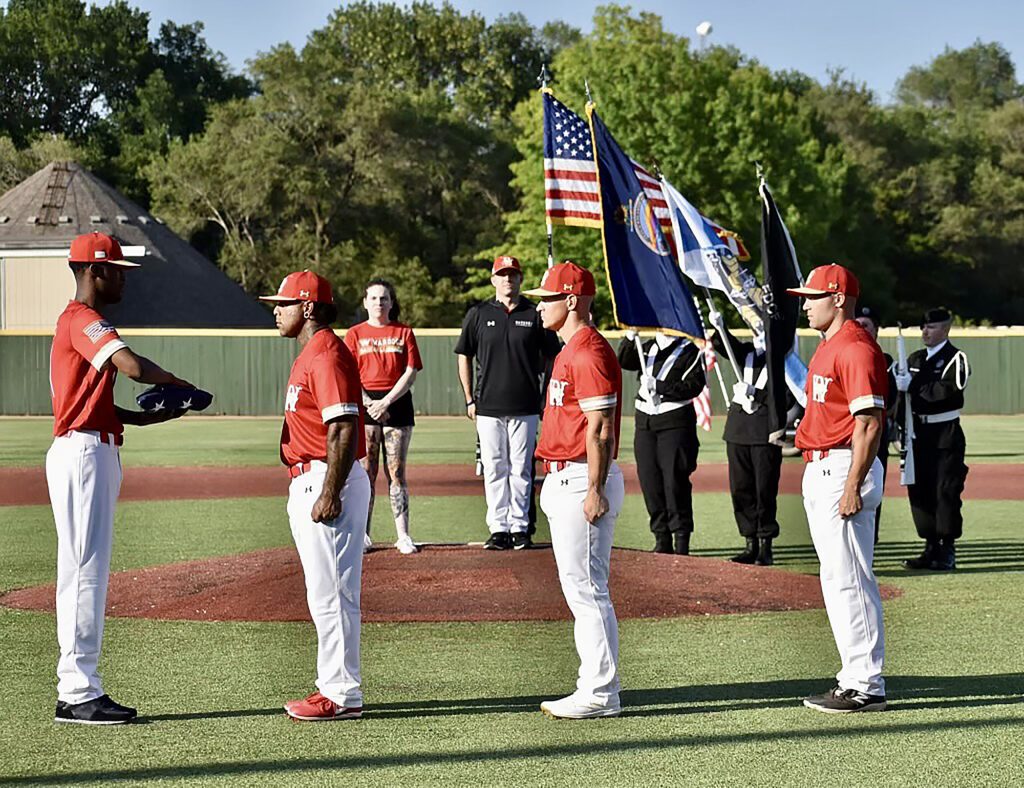
U.S. Air Force Tech Sgt. Travis J. Hackett, right, 1st Special Operations Security Forces Squadron standardization and evaluation, participates in a folding the flag ceremony during a WarDogs Baseball game. Hackett presented the folded flag to a Gold Star family. (Courtesy photo)
“I found the WarDogs through social media when I got stationed here,” Hackett recalls. “Joining this unique team required more than just a love for the sport. You have to send all your stats because this organization plays in collegiate leagues, playing against college-level players.”
The WarDogs annually choose the best baseball players from the United States Armed Forces. These exceptional individuals come together during spring training and embark on a nationwide tour. The primary goal is to generate awareness and funding for Veterans and their families.
What sets the WarDogs apart is their mission. They’re not just playing baseball; they’re raising funds for veterans suffering from PTSD.
Hackett elaborates on their mission: “We raise money through raffle tickets, fundraisers, charitable events, and then we try to purchase a service animal for a veteran. We give that service animal to a veteran at a baseball game.”
As part of the WarDogs, Hackett and his teammates embarked on a challenging season comprising 17 games, with the goal of raising $10,000. Their last game was tantalizingly close, with $8,000 raised. Then, a surprise donation of $10,000 in Nebraska pushed them past their target, resulting in a total of $18,000 raised.
As a representative of the Air Force, Hackett described the interactions with these families as a means of fostering camaraderie.
The conversations held prior to each game seemed to bring the families even closer to their departed loved ones, creating a poignant and touching connection.
Being part of the flag folding ceremony for each game was a deeply moving experience, according to Hackett. In this role, Hackett had the privilege of presenting a flag to a Gold Star family, those who have lost a service member in war.
“Hackett needs little support, but he trained hard to become a part of this team,” U.S Air Force Master Sgt. Robert A. Vickers, 1st Special Operations Security Forces Squadron, colleague of Hackett, acknowledges his dedication on and off the field. “I would imagine he is a great baseball player, since he was able to make a DoD level team.”
Vickers has seen Hackett’s commitment in the gym, “I know how much effort he puts into being a great athlete. I am very proud to see all his training and hard work come together.”
According to Vickers, Hackett stands out as an exceptional non-commissioned officer. His consistent drive at work serves as a source of motivation for those in his vicinity.
He envisions Hackett’s contagious enthusiasm extending onto the field, where he inspires teammates to deliver their utmost effort.
Beyond the games and the fundraising, Hackett and his team visited VA hospitals, spending time with veterans and sharing stories. He recalls, “We would sit down and talk to them, take pictures, and just bring a day of kindness.”
For Hackett, the WarDogs mission isn’t just about the money they raise. “Those service animals are going to provide a great deal of emotional support and medical support for those veterans in need,” he says. “It’s important to give back to the community and show support to our veterans.”
“It’s given me a more open-minded approach when it comes to our veterans,” Hackett believes. “Those guys paved the way for you and me and giving them gratitude and support where it’s needed is essential.”
Hackett plans to continue playing in the local league of Okaloosa, Florida and travel with the WarDogs for their upcoming season, which will take them to the New England region.
He’s excited about recruiting players from his current men’s league to join the WarDogs, ensuring that their mission continues to thrive.
I would love to see more Airmen join the WarDogs “Anyone who wants to join the baseball team can definitely contact me at any time, says Hackett enthusiastically. “It’s about more than just the game; it’s about making a difference.”
Agile Combat Employment is a proactive and reactive operational scheme of maneuver executed within threat timelines to increase survivability while generating combat power. In Air Force Special Operations Command, we are meeting the service’s initiative of ACE by creating and employing Mission Sustainment Teams. An MST is a group of highly skilled Airmen from across multiple specialty types who can move quickly around an area of operations and provide base operating support to aircrew and maintainers. We produce this by employing Mission Command, which gives Airmen the freedom of action needed to exploit rapidly developing opportunities and succeed.
From personal experience, being a Mission Commander and a part of AFSOC’s MST has been amazing! It is rare for service members who have a non-operational job to get the opportunity to be a part of the joint environment tactically. When my commander at the 1st Special Operations Comptroller Squadron, Maj. Joe Regan, approached me with the opportunity to lead a team of 55 Multi-Capable Airmen, I knew this was a calling to serve that I have always dreamed about. When I listen to our former Chief of Staff, and now Chairman of the Joint Chiefs, General Charles Q. Brown, speak on “Accelerate Change or Lose,” I believe our team was set up perfectly to operate within his intent.
Comptroller reflection
Although I looked forward to the leadership opportunity as an MST lead within the 1st Special Operations Support Squadron, I knew leaving the 1 SOCPTS was going to be a difficult part of that journey. The family-like atmosphere that our leadership, Regan and Chief Master Sgt. Graham, cultivated during their time here put a precedence on taking care of the squadron family and our customers. When I reflect on my time within 1 SOCPTS, I can clearly see the impact we made in accelerating change in how we provide customer service.
We’ve been able to launch “OpEvolve,” which is our virtual face-to-face customer service program that allows us to tailor services and provide financial support to our customers anyplace, anytime, anywhere. We also extended our customer service hours from 0900 – 2000 to provide our Air Commandos with more convenient times that better meet their operational needs. I absolutely miss being able to provide the world class customer service that we offer here at the 1 SOCPTS, but I relish the opportunity that has been given to me here in the MST.
MST reflection
As they say, a leader needs to be comfortable with uncomfortable, and I have been challenged and have grown since my selection to AFSOC’s MST. First, I recognized that our most valued asset is our diversity. Leading a team that has over 26 specialty codes allows you to analyze and assess issues from many different perspectives. It has been a pleasure observing and developing the members of our team to solve problems with various approaches, whether creatively, analytically, or rationally. There are several ways to slice a pie and we need to continue to seek ways to employ the lethality from our diversity. Second, MST’s are positioned in line with CSAF action orders. Action Order, “C: Competition, requires us to adapt to the competition we are facing and D: Design Implementation refers to the development of combatting our competition.” MST’s are organized, trained and equipped for rapid, scalable employment across the globe, in affect answering our Nation’s call with how we will win the next fight. Lastly, I’ve learned that true Air Commando culture can be authentically created through a diversification of Airmen who are tied to a purpose.
My foundation as an Air Force comptroller, having the adaptability to respond to external requirements and needs, set the tone for being able to adapt and succeed within the Air Force’s ACE construct. My time as an MST commander allowed me and the members of my team to embrace a camaraderie that fuels us with a deep-rooted passion for the mission. Ultimately, our Air Commando culture is the strategic advantage between winning and losing our next conflict.
“We are spending millions on fire trucks, explosive ordnance robots, but we are missing the necessity of taking care of our Airmen,” said Joseph Suddarth, Eglin Fire and Emergency Services assistant fire chief. “We went to the drawing board and said this doesn’t look right.”
The two units collaborated with a manufacturer to design a capability that would reduce heat stress, promote better work and rest cycles when performing jobs in hazardous environments. The team came up with the Specialized Mobile Advanced Rehab Technologies or SMART Trailer that provides a climate chamber, restroom, decontamination shower, a place to store contaminated gear, provide hydration and charge batteries.
Thanks to the SMART trailer, fire department members can now depart from their operations as clean as they were when they started, despite the rough conditions they encounter during their missions.
While the facility can’t eliminate carcinogens, the mobile decon showers, gear extractors, and dryers, can reduce risks and aid cancer prevention.
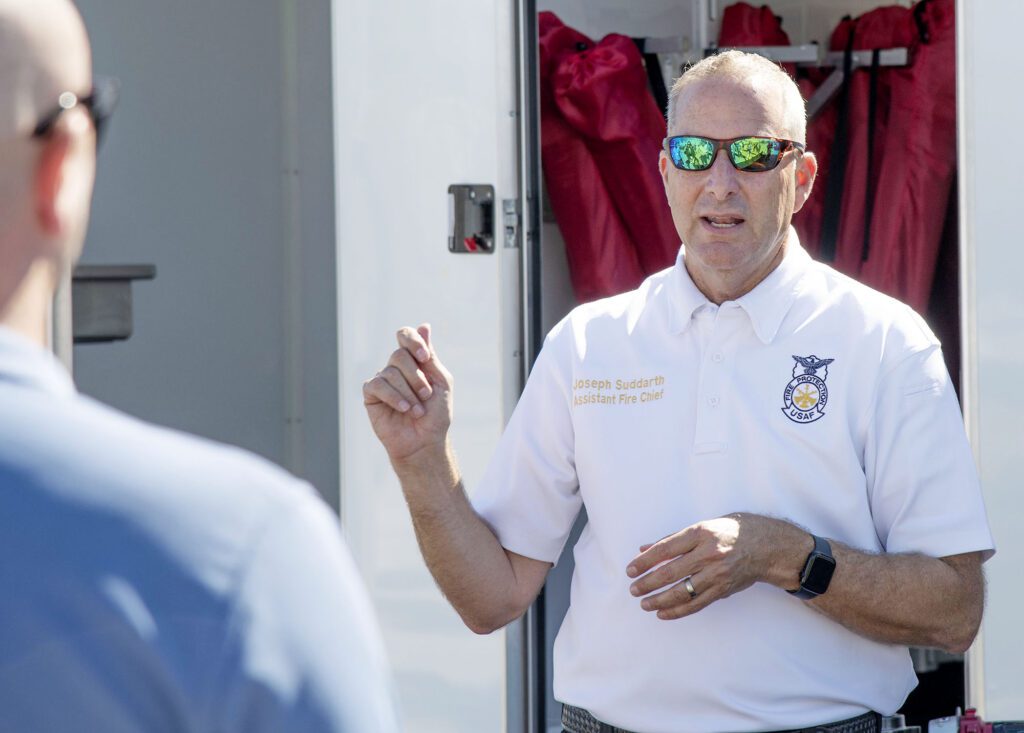
Joseph Suddarth, Eglin Fire and Emergency Services assistant fire chief, speaks to AFWERX personnel at their Fall program management review at the Destin-Fort Walton Beach Convention Center, Oct. 24, 2023. Suddarth highlighted the Eglin Spark Cell’s one and only Air Force wide Specialized Mobile Advanced Rehab Technologies or SMART Trailer, with a mobile climatic chamber designed to reduce heat stress, promote better work and rest cycles for first responders performing jobs in hazardous environments.
Suddarth stated his team learned they have a higher risk of cancer from the contaminants they encounter on the job. According to Centers for Disease Control and Prevention, on a firefighter’s first day on the job there is a 9% increase of cancer diagnoses and a 14% higher risk of cancer-related deaths as related to the civilian population.
The SMART trailer is the first and only Air Force wide rehab trailer. With its extensive uses, other units could potentially benefit such as explosive ordnance disposal teams.
“I wish we had this when I was an explosive ordnance disposal technician,” said Steven Bailey, now the 96th TW chief innovation officer. “Whereas now we have this mobile cleaning chamber, where our people can reduce the likelihood of spreading the contamination.”