Please ensure Javascript is enabled for purposes of website accessibility
Skip to main content
Advertisement

HAPPENINGS: Taking care of your pets and children during hot weather

With the days being so hot, please don't leave your pets outside all day. Bring them in so they have cooler air and make sure there is plenty of water, both inside and outside.

Because our companion pets have fur, they can potentially heat up faster than we do. One important safety procedure to always follow is never leave your pet in a parked car.

On humid days, it is especially important to bring your pets inside as the increased humidity makes it difficult for your pet to cool down through their panting. When it is hot outside, don't expect your pet to walk on ultra-hot asphalt. They can burn their paw pads. Buy some booties made for dogs, walk on the grass only, or best of all, wait until it is evening and much cooler to take them out.

Should your pet get heat exhaustion or heatstroke, here are suggestions from the Humane Society (www.humanesociety.org/resources/keep-pets-safe-heat).

"Move your pet into the shade or an air-conditioned area. Apply ice packs or cold towels to their head, neck and chest or run cool (not cold) water over them. Let them drink small amounts of cool water or lick ice cubes. Take them directly to a veterinarian."

Pets are important members of our families. Just as we don't want to be sitting outside in the extreme heat, neither do our pets enjoy being out in this heat.

Heat strokes in children

Keep your children inside during the heat of the day, as you don't want them to get over-heated or get heatstroke. Let them play outside in the early morning hours and late in the afternoon when the heat isn't as intense.

Make sure that there is plenty of water or drinks with ice for your kids.

Here are a few of the symptoms of heat exhaustion in children from the Children's Health website, https://bit.ly/2UAa2y4.

  • An elevated body temperature, usually between 100˚ and 104˚ Fahrenheit
  • Cool, clammy skin despite the heat
  • Goose bumps
  • Headache
  • Increased sweating
  • Increased thirst
  • Muscle cramps
  • Nausea and/or vomiting

Should your child exhibit any of these signs take them into an air  conditioned environment and give them cool fluids with electrolytes to drink.

Cool wet towels applied to their skin can also help get their temperature down.

If your child won't drink, is agitated or having seizures, call your doctor immediately. If your doctor is unavailable, call 911 or take them to the nearest emergency room. Heat stroke in children can be very serious.

An additional safety tip for both pets and children is to never leave them unaccompanied next to a swimming pool or other body of water.

It only takes a second for a pet or child to fall in and a potential tragedy could occur. Be aware of your surroundings and enjoy your summer!

Janice Lynn Crose

Janice Lynn Crose, a former accountant, lives in Crestview with her husband, Jim; her two rescue collies, Shane and Jasmine; and two cats, Kathryn and Prince Valiant.

This article originally appeared on Crestview News Bulletin: HAPPENINGS: Taking care of your pets and children during hot weather

CHECK IT OUT: Still some time to read for summer challenge

With the summer coming to an end, the Summer Reading Challenge is also coming to an end.

The challenge has gone along swimmingly, but it’s not over yet! There are still more days to read and of course the awards ceremony is not to be missed.

I have heard tale of many wondrous tails to behold and perhaps even hold on July 30 for the youth awards.

Kiddos, remember to bring your parents to the awards ceremony so they can enjoy the tails as well.

The adults are not to be left out either, enjoying a separate awards ceremony on Aug. 6 to culminate the 2021 Summer Reading Challenge.

Although we won’t have tails to enjoy, the tales you can share will encourage more summer readers for years to come.

We can’t wait to see you there and share another part of this journey with you.

If you need more information, don’t forget to stop by the library, 1445 Commerce Drive, Crestview, or online at www.cityofcrestview.org/186/Classes-Clubs-and-Services.

August Whittle is the adult services librarian at the Crestview Public Library.

This article originally appeared on Crestview News Bulletin: CHECK IT OUT: Still some time to read for summer challenge

EXTENSION CONNECTION: Cuban treefrog considered an invasive species

Treefrog calls are often heard with each rain event, but how about a “snoring raspy” call that begins after a day time light rain?

That may be a male Cuban treefrog trying to attract the girls. Cuban treefrogs breed predominately in the spring and summer. Reproduction is largely stimulated by rainfall, especially warm summer rains such as those associated with tropical weather systems and intense thunderstorms.

The Cuban treefrog is considered an invasive species in Florida.

The Cuban treefrog (Osteopilus septentrionalis) was accidentally introduced to Florida in the 1920s as a stowaway in shipping crates from the Caribbean. Over the last 100 years, the invasive frog has managed to spread throughout Florida and the Southeastern U.S. by hitchhiking on ornamental plants, motorized vehicles and boats.

Though occasional cold winters have created temporary population setbacks, new generations of Cuban treefrogs continue to be reported in north Florida, including the Panhandle.

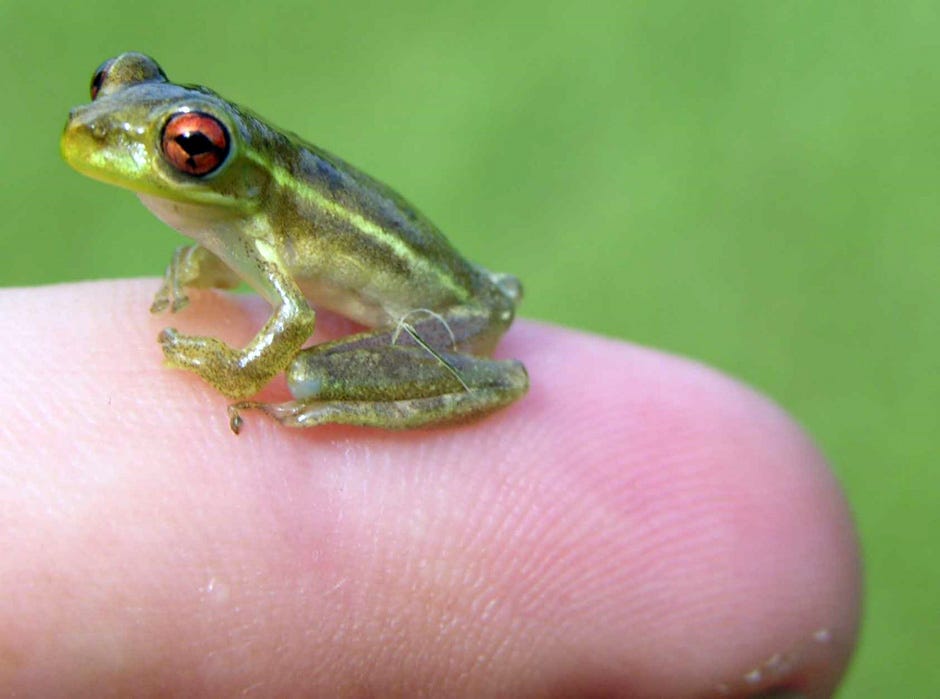
This is a juvenile Cuban treefrog. They eat native Florida frogs and even small snakes, and females can lay over 10,000 eggs per season in small amounts of water.

An invasive species is generally defined as a plant, animal or microbe that is found outside of its native range, where it negatively impacts the ecology, economy or quality of human life.

Cuban treefrogs come out at night to feed on snails, millipedes, spiders and a vast array of insects. But, they are also predators of several Florida native frogs, lizards and snakes.

Tadpoles of the invasive Cuban treefrog have been shown to inhibit the growth and development of native Southern toad and green treefrog tadpoles when all of the species are in the same water body. Additionally, a large female Cuban treefrog can lay over 10,000 eggs per season in very small amounts of water.

Identification

Panhandle citizens can help manage the invasive Cuban treefrog by learning to identify them and reduce their numbers. All treefrogs have expanded pads on the ends of their toes. Cuban treefrogs have exceptionally large toepads. They also have a “big eyed” appearance due to their oversized bulging eyes.

Cuban treefrogs may exceed 6 inches in length, have warty-looking skin with possible blotches, bands or stripes, and vary greatly in color.

However, they can be distinguished from other treefrogs. Cuban treefrogs have a yellowish wash where their front and rear legs are attached to their body. Juvenile Cuban treefrogs have red eyes and blue bones visible through the skin of their hind legs.

Blue leg bones in juveniles are one of the ways the Cuban treefrog may be identified.

The skin of the Cuban treefrog produces a sticky secretion that can cause a burning or itching sensation if it contacts the eyes or nose of certain individuals. It is recommended to wear gloves and wash your hands after handling Cuban treefrogs.

Trapping and euthanizing

It is important to document the locations of Cuban treefrogs in the Panhandle. Placing short sections of PVC pipe in the ground around your home and garden will provide hiding places for the treefrogs that enables you to monitor them.

Cut 10-foot sections of 1.5-inch-diameter PVC pipe into approximately three-foot-long sections and push them into the ground about 3-4 inches.

To remove a frog from a pipe, place a clear sandwich bag over the top end, pull the pipe from the ground, and insert a dowel rod in the other end to scare the frog into the baggie.

Reporting sightings

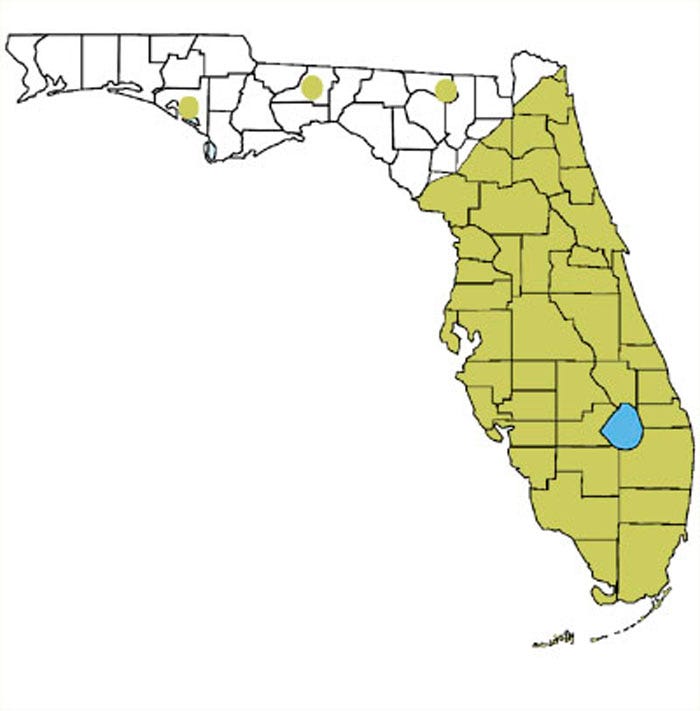
This map shows the range of Cuban treefrogs in Florida.

If you suspect you have seen one, take a picture and send it to Dr. Steve Johnson at tadpole@ufl.edu. Include your name, date, and location. Dr. Johnson can verify the identity.

If it is a Cuban treefrog, upload the information by going to www.eddmaps.org/ and click the “Report Sightings” tab.

Once identified as a Cuban treefrog, it should be euthanized humanly. To do that, the Cuban treefrog in a plastic sandwich bag can be placed into the refrigerator for 3-4 hours then transferred to the freezer for an additional 24 hours.

Alternatively, a 1-inch stripe benzocaine-containing ointment (like Orajel) to the frog’s back to chemically anesthetize it before placing it into a freezer. After freezing, remove the bagged frog from the freezer and dispose of in the trash.

Removing eggs

Ornamental ponds should also be monitored for Cuban treefrog egg masses especially after a heavy rain. The morning after a rain, use a small-mesh aquarium net to scoop out masses of eggs floating on the surface of the pond and simply discard them on the ground to dry out.

Various objects that can collect water found throughout your yard need to be dumped out regularly to reduce breeding spots for both Cuban treefrogs and mosquitoes.

Sheila Dunning

Sheila Dunning is an agent at the University of Florida's Institute of Food and Agricultural Sciences Extension office in Crestview.

This article originally appeared on Crestview News Bulletin: EXTENSION CONNECTION: Cuban treefrog considered an invasive species


HAPPENINGS: I'm considering dumping AT&T services

I have a love/hate relationship with AT&T cellular service. In many ways their service is great, but their customer service has deteriorated over the years and is now lacking.

AT&T has become quite greedy with their late fees, service fees and many other extraneous fees in order to recoup their massive losses on their acquisitions of both Time-Warner and Direct TV. 

These losses are due to AT&T's greed, poor financial choices and have nothing to do with their customers. However, AT&T now views their customers as cash cows, extracting fees at every opportunity. I am not the only person who has noticed this phenomenon.

An article from Wolfstreet — https://bit.ly/3iv1QYb — explains what went so wrong with AT&T and how they are trying to make financial changes. This doesn't sound good and isn't the way to run a fiscally sound business.

"After a horrendously expensive acquisition spree of legacy companies that included DirecTV and Time Warner … AT&T today disclosed that it wrote off $16.4 billion in assets in Q4, for a total $18.9 billion write-off in the year 2020."

The article goes on to say that AT&T ended the year 2020 with a loss of $5.2 billion. No wonder AT&T is continually nickel and diming their customers all the time. They are trying to increase revenues, even as they are losing customers.

For instance, if you pay your bill at an authorized AT&T location, you will be charged a "convenience" fee of $6. If available, and you pay using a kiosk with a credit card and require no help from an AT&T employee, there is no fee. 

People that have been long time customers, such as my husband and me, are getting tired of all the added fees and bogus "late" fees. If one shorts their bill by even a few cents, an automatic $7 late fee is now added.

It doesn't matter how long one has been a customer or how many services one has with AT&T, this is applied across the board. Customer service has gone away with COVID-19 and big companies no longer care if they offend their customers.

I am not the only one talking about problems with AT&T. On May 18, 2021, the Los Angeles Times ran a piece by Business Columnist David Lazarus regarding late fees and poor customer service (https://www.latimes.com/business/story/2021-05-18/att-late-fees).

We, as a family, are ready to try another cell phone company. We haven't settled on one yet and are looking at our options.

Be aware that many companies are adding convenience fees, late fees and all sorts of other money-making schemes to their bills in order to offset their losses or poor business practices.

Be aware, check your statements and watch out for those extra fees.

Janice Lynn Crose

Janice Lynn Crose, a former accountant, lives in Crestview with her husband, Jim; her two rescue collies, Shane and Jasmine; and two cats, Kathryn and Prince Valiant.

This article originally appeared on Crestview News Bulletin: HAPPENINGS: I'm considering dumping AT&T services

EXTENSION CONNECTION: Learn pepper jelly canning at upcoming workshop

CRESTVIEW — Home canning popularity has been rising in the past number of years, but since COVID-19, it has seemed to skyrocket!

People who began gardening and limiting trips to the store had to find a way to preserve their bounty, something our grandparents did many years ago.

Those who register for an Aug. 3  extension workshop at the Okaloosa extension office in Crestview will make a jar of their own pepper jelly to take home.

Home canning safety

Canning may seem very familiar to us. The glass jars, metal bands, and speckled canner all look the same; they haven’t seemed to change much since our grandparents used them many years ago. What has changed are the developments in the science of food and canning safety.

Today, science is used to research the best methods for canning foods, the cooking time needed to kill harmful microorganisms in food, and the best way to sterilize our equipment.

Science has shown methods used in the past, such as using an oven to heat jars until they seal or open kettle canning. Newer techniques, such as using the dishwasher, microwave, or electric multi-cooker canning, have also been found not to be safe.

In some instances, these canning methods may encourage the growth of microorganisms in canned foods, increasing the risk of foodborne illness, such as botulism.

Foodborne illness symptoms can be severe. For example, the symptoms of botulism include severe cramping, diarrhea, nausea or vomiting, difficulty breathing, muscle weakness, paralysis, and death. In a person with a compromised immune system, a very young child, or an elderly person, these symptoms can be even more dangerous.

For the best, updated information on safe home canning practices, contact your local Family and Consumer Science Extension Agent; visit the National Center for Home Food Preservation website at https://nchfp.uga.edu; and follow the guidelines in the U.S. Department of Agriculture Complete Guide for Home Canning.

This guide can be downloaded for free at https://nchfp.uga.edu/publications/publications_usda.html.

Pepper jelly workshop

If you would like to learn more about home canning, join the extension office's Pepper Jelly Workshop, which is scheduled from 5:30-7:30 p.m. Aug. 3 at 3098 Airport Road, Crestview.

Registration is required and can be completed by visiting  https://okaloosacanning2021.eventbrite.com.

The cost is $15 per person; class size is limited.

During this class, you will learn how to prepare home-canned goods using the water-bath canning method and USDA guidelines to prevent foodborne illness.

The best part is you will get to take home a jar of your very own pepper jelly!

For more information about food preservation methods or classes contact Jill Breslawski, Family, and Consumer Science, with the UF/IFAS Okaloosa County Extension at 850-689-5850 or jbreslawski@ufl.edu.

Jill Breslawski

Jill Breslawski is an agent at the University of Florida's Institute of Food and Agricultural Sciences Extension office in Crestview.

This article originally appeared on Crestview News Bulletin: EXTENSION CONNECTION: Learn pepper jelly canning at upcoming workshop

HAPPENINGS: COVID-19 doesn't bring out the best in people

When we think of bullies, we think of the mean kid on the playground that steals other children's lunch money or that neighborhood kid always getting in trouble for beating up younger children.

Webster's online dictionary defines bully as "one who is habitually cruel, insulting, or threatening to others who are weaker, smaller, or in some way vulnerable." We have all run across adults who are bigger bullies than any child on the playground.

Janice Lynn Crose

In many ways, COVID-19 didn't bring out the best in people. There are those who are extremely authoritarian and controlling and have tried to bully others, from the wearing of masks to vaccinations.

Now that an experimental vaccine is available, some would like to force-vaccinate everyone, including those who question the efficacy and safety of this mRNA shot.

Do we really have freedom if we can't control what goes into our body? I know of a few people that think they should decide for everyone else, but in this country, we have freedom and that includes the freedom to accept or decline an experimental vaccine.

Many people are unaware of VAERS (Vaccine Adverse Event Reporting System) that is run by the Centers for Disease Control and Prevention. You can find it here: www.cdc.gov/coronavirus/2019-ncov/vaccines/safety/adverse-events.html.

There are several severe reactions people have had, including death, so this isn't something that should be taken lightly as it could affect your life.

I have a friend whose father's heart stopped after his vaccine. His life was saved, but he spent 15 days in the hospital, mostly in the Intensive Care Unit, and now walks with a walker, something he never did before.

Denmark has suspended some brands of vaccines because of safety concerns. According to a Reuters story, "Denmark on Monday became the first country to exclude Johnson & Johnson's COVID-19 shots from its vaccination programme over a potential link to a rare but serious form of blood clot."

The move comes after the Nordic country stopped using AstraZeneca's vaccine altogether last month citing similar concerns.

The country's health authority said in a statement (https://yhoo.it/3wp96td) it had found that "the benefits of using the COVID-19 vaccine from Johnson & Johnson do not outweigh the risk of causing the possible adverse effect in those who receive the vaccine."

As one can see, receiving this vaccine is not quite as simple as one may think. Plenty of medical personnel and scientists are concerned about possible side effects from these vaccines.

The government shouldn't coerce or force anyone to have a vaccine that hasn't been thoroughly vetted through long-term testing. This is a serious decision and one that each individual or family must make for themselves.

We all want COVID-19 eradicated, but we also don't want someone to die from the Emergency Use Authorization vaccine.

There are many people who want to wait and see what the long term effects are from this vaccine before they introduce it into their body, and they shouldn't be bullied for this decision.

Realize there are differing opinions on this subject. And truthfully, someone else's vaccination status is not your business.

Let's be kind to each other here in Crestview!

Janice Lynn Crose, a former accountant, lives in Crestview with her husband, Jim; her two rescue collies, Shane and Jasmine; and two cats, Kathryn and Prince Valiant.

This article originally appeared on Crestview News Bulletin: HAPPENINGS: COVID-19 doesn't bring out the best in people

Next family movie night features Disney animated adventure

CRESTVIEW — Pack up the kiddos, the blankets and folding chairs and head to the Spanish Trail Park amphitheatre Crestview Family Movie Night.

Families and neighbors socialize before the start of a previous Family Movie Night feature at the Twin Hills Park amphitheatre in Crestview.

Up on the screen will be a PG-rated computer animated Disney feature that was released earlier this year.

The movie starts 8 p.m. Saturday, July 17, at the Old Spanish Trail Park amphitheatre, located on Stillwell Boulevard in Crestview. Enter the park from the gate on Stillwell Boulevard.

A program of the Mayor’s Cultural Series, the free film screening is sponsored by community business partner Keller Williams Emerald Coast Realty of Crestview.

The story in a nutshell: Once upon a time, dragons and humans lived happily together in a fantasy world called Kumandra. Evil monsters called Druun tried to spoil that harmony, but the dragons sacrificed themselves to save humanity. Now, the bad critters are back, and a lone warrior named Raya must find the sole remaining dragon to put an end to the Druun once and for all.

Due to licensing restrictions, the city of Crestview can’t announce the name of the film. Visit the city’s Facebook page or website for details.

“We’ve been getting a wide variety of great films for our families this year,” Crestview Mayor JB Whitten said. “and it’s all possible thanks to community business partners like Keller Williams. We thank them all for making this family movie program possible.”

Featured food vendors Love and Tacos, Sports to Geaux and Retro Snow will offer a variety of cuisine and sweets to choose from. 

This article originally appeared on Crestview News Bulletin: Next family movie night features Disney animated adventure

EXTENSION CONNECTION: Drones can be used for work and recreation

CRESTVIEW — Drones are definitely a useful tool in many professions these days. Industries such as agriculture, engineering, utilities, military, and real estate use drones to collect data and images.

Drones can also be a lot of fun to fly as a hobby, but there are rules to drone flying that we all must follow in order to safely share the airspace. Drones are regulated by the FAA (Federal Aviation Administration).

If you are flying purely for fun and enjoyment, you are considered a recreational pilot. As such, there are rules that you must abide by.

Drones can be used for work and fun. They are regulated by the Federal Aviation Administration.

First, you must register your drones at FAA Drone Zone. Any drone weighing between 0.55 pounds and 55 pounds must be registered and marked with the FAA registration number. The cost is $5 and is valid for three years.

The FAA has recently launched The Recreational UAS Safety Test (TRUST). The FAA selected 16 organizations to provide education and testing for recreational pilots.

Our very own HSU Educational Foundation is one of the selected organizations. You can receive your TRUST certificate at https://aaollc.com/recreational-uas-safety-course/.

If you fly for any other purpose than just fun or enjoyment, you fall under Part 107 and need a Remote Pilot Certificate. To be eligible to obtain a Remote Pilot Certificate, you must be at least 16 years old, able to read, speak and understand English, and be mentally and physically able to safely fly a UAS (Unmanned Aircraft System).

To obtain the certificate, you must pass the initial aeronautical knowledge exam: "Unmanned Aircraft General – Small.”

Once you receive your certificate, you must complete online recurrent training every 24 months in order to maintain your certification. Certified Remote Pilots must also register their drones at the FAA Drone Zone and mark each drone with the FAA Registration number. This costs $5 each drone and is valid for three years.

Drones are a great tool for many industries, as well as just fun to fly, but you need to know and follow the rules before you fly.

If you have any questions regarding drones, you can visit the FAA website (www.faa.gov/uas/) or you can contact me at bearden@ufl.edu.

Jennifer Bearden

Jennifer Bearden is an agent at the University of Florida's Institute of Food and Agricultural Sciences Extension office in Crestview.

This article originally appeared on Crestview News Bulletin: EXTENSION CONNECTION: Drones can be used for work and recreation

HAPPENINGS: Celebrating our freedom and Independence Day

CRESTVIEW — This past weekend, we celebrated the 245th birthday of the United States of America. How did you and your family celebrate? Did you participate in the activities at Twin Hills Park?

I enjoy fireworks and love to see a big display. It is nice that things like our festivities weren't cancelled and that we could celebrate as a community here in Crestview.

What does our country mean to you? Do you value your freedom and the independence we have in this country? The fact that we can travel from state to state and even leave the country? Are you happy with your state? If not, you are free to find a job in a different state and move.

Sometimes we take our freedom for granted. We are very blessed to live in a country where we can worship at the church of our choice, work in the profession we choose, attend the schools of our choice and drive the cars we like. We are blessed that we have the freedom to make our own choices.

There are those that say we have too many choices, but I disagree. That is part of what makes our country wonderful, our freedoms, our liberty and the ability to make our own choices.

Here is the definition of liberty (http://webstersdictionary1828.com/Dictionary/Liberty): "Freedom from restraint, in a general sense, and applicable to the body, or to the will or mind. The body is at liberty when not confined; the will or mind is at liberty when not checked or controlled. A man enjoys liberty when no physical force operates to restrain his actions or volitions."

As you can see, freedom and liberty are words that can be used interchangeably and we need to cherish our liberty and freedom.

The Pledge of Allegiance states: "I pledge allegiance to the flag of the United States of America and to the Republic for which it stands. One nation, under God, indivisible, with liberty and justice for all." These are good words to remember not only during our celebration of Independence Day, but every day.

I hope that you and your family took some time to reflect on the lives that were lost when our country broke away from Britain, and the hardships and danger that accompanied that war for our independence.

We owe a huge debt of gratitude to our founding fathers and those who wrote our Constitution and paved the way for our freedom!

Remember, that freedom isn't free. It always has a price. Thank you to the men and women who sacrificed so much to make us a free nation.

Janice Lynn Crose

Janice Lynn Crose, a former accountant, lives in Crestview with her husband, Jim; her two rescue collies, Shane and Jasmine; and two cats, Kathryn and Prince Valiant.

This article originally appeared on Crestview News Bulletin: HAPPENINGS: Celebrating our freedom and Independence Day

Check It Out: Poetry collection written at library now available there

CRESTVIEW — Folks visit the Crestview Public Library for many different reasons.

Some go to check out books and movies. Others attend youth, teen and adult programs. Some just love the atmosphere, being surrounded by great thoughts, concepts and stories.

And some seek inspiration for literary works of their own.

Crestview Public Library patron Hugh A. Parker II composed this book of poetry while visiting the library. He donated several copies to the library. Enjoy some delightful poetry as part of your summer reading!

“A gentleman came in and used our computers to write a book of poetry,” Crestview Public Library Director Jean McCarthy said. “Then he recently returned and donated several copies of the published book to the library!”

Hugh A. Parker II published “The World’s Greatest Poems,” a slim volume of reflections that reflect his spirituality and connectivity with nature. Published by Page Publishing, the work is sumptuously and colorfully illustrated by Melissa Santiago.

“As a man of this world and of God’s Spirit, it is my soul’s duty to stand up for this world and all of our people,” Parker wrote in a letter inserted in the front of one of the copies of the book.

Pieces the poet composed at the library include the whimsical “A Frog named Moe,” the heartfelt “The Color of Love,” the hopeful “The Flower of Summer and Spring,” the spiritual “The Raindrop,” and the reflective “Brighter than Gold.”

The dedication in the back of the volume says in part, “To my World with Love.”

For a quick summer read, pop by the Crestview Public Library and relish the poetry — and world — of Hugh A. Parker’s “The World’s Greatest Poems.”

To learn what else your library has to offer, including books of poetry, visit www.cityofcrestview.org/178/Library, call 850-682-4432, and follow the library on Facebook and Instagram.

Brian Hughes

Brian Hughes is the city of Crestview's public Information officer. 

This article originally appeared on Crestview News Bulletin: Check It Out: Poetry collection written at library now available there

error: Content is protected !!