Please ensure Javascript is enabled for purposes of website accessibility
Skip to main content
Advertisement

LETTER: Unsatisfied with local foster family services (VIDEO)

Editor's Note: This resident uses a pseudonym due to the situation's sensitivity.

Regarding your article informing people of FamiliesFirst Network needing people to take care of foster children:

Let your readers know that this is not an easy process.

It is very hard to become certified in the first place. 

—Below: Watch "Editor's Notes" to learn more about this letter—

Once you do become certified, there are a number of things that could happen to you and your family that FFN and Department of Children and Families do not tell you about. 

I have been in the military for over 10 years, and my wife and I already have four amazing kids. We wanted to adopt but saw the need to take care of foster children.

We were accused and found guilty of neglect and abuse by DCF after five months of taking care of two wonderful children. We have no problem with investigations being conducted for the children's safety and wellbeing; however, we believe this investigation was biased and not conducted in any sort of professional manner so as to ascertain if any abuse actually took place.

We are not the first family to be wrongly accused of abuse. And because of this, six families at our church will now not become foster parents.

I say that to say this: If you want to foster, do your homework, and have $10,000 in the bank for your lawyer's fees.

Be prepared to not be able to foster or adopt because someone somewhere said your kid might be abused.

What's your view? Write a letter to the editor.

This article originally appeared on Crestview News Bulletin: LETTER: Unsatisfied with local foster family services (VIDEO)

LETTER: Headline misses point of King's dream (VIDEO)

It is not too difficult to picture the image of Martin Luther King Jr., before the Lincoln Memorial shedding a tear over the headline, "Chamber's first black president takes command." 

Sad that after all these years our lives are still missing the elusiveness of Dr. King's "I have a dream." 

To the degree that the headline misses what Dr. King wanted for his children, and Alicia Booker, we should all be crying. 

Click here for the editor's response to this letter>>

This article originally appeared on Crestview News Bulletin: LETTER: Headline misses point of King's dream (VIDEO)

LETTER: Okaloosa roads still need repairs following flood

Okaloosa County, why have you not fixed roads, dams and water runoff areas after the historic flooding in April?

Roads like Oak Hill are still impassable. They continue to erode every time it rains because of no action by the county.

Then to hear that you want to raise our tax to cover the storm damage is completely ridiculous.

You have received money from FEMA to fix damage! Why is there not a plan in place to be able to fix damage caused by natural disasters?

I think the county residents deserve answers!

This article originally appeared on Crestview News Bulletin: LETTER: Okaloosa roads still need repairs following flood

GUEST COLUMN: Why our industrial age schools are failing our information age kids

In spite of the billions of dollars spent on educational reform since “A Nation at Risk” was published in 1987, more than half of America’s high school seniors are not proficient in reading, and 75 percent can’t do math, according to the recently released National Assessment of Educational Progress.

“Clearly, the current approaches to educational reform are failing,” says notes educational researcher and consultant Charles M. Reigeluth, author of “Reinventing Schools: It’s Time to Break the Mold." Reigeluth said, "The problem is that major aspects of our educational system were devised to meet the societal needs of a bygone era.”

“We need to change the paradigm – we need to move from Industrial Age ‘factory model schools’ to accommodate and reflect Information Age needs and realities.”

The Industrial Age in the United States, roughly 1830 to 1960, was shaped by machinery and mass production. Many jobs moved from farms to factories, which required workers – and therefore students – who would follow instructions and endure repetitive, boring tasks, he says.

“We did not need to educate many people to high levels, so Industrial Age schools sorted students, promoting the few needed for managerial and professional work, and flunking out the many needed for the assembly lines,” says Reigeluth, a former high school teacher and Indiana University professor.

“Today, knowledge work is more common than manual labor, and our systems are far more complex. All adults need a higher degree of knowledge just to function in society, so we can no longer afford a system that is designed to leave many children behind.”

Here are four Industrial Age educational artifacts, according to Reigeluth, and how to update them for the Information Age:

•  Time-based student progress: Currently students in a class move on together to the next topic according to the calendar, regardless of whether they have learned the current material.  Slower students accumulate learning gaps that make it more difficult for them to master related material in the future, virtually condemning them to flunk out. The system is designed to leave many children behind.

A paradigm designed to leave no child behind would allow each student to move on as soon as he or she has learned the current material, and no sooner.  This requires “personalized learning’’ and “learner-centered instruction” that is both high-tech and high-touch.

•  Standardized and other broad tests: Rather than evaluating a student based on how much he or she has learned in a certain amount of time, such as a 9-week period, each student should be evaluated to determine when the material has been learned, so we know when the student is ready to move on. This is called “criterion-referenced assessment,” a different paradigm from “norm-referenced assessment.”

“A big test with 20 different topics, as we use now, shows only how much a student knows compared to other students,” Reigeluth says. “In the Information Age paradigm, all students are expected to finish learning whatever they undertake to learn. Like a Boy Scout working on a badge, each student continues to work until the material is mastered.”

Assessments, then, are incremental and cover a single competency, or a small set of competencies. They certify mastery while also helping guide learning by showing students what they need to continue working on.

•  The traditional grading system: The traditional grading system indicates how well a student performed compared to the other students in a class – a tool that is only effective in sorting students. It’s not an effective way of guiding and ensuring individual student learning, and it tells you little about what the student has learned.

“Rather than achievement reflected as grades on a report card, it would be reflected as lists of skills and concepts that the student has mastered,” Reigeluth says.

•  Locking students into grades: Grade levels are incompatible with the Information Age model because students learn at different rates and become ready to move on to different material at different times. Grade levels are a key feature of the time-based, sorting-focused paradigm that served us well during the Industrial Age, but are detrimental to meeting Information Age educational needs.

Instead, group students into similar developmental levels, which typically span three to four years.

“Grouping developmentally, rather than based on age or rigid levels of content learning, accounts for the different rates at which children develop socially and emotionally,” Reigeluth says. “Children can remain in their social-emotional peer group while working on projects typically tackled by students of a higher or lower age.”

Charles M. Reigeluth is a distinguished educational researcher who focuses on paradigm change in education. He has a B.A. in economics from Harvard University, and a Ph.D. in instructional psychology from Brigham Young University. He was a professor at the Instructional Systems Technology Department at Indiana University, and is a former chairman of the department. His new book, “Reinventing Schools,” available from his website, advocates and chronicles a national paradigm change in K-12 education. He offers presentations and consulting on this topic.

This article originally appeared on Crestview News Bulletin: GUEST COLUMN: Why our industrial age schools are failing our information age kids

LETTER: City leaders should campaign for more business

Wow, another fast food restaurant is being built. Is this all this town is capable of bringing in?

Crestview's population has grown enormously over the last few years. When are the city leaders going to go out and campaign to get more established businesses?

Trying to revitalize Main Street is a good idea, but I think they need to revitalize the city. Residents are driving to Destin, Fort Walton and Niceville to meet their needs.

The mall project just seems to live and die.

This town needs to grow.

This article originally appeared on Crestview News Bulletin: LETTER: City leaders should campaign for more business

LETTER: Ditch cancerous meat; enjoy Memorial Day with veggie burgers

Dear Editor:

Folks setting to break out their outdoor grill on Memorial Day face a deadly choice of inflicting food poisoning or cancer on their family and friends. Food poisoning by E. coli and Salmonella bacteria, if they undercook their meat. Cancer – if they heat their meat to the point of creating cancer-causing compounds.

Luckily, a bunch of enterprising U.S. food manufacturers and processors have met this challenge head-on by developing a great variety of healthful, delicious and convenient, veggie burgers and soy dogs. These delicious plant-based foods don’t harbor nasty pathogens or cancer-causing compounds. They don’t even carry cholesterol, saturated fats, drugs, or pesticides. And, they are waiting for us eagerly in the frozen food section of our supermarket.

This Memorial Day offers a superb opportunity to consign meat to a bad memory and to share wholesome veggie burgers and soy dogs, covered in barbecue sauce, with our family and friends.

This article originally appeared on Crestview News Bulletin: LETTER: Ditch cancerous meat; enjoy Memorial Day with veggie burgers

LETTER: Who's really on welfare, Cliven Bundy?

Dear Editor,

It’s ironic for rancher Cliven Bundy to excoriate poor people for collecting government subsidies, while ripping off the federal government of a million dollars in grazing fees. But, even if he were to pay up, Bundy and his fellow ranchers would still be living on government welfare.

According to the Center for Biological Diversity, livestock grazing is subsidized by federal agencies on public land in 11 western states to the tune of nearly $300 million annually. Monthly grazing fees per cow and calf on private rangeland average $11.90, but corresponding fees on federal lands are set at a paltry $1.35.

Even so, grazing subsidies are dwarfed by other government subsidies and the medical, environmental, and other external costs imposed on society by animal agriculture. These extra costs have been estimated at $414 billion annually, or $3,600 per household.

Each of us can make our $3,600 annual contribution to the common good by replacing animal products in our diet with the rich variety of grain, nut, and soy-based meat and dairy alternatives in our neighborhood supermarket.

This article originally appeared on Crestview News Bulletin: LETTER: Who's really on welfare, Cliven Bundy?

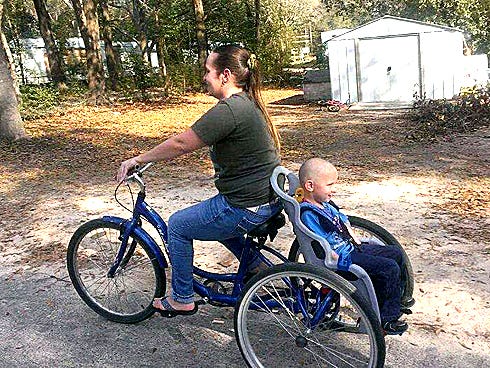
LETTER: Tricycle theft particularly affects 11-year-old

Have you seen this tricycle? The owner says it was stolen.

Dear editor:

On April 25, someone came into our yard and stole my granddaughter Alexis' adult tricycle.

That bike was hers and only hers. She is so heartbroken over this I cannot even explain.

Please — all we want is her pride and joy back. If you see it, please call us, 912-339-7471 or 912-339-7429, anytime!

Please help us.

This article originally appeared on Crestview News Bulletin: LETTER: Tricycle theft particularly affects 11-year-old

LETTER: Relay For Life luminaria sales support Sharing And Caring

Dear editor,

Because of the generosity of everyone who participated in the 2014 Relay For Life luminaria ceremony, we were able to donate 671 canned goods to Sharing And Caring of Crestview. 

The donations will go a long way to help meet the needs of people in our community who cannot make it entirely on their own.

Thanks to Thomas Boni and the Crestview News Bulletin for helping get the word out.

This article originally appeared on Crestview News Bulletin: LETTER: Relay For Life luminaria sales support Sharing And Caring

LETTER: PJ Adams, Antioch roads need repairing

It should embarrass Crestview residents that the first impression of our city that hundreds of tourists passing through town each month get is the cracked, rutted and potholed Antioch and P.J. Adams Parkway roads.

Once the tourist passes the fire station on P.J. Adams, he or she takes their life in their hands before reaching Highway 85.

(One wonders) whether local county commissioners or city council members ever travel that stretch of road. If they did, it might be repaired or condemned by now.

Yes, there is "talk" of widening the road in two years — but there will be nothing left to widen in two years.

It will be one giant pothole by then!

What's your view? Write a letter to the editor

This article originally appeared on Crestview News Bulletin: LETTER: PJ Adams, Antioch roads need repairing

error: Content is protected !!