




Please ensure Javascript is enabled for purposes of website accessibility
Skip to main content
Advertisement
Advertisement

PAWS says county declines renewal at higher cost

The Panhandle Animal Welfare Society (PAWS) executive board voted April 30 to end its contract with the county. Service stops on Sept. 22. Animal control is mandatory per state statutes, so the county must have a solution.

The money will come from surtax reserves and can only be spent on capital costs, such as shelter construction, vehicles, kennels and equipment. In county documents, the county’s attorney said animal control is a matter of public safety and can use surtax funding.

Deputy County Administrator Craig Coffey laid out a two-part plan that is still in the works.

“In the north end, we’re working hard with the city of Crestview,” he said. “We hope to continue that partnership.”

Coffey explained that Crestview would provide animal control and sheltering; the county would pay to retrofit an existing building, estimated at anywhere from $750,000 to $1.2 million, tripling its capacity.

In the south, Coffey said the county will hire officers directly and either contract for shelter space or build its own.

In the rejected offer, the county proposed $6.25 per capita for a south county-only contract covering around 40,000 people. It was the same fee that three other cities gave PAWS, plus annual increases, two vehicles worth $25,000 each, inmate labor, county fuel and ordinance changes cutting the mandatory hold from five days to three days.

Commissioner Paul Mixon said the fallout has reached his office.

“I received a lot of correspondence on this. Not very nice correspondence on this. However, I think it needs to be reminded to fold that PAWS terminated their contract,” he said. “They chose to not move forward in business with us.”

Okaloosa County Public Safety Director Patrick Maddox said the county has also scaled back hiring. He noted that it advertised a chief-level position to run the program but said negotiations with a finalist and another possible partner in the south end changed the math.

“We will likely not have a chief over the division at this time,” he said. “We can always scale up if the situation presents itself.”

Looming over future funding is the proposed “Save Our Homes From Excessive Property Taxes” amendment on the November ballot that could reduce the county’s general fund balance by around $35 million if it passes.

Commissioners approved a bare-bones “animal control light” model in June, and Commissioner Carolyn Ketchel pressed on whether they could ever do more in the future.

“We’re all nervous about every aspect of county government because we’re not going to have the money for services that we currently have, let alone beginning new services,” she said.

Maddox noted that the reason they went ahead with the surtax ask rather than using general fund dollars was the timing of the proposal due to PAWS’ decision.

“We didn’t expect the rug to be pulled out on the contract,” Maddox said.

According to county documents, the Infrastructure Surtax Advisory Committee approved the recommendation at its meeting on July 28.

In a statement to the Crestview News Bulletin, Tracey Kinsley, the executive director of PAWS, said that animal control has always been a public safety function that serves the community and that the responsibility of footing the bill falls on government.

“These are governmental responsibilities and should ultimately be operated and funded by a government entity—not by a small nonprofit organization whose primary mission is animal sheltering and lifesaving,” wrote Kinsley. “PAWS has been significantly underfunded for decades while providing a government public safety service.”

Kinsley also responded to allegations from county officials who said during the meeting that they were caught off guard by the decision.

“Mr. Coffey met with me, and we discussed a few options, however, I never received a proposal like he said. Nothing in writing. He did offer prisoners – but we would have to pick them up and return them at the end of the day, all without supervision,” she said. “We already pay them for our fuel costs at the end of the month, so there was no change there, and he said he “might” have a vehicle he could provide.”

PAWS receives $814,000 per year to provide animal control services, taking in about 1,300 animals each year. According to Kinsley, the organization spends $1 million on intake costs for the animals, which include vaccinations, medical evaluations, food, housing and daily care.

What the figure does not include, according to Kinsley, is “substantial operational expenses,” such as vehicle purchases and maintenance, fuel, insurance, administrative support, equipment and other overhead costs.

Kinsley said the shelter accrues $500,000 in losses each year.

“No nonprofit should be expected to jeopardize its own financial stability to subsidize a governmental service indefinitely,” said Kinsley. “Our mission is to save animals’ lives, provide exceptional shelter care, and serve our community—not to jeopardize the future of the organization by continually funding governmental responsibility.”

Kinsley said that in the end, the decision was never about walking away from the community, but rather making sure PAWS could remain financially solvent and “mission focused” as it continues to provide services for animals.

“While our role in providing Animal Control services for unincorporated Okaloosa County is coming to an end, our commitment to the animals and people of this community is not,” Kinsley said.

“This transition allows us to strengthen our organization, invest more deeply in lifesaving programs, expand the services that directly support our mission, and ensure that PAWS continues to be a trusted resource for our community well into the future.”

 

Crestview Approves Use of Federal Forfeiture Funds for Police Equipment, Training

The approved funding includes:

  • $15,000 for a new K-9 dog, including training and equipment
  • $15,000 for crime scene photography 3D scanning equipment
  • $7,000 for a tactical pole-mounted camera system
  • $2,583 for GPS tracking and mapping systems, including software and equipment

The forfeiture funding stems from the department’s participation in a multi-agency drug task force that coordinates with federal law enforcement. In cases that result in convictions, assets tied to criminal activity may be seized. The federal government then redistributes those funds to participating local agencies, with spending restricted to specific law enforcement purposes and subject to local governing body approval.

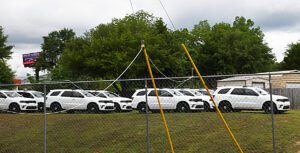
Police vehicles are parked in the Crestview Police Department’s lot. Recently, the Crestview City Council authorized the use of forfeiture funds to purchase new equipment and fund training programs. (Photo by Lindsey Stroud)

Crestview Police Chief Stephen McCosker said the proposed purchases represent “a good use of the funds.”

McCosker noted that Crestview’s Police Officer of the Year was assigned to the task force responsible for generating the forfeiture revenue.

“These funds are coming from his efforts in that role,” McCosker said.

He also emphasized the value of K-9 units in past investigations and the need to maintain a balanced program with dogs at different stages of service.

“Some of those funds were collected because of the use of K-9 programs,” McCosker said. “We don’t get all the dogs at the same time … we need different dogs at different stages of their work life.”

McCosker also highlighted the department’s SWAT team, which recently executed five simultaneous search warrants, underscoring the need for enhanced safety equipment.

“A pole camera is not something that would be fixed in a location – it’s used for officer safety during high-risk search warrants,” he said. “We can extend that camera further than a person can safely go.”

He added that the department had previously sought funding for GPS tracking and mapping systems, but available grant funding had fallen short.

The total cost of the requested items is $39,583, below the approximately $43,000 currently available in forfeiture funds. McCosker said the department also expects to receive an additional $30,000 in future forfeiture revenue.

The City Council approved the request in a 4-0 vote, with one member absent.

Florida Department of Health addresses Respiratory Syncytial Virus (RSV) in Florida

 RSV is an infection of the lungs and respiratory tract with symptoms similar to a common cold. Mild case symptoms can include congested or runny nose, dry cough, low-grade fever, sore throat, sneezing, and headache. In severe cases, RSV symptoms may include fever, cough, wheezing, rapid or difficulty breathing, or bluish skin color.

To protect yourself and others from respiratory illness, Florida DOH is asking people to follow five steps.

The first step is to wash your hands often with soap and water. If soap and water are not available, DOH advises you to use alcohol-based hand sanitizer. The second step is to avoid close contact with people who are sick.

Step three is to clean and disinfect frequently touched surfaces. The fourth step is to stay home if you are sick. If you have children who are sick, keep them at home as well.

The fifth step is to cover your mouth and nose when sneezing and coughing. DOH says if you don’t have a tissue, cough or sneeze into your upper sleeve or elbow, not your hands.

According to DOH, infants are the most affected by RSV. Symptoms of severe cases in infants are short, shallow, and rapid breathing, struggling to breathe, cough, poor feeding, unusual tiredness, or irritability.

Most children and adults recover in one to two weeks, although some might have repeated wheezing. Severe or life-threatening infection requiring a hospital stay may occur in premature infants or in anyone who has chronic heart or lung problems. For more information, please visit the Florida Department of Health and Centers for Disease Control and Prevention (CDC)

BBB warns public about DNA testing contacts

PENSACOLA — Several people have been calling senior service providers like SHINE (Serving Health Insurance Needs of Elders) with the Northwest Florida Area on Aging, reporting they have had visits from someone claiming to provide genetic testing.

These "visitors" have shown up at local senior centers and individual homes. Victims are also being contacted by a phone caller requesting Medicare information prior to providing the tests.

BBB offices from across the United States have also received reports of consumers being asked to take part in free DNA testing. Consumers are told the test can detect cancer and other diseases. Consumers are asked to provide Medicare and Medicaid information so the company doing the testing can file insurance claims. 

While genetic testing is a legitimate service, it is not always covered by Medicare. Consumers should always consult with their primary caregiver before agreeing to tests not initiated directly from them. 

BBB tips on avoiding health care scams

•Do not give out your personal identifiable information with someone who has contacted you unsolicited whether it's over the phone, by email, or on social media. This includes banking and credit card information, your birthdate, Social Security number, and your health insurance number.

•Never consent to any lab tests at senior centers, health fairs, or in your home. Be suspicious of anyone claiming that genetic tests and cancer screenings are "free" or "covered by Medicare."

•If you need genetic testing, always work with your doctor. Medicare only covers genetic tests that are medically necessary and ordered by your primary physician.

•Monitor your Medicare Summary Notice to see if there are any services you did not receive (or if you were billed for services that you can’t identify)

•Research any business and its owners carefully. Check the company’s BBB Business Profile at bbb.org.

•Do not trust a name or phone number. Con artists often use official-sounding names or mask their area codes to make you trust them.

•Make sure to verify their credentials before you allow them to assist you. Just because someone is dressed like a healthcare professional, it doesn’t mean they are qualified to practice medicine.

•If you think you are a victim of this scam, be sure to take steps including: contacting Medicare and other services to protect your identity.

Share your experience to educate others at BBB.org/scamtracker.

This article originally appeared on Crestview News Bulletin: BBB warns public about DNA testing contacts

BBB lists top scams for college students to avoid

PENSACOLA, Florida — College students are often intended targets of scams. Newly independent and excited to be on their own, that freedom can make them targets of and susceptible to scams.

Students may not always recognize when a scam comes knocking. As college students begin to head back to campus, the Better Business Bureau wants to remind students and parents about preventing fraud when they’re away from home.

BBB has some information on the top scams for college students to avoid:

Roommate-rental scheme – If you post an ad for a roommate on Craigslist, beware of “fake roommates” who are out of the country, but can provide the rent upfront in the form of a money order. When you receive it, the amount is higher than the amount requested (overpayment scam). You are asked to cash it, and wire back the rest. This is a scam!

Credit cards – Credit card offers are all over campus. While it is important to build credit, it is more important to maintain good credit. Many of these cards have annual fees or charge high interest rates on purchases. Shop around for the best rate and pay off your credit card bills every month.

Employment – Beware of ads that pop up near campus offering jobs with “no experience necessary.” Often, these “opportunities” are bogus! If you are interviewed in a hotel lobby or required to sign a contract, or have to pay for everything including training, travel, lodging, food, etc. associated with the job – forget it! Check out a company first with bbb.org.

Scholarships and grants – Scholarship-finding services “guarantee” grants or scholarships. They sell lists to students on potential scholarship or grant opportunities. However, nearly all available financial aid comes from the federal government or from individual colleges. Go to grants.gov for more information.

Safeguard your ID – Keep your personal information, including your driver’s license, student ID, debit cards, credit cards, and bank information in a SAFE place. Be wary of any online solicitations, emails, social media sites, or phone calls asking for your personal information. NEVER give out personal information to someone you don’t know.

Locksmith scams – College students are prone to locking themselves out of their homes or cars. If this happens to you, you probably will use your cell phone or local yellow pages to find a nearby locksmith. Problem is, some disreputable locksmiths will post bogus addresses in their ads to make them appear local, when they’re not. Check out the company first, and make sure you are not over-charged for services. (BBB recommends researching first and keeping the local, reputable locksmith’s contact information in your purse or wallet).

Online shopping deals – You see a much-wanted item for a steep discount online. The catch? The site asks you to wire payment to them instead of using a credit card – a huge red flag. Once the money is sent, the item is never received.

Also make sure you have the company’s address, and double check it to make sure the address exists (and isn’t a rented drop box). Before providing your credit card information online, be sure that the lock icon and https: appears in the URL.

Trial offers – From fitness club memberships to magazine subscriptions to acne medicine, diet pills, or free DVDs and CDs, know how much these products and services are going to cost you once the “Free Trial Offer” expires.

Illegal downloads – It may be tempting to save money by downloading free music, movies, or textbooks, but many contain spyware that can end up causing financial havoc.

To report or track a scam, visit www.bbb.org/scamtracker/northwest-florida.

This article originally appeared on Crestview News Bulletin: BBB lists top scams for college students to avoid

error: Content is protected !!