The interns, part of the Air Force’s Leadership Experience Growing Apprenticeships Committed to Youth Science, Technology, Engineering, Mathematics and Medical partnership, presented their projects to the 96th TW executive director and other wing STEM partners.
“What an impressive group of young interns,” said Dale Marks. “I just witnessed 20 incredible students demonstrate a level of learning and doing that’s off the charts.”
This program could not see these results and the interns couldn’t reach their potential without Eglin’s engineers serving as mentors, according to Ron La Jeunesse, 96th Range Group.
“Team Eglin engineering professionals play a critical role in teaching, training, inspiring and vectoring the interns toward a successful career path,” he said.
Air Force Research Lab mentors guided intern, Milo Rasz, through complex concepts of manipulation of light properties, micro spectrophotometry and structural color, insect behavior and polarization.
Other AFRL mentors helped guide interns with the AI Star Tracker development and drone redesigns respectively.
The 96th RN mentors helped with more AI examinations, coding and robotics.
“The interns do the heavy lifting, but the STEM support team makes it all work,” said Elaine La Jeunesse, 96th TW K-12 STEM lead.
The Legacy program and Eglin STEM pipeline will soon gain another partner as the 96th TW stands up an engineering and technical management section serving Team Eglin’s science and engineering workforce needs.
For those interested in applying for the STEM LEGACY program or would like to be a mentor, call 850-882-4319.
This capability is an answer to an urgent need to quickly neutralize maritime threats over massive expanses of ocean around the world.
“The development of this technology helps deliver technological superiority to ensure the United States can defend our interests, maintain freedom of action, and seize the initiative over large maritime areas,” said Col. Matthew Caspers, Air Force Research Laboratory, Munitions Directorate director.
The AFRL Munitions Directorate operates an ongoing Maritime Weapon Program in partnership with the U.S. Navy to develop anti-ship lethality with air-launched weapons.
In July, in partnership with the U.S. Navy, a B-2 Spirit stealth bomber proved a low-cost, air-delivered method for defeating surface vessels through a QUICKSINK demonstration, as part of the second RIMPAC SINKEX. The collaboration between the AFRL, U.S. Navy, and industry partners represents a significant step forward in the U.S. Air Force’s naval warfare capabilities.
AFRL is developing solutions to the nation’s most pressing science and technology challenges, which requires balancing between developing technologies that address current needs and making the research investments we need to maintain superiority and win in future conflicts.
“The men and women of the Munitions Directorate consistently find ways to solve our nation’s greatest challenges,” Caspers said. “QUICKSINK is an answer to an urgent need to neutralize maritime threats to freedom around the world. This program is unique in that it can provide capabilities to modify existing and future Department of Defense weapons systems, giving combatant commanders and our national leaders new ways to defend against maritime threats.”
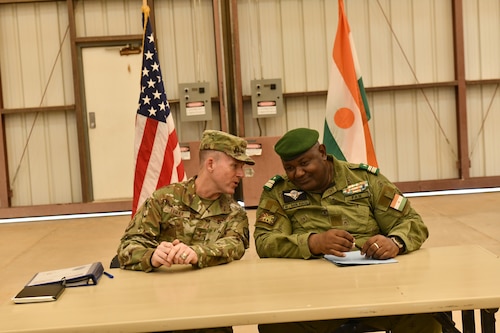
“We were able to complete the major phase of this withdrawal so quickly due to the cooperation with our Nigerien military counterparts,” said U.S. Air Force Maj. Gen. Kenneth Ekman, Department of Defense West Africa Coordination Element lead, U.S. Africa Command. “It continues at the military level and is affirmed at the political level by Nigerien authorities. The safe, orderly, and responsible withdrawal of U.S. forces and assets is made possible due to our 15 years of close collaboration with the Nigerien military.” U.S. logistics personnel, in cooperation with the Joint Disengagement Commission, ensured personnel and assets were vacated from AB 201in a safe and efficient manner. The commission will continue coordination efforts to ensure the full withdrawal is completed by or before the planned date of Sept. 15. “The U.S. service members I have met during the withdrawal have impressed me with their professionalism and commitment to their mission despite the unique set of challenges they have faced over the last few months,” Ekman said. “They and their families personify resilience. I was struck by the number of service members who insisted on staying until the very end to ensure the withdrawal was done well.” In addition to ensuring the safety of all personnel and assets throughout the withdrawal process, U.S. and Nigerien forces effected an efficient turnover of facilities to enable Niger’s efforts to counter violent extremist organizations throughout the Sahel region. Withdrawal efforts at AB 201 come two months after the first C-17 aircraft departed Air Base 101 in Niamey on June 7; withdrawal efforts there lasted one month.
Aircrew from the Air Force Reserve’s 5th SOS at Hurlburt Field, trained on the AC-130J Ghostrider with support from active-duty maintenance specialists from the 1st Special Operations Maintenance Group in Alaska on July 15-21, 2024, to enhance readiness and practice logistical challenges inherent with operating in an unfamiliar environment.
“It’s a huge benefit for us to train in different climate zones and terrain,” said Master Sergeant Gregory Hosko, 5 SOS Aerial Gunner. “We walked away with some great lessons learned working the logistical challenges and operational planning.”
Some of those challenges included transporting maintenance teams and support functions across the United States on a more than 3,000-mile journey from Florida to Alaska. While several Reservists have experience in this area, the planning, packing, and working through systems necessary to move this amount of personnel and equipment across the continent isn’t something they do every day. Combined with an extensive ongoing multinational exercise in the same locale, this further honed their logistical prowess.
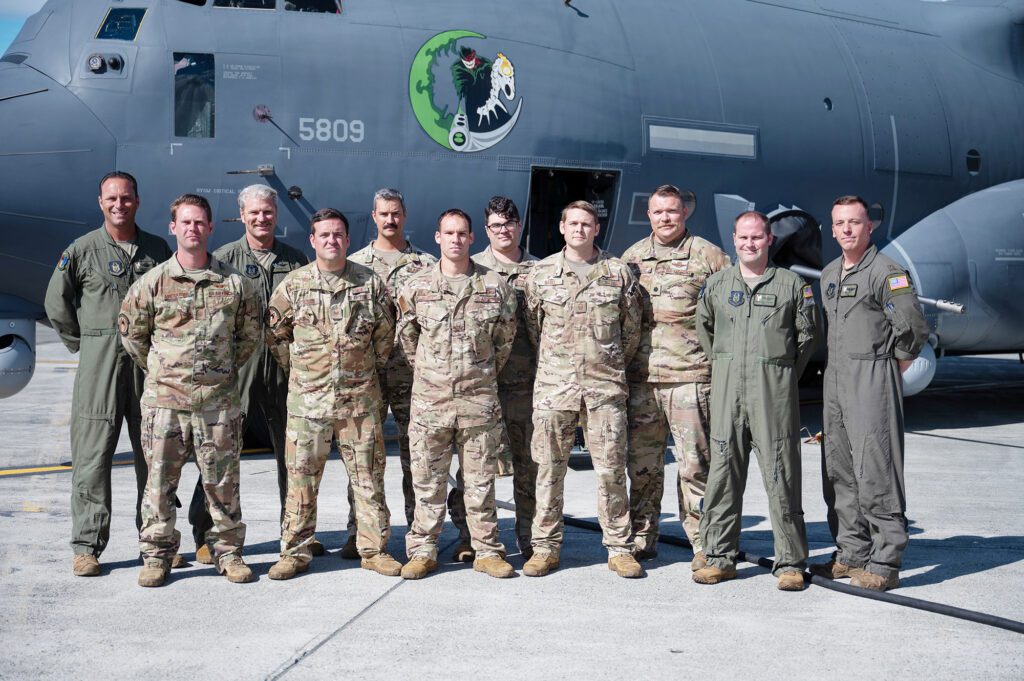
Aircrew members from the 5th Special Operations Squadron stop for a photo alongside the AC-130J Ghostrider aircraft on Joint Base Elmendorf-Richardson, Alaska, July 16, 2024. The 5th SOS serves as a schoolhouse teaching active-duty counterparts to fly and operate the AC-130J.
“The weather and mountainous terrain added numerous challenges that we don’t see at home station,” said Lt. Col. Nick Beihl, 5th SOS Pilot and mission commander for the training. “This took a lot of coordination in advance on several fronts to include everything from range entry procedures to moving munitions to Alaska.”
The aircrew who participated also enhanced their readiness by operating in the new and geographically diverse area, adding elements of uncertainty that would be reflected in an operational environment. Pilots, weapon systems officers, aerial gunners and maintainers made for a highly-capable team who worked together to bring the mission to fruition.
The crew employed eight AGM-114 Hellfire missiles and four AGM-176 Griffin missiles, shooting 255 rounds of 30mm and 20 rounds of 105mm into ground-based targets in mountainous terrain below the weather. Gunners and maintainers gathered around the mission operator pallet displays to watch their rounds explode on impact with the simulated combatants.
“The AC-130J has an amazing standoff capability,” Hosko said. “We could be 10-15 miles away and still provide more than just direct fire of guns overhead.”
“The maintenance troops had the plane ready at every moment, which made the operation seamless,” said Beihl. “This team of professionals made it so we didn’t have to worry about the aircraft at any point in time.”
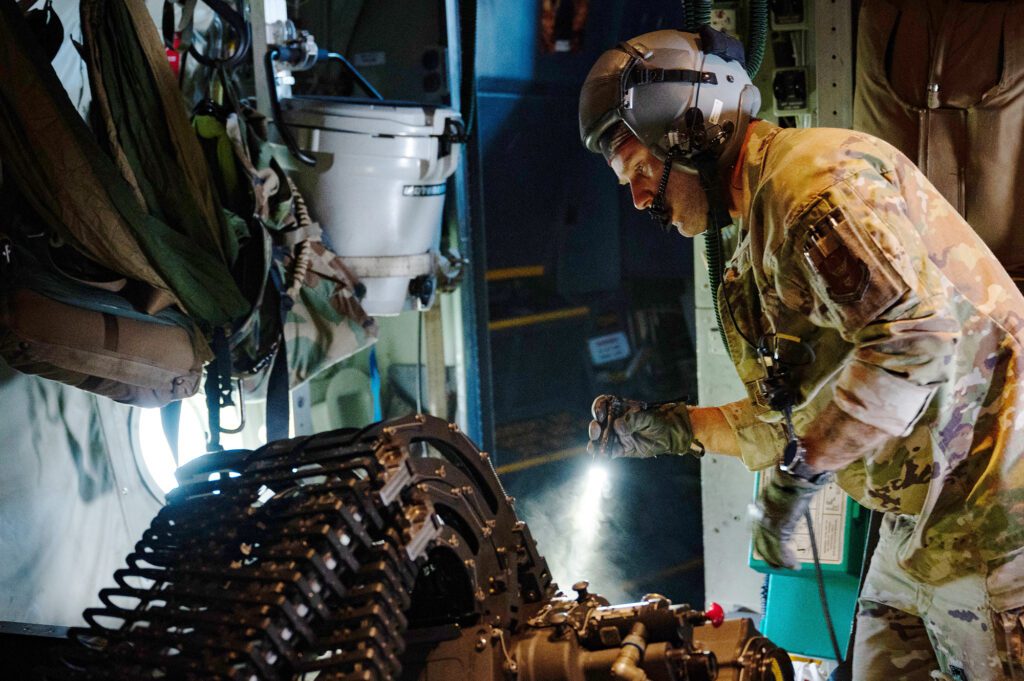
Master Sgt. Kyle Linebarger, 5th Special Operations Squadron aerial gunner, inspects a weapons system onboard the AC-130J Ghostrider during livefire training near Anchorage, Alaska, July 17, 2024. Air Force Special Operations Command and Air Force Reserve Command placed a renewed focus on the gunship mission to align with the new peer-peer warfighting model.
While enjoying America’s last frontier, they also built relationships and extended their capabilities with their 1st Special Operations Wing counterparts.
The team out of Hurlburt Field, Florida hosts a capability with deep ties to the Reserve Component of Air Force Special Operations Command. The 919th Special Operations Wing used to operate AC-130A’s decades ago. As national defense requirements changed, the wing diversified into other weapons systems. Currently, the 5th SOS serves as a schoolhouse teaching active-duty counterparts to fly and operate the AC-130J, C-146, and U-28A aircraft.
As the Air Force continues adapting to a peer-to-peer warfighting model, the aircraft continue to provide a critical capability. It is common for many of the seasoned aviators of the 5 SOS to train and fly with operational units.
“By the time the 5th SOS finished their return leg, the seasoned crew proved their ability to deliver lethal capability abroad,” Beihl said.
The Great North offered challenges that improved their interoperability as a team and set a path for future training opportunities.
By Air Force Special Operations Command Public Affairs
Plater began his career in the U.S. Army upon graduation from the University of Tennessee, Knoxville, as a Distinguished Military Graduate, and retired as a colonel. He commanded at the battery, battalion, squadron and brigade levels. When he arrived to AFSOC in January of 2019, Plater noted that due to his background he was not overly familiar with the Air Force and AFSOC.
“When I came to AFSOC I didn’t appreciate its complexity… it took six to nine months to fully appreciate how we’re organized and how all the pieces come together to form the organization,” he reflected.
After settling into his position, Plater shouldered multiple duties including the responsibility for determining the scope, objectives, and resolutions of assignments and resources in AFSOC. He also provided executive guidance and direction for financial planning, strategic investment, capabilities development, programming, Program Objective Memorandum development and execution of budgetary requirements.
Out of his many accomplishments, Plater is most proud of his development of the “Night Court” program, which strategizes service contracts. Night Court gives the command a better idea of where money is being spent and confirmation that existing contracts are utilized for the intended purpose.
Under “Night Court,” Plater led a four-month review of 213 contracts valued at $3.6B across the Future Years Defense Program (FYDP) to revise or rescind service contracts. This tactic identified $364M worth of savings, which exceeded the goal of $100M across the FYDP in fiscal year 2024 alone.
Donald Plater, a member of the Senior Executive Service, served more than five years with the command and possesses a combined 51 years of federal service.
Plater also coordinated the funding required to resource the commander’s directive of flying 115% of the Flying Hour Program. This expanded high-end training across the FYDP that led to increased readiness for competition with adversaries which ultimately became a model for other components to utilize.
“Remember that every person in this command everyday makes history, they may not realize it… but recognize that what they did made a difference,” Plater said.
In addition, he led the AFSOC Military Construction Projects efforts that resulted in United States Special Operations Command and the Air Force funding 33 projects across 10 years supporting 11 different locations across the globe. These projects will enhance not only maintenance readiness, but quality of life and quality of mission requirements.
Plater also reflected on the changes he observed in AFSOC over the past five years. He emphasized the importance of not reinventing the wheel but instead improving upon the foundations laid by previous leaders. He conveyed the significance of consistently pushing to improve processes and not stagnate.
“If you don’t continue to learn then you’re not effective… always remember that I’m only as good as I was yesterday,” Plater said. “What am I doing today to be better for tomorrow?”
Brig. Gen. Mark Massaro, 96th Test Wing commander, passed the 96th CEG guidon to Sterling, representing the start of her command.
“I’m positive that her leadership values of character, competence, community will serve this team well,” Massaro said. “Michelle, you’re taking the reins of this highly regarded dynamic organization. Your background and your values already show the civil engineering group is in good hands. I look forward to the future of the 96th Civil Engineer Group under your leadership.”
Sterling thanked her friends and family both in the crowd and watching virtually. Then, she expressed her excitement and passion at being the 96th CEG’s new commander.
“My promise to the 96th Civil Engineer Group is that we will have hard days, but we will show up together and we will share the load,” she said. “I know that if we do that we can move mountains, because you have already in this very short time showed me how capable you are in getting the mission done showing up for one another, I look forward to joining this team and getting to know you all better as we carry on the mission of the 96th Test Wing.”
The 96th CEG manages more than 3,000 facilities, 1,200 miles of roads, 465,000 acres of land, and the U.S. Air Force’s largest Fire Protection Program.
The Innovating Academic Excellence through Partnership Program, in partnership with the USAF Leadership Experience Growing Apprenticeships Committed to Youth (LEGACY) program, offers Craftsmen Camps for students aged 11-15 years-old, Junior Apprentice programs for children aged 16 years-old and older, and an Apprentice program for high-school graduates and college students.
“We knew we needed to work hard and fast in developing STEM+M partnerships with our Department of the Air Force STEM partners and local education agencies if we wanted to stay in the game,” said Elaine LaJeunesse, 96th Test Wing School Liaison program manager and K-12 STEM lead. “We want folks to know it’s there and can be used.”
Each program is fully funded and geared toward developing interest in STEM by placing students in real-world paid internships, and polishes students’ professional skills for a smooth transition to the STEM workforce.
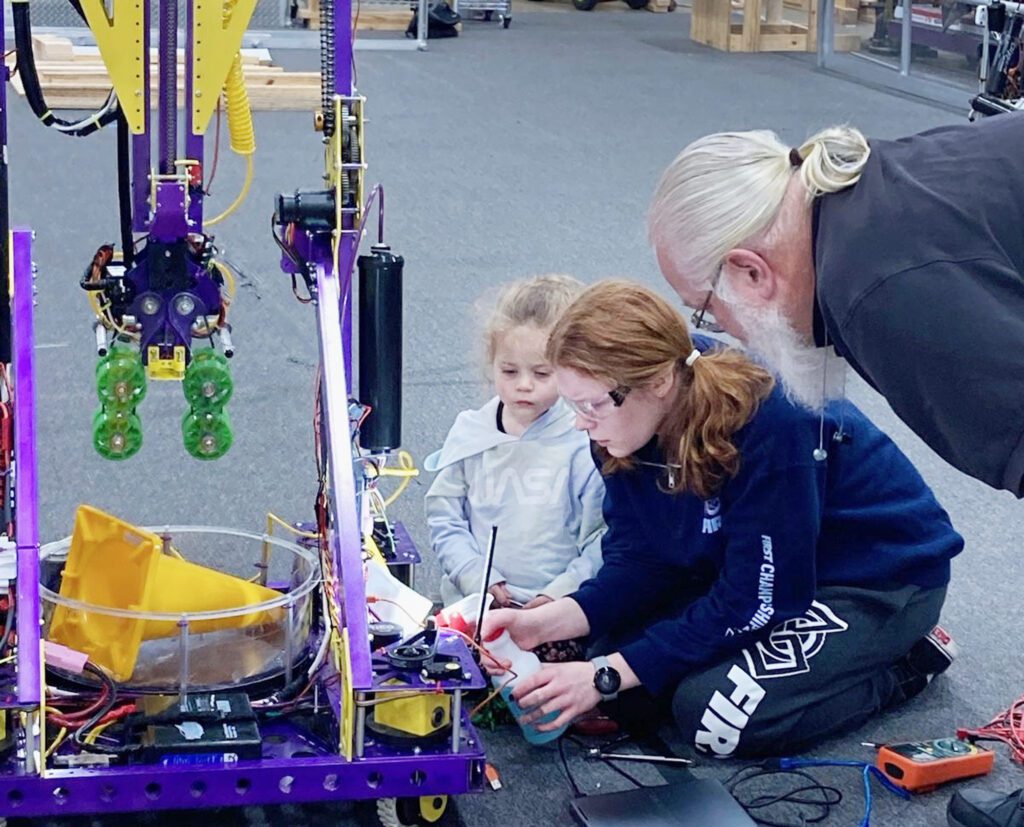
(center) Elizabeth Vanderkooy, shows a young girl how to calibrate the FIRST Robotics Team award-winning robot developed from spare parts and raw materials during the 2023 First Robotics Lab STEM event in Bluewater Bay. (Courtesy photo by Ron LaJeunesse)
“Our partnership with the 96th Test Wing has been instrumental in taking our LEGACY program to the next level,” said Dr. Kim Gasaway, Eglin LEGACY Site Lead. “We’ve watched several of our students get selected for the Premiere College Internship Program (PCIP) and one received a full scholarship under the Science, Mathematics, and Research for Transformation (SMART) program. We are planning to add two more SMART applicants and one PCIP for 2025.”
Elizabeth Vanderkooy recently transitioned to the PCIP program in Eglin’s 896th Test System Support Squadron. She was a former LEGACY Apprentice and First Robotics Champion.
“It’s really amazing,” Vanderkooy said. “The program has given me a secure outplacement position, which means I can take my time to learn deeply and explore different opportunities within the Air Force.”
Vanderkooy is currently attending the University of Florida studying mechanical engineering. She completes the PCIP program upon graduation and is placed into the Palace Acquire (PAQ) Program as a mechanical engineer.
The LEGACY program aims to foster and educate children in local communities with an interest in contributing to the U.S. Air Force’s mission by offering hands-on experience, mentorship, and a clear pathway to a career in STEM fields.
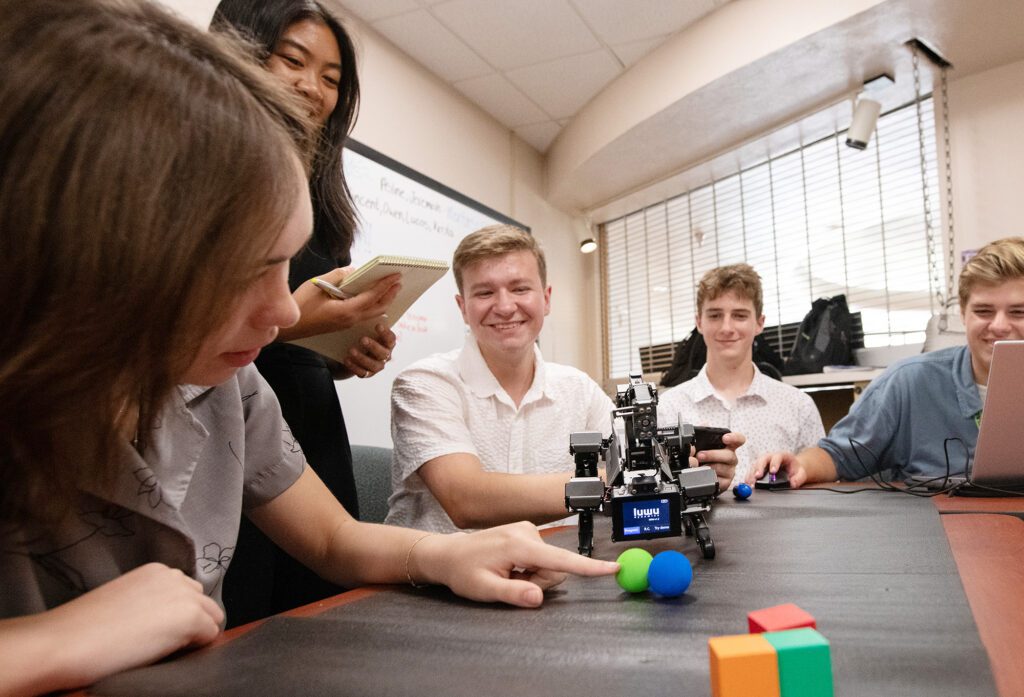
A group of STEM students with the Air Force Leadership Experience Growing Apprenticeships Committed to Youth (LEGACY) program work on a hands-on robotics activity in the STEM Workstation at Eglin Air Force Base on June 25, 2024. LEGACY curriculum is designed to sharpen students’ abilities and polish professional skills to provide a smooth transition to the workforce. (left to right, Khloe Minervine, Lillian Nguyen, Lucas Eaton, Ethan Kirk, Vincent Johns) (U.S. Air Force photo by Michelle Gigante)
Another student to benefit from the LEGACY developmental and scholarship programs is Owen Perry a 2024 Rocky Bayou Christian School graduate who received a full college scholarship through the SMART Program to study computer engineering at the University of Alabama. He is also set to work in Eglin’s 96th Range Control Squadron.
“Our LEGACY program is fully committed to providing our students with an opportunity to grow, develop and hopefully transition in the STEM workforce where they can make an impact on the future of our Nation,” Gasaway said.
“I want kids to know that the 96th TW is not just a place to work, we are a family,” LaJeunesse said. “Young local talent can find a litany of STEM related job opportunities in the TW. We are passionate about making an impact and we want young students to know they can start with us.”
For those interested in applying for the STEM LEGACY program or would like to be a mentor, reach out to LaJeunesse at 850-882-4319.
For more interest in STEM programs and academic activities go to AF LEGACY.
Col. Scott Hurrelbrink will take command of the only special operations unit in the Air Force Reserve in front of fellow citizen airmen, community partners and other distinguished guests.
Hurrelbrink became commander of the 919th SOW by order of Maj. Gen. Regina Sabric, 10th Air Force commander. He replaced Col. Jason Grandy who had been the commander since 2021.
“These are two of the best commanders we have in the Air Force Reserve,” Sabric said. “Scott, serving as wing commander at a place like Duke Field will likely be the best job you will ever have. The wing’s in great shape. Jason’s done an absolutely phenomenal job. You have achieved many successes in your career and are well versed in issues facing the 919 from your time at [Air Force Reserve Command] headquarters.”
Sabric went on to say the 919th has undergone a lot of changes, and he is excited by the new opportunities that are on the horizon. The general also said members of the wing know how to lead and implement change while still remaining combat ready.
“I am humbled and proud to be part of this wing,” Hurrelbrink said. “The 919th is not just any wing. It is the Air Force Reserve’s hardest working, most successful and highly-decorated group of warriors. I’ll give everything I have to lead with integrity, uphold the proud history of the 919th, and further build the next generation of combat wings.”
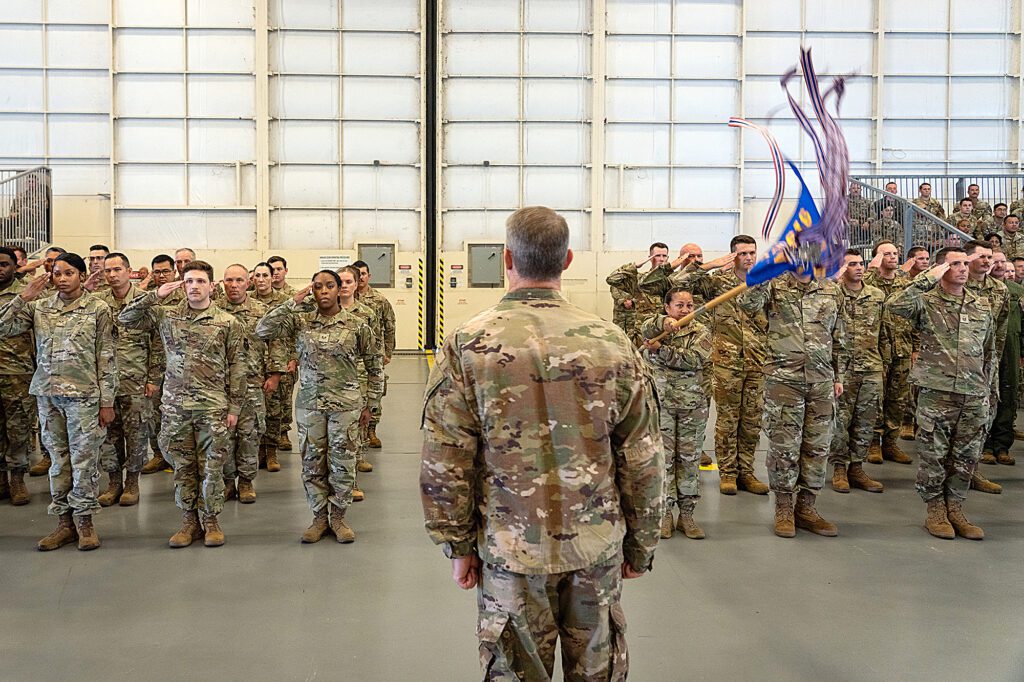
Members of the 919th Special Operations Wing render a salute to their outgoing commander during the wing’s change of command ceremony July 13, 2024, Duke Field, Florida. Airmen assigned to the wing conduct flight instruction and deploy as required in the U-28, PC-12, AC-130J and C-146A aircraft. (U.S. Air Force photo by Staff Sgt. Dylan Gentile)
Hurrelbrink received his commission from the Reserve Officer Training Corps Program in Bowling Green, Ky in 1994. He completed Undergraduate Navigator Training at Naval Air Station Pensacola, Fla., and was late selected for Undergraduate Pilot Training which he completed at Columbus Air Force Vase, Miss. The colonel has held positions throughout the wing, major command, combatant command and with the North Atlantic Treaty Organization.
Hurrelbrink also addressed the 1,600 Citizen Air Commandos who comprise the Reserve’s only special operations wing.
“To the men and women of the 919th, I cannot wait to roll up my sleeves and get to work with you,” Hurrelbrink said. “I assure you I will uphold the tradition and culture of the Citizen Air Commandos. In return, I ask that you be loyal to the mission and take care of each other. Lead with respect, empathy and support. If we do these things, nothing or no one will stop us.”
The mission of the 919th SOW is to provide Citizen Air Commandos any time, any place in support of Air Force Special Operations Command. The unit is the only Air Force Reserve special operations wing and has a long and distinguished history of valor in combat since its inception at Duke Field in July 1971.
Hurrelbrink’s previous assignment was as the deputy director of operations for Air Force Reserve Command Headquarters, Robins Air Force Base, Georgia.
Grandy who has several tours with the 919th SOW before taking over as commander, now departs for a position in the current operations division in the Pentagon.
Presiding over the ceremony, Air Force Chief of Staff Gen. David Allvin praised Bauernfeind’s past accomplishments and Conley’s future potential as the commander of AFSOC. Allvin said the image that came to mind when he thought of the transition to a new commander was the passing of a baton in a race.
“Races are won or lost by fractions of a second,” he said. “The stakes are high for our Air Force, our special operations community, and our nation and we can’t afford to take a pause. Mike Conley is up to speed. He’s ready. He brings a breadth of experience working with the Air Force, major command and joint staff. He also has a depth of experience in the AFSOC mission.”
During the ceremony, four formations of Air Commandos stood at attention to represent the Airmen of AFSOC. The military formation, comprised of 85 Airmen, represented the five active-duty, one Reserve wing, and two National Guard wings; and more than 20,000 active duty, Air National Guard, Air Force Reserve and civilian Airmen who serve across AFSOC.
U.S. Army Gen. Bryan Fenton, commander of United States Special Operations Command, also provided remarks during the ceremony, as AFSOC is the Air Force component of USSOCOM. Fenton welcomed Conley as AFSOC’s new commander and praised the command for its spirit of innovation.
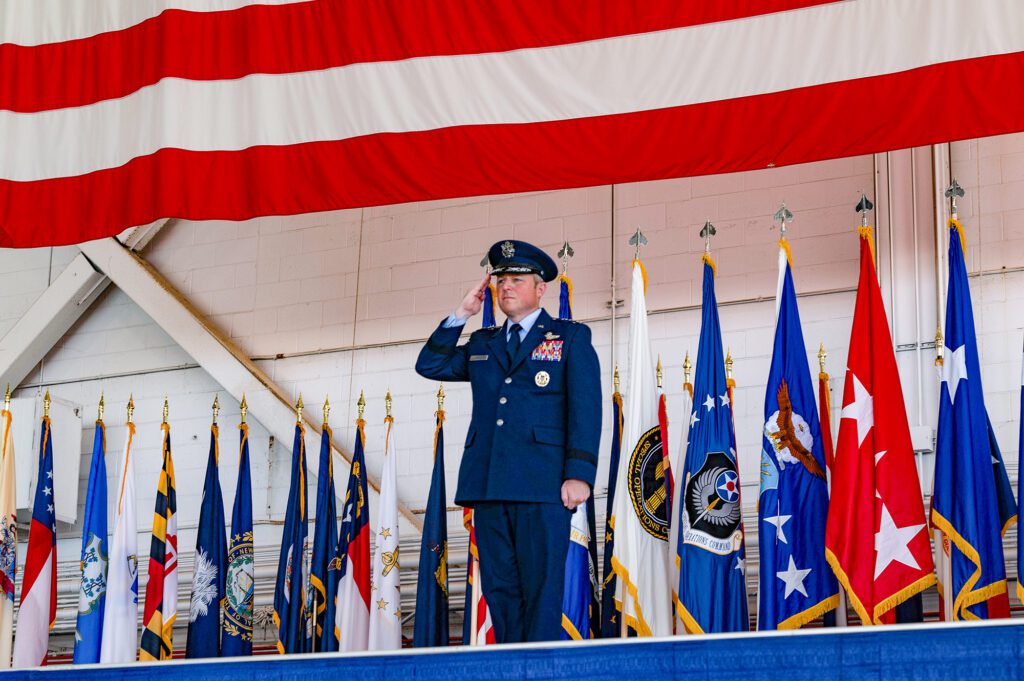
U.S. Air Force Lt. Gen. Michael Conley offers his first salute as he assumes command of Air Force Special Operations Command during a change of command ceremony at Hurlburt Field, Florida, July 2, 2024. Conley was previously the director of operations for Headquarters AFSOC. (U.S. Air Force photo by Senior Airman Ty Pilgrim)
“Mike, welcome aboard,” he said. “You are taking charge of an exceptional team. You know this already because you’ve been a key part. You’re inheriting an incredible organization that is not only pathfinding and trailblazing for SOCOM but equally for our Air Force and on top of that, the Department of Defense. And they are doing it at lightning speed. You’re exactly what AFSOC needs to continue that transformation.”
Lt. Gen. Michael Conley assumed command of Air Force Special Operations Command after previously serving as the director of operations for Headquarters AFSOC. He was responsible for implementing and directing operational command policy for AFSOC’s worldwide special operations units including 20,800 personnel, approximately 300 aircraft and $17 billion in assets. He also served as the vice commander for AFSOC’s 27th Special Operations Wing and the commander of the 1st Special Operations Wing.
“I am honored and humbled for this opportunity,” he said. “I am committed to making this command the best it can be in ensuring we are ready to go whenever you need us to.
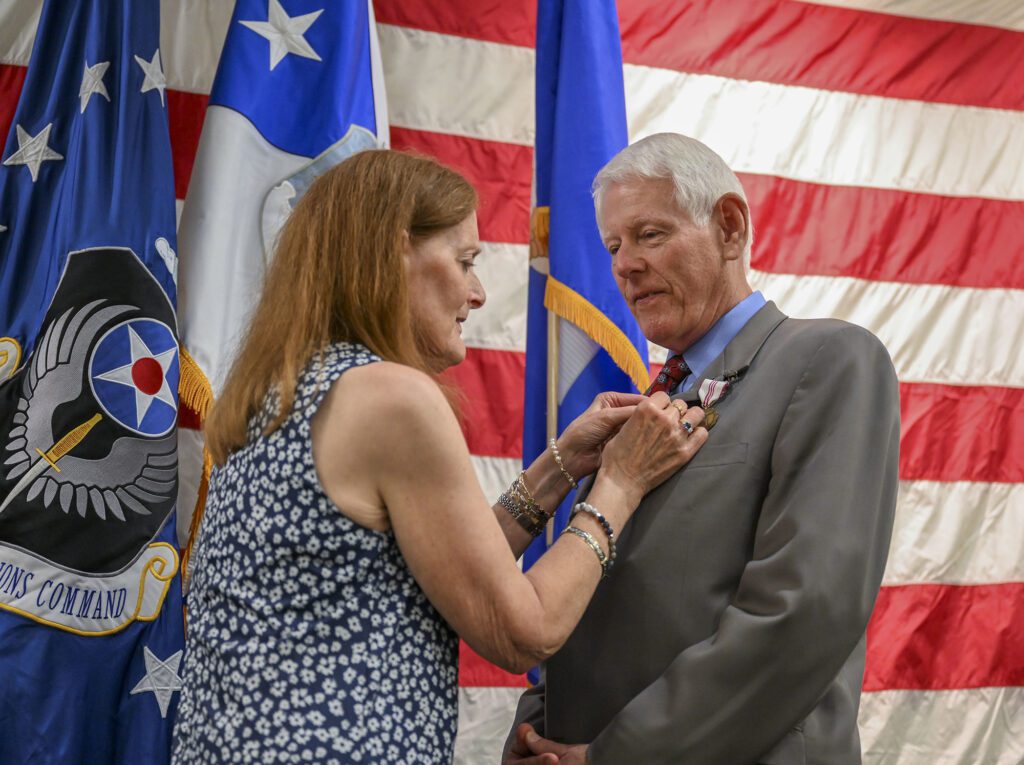
Bauernfeind was awarded the Distinguished Service Medal as well as the USSOCOM ceremonial colors for his accomplishments as commander and then received the final salute from the Air Commandos. He will depart AFSOC to become the next Superintendent of the United States Air Force Aca
Argentinian air force Chief of Staff Gen. Fernando Luis Mengo hosted the event, which was attended by U.S. Air Force Chief of Staff Gen. David Allvin.
The senior Air Force leaders of 19 nations took part in discussions concentrated on readiness needs to meet a collective vision and laid plans for future exercises together.
“The Conference of American Air Chiefs is a unique opportunity to learn from and build partnerships with our neighbors in the Western Hemisphere,” Allvin said. “It is also an exceptional forum for enhancing our shared security objectives while generating mutual trust and understanding. I was honored to engage my counterparts firsthand and look forward to improving our collective ability to meet complex global challenges.”
The 3-day conference was sponsored by the System of Cooperation Among the American Air Forces, an apolitical institution established in 1961, now sitting at 23 member nations with a purpose to be an efficient organization in cooperation and mutual support between the American Air Forces and their equivalents.
“CONJEFAMER is the medieval roundtable for the American Air Forces today,” said Brazilian air force Col. Bruno Pedra, undersecretary general for SICOFAA. “Which makes it imperative to maintain and strengthen an environment of trust and professional cooperation.”
Much of the value gained during the annual conference can be placed on the relationships built among the air chiefs to aid in emergent situations when a rapid response is needed.
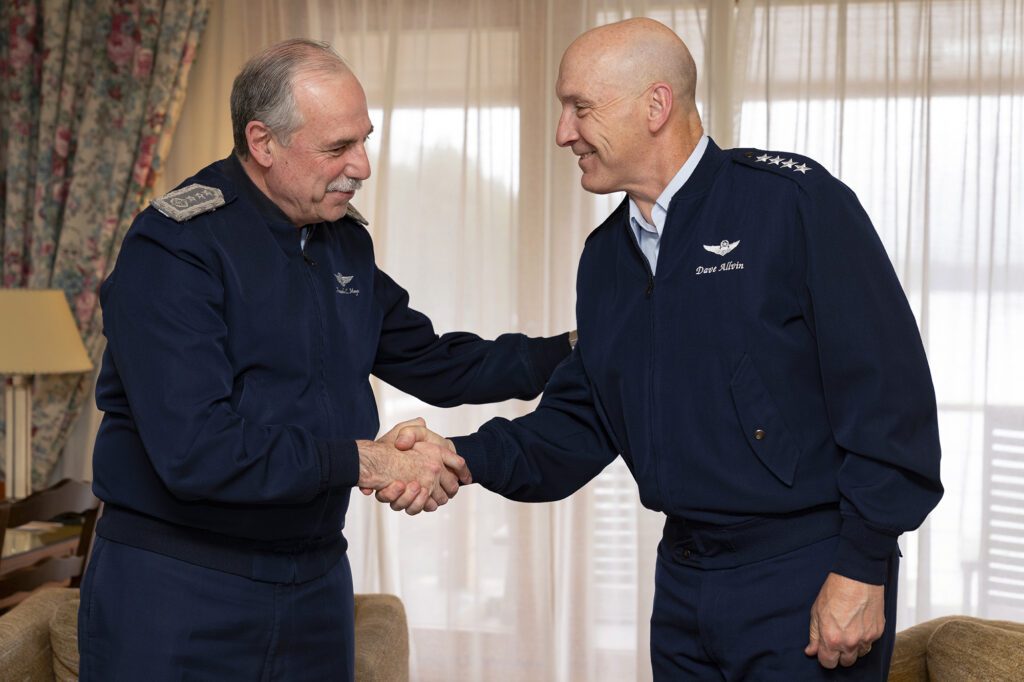
U.S. Air Force Chief of Staff Gen. David Allvin, right, shakes hands with Argentinian air force Chief of Staff Gen. Fernando Luis Mengo, left, during the 64th Conference of the American Air Chiefs meeting in San Carlos de Bariloche, Argentina, June 19, 2024. Senior air force leaders and representatives spanning 19 nations took part in discussions concentrated on the collective readiness needs of the Western Hemisphere in order to meet shared visions and lay plans for future exercises. (U.S. Air Force photo by Tech. Sgt. Rachel Maxwell)
This year alone Colombia experienced devastating wildfires and Brazil encountered unprecedented flooding, bringing discussions of humanitarian assistance and disaster response efforts to the forefront of remarks amongst some leaders.
“In the world we live in today there are two irrefutable truths,” said Colombian air force Deputy Commander and Chief of Staff, Maj. Gen. Carlos Fernando Silva Rueda. “The first is that there is a climate change that will potentially produce natural disasters at any time. The second is that there is nothing like having friends to lean on when you need it most. Our brothers, the air forces of Argentina, Brazil, Chile, the United States and Uruguay, through our system, answered our call, giving us a hand, providing their capabilities so we could sort these fires.”
“CONJEFAMER is where lessons learned are reported and activities to be developed are decided,” Pedra noted. “Congruently, in Argentina, the wildfires in Colombia and floods in Brazil were both addressed in a framework of the pre-coordinations mediated by SICOFAA.”
Pedra also hinted in the potential expanding influence within similar organizations outside the Western Hemisphere.
“Studying SICOFAA in its entirety, it becomes clear that SICOFAA’s future includes a systematic relationship with homologous systems in Africa and the Indo-Pacific region,” he said. “In this way, the maximum benefit for its members will increasingly depend on the diplomatic capacity of their representatives either among themselves or with their respective governments.”
Formal proceedings came to a close when Mengo relinquished the SICOFAA ceremonial bell into the hands of next year’s host, Paraguayan air force Commander Gen. Julio Rubén Fullaondo Céspedes, symbolizing the beginning of next year’s activities.