



Please ensure Javascript is enabled for purposes of website accessibility
Skip to main content
Advertisement

Auto Bits: 3 ways soybean farmers’ biodiesel helps clear the air

[Special to the News Bulletin]

Tip of the Week

Soybean farmers in Minnesota wear many different hats: small-business owner, agronomist, equipment expert, accountant and environmentalist. Yes, they are the original stewards of the land, continually evolving their practices to keep natural resources healthy for the next generation.

But it doesn’t end there. Soybean farmers have been at the forefront of developing a homegrown renewable fuel that has resulted in a dramatic improvement of the air quality in the Gopher state.

Biodiesel has become an important part of the energy landscape not only in Minnesota, but across the country, too. In just over 15 years, the biodiesel market in the U.S. has increased from about 25 million gallons to more than 2.8 billion gallons. Made from domestic, renewable resources such as soybean oil, biodiesel is a value-added by-product containing sources that would normally go to waste.

You may be scratching your head and saying, “I don’t drive a diesel vehicle. Why should I care?” Well, you’re not alone. According to the Bureau of Transportation Statistics, diesel-powered cars accounted for only about 3 percent of total U.S. auto sales in 2014.

But, unless your family continues to rely heavily on the moped for travel and commerce, here’s why biodiesel matters.

Diesel engines are all around you

According to the Diesel Technology Forum, more than 95 percent of all large, heavy-duty trucks are diesel-powered, as are a majority of medium-duty trucks. Together, they move more than 90 percent of the nation’s freight. And don’t forget public transit, school buses and construction equipment. Things we all come in contact with every day.

Waving the green flag

And while you may think these trucks’ massive diesel engines are an unfortunate but necessary aspect of commerce and expansion, think again.

According to the American Lung Association of Minnesota during the 10-year period with biodiesel as a fuel standard for Minnesota, a reduction of more than 7.4 billion pounds of carbon dioxide has already been realized. ALAMN estimates that is comparable to removing the emissions from 706,649 passenger vehicles or 17,998 railcars of coal.

That’s not a typo. Removing emissions. Breathing easier. Biodiesel’s ability to reduce greenhouse gas emissions by more than 50 percent is why the Environmental Protection Agency recognizes it as the only advanced biofuel.

Revitalizing rural communities

According to the Minnesota Department of Agriculture, the biodiesel industry contributes $1.7 billion annually in the state, while supporting 5,397 jobs. Nationwide, there are approximately 200 biodiesel plants, which provide nearly 48,000 jobs. These are often hard-hit areas where employment options are few. Leaving for “greener pastures” is no longer the only option.

“Biodiesel is another step in increasing the diversity of our energy needs,” says Tom Slunecka, CEO, Minnesota Soybean Research and Promotion Council. “Minnesota soybean farmers are proud to be leaders in growing that diversity.”

In 2002, Minnesota became the first state to require that all diesel fuel sold here contain at least 2 percent blend of biodiesel. In the summer of 2018, Minnesota will be the first to move to B20, a blend of 20 percent biodiesel and 80 percent petroleum diesel.

The benefits of biodiesel are considerable, not just for Minnesota, but for the country as a whole.

— Brandpoint

Car stats

According to a new survey from the AAA Foundation for Traffic Safety, the proportion of drivers who self-report talking on a cell phone regularly or fairly often when behind the wheel has increased by 46 percent since 2013. Nearly half (49 percent) of drivers admit they have recently talked on a hand-held phone while driving and nearly 35 percent say they have sent a text or email while driving.

— More Content Now

Did you know?

Just like your tires, you should check your windshield washer fluid level once a month. To do so, first turn off the engine, then pop your hood before locating the washer fluid reservoir. In most vehicles, it’s on the very left, front corner of the engine compartment.

Check the level on the side of the reservoir. It should be between the full and low marks, if not, then refill it.

— More Content Now

This article originally appeared on Crestview News Bulletin: Auto Bits: 3 ways soybean farmers’ biodiesel helps clear the air

Aguire, Crawford and Payne graduate from basic military training

[FILE PHOTO]

CRESTVIEW — Three North Okaloosa residents have completed Army basic training in recent weeks.

Pvt. Daniel Aguire, Pvt. Zartavious Crawford. and Pvt. Tiara Payne completed Army Basic Combat Training at Fort Jackson, South Carolina earlier this year.

Over the course of 10 weeks, these soldiers learned basic tactical and survival skills along with how to shoot, rappel, and march. They also learned the basics of Army life and military customs, including the Seven Core Army Values

Aguire is currently attending Advanced Individual Training in Fort Sam Houston, Texas to become a biomedical equipment specialist. He graduated from Crestview High School in 2010. His parents are Voni and Alan Aguire of Crestview.

Crawford graduated AIT in Fort Lee, Virginia as a supply specialist. He will now be stationed at Fort Benning, Georgia. He graduated from Crestview High School in 2017.

Payne graduated AIT in Fort Lee, Virginia as an ammunition stock control and accounting specialist. She will be now stationed in Hawaii. She graduated from Baker High School in 2017.

This article originally appeared on Crestview News Bulletin: Aguire, Crawford and Payne graduate from basic military training

Grant graduates from basic military training

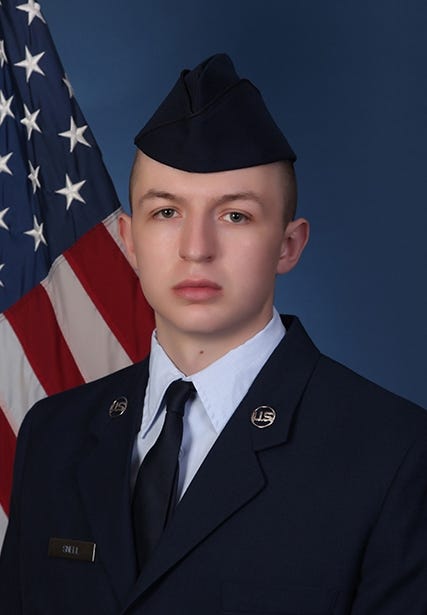
Airman Desiree Grant

CRESTVIEW — U.S. Air Force Airman Desiree A. Grant graduated from basic military training at Joint Base San Antonio-Lackland, San Antonio, Texas.

The airman completed an intensive, eight-week program that included training in military discipline and studies, Air Force core values, physical fitness, and basic warfare principles and skills.

Airmen who complete basic training also earn four credits toward an associate in applied science degree through the Community College of the Air Force.

Grant earned distinction as an honor graduate.

She is the daughter of Stephanie Altom of Crestview, Fla., and Todd Striplin of Schertz, Texas, granddaughter of Mel and Marsha Altom of Flushing, Mich., Robert Gonzales of Grand Rapids, Mich., and Donna Gonzales of Lowell, Mich., and daughter-in-law of Richard and Christine Grant of Lowell, Mich. She is also the wife of Brayton Grant.

Grant is a 2015 graduate of Lowell High School, Lowell, Mich.

This article originally appeared on Crestview News Bulletin: Grant graduates from basic military training

4-H summer camp open for registration

Archery will be among this year’s Okaloosa County 4-H summer camp activities. [Pixabay.com]

CRESTVIEW — Looking for something for the kids to do this summer?

Okaloosa County 4-H is having its annual summer camp June 4 through 8 at Camp Timpoochee in Niceville.

Registration is open until April 30 for campers ages 8 to 12 and counselors ages 13 to 18.

This year’s camp will include activities like fishing, kayaking, archery and outdoor skills. It will also include social events such as creative dramatics, a talent showcase, a movie night and field games.

The University of Florida Institute of Food and Agricultural Sciences Extension in Okaloosa County coordinates 4-H programs throughout the county, including clubs on Eglin Air Force Base and Hurlburt Field.

Taylor Wilken is the extension’s 4-H youth development agent who oversees the programs. She said kids that go to the 4-H camps learn valuable life skills and often come back for future camps.

“A lot of our teens, there’s a lot more camps for them throughout the year,” Wilken said. “So once they go to one, they want to be with all their friends at all the other ones, so they learn a lot of life skills that way.”

Wilken also talked about the benefits of the 4-H program in general.

“A lot of the kids learn life skills like responsibility, because a lot of them take care of their own animals or they have a certain project that they’re responsible for,” she said. “A lot of them have said that they’ve gotten out of their shell because they’re in front of a lot of people and they’re social.”

Among those skills are things like public speaking, photography and especially leadership.

“It’s mainly youth-driven. So what we do is have our older kids or any of the youths teach their class, and we just basically supply everything and make sure that they’re comfortable teaching each other,” she said.

Okaloosa 4-H isn’t just limited to agriculture. The program incorporates a wide range of activities, particularly in the camps on the military bases.

“We have our doghouse club, which is dog training mainly, and then we have a livestock one and then we have our animal science one,” Wilken said. “Both bases, the most they do with animals is they have guinea pigs and fish, so they’re more into the gardening, the photography, the arts, the sketches; they do a lot of the robotics. Computer coding is a big one there.”

To register for 4-H summer camp, go to http://sfyl.ifas.ufl.edu/okaloosa or call (850) 689-5850.

This article originally appeared on Crestview News Bulletin: 4-H summer camp open for registration

Eglin testing may cause aircraft noise, GPS unavailability

EGLIN AIR FORCE BASE — Residents may experience aircraft noise and GPS unavailability April 1-6 when the 53rd Weapons Evaluation Group conducts boat operations in the Gulf of Mexico and Choctawhatchee Bay.

Ground-based navigation and electronic devices or smart phone apps that rely on GPS may be affected in the vicinity of Eglin Air Force Base during tests from 8 a.m. to 12 p.m. Normal GPS reliability will resume once testing is complete each day. Those in the area are strongly encouraged to plan activities accordingly.

Each morning, fighter aircraft will release munitions between 8 a.m. and 12 p.m. approximately 20 nautical miles south of Destin over the Gulf of Mexico. The test will be conducted within a cleared range safety area which includes boat surveillance. Notices to mariners will be issued prior to missions, and flyers will be handed out at the local marina.

In the afternoons between 1 p.m. and 5 p.m., boats traveling in formation will transverse between the Mid-Bay Bridge and the Highway 331 Bridge, to include 10 to 20 miles south of Destin over the Gulf of Mexico. The boat formation will be used as visual targets by military aircraft flying over the area. No weapons or ammunition will be involved with this boat formation.

Please be advised that some boats will have mock-up, fake deck guns and rocket launcher tubes. The boats will also use marine flares as visual markers.

These operations are part of the 53rd Wing's Weapon System Evaluation Program. For more information, please contact the Team Eglin public affairs office at 882-3931 or the 53rd Wing public affairs office at 882-0423.

This article originally appeared on Crestview News Bulletin: Eglin testing may cause aircraft noise, GPS unavailability

Special Olympics Torch Run takes place

Crestview Police Department Cadet Officer Justin Wallen carried the Law Enforcement Torch Run flag part of the way down Industrial Drive March 28 in Crestview. CPD Critical Systems Manager Kathy Duke, center, also carried it. [BRIAN HUGHES | CPD]

CRESTVIEW — With a cheer from supporters, the North Okaloosa County leg of the 2018 Law Enforcement Torch Run for Special Olympics commenced in the parking lot of the new north Crestview Publix March 28 as more than 50 runners and walkers set off down Industrial Drive.

The 1.5-mile route concluded at the Whitehurst Municipal Building, the home of the Crestview Police Department, as the same enthusiasm and cheers that hailed their departure welcomed the runners about 20 minutes later.

Among the runners were representatives of multiple law enforcement agencies, including the Crestview Police Department host agency, the Okaloosa County Sheriff’s Office, state and county corrections officers, and the U.S. Air Force Military Police.

"We love doing this," CPD Critical Systems Manager Kathy Duke said before the run. "It’s a great charity and we do what we can to support it. It’s a cause we believe in."

While Duke carried the torch for part of the run, Cadet Officer Justin Wallen received the Torch Run flag from another runner and carried it for part of the route. Officers passed the torch and flag to each other, so many had the honor of bearing the run’s symbols.

Law enforcement officers weren’t the only torch and flag bearers. Earlier in the run, Special Olympics athlete Jacob Luttrell, a 2016 graduate of Richbourg E.S.E. School in Crestview, was a torch bearer, flashing a broad grin as he ran.

"I felt good," Jacob said at the run’s conclusion. "The games will be great."

The Special Olympics Florida summer games areMay 18 and 19 at the ESPN Wide World of Sports in Lake Buena Vista.

This article originally appeared on Crestview News Bulletin: Special Olympics Torch Run takes place

Maternal mental health: Doctors worry there’s ‘nowhere to send’ new and expectant moms with depression

[Special to the Press Gazette]

Lawmakers in California will soon begin debate on a bill that would require doctors to screen new moms for mental health problems — once while they’re pregnant and again after they give birth. 

But many obstetricians and pediatricians bristle at the idea, saying they are afraid to screen new moms for depression and anxiety. 

"What are you going to do with those people who screen positive?" said Dr. Laura Sirott, an OB-GYN who practices in Pasadena. "Some providers have nowhere to send them." 

Nationally, depression affects up to 1 in 7 women during or after pregnancy, according to the American Psychological Association. 

And of women who screen positive for the condition, 78 percent don’t get mental health treatment, according to a 2015 research review published in the journal Obstetrics & Gynecology. 

Sirott said her patients give a range of reasons why they don’t take her up on a referral to a psychologist: "‘Oh, they don’t take my insurance.’ Or ‘my insurance pays for three visits.’ ‘I can’t take time off work to go to those visits.’ ‘It’s a three-month wait to get in to that person.’" 

She said it’s also hard to find a psychiatrist who is trained in the complexities of prescribing medications to pregnant or breastfeeding women, and who is willing to treat them, especially in rural areas. 

"So it’s very frustrating," Sirott said, "to ask patients about a problem and then not have any way to solve that problem." 

Moms are frustrated, too. After the baby comes, no one asks about the baby’s mother anymore. 

Wendy Root Askew struggled for years to get pregnant, and when she finally did, her anxiety got worse. She couldn’t stop worrying that something would go wrong. 

"And then, after I had my son, I would have these dreams where someone would come to the door and they would say, ‘Well, you know, we’re just going to wait two weeks to see if you get to keep your baby or not,’" Root Askew said. "And it really impacted my ability to bond with him." 

She likes California’s bill, AB 2193, because it goes beyond mandated screening. It would require health insurance companies to set up case management programs to help moms find a therapist, and connect obstetricians or pediatricians to a psychiatric specialist. 

"Just like we have case management programs for patients who have diabetes or sleep issues or back pain, a case management program requires the insurance company to take some ownership of making sure their patients are getting the treatment they need to be healthy," said Root Askew, who is now advocating for the bill on behalf of the group 2020 Mom. 

Health insurance companies haven’t taken a position on the legislation. It’s unclear how much it would cost them to comply, because some already have infrastructure in place for case management programs, and some do not. But there is consensus among insurers and health advocates that such programs save money in the long run. 

"The sooner that you can get good treatment for a mom, the less expensive that condition will be to manage over the course of the woman’s life and over the course of that child’s life," Root Askew said.

Some doctors still have their objections. Under the bill, they could be disciplined for not screening. Some have said they worry about how much time it would take. 

The health care system, and the incentives, aren’t set up for this sort of screening, Sirott said. 

"Currently, I get $6 for screening a patient," she said. "By the time I put it on a piece of paper and print it, it’s not worth it." 

It’s not clear whether the direct and indirect costs of screening would be worth it to the patients, either. Four other states — Illinois, Massachusetts, New Jersey and West Virginia — have tried mandated screening, and it did not result in more women getting treatment, according to a study published in Psychiatric Services in 2015. 

Even with California’s extra requirement that insurance companies facilitate care, women could still face high copays or limits on the number of therapy sessions. Or, the new mothers might be so overwhelmed with their care for a newborn, that it would be difficult to add anything to their busy schedules. 

What does seem to work, according to the study of mandated screening in other states, is when nurses or mental health providers visit new moms at home.

"Despite abundant goodwill, there is no evidence that state policies are addressing this great need," the study’s authors report. 

Supporters of California’s proposed bill, however, say doctors need to start somewhere. Screening is the first step in recognizing the full scope of the problem, said Dr. Nirmaljit Dhami, a Mountain View, Calif., psychiatrist. Women should be screened on an ongoing basis throughout pregnancy and for a year after birth, Dhami said, not just once or twice as the bill requires. 

"I often tell doctors that if you don’t know that somebody is suicidal it doesn’t mean that their suicidality will go away," she said. "If you don’t ask, the risk is the same."

This article originally appeared on Crestview News Bulletin: Maternal mental health: Doctors worry there’s ‘nowhere to send’ new and expectant moms with depression

'We love you, Calandra!'

CRESTVIEW — A group of relatives and friends gathered March 27 in honor of Calandra Stallworth, a Crestview resident who has been missing for a year.

Lighted candles and flowers surrounded Stallworth's photo placed on a chair on her grandmother's porch, just a few feet away from the  house Stallworth once rented for herself and her two daughters.

Daniel Jackson of Crestview, an assistant minister, led the event with a prayer. He asked the Lord to be with the family and strengthen them, as well as to be with case investigators and law enforcement to encourage them to keep on looking and searching for answers.

The ceremony was naturally emotional for Stallworth's mother, Shelia Knight. Relatives comforted her when she called out her daughter's name.

The brief ceremony concluded with a balloon release. Participants moved clear of the trees into the street. They let go of the balloons and said, "We love you, Calandra!"

This article originally appeared on Crestview News Bulletin: 'We love you, Calandra!'

Investigation into homeless teens comes up empty

This wooded area near Twin Hills Park was one the rumored locations of a large group of homeless teens. A Crestview Police Department search of the area found no evidence of a homeless encampment. [AARON JACOBS|NEWS BULLETIN]

CRESTVIEW — An impassioned sermon at a local church may have sparked a fruitless police search for an alleged large group of homeless children living in the woods around Crestview.

Crestview Police Department sent out a media release March 22 denying rumors that there was a “colony of five dozen homeless teens living in the woods somewhere in the city.”

Brian Hughes, public information officer for CPD, said the department had received numerous calls regarding the rumors, prompting an investigation.

“We started getting phone calls about it,” Hughes said. “Our investigators, actually some people contacted them personally, so it kind of became clear that we had to do something about it.”

Rumors of homeless people living in the woods around Crestview are not a new phenomenon, and they’re not always baseless. Hughes, who once worked as a reporter for the News Bulletin, recounted a story he wrote in 2015 about a small homeless encampment near Ridge Crest Estates. But talk of a large group of homeless teens living in one area is entirely different, and it caused alarm among some residents.

The rumor may have its roots in a sermon given recently at a local church. Pastor Jason Townsend of The Summit church, in an emotional speech during a late February service, talked about the homeless problem that he had recently learned about.

Townsend had been told by other pastors at the church that 8 to 12 homeless kids were sleeping in the woods near Twin Hills Park. When he found out, he spoke with his staff about trying to locate the homeless children.

“So we got out there and started searching and looking, and we were wrong,” Townsend said in the sermon. “It is not 8 to 12 kids that are living in the woods; those are their ages. There are 60 kids that live and sleep in tents in your community.”

It was Townsend’s first sermon at The Summit’s main campus in Crestview. He and his wife, Misty, previously served at the Destin campus and now minister at both locations. Townsend urged the congregation to take action to help house and feed the homeless teens.

The media release from CPD mentioned a Facebook post written by a member of the congregation. It read, in part, “When you find out that there are over 60 homeless teens living in woods in Crestview what will your response be? What if that was your teen or your niece or nephew?”

While neither the sermon nor the Facebook post specifically stated that all 60 teens were living in one wooded area, the idea prompted calls to city police.

“Word just went out like wildfire that there was this group of teens living in the woods,” Hughes said. “There were slight variations of (the story). The number changed. Sometimes it was slightly fewer, and the colony just kept growing.”

The phone calls led police to investigate the wooded areas around Twin Hills Park, but they did not find evidence of an encampment in the area. Investigators also searched two other areas in the city that were rumored to be possible locations, but no homeless children were found at either location.

Investigator Ralph Garrett, who worked on the case, said he spoke with neighbors and church members, but could find no evidence to substantiate the claims of a large group of homeless teens.

“There isn’t even enough room in those woods for 60 kids,” Garrett said, referring to the wooded area to the east of Twin Hills Park.

If it was Townsend’s sermon that sparked the rumors, he said it was not his intention. Townsend said he had not been to the alleged location and had not personally seen a large group of homeless teenagers.

“There are kids that sleep in the woods,” Townsend said. “Have I gone and looked for them? Nope, I have not. But I’ve heard so many times about that, that there are kids that are in the woods.”

Townsend said he was made aware of the large number of homeless teens in Crestview by Rosa Rivera, who runs a non-profit called the Belief Foundation. The foundation provides mentoring and educational programs for at-risk, school-age children. But Townsend clarified that the homeless teens were not living in one wooded location together.

“My first day as the official lead pastor for the Crestview campus, these children come to be made aware to us,” Townsend said. “The whole kids only in the woods, I’m not real sure how that got started, with them only in the woods, because certainly they’re not only in the woods.”

One fact that this situation has made clear is that everyone involved, from Crestview Police Department to the churches and non-profits in the area to concerned citizens, all take the issue of homeless teens seriously.

The Summit is working with the Belief Foundation to provide food for the at-risk youths served by the foundation. The church also plans to try to open a group home for homeless children, though they are not actively accepting donations for that cause at this time, according to Townsend.

“If you want to give something at all, you can give financially for us to feed (at-risk kids) at the Belief Foundation Monday through Thursday,” Townsend said.

While no large groups of homeless teens have been discovered in the city, Investigator Garrett urged anyone with concrete information on the location of such a group to come forward.

“If anybody has info about 25-60 kids, contact us immediately,” he said. “We’re ready.”

This article originally appeared on Crestview News Bulletin: Investigation into homeless teens comes up empty

error: Content is protected !!