Crime fiction is the literary genre dealing with crimes and their detection and criminals and their motives.
Perhaps one reason for its wide and enduring appeal is the genre’s flexibility. It means different things to different people at different times.
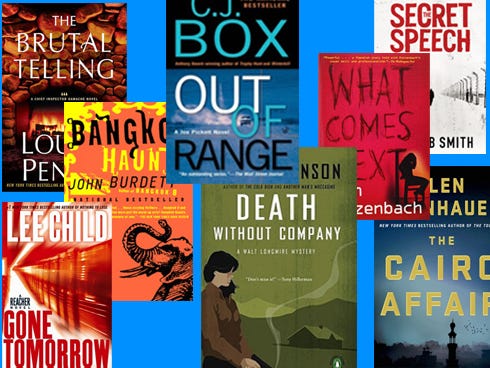
Booklist recently named their "Best Crime Novels of the Past Decade."
Here are some highlights:
•Louise Penny’sArmand Gamache Three Pines series, starring an intrepid Canadian police inspector in the Quebec village of Three Pines, are some of the best traditional crime mysteries being published today.
With rich characters and a firm grasp of human psychology, Penny uses police stories to explore depth of character and the intrigue of human relationships.
“A Rule against Murder” finds the inspector traveling to a remote resort to celebrate his wedding anniversary; naturally, murder is on the guest list.
When the choir director of a monastery in a remote corner of Quebec is murdered in “The Beautiful Mystery,” the inspector is charged with finding a killer among a group of largely silent monks, whose recording of Gregorian chants has made them famous.
“Roiling human passion set against the sublime serenity of the chants produces a melody of uncommon complexity and beauty," the list states.
More titles in the series include: “Brutal Telling,” “Bury Your Dead,” “How the Light Gets In” and “The Long Way Home.”
•“Bangkok Haunts,” by John Burdett: Burdett’s third Sonchai Jitpleecheep novel, starring the Bangkok police detective and co-owner, with his mother, of a brothel in the city’s notorious District 8, builds on the exquisite moral ambiguity implicit in both setting and hero with his tightest plot yet — and an even more potent mix of underworld seaminess, startling tenderness, and Buddhist wisdom.
•“The Dark Horse,” by Craig Johnson: From the motel backdrop through the indelibly inked characters, and on to the set piece ending (in snow and lightning atop a mesa), this is one of Johnson’s best.
Likewise, in “Death without Company” Johnson uses the landscape of the Wyoming high country to evoke the sense of lives crushing in upon one another, as secrets refuse to stay buried and old wounds continue to fester. Johnson combines a vivid sense of the dailiness of life with a sure-handed touch for jolting both his characters and his readers out of their comfort zones and deep into harm’s way.
Additional top crime fiction includes:
"Blotto, Twinks, and the Dead Dowager Duchess," by Simon Brett
"The Broken Shore," by Peter Temple
"The Cairo Affair," "The Nearest Exit" and "Victory Square," by Olen Steinhauer
"Cemetery Road," by Gar Anthony Haywood
"The Devil She Knows," by Bill Loehfelm
"Darkness, Darkness," by John Harvey
"Echo Park," by Michael Connelly
"Exit Music," by Ian Rankin
"The Foreign Correspondent," by Alan Furst
"Free Fire" and "Out of Range," by C.J. Box
"The Godfather of Kathmandu," by John Burdett
"Gone Girl," by Gillian Flynn
"Gone Tomorrow," by Lee Child
"Hush, Hush," by Laura Lippman
"In the Morning, I’ll Be Gone," by Adrian McKinty
"Iron House," by John Hart
"Live by Night," by Dennis Lehane
"Natchez Burning," by Greg Iles
"Night Film," by Marisha Pessl
"An Officer and a Spy," by Robert R. Harris
"Painted Ladies," by Robert B. Parker
"Perfidia," by James Ellroy
"Poison Flower," by Thomas Perry
"Red Means Run," by Brad Smith
"The Redbreast and The Snowman," by Jo Nesbo
"The Rules of Wolfe," by James Carlos Blake
"The Sacred Cut," by David Hewson
"The Secret Place," by Tana French
"Secret Speech," by Tom Rob Smith
"Started Early, Took My Dog," by Kate Atkinson
"Suspect," by Robert Crais
"The Thicket," by Joe R. Lansdale
"The Troubled Man," by Henning Mankell
"Vicious Circle," by Robert Littell
"What Comes Next," by John Katzenbach
"The Whites," by Harry Brandt
"Winter’s Bone," by Daniel Woodrell
"Wyatt," by Garry Disher
Sandra Dreaden is the Crestview Public Library's reference librarian.
This article originally appeared on Crestview News Bulletin: DREADEN: Best crime novels of the past decade