Please ensure Javascript is enabled for purposes of website accessibility
Skip to main content
Advertisement
Advertisement

County Courthouse demolished in Crestview

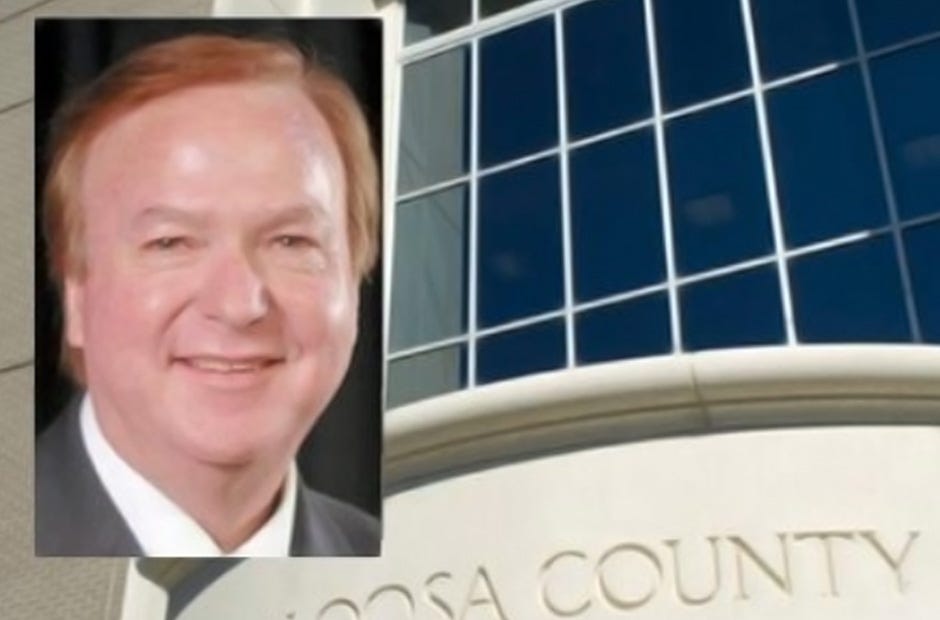
The Okaloosa County Courthouse in Crestview was torn down Tuesday. The building opened in 1955, but was closed in April 2016. MARK JUDSON | News Bulletin

CRESTVIEW — After standing for more than 60 years, the Okaloosa County Courthouse in Crestview was demolished Tuesday.

The courthouse, at 101 James Lee Blvd. E., opened in 1955 but recently fell into poor condition. Inspectors found mold, asbestos, a leaking roof and a failing heating and air conditioning system.

In October 2015, Okaloosa County Board of Commissioners voted to raze the building and construct a new courthouse on the property. The courthouse closed its doors for the final time in April 2016 and it has further decayed since then.

Several plans were discussed on what to do with the courthouse and property. Ultimately, the construction of a new courthouse on the same plot of land was decided upon. The new project has a set maximum price of about $23.7 million.

"The goal is to achieve a facility that the citizens up here can be proud of and make sure Crestview will be the home of the county courthouse for the next generation," Okaloosa County Commissioner Nathan Boyles said at the time of the decision.

The county expects the new courthouse to be completed by July 2018.

This article originally appeared on Crestview News Bulletin: County Courthouse demolished in Crestview

Skills, discipline part of taekwondo belt ceremony

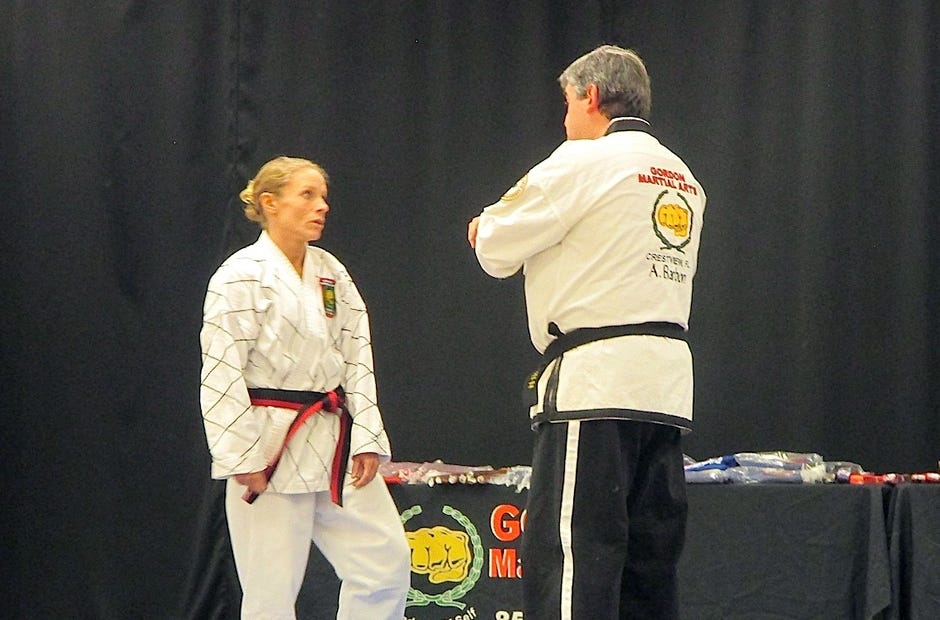
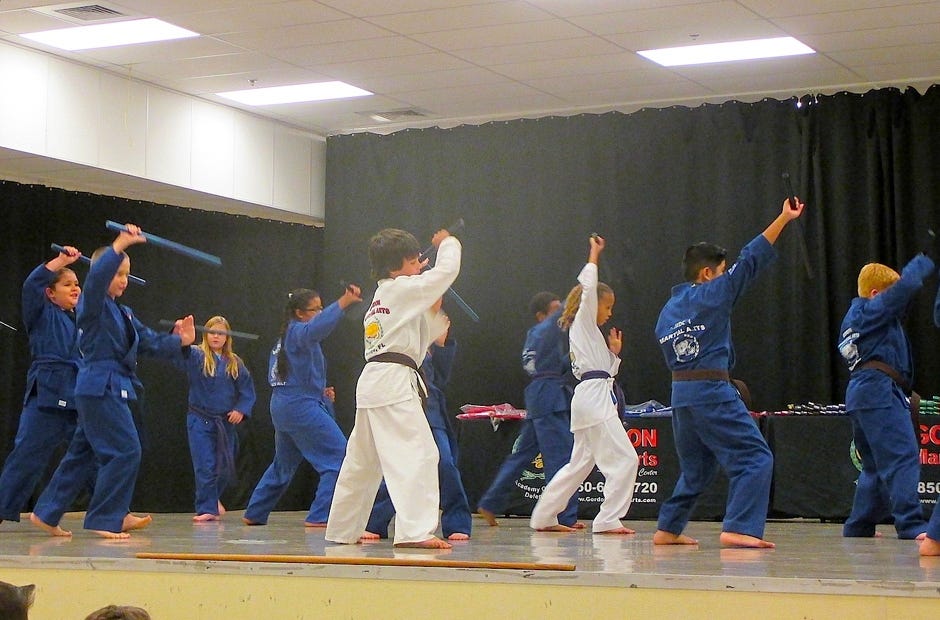
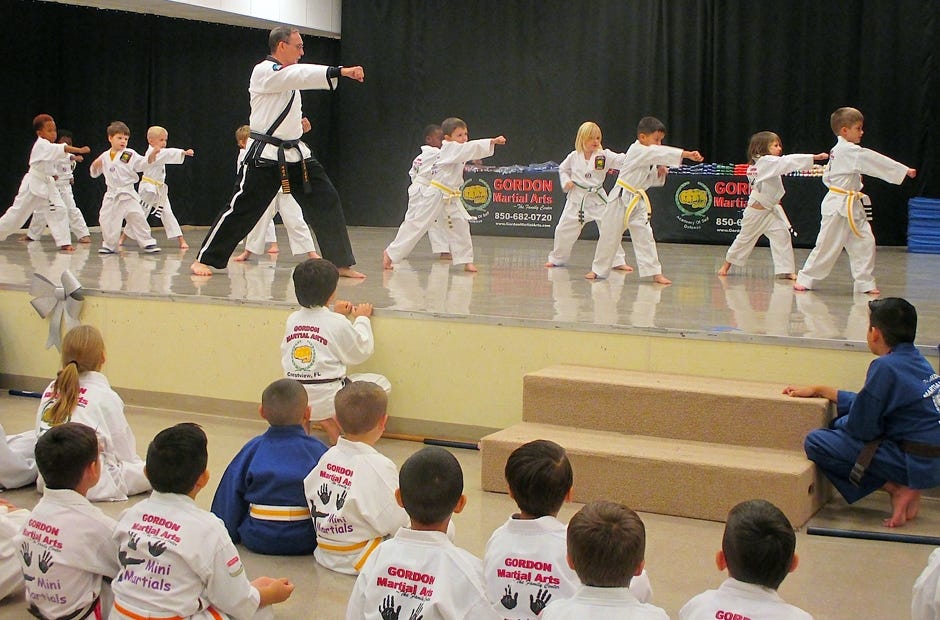
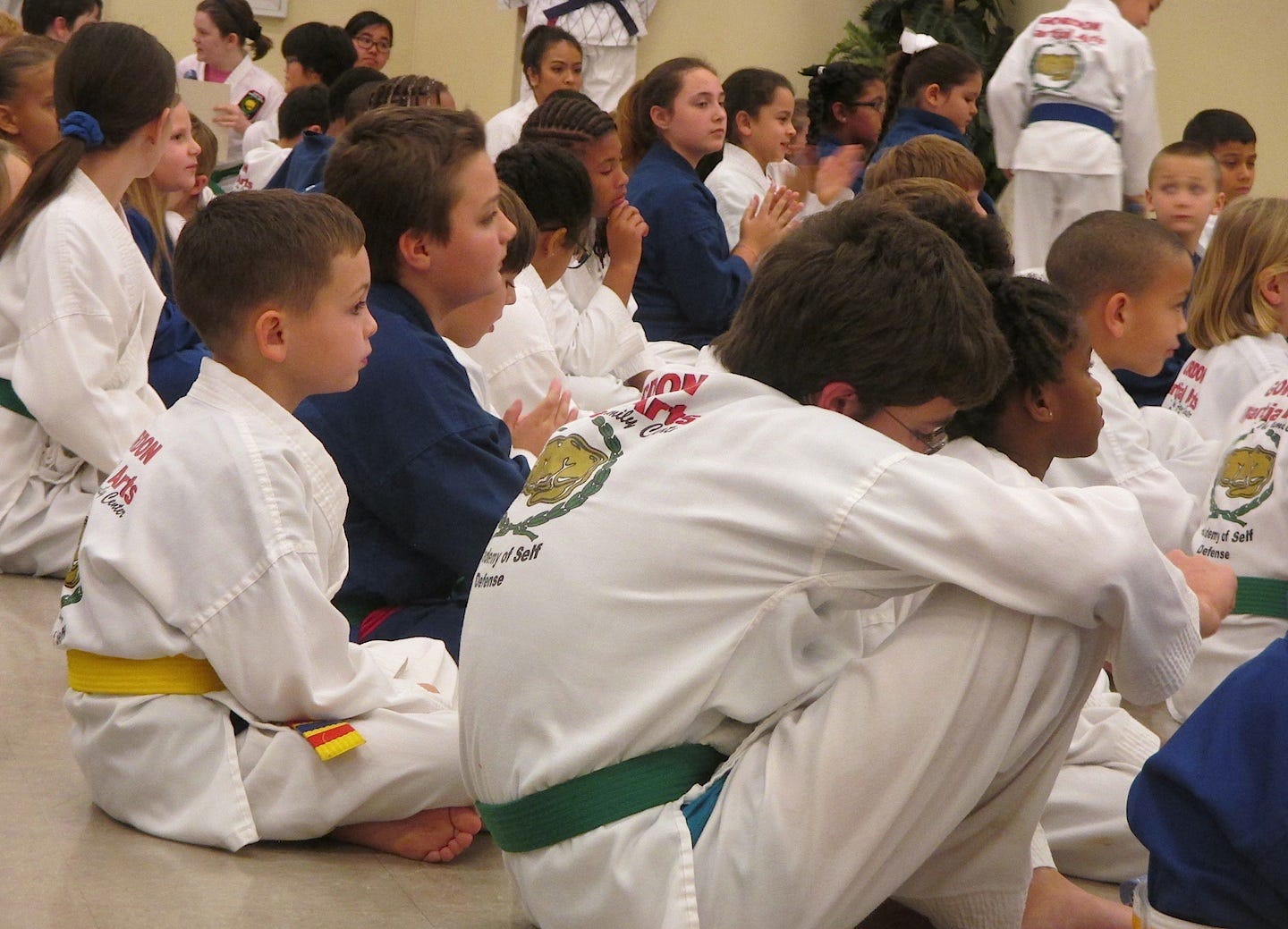
Gordon Martial Arts instructor Greg Bledsoe puts Mini Martials students between 4 and 6 years old through a form, or routine, during the academy's Jan. 6 belt ceremony. Brian Hughes | Special to the News Bulletin

CRESTVIEW — Punches flew and kicks were delivered at the Crestview Community Center Jan. 6, but nobody was injured. In fact, those who kicked and punched well were rewarded.

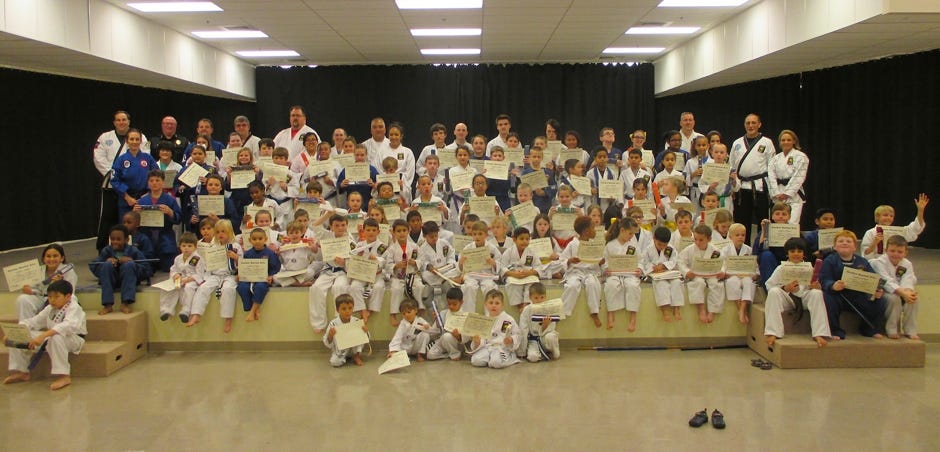
As each advanced to the next level of their studies in taekwondo, students at Gordon Martial Arts academy received colored belts attesting to their prowess and signifying where they were on their respective journeys.

While developing physical skills and character, the kids — some as young as 4 years old — also have a great time as they learn the Korean art's techniques, philosophy and discipline demanded of its practitioners.

"He loves it!" Lynn Mayo said of her son, Phenix, 7, who received his blue senior belt at the ceremony.

Gloria Garcia, whose 7-year-old grandson, Chandler Dill, was promoted to orange belt from yellow Friday night, echoed Mayo's sentiment. "He really enjoys it," Garcia said.

The 120 promoted students, including 25 teens and adult martial artists, four of whom also advanced in Korean hapkido, follow a strict observance of the academy's five tenets: courtesy, integrity, perseverance, self-control and indomitable spirit.

The ceremony's guest speaker, Crestview Police Chief Tony Taylor, commented on each attribute:

•Courtesy: "Treat people with respect, even if they don't respect you."

•Integrity: "It's one of the most important things you can have in life. It's important in what we do in law enforcement. Always protect your integrity with everything you do."

•Perseverance: "Never give up if you have a goal in life. You can achieve it. With perseverance, you can overcome anything you need to overcome."

•Self-control: "When you have great self-control, it's easy to be courteous to people who aren't courteous to you."

•Indomitable spirit: "Always try your best to be positive, even if you're having a bad day."

Taylor's words stuck with Derek Vegas, 8, who advanced to blue senior belt level during the event.

"I want to be a policeman," Derek told Taylor as he asked his dad to take a photo of him and his little brother, Ethan, 5, with the police chief. That was good news "because we're hiring officers," Taylor told the boy. "Keep up the good work because you're going places."

Academy owner Thomas Gordon said producing such well-rounded, disciplined and confident future leaders is one of Gordon Martial Arts' goals. And it's not just for kids.

"This is something for the whole family," he said. "Anybody can do it."
This article originally appeared on Crestview News Bulletin: Skills, discipline part of taekwondo belt ceremony


Investment tips for millennials

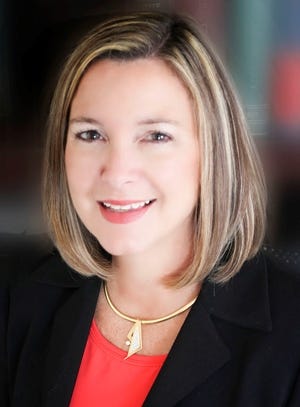
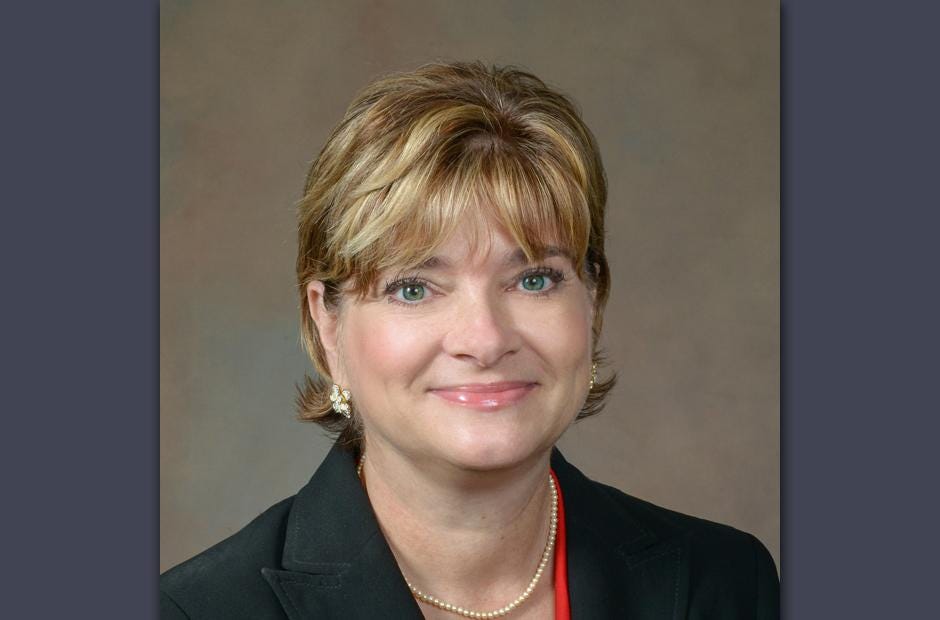
Yvonne Shanklin (Special to the News Bulletin)

If you are a "millennial" — a member of the age cohort born anywhere from the early 1980s to the late 1990s — then you're still in the early chapters of your career, so it may be a stretch for you to envision the end of it.

But since you do have so many years until you retire, you've got the luxury of putting time on your side as you save and plan for retirement.

Here are some suggestions for making the best use of that time:

•Invest early — and often. Even if you are at the very beginning of your career, make investing a priority. At first, you might only be able to contribute a small amount each month, but something is far better than nothing — and after a year or so, you might be surprised at how much you've actually put away.

•Take advantage of your employer's retirement plan. If your employer offers a 401(k) or similar plan, contribute as much as you can afford. At the least, put in enough to earn your employer's match, if one is offered. Your contributions can lower your taxable income, and your earnings can grow on a tax-deferred basis.

•Invest more as your earnings increase. As your career advances, and your earnings rise, you'll want to increase your contributions to your 401(k) or similar plan. And if you ever "max out" on your annual 401(k) contributions (the limits change over time), you can probably still contribute to another tax-advantaged retirement plan, such as a traditional or Roth IRA.

Thus far, we've only discussed, in general terms, how much and how often you should invest. But it's obviously just as important to think about the types of investments you own. And at this stage of your life, you need an investment mix that provides you with ample opportunities for growth. Historically, stocks and stock-based vehicles provide greater growth potential than other investments, such as government securities, corporate bonds and certificates of deposit (CDs).

Of course, stocks will rise and fall in price, sometimes dramatically. But with decades ahead of you, you do have time to overcome short-term losses. And you may be able to reduce the effects of market volatility by spreading your dollars among many different stock-based investments, along with a reasonable percentage of bonds and other, more conservative securities.

Here's something else to consider: Many millennials want more from their investments than just good performance — they also want their money to make a difference in the world. This interest in "impact" investing (also known as "socially responsible" investing) has led some of your peers to screen out companies or industries they believe have a negative impact on society in favor of other businesses that are viewed as contributing to a more sustainable world. If this viewpoint resonates with you, then you may want to explore these types of investment opportunities with a financial professional.

But most important, keep on investing throughout your life. As a millennial, you've got plenty of the one asset that can never be replaced: time. Use it wisely.

This article was written by Edward Jones on behalf of your Edward Jones financial adviser.

This article originally appeared on Crestview News Bulletin: Investment tips for millennials

Golf pro now runs Foxwood Country Club

Brandon Martin, a Crestview High graduate, brought his professional golf skills back to Foxwood Country Club after choosing family over bigger paychecks. MARK JUDSON | News Bulletin

CRESTVIEW — Returning to Crestview meant sacrificing bigger paychecks, but a local golfer said he wouldn’t have it any other way.

Brandon Martin is the new general manager and golf professional at Foxwood Country Club. After spending several years outside Crestview, he returned in April 2014 and began working at Foxwood at the club’s bar and pro shop.

Eventually, Martin started giving lessons and accepted more responsibilities over time, he said. Now, he’s running the course.

But let’s rewind.

Martin began playing golf at 12 years old in the sixth grade. He played at Crestview High School, along with other sports, but quit sports in college. Originally studying to be a meteorologist, Martin realized he “needed something competitive to do.”

“It got to where I realized I didn’t like calculus,” Martin said with a laugh. “I like normal math, but once you start adding the alphabet, it’s a little bit too much.”

Martin enrolled in the Golf Academy of America in Orlando after a recommendation from a friend. The academy is a business school focused on the golf industry. Martin trained at the academy and received an associate degree in golf complex and operations management in 2010, along with a teaching certificate.

In the time following the BP oil spill in the Gulf of Mexico, Martin couldn’t find a job in the Panhandle area. Having extended family in Washington, he left Florida to work at a golf club in the northwest.

“I found out in my career that I would rather have my friends and family than an enormous paycheck,” Martin said.

So, he left his job in Washington after four years and returned to Crestview.

Foxwood was a natural fit for Martin. He worked at the club when he was in high school as a cart boy and said some of the members from that time still play at the course. Martin believes this adds to the area’s family feel.

A family-oriented environment is one of Martin’s goals as he takes over leadership at Foxwood. He also wants to make the club, and golf in general, more accessible to a younger generation.

“It’s kind of like going to church; it gives you a backbone to live your life off of,” Martin said of playing golf. He believes the sport teaches young people values, etiquette and how to be a strong individual.

While some people may view golf as a difficult sport, Martin said this doesn’t have to be the case. Clubs are a one-time investment, unlike other sports, which require new equipment each year, and the more you play, the less it costs, he said.

Martin has focused on improving Foxwood’s course conditions and hopes continued improvements could build membership. Currently, the club has about 180 members.

As for Martin, he’s happy to be back with old friends and his immediate family.

Although he does miss the cool, Washington summers, he joked.

“As long as I can live a decent life, can pay my bills, be around friends and family — I’m happy," he said. 

This article originally appeared on Crestview News Bulletin: Golf pro now runs Foxwood Country Club

Gulf Power prices decrease for new year

A Gulf Power Company employee assists with recovery from Hurricane Hermine Sept. 5 in Tallahassee. The company will lower its rates in January. Colin Hackley |Special to the News Bulletin

PENSACOLA — As of Jan. 1, Gulf Power customers should see their prices drop 3 percent due to lower fuel costs used in energy production.

In November, the Florida Public Service Commission approved Gulf Power’s request to decrease customer’s bills by $4.63, from $148.64 to $144.01 for the average residential customer.

This is the second year in a row Gulf Power customers have seen a decrease in energy prices brought about by planning and management of the natural gas and clean coal the energy provider uses to generate electricity. Last January, residential energy bills decreased 5 percent.

“Gulf Power employees have worked hard to manage costs to benefit our customers directly, especially as we head into the cold winter months,” said Rick DelaHaya, Gulf Power spokesperson. “And because Gulf Power employees have been working hard toward a more balanced energy mix, our customers can take advantage of lower fuel prices now, and into the future.”

Every year, the Florida Public Service Commission adjusts Gulf Power’s prices to reflect cost changes in fuel, environmental controls and energy conservation programs. Fuel cost savings are passed to Gulf Power customers, with no profit to the company.

This decrease follows a price increase request to continue to invest in Northwest Florida’s energy infrastructure. In October, Gulf Power requested that the Florida Public Service Commission conduct a public review of their prices and a proposed increase that would begin in July 2017.

The last time customers saw a price increase was in January 2015, and when compared to those prices, the average residential customer’s monthly bill in July 2017 after PSC approval would increase by $2.50 per month or less than 2 percent.

“If approved, that requested investment would help secure long-term reliability, continue smart grid improvements, and bolster our goal of achieving a balanced energy mix,” DelaHaya said. “A balanced energy mix helps keep customers’ costs stable and insulates customers from price fluctuations that can be caused by price volatility in the fuel we use to generate electricity.”

Along with that request, the energy company has asked for approval of new customer rate options designed to make bills more predictable and has instituted new initiatives designed for greater customer conveniences, including an improved online experience, additional payment locations at popular stores and payment kiosks in business offices.

Gulf Power customers can find additional savings by making their homes more energy efficient. Go to www.gulfpower.com for more information.

This article originally appeared on Crestview News Bulletin: Gulf Power prices decrease for new year

Forage testing is important to livestock owners

Knowing key information about hay samples will allow you to determine how much feed is necessary to maintain body conditioning for your livestock. Special to the News Bulletin

Often people define hay quality in terms of palatability. But we also need to consider other parameters such as digestibility and nutritional value.

To evaluate hay on these parameters, you need to sample and test your hay.

A hay sample is easy to take. We sample each hay lot separately. A hay lot is hay from the same field and same cutting that is harvested under the same environmental conditions and has the same forage composition. Hay samples are taken using a hay probe. The sample is then sent to a lab such as our University of Florida Institute of Food and Agricultural Sciences Forage Extension Laboratory or a private lab such as Waters Lab in Georgia.

Hay samples are taken using a hay probe. The sample is then sent to a lab such as our University of Florida Institute of Food and Agricultural Sciences Forage Extension Laboratory or a private lab such as Waters Lab in Georgia.

Sample results should include crude protein and total digestible nutrients at a minimum and should be reported on a dry matter basis. Dry matter refers to the portion of the forage after water is excluded. Reporting on a dry matter basis allows us to compare different forages. Crude protein is the nitrogen and amino acids in feeds. Total digestible nutrients, or TDN, represents the energy value of feeds, which is the sum of digestible fibers, starch, sugars, protein and fats in the forages.

Knowing CP and TDN, along with evaluating the palatability, will allow you to determine how much to feed to maintain body conditioning for your livestock. 

Here is a guide:

Bahiagrass Hay; 4-13 percent CP; 42-56 percent TDN

Bermudagrass Hay; 7-16 percent CP; 38-54 percent TDN

Bahiagrass hay seems to be less palatable sometimes but this is more of a management issue. Bahiagrass is often cut after peak palatability. In general, good bahiagrass hay will provide appropriate nutrients for livestock if palatability is high. Bermudagrass seems to be more palatable to picky eaters and contains adequate nutrients for most livestock.

For more information about hay quality or to have your hay sampled, call me at 689-5850 or email bearden@ufl.edu

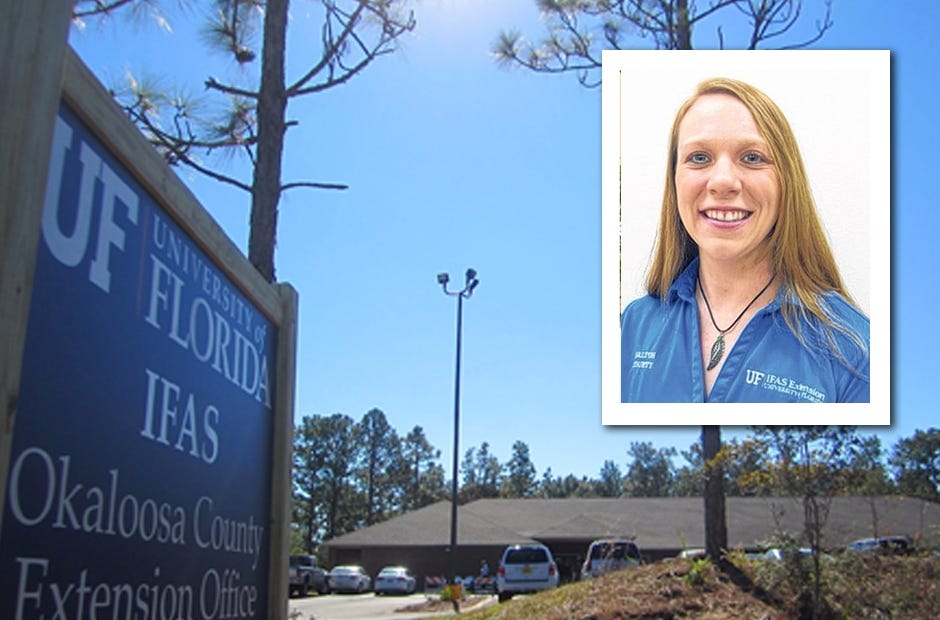
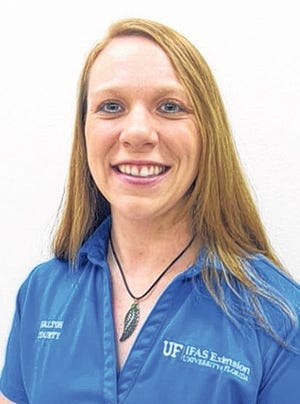
Jennifer Bearden is an agent at the University of Florida Institute of Food and Agricultural Sciences offices in Crestview. 

This article originally appeared on Crestview News Bulletin: Forage testing is important to livestock owners

Considering the value of white space

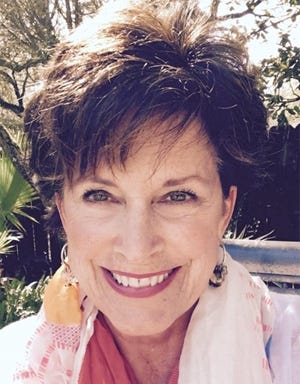
Heather Nitzel is the Crestview Public Library's youth services librarian.

Three times a year I design a brochure that explains opportunities available for youths from birth through age 17 at our library.

It is always a rather monstrous task to wrangle into submission, and I'm always relieved when it's ready to print. Ever aiming for perfection, no matter how often I miss the mark, at least two sets of eyes proofread it before I start burning up toner to beat the band.

Esther Hurwitz is one of the coworkers I'll hit up for this brain-numbing exercise of proofreading. Several times, she told me it makes her feel tired just looking at it. I get the same feeling, so I didn't think much of her statement. For me, it outlines a lot of upcoming work and deadlines, so logically it would make me tired.

She had to come at it from a different angle to get her point across. "It needs more white space." I had purposely pushed the margins to the printable edge of reason to cram in more information. Could less really be more?

Another coworker, Ginny Dennison, pointed out the need for "empty" space in another library realm: displays. I was asking her and our volunteers to put two books in each book stand, so we'd have a "backup." Ginny noticed fewer items got picked up from the displays when we did this. The display was overwhelming … too busy.

This need for white space, or margin, has spilled over into my thinking about other areas of my life as well. I am an expert at cramming in as much as possible into my time and a novice at creating a "rhythm of rest" — as my pastor, Ian Anderson, calls it.

Perhaps instead of squeezing out every last drop of energy, it would be wiser to intentionally build in white space … margin … rest.

Heather Nitzel is the Crestview Public Library's youth services librarian.

Here are upcoming events at the Crestview Public Library, 1445 Commerce Drive:

AGES 0-2 LIBRARY CLASS: 10:15 a.m. Thursdays and 9:15 a.m. Fridays, Crestview library. Limited to 30 children per class. Topics are: Jan. 5, 12 and 13, Color; Jan. 19-20, Bedtime (wear pajamas); Feb. 2-3 and 9-10, Baby Love; Feb. 16-17, and 23-24, Birthdays; March 2-3 and 9-10, Chicks & Ducklings; March 16-17, Growing & Gardening; March 23-24 and 30-31, Animal Sounds; April 6-7, and 13, Spring and Easter; April 20-21 and 27, Wildlife; May 4-5 and 11-12, Praiseworthy Parents.

AGES 3-5 LIBRARY CLASS: 10:15 a.m. Tuesdays, Crestview library. Topics are: Jan. 10 and 17, Reach for Peace; Jan. 24 and 31, Clothing; Feb. 7, Eye Care; Feb. 14, Valentines; Feb. 28, African Tales; March 7, Farm to Table; March 14, In Our Garden; March 28, Flying High; April 4 and 11, Easter; April 25, Environmental Center Field Trip; May 2 and 9, Praiseworthy Parents.

FRIENDS OF THE CRESTVIEW LIBRARY: 10:30 a.m. Jan. 19, Crestview library. Membership starts at $10 a year for individuals.

FAMILY LIBRARY TIME: Events for ages 4 and up at the Crestview library are as follows.

●6:30-7:15 p.m. Jan. 26, Crestview library. Bear Hunt for ages 4 and up. Wear pajamas, and bring a teddy bear, flashlight, and six cookies to share. Limited to first 30 children; registration recommended.

●6:30-7:15 p.m. Feb. 21, Pelican Pickers perform music for the young and young at heart.

●6:30-7:15 p.m. March 21, Beekeeping with Bundrick Honey Farms.

●6:30-7:15 p.m. April 18, Nonie's Ark visit. Registration limited to first 30 children ages 4 and up only.

FREE TAX PREPARATION AND FILING: 2-6 p.m. Mondays, and 10 a.m. to 2 p.m. Tuesdays, Thursdays and Saturdays Feb. 2-April 18 on a first-come, first-served basis.

TEEN WII: 2-4 p.m. Fridays, Crestview library. Wii playing for students in grades 6-12.

READ TO DOZER: First Saturdays, 10-11 a.m. for children ages 4 and up.

This article originally appeared on Crestview News Bulletin: Considering the value of white space

What's your retirement 'contingency plan?'

Yvonne Shanklin

You probably have thought about what you'd like to do during your retirement years. But all your plans probably depend, to at least some extent, on your financial situation.

What happens if you reach the age at which you wish to retire and you just don't have the money you thought you'd have?

If this occurs, it's time for "Plan B." What does that look like? Here are a couple of possibilities:

•Continue working. If you like your job, you may not mind working an extra year or so. You'll be bringing in more income and contributing more to your 401(k) or other retirement account — and, perhaps almost as importantly, you may be able to avoid tapping into these retirement accounts, thus giving them more time to potentially grow. (However, once you turn 70½, you'll need to begin taking withdrawals from your 401(k) and a traditional IRA.) But if you are really not enamored with the idea of working any longer, you might find that even the ability to "beef up" your retirement plans for another couple of years isn't much consolation.

•Adjust your retirement lifestyle. It's pretty simple: If you don't save as much as you had planned for retirement, you probably can't do all the things you wanted to do as a retiree. For example, you may not be able to travel as much, or pursue your hobbies to the extent you'd like.

Clearly, you'd like to avoid these "retirement contingency plans." To do so, though, you'll need to take steps well before you retire. And the most important move you can make may be to contribute as much as you can possibly afford to your IRA and your 401(k) or another employer-sponsored retirement plan.

During the last several years before you wish to retire, you may be in a strong position to "max out" on these plans because, at this stage of your life, your income may be at its highest point, your children may be grown and you may even have "retired" your mortgage. If you still have money left with which to invest, you may want to look at other tax-advantaged vehicles that can be used for retirement.

But while it's important to put in as much as possible to your retirement accounts, you need to do more than that — you also must put the money in the right investments within these accounts. Your exact investment mix should be based on your individual risk tolerance and time horizon, but, as a general rule, these investments must provide you with the growth potential you'll need to accumulate sufficient resources for retirement.

Of course, as you know, investments move up and down. You can't prevent this, but you'll certainly want to reduce the effects of volatility as much as possible when you enter retirement. Consequently, during your final working years, you may need to adjust your retirement accounts by shifting some of your assets (though certainly not all) from growth-oriented vehicles to income-producing ones.

It's a good idea to have contingency plans in place for virtually every endeavor in life — and paying for your retirement years is no different. But if you can make the right moves to avoid the contingency plans in the first place, then so much the better.

This article was written by Edward Jones on behalf of your Edward Jones financial adviser.

This article originally appeared on Crestview News Bulletin: What's your retirement 'contingency plan?'

error: Content is protected !!