Please ensure Javascript is enabled for purposes of website accessibility
Skip to main content
Advertisement

Council sends sales tax resolution to Okaloosa commissioners

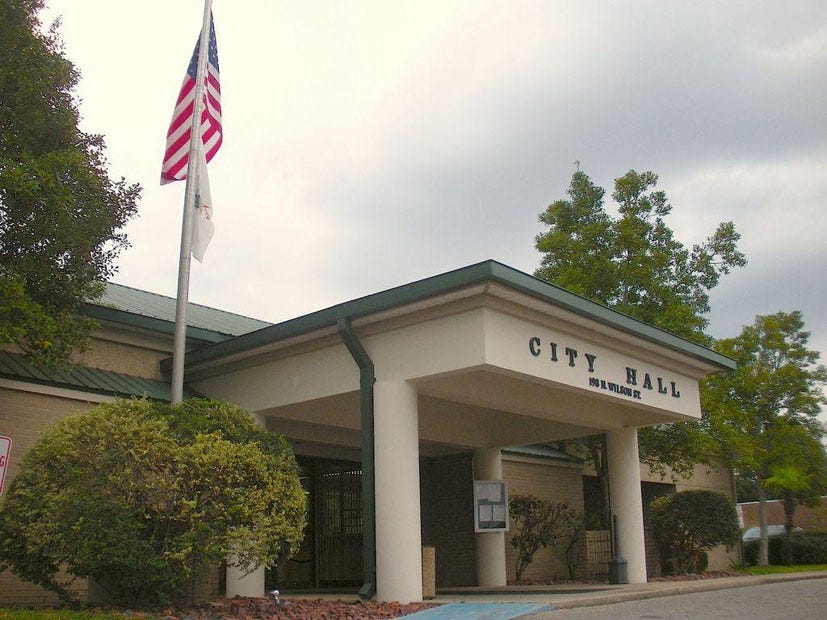
Laurel Hill's city council met May 4 and discussed items such as the half-cent sales tax, the city scholarship, project updates and fundign from the FDOT. [ALICIA ADAMS | News Bulletin]

LAUREL HILL — A half-cent sales tax proposal is making its way through Okaloosa County.

The Laurel Hill City Council received a resolution from the Okaloosa County League of Cities to levy a half-cent sales tax for five years to fund capital improvement projects.

The council unanimously voted May 4 to submit the resolution to Okaloosa County commissioners.

Councilman Scott Moneypenny, who made the motion to send the resolution to commissioners, said he is not in favor of raising taxes.

Councilwoman Debra Adams said she thinks the half-cent tax is a fair way to collect money, as opposed to property taxes.

If commissioners approve the resolution, Okaloosa’s registered voters will decide on the sales tax issue in the 2018 election.

If approved, capital improvements would benefit the entire county. Each city gets a certain percentage of funding based on their population. 

This article originally appeared on Crestview News Bulletin: Council sends sales tax resolution to Okaloosa commissioners

No funding for filling potholes

The Laurel Hill City Council meets 6 p.m. the first Thursdays of the month at city hall. [File photo]

LAUREL HILL — For now, Laurel Hill residents will just have to deal with potholes on city streets.

Virgie Bowen, with the Florida Department of Transportation District 3 Chipley office, attended Laurel Hill’s May 4 City Council meeting to answer questions about filling potholes on a 3-mile segment of Steel Mill Creek Road.

“Unfortunately, we don’t have a funding program to address that need that you have,” Bowen said. “So, unfortunately, we are not able to help along those lines.”

There was also a request for sidewalks along Ebenezer Road and T.E. Rogers Road. The FDOT’s Transportation Alternatives Program can fund this type of improvement, but the city needs to submit an application for consideration.

“We recently did [an application],” City Clerk Nita Miller said. “Actually, it wasn’t through FDOT; it was through the Safe Routes to School Program.”

This is a different program, out of the FDOT’s safety office, and the funding comes from the same place.

There was also a request for maintenance on sidewalks near Laurel Hill School. Bowen said that when sidewalks are completed, there is no funding for maintenance; therefore, local residents typically agree to take care of the maintenance.

Numerous projects in the FDOT’s five-year work program in Okaloosa County are in the south part of the county, where most residents live. According to Bowen, FDOT is starting to look at rural areas’ concerns.

Councilwoman Debra Adams asked if there was a program pertaining to the pothole maintenance.

“There is what is called a County Incentive grant Program, but to qualify for that, you have to show how that improvement is going to relieve congestion on a state road,” Bowen said.

Councilman Daniel Lane asked Bowen if the installation of streetlights falls under a program due to their importance to safety; Bowen said it likely wasn’t under the TAP program.

This article originally appeared on Crestview News Bulletin: No funding for filling potholes

County courthouse moves closer to completion

Okaloosa County commissioners voted to demolish and rebuild the courthouse in October 2015. [MARK JUDSON/NEWS BULLETIN]

THE DETAILS

The Okaloosa County courthouse was reduced to rubble in January with the intention of being rebuilt.

Standing since 1955, the structure became overrun with black mold and asbestos. County commissioners voted to demolish the building in October 2015 and its doors closed for the final time April 2016.

After months of debate, the county decided to rebuild on the existing site, hoping to complete the project by July 2018. Groundbreaking began shortly after the former complex was demolished.

The new building received a cost estimate of $23 million, compared to the $400,000 spent constructing its predecessor in 1955 and $29,000 spent on the original building in 1918.

“The goal is to achieve a facility that the citizens [in Crestview] can be proud of and make sure Crestview will be the home of the county courthouse for the next generation,” Okaloosa County Commissioner Nathan Boyles said when the decision was made to rebuild on the same property at 101 James Lee Blvd. E.

THE PROGRESS

After months of demolition and site clearing, the courthouse construction is seeing significant progress. Multiple walls have been built and a steel frame for portions of the building are in place.

According to Jason Autrey, Okaloosa County’s public works director, recent storms have only had mild impacts on construction, and rain days are being tracked in accordance with the contract.

Autrey said the construction project is currently on schedule, and the contract completion date remains July 3, 2018.

Staff Writer Alicia Adams contributed to this report.

This article originally appeared on Crestview News Bulletin: County courthouse moves closer to completion

5 things to know about a charter reform

Mayor David Cadle and City Council sit beside signs depicting the current government structure. This structure could change if voters decide for reform. [MARK JUDSON/NEWS BULLETIN]

1. Past failure

The City Council’s effort to possibly alter the city charter and government structure isn’t Crestview’s first venture into the reform.

The measure was presented to voters Nov. 6, 2012, after an extensive, multi-year review process. The ballot question asked voters if they would approve of the hiring of a city administrator—replacing the mayor-council government structure—and making the city clerk an appointed position, as opposed to elected.

The question needed a simple majority to pass but fell short. Results showed 4,319 people voted against the measure and 3,795 voted to approve.

Although it was featured on the ballot, a clerical error made the question invalid. Several hundred voters in the 2012 election didn’t vote on the reform, possibly due to its invalid status, according to current City Council President J.B. Whitten.

2. Size an issue

Crestview currently operates under a council-mayor form of government, which is commonly used by large areas like New York City and Houston or by small towns, according to the National League of Cities.

Larger cities, like Pensacola, opt for a strong mayor system, which places departments and administrative positions under the mayor’s supervision and sometimes grants mayors veto power over city council. Smaller cities often use a weak mayor structure that gives limited oversight to the mayor and instead places city departments under the council.

There are 84 cities in Florida that use a council-weak mayor structure, out of the state’s 411 total cities. Only 33 of those—not including Crestview—have a population over 1,000. Crestview (approximately 24,000 residents) and Sebring (approximately 10,400 residents) are the only two council-weak mayor governments in Florida with populations over 10,000.

Whitten believes this is a sign the city has outgrown its current form of government.

3. Changes aren’t just about a city manager

Most of the conversation about changing the charter has focused on the hiring of a city manager but this isn’t the only decision that could possibly be on a ballot.

One other contested topic is a possible alteration to the selection of a city clerk. Crestview elects its clerk position, as opposed to most Florida cities, which appoint their clerk. The difference resides in qualification standards and accountability.

Electing a city clerk can lead to questions about a candidate’s qualifications and ability to perform the tasks of the position. This is compared to an appointed position, which gives the mayor or council ability to hire someone based on their experience and can terminate their employment if they believe it is sub-par. This issue was raised in DeFuniak Springs in 2010.

However, supporters of an elected clerk argue that it reduces the chance of possible corruption because the clerk is answerable to the people and not other officials. Therefore, if a clerk were to be pressed to do something unethical or against standard procedure, they would be able to say “no” without risk or termination. An elected clerk, in this theory, is accountable to the voters first and thus, creates a more transparent government.

4. The cost of change

While city council members and mayors make little to no money in salary, a city manager is a different situation.

Fort Walton Beach pays their city manager Michael Beedie $120,000 per year in salary, which is an average amount for cities that size, he said.

Crestview has not yet disclosed what a manager would be paid but six figures per year would be a large investment for the city. These costs can be made up by cuts to other funds but Beedie added improving the efficiency of the city has been worth the extra cost to Fort Walton Beach.

The city would also have to pay to place the motion on a ballot if they decide to move forward with a reform. However, these costs are in the range of a few hundred dollars and have yet to be a deciding factor in any conversations.

5. How Crestview residents will decide

If a review commission is created and decides to reform the city charter, residents will have the final say at the polls—and maybe at the mailbox.

Officials and residents have discussed mailing the ballot to eligible voters as a way to increase voter turnout. The city’s elections in March generated a little over three percent turnout. Okaloosa County Supervisor of Elections Paul Lux confirmed at a previous City Council meeting the measure could be done via mail.

Aside from how residents can vote, it’s still undecided how many items they’ll be voting for.

Beedie and former City Councilman Tom Gordon believe that lumping all aspects of the bill into one question could cause residents to vote “no” if they disagreed with one aspect but agree with everything else. Gordon believes this was an issue in the 2012 election.

When Fort Walton Beach adopted a new city charter several years ago, voters had seven measures to vote on. Officials were concerned residents would get “voter fatigue” and not make a decision, according to Beedie, but that was not the case. That decision was made partially in response to seeing Crestview’s reform attempt fail by having all measures lumped together, he added.

Splitting measures apart also allows for more in-depth descriptions on each issue. Florida limits ballot summaries to 75 words, making it difficult to fully describe several measures.

This article originally appeared on Crestview News Bulletin: 5 things to know about a charter reform

Laurel Hill City Council agenda: May 4

[File Photo | News Bulletin]

LAUREL HILL — The Laurel Hill City Council will meet 6 p.m. May 4 at city hall, 8209 US Highway 85 N, Laurel Hill.

Here is the meeting's agenda.

1. New business

a. Approval of consent agenda

1. April 6 and 14 minutes

2. Update on internal audit: general and water funds (April) — no problem.

b. Virgie Bowen with Florida Department of Transportation.

c. Projects update (Dewberry)

d. Award scholarship

e. Sales tax resolution (Okaloosa County League of Cities)

f. Interlocal agreement with Okaloosa County (Local Option Gas Tax)

2. Public comments.

3. Unfinished business — none

4. Adjourn

The next regular meeting is 6 p.m. June 1 at city hall, 8209 US Highway 85 N, Laurel Hill.

This article originally appeared on Crestview News Bulletin: Laurel Hill City Council agenda: May 4

Crestview meeting agendas: April 24

[File Photo | News Bulletin]

CRESTVIEW — The Crestview City Council will meet 5 p.m. and 5:30 p.m. April 24 at Warriors Hall, 201 Stillwell Blvd.

Here are the meeting agendas.

5 p.m. Special Meeting

1. Call to order

2. Pledge of Allegiance

3. Open meeting

4. Approval of agenda

5. Item for consideration

a. Request approval of final inspection, acceptance of utility infrastructure and release of defect security in the amount of $10,447.18 (escrow) for Taylor Farms subdivision.

6. Comments from the audience

7. Adjournment

5:30 p.m. Workshop Agenda

1. Call to Order

2. Pledge of allegiance

3. Open workshop, council president announcements

4. Presentations from city of Crestview

5. Presentations from other cities

•Mayor Chris Stein, city of Mary Esther

•Dan Henkel, council member, city of Niceville

•Michael Beedie, Fort Walton Beach city manager

6. Presentations from department heads

7. Public opportunity to speak

8. Council discussion

This article originally appeared on Crestview News Bulletin: Crestview meeting agendas: April 24

Crestview's 2017 master plan revealed

New plans for Crestview Junction call for demolishing this vacant property and convert it to a park, connecting with Twin Hills Park, seen in the background. [MARK JUDSON/NEWS BULLETIN]

CRESTVIEW — The Community Redevelopment Agency has unveiled its 2017 master plan, highlighting opportunities and recommendations to spur downtown revitalization.

The plan is a “long-term vision of possibilities for redevelopment and revitalization with some short-term recommendations,” David Haight, the project manager for its creation, said. 

Several key project recommendations highlighted in the master plan include an updated vision for the Crestview Junction, wayfinding signs throughout downtown and gateway enhancements.

CRESTVIEW JUNCTION

The Crestview Junction was originally introduced in the CRA’s 2015 master plan, but a new vision has brought it back into the conversation.

The CRA sees the opportunity to convert several vacant lots on Woodruff Avenue East, Brett Street North and Oakdale Avenue East into a park. This redeveloped area would connect the downtown district with Twin Hills Park. One portion of the park would be built into an outdoor amphitheater available as a public venue for events and gatherings.

Currently, Twin Hills and downtown are not directly connected. Linking the two would help increase the area’s walkability. The ability to walk or bike with ease through downtown is a necessity if mixed-use residential buildings are constructed downtown — a strong recommendation from Haight.

DOWNTOWN RESIDENTS

“With new residential development, walkability becomes more necessary for connecting residents within the central business district,” Haight said in his presentation to the CRA board.

The central business district struggles to draw commuters in its present state. A lack of residents reduces demand for retail, dining or other commercial entities in the area, according to Haight. Constructing residential buildings will help revitalize downtown.

“Today, downtown Crestview has been bypassed in many ways,” Haight said. This is the result of community gathering centers — library, farmer’s market, post office, YMCA, grocery stores — leaving downtown to relocate or close down.

The result is that traffic moves past downtown, without the need or reason to stop there.

TRAFFIC BYPASSING DOWNTOWN

The portion of Ferdon Boulevard that borders downtown moves about 38,500 vehicles each day, according to the Florida Department of Transportation. Downtown streets, conversely, see 1,000 to 2,000 vehicles daily, depending on the road.

The CRA believes building wayfinding signage is a simple, first tactic to promoting the downtown area to commuters. These signs would feature the city crest and arrows directing people to area points of interest. Similar signs are seen in downtown and historic districts across the country.

Similarly, gateway arches can be constructed to signify the entrance to downtown.

Other recommendations in the plan include developing bike paths, enhancing existing parks, hosting downtown cultural events and enforcement of city regulations.

MAKING IT HAPPEN

The master plan presents no target timelines for projects and lacks detailed plans on how to accomplish its recommendations.

“The next step [for the city] will be identifying what projects it will pursue,” CRA Director Brenda Smith said. However, there is no indication on when such decisions could be made, if at all.

The plan also aims to engage Crestview residents to help spur growth and revitalization in the community.

“The real catalyst for future improvements will be committed groups of citizens willing to jump start these new initiatives,” Haight said. ”All of the physical improvements that development and infrastructure can provide cannot substitute for energy provided by the community.”

The 2017 CRA master plan is the fourth version of the plan — others appeared in 1995, 1998 and 2015.

The latest version expands on options and validates that certain areas need development, according to Smith. She said issues with implementing the plan need to be “cleared up.”

This article originally appeared on Crestview News Bulletin: Crestview's 2017 master plan revealed

Congressional visit paints dim outlook of economy

U.S. Rep. Matt Gaetz discussed what his budget committee discusses and the impacts their decisions can have. [MARK JUDSON/NEWS BULLETIN]

CRESTVIEW — A “looming budgetary catastrophe” was the message U.S. Rep. Matt Gaetz sent to a senior economics class at Crestview High School on Tuesday.

Gaetz's visit to CHS was part of a series of district stops during a two-week Congressional recess. The day began with the congressman speaking to senior honor graduates in the school’s auditorium. He congratulated students on their success and asked questions about their educational paths.

“You represent this community that is incredibly proud,” Gaetz told the graduates.

He encouraged students to manage time well when in college and focus on schoolwork and studying before going off to have fun — adding college can be one of the most enjoyable times in life.

“If you don’t get the work done — whether you're on a scholarship, or grants, or have Mom and Dad helping you out — if you don’t make it count and get it done, the money will dry up,” Gaetz said.

Asked about his own college curriculum and experience, Gaetz said planning and meeting with advisers played a key role. A political science major, he added if he could redo college he’d focus on finance or economics because of the vital role those studies play in his current position on the House Budget Committee.

Gaetz asked students if they paid attention to current foreign and domestic affairs but the students didn’t pose any questions for the congressman on the matters; instead, they focused on college discussions.

The representative taught an economics lesson during the second part of his visit, discussing issues his budget committee faces daily and what impact their decisions can have. Gaetz expressed personal political opinions that, at times, made the class feel more like a campaign stop.

“We are screwed as young people because of past congressional choices,” Gaetz, 34, said early in his lesson plan to the class.

He continued to discuss national spending, debt and budgeting — analyzing past trends and what they suggest for the future. Gaetz concluded with a grim prospect that “we are in deep trouble” if problems within the budget are not corrected.

Political beliefs focused on the consequences of increased spending, although Gaetz did offer a broad overview of various ideologies such as those concerning tax code reform.

Students could make suggestions and have an open discussion with the congressman. One student engaged Gaetz on foreign policy decisions concerning Syria and China, to which the representative stressed the influence budgetary decisions have on international affairs.

“How can we get tough on our own banker, when China owns so much of our public debt,” Gaetz said.

When asked why the decision was made to bomb Syria, Gaetz said the “real threat we face is inactivity.” Adding that President Donald Trump’s decision to bomb the country indicated a change in policy from past presidents to use bombs or missiles instead of U.S. troops.

“This was the first time I’ve ever done something like this,” Harry Walker, the economics teacher who offered his classroom to Gaetz, said. “It was a great opportunity for these students and might be a once-in-a-lifetime chance to speak so casually with a member of Congress. They had the chance to throw ideas out there and be heard.”

Gaetz took time during his visit to talk with several staff members. He sat with a table of students during their lunch time to join their conversation and take a selfie while eating his slice of cafeteria pizza.

The congressman will make district stops until the House of Representative reconvenes April 25.

This article originally appeared on Crestview News Bulletin: Congressional visit paints dim outlook of economy

City Council to discuss possible government restructuring

A Crestview City Council charter review workshop is cancelled. [File Photo | News Bulletin]

CRESTVIEW — A Crestview City Council workshop is moving to a new venue.

The workshop, for discussing possible changes to city structure and the processes for achieving those changes, starts at 5:30 p.m. April 24 at Warriors Hall, 201 Stillwell Blvd., Crestview.

Maximum seating is 200 inside the hall.

This article originally appeared on Crestview News Bulletin: City Council to discuss possible government restructuring

City Council acts to protect RV owners

Members of the public stand to show support for a change to the city's recreational vehicle code during the presentation of Andrew Rencich. [MARK JUDSON/NEWS BULLETIN]

CRESTVIEW—The Crestview City Council heard the voices of their constituents Monday evening and suspended enforcement of a city code concerning recreational vehicles.

The code, Section 102-538, prohibited camping trailers over 24 feet in length from being stored on residential property and outlawed any trailer from having utility services connected.

Eighteen members of the public spoke at the meeting, all of whom stated the ordinance should be modified. City Council agreed with speakers by voting 5-0 in favor of suspending the code for 90 days, during which time the Growth Management Department will craft a replacement or modification. If a replacement is not created in the allotted time, an additional 60-day period will be granted.

Several of the speakers were RV owners who expressed concern over keeping their vehicle in lots, where they could be subjected to thefts, or not connected to power. Not connecting these vehicles to power can lead to black mold and interior damage due to Florida’s humidity.

“This code needs to be updated because you can hardly find an RV under 24 feet,” Michele Dennis, an RV owner, said. “As an American, I expected to live free on my property.”

Other speakers weren’t RV owners but were considering a purchase or believed the code was an overstep of municipal power. Multiple individuals threatened to leave the city if the code wasn’t adjusted.

“I can appreciate what everyone … has said,” Councilman Doug Faircloth said. Faircloth’s wife purchased a horse trailer with living amenities several years ago. He stressed people’s right to keep the vehicles, which are a large investment to many, on their property and further protect that investment by connecting it to power.

Faircloth was unaware of the unenforced ordinance that was created in 1999, as were many other city officials. The code was brought to attention at the March 13 City Council meeting when Andrew Rencich informed the council he received a warning notice about an RV parked on his property.

Several other residents were given notices ordering removal of vehicles from their property or face a $250 to $500 fine per day of violation. The complainant the notices stemmed from used a fake address and contact number, according to several speakers.

“I’ve been an RV-er for a long time,” Councilman Joe Blocker said. “My recommendation is, starting yesterday, to put a moratorium on this ordinance.”

A moratorium would require a separate agenda item during a different meeting, according to Growth Management Director Teresa Gaillard. Meaning, more notices could be given and fines imposed before a solution reached. She suggested a procedural digression, which functions the same as a moratorium but only required an immediate consensus.

The council agreed.

No resident is reported to have received fines for storing an RV on their property, only being served notices. All future actions concerning the code are suspended with the procedural digression in place. This means that notices will not turn into fines and no more warnings will be given.

The Growth Management Department will now have the opportunity to update, revise or eliminate the code through the proper legal channels without leaving residents subject to fines during that period.

This article originally appeared on Crestview News Bulletin: City Council acts to protect RV owners

error: Content is protected !!