Traps may be placed back in the water in this area starting Jan. 15, although closures may be reduced in duration if it is determined that the number of lost and abandoned traps in the region will take less time to remove. Until the trap season reopens, blue crabs may be harvested with other gear, such as dip nets and fold-up traps. Blue crab harvesters may also use standard blue crab traps during the closure if the traps are attached to a dock or other private property.
It is important to remove lost and abandoned blue crab traps because they can continue to trap crabs and fish when left in the water, can damage sensitive habitats and pose navigational hazards to boaters on the water.
The closure is one of three regional, 10-day blue crab trap closures in 2025 on the Gulf coast of Florida. There are six regional closures total: three in odd-numbered years on the west coast and three in even-numbered years on the east coast.
For more information regarding the FWC’s trap-retrieval program, blue crab trap closure dates, and regulations and cleanup events, go online to MyFWC.com/Marine and click “Traps and Debris.” For additional information, call 850-487-0554.
Florida is home to only one kind of bear, the black bear, and they can be very active during the warmer months. While most remain in the wooded areas across the state, some do find their way into more human populated areas. Recently, a black bear was spotted swimming in the Gulf of Mexico and came ashore amongst the tourists at a beach in Destin.
FWC estimates there to be approximately 4,050 bears statewide and 120 in the west panhandle, which includes Santa Rosa and Okaloosa counties. Bears roam forests and swamps from Eglin Air Force Base in the Panhandle to Ocala National Forest in the state’s midsection to Big Cypress National Preserve in southwest Florida. Bears currently occupy 49 percent of their historic range in seven bear subpopulations.
According to FWC, the reason more bears may be seen during summer is that juvenile black bears are starting to leave their mothers’ home ranges in search of new homes of their own. Between the ages of 1½ -2½ years, juvenile or yearling bears start dispersing in spring and summer, with spring marking a return to activity for bears after limited movements in winter.
During this time, juvenile bears may be seen in unexpected areas as they travel across a wide range of areas in search of a new location to settle down. FWC said this likely accounts for the bear in Destin.
“While it is unusual to see a bear swimming in the shallows of a crowded beach, it isn’t unusual to hear of black bears swimming in the Gulf, on their way to barrier islands in search of food,” said Lisa Thompson with FWC. “During this time of year, juvenile bears such as the one seen in Destin are starting to leave their mother’s home range and may be seen in unexpected areas as they try to find a new home. Typically, these bears will move away on their own.”
To address black bear populations, FWC has developed the Florida Bear Management Plan. The plan, first approved in 2012, helps gather research on black bears, best practices for managing their populations and to ensure the long-term survival of the species.
As part of the management plan, FWC created Bear Stakeholder Groups (BSG) to receive public input on bear conservation. These groups, which are in seven regions across the state, consist of government officials, landowners, nonprofit organizations, businesses and other citizens and groups.
While black bears are generally not aggressive, like any wild animal, if they feel threatened, they can become defensive. This can pose a potential danger to people but more so pets.
Dogs have been involved in over half of the incidents of people being injured by bears in Florida. FWC advises when walking dogs, to keep them close to you – preferably on a non-retractable leash – and be aware of your surroundings, which is good practice for preventing conflicts with both bears and other wildlife. Before letting your dog out at night, flip lights on and off and bang on the door to give bears and other wildlife a chance to leave the area.
As bears become more active this time of year, they cross more roadways. People can protect bears and themselves by slowing down when driving, particularly on rural highways at dawn or dusk. Watch for road signs identifying bear crossing areas. Each year in Florida, an average of 250 bears are killed after being hit by vehicles.
If you have bears in your area, FWC advises you to follow their ‘BearWise® Basics’ to help prevent conflicts with bears. This includes not feeding bears as it makes them lose their natural fear of people, storing garbage in a garage and putting it out in the morning before pickup, cleaning grills and feeding pets indoors. More tips can be found at https://bearwise.org/six-bearwise-basics/.
“If you see a bear, give it space, don’t try to approach it, and never feed it,” Thompson said.
To contact FWC regarding a bear in your area, call FWC’s Northwest Region at 850-265-3676. If you want to report someone who is either harming bears or intentionally feeding them, call the FWC’s Wildlife Alert Hotline at 888-404-FWCC (3922).
The FWC and its agency partners take CWD very seriously and have implemented a comprehensive response plan. As part of the plan, the FWC will collect samples from specific established zones to further assess the spread of the disease. The results from this initial sampling effort will inform resource managers so they can react with appropriate management strategies.
The FWC has been monitoring free-ranging deer since 2002 to detect CWD. During that time, the FWC has tested approximately 17,500 hunter-killed, road-killed and sick or diseased deer for CWD. In FY 2020-2021 in addition to funds generated by hunting permits, $266,000 was appropriated by the Florida Legislature to prepare the state’s comprehensive response to prevent the spread of CWD.
“With the continued support of Governor DeSantis, the Florida Legislature and hunters across the state, we have taken significant steps to prevent the spread of CWD,” said FWC Executive Director Roger Young. “Working with FDACS and our other partners, I’m hopeful that our combined efforts will limit the effects this will have on Florida’s deer population and preserve our exceptional hunting opportunities for future generations statewide.”
“We take very seriously our responsibility to prevent, detect, and respond to animal health issues in Florida – all to safeguard our agriculture industry and our world-renowned wildlife and natural resources,” said FDACS Commissioner Wilton Simpson. “Ensuring the health of Florida’s deer population is a team effort, and we will continue to work diligently with our state and federal partners to respond.”
The FWC is asking anyone who sees a sick, abnormally thin deer or finds a deer dead from unknown causes to call the CWD hotline, 866-CWD-WATCH (866-293-9282) and report the animal’s location.
Currently, there is no scientific evidence that CWD can be transmitted to humans or livestock under natural conditions. However, the Centers for Disease Control and Prevention do not recommend consuming meat from animals that test positive for CWD or from any sick animal. The FWC provides information about precautions people should take when pursuing or handling deer that may have been exposed to CWD.
CWD is a contagious disease believed to be caused by an abnormal protein called a prion. It is a fatal disease for all members of the deer family and is currently documented in white-tailed deer, mule deer, sika deer, elk, moose and caribou. Signs of the disease usually appear 1.5 to 3 years after initial exposure and can include extreme weight loss and abnormal behaviors such as listlessness, lowering of the head, inattentiveness toward people, walking in circles, staggering and standing with a wide stance.
Controlling the spread of CWD is difficult once it becomes established in a natural population. Because prions shed by infected deer persist in the environment, the best chance for controlling CWD is acting quickly after it’s been detected to prevent more animals from becoming infected. CWD can be transmitted directly – from animal to animal – or indirectly from the environment. Multiple management strategies will be employed to control the spread of the disease.
The FWC along with its partners – the Florida Department of Agriculture and Consumer Services, U.S. Department of Agriculture, U.S. Fish and Wildlife Service, Florida Department of Health, the Centers for Disease Control and Prevention, and the Southeastern Cooperative Wildlife Disease Study – will continue to update the public as more information becomes available. For more information, visit MyFWC.com/CWD.
License-free fishing weekends offer a great opportunity to enjoy the outdoors and experience the many fishing opportunities the Fishing Capital of the World has to offer. The FWC encourages everyone to take advantage of these weekends to spend time enjoying the beautiful Florida waters.
“Fishing is a great way to enjoy the outdoors and experience Florida’s abundant fishing opportunities,” said Roger Young, FWC’s Executive Director. “License-free fishing weekends allow Floridians and visitors to get outdoors, connect with nature and create lasting memories with family and friends.”
During the license-free weekends, all bag limits, size limits and fishing regulations still apply. Anglers must also follow all other fishing rules, such as gear restrictions, seasons and closures. To help ensure a fun and safe fishing experience, the FWC encourages all anglers to review the regulations before heading out on the water. For current recreational fishing regulations, visit MyFWC.com/about and click on “Rules & Regulations” or download the Fish Rules App to stay up to date on saltwater and freshwater regulations in your area.
Find a location to go fishing through the pier finder tool or visit a Fish Management Area. Launch your vessel at a local boat ramp or access point. View the quarterly FWC’s Freshwater Fishing Forecasts by region.
For more information about license-free fishing weekends, including fishing tips and regulations, visit MyFWC.com/LetsGoFishing. Anglers can also download the Fish|Hunt FL app, available for free on Apple and Android smartphones, to access regulations, season dates, and more.
“Okaloosa County continues to be a leader in helping to create sustainable marine ecosystems,” said Okaloosa County Board Chairman Trey Goodwin. “We are thankful for all of the divers and sponsors who helped make this event so successful.”
The Emerald Coast Open, hosted by Destin-Fort Walton Beach Tourism and Florida Fish and Wildlife, was held May 19 and 20 with an award ceremony at AJ’s Seafood and Oyster Bar May 21. The tournament had 144 divers participate, competing in a variety of categories.
The largest lionfish was caught by a diver from the team Dibs on Bottom and measured 17.95 inches while the diving team Deep Water Mafia caught the most lionfish at 2,898. In addition to the main tournament over the weekend, the event also set a pre-tournament record of 5,139 lionfish caught.
The tournament coincided with the fifth annual Lionfish Removal & Awareness Festival at HarborWalk Village in Destin. The festival included Lionfish & Libations, an event where the public tried samplings of various local brews paired with food provided by participating vendors. Various educational booths were also set up for a crowd of about 5,000 to learn about the species.
Leading up to the tournament, Emerald Coast Open Restaurant Week offered the public unique lionfish dishes prepared by chefs at local restaurants that both satisfied their customers while also informing them of this beautiful, yet invasive species. Judges selected La Paz as this year’s winner who served Filete de Lionfish Empapelado. Ingredients included lionfish, epazote, calabacitas, carrot, potato and peppers.
“Every year this event gets bigger and bigger and wouldn’t be possible without the community’s support,” said Alex Fogg, coastal resource manager with Destin-Fort Walton Beach Tourism. “We know that lionfish removal events have significant positive impacts on the local ecosystem. Hosting the Emerald Coast Open in Destin – Fort Walton Beach at the beginning of the season really does help our local fishery that is so important to our destination.”
More results and information can be found at www.emeraldcoastopen.com.
This year’s strawberry growing season began in late February, Kathy Brooks said recently.
“The cold weather didn’t hit us like it did last year,” she said of the strawberry patch. “Last year, it set us back until April and we didn’t open until Easter.”
Overall, it was a good season, she said.
“Strawberries don’t like hot weather,” Brooks noted. Until recently, “It was fairly cool around here in the mornings and you had to wear a light jacket, so the strawberries did really well with that.”
At press time, the Brooks’ current U-pick season for strawberries was coming to an end, as was the season at the neighboring strawberry patch at Sweet Southern Farms, 1074 Melton Road.
Kathy Brooks said she and her brother have grown strawberries on their 5-acre patch since the 1990s. Their first U-Pick season began about five years ago.
At her and her brother’s multi-crop farm on Gerald Brooks Road, she and her staff are preparing for a busy season of growing produce such as blueberries, blackberries, corn, watermelon, cantaloupes, peas, tomatoes, squash, cucumber, bell pepper, and eggplant.
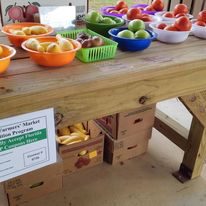
The Crestview Farmers’ Market usually offers a large variety of fresh produce.
The Brooks’ U-pick season for blueberries and blackberries is in June and July. U-pick customers should check in at Brooks Farm Produce on Lee Avenue to gather buckets and directions to the rows of blueberries and blackberries. For more information, call 850-537-5373.
Because of two hard frosts earlier this year, Dairy Acres of Baker might not have its usual U-pick season for blueberries this year, the farm’s proprietor, Grant Kampa, said recently.
His 5-acre blueberry patch is at 5949 Dairy Road.
“If I do it, it will start in two weeks,” Kampa said on May 15 about the potential U-pick season. “I don’t have nearly the amount of berries that I usually have.”
He plans to provide updates on the status of his blueberries on the Dairy Acres of Baker Facebook page.
Many area farmers sell their produce, as well as cottage food items such as honey and jam, at the seasonal Crestview Farmers’ Market. It’s at Spanish Trail Park on Stillwell Boulevard, one block off of North Ferdon Boulevard (State Road 85).
The Crestview Farmers’ Market is at Spanish Trail Park.
Depending on produce availability, the market is open from 7 a.m. to 2 p.m. on Tuesday, Thursday and Saturday.
Farmers who want to sell their items at the market must have a University of Florida Institute of Food and Agricultural Sciences County Growers Permit. It can be obtained by visiting the UF/IFAS Extension Office at 3098 Airport Road in Crestview or by filling out a form at https://sfyl.ifas.ufl.edu/okaloosa/agriculture/farmers-markets/.
They overwinters as eggs on the underside of infested leaves or in the leaf litter or mulch under the shrub. Eggs hatch in late March and early April. The insect then passes through five nymphal instars before becoming an adult.
It takes approximately one month for the insect to complete development from egg to adult and there are at least four generations per year. Valuable plants that are susceptible to lace bug damage should be inspected in the early spring for the presence of overwintering lace bug adults, eggs and newly hatched nymphs. Inspect these plants every two weeks during the growing season for developing lace bug infestations.
Both adults and nymphs have piercing-sucking mouthparts and remove sap as they feed from the underside of the leaf. Lace bug damage to the foliage detracts greatly from the plants’ beauty, reduces the plants’ ability to produce food, decreases plant vigor and causes the plant to be more susceptible to damage by other insects, diseases or unfavorable weather conditions. The azalea can become almost silver or bleached in appearance from the feeding lace bug damage.
However, lace bugs often go undetected until the infested plants show severe damage sometime into the summer. By then several generations of lace bugs have been weakening the plant. Inspecting early in the spring and simply washing them off the underside of the leaves can help to avoid damage later and the need for pesticides.
Adult lace bugs are flattened and rectangular in shape measuring 1/8 to 1/4 inch long. The area behind the head and the wing covers form a broadened, lace-like body covering. The wings are light amber to transparent in color.
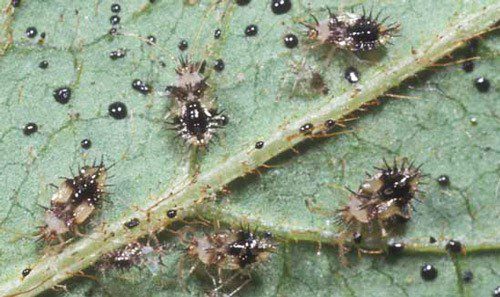
Lace bugs leave behind spiny black spots of frass (excrement).
Nymphs of the azalea lace bug are seen in this photograph, along with several cast skins and excrement.
Lace bug nymphs are flat and oval in shape with spines projecting from their bodies in all directions. A lace bug nymph goes through five growth stages (instars) before becoming an adult. At each stage the nymph sheds its skin (molts) and these old skins often remain attached to the lower surface of infested leaves.
Azalea lace bug eggs are football-shaped and are transparent to cream colored. Lace bug eggs are found on the lower leaf surface, usually alongside or inserted into a leaf vein. Adult females secrete a varnish-like substance over the eggs that hardens into a scab-like protective covering.
Other plant species, such as lantana and sycamore, may have similar symptoms, but realize that lace bugs are host specific. They feed on their favorite plant and won’t go to another plant species. However, the life cycle is similar. Be sure to clean up all the damaged leaves. That’s where the eggs will remain for the winter. Start next spring egg-free.
For more information go to: http://entomology.ifas.ufl.edu/creatures/orn/shrubs/azalea_lace_bug.htm
The bill, SB 932, would make it illegal for people to allow their dogs to stick their heads out of car windows. In addition, the bill would ban the declawing of cats and prohibit manufacturers from selling cosmetics in Florida that have been tested on animals.
SB 932 was proposed by state Sen. Lauren Book and is meant to protect animals and, to a degree, people. When asked for a statement on the bill and, specifically the provision concerning the transportation of dogs on public roadways, Book’s office gave the following response to Navarre Press via email:
“Our family has three dogs – two of which are almost 175 pounds each and love sticking their heads out the window – so I welcome and appreciate all public comment on this issue, which is only one piece of a complete proposed overhaul of the state’s animal welfare system as brought to me by veterinarians and advocates. We can easily amend this piece out of the bill while protecting the intent of the animal welfare community and vets who proposed the policy because of unintended injuries they’ve treated — and we will. In the meantime, let’s all invest in a good pair of ‘doggles’ to keep our furry friends safe.”
While this provision in the bill is reportedly going to be amended, it has got people talking about the safety of animals, especially when traveling in vehicles.
According to American Humane, an animal welfare organization, pet owners should properly restrain their pets, not allow pets to stick any part of their body out the window as grit and debris can hit them, and maintain up to date pet IDs in case they get separated from their owner.
In addition to pet safety while driving, American Humane also advises pet owners to not leave their pets unattended inside cars. The main concern with that is vehicles can heat up out in sun and pets, like humans, are susceptible to heatstroke.
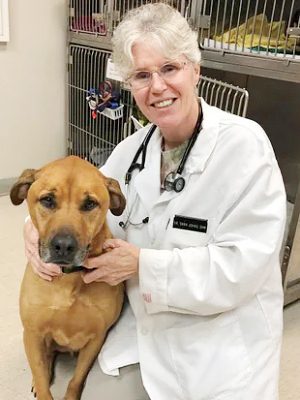
Dr. Dara Johns, a veterinarian at Wynn Haven Animal Hospital, has been caring for animals for 35 years. She believes maintaining pet safety should be a top priority for any pet owner but said one thing that has always bothered her is dogs riding in truck beds.
Dr. Dara Johns
“I think it’s totally wrong for them to ride in the back of a truck,” Johns said.
She said she has worked on dogs that have fallen off the back of trucks who had broken legs and suffered severe road burns. Even dogs who don’t jump out are susceptible to injuries if the driver slams on brakes.
When it comes to pets being restrained, Johns said the best thing is to have your pet in a carrier. There are also safety harnesses and crates with anchor straps to keep the animal from moving.
Jerry Bossert, a former paramedic who has lived in Navarre for the past 12 years, said many people don’t bother to secure their pets.
“You see it all the time. As a paramedic I saw lots of distracted drivers because of dogs,” Bossert said. “Dog falls out of lap of driver and hits gas pedal or falls out of the back of a pickup truck and people either run into the dog or each other.”
Driving with a dog in your lap can be quite dangerous, not only as a distraction while driving but as a potential hazard in the event of a crash. Bossert said he has seen dogs injured from being in the front when the airbag goes off and has seen people seriously injured and even die after being impaled by a dog bone from the airbag.
Several states have banned the practice of allowing motorists to drive with a pet in their lap because of potential distractions and harm.
On top of his experience as a first responder in the healthcare field, Bossert is also a dog owner. He currently owns two rescue dogs and has recently been looking after a foster dog.
Whenever he travels, Bossert puts his dogs in the backseat but admits that he doesn’t restrain them. He said they should be as far back as possible so they hit the cushioned seat rather than become a projectile in the car upon impact.
According to a 2011 AAA survey and press release, an unrestrained 10-pound dog in a crash at 50 mph will exert roughly 500 pounds of pressure, while an unrestrained 80-pound dog in a crash at only 30 mph will exert roughly 2,400 pounds of pressure.
“There are a lot of injuries that can happen to dogs and to humans from dogs in accidents,” Bossert said. “If you don’t act proactively, it’ll never change. Many people say, ‘it’s not going happen to me.’”
Everyday citizens aren’t the only ones who drive around with dogs and other animals. Police K9 units regularly transport dogs across their jurisdictions. For the Santa Rosa County Sheriff’s Office, they have a system all their own to make sure their K9s are safe while being transported.
Major Roman Jackson, who spent 12 years with the K9 unit, said the unit uses roll cage-type kennels installed inside the back of the vehicle.
“If the vehicle were to flip or something was to happen like that, it protects the dog,” Jackson said.
The kennels they use allow space for the dogs to move around more so their legs don’t get stove up. There are also temperature gauges inside the vehicle that help keep the dogs cool and keep the car ventilated. When it comes to pet safety in vehicles, Jackson advises people keep their dog in one area of car, particularly the backseat.
“I think realistically, all we can ask is if you have a vehicle that allows you to use the backseat or the far back area where you have the hatch, that’s your best bet to keep them from becoming a distraction,” Jackson said.
The rule will also require the use of a descending device or venting tool if a fish is exhibiting signs of barotrauma prior to release. This rule is designed to increase the survival of released reef fish, a top priority management issue in the Gulf and South Atlantic.
As reef fish are reeled up from depth, they can suffer pressure-related injuries known as barotrauma. These injuries include the stomach protruding out of the mouth, bulging eyes, bloated belly, distended intestines and inability to swim down independently. If not treated correctly, barotrauma can be lethal to reef fish.
Tools such as descending devices or venting tools can help released fish recover from the effects of barotrauma. Descending devices are weighted devices capable of releasing fish at a depth that is sufficient to recompress expanded gas and help fish recover from the effects of barotrauma. Venting tools are sharp, hollow instruments that allow expanded gas to escape from an over-expanded swim bladder. Learn more about barotrauma at MyFWC.com/Barotrauma.
Barotrauma mitigation tool requirements have already been adopted in Gulf and Atlantic federal waters. In Gulf federal waters, fishers have the choice of possessing either a descending device or a venting tool that is rigged and ready for use. In Atlantic federal waters, fishers are required to have a descending device that is readily available for use.
Find current reef fish gear requirements at MyFWC.com/ReefFishGear.
Anyone who plans to harvest or attempt to harvest, including catch and release, certain reef fish species in Gulf or Atlantic waters from a private recreational vessel, must sign up for the free State Reef Fish Angler designation and renew it annually. Learn more at MyFWC.com/SRFS and sign up today at GoOutdoorsFlorida.com.
For more information, including the February 2023 Commission meeting presentation, visit MyFWC.com/Commission and click on “Commission Meetings.”
FWC introduced the new regulation at a December 2021 meeting in which they also introduced a regulation that prohibited the collection of diamondback terrapins from the wild without a permit. That rule went into effect March 1, 2022.
Crabbers can also get a bycatch reduction device (BRD) to put on their existing traps to comply with the regulation. These devices are available at select coastal UF/IFAS extension offices and at Florida Sea Grant agent offices, which are in almost every Florida county.
Diamondback terrapins are turtles that can be found in brackish water habitats throughout Florida. They can live up to 25 years in the wild and eat foods such as shellfish, worms, fish and plants.
Rick O’Connor, a Florida Sea Grant agent for Escambia County, has been studying diamondback terrapins for 15 years and is spearheading the educational outreach part of this new regulation for the state. He is leading a BRD distribution initiative throughout the state, as well.
He said the local habitat for these terrapins are primarily salt marshes in brackish water. The terrapins also go out into the sea grass beds within Florida’s bays and estuaries. Females swim out to open water, such as Santa Rosa Sound, to search for sandy beaches to lay their eggs.
O’Connor said diamondback terrapins are ecologically important as they consume snails that eat live sea plants such as seagrass and marshes.
According to FWC, diamondback terrapin populations are in decline. This is due to a variety of issues including habitat loss, unsustainable collection from the wild due to growing popularity in the global pet market, predation and road mortality.
This new rule is part of the larger effort to try and conserve these terrapins.
“We do not know the exact population of terrapins in Florida, but studies show their numbers are small and it is incredibly important that we protect what we have,” O’Connor said. “Many people do not even know these small turtles exist. They are so rare, and we have been concerned of their status for years.”
O’Connor said in local waters, they typically will find 50 to 75 terrapins at most in any one area. He said the population sizes of diamondback terrapins are smaller in Northwest Florida and in South Florida, but larger in the Big Bend region of Florida.
In Florida, there are five subspecies of diamondback terrapins: Carolina, Florida east coast, Mangrove, Ornate and Mississippi. Of these five, three are found nowhere else but Florida. The primary kind found along the Emerald Coast are Mississippi diamondback terrapins.
The new regulation only targets recreational crabbing.
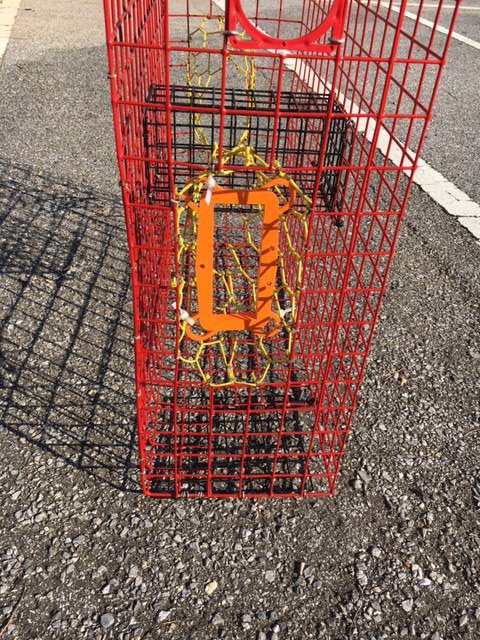
This is a picture of a crab trap with the regulation size bycatch reduction device (BRD) attached. Starting March 1, Florida’s recreational crabbers must be in compliance with a new regulation requiring traps to have a rigid opening no larger than six-by-two inches.
According to O’Connor, the FWC is talking about ways to regulate commercial crab traps for terrapin conservation. He did point out, however, that most commercial crab traps aren’t located where the terrapins’ habitat is.
For those worried that the new regulation will also keep the crabs out, O’Connor said not to worry. In the Chesapeake area around Virginia and Maryland, they had a similar issue with terrapins in crab traps. With the bycatch reduction devices, crabbers found a significant reduction in the number of terrapins caught and little change to crab catch.
According to FWC, studies have shown BRDs reduced terrapin capture by 80-90%.
Crestview News Bulletin reached out to FWC with questions regarding enforcement of the new regulation and here was their response:
“FWC officers have the unique training and experience to enforce Florida’s marine fisheries regulations, one of the agency’s core missions. Our officers regularly conduct proactive enforcement efforts through license and gear checks, etc. and respond to complaints. Similar to other regulation changes, FWC law enforcement officers will likely take an educational approach as crab fisherman become accustomed to the new rule. A violation of this rule is a 2nd degree misdemeanor. The regulation does not affect commercial crabbers.