Please ensure Javascript is enabled for purposes of website accessibility
Skip to main content
Advertisement

HELMS: The Holy Spirit helps us overcome moral corruption

Water, moving in and out, assists in carrying away pollutants, and moving fish around. The Holy Spirit can do the same thing, the Rev. Richard Helms says.

Growing up in the Okaloosa County section of the Panhandle, I had a blast going fishing in the Sound with my Papaw on several occasions. 

Around lunch time, he would pull his boat into one of the islands and break out our lunch: crackers, ketchup and an oyster knife.

Parked over an oyster bed we would reach over, give an oyster a quick swish in the water, pop that baby open and enjoy the finest gourmet lunch around!

At least, that was my opinion. 

You can't do that so safely anymore. Too many boats, water runoff of fertilized yards — all kinds of things — have made it a little too risky to eat in the volume we used to enjoy.

My brother and I used to walk down the beach of the bay with my dad, cast net in hand, while we chased crabs. In those days, men would fish for mullet by encircling a school and taking their nets from shore outward and then back again. 

Several times, they would tell my dad to just go ahead and throw in there and get a mess. Afterward, he would have me assist him and we would help the fishermen gather their catch. 

You cannot do that anymore. 

One, their nets are illegal, and two, you would be costing them too much money. 

Priorities have changed.

Simpler times allowed for simpler activities. It is the same in our lives.

We have so polluted our lives with the cares of this world to where we cannot simply enjoy the presence of the Father. Daily, we are constantly polluted with the cursings of people who no longer have respect for others around them. 

You have to wonder about what is being taught at home and in schools when the only way many people can express themselves is to curse. 

We are bombarded by pollution on our airways, radios, the news — you name it. 

Don't believe me? Go pump gas and listen to the words of the persons next to you.

Turn off your TV for two weeks; turn it back on and realize how bad it has gotten. 

It is risky to live in this world, and only through God's Holy Spirit can we be kept from being overcome by it.

We allow our own needs to push us to take care of only our needs. We no longer look around and share the bounty of God's love with others.

Do not cast your net here, for we want all that is in front of us, even at the expense of others. 

You know, God has created a way for the waterways to cleanse themselves by the use of tides. 

Water, moving in and out, assists in the carrying away of pollutants, and moving the fish around. 

His Holy Spirit can do the same thing. Can we not allow Him to move in our lives and cleanse us?

Perhaps pollutants of this life can be cast away, and we can be used to be dispersed to be a blessing to others.

The Rev. Richard Helms serves at Miracle Acres Ministries, 3187 E. James Lee Blvd., Crestview.

This article originally appeared on Crestview News Bulletin: HELMS: The Holy Spirit helps us overcome moral corruption

BROADHEAD: Lessons for Okaloosa about choices, children and enemies

Here are some devotionals you may find helpful. 

“Dear brothers and sisters, be quick to listen, slow to speak and slow to get angry."—James 1:19-20

One choice we make is whether to be happy. When someone cuts you off in traffic, you can choose to become angry at that person, or you can offer a prayer for his or her safety and wellbeing.

When someone rushes in front of you in the checkout line, you can choose to get steamed up or hope the reason for the person’s action is nothing life-threatening at home.

Today, what choices will you make? Will you choose to be happy?

•••

“A little child shall lead them.” —Isaiah 11:6

A parent told this story: While in line at a store, my 9-year-old daughter asked for a candy bar. After saying no twice, I gave in. I paid, and as we walked away I gave it to her.

She stopped, turned around and handed it to a little boy crying in line behind us at the register. I asked her why she gave it to him and she said she heard the boy’s mom tell him they didn’t have money left for candy until she can find another job. (Source unknown)

•••

"If the one who hates you is hungry, feed him. If he is thirsty, give him water.”—Romans 12:20

Why on Earth would anyone want to do something nice for someone who hates them?

Ah, but if we feed them or give a drink, they may soon stop hating us and we will gain a friend. It goes contrary to popular thinking, and that is what Jesus calls us to do: think outside the box.

The Rev. Mark Broadhead is Laurel Hill Presbyterian Church and First Presbyterian Church of Crestview's pastor.

This article originally appeared on Crestview News Bulletin: BROADHEAD: Lessons for Okaloosa about choices, children and enemies

HELMS: Listen to a personal God, or suffer punishment

I believe in a very real, very personal God.

A God that I can feel moving deep within my spirit. A loving Father who not only blesses me with good things and the promise of eternal life, but also cares enough to correct me as I need it.

When I asked Him to forgive me of my sins and come dwell within me, I could feel Him washing me clean.  When in prayer, as I learn to shut my mouth and listen, He whispers His desires as well as His love in ways that I can clearly understand.

He talks, corrects and guides, all through the wonderful love letter called the Holy Bible.

One can sense His Holy Spirit's conviction when we sin, and can feel the leading He gives.

He gave His Son for me. I have been purchased with a precious price: the blood of God's only Son.

I belong to Him, so that I can indeed call Him my Father, my Savior, my Master, my deliverer, my redeemer, my God.

Paul, in writing to the church in Philippi, said these words (Philippians 4:19): "And my God shall supply all your need according to His riches in glory by Christ Jesus."

He said "My God." Time and again, the Bible refers to the promises of God, and the announcement by Him that "I will be their God."

That is a personal God who desires to be able to walk with, talk to, and bless His creation.

In Jeremiah's writings come a damning observation concerning the state of Israel and Judah. This statement tells what the full problem was with the nations and why they were headed to judgment.

God did not mention the rampant perversion — not even a mention of the drunken parties, or anything else that church leaders rightly vilified.

Chapter 7, verses 23 and 24 state, "But this thing commanded I them, saying, Obey my voice, and I will be your God, and ye shall be my people: and walk ye in all the ways that I have commanded you, that it may be well unto you.

"But they hearkened not, nor inclined their ear, but walked in the counsels and in the imagination of their evil heart, and went backward, and not forward."

His condemnation was based on the fact that He reached out, and no one would listen any more.

Is this not the real truth behind America's moral decay? We no longer seek Him, nor do we stand and defend His principles and directives. This personal God is being shoved out of our lives.

Today, we too are guilty of not paying proper attention to Him or His Word.

Please, seek Him while He may be found. He will receive you with open arms, and once again be your very personal heavenly Father.

The Rev. Richard Helms serves at Miracle Acres Ministries, 3187 E. James Lee Blvd., Crestview. 

This article originally appeared on Crestview News Bulletin: HELMS: Listen to a personal God, or suffer punishment

BROADHEAD: Failure is often the beginning of a new life

In the Bible, God didn't hand-pick people like Moses because he was somehow more special than others. In fact, Moses was a murderer. So were Paul and David.

Did you wake up this morning and say to yourself, “I hope I fail today!"?

I don’t know anyone who sets out to fail at something in life —not consciously. I do know people who unconsciously set up themselves to fail.

And the main reason they do that is because they are afraid to succeed.

No one likes to fail. Most would rather be the kind of person who is all put together; who has purpose; and who would be used by God because he or she was special.

I have heard some people wistfully say they wish they could be like the people in the Bible. It seems they were hand-picked by God because they were somehow more special than others.

They were all put together. They succeeded at everything they set out to achieve.

The reality is, they were no different than you or I.

Moses stuttered.

David’s armor didn’t fit.

John Mark was rejected by Paul.

Hosea’s wife was a prostitute.

The only kind of training Amos received was in the area of fig tree pruning.

Jacob was a liar.

David had an affair.

Solomon was too rich.

Lazarus was dead.

John was self-righteous.

Jesus was too poor.

Paul was a murderer. So was Moses. So was David.

Jonah ran from God.

Miriam was a gossip.

Jeremiah was depressed and suicidal.

Elijah was burned out.

John the Baptist was a loudmouth.

Martha was a worrywart.

Samson had long hair.

Noah got drunk.

Did I mention that Moses had a short fuse? So did Peter, and Paul — well, lots of folks did.

Sure, there are lots of reasons why it seems God wouldn’t want us to do anything for him. But if we love him, if we seek him with our whole heart, mind, soul and strength, he will use us in spite of our fears and uncertainties.

But bear in mind, this doesn’t mean we won’t fail our Lord now and again, because we will.

It is important to remember this: failure is not the end. It is often the beginning of a new life, because it is in our weakness that Jesus makes us strong — when we put our hope and trust in him.

The Rev. Mark Broadhead is Laurel Hill Presbyterian Church and First Presbyterian Church of Crestview's pastor.

This article originally appeared on Crestview News Bulletin: BROADHEAD: Failure is often the beginning of a new life

BROADHEAD: Focus on uniting similarities, not divisive differences

Editor's Note: This is the fourth column in a series on how to restore any lost respect for Christianity.

For the past several weeks I have pointed out several matters within the contemporary Christian church that I believe have caused great anxiety within Christianity.

Pride, arrogance, privilege (and the loss of it) have been looked at.

It is a shame that within Christ’s church, people don’t seem to stop often enough to think about how much more we have in common than we have in differences.

Granted, the number of differences between us is far greater than the similarities that untie us. But the significance of what we have in common far outweighs our differences — if we would only focus on it.

A good friend of mine once told me that a baseball coach of his said that when his game seemed to be out of focus, it was a good practice to get back to the basics.

In the Christian church, our game is out of focus. We are divided more than ever. We are scorned more than ever. We are ignored more than ever. We need to go back to the basics.

We all have three major things in common. It is those three — when we focus on them to a greater degree — that should unite us more than the other issues divide us.

What is central to our faith, what we all have in common as disciples of Jesus Christ, is the Trinity and the fact that Jesus Christ is the center of our faith. We have been called to love and serve him. We have been called to preach his good news. We have been called to care for each other and those in need. We have been called to have the mind of Jesus Christ.

How we interpret the elements of the Lord’s Supper — secondary.

How we interpret the age or method of Baptism — secondary.

The creation of the world in a literal six days or six millennia — secondary.

A literal or symbolic apostolic succession — secondary.

By acknowledging the strength of what we have in common more than we argue about our differences, we will be able to become more united in our diversity. We will provide a much stronger witness in the world for our Lord and Savior, Jesus Christ — rather than our particular denomination or theological interpretation. We will be more effective in conveying the message that it is okay to have differences, and to let God be the Lord of the conscience.

Jesus said, “Just as I have loved you, you also should love one another. By this everyone will know that you are my disciples, if you have love for one another.”

Very important words by which to live.

The Rev. Mark Broadhead is Laurel Hill Presbyterian Church and First Presbyterian Church of Crestview's pastor.

This article originally appeared on Crestview News Bulletin: BROADHEAD: Focus on uniting similarities, not divisive differences

North Okaloosa faith calendar

CRESTVIEW — North Okaloosa residents can celebrate their faith and grow closer to God during these upcoming events. 

UPCOMING

NATIONAL DAY OF PRAYER: Crestview observances on Thursday, May 7 are as follows:

•Noon, city hall, 198 Wilson St. N.

•6 p.m. on Okaloosa County Courthouse's southern steps, 101 James Lee Blvd. E., Crestview. Pastors Dwight Baggett of Macedonia Missionary Baptist Church, Mark Broadhead of Crestview First Presbyterian Church, and Paul Mixon of Central Baptist Church will lead the ceremony.

DIXIE ECHOES CONCERT:6 p.m. May 9, Central Baptist Church, 951 Ferdon Blvd. S., Crestview. A suggested $10 donation is requested at the door. Details: 682-5525.

DORM LUAU: 4-6 p.m. May 17, DFAC parking lot, Eglin Air Force Base. Hosted by Eglin Chapel Singles and Young Adults, and the Asian Pacific American Heritage Committee. Hula dancers, music, bungee jump, rock climb, free food and fun. Details: Technical Sgt. Norman Davis, 883-4694, or Chaplain Baker, 882-2111.

LIFEPOINT ACADEMY SUMMER CAMP: 6 a.m. to 6 p.m. June 8 through Aug. 14, Lifepoint Church, 400 Ferdon Blvd. S., Crestview. For ages 6-12. Enrollment costs $35; weekly tuition costs $90. Christ-centered program involves fun bible challenges, enrichment activities, guest presentations and special interest camps. 306-2245.

RECURRING

WOMEN'S BIBLE STUDY: 9:30-11:30 a.m. Tuesdays, West Gate Chapel, Eglin Air Force Base. Open to women with base access. Janette Gregg, 863-4264.

REFORMERS UNANIMOUS: 7-9:30 p.m. Fridays, Central Baptist Church, 951 Ferdon Blvd. S., Crestview. Faith-based recovery program for people with any addiction. Directed by Wendell Morgan. 682-5525.

FOOD DRIVE: The Joy Fellowship youth group is "Saving Lives One Can/Jar at a Time." Goal: collect 5,000 pounds of canned, nonperishable items for local food pantries and the Crestview Pregnancy Center. Drop off donations from 10 a.m. to noon weekdays  at 5978 Old Bethel Road, Crestview.

Email your church’s announcements to be included in the listing>>

This article originally appeared on Crestview News Bulletin: North Okaloosa faith calendar

HELMS: Hope — that's a promise you can believe

Did you know we use the word hope in a fashion different from its Biblical definition?

We say, "I hope it rains tomorrow," and the word indicates there is a possibility that it might not rain.

However, in the Concise Bible Dictionary, the word hope is explained as waiting for something promised. Using this definition, we can see a slightly different, as well as more positive, perspective to the promises contained in His precious Word.

Understand this: It is impossible for God to lie. That being said, why do we approach His promises as though they might not happen? 

Whenever you see the word hope in your Bible, it is intended to instill in us an assurance, or guarantee that a promise is being fulfilled.

We have hope in His return, which means He is returning and we need to be acting like we are expecting it. Not wavering, thinking that it may or may not occur. 

Be sure in your relationship with God. Know that He loves and cares for you. Know that because of hope (assurance) in Him we will one day stand before Him. It will happen! 

When we live in the rest of His hope, we will have victory.

That, my friend, is a promise that you can believe in.

Rev. Richard Helms serves at Miracle Acres Missions, 3187 E. James Lee Blvd., in Crestview.

This article originally appeared on Crestview News Bulletin: HELMS: Hope — that's a promise you can believe

BROADHEAD: Some Christians sound like modern-day Pharisees

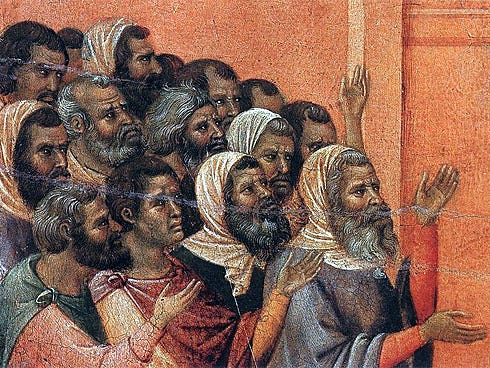
Christ Accused by the Pharisees, by Duccio, Italian painter

Editor's Note: This is the third column in a series on how to restore any lost respect for Christianity. See Part 1 and Part 2. 

To some people, Christians are hypocrites because they seem to talk out of both sides of their mouth.

They espouse Christian truths when trying to share the gospel, but don’t live them in daily life. Love my neighbor? Get my gun. Help the poor? Let them get a job. Meanwhile, skin color, emotions, taste in music and sexual orientation still divide us in many places.

Jesus says the world hates his followers because his followers do not belong to this world. And yet, much of Christianity has been consumed by the world. Christians in this nation have had a place of privilege for decades. But now, it is no longer true. There is grumbling about other faiths “worming their way” into a society supposedly founded on Christian principles. Christians are screaming, “Not fair!”

I’m sorry, but Christians, in my opinion, have lost the right to complain about fairness. For a very long time, a position of privilege had been enjoyed; then the privilege became abused. And by abused, I mean taken advantage of, exploited, held out with pride in front of others. It seems to me that many Christians have placed themselves not only before other people, but above them as well.

Jesus never claimed a place of privilege. He was humble, putting others before himself.

In many ways, there are those among us who have become modern-day Pharisees — being legalistic, arrogant and expecting a place of honor and privilege. Jesus didn’t like them very much, either.

I wonder how he feels about us, today.

The Rev. Mark Broadhead is Laurel Hill Presbyterian Church and First Presbyterian Church of Crestview's pastor.

This article originally appeared on Crestview News Bulletin: BROADHEAD: Some Christians sound like modern-day Pharisees

HELMS: Christians are a lot like these weeds among wheat

Darnel is poisonous to humans and tends to intertwine itself around stalks of wheat so that eradication is virtually impossible without damaging the intended crop.

The Bible, in Matthew 13, tells the story a farmer who plants his field, and others notice tares growing in the rows.

Tares are usually interpreted as the plant darnel. It's poisonous to humans and tends to intertwine itself around stalks of wheat so that eradication is virtually impossible without damaging the intended crop. Therefore, it is usually separated at harvest time to be burned.

Jesus, who tells the parable, explains that the enemy plants bad seed to poison His Kingdom. You see, just as darnel looks so much like wheat, so also are many enemies in the church today. They know the right words, react correctly, and it is virtually impossible to separate them from those who have a close personal relationship with Him.

But when harvest time comes, Jesus states that His angels will separate the real from the impostors, and the impostors will be burned in the fire. 

Do not set your sights on outward signs to determine a person's walk with God, but seek their heart.  For out of the abundance of the heart, the mouth will speak. 

Neither tongues, miracles, signs nor eloquent speech are marks of a spiritually led man or woman.

Certain fruits will develop in a person's life. Become a fruit inspector, and pray that God will change those "tares" into true fruit for the Master. 

The Rev. Richard Helms serves at Miracle Acres Ministries, 3187 E. James Lee Blvd., Crestview.

This article originally appeared on Crestview News Bulletin: HELMS: Christians are a lot like these weeds among wheat

BROADHEAD: Pride hurts the Christian witness

Editor's Note: This is the second column in a series on how to restore any lost respect for Christianity. Here is Part 1. 

Did you know there are over 40,000 Christian denominations worldwide?

How did this happen?

Well, one reason is because people cannot agree on various issues and interpretations of the scriptures. Someone presents an interpretation or understanding; others vehemently disagree; they split off with like-minded people; and a new denomination is born.

Theological matters are divisive.

Think about it: Can a person grant forgiveness for another’s sins? Is baptism only good if a person is totally immersed in water? Do the bread and wine of the Lord’s Supper become the actual body and blood of Jesus, or are they simply symbolic? What about same-gender marriages?

Biblical and theological interpretations divide Christianity. Disagreement brings dissention. It creates enmity. “We’re right. You’re wrong.”

At the root of this sentiment is one of the seven deadly sins — pride.

Pride is an ugly trait. And it does cause death — maybe not physical death, but certainly spiritual. Pride tends to kill compassion. It destroys understanding. It wipes out the ability to hear another point of view that may bring about growth and deeper wisdom. Any issue becomes a contest to be won.

The Bible states, “Pride goes before a fall.” Pride, among a few other matters, hurts the Christian witness. If Christians cannot get along, or agree to disagree in a loving and compassionate manner, why would anyone be attracted to the Head of the Church — Jesus Christ — whom we are to represent?

Let me invite you to be in prayer about how you might unknowingly be a victim or purveyor of pride within your practice of the faith. I know I have been to a certain degree, and I seek God’s forgiveness.

Looking at this is not an easy task. But in the long run, it will bring God’s blessing.

To be continued…

The Rev. Mark Broadhead is Laurel Hill Presbyterian Church and First Presbyterian Church of Crestview's pastor.

This article originally appeared on Crestview News Bulletin: BROADHEAD: Pride hurts the Christian witness

error: Content is protected !!