Please ensure Javascript is enabled for purposes of website accessibility
Skip to main content
Advertisement

Test wing welcomes new commander

By Kelley J. Stewart

Maj. Gen. Evan C. Dertien, Air Force Test Center commander and former 96th TW commander, presided over the ceremony.

“I’m so happy to return to Eglin,” Massaro said. “While it’s fantastic to return as a previous member of the test wing, and it’s comforting to be back as a Florida native, even in July, what causes me to smile the most is getting to contribute to this mission again.”

Massaro, a command pilot with more than 2,200 combat hours, began his test pilot career in 2007. His first duty assignment as an F-16 experimental test pilot was with the 40th Flight Test Squadron at Eglin.

He joins the wing after commanding a data masked organization where he led military, civilian, and contractors and managed more than $10 billion in resources across multiple locations.

“[Gen. Massaro] congratulations. I am confident you will lead the 96th TW with the same passion and dedication you have shown in your previous assignments,” Dertien said. “I look forward to the future of the 96th TW under your leadership as you continue the distinguished legacy of this organization.”
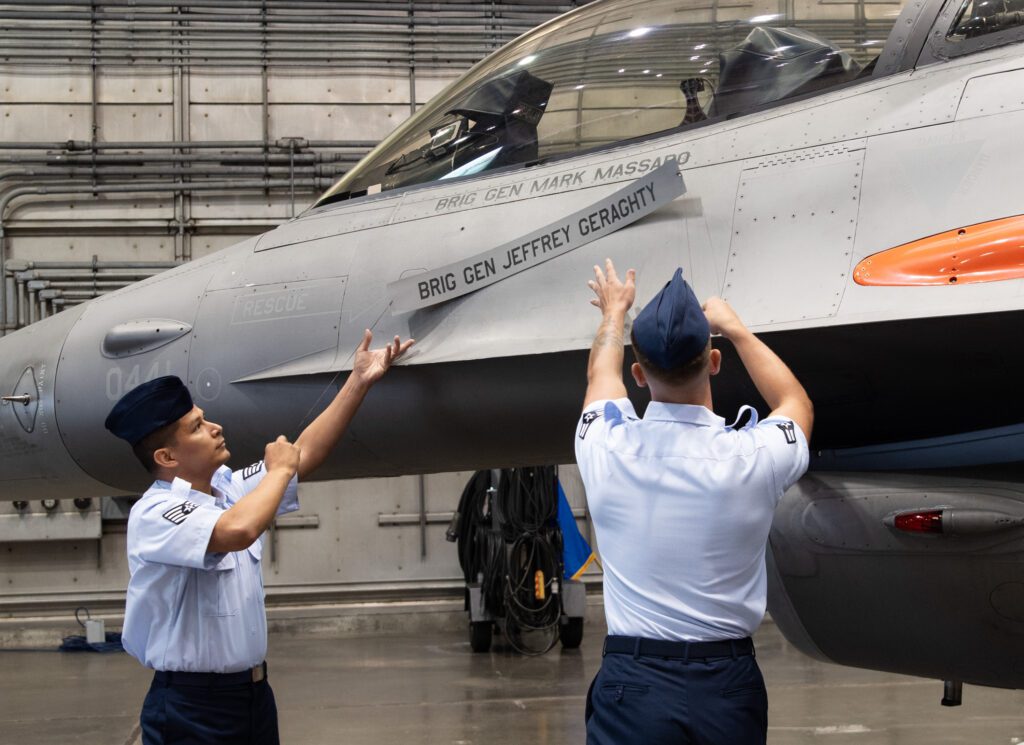
U.S. Air Force Staff Sgt. David Olmeda and Airman 1st Class Jack Lutz, 96th Aircraft Maintenance Squadron, reveal Brig. Gen. Mark Massaro’s name on his F-16 Fighting Falcon during the 96th Test Wing’s change of command inside the McKinley Climatic Lab at Eglin Air Force Base, Fla., July 3, 2024. Massaro assumed command from Brig. Gen. Jeffery Geraghty during a ceremony presided over by Maj. Gen. Evan Dertien, Air Force Test Center commander. (U.S. Air Force photo by Kelley J. Stewart)

As the new commander, he leads more than 10,000 military, civilians and contractors who conduct developmental testing and evaluation of conventional munitions, command and control systems, aircraft avionics and guidance systems, and radar cross section measurements. Massaro will also manage a 120,000 square mile over-water test range plus facilities in six states and direct all base operating support, infrastructure and services support for Eglin.

“In this time of significant change as we reoptimize our Air Force for Great Power Competition and develop imperative operational capabilities that increase lethality and effectiveness and enhance command and control in a multi-domain peer adversary environment, I know that while there’s a lot for us to do, our Nation can absolutely count on the 96th TW and our Team Eglin mission partners to get it done,” he said. 

“As commander, my priorities are simple but essential – execute the mission, take care of our people, and partner for success,” Massaro said.

Geraghty, who assumed command of the 96th TW in June 2022, departs to become Air Force Material Command’s director of International Affairs, and the Air Force Life Cycle Management Center director of Air Force Security Assistance and Cooperation at Wright-Patterson Air Force Base, Ohio.

Goodbye Grey Wolf

By Samuel King Jr.

The lift-off June 27 marked the last aircraft out and official end of the new helicopter’s time at Eglin and its flight forward to a future as an Air Force Global Strike Command combat capable asset.

The MH-139 arrived at Eglin in December 2019 and was officially named Grey Wolf shortly after. For its first two years, testing was limited for the then Boeing-owned aircraft. The 413th Flight Test Squadron teamed up with AFGSC’s Detachment 7 to manage, fly and crew the test missions with Boeing flight crew during the aircraft’s time at Eglin.

In August 2022, the Air Force took ownership and testing began quickly with as many as six aircraft located at Duke Field, one of Eglin’s many auxiliary fields.

The Air Force ownership coincided with the arrival of Palka, a helicopter flyer or Rotorhead as they are known, just out of test pilot training at the Naval Test Pilot School, NAS Patuxent River, Maryland, who joined the 413th FLTS MH-139 test team.

Although new to Air Force developmental test, Palka wasn’t completely new to the aircraft. He piloted the Grey Wolf’s civilian counterpart, AW-139, in simulator training and then delivered one of the test aircraft to Duke Field.

“(At USNTPS) you are always short on time and frequently fly aircraft you don’t know a lot about, so it was nice to have the time to deep dive and get a comprehensive understanding of the aircraft and its systems,” said Palka, who flew the UH-1N Huey at Yokota AB, Japan, and FE Warren AFB, Wyoming before becoming a test pilot. “I got to use a lot of what I learned at TPS here at Eglin. My timing was lucky, and I am grateful for it.”

When flying a brand-new aircraft like the MH-139, the test pilots and special mission aviators didn’t have the military safety procedures, manuals and operating instructions honed from years of flights. They were the airmen creating those critical documents that the Grey Wolf’s aircrews use going forward.

The role of the test pilot is critical in the early life cycle of these new aircraft, according to Palka. They act as liaisons, translating engineer lingo to pilot-speak. They plan and execute tests, potentially on unfamiliar aircraft, which are sometimes challenging, sometimes benign and provide useful data and recommendations to the user.

“Data is really only useful if you can relay how your findings are going to affect the end user and make recommendations accordingly,” Palka said.

A 413th FLTS mission statement is “to safely deliver independent, decision-quality information on time.” Palka said the word independent is so important in that statement.

“Test is specifically separated from the program office’s chain of command to avoid biases or influence that could result in inaccurate data, driven by things like cost or schedule pressure,” said Palka, who’s served as the leader of the MH-139 operations team.

Being new to the 413th FLTS and its testing procedures, Palka teamed up with someone very familiar with the rotary-wing developmental test process, the squadron’s resident test pilot, Tony Arrington.

Arrington has been a 413th FLTS employee for 20 years through its various iterations and a rotary-wing pilot for approximately 38 years as both active duty and in Air Force civilian service. The two pilots sat across from each other both in the office and often in the cockpit for the duration of the MH-139 testing at Eglin.

Remembering the fallen

On the night of June 25, 1996, 19 Airmen lost their lives while over 400 U.S. and international military and civilian members were injured during the Khobar Towers attack in Dharan, Saudi Arabia; 12 of the fallen were Nomads.  

On June 26, over 200 attendees from the 33rd Fighter Wing and local community gathered in remembrance of the men and women who made the ultimate sacrifice on the 28th anniversary of the Khobar Towers bombing.  

This year’s memorial included a guest speaker, the traditional wreath-laying, recitation of names, and the playing of “Taps.” The recitation of names was carried out by 19 current Airmen from the 33rd FW who were chosen to stand on behalf of the fallen, deliver the fallen member’s name, and render a salute. 

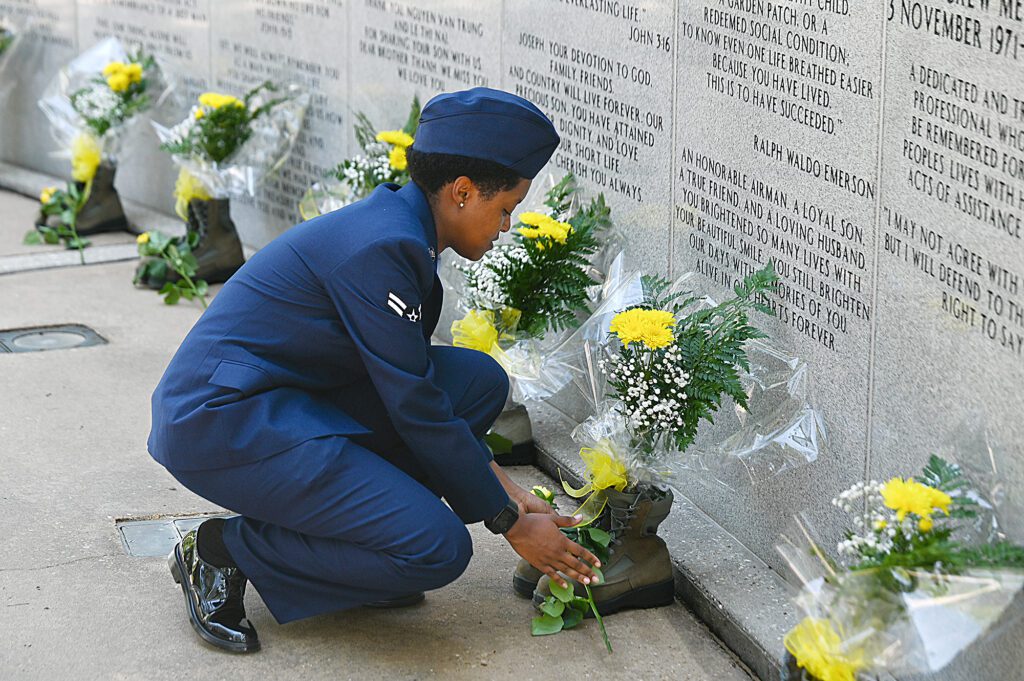
U.S. Air Force Airman 1st Class Bobbie Mills, 60th Fighter Squadron aircrew flight equipment apprentice, places a rose to honor a fallen airman during the Khobar Towers memorial ceremony at Eglin Air Force Base, Florida, June 25, 2024. Placing the flower over the toes of the uniform boots is a tradition that honors the lives lost. (U.S. Air Force photo by Senior Airman Briana Beavers)

“As we reflect on this tragedy, we are reminded of the incredible acts of courage and camaraderie that emerged from that fateful night,” said Col. Dave Skalicky, 33rd FW commander. “Many of our Nomads exemplified selflessness and courage in the face of unimaginable danger. Their actions that night continue to inspire us and serve as a poignant reminder of the personal costs of service.” 

Following Skalicky’s remarks, Zach Sutton, a survivor of the attack, Catalyst Church of Panama City pastor, and ceremony guest speaker, spoke of the wounds that remain. 

“I was 23 years old when I showed up in 1996 to Khobar Towers,” Sutton said. “I stand here today 28 years later still wounded by this event. Like most of the survivors today I have physical scars, but even more than that I have unseen scars … almost every survivor you meet today has the same struggles, and to them I stay ‘Keep going, don’t let the hard days win’.” 

The wing’s emblem, the flaming sword, stands at the center of the memorial, where an inscription reads: “This monument is dedicated to the brave warriors who were killed by a terrorist bomb at Khobar Towers, Saudi Arabia, on June 25, 1996. They made the ultimate sacrifice as guardians of this grateful nation. We shall never forget them.”  

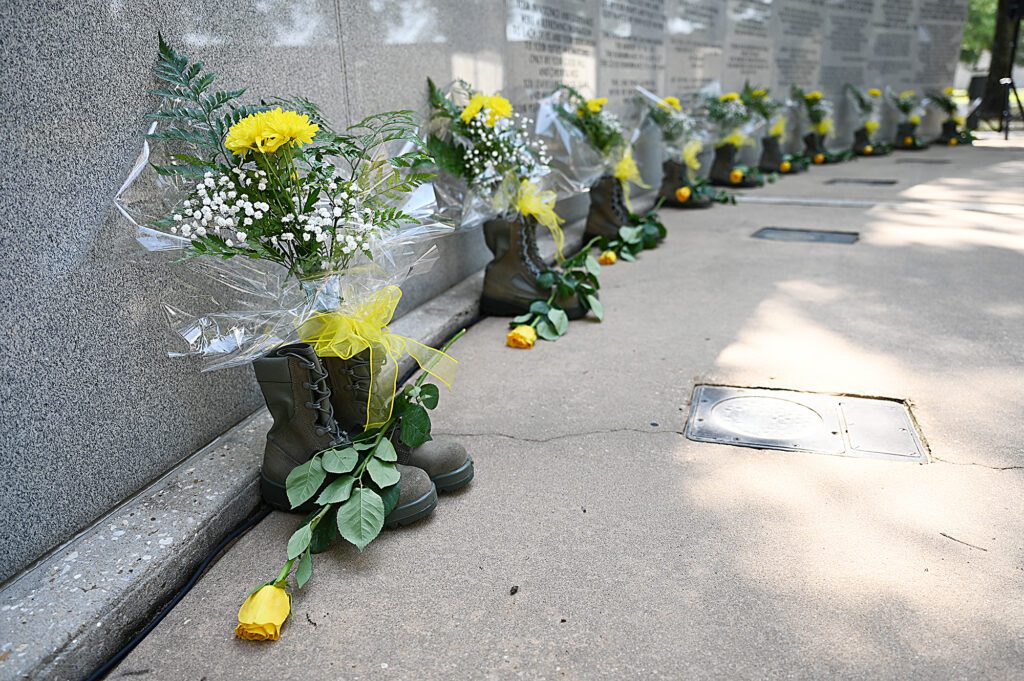
Combat boots and yellow flowers representing those who lost their lives are displayed during the 28th Annual Khobar Towers Memorial Ceremony at Eglin Air Force Base, June 25, 2024. Every year, friends, families, survivors and former Nomads unite to pay tribute to those who were killed during the terrorist attack at Khobar Towers in Dhahran, Saudi Arabia on June 25, 1996. (U.S. Air Force photo by Senior Airman Briana Beavers)

The names of the fallen are below: 

58th Fighter Squadron: 

Master Sgt. Kendall K. Kitson, Jr. – Yukon, Oklahoma 

Tech. Sgt. Daniel B. Cafourek – Watertown, South Dakota 

Staff Sgt. Millard D. Campbell – Angelton, Texas 

Senior Airman Earl F. Cartrette, Jr. – Sellersbug, Indiana 

Airman 1st Class Brent E. Mathaler – Cambridge, Minnesota 

Airman 1st Class Brian W. McVeigh – Debary, Florida 

Airman 1st Class Joseph E. Rimkus – Madison, Illinois 

Airman 1st Class Joshua E. Woody – Corning, California 

60th Fighter Squadron: 

Tech. Sgt. Patrick P. Fennig – Greendale, Wisconsin 

33rd Logistics Group: 

Tech. Sgt. Thanh V. (Gus) Nguyen – Panama City, Florida 

33rd Operations Support Squadron: 

Airman 1st Class Peter J. Morgera – Stratham, New Hampshire 

33rd Maintenance Squadron: 

Senior Airman Jeremy A. Taylor – Rosehill, Kansas 

 Patrick Air Force Base: 

Capt. Christopher Adams – Massapaque Park, New York 

Capt. Leland Timothy Haun – Fresno County, California 

Master Sgt. Michael Heiser – Palm Coast, Florida 

Staff Sgt. Kevin Johnson – Shreveport, Louisiana 

Airman 1st Class Justin Wood – Modesto, California 

Offutt Air Force Base: 

Staff Sgt. Ronald King – Battle Creek, Michigan 

Wright-Patterson Air Force Base: 

Airman 1st Class Christopher Lester – Wyoming County, West Virginia 

Cadet to cadre: Marine returns to Junior ROTC program at Hurlburt Field

In front of him, a group of Junior ROTC cadets moved together as a unit, scanning the shoreline of Santa Rosa Island, near Hurlburt Field, Florida. With the sounds of simulated gunfire closing in on them, they spoke quietly amongst themselves to make their next move.

The students, participating in a Junior ROTC summer leadership school program at Hurlburt Field, were tasked with a training personnel recovery mission.

“Airstrike, airstrike, airstrike!”

Again, their instructor shouted to warn them of incoming danger.

Reacting to Caldwell’s message, they hurried to avoid the mock airstrike.

From there, they located a simulated injured patient, performed basic first aid procedures and worked to move him to their extraction point: a boat parked on the southern end of the small island.

As they headed for the boat, Caldwell continued to shout toward the cadets, warning them of incoming threats.

Years before, Caldwell stood in the same place as the students – as a participant in the first-ever SLS class in 2011. Much like his role as an instructor today, Caldwell recalled that he was far from quiet during his time at SLS.

“I was more in a leadership position,” he said. “I wanted to be able to help make people better.”

Looking back, Caldwell said that when he first joined Junior ROTC in high school, he wasn’t particularly interested in joining the military. However, just one year after he went through the program, he enlisted and left for Marine Corps boot camp on Parris Island, South Carolina.

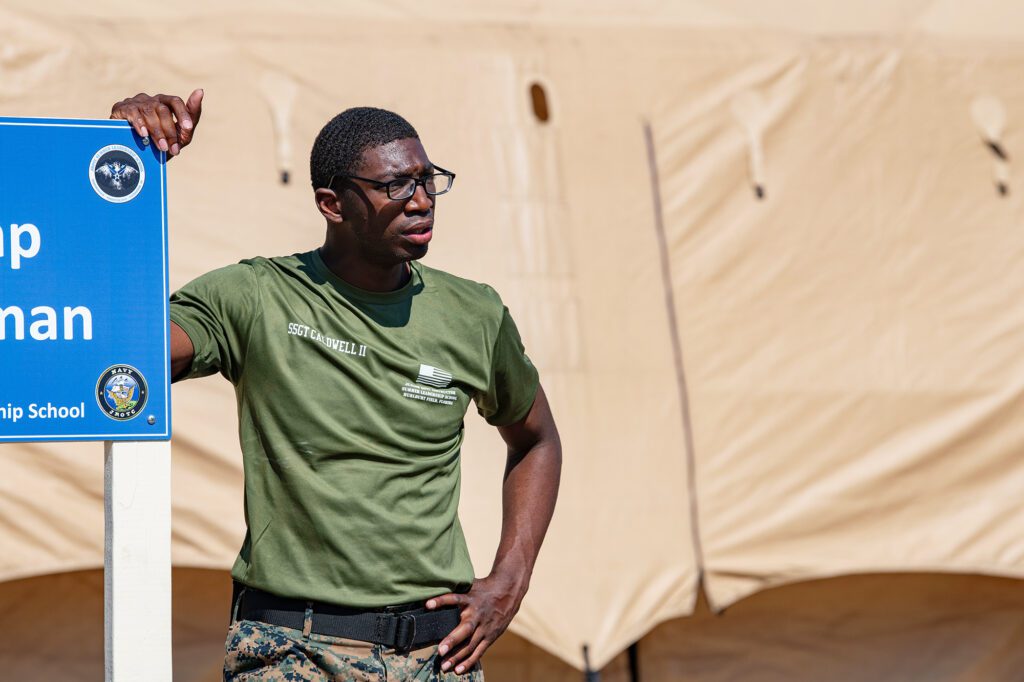
U.S. Marine Corps Staff Sgt. Bryan Caldwell prepares for briefing during a Junior ROTC summer leadership school program at Hurlburt Field, Florida, June 14, 2024. Caldwell, a former SLS Junior ROTC student, now volunteers as an instructor for the annual program. (U.S. Air Force photo by Senior Airman Natalie Fiorilli)

He added that returning to SLS as an instructor for the past several years has been an opportunity for him to be someone with whom the cadets can relate.

“I try to give them pointers on life, not just on the military,” Caldwell said.“I try to share my experience with them and help them really see the bigger picture.”

Held in partnership with the 1st Special Operations Wing, the SLS program at Hurlburt Field began in 2011.

Retired U.S. Air Force Col. Kenneth Rodriguez, SLS director, explained that the program has grown and matured over the years.

This year, SLS took place June 10-14 and included more than 60 Junior ROTC students from seven local and regional high schools near Hurlburt Field. Throughout the five-day program, the students slept in tents, ate meals at the base’s dining facility, participated in daily physical training and classroom training sessions – an experience similar to that of Air Force basic military training.

Additionally, the students experienced an orientation flight on board an MC-130J Commando II, repelled down the side of a wall, learned land and water survival skills and tactical combat casualty care and participated in several team-building activities.

“These experiences at SLS can be life-changing,” said Rodriguez. “The kids get so much exposure to phenomenal role models and they can see themselves in their shoes one day.”

Eglin celebrated Juneteenth National Independence Day

The official end of slavery was June 19, 1865, when the Emancipation Proclamation was read to enslaved blacks in Galveston, Texas. Texas was the last Confederate state to surrender to the Union Army.

President Joe Biden signed the Juneteenth National Independence Day Act into law June 17, 2021, making June 19 a national holiday.

Sabu Williams, Okaloosa County NAACP branch president, Air Force veteran and retired civil servant, was the guest speaker.

“Juneteenth didn’t just happen, to end slavery,” he said. “Freedom comes at a price. From the moment enslaved people reached these shores, to the time they were informed they were free, countless sacrifices were made. But there is still work to be done.”

Williams encouraged the audience to remain vigilant on protecting and preserving freedom.

Karen Brown, an Army veteran and local entrepreneur, shared why Juneteenth is a federal holiday.

“Juneteenth acknowledges not only black history, but also military history,” she said. “The many challenges enslaved people faced, and the many battles our miliary members fought to free the slaves, makes Juneteenth worthy of being a federal holiday.”

Dale Marks, 96th Test Wing Director, gave closing remarks. 

Juneteenth is a holiday for all of us,” he said. “When we forget to remember our history, we lose sight of who we are. This is an incredibly important day, and I’m glad we have this opportunity to reflect and commemorate it.”

Department of the Air Force launches NIPRGPT

DAF senior leaders are focused on maximizing competitive advantage, recognizing that Airmen and Guardians need advanced technologies at the speed of relevance. To that end, the DAF is launching NIPRGPT, an experimental bridge to leverage GenAI on the Non-classified Internet Protocol Router Network while continuing to explore maturing industry solutions.

“Our recent GenAI Roundtables with industry and academia have shown us this is an actively growing field,” said Venice Goodwine, DAF chief information officer. “Now is the time to give our Airmen and Guardians the flexibility to develop the necessary skills in parallel. There are multiple modernization efforts going on right now across the federal government and within the DAF to get tools in the hands of the workforce. This tool is another one of those efforts.”

NIPRGPT is part of the Dark Saber software platform developed at the Air Force Research Laboratory Information Directorate in Rome, New York. Dark Saber is an ecosystem of Airmen and Guardians from across the DAF that brings together innovators and developers and equips them to create next-generation software and operational capabilities deployable to the Force at a rapid pace.

At no additional cost to the unit or the users, NIPRGPT is an AI chatbot that allows users to have human-like conversations to complete various tasks. The CAC-enabled GenAI tool can answer questions and assist with tasks such as correspondence, background papers and code, all within a secure computing environment.

“Technology is learned by doing,” said Chandra Donelson, DAF acting chief data and artificial intelligence officer. “As our warfighters, who are closest to the problems, are learning the technology, we are leveraging their insight to inform future policy, acquisition and investment solutions.”

The experiment is an opportunity to facilitate real-world testing, focusing on key metrics such as computational efficiency, resource utilization, security compliance, etc., to understand GenAI’s practical applications and challenges and ensure that future implementation is effective and efficient. The platform includes user feedback opportunities to help develop governing policies and enable informed conversations with vendors as the DAF works to incorporate these tools into its operations.

“NIPRGPT is a critical bridge to ensure we get the best tools we have into our team’s hands while larger commercial tools are navigating our intense security parameters and other processes,” said Alexis Bonnell, AFRL chief information officer. “Changing how we interact with unstructured knowledge is not instant perfection; we each must learn to use the tools, query, and get the best results. NIPRGPT will allow Airmen and Guardians to explore and build skills and familiarity as more powerful tools become available.”

Civilian and uniformed Airmen and Guardians, as well as contractors who are CAC holders, can register for NIPRGPT access here: https://niprgpt.mil.

A black lettered send off

The 943rd MXS has proven their effectiveness at not only achieving the mission standards but by attaining perfect marks during inspections.

“A ‘black lettered’ aircraft indicates that there is nothing wrong with it,” said Capt. Anthony Laporta, 943rd MXS director of operations. “I personally have been in the Air Force 19 years and have only seen it one other time. Most of these models have always carried a discrepancy.”

Throughout its service, A6224 has accumulated over 7,204 flight hours. The aircraft has participated in over one thousand successful real–world rescue missions. These missions range across the U.S. and supported evacuation efforts during Hurricane Katrina.

The helicopter was used in training over 300 pilots and other aircrew, directly impacting D-Ms mission. It has supported countless TDYs and 15 deployments to locations such as Turkey, Afghanistan, Somalia, Jordan, Syria, and Djibouti. The squadron’s creed is “anytime, anywhere” and has proven this through its record of operations.

This history is a testament to and reflects the work of the 943rd MXS. The quality assurance review took place weeks before the official retirement of the aircraft, emphasizing the squadron’s commitment to mission operations and standards.

“Our maintainers strive daily for excellence,” said Senior Master Sgt. Benjamin Wells 943rd MXS section chief. “The black letter on A6224 shows how hard they work, making sure a safe and well-maintained aircraft is always ready to support the 943rd Rescue Group combat search and rescue mission: ‘Conduct combat rescue operations to prevent the exploitation of isolated personnel and ensure their return.”

With the retirement of A6224 to the 309th Aerospace Maintenance and Regeneration Group, the team is prepared for the operational use of the HH-60W Pave-Hawk helicopters. The team will take their skills and standards developed over the years and execute their future mission with the same efficiency.

“With the induction of HH-60W models, leadership is confident in our maintainers to continue to strive for excellence in maintenance,” said Wells.

The effective training and professionalism of the Airmen at the 355th Wing play a role in the
many different organizational components of Rescue and Attack here at D-M.

AFSFC reaches final phase of fielding Model Defender gear

By Debbie Aragon

In addition to securing the contract award through the Air Force Installation Contracting Center’s 773rd Enterprise Sourcing Squadron, the Air Force Security Forces Center worked with Air Force Materiel Command logisticians to get the equipment into the Logistics Readiness Inventory Control System.    

“Because of this effort, not only will it be easier to account for equipment, defenders will now be able to move from one installation to another with their Model Defender Individual Equipment Kit under the Gear for Life program,” said Master Sgt. Derek Walton, AFSFC Model Defender and Gear for Life program manager. “This means they will no longer need to have that equipment issued at each installation as they progress in their careers.”

At the direction of Air Force Security Forces, the Model Defender initiative began in June 2020 with a focus on standardizing must-have daily gear for every defender in the Department of the Air Force.  

“The establishment of the Model Defender Individual Equipment Kit was crucial as it standardized gear across the Air Force security forces enterprise enhancing operational efficiency, ensuring the safety and professional appearance of personnel and fostering modernization within the Total Force,” said Dennis Rodriguez, AFSFC individual protective equipment branch chief.

AFSFC started the new initiative by developing a standardized equipment list of 23 items which was then coordinated, amended and approved through major commands and security forces headquarters. This resulted in a final Model Defender Individual Equipment Kit.

Working with industry and Air Force contracting partners, the center then conducted phase 1 testing of state-of-the-art equipment using active-duty, National Guard Bureau and Air Force Reserve Command defenders in the San Antonio area.

“This collaborative effort with industry partners for phase 1 testing also streamlined the acquisition process, ensuring that all security forces are well equipped and ready for their duties,” Rodriguez said.

Based on testing results, AFSFC continued to phase 2 for expanded day-to-day testing at eight installations across four major commands, and phase 3 where the center consolidated and scrutinized collected data before presenting their findings to the Air Force Equipment and Weapons Configuration Board for validation.

“By conducting ongoing testing with the consolidation and analysis of test results, we were able to swiftly transition through the phases,” Rodriguez said. “This parallel processing allowed for immediate adjustments and expedited the validation and acquisition processes.” 

As a result, the equipment procurement plan was set to go immediately after the team confirmed the best equipment for the security forces enterprise, he added. 

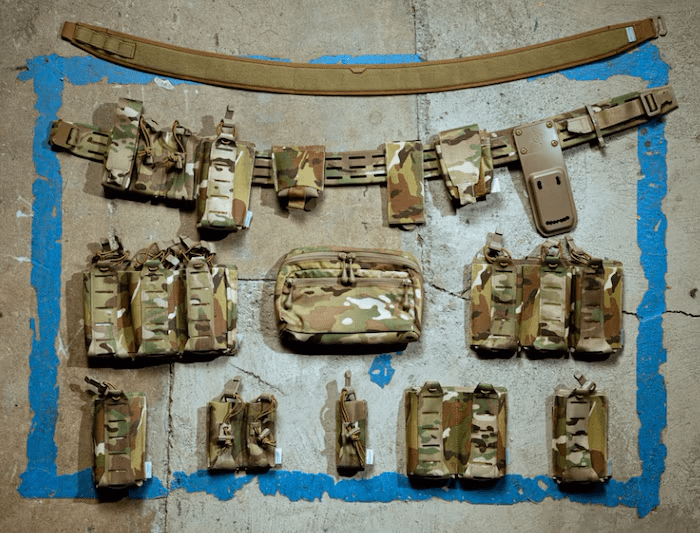
The Air Force’s new Model Defender Individual Equipment Kit on display. The kit will begin rolling out to installations by the end of 2024. (Photo Courtesy Blue Force Gear)

Phase 4, the first purchase of Model Defender kit equipment took place May 2023 with Blue Force Gear and marked a significant milestone in the timeline.

“Blue Force Gear developed a kit specifically to meet the needs of our security forces enterprise,” Walton said. “Their laser cut technology is cutting edge and integrates seamlessly with the body armor solution that was selected by the Air Force.”  

Upon receiving the initial small equipment purchase, the AFSFC team shifted focus to begin collaboration with Headquarters Air Force.

“The goal was to integrate the Model Defender items into the supply system through the Gear for Life initiative,” Rodriguez said. “Which was crucial for us to ensure the newly acquired equipment would be seamlessly incorporated into the broader system, enhancing the overall readiness and capability of the SF enterprise.”

“Our collaboration with headquarters was pivotal,” he added. “Integrating the Model Defender equipment into the Gear for Life initiative is not just a step, it’s a leap toward equipping defenders with the tools they need to face the future head-on.”

The final phase award was the career field’s largest purchase ever when the full contract of $39 million was awarded to Blue Force Gear in April.

The finalized Model Defender kit consists of:  

  • M-4 magazine pouches
  • M-18 magazine pouches  
  • Dump pouches (for easily stowing a variety of items like empty magazines)  
  • Holster adapters  
  • Mollie belts (a webbed belt that allows gear to be attached in a variety of configurations)  
  • Utility and handcuff pouches  
  • Flashlight and baton pouches

Space Force to accept Air Force Reserve volunteers for full-time positions

This transfer option is part of the Space Force Personnel Management Act (PMA), approved by Congress and signed into law as part of the Fiscal Year 2024 National Defense Authorization Act.

By Secretary of the Air Force Public Affairs

When fully implemented, the PMA will enable the Space Force to create a new model of service that integrates active-component Guardians and Air Force Reservists serving in space-focused career fields into a unified service that offers both full- and part-time service options.

“This is an important first step toward fully integrating critical space expertise from the Reserve into our force,” said Chief of Space Operations Gen. Chance Saltzman. “We’ve been serving side-by-side together, supporting the same mission, for longer than the Space Force has existed. I’m excited to officially call the teammates who decide to transfer Guardians.”

Air Force Reservists who hold the below Air Force Specialty Codes are eligible to apply for transfer into the Space Force in full-time capacity:

Officers: 13S – Space Operations, 17X – Cyberspace Operations, 14N – Intelligence, 62E – Developmental Engineer, 63A – Acquisition Manager, and 61X – Scientist. Officers selected from the 6X career field will re-core to a 62E or 63A since Space Force does not maintain that career specialty.

Enlisted: 1C6 – Space Systems Operations, 1N0 – Intelligence, 1N1 – Imagery Analysis, 1N2 – Sigint, 1N3 – Cryptologic Language Analyst, 1N4 – Network Intelligence Analysis, 1N8 – Targeting Analyst, 1D7X1 – Cyber Defense Operations, 1D7X2 – Spectrum Operations Technician, and 1D7X3 – Cable and Antennae Defense Operations.

“The Space Force is about to integrate some of the most talented space operators,” said Chief of the Air force Reserve and Air force Reserve Command Commander Lt. Gen. John Healy. “I have no doubt they will be key to advancing security in the space domain.”

In time, the Air Force Reserve, like the Air Force, will no longer maintain space operations as career fields, meaning Reservists with 13S and 1C6 specialties must transfer to the Space Force in either a full- or part-time position, or re-train under a different Air Force Specialty Code.

Application windows for Air Force Reservists interested in transferring to the Space Force in a part-time capacity are expected to open in 2026 once policies, processes and systems are established. The PMA does not currently apply to space units and personnel currently resident in the Air National Guard; however, Guard members could expect a similar process to their Reserve counterparts after authorized and appropriate legal and policy changes.
Interested Air Force Reservists can apply via MyVector and can access additional application details and requirements on the Space Force Transfer page.

Additional VHF antenna enhances communication to improve forecasts

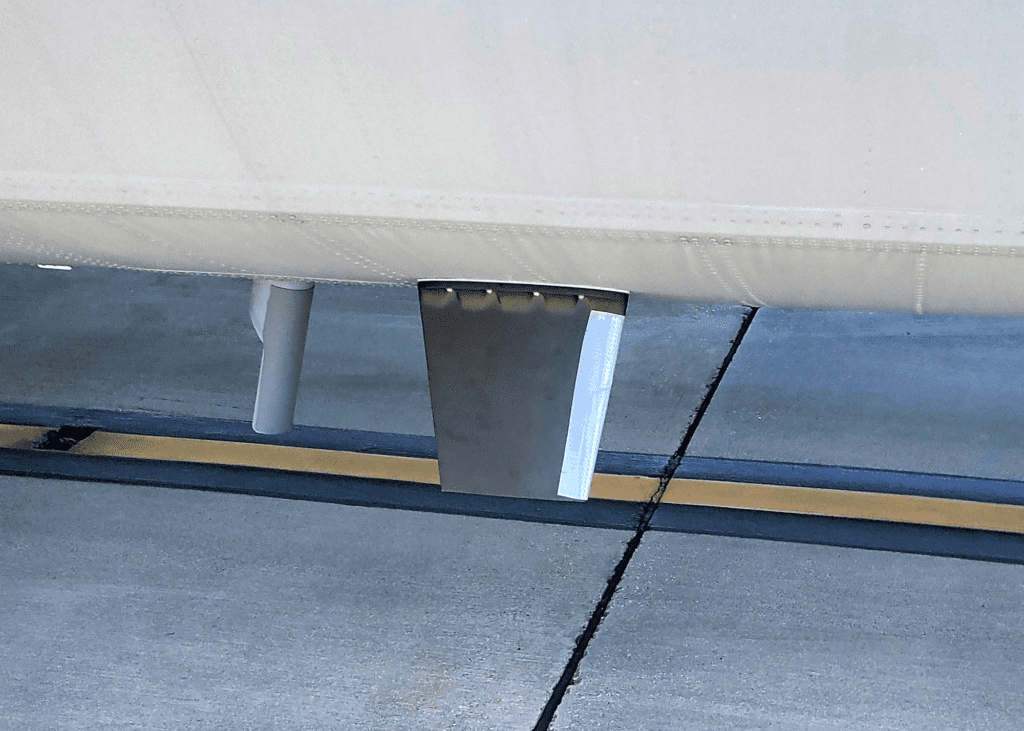
Once testing and evaluation is completed over the summer, installation of the antenna on the 10 WC-130Js is projected to begin this fall.

“Normally we have two VHF radio channels on board our aircraft,” said Tech. Sgt. Mason Henry, 403rd Maintenance Squadron meteorological equipment technician. “The VHF channels are used by the pilots for emergency communications and notifications.”

Russ Evans, C-130 Systems Program Office Avionics Engineer, Robins Air Force Base, Georgia, said that adding the third VHF antenna to the WC-130J gives the Training and Research in Oceanic and Atmospheric Processes in Tropical Cyclones, or TROPIC, U.S. Naval Academy’s internship program a dedicated channel for gathering data during storm missions. Their deployed sensors, the Airborne Expendable BathyThermographs, or AXBT, dropsondes, provide data such as sea temperature and salinity as they descend in the ocean.

Every summer, U.S. Naval Academy cadets with TROPIC work with the 53rd WRS to improve hurricane forecast accuracy by understanding what is happening under the sea during tropical disturbances in the Atlantic and Pacific oceans. The TROPIC team augments the Hurricane Hunters’ atmospheric measurements by collecting ocean data in and around the storm environment.

“Traditionally, the TROPIC team would connect to one of the two VHF channels already located on board,” said Tech. Sgt. Mason Henry, 403rd MET shop specialist. “This meant that the pilots had to give up one channel to get the research data from the AXBT’s during flight.”

“This additional channel ensures that the pilots have full use of the two VHF channels for communications while conducting critical weather reconnaissance missions,” Evans said.

Due to the impacts of the COVID pandemic and personnel turnover at the Naval Oceanographic Office, the C-130 System Program Office redirected its efforts to work specifically on the integration of the third antenna into the aircraft as the first step in integrating the AXBT mission-related equipment and software into the WC-130J’s weather equipment suite, Evans said.

“The installation of the new VHF radio system marks a significant milestone for our research,” said U.S. Navy Capt. (ret.) Dr. Beth Sanabia, senior principal oceanographer at the University of Washington Applied Physics Lab. “This additional antenna is essential for the success of our missions, especially when tracking and analyzing severe weather phenomena. This upgrade ensures that our crews can operate with greater confidence and efficiency.”

According to the C-130 System Program Office, the installation process was planned and executed by experts from their team and members of the 403rd MXS MET shop. The full upgrade will involve retrofitting the aircraft with the new antenna, receivers, control interfaces, and software, while ensuring seamless integration with the existing weather suite. In this first iteration, the aircraft and antenna underwent thorough ground testing and in-flight testing comparing the new antenna signal to the VHF channel previously used to verify the performance and reliability of the new system. This testing ensures that all operational, airworthiness, and cybersecurity risks or concerns are properly addressed before equipment is cleared for permanent installation and operational use.

The successful addition of the VHF radio antenna on the WC-130J Super Hercules is just one step in updating and leveraging innovation to support the joint weather mission in collecting vital meteorological data in severe weather conditions.

“There are more projects in the works to continue investing in technological advancements to maintain and enhance the capabilities of the aircraft for the TROPIC research mission,” said Sanabia. “The upcoming projects will help get information more efficiently.”

error: Content is protected !!