Please ensure Javascript is enabled for purposes of website accessibility
Skip to main content
Advertisement

Eglin’s F-35 flight simulators integral part of pilot training (VIDEO)

Air Force Maj. Matt Johnston, right, and Marine Corps Maj. Mike Rountree discuss how Eglin’s F-35 simulators help train pilots.

EGLIN AIR FORCE BASE — To use the military’s new multimillion dollar, state-of-the-art F-35 flight simulators, pilots must first be in the dark.

When a pilot steps into the expansive room that houses a simulator — about 40 feet by 50 feet with a towering 40-foot ceiling — it’s pitch black.

View a video of the simulator.

The entire room is painted matte black. The only light comes from reflectors along a walkway that leads the pilot up to a full-size replica of the fighter jet’s cockpit.

Once the pilot is inside, the cockpit slides along a conveyor belt through a small opening and into the actual simulator, a 30-foot globe resembling a giant golf ball.

Then there is light.

The globe is aglow with a 360-degree visual display made up of about 30 high-definition projector screens.

No other light can be let in because the world inside the golf ball is now the pilot’s reality. He’s on Eglin’s flight line preparing to soar off at 9 Gs.

The visuals are of such high fidelity and accuracy it’s easy to forget that you’re not flying a real jet. At least that’s how the pilots tell it.

The rooms that house Eglin’s four simulators are classified and not open to the public or the media. Lockheed Martin, the company that produces them, declined to disclose its dimensions, the specifications of the computer system that runs it or the cost. Representatives said the information was sensitive, technical data.

The pilots who have used the simulators, though, testified to their staggering size and scope while in a classroom at Eglin recently.

They compared using the simulators to going on a theme park ride or hopping aboard the Battlestar Galactica — the pilot is immersed in another world. The pilots said they are an invaluable tool in learning to fly the military’s newest fighter jet.

“I’m positive I’m not the only pilot in this room that has forgotten he is in a simulator,” said Marine Maj. Michael Rountree, one of the first certified F-35 pilots and an instructor at the school. “You don’t even remember that you’re not moving. The way things move around you in that 360-degree globe, it feels like you’re flying and you just forget.”

Pilots from all branches of the military go through training at the schoolhouse at Eglin to learn to fly the F-35. Plans call for dozens of pilots to attend this year.

The simulators are a major part of the six-week curriculum.

The course includes academics and actual flights in the plane, but most of the lessons take place in a simulator, said Air Force Maj. Matt Johnston, one of the first pilots to go through the program as a student. Now he’s an instructor and director of standardization and evaluation for the Air Force’s variant of the jet.

After academics and lessons on computers using less-costly joystick programs, students move on to the simulators.

The first few lessons cover basic operations.

One of the groundbreaking features of the simulator is the high resolution and fidelity of the visual display, said Greg Wilder, the lead instructor pilot for Lockheed Martin. It provides a 360-degree view that moves as fast as the jet would. It also is programmed with the actual landscape around Eglin.

“When you take off you see Destin, you see the Destin Bridge, the Pass, all the bayous,” Wilder said. “Everything that is out there.”

The sound of the engine is simulated, as are the sounds of the landing gear and other operations. The pilot can feel the thumps and jolts in the seat.

After the first few lessons on basic operations, pilots start to learn how to handle emergencies and other unexpected factors that could affect their flights.

Another groundbreaking aspect of the simulator is how dynamic it is. Instructors sit at a control consul and manipulate a host of conditions, from the environment to how the plane is functioning, Wilder said.

An instructor can make the simulator mimic different malfunctions or emergencies until the student learns how to respond correctly so the jet can be landed safely.

“These guys put you through the ringer,” Johnston said. “You are just getting hammered with emergency after emergency. These are not things you can go out and do in the jet. I can’t see what an engine fire looks like in the F-35, but (an instructor) will continue to do that to me until I can somehow manage a way to survive through it.”

Instructors can also play weatherman.

“We can make it a beautiful Florida day without a cloud in the sky, or if I want to stress them we can start bringing in clouds and lowering visibility. We can make it start raining,” Wilder said. “We start them out nice and easy — nice day, good weather. ‘OK, you can handle that, now let’s turn it up a notch and see what you can do.’ ”

Rountree said instructors can marry the simulator with the student’s learning style, reaching into the computer and making it perform to hammer home a point.

The simulator also can allow pilots to practice refueling in the air, landing on an aircraft carrier, evading missile fire from other aircraft or the ground and flying in formation.

Two simulators also can link together. Pilots in one will see when the pilot in the other lowers his landing gear.

In a practice engine fire, the pilot sees smoke coming off the plane. If there is a hydraulic leak, red fluid can be seen on the bottom of the plane.

Wilder, who was an F-16 pilot in the Air Force for 16 years before moving to Lockheed to develop the F-35, said no simulator he’s ever seen has offered that level of detail.

“That’s Disney World kind of stuff,” he said. “You just don’t do that in military simulators anywhere to that kind of fidelity, but that’s the detail they’ve gone with us. That’s amazing to me.”

The level of detailed instruction is important because once pilots go up in a single-seat F-35, they have to have learned in a relatively short time how to take off, fly and land successfully and safely on their own. The simulator makes that possible, the pilots said.

“The simulators could be a little lower fidelity in an F-16 or Harrier because you’d have someone back there who had experience who would ride the controls for you and maybe even fly it around a little so you could get a feel for it,” Rountree said. “In this airplane you don’t have that luxury. We have to be able to take off that airplane the first time and land it the first time safely by ourselves.”

He said the simulator bridges the gap between the academics and actually flying the plane for the first time.

“There was that seat-of-the-pants feel, but that was it,” Rountree said. “There were no surprises.”

Not only is the simulator providing a high-level of education, but lessons cost much less than actually operating the jets.

A fifth simulator is set to go online at Eglin in several weeks, Wilder said.

The course can allow students to go from no instruction to flying the F-35 solo in such a short period of time because of the simulators, Wilder said.

“You couldn’t have done this 15 or 20 years ago,” he said. “The simulators just weren’t good enough back then.”

This article has been corrected from a previous version to indicate that dozens of pilots are expected to go through the training school this year, not hundreds.

Contact Daily News Staff Writer Lauren Sage Reinlie at 850-315-4440 or lreinlie@nwfdailynews.com. Follow her on Twitter @LaurenRnwfdn.

This article originally appeared on Crestview News Bulletin: Eglin’s F-35 flight simulators integral part of pilot training (VIDEO)

Eglin civilians receive furlough notice

EGLIN A.F.B. — Civilian employees of Eglin Air Force Base were notified this afternoon to begin making preparations for possible furloughs if Congressionally mandated "sequestration" is activated March 1.

Sequestration is a half-trillion-dollar across-the-board government spending cut required by law following the failure of the bi-partisan Joint Select Committee on Deficit Reduction to arrive at a plan for reducing the national deficit. The "super committee," as it was called, announced its inability to reach an agreement on Nov. 21, 2011.

The memo received by civilian workers at Eglin announced the Department of Defense today notified Congress of its intent to furlough civilian workers if sequestration is activated March 1. President Barack Obama shielded active duty military members from furloughs.

"Notification of DoD's intent to furlough is the first step in the furlough process," the memo stated. "It is NOT an irrevocable decision to furlough civilian airmen, but you should begin personal planning in the event sequestration is not avoided."

Furloughs could occur one day a week for up to 22 weeks, defense contractor InDyne General Manager Jim Heald said during an interview with News Bulletin editorial staff.

"All government civilians would take one day off per week without pay," Heald said. "That's a 20 percent hit. We'll all be watching Washington, D.C., to see what's going to take place in the next week…I'm very nervous for my workforce. I have about 800 great patriots working for me. Hopefully Congress will do its job."

Because it works hand-in-hand with its government customers, InDyne, though a private company, would be affected by fuloughs.

"What we have is government oversight of us," Heald said. "When we are doing a test on the range, we obviously don't do anything alone. There are large teams that work a test program. …Typically we won't do the test unless the test engineer, typically a government person, either military or government civil service, is there watching.

"It may slow things down. If we can't do testing on the day the government employee isn't there, we'll have to do something else and we hope that something else is not furloughs."

Crestview City Council President Ben Iannucci III said the impact of civil service employee furloughs would be felt throughout the community.

"How many people in Crestview either are in the military or work for the military?" Iannucci asked rhetorically. "It's a lot of people in our community. Furloughs would go through the fiscal year. That's going to effect everything from shopping to people thinking of coming here on vacation. Even things like Christmas shopping would take a hit."

Accompanying the memo received by civilian Eglin employees was a memo from Secretary of Defense Leon Panetta.

"In the event of sequestration, we will do everything we can to continue to perform our core mission of providing for the security of the United States, but there is no mistaking that the rigid nature and scale of the cuts forced upon this department will result in a serious erosion of readiness across the force," Panetta's memo stated.

"I have also been deeply concerned about the potential direct impact of sequestration on you and your families. We are doing everything possible to limit the worst effects on DoD personel —  but I regret that our flexibility within the law is extremely limited."

Heald said he was hopeful elected representatives will do their job and head off the spending cuts.

"I think Congress knows sequestration is a dumb idea," Heald said.

This article originally appeared on Crestview News Bulletin: Eglin civilians receive furlough notice

Two distance runs set for Special Operations Warrior Foundation

DESTIN — On Saturday evening some of the world’s best endurance runners will stride off onto the beach. They’ll watch the moon set, the sun rise and then set again — and they’ll still be running.

Six people will vie to break the world record for running the farthest distance in 24 hours in the sand as part of the third-annual Destin Beach Ultra Run.

About 90 more will participate in a 50-mile run on the beach Sunday.

The third-annual event is a fundraiser for the Special Operations Warrior Foundation, which provides full scholarships for children of Special Ops servicemen who have died in combat.

Mike Morton, the 41-year-old who holds the current American record for the 24-hour run (172.4 miles), is an Army Special Operations master sergeant stationed at MacDill Air Force Base near Tampa.

The run is for a cause that hits home for him, he said.

“Having seen families who have lost their dad or husband, that’s a tragedy that they continue to deal with even after all the services are over and other people have moved on,” Morton said. “The Special Operations Warrior Foundation stays there to help them for the long term. It’s important not to forget the families that were left behind.”

The runners have already raised about $35,000 through pledges and fundraising drives. Race Director Zane Holscher said he hopes the event can raise at least $5,000 more.

Holscher, a Special Operations airman who served at Hurlburt Field for five years, said he started the 50-mile race to raise money for the Warrior Fund, a cause he has supported since two fellow Air Force Academy graduates were killed in Iraq in 2005.

He met later with the widow and child of one of the airmen and saw first-hand the importance of providing for fallen comrades’ families.

Even though his service has taken him to another location, Holscher continues to return to Destin to organize the event. It’s grown exponentially over the years; in 2011, only 18 people finished the 50-mile race.

The 24-hour record attempt is a new addition. They’ve set up the run with painstaking detail so it should qualify as an official Guinness Book of World Records attempt, Holscher said.

The contenders will run up and down a one-mile stretch of beach in front of Tops’l Beach Resort in Miramar Beach.

The record for running on sand for 24 hours is 83.04 miles. The longest known run, unofficially, is 94.08 miles.

Morton said he didn’t really train for this weekend’s run. Holscher noted though that he ran — and won — two 100-mile races in the past few weeks.

He said he mostly focuses on getting fit, building endurance and getting his body efficient.

The 50-mile course, believed to be the longest of its kind on only beachfront, runs from Tops’l east to Seagrove Beach, turns back west to Destin Harbor and then returns east to Tops’l. Runners will start at 5 a.m.

The fastest runner to complete the race so far did it in seven hours, Holscher said.

Ann Gwinnup, a 39-year-old from Niceville who has completed the 50-mile run in Destin the last two years, said she tries to take a long run on the beach each weekend in the weeks leading up.

“It’s definitely slower (than pavement) and it takes more of a toll on your ankles and feet,” she said. “You have to pay more attention to your footing, but in terms of beauty, there’s no comparison.”

She’ll run at least half the miles barefoot. She loves to feel the sand beneath her feet and the water on her toes.

Once on a beach run, a group of stingrays swam along with her, tracking her for a few miles, she said. Last year during the 50-mile run, she found live starfish and even a sea horse that she stooped to toss back into the waves.

She hopes to complete this year’s race in about 12 hours.

Twenty-five relay teams also will be running the 50 miles. Two of those teams are deployed, but will start their race at the same time as the runners in Destin, Holscher said.

On Saturday, for runners not quite up for the endurance challenge, the Son of Beach 5K and Cross Fit challenge will be held at the Back Porch restaurant. Registration is still open; at least 65 people already have signed up.

Saturday’s events will be dedicated to the crew of Ratchet 33, the U-28 plane that crashed about one year ago, killing all four Hurlburt airmen onboard.

People are invited to Tops’l to cheer on the runners Sunday, especially those vying for the 24-hour record.

“They are going to be needing some cheering on by Sunday morning, for sure by Sunday afternoon,” Holscher said.

TO LEARN MORE:  Visit www.destin50.com.

Contact Daily News Staff Writer Lauren Sage Reinlie at 850-315-4440 or lreinlie@nwfdailynews.com. Follow her on Twitter @LaurenRnwfdn.

This article originally appeared on Crestview News Bulletin: Two distance runs set for Special Operations Warrior Foundation

Goodbye AFSOC training center, welcome Air Warfare Center

Lt. Gen. Eric Fiel, left, hands a flag to Brig. Gen. Jon A. Weeks at a ceremony to stand up the Air Force Special Operations Air Warfare Center on Monday afternoon at Duke Field.

At a ceremony Monday, they dissolved the long-standing Special Operations Training Center at Hurlburt Field, rolling its mission into a larger one: the Air Force Special Operations Air Warfare Center. The new center will combine training and education with weapons testing and evaluation, as well as preparing airmen to deploy for counter-insurgency operations.

The Special Operations Air Warfare Center was originally formed at Hurlburt Field in 1962 to train and deploy some of the first special operations airmen, including the elite Jungle Jim commandos, but was dissolved after the Vietnam War due to budget cuts.

As the Air Force has continued to expand its irregular warfare capability in recent years, they lacked an organization able to integrate the various efforts. The Air Warfare Center will help solve that, said Brigadier Gen. Jon Weeks, who took over command of the center at the ceremony Monday.

“This is a great opportunity to bring back those functions we started in 1962, to go back to that model of irregular warfare/building partnership capacity, testing and training all under a single commander,” Weeks said after the ceremony.

The Air Warfare Center will oversee the missions of all the units that fell under the former training center at Hurlburt, and add the 919th Air Reserves Special Operations Wing at Duke Field and two Air Guard units in Mississippi and Alabama. The move will streamline command of the various missions and could lead to some cost savings down the road, Weeks said.

Col. William Anderson, who had been the commander of the Special Operations Training Center, stepped down from his position Monday. He will be retiring from the military after serving more than 20 years.

He began working to re-create the Air Warfare Center last summer.

Since then, all the airmen involved have had to work to stand up the new center while continuing to train and educate new air commandos.

“It’s been an incredible honor to be your commander,” Anderson said to the special operations men and women gathered for the ceremony. “You can be justifiably proud of all your accomplishments in these few short months.”

He said the Air Warfare Center was an exciting place to be right now as they forge a new future for special operations command.

Lt. Gen. Eric Fiel, commander of Air Force Special Operations at Hurlburt, echoed the sentiment.

“These achievements will be felt through the special operations community for decades to come,” he said.

Among other duties, the Air Warfare Center will organize, train, educate and equip special operations forces; lead major command of counter-insurgency and irregular warfare missions; test and evaluate weapons programs; and develop tactics, techniques and guidelines for special operations missions.

Headquarters for the Air Warfare Center will be located at Hurlburt Field, with operating locations at Duke Field and Robins Air Force Base in Georgia, according to public affairs for the Air Force Special Operations Command at Hurlburt.

About 850 active-duty and 900 reserve airmen will fall under the center’s command.

Weeks, who was previously a special assistant to the commander of Air Force Special Operations at Hurlburt, said now that the Air Warfare Center is officially up and running they can concentrate on their added responsibility of preparing airmen to deploy for counter-insurgency operations. In addition, they will be looking for ways to make the operation run better.

“Honestly, we’re going to have to look at some efficiencies and how we do business, particularly in training,” he said. “How can we possibly make this more efficient?”

He said he was honored, excited and humbled by the opportunity to command the Air Warfare Center.

“I couldn’t ask for a more professional group to serve with,” he said during the ceremony. “Today we start a new chapter of a full-force enterprise to be a model for the rest of the Air Force.”

Contact Daily News Staff Writer Lauren Sage Reinlie at 850-315-4443 or lreinlie@nwfdailynews.com. Follow her on Twitter @LaurenRnwfdn.

This article originally appeared on Crestview News Bulletin: Goodbye AFSOC training center, welcome Air Warfare Center

90-year-old veteran shares his story: a dream to ‘fly, man, fly’

George Mazock is seen during World War II when he was in his early 20s.
Special to the Northwest Florida Daily News

CRESTVIEW — Even after 70 years, George Mazock still cries when he thinks about his time during World War II.

The 90-year-old Army Air Corps veteran says there were hard days during his 20 years in the military, but despite the emotional moments it was one of the best times of his life.

He says he was doing what he always wanted to do: fly.

“Dad wanted me to be a mechanic, but I wanted to fly, man, fly,” Mazock said as he showed visitors to his home his wall of honor featuring four generations of military in his family. “I wanted to fly for as long as I could make model airplanes. It’s all I wanted to do.”

At 21, just a month after World War II broke out, Mazock joined the Army Air Corps. After a short stint as an instructor he was recruited to become one of a handful of men in an experimental group taken from training straight to combat under Lt. Col. Claire Lee Chennault.

Mazock became one of the Flying Tigers, who flew only at night and under poor weather conditions with little to no equipment to guide them.

“A lot of people didn’t realize what was happening in China, but while we were there we held off 1.5 million Japanese. That would have made a difference,” Mazock said.

He said during his thousands of hours of flying he gained the name “Death Takes a Holiday Mazock” for his grace under fire.

“A lot of the men would only fly with George because they knew he would get them back,” said Mazock’s wife, Beth Mazock. “He was a talented pilot.”

Mazock said one of his most memorable missions was in 1943 when Chennault recruited him to fly over the Himalayas, or the “Hump,” into China.

“All I wanted to know was why and if I had enough gas to get back,” Mazock said. “All I was told was that I was picking up 17 very important people.”

When he landed on the speck of land described by his lieutenant, he learned who would be his passengers: 17 escaped prisoners of war who had been on the run for more than three months.

“To think what they had gone through,” Mazock said, pausing as tears filled his eyes. “To me, in one way I hated seeing them, but in another way I had to see them. No matter, we got them out.”

While loading up the men, Mazock said his fear of running out of gasoline came true. But hidden gas left over from the Doolittle Raid the year before was found and used to get Mazock and his passengers back to base.

Over the course of his career, Mazock flew 8,000 hours in a variety of aircraft, from his Flying Tiger days with the C-47 to his later years with the KC-97.

As Mazock shares his stories he never talks about wars, just situations such as the “Korean Situation” and the “Vietnam Situation.” He says he always will look back at his time in the military as a pleasant memory.

“I was one of the few that enjoyed the war,” Mazock said. “I did what I wanted to do: I flew.”

Contact Daily News Staff Writer Angel McCurdy at 850-315-4432 or amccurdy@nwfdailynews.com. Follow her on Twitter @AngelMnwfdn.

This article originally appeared on Crestview News Bulletin: 90-year-old veteran shares his story: a dream to ‘fly, man, fly’

F-35Bs grounded after engine problem discovered

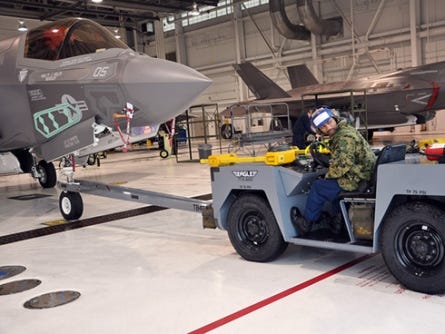
F-35B maintainer Antonio Spencer moves an F-35B in a hangar at Eglin Air Force Base on Tuesday. Maintainers for Lockheed Martin and the Marines will continue to work and train on the 13 F-35Bs at the base until flights are given the OK to resume.

EGLIN AFB — The Marine variant of the F-35 fighter jet has been grounded after a flight at the base experienced an engine problem during takeoff.

Flights of the plane have been banned across the country until the problem is addressed.

On Jan. 16 as a pilot was starting his takeoff, a failure of one of the fueldraulic lines on the side of the motor was noticed, said Lt. Col. David Berke, commander of Marine Fighter Attack Training Squadron 501 at Eglin.

The pilot was moving at a relatively slow speed and was able to stop the jet with no additional problems. No one was injured and the plane was not damaged, Berke said.

The Marine model of the plane, the F-35B, is designed for short takeoff and vertical landing capability, but was performing a traditional takeoff when the flight was aborted.

It was the first time a $70 million-plus F-35B had to stop a flight during takeoff at Eglin.

“We rarely fly aircraft where we have issues that arise during flight,” Berke said.

Aircraft maintainers evaluated the cause of the failure and reported their findings to the command staff. The planes were grounded program-wide Jan. 18.

Engineers are continuing to investigate the root cause of the problem, which may be a manufacturing defect in the fueldraulic lines.

“Once they come up with a solution, we will start flying airplanes again,” Berke said.

The incident marks the longest grounding for any variant of the F-35. The jets have been grounded four times previously, but not for more than 15 days and not once since they started flying at Eglin last year.

Berke said it is not uncommon for new aircraft to have problems in their first years.

“This is not unique to the F-35B,” he said. “With immature systems these discoveries can and will present themselves over time.”

He doesn’t expect the grounding to slow down plans to train pilots and maintainers this year.

He said there is plenty of work to do improving and expanding the training curriculum, maintaining the jets and using state-of-the-art flight simulators.

“It hasn’t really affected our ability to do anything other than fly,” Berke said. “I don’t anticipate this putting us behind our timeline.”

Contact Daily News Staff Writer Lauren Sage Reinlie at 850-315-4440 or lreinlie@nwfdailynews.com. Follow her on Twitter @LaurenRnwfdn.

This article originally appeared on Crestview News Bulletin: F-35Bs grounded after engine problem discovered

40 years after ‘peace with honor’ (GALLERY)

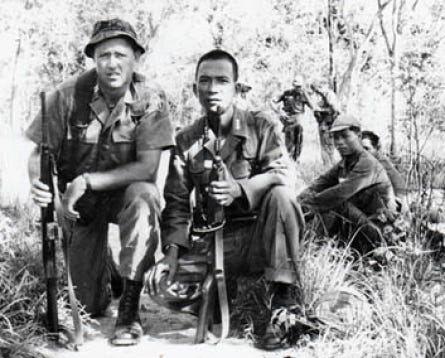
Johnnie Prichard, left, and other members of his unit stop for a trailside meal, which typically included monkey and lizard.

All troops would be withdrawn from the country within 60 days.

The announcement on Jan. 27, 1973, drew mixed emotions from the 500,000 Americans who fought in the nearly decade-long war. More than 58,000 Americans were killed and 150,000 were seriously injured.

A clear victory hadn’t been reached.

View a slideshow of photos from the war. ‘More work to do’ In 1970, Jim Weatherbee’s commander gathered his team in the officers’ club in Pleiku, where the 32-year-old had been serving as a forward air controller for about a year.

Weatherbee and his team of 30 Cessna 0-2 Skymaster pilots had been running reconnaissance seven days a week, 12 hours a day for the U.S. and South Vietnamese Army Special Forces troops on the ground.

If the troops came under fire, they’d fly in and lay rockets as markers for fighter planes coming through to stop the firefight by dropping bombs or napalm.

The Cessnas were under constant fire from the ground. Weatherbee had been hit twice. He said he was careful not to get hit again or he’d have been grounded from flying.

That day at the officers’ club, Weatherbee’s commander told him they would be turning over all operations to the South Vietnamese Army. They would be left to fight the North Vietnamese on their own, a process called Vietnamization that had always been a goal.

Minutes after the announcement, a rocket was fired into the club and the roof was blown off.

“We still had some more work to do,” Weatherbee said recently at his home in Fort Walton Beach.

Despite that, he and his unit were sent to Thailand. By the end of 1972, he was flying reconnaissance for the B-52s that were trying to bomb Hanoi into submission, he said.

That would turn out to be a turning point for the United States. After the bombing, Nixon quietly negotiated with the North Vietnamese and in January announced they had reached an agreement to end the war.

The problems that plagued the South Vietnamese Army in their fight to stave off the North Vietnamese in Pleiku when Weatherbee’s mission was called off in 1970 were still there after the war was declared over, Weatherbee said.

“I thought it was an appropriate thing to do (to end the war), but when we do that you have to leave something in place that can defend itself,” he said. “Unfortunately, as soon as we withdrew, the South Vietnamese just couldn’t handle it.”

The North Vietnamese had taken over Saigon by the end of 1975. A waste of lives In 1966 Johnnie Prichard, who was in his 30s and serving in the Army, was sent to the jungle as an adviser to the South Vietnamese Army.

“It was unfortunate, or I thought it was, that I wasn’t with an American unit,” Prichard said recently at his home in Bluewater Bay. “You’re out there by yourself and it’s not like having your buddies here on each side of you.”

He said he didn’t sleep for a week until he was too tired to stay awake any longer. He was afraid.

“I had nobody around I’d ever even seen before in my life,” he said.

As Prichard slogged through the hot, steamy jungle, he toted a short automatic rifle, his ammunition, four canteens of water strapped around his waist, several grenades and an unwieldy radio.

He lost 50 pounds in the first six months, he said.

“It was 114 degrees in the morning,” he said. “It didn’t take you long to lose any excess weight.”

The brutality he saw was hard to recover from.

When he arrived in Saigon, before he even got into the jungle, he saw a firing squad kill several Vietnamese soldiers in the street.

At one point after he was embedded with the South Vietnamese in the jungle, the squadron split up for a mission. However, one of the companies had been infiltrated by about 50 Viet Cong soldiers, Prichard said.

“When they got off by themselves, they lined that company up and took the officers and shot every one of them between the eyes,” he said.

The effects of the war continued long after then-Maj. Prichard returned home.

He avoided windows, and when he heard a loud noise he would find himself on the floor. One time his wife woke him and he jumped up and knocked her to the ground.

“It took awhile to get over that, but you work on it,” he said. “You just work on it.”

When Nixon announced the end the war, Prichard said he thought it was great.

“After I was over there, I thought it was a waste of 58,000 soldiers and blood and all that money,” he said. “It wasn’t a betterment for anybody. All we did was delay what was inevitable.”

An unhappy camper Retired Maj. Gen. Dick Secord was in the Pentagon by the time Nixon declared an end to the war in 1973, but he started out seven years earlier as one of the first U.S. troops in Vietnam.

In 1966, Secord was serving with an elite Special Forces group, the Jungle Jim operation that trained at Hurlburt Field. They were stationed at Bien Hoa Air Base near Saigon. Secord flew an AT-28 single-engine plane carrying 3,500 pounds of ordnance, napalm cans, gun bombs and pods of rockets. They were pummeling targets on the ground.

Vietnamese soldiers rode in the back seats; the missions officially were registered as training flights if any of the planes went down.

They were under constant fire and many planes got hit, Secord said.

“But not mine, thank God.”

More than 20 airmen from the elite operation were killed in the first two years of the war.

When Nixon announced the end of the war, Secord was working in the Office of the Secretary of Defense at the Pentagon.

He was extremely disappointed. “I was not a happy camper,” he said.

The United States had just completed the Linebacker II bombing campaign in North Vietnam, and Secord felt that militarily they had the upper hand.

“The North Vietnamese were pounded into a frazzle and they gave up,” he said. “Nixon and (Henry) Kissinger decided to call it off after that, but I think history shows they should have kept it up for a while.” No need to be there In 1972, Bob Welty, then 21 years old and serving in the Air Force, was stationed in Da Nang as a radar mechanic for F-4D phantom jets.

He and his crew worked 12-hour shifts to prepare the planes for constant bombing missions.

Every third night or so their base came under rocket attacks, Welty said.

They knew the rockets were coming because the dining hall that day would only have plastic utensils, a sure sign that the locals had not come to work because they had been tipped off.

Welty, now 62 and living in Fort Walton Beach, described what he felt after he heard the rockets being fired as “five seconds of sheer terror.”

“In six months, that’s 50 nights of ducking,” he said. “You’d stay up all night waiting for them and then get down on the ground and kiss your ass goodbye or smile because you were safe … I saw a lot of people get hurt.”

Welty said he did what he was asked to do in Vietnam, and at the time he was proud of the work he did, but many years later his views started to change.

“I was all gung-ho and for the war when I went over. I was 21, 22 years old. I was a kid,” he said. “Now I think we were pretty terrible and of how many people I was responsible for killing. But, back then we were doing our job.”

He said when Nixon announced the end of the war he knew it was good to get out of Vietnam.

“This is so ridiculous,” he said he thought at the time. “Why did we even get involved? We didn’t even need to be there.”

Contact Daily News Staff Writer Lauren Sage Reinlie at 850-315-4440 or lreinlie@nwfdailynews.com. Follow her on Twitter @LaurenRnwfdn.

This article originally appeared on Crestview News Bulletin: 40 years after ‘peace with honor’ (GALLERY)

Air Force institutes civilian hiring freeze due to possible budget cuts

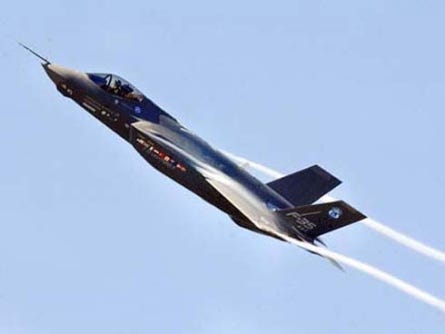
2012 was the year the F-35 finally took off at Eglin Air Force Base.

In preparation for the possibility of upcoming budget cuts, the Air Force has instituted a hiring freeze for all civilian workers. The measure includes termination of all temporary and term employees.Exactly how the measures will play out Air Force-wide has not been determined. Eglin Air Force Base, which has over 3,800 civilian employees, has not yet released how many workers, if any, will be affected. At Hurlburt, 15 temporary employees will lose their jobs on Feb. 23 and an additional 51 term employees will be terminated when their contracts expire, according to the public affairs office for the 1st Special Operations Wing. Gate guards will not be affected, the office reported. “We recognize the invaluable contributions of our civilian workforce; however we must address the current fiscal environment affecting all of the Air Force and the Department of Defense,” the office reported. Lt. Col. Laurel Tingley, with the Air Force’s public affairs office, said the Department of Defense issued a memo last week advising the Air Force to consider a hiring freeze to deal with potential budget shortfalls. “It’s one piece of the overall response the DOD is looking at to reduce spending and mitigate some of the budgetary uncertainty,” she said. She said command staff is working to figure out how and when exactly to put the freeze into effect. She did not have numbers of how many people would be affected or how much money the measure would save. “They are all in the process of figuring out how to execute this directive,” she said. “It’s a really complicated thing.” Rocky Tasse, president of the American Federation of Government Employees union for local Air Force bases, said the freeze will continue to exacerbate the effects of recent cuts. Over 300 positions we at Eglin and 100 at Hurlburt were eliminated over the last two years. An over four-year hiring freeze was just lifted in the end of 2011, Tasse said. In addition, early retirement packages were offered last year and many long-standing highly specialized employees took the offer. Their positions have not been refilled. That creates the potential for a vacuum of knowledge in the research and development functions, especially at Eglin, he said. Younger, less experienced civilian workers are moving in to take over those positions. “There are a lot of kinks in the armor when you do that,” he said. “The mission-oriented, experienced people, they’re gone.” In addition to the hiring freeze, Eglin and Hurlburt have curtailed non mission-essential flights or travel, such as air shows and flyovers or conferences and symposiums. They have also curtailed or stopped minor purchases of items like furniture and routine computer or software. “We are following the Secretary of Defense’s guidance in implementing these prudent near-term measures that will help mitigate the nation’s budget risks, while minimizing any harmful effects on readiness to the extent possible,” said Col. Jim Slife, commander of the 1st Special Operations Wing at Hurlburt in a written statement. Eglin has said they will offer additional details about implementation of the hiring freeze and other budget actions as soon as they are available. “Air Force Material Command leadership is working to determine how best to implement the directed actions while ensuring our mission is accomplished,” according to the Eglin public affairs office

This article originally appeared on Crestview News Bulletin: Air Force institutes civilian hiring freeze due to possible budget cuts

Special Ops airmen to march for comrades killed last year

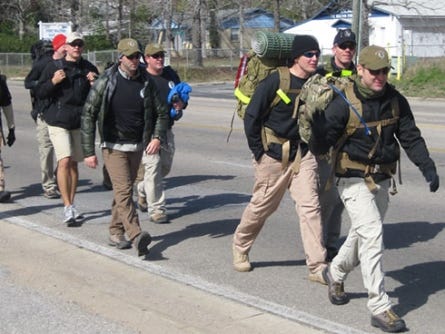
The four relay “ruck” teams will march day and night through Feb. 8, the date of their expected arrival at the headquarters of U.S. Special Operations Command at MacDill Air Force Base.

They are marching to honor five of their Special Ops comrades who were killed in action over the last year and to raise money for the children they left behind to go to college.

“We can only imagine the pain and suffering of their families,” said Sgt. Deon McGowen, a Hurlburt airman who organized the event.

McGowen started the march last year to honor the people who died when a Chinook helicopter crashed in Afghanistan in August 2011. Many of those killed were Special Ops service members and several were McGowen’s friends.

Five airmen with the Air Force Special Operations Group at Hurlburt were killed last year in the line of duty. All died in February 2012, shortly after last year’s march wrapped up.

The morning after McGowen’s group completed their march to Tampa, they received word that four fellow airmen had been killed in a plane crash Feb. 18.

Capt. Ryan Hall, 30, Capt. Nicholas Whitlock, 29, 1st Lt. Justin Wilken, 26, and Senior Airman Julian Scholten, 26, died when their U28-A airplane crashed in the Horn of Africa.

About a week later on Feb. 28, Lt. Col. John Loftis, 44, was shot to death at his desk during an attack on the Interior Ministry in Kabul, Afghanistan.

The Taliban claimed responsibility for the attack.

“It was a hard week for everyone,” McGowen said.

Several of the airmen who will march this year were close friends or roommates with the men who were killed, McGowen said.

The group already has raised more than $5,000 for the Special Operations Warrior Foundation and hope to reach this year’s goal of $50,000.

They raised $25,000 last year, McGowen said.

The foundation provides full college scholarships for children of Special Ops servicemen who are killed in the line of duty. The foundation now funds 140 children in college or vocational programs and has another 900 children who will be eligible, McGowen said.

His group has grown from 11 to 16 marchers this year, although he is the only one returning from last year.

“They were a lot smarter than me,” he joked.

Two additional team members, a medic and an airman who will provide technical and media support, will travel with the marchers.

The airmen dedicate their personal time to the event and have been training by walking and running with 40 to 50-pound rucksacks on their backs.

They plan to cover about 90 miles a day.

McGowen said they’ll likely get about four to five hours sleep a night while their team is on break.

The marchers can expect blisters, torn toenails and more than a few backaches.

“But it’s just a little sacrifice we can endure because these guys paid the ultimate sacrifice,” McGowen said.

CHECK IT OUT: All 16 marchers will kick-off at Hurlburt Field at 9:15 a.m. Sunday. They will march north on Martin Luther King Boulevard to Green Acres Road to Beal Parkway and stop briefly at Quality Imports, the car dealership that is a major sponsor of the event, about 11 a.m. The first relay group will continue down Beal to U.S. Highway 98 and on to Helen Back on Okaloosa Island by about 2 p.m. and then Johnny O’Quigley’s in Destin about 5:30 p.m.

The public is invited to come out and cheer the marchers on or even join them for any part of the march.

WANT TO HELP? To donate, find out more information and track the group’s march visit their Facebook page “Air Commando Ruckers” or their page at firstgiving.com under “Air Commando Ruck & Climb.”

Contact Daily News Staff Writer Lauren Sage Reinlie at 850-315-4440 or lreinlie@nwfdailynews.com. Follow her on Twitter @LaurenRnwfdn.

This article originally appeared on Crestview News Bulletin: Special Ops airmen to march for comrades killed last year

JAG announces law school programs for Air Force officers

HURLBURT FIELD — Applications for the Funded Legal Education Program, or FLEP, and Excess Leave Program, or ELP, are  being accepted through March 1. Interested officers are encouraged to compete. The number of FLEP and ELP applicants selected in any academic year is determined based on the needs of the Air Force.

“Our Air Force missions are constantly changing, and commanders deserve to have access to legal advisors with a broad background of military experiences,” said Lt. Col. Rebecca Vernon, Staff Judge Advocate, 1st Special Operations Wing Office of the Staff Judge Advocate. “The FLEP and ELP will ensure that we can continue to maintain a Corps of officers whose military experience complements their legal training providing commanders with the highest caliber of legal support.”

According to Vernon, Air Force Judge Advocate Generals do more than just provide legal assistance. In addition to prosecuting and defending clients brought before courts-martial, JAG officers routinely participate in nearly every facet of the Air Force mission including developing and acquiring weapons systems, ensuring availability of airspace and ranges where those systems are tested and operated, consulting with commanders about how those systems are employed in armed conflict, and assisting commanders in the day-to-day running of military installations around the world.

The FLEP is a paid legal studies program for active-duty Air Force commissioned officers and is an assignment action. Participants receive full pay, allowances, and tuition. FLEP applicants must have between two and six years active duty service, enlisted or commissioned, and must be in the pay grade O-3 or below as of the day they begin law school. The FLEP is subject to tuition limitations and positions may be limited due to overall funding availability. The Air Force Institute of Technology, or AFIT, establishes the tuition limit and in academic year 2012 was set at approximately $16,000 per year. While in 2012, due to unfortunate budgetary constraints, the Air Force was unable to offer any FLEP seats, the Air Force has secured a handful of seats in 2013 and encourages all eligible officers interested in becoming a member of the Air Force JAG Corps to apply.

The ELP is an unpaid legal studies program for Air Force officers. ELP participants do not receive pay and allowances but remain on active duty for retirement eligibility and benefits purposes. ELP applicants must have between two and ten years active duty service and must be in the pay grade O-3 or below as of the first day of law school.

Applications for FY12 FLEP and ELP will be accepted from Jan. 1 through March 1. Both the FLEP and ELP programs require attendance at an American Bar Association (ABA) accredited law school. Upon graduation and admission to practice law in the highest court of any state, commonwealth, or territory of the United States, candidates are eligible for designation as judge advocates.

To be considered for FLEP or ELP, applicants must complete all application forms, apply (acceptance is not required at the time of application for FLEP/ELP) to at least one ABA accredited law school, receive their Law School Admissions Test, or LSAT, results, and interview with a Staff Judge Advocate by Feb. 15. Officers must provide a letter of conditional release from their current career field. Selection for both programs is competitive.

A selection board goes over the applications in early March, and selections are made based on a review of the application package using a “whole person” concept. The total number of applicants selected for any academic year is based on the needs of the Air Force. AFI 51-101, Judge Advocate Accession Program, Chapters 2 and 3, discuss the FLEP and ELP.

For more information and application materials, visit http://www.airforce.com/jag, contact the base legal office at 884-7821, or contact Maj. Sean Elameto, HQ USAF/JAX (sean.elameto@pentagon.af.mil or 1-800-JAG-USAF.)

This article originally appeared on Crestview News Bulletin: JAG announces law school programs for Air Force officers

error: Content is protected !!