Please ensure Javascript is enabled for purposes of website accessibility
Skip to main content
Advertisement

High-flying role model: Tuskegee airman tours Eglin Air Force Base
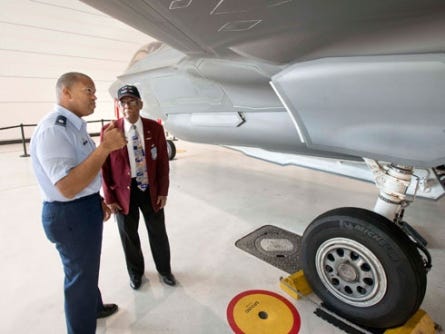
Lt. Col. Maurice Lee, commander of the 33rd Aircraft Maintenance Squadron, gives Tuskegee Airman Lt. Col. (retired) James Harvey a tour of one of the 33rd Fighter Wing’s F-35s at Eglin Air Force Base on Monday afternoon. Harvey started his Air Force flying career in the P-47 in 1944 and later flew the F80 during the Korean War, becoming the Air Force’s first black jet pilot to fly in Korean airspace.

EGLIN AIR FORCE BASE — When James Harvey III volunteered to become an Air Force pilot during World War II, he wasn’t wanted.

Harvey, who is black, said that in the early 1940s, the Air Force didn’t believe people of his skin color had the intelligence or ability to fly. Under pressure, they set up a special school and shipped aspiring black pilots there.

“They didn’t want us to be pilots,” Harvey said. “The program was actually designed for us to fail.”

Despite that, Harvey succeeded, along with dozens of other black men who went through the flight school. They proved the military wrong, fighting not only on the battlefield, but also for social and civil rights at home.

On Monday, Maurice Lee, a young black airman who commands the 33rd Aircraft Maintenance Squadron at Eglin Air Force Base, was promoted to lieutenant colonel. During the ceremony, he was flanked by Harvey, his 89-year-old predecessor and friend.

The two met in preparation for an awards ceremony last year and have become close. Lee has visited Harvey’s home in Denver, Colo., several times.

Lee said he was honored and humbled to have Harvey attend his promotion.

“At a time when our country was totally involved in World War II, these folks volunteered to put their lives on the line and to challenge the social status for everyone,” Lee said after his promotion ceremony. “These were some of the very first people to do that and to overcome those obstacles and challenges.”

Harvey said that while the Tuskegee program was designed for him and other airmen to fail, they didn’t.

The washout rate at the school was 40 percent, compared to over 60 percent for the rest of the Air Force, he said.

Some in the military were unhappy with the Tuskegee airmen’s success and pushed the rate until it reached over 70 percent. They were  washing out qualified pilots for minor infractions such as spots on their pink and green uniforms, Harvey said.

A commander reportedly commented that the military was failing out better pilots at Tuskegee than were graduating from other academies.

Harvey was one of the few who made it through.

“I just knew I wasn’t going to wash out,” he said.

They had to be perfect. The men who graduated and became the first black pilots to serve in combat are highly regarded and seen as some of the top pilots in their field.

“We were the best, and we proved it,” Harvey said.

The lieutenant colonel went on to become the military’s first black jet pilot to fight in the Korean War, and he waged significant battles for the American forces.

In 1949, after a barrage of legal challenges and political and social pressure, the U.S. military was desegregated.

The Tuskegee airmen were splintered and embedded with primarily white units.

Harvey said after that, he didn’t face much harassment or discrimination within the military, but the civilian world was a different story.

When stationed in California, he would make long cross-country drives to visit his home on the East Coast. He wasn’t able to stop for overnight stays in hotels because he was black.

He said he tried wearing his uniform with hopes that it would help, but it rarely did.

He said he doesn’t like to think too much about how he and other black servicemen were treated.

“I just don’t want that in my psyche,” he said.

Times have moved on. And so has the Air Force.

During his 22 years of service, Harvey flew more than 10 different aircraft, including the F-102, the Air Force’s first supersonic interceptor jet, developed in the 1950s. On Monday, he was able to view the military’s newest stealth fighter jet, the F-35, the plane that Lee works to maintain.

Harvey was excited to see it.

“The jets I flew could go supersonic, but the F-35 can definitely do better than that.”

Contact Daily News Staff Writer Lauren Sage Reinlie at 850-315-4443 or lreinlie@nwfdailynews.com. Follow her on Twitter @LaurenRnwfdn.

This article originally appeared on Crestview News Bulletin: High-flying role model: Tuskegee airman tours Eglin Air Force Base

Crestview's McKeon in combat for the love of it

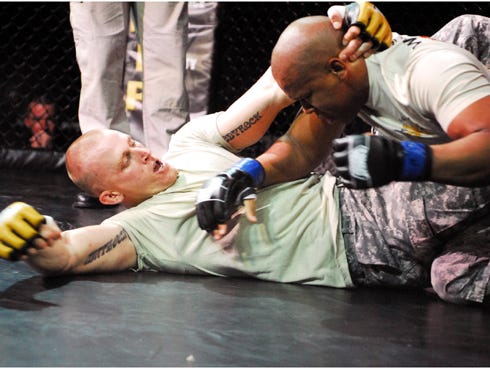
Crestview native Staff Sgt. Matthew McKeon Sr., left — an infantryman with the 2nd Lancer Battalion, 5th Cavalry Regiment, 1st Ironhorse Brigade Combat Team, 1st Cavalry Division — prepares to punch his opponent during the championship bout of the Fort Hood Combatives Tournament Feb. 23 at Fort Hood, Texas.

FORT HOOD, Texas —One soldier found his "perfect fit" for the Army during basic combat training just more than four years ago.

"I got interested in combatives (the Army’s version of martial arts) in basic training," said Crestview native Staff Sgt. Matthew McKeon Sr. The infantryman is assigned to the 2nd Lancer Battalion, 5th Cavalry Regiment, 1st Ironhorse Brigade Combat Team, 1st Cavalry Division. "I used to fight before I joined the Army, so in basic training, when combatives was introduced to me, I was like, 'Wow, this is what I did before I joined the Army,' so it kind of fit perfect together."

Although McKeon, 26, didn't start wrestling until he was in high school, he said he did well with just three years’ experience. He won many tournaments, and as a Crestview High School wrestling team member, he worked his way to the state tournament.

Joining the Army

After graduating from high school, McKeon still had the drive to compete in wrestling, leading him to join a local gym that offered a mixed martial arts program.

"I got my feet wet in MMA and did pretty good," he said. "But I realized it wasn't going to pay the bills, so I joined the Army."

McKeon was introduced to combatives during basic training. After learning the technique, he earned first place in his training unit’s mini combatives tournament.

McKeon’s passion for the sport lives on more than four years later. Now stationed here with the Lancer Battalion, he has competed in multiple postwide combatives tournaments. He never won —until the Feb. 20-23 Fort Hood Combatives Tournament, in which McKeon placed first in the cruiserweight category.

"After the fight, I was smiling from ear to ear. I couldn't stop it because it just felt like there was a lot of weight that was lifted off my shoulders," McKeon said.

Goal: win four in a row

Hoping to earn a spot on the Fort Hood Combatives Team and compete in the All-Army Tournament this summer, McKeon joined Ironhorse's combatives team.

"McKeon contributed overall leadership with his experience as a noncommissioned officer as well as a fighter," Command Sgt. Maj. Daniel O'Brien said. O'Brien is a senior noncommissioned officer of the 1st Brigade Special Troops Battalion of the Ironhorse Brigade and Ironhorse combatives coach. "He was able to assist in coaching the team with his experience in combatives."

O’Brien said that McKeon's recreational involvement with fighting helped with the rest of the team.

The Fort Hood Combatives Team used last month’s tournament to choose recruits for the All-Army Combatives Tournament.

"I was on the Fort Hood team in 2011 and we won the championship," McKeon said. "I was deployed for the (2012 competition) where they won again, so my goal is to help them win four in a row."

McKeon said he couldn’t have been successful without the support and encouragement of those closest to him.

"I love my wife, son and parents, and want to thank them for supporting me through all this," he said. "I wouldn't have been able to do it without you."

Sgt. Bailey Kramer is with the 1st Brigade Combat Team, 1st Calvary Division, U.S. Army.

This article originally appeared on Crestview News Bulletin: Crestview's McKeon in combat for the love of it

Pentagon reduces length of furloughs for civilian employees

The Pentagon has reduced the number of days civilian workers will be required to take unpaid leave this fiscal year.

The unpaid leave, or furlough, will be for up to 14 days instead of the 22 originally planned. It must be taken by the end of September.

The decision was made after President Barack Obama earlier this week signed a bill giving the Department of Defense more flexibility in implementing steep budget cuts by the end of the fiscal year. The DoD said the bill puts $10.4 billion back into this year’s budget.

Secretary of Defense Chuck Hagel said at a press conference Thursday that 14 furlough days will account for about $2.5 billion in cuts, versus about $4.5 billion the 22 days would have cut.

“These numbers are floating as you all know, but it’s good news,” Hagel said.

Watch a video of the press conference.

More than 5,000 civilian workers are employed at local bases, and many have expressed concerns about how they will handle the pay cuts resulting from the furlough.

The Defense Department has yet to release 30-day notice of the furloughs, but if it does require the full 14 days and the furlough goes into effect in May — the soonest it could begin — workers will see about a 15 percent reduction in their paychecks over five months.

In comparison, the 22 days would have resulted in about a 20 percent pay cut.

Local workers’ representatives had mixed reactions to the announcement Thursday.

Rocky Tasse, president of the American Federation of Government Employees Local 1942, said while the reduction in lost days is positive, it still results in a significant pay cut for defense workers.

“We’re still getting furloughed for 14 days, so that’s almost three work weeks,” he said. “While we’ve stopped the hemorrhaging, we still have a major bleed.”

He and other union representatives pointed out that the $10 billion should be enough to eliminate the need for furloughs altogether.

“If they can cut eight days just imagine what they should be able to do if they really put their nose to the grindstone,” Tasse said. “They should be able to eliminate the furlough completely.”

Meanwhile, civilian employees continue to have questions.

The American Federation of Government Employees Local 1897, which represents almost 4,000 local blue-collar defense workers, has been inundated with calls and concerns about the furlough.

Last week, Alan Cooper, vice president of the union, said they were fielding 150 to 200 inquiries a day.

Many people are concerned about making ends meet, and a lot of uncertainty remains over how and when the furloughs will be implemented weeks after the Defense Department raised the possibility.

The union has boosted staffing at its two offices and tries to have the call centers manned with at least two volunteers eight hours a day.

They refer concerned workers to the Employee Assistance Programs and Airman and Family Readiness Centers at local bases.

They also suggest calling their chaplain for consolation to help them cope with added stress and anxiety over the impending loss in pay.

“The (workers) are using the word stress a lot more than they did two weeks ago,” Cooper said.

Tasse said he is concerned about the well-being of the workers, who already are under financial pressure after taking a pay cut several years ago.

His main priority is getting accurate and up-to-date information to his employees to try to alleviate some of the added anxiety.

“I don’t want people throwing in the towel thinking that the sky is falling,” he said. “There are too many uncertainties. We’re going down this path together.”

Some callers are reporting that their managers already are dictating how they will be able to take their leave, which could be in violation of an agreement the unions signed with the Air Force, Cooper and Tasse said.

The agreement states that after a notice of the furlough is issued, employees will have 30 days to request how they want to take their leave. Options include one day a week, longer chunks or one stretch, whatever works best for them.

Managers must review the request, but will have the final say on how furloughs are implemented.

Tasse and Cooper said dictating how the leave can be taken before the notice even has been issued appears to be in violation of the agreement.

Cooper said he wants workers to know the union is putting groundwork in place so that when the furloughs take effect it will be able to serve as a watchdog to make sure it is implemented legally.

“I want to be able to look (employees) in the eye and say ‘I understand it hurts. I’m going to get furloughed, too, but in the end the agency got it right,’ ” he said. “If we can do that I think all parties will be satisfied that we followed the rules and did this the best we could.”

Contact Daily News Staff Writer Lauren Sage Reinlie at 850-315-4440 or lreinlie@nwfdailynews.com. Follow her on Twitter @LaurenRnwfdn.

This article originally appeared on Crestview News Bulletin: Pentagon reduces length of furloughs for civilian employees

Local doctor donates treatments to wounded troops

Years after going through intensive recovery from losing both legs and part of his hand in a blast from a roadside bomb in Iraq, Army Sgt. Joshua Cope was still struggling.

In 2011, five years after the explosion that wounded him and killed two others, Cope had very little short-term memory. He hardly spoke, was depressed and quick to anger. He couldn’t sleep. He was frustrated with his condition and always was on edge.

The explosion also gave Cope a severe concussion, and years later he still was grappling with the effects it had on his brain as well as lingering post-traumatic stress.

He and his family were at wits’ end.

Cope heard of a type of therapy, hyperbaric oxygen, that provided relief for other soldiers who had been injured in bombings or blasts.

The treatment wasn’t covered by his veterans benefits, but a local doctor, Eddie Zant, was donating his services to people who were wounded in the military.

Cope underwent the therapy, and it worked.

“I’m a totally different person,” he said recently from near his home in Orlando where he was playing outside with his three young children. “I was just so thankful that he was willing to do it.”

Over the past several years, Zant, a retired Army medic who served during Vietnam, has given hyperbaric treatments to about 50 Iraq and Afghanistan veterans from across the country.

He said it has cost him about $170,000 out-of-pocket for the liquid oxygen alone, not counting labor and rent costs, but it works and he wants to help.

“These are great people,” Zant said. “I enjoy working with them and seeing them get better.”

More and more veterans have been returning home from war zones with severe concussions from roadside bombs and rocket-propelled grenades, Zant said. 

“I could spend the rest of my life treating military men and women,” he said.

He said there are an estimated 350,000 people in the military who are suffering from severe concussions or post-traumatic stress.

Many search in vain for treatment that will help.

The Army and the Veterans Affairs don’t pay for hyperbaric oxygen treatment, but Zant said he hopes that will change soon.

Zant has neuropsychological tests in place to track patients’ progress. He’s compiled research reports and taken his findings to Congress to try to get coverage for the treatment.

“It’s not guesswork,” he said. “They get better.”

After a severe concussion, neurons in the brain are damaged and don’t connect properly. The oxygen therapy helps the brain generate new cells that can bring the neurons back to a functional level.

Okaloosa County Judge Patt Maney, a brigadier general in the Army Reserve, was wounded when an improvised bomb exploded under his Toyota Land Cruiser in Afghanistan in 2005.

A year after recovering from the injuries to his body, Maney’s wife Caroline still had to help him get around. He couldn’t remember what he was trying to do long enough to complete a task.

He couldn’t find words to finish simple sentences. By the time he got to the end of a sentence he was reading, he’d forgotten what it said at the beginning. He couldn’t follow television shows or balance his checkbook. He couldn’t sleep.

“I could walk and talk but I wasn’t functioning,” Maney said.

His body was healing but his brain injuries were not.

He couldn’t continue to perform his Army duties, and there was no way he could return to the court bench.

Zant, a friend of his, recommended the hyperbaric oxygen therapy.

“It totally saved my way of life. My quality of life has been restored because of him,” Maney said.

Maney returned to the bench in June 2007, and has recommended the treatment at Zant’s clinics in Destin and Fort Walton Beach to many veterans.

“Every wounded warrior that I have encouraged to go there had improvement. Every single one,” Maney said.

He said he believes it is a “professional scandal” that the military and Veterans Affairs are not adequately treating brain injuries.

Cope and Maney have advocated for the DoD and VA to consider the treatment.

For now, Zant remains one of a handful of doctors across the country who offer the service for wounded warriors.

“I honestly think he’s a hero both as a professional and for the community,” Maney said.

TO LEARN MORE: Read more about the treatment and Dr. Eddie Zant’s clinic at www.flhbot.com.

Contact Daily News Staff Writer Lauren Sage Reinlie at 850-315-4440 or lreinlie@nwfdailynews.com. Follow her on Twitter @LaurenRnwfdn.

This article originally appeared on Crestview News Bulletin: Local doctor donates treatments to wounded troops

Iraq War veteran to command Military Order of the Purple Heart

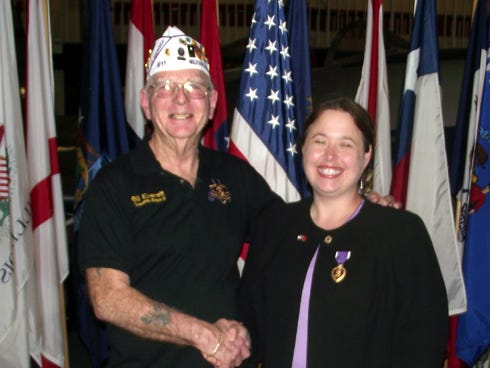
Region IV Cmdr. Bill Everett congratulates Meredith McQuagge, the Niceville Military Order of the Purple Heart’s first female chapter commander, March 16. The chapter has a number of members in Crestview, Baker and Laurel Hill.

CRESTVIEW — The Military Order of the Purple Heart Chapter 811, Niceville, has elected Meredith M. McQuagge, a combat-wounded Iraq War veteran, as Florida’s first female chapter commander.

McQuagge, 34, was born in Stamford, Texas, and graduated Magna Cum Laude in 2001 from the University of North Texas with a Bachelor of Arts in Communications. She joined the U.S. Army in March 2006. After basic training and advanced individual training at Fort Leonard Wood, Mo., she reported to Fort Sill, Okla. 

She served in Iraq from December 2007 to March 2009, providing convoy security for vehicles at Tallil Airbase, southeast of Baghdad, and as a member of a dedicated movement team working with the State Department at Camp Echo, Iraq.  

On July 5, 2008, McQuagge was wounded when a 105-mm rocket exploded nearby. Wounds included shrapnel in her face and neck, with the largest piece less than 1/4-inch from her carotid artery; third-degree burns to her neck; damage to her mouth and teeth; and a traumatic brain injury, which has resulted in blinding headaches, vertigo and memory lapses. 

She was awarded the Iraq Campaign Medal with two stars; the Purple Heart; Army Achievement Medal; Army Commendation Medal; the National Defense Service Medal; Global War on Terrorism Service Medal; the Army Service Ribbon; Combat Action Badge; and a Driver and Mechanic Badge. She and other members of her platoon also received a Meritorious Honor Award from the Department of State. 

McQuagge joined the Military Order of the Purple Heart soon after leaving the Army in 2009.

Reflecting on her reasons for joining, she said, “Being in combat really changes a person, and only those who have been there truly understand what it is like and how, after you return, the world is never the same.

"I enjoy being a part of an organization (that) strives to see that veterans are recognized for their service and are remembered.

"I know I was very lucky, and what I endured is nothing (compared) to the price paid by many and who continue to give, every day, in ongoing conflicts," McQuagge said.

This article originally appeared on Crestview News Bulletin: Iraq War veteran to command Military Order of the Purple Heart

Ribbon cutting, first service planned for 7th's Liberty Chapel

A ribbon cutting for the newly constructed Liberty Chapel is 3 p.m. March 25 at the 7th Special Forces Group Airborne compound. Soldiers, families and friends are invited to attend.

EGLIN A.F.B. — The construction of the 7th Special Forces Group Airborne Liberty Chapel has been completed and a ribbon cutting ceremony is 3 p.m. March 25 at the 7th Special Forces Group Airborne compound.

The 7th's command and ministry teams invite all soldiers, families and friends to attend. The event includes an open house tour of the facility, music by Dr. David Ott, an internationally recognized composer and conductor, and refreshments by Magnolia Grill.

The first chapel service is 10 a.m. March 31, Easter Sunday. The Protestant service includes children’s church and a nursery, followed by an Easter egg hunt and refreshments for attendees.

"With Easter being one of the three most popular attendance days of the church, this should be a great day to open the chapel up for services," Maj. Tony Petros, chaplain, said.

This article originally appeared on Crestview News Bulletin: Ribbon cutting, first service planned for 7th's Liberty Chapel

Pentagon delays furlough notices

Pentagon officials announced Tuesday they will postpone the forced unpaid leave for civilian employees pending analysis of legislation that could affect their budget.

The officials will not issue 30-day notices of the leave, or furlough, until about April 5.

Officials are delaying the notice so they can review pending legislation regarding the federal budget for the rest of the fiscal year. The legislation could reduce the number of furlough days required, according to the Defense Department.

Currently, the Pentagon is expecting that civilian employees will have to take 22 days of unpaid leave before the end of September.

More than 5,000 civilian employees work at local Air Force bases.

The 22 furlough days would result in about a 20 percent pay cut for about six months, and many employees are worried about how they will be able to meet their financial obligations.

Despite the furlough being pushed back, officials at Eglin Air Force Base and Hurlburt Field are continuing to prepare for it and have resources to support civilians who are affected.

“We want them to know there is hope, there are steps that can be taken to mitigate the impact,” said Mark Wilke, director of the Airman and Family Readiness Center at Eglin.

Wilke’s center and a similar one at Hurlburt are equipped to provide one-on-one financial planning sessions to assist affected employees, as well as a space to talk about the stress of a sudden loss of income.

Officials said they haven’t yet seen an increase in the number of people seeking counsel at the centers.

Wilke said he thinks employees are still processing their situation, but the resources are there if and when they need them.

Financial counselors can help employees figure out how the furlough will affect their monthly income, review their monthly spending plan and assess how the loss will impact their long-term financial goals.

Wilke said they can sometimes find ways employees can offset the income loss.

He said during the stress of facing sudden pay cuts, people can forget some of the fairly simple adjustments they can make to save money. The counselors try to help them identify categories of spending where they could cut back, such as packing a lunch instead of eating out or reducing their gasoline bills by driving less.

 Wilke said all the employees at the center will also be affected by the furlough, so they understand the challenges and stress.

 “We cannot only give advice, but we can empathize because we’re in the same boat,” he said. “We’re just helping folks to look at their options because sometimes in the fog you may miss something here or there.”

The counselors can also point to resources in the community that can provide food and other necessities if employees are living paycheck to paycheck and find themselves in trouble, or help employees apply for emergency financial assistance.

“They may look at some of the options they might not have normally considered,” Wilke said.

Many civilian employees have expressed concerns that with the pay cut they will be unable to meet financial obligations to lenders, which would hurt their credit and be potentially devastating to their financial future.

Wilke suggested taking proactive steps.

Because there are still several weeks before the first possible furlough day May 6, employees should contact their creditors now to let them know in advance about their situation.

He said most financial institutions have programs available to help with sudden losses in income.

“I really encourage them to talk to their banks, their credit unions, their mortgage lenders,” he said. “Most lenders are not looking for their folks to default. They want their clients to be successful, too.”

Also, if an employee requests, Air Force management will be required to write a letter explaining the furlough situation to anyone the employee is struggling to make a payment to, according to a labor agreement between civilian employee unions and the Air Force that was signed earlier this month.

LaVonne Vasques, director of the Airman and Family Readiness Center at Hurlburt, said the centers also have people to help with personal issues.

“They can talk about the stress they are feeling with their work life and how to be resilient through this,” she said. “Any kind of concerns, they should be coming over or calling us and seeking our assistance.

“It’s one team, one fight,” she said.

WHERE TO GET HELP

Affected employees can contact the Airman and Family Readiness Centers at Eglin Air Force Base and Hurlburt Field with questions or to set up an appointment. Walk-ins are also accepted. Call the center at Eglin at 882-9060 or at Hurlburt at 884-5441.

Contact Daily News Staff Writer Lauren Sage Reinlie at 850-315-4443 or lreinlie@nwfdailynews.com. Follow her on Twitter @LaurenRnwfdn.

This article originally appeared on Crestview News Bulletin: Pentagon delays furlough notices

Report: Lack of communication contributed to Eglin airman’s death

Maj. Garrett Knowlan was killed Oct. 11 during water survival training at Pensacola Naval Air Station. He was assigned to the 96th Test Wing at Eglin Air Force Base.

A lack of communication between crews and leaders contributed to a boat crash that killed an Eglin airman during a training exercise in Pensacola Bay last fall, according to an accident report released Tuesday.

Read the report for yourself.

Maj. Garrett Knowlan with the 96th Test Wing was killed Oct. 11 after he was hit by a boat participating in the training.

“Evidence suggested a misunderstanding of command and control responsibilities,” the report said.

Knowlan had been in Pensacola for a three-day parachute water survival training course.

The 32-year-old flight test engineer recently had moved to Eglin from Hurlburt Field and was transitioning to fly F-15s and F-16s, which is why he was required to take the training course. The jets are equipped with ejection seats and frequently fly over water.

The Air Force contracts with Naval Air Station Pensacola for the training. Contracted crews from Metson Marine Services had been hired to operate six boats for the exercise.

For the exercise on Oct. 11, students were to be dropped from a parasail into the bay and inflate a one-man life raft.

Knowlan was the first student to begin the exercise, according to the report from the Air Force’s Ground Accident Investigation Board.

He was towed off a launch platform on a parasail. After given the signal, he detached from the tow rope and used the parasail to float down into the water.

He successfully inflated his life raft and was debriefed by an instructor on a nearby pick-up boat.

The boat left him in the water.

Meanwhile, another boat picked up a student who had a knee injury and wasn’t able to perform the parasail practice. He was directly dropped off in the water for the life-raft exercise.

Although leaders of the exercise discussed that morning that they were going to allow the student to participate in the lifeboat portion, they did not communicate to everyone involved in the exercise exactly how it was going to be coordinated, including where and when the student would be put in the water, the report said.

They also did not use the radio to make it clear to all boats involved after the student had been put in the water.

A second student had been launched on a parasail, and then a third boat went to launch a third student.

That boat’s captain reported that he was unaware that the injured student had been put in the water, the report said. The captain misidentified the injured student as Knowlan.

The safety officer onboard noticed two students in the water, but did not communicate that to the captain or continue to monitor the students, according to the report. Instead, he monitored the parasail, which he felt was fundamental to his safety duties.

“His decision to disregard students ahead and look around did not incorporate other facts he also knew: that tow boats routinely pass very near students, that tow boat path can be unpredictable … and that everyone else (on the boat) was already looking backward at the parasail,” the report states.

At 11 a.m., about one minute after starting their tow, the crew felt the boat hit something in the water. They noticed Knowlan’s helmet floating near the boat and realized what had happened.

A rescue swimmer found Knowlan lodged under the boat and reported that he appeared to be dead, according to the report.

He had suffered extensive injuries and died instantly, the report stated.

Investigators found no medical or environmental conditions that contributed significantly to the incident, and everyone involved had required training. Knowlan did nothing to contribute to the accident.

The report states that procedures did not require specific calls about the number of students in the water, and that the job of the safety observer lacks a standardized qualification process.

It was unknown late Tuesday whether any changes have been or will be implemented in response to the report.

Contact Daily News Staff Writer Lauren Sage Reinlie at 850-315-4440 or lreinlie@nwfdailynews.com. Follow her on Twitter @LaurenRnwfdn.

This article originally appeared on Crestview News Bulletin: Report: Lack of communication contributed to Eglin airman’s death

DoD report: Value of F-35 student training is limited (DOCUMENT)

A recent Defense Department analysis has reported that there is limited use to training students on the F-35 fighter jet because it is still in development and substantially limited in capability.

Student pilots officially began training at Eglin Air Force base this year.

The report provides a snapshot of what the military’s newest and most-expensive fighter jet is capable of — but mostly what it’s not — 12 years after work on the program began. It also points to several potential safety and procedural issues with the aircraft, including lack of radar capability and deficiencies in the oft-lauded and highly expensive helmet-mounted visual displays.

Read a copy of the report for yourself.

Air Force and F-35 program officials say the program is designed so that pilot training develops along with the aircraft, and that the training is valuable to the progression of the program. They noted that when the Air Force evaluated the training at Eglin last fall, it found no critical problems that would deter training from continuing.

Four test pilots were followed through the program between September and November to determine whether the school was ready for its first official class.

The Air Force gave it the go-ahead in December.

The program

The Defense Department’s Department of Testing and Evaluation had recommended the Air Force delay its evaluation of the training program until the F-35 possesses combat capability, the DoD report states. The Air Force went ahead with it and the Testing and Evaluation Department was tasked with reviewing its findings for its recent analysis, which was released in February.

It shows a snapshot of a program still in its infancy, only one-third of the way through development, the report states.

The F-35, which has variants for the Air Force, Marines and Navy, is going through development, production, training and testing at the same time, a process dubbed concurrency that the jet’s developer Lockheed Martin originally touted as a way to save money and time.

The first years of the program have instead been plagued by cost overruns and delays.

A report released last week from the Government Accountability Office states the program has made significant developments in the past year and seems to be getting back on track, but rising long-term costs remain a major concern.

Acquisition of 2,457 jets was estimated to cost $395.7 billion in March 2012. That’s up from the $233 billion for 2,866 jets that was estimated in 2001 when the program was conceived, according to the GAO report.

The costliest development phases are still ahead, it states.

The schoolhouse

All students learning to fly the F-35 must attend the courses at Eglin. Currently, only experienced pilots are training on the jets, and they will become instructors for future classes, said Col. Andrew Toth, commander of the 33rd Fighter Wing, which hosts the school.

The pilots now are training on an early version of the jet, called Block 1, that has limited capability.

The planes can provide basic pilot training but have no combat capability. The pilots also are very restricted in what they are allowed to perform in the aircraft, according to the DoD report.

“The utility of training with an aircraft this early in development is limited because of the extreme aircraft operating limitation and lack of mission capability,” the report states. “There are a number of restrictions on the aircraft that are typical of a test aircraft only partway through its flight test program, but very atypical of a fighter aircraft used for student training.”

For example, the F-35s soaring over Northwest Florida are prohibited from performing aerobatics, descending at more than 6,000 feet per minute, exceeding Mach 0.9 speed or maneuvering at more than 5 Gs. They can’t take off or land in formation, fly at night or use instruments to fly during weather events, the report states.

Winslow Wheeler, who released the report last week on the website of the Project for Government Oversight, said the analysis indicates that student training started too soon.

“The airplane is so immature that the pilots are getting very little out of it,” he said of the DoD report. “The training exercise turns out to be clearly premature and should have been held off for another couple years until more competent airplanes are available for pilots to fly.”

Toth said training student pilots, even on the limited-capability aircraft, allows them to set a foundation for the future of the program and create a cadre of instructor pilots.

In addition to the pilot training, a large number of aircraft maintainers are receiving hands-on experience with the jet and learning what it takes to get it off the ground each day, he said.

“When the aircraft is fully functional and capable, we will already have the maintainers in place and we will have pilots that are already able to operate the aircraft,” he said.

Although full functionality is still several years off, Eglin is set to receive jets with additional capabilities this year.

By the end of the month, the first Block 2 jets should be delivered to Eglin, said Kyra Hawn, a spokeswoman the F-35 Joint Program office. The jets will have additional weapons engagement capabilities.

Eglin should receive a second Block 2 jet shortly after and have a total of 24 by the end of the year, Toth said.

Eventually, the Block 1 aircraft also will be upgraded, although that was not initially in the plan.

Toth said Lockheed Martin has realized those planes also must be upgraded to be functional for the services.

Hawn said the malfunctions with the helmet-mounted display and the radar are being addressed, and were not designed to be fully functional with the early-version aircraft at Eglin now.

The DoD report states the training at Eglin was sufficient for the limited number of students that went through last fall, but with the new aircraft will come a new course syllabus and additional training requirements.

The Air Force had to provide substantial resources and work-arounds to meet the requirements of the limited syllabus in the fall, and it likely will have trouble keeping pace with a more advanced syllabus and an increased student load, the report states.

The Air Force provided additional F-16 jets to fly as chasers behind the F-35s in the cases when enough F-35s weren’t cleared for flight. Those jets won’t be available after this month.

Even so, Toth is optimistic, especially with the commitment of the men and women working on the program at Eglin.

The first official class of Air Force pilots has completed academic training and is starting flight tests. Another class started this month.

All three branches hope to put more than 50 pilots through training by the end of the fiscal year, Toth said.

More than 600 maintainers already have been trained, and that number should more than double this year, he said.

Toth said 19 sorties were launched Wednesday, the most in one day at Eglin.

“This program continues to grow on a daily basis and it’s all a credit to all of our maintainers and pilots that are making this happen,” he said.

Contact Daily News Staff Writer Lauren Sage Reinlie at 850-315-4443 or lreinlie@nwfdailynews.com. Follow her on Twitter @LaurenRnwfdn.

This article originally appeared on Crestview News Bulletin: DoD report: Value of F-35 student training is limited (DOCUMENT)

error: Content is protected !!