Please ensure Javascript is enabled for purposes of website accessibility
Skip to main content
Advertisement

23 STS IDMT: ‘Knowing what to do and being ready can make all the difference’

By Staff Sgt. Natalie Fiorilli

24th Special Operations Wing

It was May 2023, and Flaspoehler was traveling to a deployed location in Southeast Asia.

He walked to the front of the cabin and found a 64-year-old woman, pale-faced, sweating and clutching her chest in pain.

After observing her symptoms, he checked the woman’s pulse and blood pressure.

“We need to divert and land as soon as possible,” he told the pilots, knowing the woman would soon go into cardiac arrest.

From there, Flaspoehler said he relied on both instinct and experience. He followed chest pain protocols, placed the passenger on oxygen and gave her aspirin and fluids. Next, he examined a bottle of nitroglycerin: a drug that could potentially stabilize the patient but could also be lethal.

“I knew I had to do it,” he said. “It was stressful, but I knew she didn’t have much time.”

As the aircraft began its descent to the nearest airport, Flaspoehler worked to keep the woman alive.

For Flaspoehler, an independent duty medical technician with the 23rd Special Tactics Squadron at Hurlburt Field, Florida, providing life-saving care is almost second nature.

His journey to that moment began years before he joined the military.

Before enlisting in the Air Force in 2016, Flaspoehler honed his medical skills as a civilian emergency medical technician in Los Angeles. Later, his career led him to a level-one pediatric trauma center at LA Children’s Hospital. There, he treated some of the most critically injured patients imaginable, he said.

“We responded to car accidents, fires, stabbings … pretty much everything imaginable,” he said. “As a whole, those jobs exposed me to a wide range of medical incidents.”

Flaspoehler said that one of those incidents in particular left him wanting something more in life.

One day, the former EMT found himself in the back of an ambulance, speeding through the streets of Los Angeles, treating a man bleeding heavily from a neck wound.

As he packed the wound to stem the bleeding, the same thought continued to flash through his mind: the injury was eerily similar to the one that had killed his friend, fallen Army Sgt. Michael Cable, who died in Afghanistan in 2013.

Flaspoehler said that in the moment, he tried not to think about Cable’s death. But afterward, he began to dwell on it. He couldn’t shake the feeling that he could be serving a greater purpose, he said.

“I wanted to be able to be there to see and treat my friends and brothers and sisters,” Flaspoehler said. “As a civilian, I was usually treating strangers. I wanted to be with a team and have the responsibility of taking care of them.”

That realization drove him to join the Air Force.

As part of the 23rd STS, Flaspoehler’s work is dynamic. His unit is tasked with missions involving austere airfield control, terminal attack control, personnel rescue and recovery, assault zone battlefield trauma care, and more.

In his role as an IDMT, he’s trained to establish medical treatment facilities in remote and hostile environments.

“I can run a 911 call, pick up an active-duty patient, treat them as a paramedic, bring them to the emergency room and then treat them and discharge them,” Flaspoehler said. “This kind of position doesn’t really exist in the civilian world.”

He also provides medical support during high-risk activities like airborne jump operations and dives, and trains personnel on Tactical Combat Casualty Care to prepare them for potential life-and-death scenarios.

“One day, it could be their friend that needs help out there,” he said, referring to fallen Army Soldier Cable.

On the flight, the 64-year-old patient’s blood pressure and heart rate returned to healthier levels and the medicine reduced her pain.

Soon after, the flight landed in Kuching, Malaysia, where Flaspoehler helped first responders carry the woman off the plane and to an ambulance.

After arriving at his deployed location in Southeast Asia, Flaspoehler followed up on the patient’s status: the woman had survived after receiving additional care in Kuching.

“I felt relieved that I made the right call,” he said. “While it was something I had handled so many times before, I had never had to do something like this on a plane, in international waters.”

Ultimately, Flaspoehler said he credits the medical experience he gained as a civilian and in the Air Force.

“Knowing what to do and being ready can make all the difference.”

Wreaths Across America honored at Beal Memorial Cemetery

By Senior Airman Ty Pilgrim

During the ceremony, volunteers from the local community came together to lay hundreds of wreaths on the graves of fallen service members.

The event was part of a nationwide initiative to honor veterans during the holiday season.

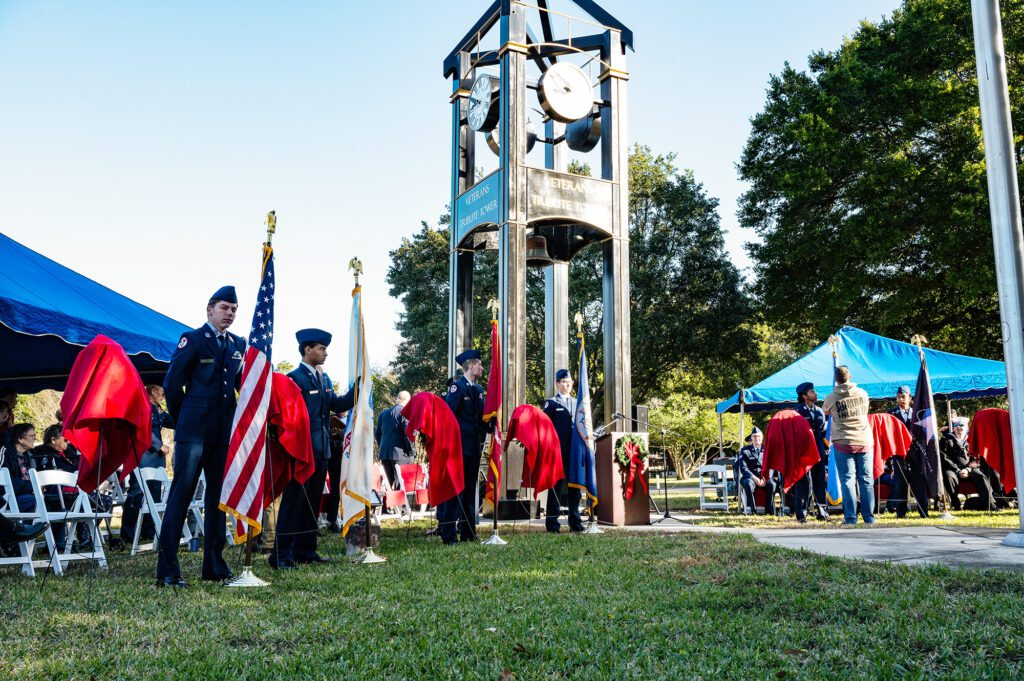
After the Freedom Bell in the Veteran’s Tribute Tower tolled, U.S. Air Force Brig. Gen. Mark A. Massaro, 96th Test Wing commander, reflected on the significance of remembering those who gave their lives in defense of the nation.

“This ceremony reminds us that the sacrifices of our fallen service members were not made in vain,” Massaro said. “They lived with purpose, dedicating their lives to the defense of freedom and the protection of our way of life.”

U.S. service members and community members attend the Wreaths Across America Placement Ceremony at Beal Memorial Cemetery, Florida, Dec. 14, 2024. Wreaths Across America is a nonprofit organization dedicated to honoring and remembering America’s fallen heroes by coordinating wreath-laying ceremonies at cemeteries and memorial sites across the country, with a mission to “Remember, Honor, Teach” about the sacrifices of U.S. veterans and their families. (U.S. Air Force photo by Senior Airman Ty Pilgrim)

Since its founding 17 years ago, Wreaths Across America’s mission is to “remember, honor and teach,” with a focus on educating young volunteers about the sacrifices made by the nation’s Veterans.

“We are here to participate in a time-honored tradition, one that transcends borders and generations,” Massaro said. “Wreaths Across America has been a beacon of patriotism and remembrance, which began as a simple gesture of respect by Morrill Worcester and has grown into a national movement.”

The 1st Special Operations Wing’s deputy commander, Col. Kaveri Crum, joined local military leadership teams, veterans and local community members in honoring those laid to rest at the cemetery by laying wreaths on veterans’ gravestones, which serves as a final resting place for both Air Force members and veterans from all branches of the military.

“We’re remembering them,” said U.S. Army Col. Griffin Merrill, 7th Special Forces Group deputy commander. “We’re honoring their sacrifice, and we’re teaching all generations about the cost of the freedom those veterans who have served and fallen before us bought and paid for.”

The ceremony concluded with a moment of silence followed by the playing of “Taps” as attendees reflected on the lives and legacies of the fallen. For more information about the program and how to get involved, visit www.wreathsacrossamerica.org.

Air Force names first female SERE specialist to chief master sergeant rank

By Miriam A. Thurber

Air Force Accessions Center Public Affairs

Although not the first female SERE specialist, when Zaloudek earned her beret in 2007, she broke an eight-year dry spell in which no women had graduated from the specialized training course. Reflecting on her initial recruitment, she remembers her recruiter handing her a SERE brochure with no women in it.

“He told me that he only knew of one woman to ever graduate SERE specialist training and that I didn’t look like the type who would do this job because I was so feminine. Well, that and because I had previously owned a pet rabbit,” Zaloudek said. “I understood SERE was a demanding career path, but I felt I was ready for the challenge.”

Sure enough, 8 years later, Zaloudek was out in the woods demonstrating to students how to properly skin and prepare a rabbit, all while rocking a bleach blonde ponytail and acrylic nails.

SERE specialists like Zaloudek prepare personnel in high risk of isolation for survival across the full range of military operations. If Airmen find themselves isolated anywhere in the world, they must rely on their SERE training to find food, build shelter, evade adversaries, navigate the terrain and assist in their own recovery. Because Airmen rely so heavily on this expertise, SERE specialists need to intimately understand every aspect of survival, evasion, resistance, escape and personnel recovery so they can adequately prepare their students. This means proficiently operating in arctic, coastal, desert, jungle, mountain, urban, water and captivity environments whether the area is friendly or hostile, day or night. SERE specialists must be able to provide basic emergency medical care, avoid capture, operate a parachute, construct shelters that blend into the surroundings, know how to safely procure food and more.

When Zaloudek first began her training, some people doubted her abilities simply due to her gender. They jokingly called her “Combat Barbie” and questioned whether she would make it. Her response to them was always the same: “I don’t know if I’m going to make it, but I’m going to leave it all out there.”

During SERE specialist training, Zaloudek said her goal was to not only meet but exceed every standard, and she told herself that quitting was never an option. She was determined to be judged on her capabilities, not her gender—she just needed the chance to perform. Training phase after training phase, Zaloudek excelled until she ultimately earned both her beret and recognition as a top performer by the SERE cadre.

Zaloudek recalled her parents—who were initially scared when she announced her plans to become a SERE specialist—attended her graduation and told her how proud they were.

“Growing up, I just wanted them to be proud of me,” she said. “I was my dad’s shadow; we would do everything together. They taught me to never quit or be afraid of hard work. They actually prepared me really well for the Air Force because, in this Air Force, you have the world at your fingertips if you just put the work in.”

Zaloudek credits the SERE specialist career field for looking beyond gender and evaluating her solely on her performance and execution, not just during training, but throughout her entire career.

“My leaders, colleagues and Airmen saw me giving my all every day,” Zaloudek said. “I wrote a report for Congress on integrating women into special warfare career fields, I played a key role in developing and implementing fitness programs at numerous bases, and I spent my free time volunteering at homeless shelters and assisted living homes. I also became the first woman in USAF SERE to qualify as a Military Free Fall Jumpmaster and Test Parachutist.” Many people throughout her career recognized her hard work, nominating her for awards and even promotions based solely on merit. Even so, some people still diminished her accomplishments by saying she was only successful because she was a woman.

After becoming a SERE specialist, Zaloudek stood out as a woman in the small career field and quickly received a lot of attention. At times, she recalled her extroverted and bubbly personality being mistaken for weakness by others. As a result, Zaloudek went into what she called “survival mode,” feeling like she had to act more reserved, stoic and introverted. According to her, many women she has talked with have experienced the same thing and have chosen to downplay certain aspects of their personalities as a response to unwanted attention or overwhelming accusations that their success is attributed to their gender or looks.

“At first, it felt almost natural to downplay parts of myself as a protective shield, especially when society has such firm ideas on how successful women should look and act,” Zaloudek said.

However, she added that over the years, she began to regain confidence in herself and to truly believe that there is no “correct” way to be a woman. Zaloudek decided not to let external judgement define her and slowly began reclaiming her identity. Today, she uses her social media platform and her Air Force leadership opportunities to encourage people everywhere, especially women around her, to do the same.

“To all the women out there, please know that strength and femininity go hand-in-hand,” Zaloudek said. “You don’t have to act or look a particular way to do well in a career dominated by men. I personally like wearing makeup and doing my hair; that doesn’t make me less of a SERE specialist. And for those who prefer not to wear makeup or do their hair, that doesn’t make them any less of a woman. You can look however you want to look—within regulation—and be your own brand of woman.”

Zaloudek urges everyone to take the leap towards their career dreams “because you’ll never know what is possible until you try. Train hard, exceed the standards and never quit. Your determination and execution can outweigh any perceived limitations.” She also encourages women not to shy away from service because today’s Air Force accepts uniqueness in uniform while maintaining uniformity and ensuring lethality.

Next Generation Aircrew Protection team conducts AC-130J vapor purge testing

By Amn Samantha Rossi

Hurlburt Field

The NGAP team’s mission is to evaluate how well standard aircraft systems protect aircrews from chemical vapor attacks, identify when it’s safe to remove Chemical, Biological, Radiological and Nuclear gear; and determine how quickly aircraft can purge harmful chemical vapors.

“With the evolving and ever-changing war environment, testing how quickly vapor can be purged from an aircraft, and how protective non-CBRN equipment can be is a key asset to every element of the Department of Defense,” said Justin Spurling, an NGAP test engineer “This includes our special operators.”

The NGAP team worked with the gunship aircrew to study the chemical environment inside the aircraft during a simulated chemical vapor attack and measure the time it takes for the aircraft to purge the hazardous chemicals while flying.

NGAP has primarily tested fighter and bomber aircraft but the AC-130J marked a new direction, leading the way for future testing on mobility aircraft.

“Air Force Special Operations Command is known for being the first to jump at innovative tactics, and working with the NGAP team was no exception,” noted Lt. Michael Rossi, Lead Joint CBRN Aircrew Protection Engineer at the Air Force CBRN Defense Systems Branch. “This directly contributes to development of next-generation equipment and feeds into new concepts of legacy equipment.”

The test begins with a pre-flight spray, followed by the installation of sensors and NGAP team members inside the aircraft to monitor the simulant vapor levels. Once a target concentration is reached the aircraft takes off and sensors continue collecting data as the simulant is purged during flight.

After the test, the data is published in a report uploaded to the Defense Technical Information Center where it informs the development of CBRN protective gear and aircrew guidelines across the Department of Defense.

“Without this information, we would have to rely on older assumptions that aren’t representative of what the threat is today,” Rossi stated. “This information is helpful to AFSOC because it helps accurately plan for their CBRN operations.”

Understanding how quickly Airmen can safely remove chemical protective gear during a chemical attack reduces the burden on both the equipment and the aircrew, allowing them to focus on the mission, explained Spurling.

“Seeing what wide-reaching effects a test like this has is the most rewarding part for me,” Rossi explained. “This is going to make our aircrew more effective in flight while maintaining their safety.”

Base, community respond in aircraft crash exercise

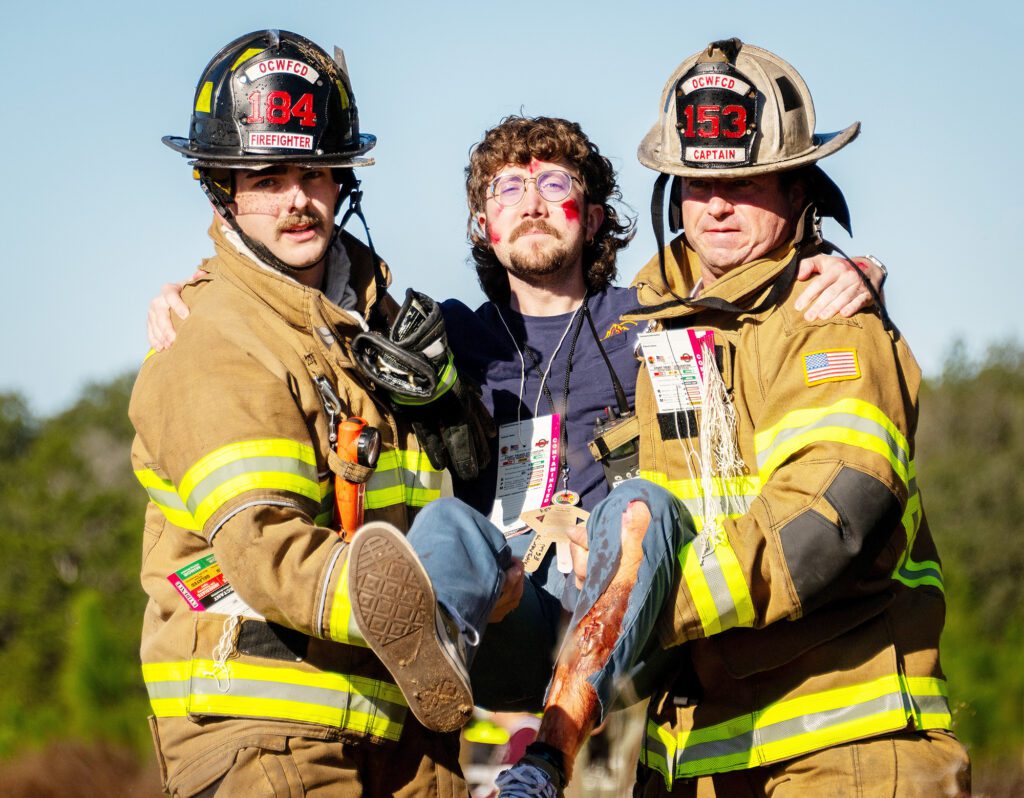
Ocean City-Wright Fire Control District firefighters move a simulated victim during a base and community accident response exercise Dec. 11 near Eglin Air Force Base, Florida. The exercise tested the base, community and airport’s response capabilities to a commercial aircraft crash in the local area. (U.S. Air Force photo by Samuel King Jr.)
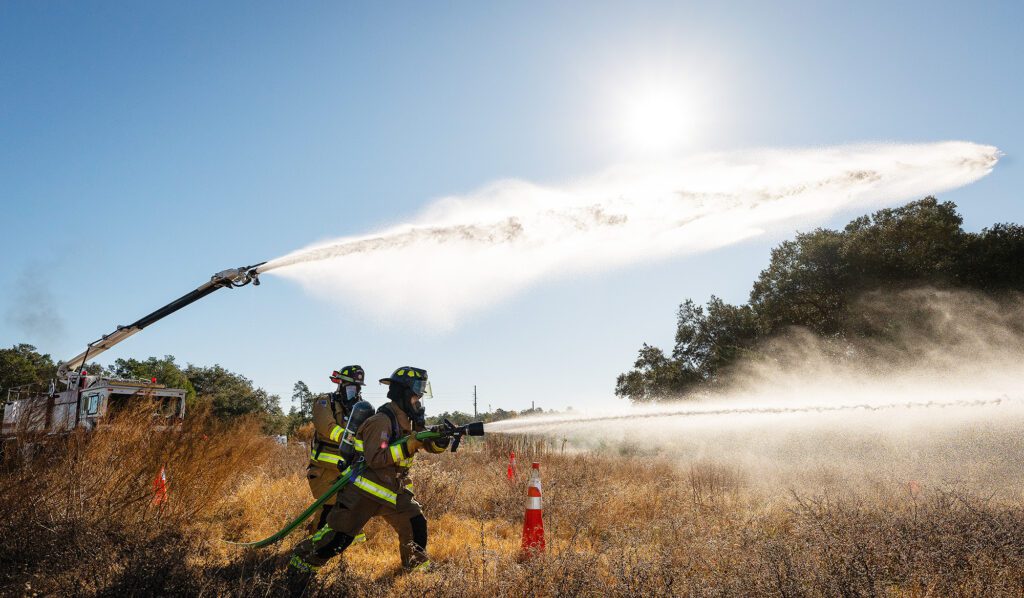
Michael Fularz and Staff Sgt. Dakota Lynn, 96th Test Wing firefighters, spray water at a simulated fire during a base and community accident response exercise Dec. 11 near Eglin Air Force Base, Florida. The exercise tested the base, community and airport’s response capabilities to a commercial aircraft crash in the local area. (U.S. Air Force photo by Samuel King Jr.)

The purpose of the exercise, that took place both on and off base, was to evaluate the wing’s ability to establish and maintain command, control, and coordination with multiple agencies.  It also satisfied the Destin-Fort Walton Beach Airport’s tri-annual review of its emergency action plan.

Air Commandos remember the crew of GUNDAM-22 on first anniversary

By Lucelia Ball

Air Force Special Operations Command Public Affairs

Air Commandos, family, friends, and community members around the world mourned the tragic loss of Maj. Jeff Hoernemann, Maj. Eric Spendlove, Maj. Luke Unrath, Maj. Terry Brayman, Tech. Sgt. Zachary Lavoy, Staff Sgt. Jake Turnage, Staff Sgt. Jake Galliher, and Senior Airman Kody Johnson.

The tragic loss of these Airmen impacted every member within AFSOC. The days and months following their loss were filled with sorrow as intensive search, recovery, and salvage efforts were conducted and the command and loved ones prepared to lay the Air Commandos to rest.

Maj. Jeff Hoernemann was 32 years old and a native of Andover, Minnesota. He served as a CV-22 Instructor Pilot and Chief of Weapons and Tactics assigned to the 21st Special Operations Squadron.

“Jeff was a true leader, SOF warrior and patriot. His character was the benchmark of officership in the United States Air Force. Jeff was the best of us,” said U.S. Air Force Lt. Col. Tyler Oldham, 21st SOS commander in a 2023 release.

Maj. Eric Spendlove was 36 years old and a native of St. George, Utah. He served as a Special Operations Flight Surgeon and Medical Operations Flight Commander assigned to the 1st Special Operations Squadron.

“Eric was an incredible son, husband, brother, and father,” said U.S. Air Force Lt. Col. Christopher Pellegrino, 1st SOS commander in a 2023 release. “Eric’s incredible attributes live on through his children and form his honored legacy in remembrance for those who knew him.”

Maj. Luke Unrath was 34 years old and a native of Riverside, California. He served as a CV-22 Aircraft Commander and Flight Commander assigned to the 21st SOS.

“Luke was a beloved husband, brother, and son, as well as an incredible leader and devout man of faith who embodied the core values,” said Oldham in a 2023 release. “Luke was a natural leader.”

Maj. Terry Brayman was 32 years old and a native of Pittsford, New York. He served as a CV-22 Aircraft Commander with duties at United States Forces Japan as the Deputy Chief of Bilateral Operations assigned to the 21st SOS.

“Terry was a beloved brother and son, as well as a multi-talented officer, skilled aviator, mission commander, and proven leader of teams,” said Oldham in a 2023 release.

Tech. Sgt. Zachary Lavoy was 33 years old and a native of Oviedo, Florida. He served as a Medical Operations Flight Chief assigned to the 1st SOS.

“Zach treasured his fiancé, parents, and brother dearly sharing stories with them no matter where he was in the world. His eternal presence will forever be in the hearts of those he loved,” Pellegrino in a 2023 release.

Staff Sgt. Jake Turnage was 25 years old and a native of Kennesaw, Georgia. He served as a Lead Flight Engineer and Noncommissioned Officer in Charge of Training assigned to the 21st SOS.

“Jake’s humor and zeal were contagious. His magnetic personality was always uplifting and lightened the load of his squadron mates. He loved to fly and to learn. His enthusiasm and positive attitude inspired others every day,” said Oldham in a 2023 release.

Staff Sgt. Jake Galliher was 24 years old and a native of Pittsfield, Massachusetts. He served as a Direct Support Operator assigned to the 43rd Intelligence Squadron, Detachment 1.

“Jacob was a beloved husband, father, son, and brother as well as a model Airman who will be forever remembered for his dedication to this great nation and his fellow warriors,” said U.S. Air Force Maj. Gilbert Summers, 43d IS, Detachment 1 Commander in a 2023 release.

Senior Airman Kody Johnson was 32 years old and a native of Cincinnati, Ohio. He served as a CV-22 Special Missions Aviator and Unit Deployment Manager assigned to the 21st SOS.

“Kody was a beloved son, brother and uncle as well as an outstanding Special Mission Aviator. Kody brought energy and focus into the organization. His knowledge, skill and attention to detail inspired competence and trust amongst his fellow aircrew,” said Oldham in a 2023 release.

These eight Airmen exemplified the Air Commando ethos through their leadership, dedication, professionalism and passion. Their spirit lives with AFSOC everyday as the command remains laser focused on ensuring Air Commandos are a professional force, ready to execute any mission asked of them.

Nov. 29, 2023, serves as a powerful reminder of the sacrifices made by military personnel and their families in service to the nation.  We will never forget these Air Commandos. We will never forget their families and loved ones. We will honor them always as we operate any place, anytime, anywhere.

ACC leaders visit command’s sole C2 wing

By Deb Henley

505th Command and Control Wing Public Affairs

As ACC’s only operational command and control wing, the 505th CCW is responsible for ensuring initial and advanced C2 training, exercise execution, testing and experimentation, and developing tactics, techniques and procedures.

“The business of today is deterrence,” Wilsbach said. “It’s clear that the 505th Command and Control Wing has embraced and is running with that mentality.”

The 505th CCW is integrating initial and advanced C2 graduates, Blue and Virtual Flag exercises, Agile Combat Employment, and testing and experimentation, into future iterations of Bamboo Eagle to deliver combat capabilities the Air Force needs in the era of Great Power Competition.

“They are providing 400-level training to the joint force and coalition partners by integrating the challenges of Agile Combat Employment and the synchronization of multi-domain effects in a combat-representative live, virtual, and constructive environment – of the scope and scale of a high-end conflict with China,” Wilsbach said.

COMACC emphasized the importance of exercises like Bamboo Eagle, that test all-domain combat power generation from disaggregated basing locations and provided an opportunity for Airmen to prepare ahead of an upcoming series of Air Force-level exercise that will provide unique opportunities to integrate various forces into joint, coalition, and multilateral training.

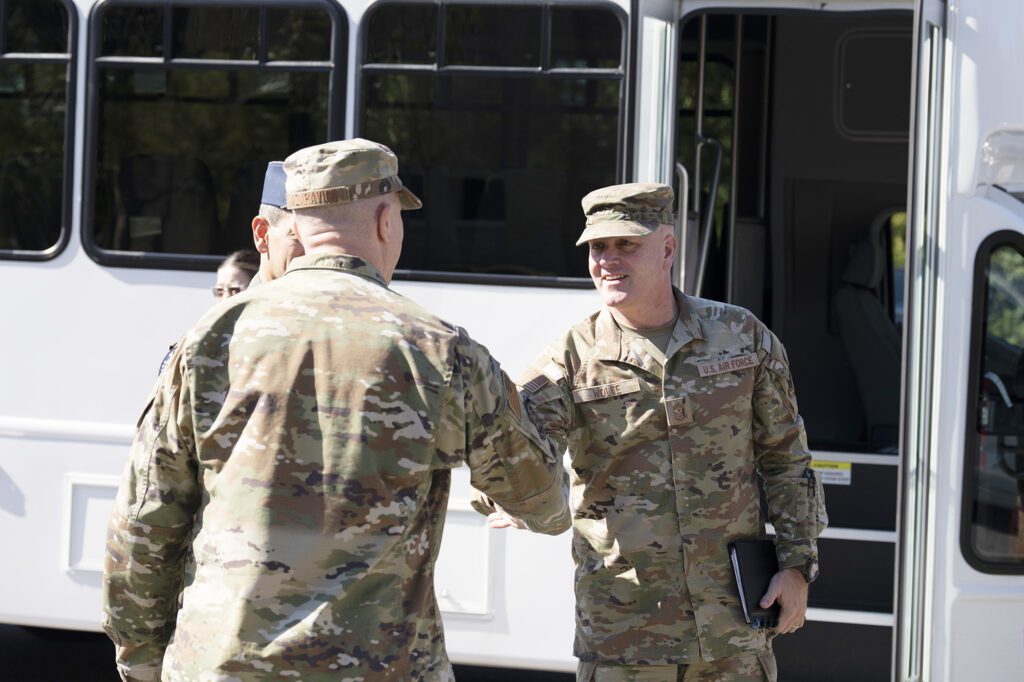
U.S. Air Force Col. Frank Azaravich, 505th Command and Control Wing deputy commander, welcomes Chief Master Sgt. Dave Wolfe, command chief of Air Combat Command, to the 505th CCW at Hurlburt Field, Florida, Nov. 14, 2024. The mission of the 505th CCW is to accelerate command and control and battle management through integrated experimentation, testing, training, and tactics development.

“ACE is more of a mindset and, fundamentally, it’s something our Airmen do every day,” Wolfe said. “Do what you need to do for your specialty, then look up and out at what’s going on around you – what impact might make everybody’s life easier at the end of the day – and do it.”

Wilsbach and Wolfe also used the day to recognize the hard work and dedication of Airmen, highlighting the importance of their contributions to the Air Force and the nation.

Speaking at an all call, Wilsbach underscored the significance of creating dilemmas for our adversaries through ACE.

“ACE changes the way we train and exercise,” Wilsbach said. “Rather than being satisfied with where we are, we will stretch our goals, take measured risks, and do what needs to be done. We don’t fail.”

Highlighting ACC’s motto of “Mission First, People Always,” the command team took the time to meet with the Exceptional Family Military Program’s Neurodiversity Team, Air Force Special Operations Command Women’s Initiative Team, Emerald Coast Exceptional Families, Military and Family Readiness Center, Child Development Center/Youth Center, and Base Housing, to find out how Hurlburt is fostering spouse inclusivity and family wellness.

Gov. DeSantis awards additional $2.1 million to Florida’s military-supporting infrastructure

“Florida is committed to investing in our military’s capacity and in military communities,” said Governor Ron DeSantis. “These funds continue my mission of making Florida the most military-friendly and veteran-friendly state in the nation.”

Since 2019, Governor DeSantis has awarded nearly $6.3 million to Florida’s military communities through this program.

“Under the leadership of Governor DeSantis, Florida is continuing to support critical projects that further strengthen military readiness,” said Secretary of Commerce J. Alex Kelly. “These awards will have impacts across the state, building on past investments and further cementing the bond between our defense communities and military installations.”

The Defense Reinvestment Grant Program to local governments or economic development organizations that represent a local government with a military installation. Organizations and local governments in Santa Rosa and Okaloosa counties are amongst those given awards.

Awards through the Defense Reinvestment Grant Program include:

  1. One Okaloosa Economic Development Council ($122,500) – to implement strategies that support and protect local military installations, missions, and ranges, and to assist in diversifying the military dependent economy with Science Technology Engineering and Math (STEM)-based industry and job growth.
  2. Bay Defense Alliance ($90,530) – to leverage the volunteer talent of Bay Defense Alliance and its community partners to continue development of existing missions and pursuit of new, next-generation defense missions.
  3. Orlando Economic Partnership ($250,000) – to support military technology development and small business involvement in Live, Virtual, and Constructive simulation projects.
  4. Economic Development Commission of Florida’s Space Coast ($106,500) – to develop a Wastewater Treatment Plant Phase 3 plan for Cape Canaveral Space Force Station to include targeted funding resources for infrastructure improvement.
  5. Pensacola-Escambia Promotion and Development Commission ($250,000) – to develop advanced facilities to accommodate existing and future cyber assets adjacent to Corry Station.
  6. Bay County ($220,000) – to create an Area Development Plan for the Barefoot Palms property located adjacent to Naval Support Activity Panama City.
  7. Santa Rosa County Board of County Commissioners ($250,000) – to fund a master plan to guide a land swap between the county and the Navy on a current outlying landing field.
  8. Clay County Economic Development Corporation ($230,000) – to leverage the opportunities created by the construction of the First Coast Expressway and local assets.
  9. Tampa Bay Defense Alliance ($85,353) – to continue development of a defense community organization inventory to assist community leaders in coordinating and directing limited resources to support regional defense needs, improve awareness, minimize redundancy, and solve problems.
  10. Miami-Dade Beacon Council ($250,000) – to diversify the economy around Homestead Reserve Air Base by supporting small and mid-sized companies diversify their client base, secure the needed partners, and access the technical assistance needed to ensure their long-term viability.
  11. Pinellas County Board of County Commissioners ($250,000) – to fund professional services to assist Pinellas County in creating redevelopment specifications for a former U.S. Department of Energy weapon’s site now known as the Young-Rainey STAR Center.

Bivouac exercise tests missions support group’s rapid deployment capabilities

By Airman 1st Class Raul Mercado

The 1st Special Operations Mission Support Group tested readiness for combat and humanitarian missions during their annual bivouac exercise by simulating real-world contingencies in austere environments.

This year’s exercise underscored the role of agile combat employment concepts: rapid airpower projection, contingency operations and the necessity of integrated, cross-unit cooperation to ensure mission success.

“Bivouac tests our ability to build up air bases, to operate an airfield and to facilitate that forward airfield,” Capt. Justin Jacobs, 1st Special Operations Force Support Squadron sustainment services flight commander and officer in charge during the exercise said. “To maintain air dominance or global superiority, military forces need the capability to project air power for that anywhere.”

A bivouac exercise is a field training where personnel simulate living and working in forward operating conditions, often involving the construction of temporary facilities under realistic deployed environments to test readiness and operational capabilities.

The 1 SOMSG Airmen practiced skills such as airfield construction, medical response and maintaining base security. It offered an environment for participants to apply their skills in a simulated yet realistic scenario.

“This is the first time MSG as a whole really had all hands-on deck for all of the units to participate,” Jacobs said. “It’s a good cross-organizational opportunity for us to learn each other’s field capabilities.”

Jacobs added the exercise served as proof of concept, demonstrating they could meet leadership expectations and build a bare base capable of projecting power. It also tested participants’ ability to respond quickly under pressure. For the 1st Special Operations Wing project manager, a highlight came when the team had to put on Chemical, Biological, Radiological and Nuclear gear during a simulated attack.

“CBRN is a huge thing that MSG does as a whole when we respond to an attack,” said the 1 SOW project manager. “It’s not just defensive fighting positions fighting back. When we hear incoming indirect fire or an explosion, all MSG participants in this exercise are putting on their CBRN gear.”

The exercise illustrated the Air Force’s commitment to maintaining a highly trained and adaptable force. By simulating real-world challenges, it demonstrated the Air Force’s readiness to respond to combat and humanitarian needs, while projecting air power globally.

“This bivouac is a prime example of how we’re training for the future and how we develop our United States Air Force as a whole,” said the 1 SOW project manager. “It’s a new capability–small teams making big impacts.”


919th SOAMXS begins new chapter with local ceremony

By Staff Sgt. Dylan Gentile

919th SOW Public Affairs

Maj. Loren Chargualaf took the reins as squadron commander and the responsibility of leading an organization of 182 Traditional Reservists and Air Reserve Technicians from across seven specialties.

This is the first time aircraft maintenance for the 919th SOW is no longer performed at Duke Field, Fla.

“To the men and women of the 919th SOAMXS, what an honor it is to serve with you ,” said Chargualaf. “We must become the experts so we can get our fellow 919th operators flying these aircraft and, in turn, support our Active Duty partners.”

Chargualaf is accountable for training and equipping combat-ready Airmen to maintain the AC-130J Ghostrider aircraft for Air Force Special Operations Command.

Chargualaf’s career spans 11 assignments, four of which took place at Hurlburt Field. She hails from Mishawaka, Indiana, and graduated from the U.S. Air Force Academy in 2013.

Col. Todd Rushford, 919th Special Operations Maintenance Group commander, presided over the ceremony and handed the unit guidon off to Chargualaf. After receiving the guidon from Rushford, the Mishawaka, Ind., native received the ceremonial first salute from a formation of 919 SOAMXS Airmen.

“This is a significant milestone in the 919 SOW’s history and a very visible reflection of the transformation taking place to ensure our value proposition to AFSOC’s operational mission,” said Col Rushford. “Our goal is to be the mission partner of choice for our Active-Duty teammates here at Hurlburt Field. We do that first and foremost by taking care of our people. I know Major Chargualaf’s experience and vision will help us usher in this new era keeping with the standard of excellence that has been the hallmark for aircraft maintenance for more than 50 years.”


error: Content is protected !!