Please ensure Javascript is enabled for purposes of website accessibility
Skip to main content
Advertisement

TrophyCatch Florida: Angler catches two Hall of Fame, one trophy bass

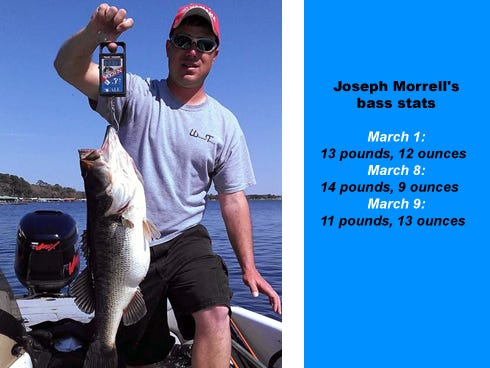
Joseph Morrell's 11-pound, 13-ounce bass was properly documented with a photo of the entire fish (head to tail) on the scale, with the weight visible, and then released at Kingsley Lake.

Joseph “Brooks” Morrell of Bradford County recently reported three huge bass that he caught, documented, released and entered in the Florida Fish and Wildlife Conservation Commission’s TrophyCatch program.

These included the second and third Hall of Fame entries for the program’s second season (Oct. 1, 2013 to Sep. 30, 2014). The bass weighed 13 pounds, 12 ounces and 14 pounds, 9 ounces and were caught March 1 and 8, respectively.

The third bass he caught on March 9 weighed 11 pounds, 13 ounces.

All three of his trophy bass were caught sight-fishing with a soft-plastic Berkley crawfish bait on Lake Kingsley in Clay County.

Morrell grew up fishing in Florida and then spent six years in the U.S. Air Force security forces prior to returning to Florida to become a law enforcement officer in Bradford County.

On March 1, he located the 13-pounder on a bed guarded by a male. After working the male off the bed, he landed her using the artificial crawfish bait and called the FWC. Conservation officers Jason Bryant and Christiane Larosa were able to help measure the bass and even photographed its successful release, which allowed it to return to the bed.

A week later, Morrell was back on Kingsley Lake and landed the 14-pounder. It was 27.75 inches long with a 21-inch girth.

Various formulas used for estimating bass weights (available on the FWC website) project a bass with those dimensions would be between 13.5 and 16.2 pounds, further substantiating the catch. This is now the biggest bass of TrophyCatch season two, and Florida is right in the middle of peak fishing time for big bass – so the challenge is on.

“Fishing has been awesome this spring,” Morrell said. “I’m so glad that I could get these documented and then release the females alive right back on their beds."

TrophyCatch is the FWC’s premier angler-recognition program that encourages anglers who catch largemouth bass over 8 pounds to photo-document them on a scale showing the entire fish and its weight. Once documented, a fish must be live-released in the same water system from which it was caught.

In return for documenting and releasing these big female bass that typically are at least 8 years old and relatively rare, the FWC’s partners provide valuable rewards. FWC posts the images on the TrophyCatch Florida website and provides a full-color certificate and club decal. Corporate partners provide additional incentives including the following:

•Lunker Club (8-9.9 pounds): $100 in gift cards from Bass Pro Shops, Rapala and/or Dick’s Sporting goods, and a club T-shirt from Bass King Clothing.

•Trophy Club (10-12.9 pounds): $150 in gift cards from Bass Pro Shops, Rapala and/or Dick’s Sporting goods, and a long-sleeve club shirt from Bass King Clothing.

•Hall of Fame (13 pounds or heavier): Free fiberglass replica from New Wave Taxidermy ($500 value), $200 in gift cards from Bass Pro Shops, Rapala and/or Dick’s Sporting goods, and a duffle bag and custom hoody, with other goodies, from Bass King Clothing.

•The biggest bass of the year also receives a TrophyCatch championship ring from the American Outdoors Fund, and if the winning bass is from one of the major lakes in Osceola County, Experience Kissimmee adds a $10,000 check.

However, for many anglers more than the value of the rewards or the bragging rights associated with the program, the biggest thrill is releasing their catch to fight another day and knowing the information provided about the catch helps the FWC ensure trophy bass for future generations. Information reported to TrophyCatch is used by the FWC to determine what management programs such as habitat enhancement, aquatic plant management, fish stocking or regulations are most effective. Moreover, the information is very valuable for promoting Florida bass fishing, which generates significant economic benefits to local communities and encourages additional angling –including getting more youth involved.

For more information, visit the Trophy Catch website and follow them on Facebook.

This article originally appeared on Crestview News Bulletin: TrophyCatch Florida: Angler catches two Hall of Fame, one trophy bass


University of Florida students get $557K grant to fund obesity prevention

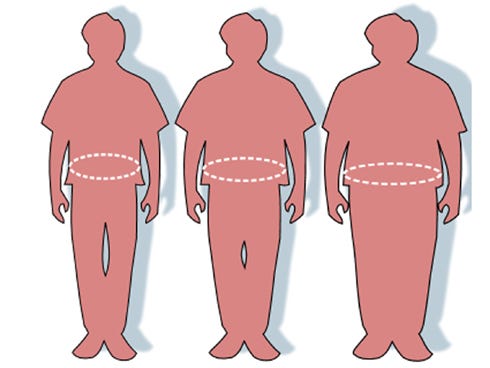
University of Florida students will create obesity prevention programs for their peers and for high school students as part of a federal research and extension grant.

The “Get Fruved” campaign will use peer interaction to get high school and college students to eat more fruits and vegetables, exercise more and manage stress more effectively.

UF will receive $557,000 for the project. The money, from the U.S. Department of Agriculture’s National Institute of Food and Agriculture, comes in one-year increments, and UF will start receiving its share in August, school officials said.

Starting in August, students at eight college campuses, including UF, will develop ways to get younger students to adopt healthier lifestyles. Students will dress as fruits and vegetables, use social media and use information from www.fruved.com.

They also may expand gardens, work to improve access to healthy foods at campus eateries, hold dance events and challenge each other to exercise more.

This article originally appeared on Crestview News Bulletin: University of Florida students get $557K grant to fund obesity prevention

Women learn do-it-yourself tips during automobile maintenance clinic (PHOTOS)

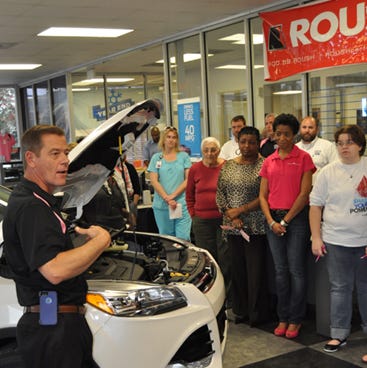
Hub City Ford consultant Brad Schaefer speaks to women about vehicle maintenance on Tuesday during "Heels and Wheels," a North Okaloosa Medical Center-Healthy Woman event.

CRESTVIEW — Destinie McCara is 13, but she's already learning mechanic work so she's ready when it's time to drive.

For that, she can partially credit Hub City Ford and North Okaloosa Medical Center employees and Tuesday's "Heels and Wheels" automobile maintenance clinic.

PHOTOS: See 12 photos from the event here>>

Kimberly Davis said she wants her daughter to know the basics. 

"I wanted (Destinie) to know how to change her tires and change her fluids before she starts driving," Davis said. "I think it is very beneficial for every child to learn how to change a tire or check their oil … because a tow truck could take (up to) three hours to get there."

Destinie said she learned how to change a flat tire and what to look for when replacing brake pads and checking vehicle fluids. 

Car problems will happen, she said, adding, "I'd rather do the manual labor than have to spend money."

Ford Motor Company employees and representatives taught attendees how to check tire pressure and change tires, and how to use roadside assistance, among other helpful tips.

"We are trying to dispel the myths that auto care facilities are taking advantage of women," said Dion Stakley, the dealer's parts and services director, one of several employees who answered questions from 30 attendees. "To help prevent that is to empower women on the maintenance process."

EmailNews Bulletin Staff Writer Matthew Brown, follow him on Twitteror call 850-682-6524.

This article originally appeared on Crestview News Bulletin: Women learn do-it-yourself tips during automobile maintenance clinic (PHOTOS)

‘Prisoner of Second Avenue’ continues through March 15

Tom Mosley of Freeport, front, Sheila Johnson of Crestview, Danielle Valdez of Navarre and Naomi Campagne of Crestview are in the cast of “The Prisoner of Second Avenue," which continues tonight and tomorrow at Northwest Florida State College.

NICEVILLE — One of Neil Simon’s most well-known comedies will be presented tonight and tomorrow at the Mattie Kelly Arts Center's Sprint Theater stage in Niceville.

“The Prisoner of Second Avenue,” presented by Northwest Florida State College’s Fine & Performing Arts Division, begins at 7:30 p.m. each night.

In the play, main character Mel Edison is a well-paid executive of a high-end Manhattan firm, which has suddenly hit the skids — and he gets the ax. His wife, Edna, takes a job to tide them over; and then she too is sacked.

Compounded by air pollution killing his plants, and with the apartment walls being paper-thin, allowing him a constant earful of his neighbors' private lives, things can’t seem to get worse.

But then they do.

Tickets are $15 for adults and $10 for youths age 18 or younger. NWFSC students receive one free ticket at the box office with valid college ID.The box office will open at 6 p.m. each show night for remaining tickets, subject to availability.

This article originally appeared on Crestview News Bulletin: ‘Prisoner of Second Avenue’ continues through March 15

Here's how you can vacation on a budget

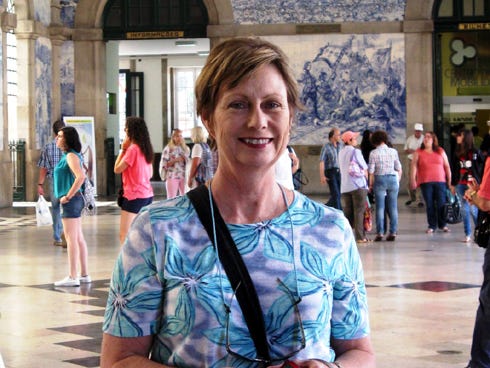
University of Florida Institute of Food and Agricultural Sciences Extension agent Elaine Courtney — pausing in Porto, Portugal's central train station, during a 2013 trip through the Iberian Peninsula — says that taking public transportation is one way to maximize vacation dollars.

CRESTVIEW — Residents don't need to go bankrupt to have fun, memorable vacations, University of Florida Institute of Food and Agricultural Sciences Extension agent Elaine Courtney said.

By planning a budget, saving for a vacation, checking Internet bargains, vacationing at home or traveling off season, travelers can maximize their vacation for minimal dollars, she said.

Saving toward a trip months in advance can save thousands compared to charging it to a credit card, said Courtney, who works in the Extension's Crestview office.

For instance, the average family's vacation costs $1,600; if charged to a typical credit card, it would take 14 years to pay off making minimum payments, and would cost $3,500 with interest, she said.

Adequate vacation planning also is essential for a stress-free get-away, taking the most advantage of limited vacation days, Courtney said during a March 4 presentation at the Crestview Public Library.

Visiting the library for planning tools such as travel guides and atlases, especially if planning international travel, can help, she said.

Vacationers with limited budgets might consider a vacation at home, also called a "staycation."

"Most of us like to go on vacation, doing and seeing new things, but the dollars are limited," Courtney said. "We want to get the most vacation we can for the least amount of money."

Visiting local museums, free or inexpensive state parks and beaches, attending library or church-organized lectures and activities, and canoeing on local rivers offer cheap, fun daytrips, she said.  

Email News Bulletin Staff Writer Brian Hughes, follow him on Twitter or call 850-682-6524.

This article originally appeared on Crestview News Bulletin: Here's how you can vacation on a budget

GONE COASTAL: Florida's sailfish offers on-the-water excitement

Florida Fish & Wildlife Commission employee Justin Lerner fishes for sailfish.

Sailfish hold a special place in many Florida resident and visitor’s hearts. Whether they’ve admired a replica of the beautiful fish while waiting for a fresh-caught meal at a local restaurant, or felt their blood pump as one leapt into the air on the other end of a fishing line, the fish known for its tall “sail-like” dorsal fin is a Florida icon.

Though you can find the highly migratory species in warm offshore waters around the globe, sailfish are so abundant off the coast of Florida and so popular with people it was made the state’s official saltwater fish in 1975.

Between its aesthetic beauty and its penchant for fighting, sailfish are a recreational favorite.

Like bonefish or tarpon, two of Florida’s other iconic fishes, the sailfish has a higher value as a recreational catch-and-release species than it does as a commercial food fish. The meat is tough and is rarely eaten unless smoked.

I sat down with coworker, Florida Fish and Wildlife Conservation Commission biologist and sailfish fan Justin Lerner to find out a little more about the appeal of fishing for sailfish.

“It’s very exciting fishing, especially when using a kite,” Lerner said, describing a fishing method where an actual kite is used to dangle bait at the top of the water, enticing the sailfish to take the bait right before your eyes. “It is a very fast, very acrobatic fish with a lot of energy.”

Lerner caught his first sailfish in 2000 on an offshore charter trip and was instantly hooked (my apologies for the pun).

While they are typically caught in water 80 to 240 feet deep, sailfish, unlike other billfish, can be found in fairly shallow water and, though not common, have even been caught off piers in south Florida and in the northern Gulf of Mexico near Panama City.

Look for color changes in the water, Lerner said, and fish along them. When the water goes from an inshore green to a deep blue you are in the right spot.

Sailfish can be caught in every region of Florida, but they are more abundant in south Florida in the colder months, from October through March.

“Cold fronts drive bait south, and fish run an interception,” Lerner said.

In areas of north Florida and the Panhandle, such as Panama City, they are more abundant during the summer and fall months.

Sailfish have been regulated in state waters at least since 1988, when a possession limit of one billfish per person was implemented, sale was prohibited, and gear was restricted to hook and line.

Today, there is a recreational bag limit of one billfish per person. Billfish includes blue marlin, white marlin, roundscale spearfish and sailfish. This means you can catch and keep one only billfish species per person, per day. There is no daily bag limit in federal waters for sailfish.

When fishing in federal waters, a federal Highly Migratory Species angling permit is required. Federal waters are beyond 3 nautical miles in the Atlantic and beyond 9 nautical miles in the Gulf.

While technique varies, one of the most popular ways to catch them is by kite fishing with live bait, usually goggle eyes or blue runners. Other popular techniques are slow trolling with live ballyhoo, or trolling with hookless bait and teasers and casting to fish as they appear in the trolling spread. Other popular live baits are threadfin herring and pilchards.

Hooked a sailfish? Once you get your fish to the boat, use caution. The long and pointed bill can be dangerous when attempting to unhook the fish. Lerner suggests holding the fish in the water by the bill while unhooking. Another option is cutting the line as close to the fish as possible. When release is your intention, leave the fish in the water at all times. Removing large fish from the water can cause internal damage to the fish and decrease its chances of survival. In all federal waters off Florida, a sailfish must remain in the water if you intend to release it.

While the species fights hard, it can tire and may need to be revived if you plan on releasing the fish. Use the appropriate tackle to shorten the amount of time it takes to bring your catch to your vessel. You can revive a sailfish by pointing its head into the current or pulling the fish through the current while the boat is moving slowly. This pushes water over the gills.

While most sailfish are caught and then released, if you plan on keeping yours, the sailfish caught in state or federal waters must be larger than 63 inches when measured from the end of the lower jaw to where the tail splits, also known as the fork.

Sailfish do not have a recreational closed season in state or federal waters.

All sailfish and other billfish caught in state and federal waters that are taken to shore or landed must be reported to National Oceanic and Atmospheric Administration Fisheries with 24 hours by calling 800-894-5528 or visiting the HMS permits website's Landing Reports page.

Learn more about billfish, including sailfish at the FWC's Highly Migratory Species webpage.

Have questions, comments or suggestions for this column? Email them to Saltwater@MyFWC.com.

Gone Coastal is one of many ways that the Florida Fish and Wildlife Conservation Commission Division of Marine Fisheries Management is helping recreational anglers understand complex saltwater regulations and learn more about saltwater fishing opportunities and issues in Florida. To contact the FWC’s Regulatory Outreach subsection call 850-487-0554 or email the above address.

This article originally appeared on Crestview News Bulletin: GONE COASTAL: Florida's sailfish offers on-the-water excitement

North Okaloosa schools raise nearly $15K for cancer research

Editor's Note: This report is part of the News Bulletin's ongoing series on cancer-research fundraisers. The newspaper is proud to support Relay For Life Crestview, which will take place 6 p.m. April 25 at Shoal River Middle School.

CRESTVIEW —  North Okaloosa schools are raising money for the American Cancer Society Relay for Life in April.

Several schools have Relay For Life teams, which have organized multiple fundraisers with teachers, faculty and students' help.

Davidson Middle School's team, which has raised more than $9,000, collected most of the funds from last month's Davidson Dash 5K/10K, which nabbed more than $7,000, team captain Daniel Richards said. The team also had a yard sale and monthly faculty luncheons.

Baker School's team met a $4,000 goal following T-shirt sales, December's Santa Shop and selling caramel covered apples, team chair Janice Roberts said.

Northwood Arts and Science Academy has raised $1,800 from monthly teachers luncheons, Kacy Kellogg said. 

This will be Bob Sikes Elementary School's 13th year of involvement, Christi Collinsworth, the school's team captain, said.

Through T-shirt sales, benefit luncheons, a school dance and a Yankee candle fundraiser, Bob Sikes has collected nearly $1,000 of its $8,000 goal, she said. Starting April 7, students can donate pocket change to wear a hat or chew bubblegum.

Riverside Elementary School has raised more than $900 toward its $2,000 goal, team captain Amber Johns said. Staffers made donations to wear jeans on early release Thursdays, and students can participate in a March 20 "mini Relay" and an April 12 Relay For Life pageant.

New participant Southside Center has raised $65, according to team captain Becky Kannapel.

She said the school will organize several benefit luncheons for teachers and staff to increase that amount.   

WANT TO GO?

WHAT: Crestview Relay For Life

WHEN: Begins at 6 p.m. April 25

WHERE: Shoal River Middle School, 3200 E. Redstone Ave. 

EmailNews Bulletin Staff Writer Matthew Brown, follow him on Twitteror call 850-682-6524.

This article originally appeared on Crestview News Bulletin: North Okaloosa schools raise nearly $15K for cancer research

FISH BUSTERS' BULLETIN: Bream destinations great for kids

Virtually all of Florida’s fresh waters are brimming with bream, which include bluegill, redear sunfish, redbreast sunfish and spotted sunfish.

These sporty little fish are many a kid’s first catch, introducing them to a lifetime of fishing fun. They provide great opportunities for shoreline fishing using simple cane poles or spinning rods. License-free freshwater fishing weekends are a great time for adults to introduce kids to fishing and see if they and you would like to take up the sport.

The Florida Fish and Wildlife Conservation Commission (FWC) schedules the first of four license-free recreational freshwater fishing days on the first full weekend in April each year (April 5-6 this year), because it is such a productive fishing time, and the weather is usually pleasant. Many of Florida’s recreational sport fishes, such as black bass, bluegill and redear sunfish, move into the shallows to spawn during spring, making them more available for anglers to catch.

During license-free freshwater fishing weekends (the first weekend in April and the second weekend in June) no recreational fishing license is required; however, all other bag limit, season, gear and size restrictions apply on these dates for recreational fishing. The FWC invites you to take this opportunity to take your family, friends and colleagues fishing.

Children don’t need a fishing license until they are 16, but parents may buy them one at any time and they won’t expire until they are 17. This helps the FWC attain additional revenue from the Federal Aid in Sportfish Restoration program to improve their fishing and gives the child pride in belonging to the angling community.

Fishing is a low-cost, wholesome form of entertainment that often pays for itself with healthy food for the table. An annual license is only $17.50 for residents.

To further encourage recreational fishing, the FWC will conduct a special contest during April to collect photos of anglers. All you have to do is post a photo of your family fishing in Florida’s fresh waters on Twitter or Instagram with #FWC-FamilyFishing. In return for your efforts, the FWC will enter your name into a drawing for one of six surprise packages, each including a $50 gift card, compliments of Bass Pro Shops and TrophyCatch, and another $50 worth of assorted fishing lures, hooks, line and goodies to make your next trip even more productive.

Submitted photos must be your own, unedited pictures, and the photo must not include inappropriate content. Photos should be taken during April while freshwater fishing in Florida and include multiple anglers enjoying their day together on the water. The FWC may subsequently use the photos for outreach purposes.

In addition, freshwater anglers are encouraged to participate in the Big Catch angler-recognition program. All you need to do is catch one of 33 species of freshwater fish that exceed a specific length or weight, go to BigCatchFlorida.com, fill out some information and post a photo. Besides getting to share the excitement of your catch on the Internet, you’ll receive via email a custom certificate to print, and a discount for SportsmanOnCanvas.com.

Big Catch encourages anglers to try different species and locations, by recognizing different levels of achievement: Master Angler (five different qualifying Big Catch species), Elite Angler (10 different qualifying Big Catch species) or Specialist (five qualifying fish of the same species). It is fun and challenging for the entire family.

Here are some tips to make your bream fishing more successful. During spring, sunfish congregate to spawn in water depths from 3 to 10 feet. Bluegill continue to spawn periodically throughout summer. Bluegill opt for slightly shallower areas than redear sunfish, but it’s not unusual to see them use the same bedding areas simultaneously. Crickets, grubs, sand maggots or grass shrimp will all catch bedding bluegill. Use a small hook, #6 or #8, with a split-shot sinker about 6 inches up the line, and concentrate on water less than 6 feet deep. A small float helps identify strikes. For artificial baits, a 1/8-ounce “beetle spin” with a white or chartreuse body on ultralight tackle is an excellent choice. Your local bait and tackle shop can quickly help you find what you need.

The redear sunfish, or shellcracker, is another popular panfish. Although they prefer snails and clams, redear sunfish are caught most often on earthworms around the full moon in March and April, when spawning peaks. Redear prefer hard-bottom habitat and typically begin spawning about one month before bluegill. In south Florida, shellcracker spawn as early as late February and will likely begin bedding in the Panhandle around the end of May, depending on water temperatures. Shellcracker continue spawning into August.

Redbreast sunfish, also known as river bream and redbellies, are the flowing water cousins of bluegill. Redbellies are more common in rivers than bluegill, and often can be found in backwater areas with less flow. The same baits that work for bluegill will catch redbreast sunfish.

The spotted sunfish, or stumpknocker, is an often overlooked stream panfish. Aptly named, stumpknockers can be found in the tangle of roots at the water’s edge. Although spotted sunfish rarely exceed 8 inches, these feisty species provide great sport on light tackle. Tiny (1/16-ounce) beetle spins pitched close to shore can be deadly, particularly tipped with freshwater clam meat.

With a fishing hole within 30-45 minutes of almost everyone in Florida, the hardest part might be picking your destination. Although your neighborhood pond or a local park may be your best bet, FWC biologists created a list of some major public water bodies they think should be great bream fisheries this year. For full descriptions of the sites, access to them and specific fishing tips for these locations, see the FWC Sites & Forecasts web page.

Bob Watterndorf is a columnist for Florida Fish & Wildlife Conservation Commission. For more Fish Busters columns, visit the FWC website and select News/Monthly Columns. Instant licenses are available at on the FWC website or by calling 888-FISH-FLORIDA (347-4356). Report violators by calling 888-404-3922, *FWC or #FWC on your cell phone, or texting or emailing Tip@MyFWC.com.

This article originally appeared on Crestview News Bulletin: FISH BUSTERS' BULLETIN: Bream destinations great for kids

Men's health issues are hot topics for March 20 Lunch and Learn

Dr. Rick Weaver will speak at a March 20 Lunch and Learn program on "Men's Mealth." The public event is sponsored by the Crestview Area Chamber of Commerce's Health and Wellness Committee.

CRESTVIEW — Men's health issues, including testicular cancer, prostate cancer, colo-rectal cancer, alcoholism, hypertension, skin cancer and cholesterol are on the agenda for the Crestview Area Chamber of Commerce Health and Wellness Committee's March 20 Lunch and Learn.

The importance of examinations for cancer forms common to men, including how to conduct self-examinations for some of them, will be emphasized, presenter Dr. Rick Weaver said.

Testicular cancer is one of the least discussed forms of the disease and is "highly treatable when diagnosed early," but is often ignored by men because of denial and embarrassment, he said.

And colo-rectal cancer is the second leading cause of cancer deaths among men and women, Weaver said.

"More lives are lost each year to colorectal cancer than to AIDS and breast cancer combined," Weaver's presentation materials state.

The Lunch and Learn will begin with a free lunch provided by Publix supermarket followed by Weaver's presentation. The program will conclude with a questions-and-answers period.

"We try to leave some time for questions, although because of  the nature of the topic, some on the committee are concerned there may be some reluctance," chamber President Dennis Mitchell said.

To avoid participants having to ask embarrassing questions aloud, Mitchell said that he and committee chairwoman Dr. Pam Meadows will solicit questions prior to the talk and pull them randomly.

Email News Bulletin Staff Writer Brian Hughes, follow him on Twitter or call 850-682-6524.

This article originally appeared on Crestview News Bulletin: Men's health issues are hot topics for March 20 Lunch and Learn

All Okaloosa beach monitoring sites pass water quality tests

FORT WALTON BEACH — All Okaloosa County parks lack potentially hazardous bathing water, the Florida Department of Health in Okaloosa County stated this week.

Lincoln Park, Valparaiso; Poquito Park, Shalimar; Fred Gannon Rocky Bayou State Park, Niceville; Liza Jackson Park and Garniers Park, Fort Walton Beach; Gulf Islands National Seashore, East Pass, Emerald Promenade, Marler Park and Wayside Park, Okaloosa Island; and Clement E. Taylor Park, Henderson Beach and James Lee Park, Destin, passed tests based on EPA-recommended enterococci standards.

Enteric bacteria’s presence indicates fecal pollution from stormwater runoff, pets and wildlife or human sewage.

Call 689-7859 or 833-9247 for more information. 

This article originally appeared on Crestview News Bulletin: All Okaloosa beach monitoring sites pass water quality tests

error: Content is protected !!