Please ensure Javascript is enabled for purposes of website accessibility
Skip to main content
Advertisement

Crestview Prayer Network plans local praying event

CRESTVIEW — The Crestview Prayer Network will have another "Praying in the Parking Lot" event.

The group will meet to pray for the U.S. at 6 p.m. Oct. 13 in the parking lot of Central Baptist Church, 951 S. Ferdon Blvd., Crestview. 

The Bible encourages the church to pray in 2 Chronicles 7:14: "If my people, who are called by my name, will humble themselves and pray and seek my face and turn from their wicked ways, then I will hear from heaven, and I will forgive their sin and will heal their land."

This event is open to everyone in the community.

This article originally appeared on Crestview News Bulletin: Crestview Prayer Network plans local praying event

HAPPENINGS: Here are some more jobs that don't require a degree

Looking at the huge amount of debt many students have when they graduate from college has me thinking of all the jobs and careers available that don't require a four-year college degree or even a masters degree.

Many students or their parents have an approximate debt of $32,000 to $50,000 for a four-year degree. If one went to a prestigious college, that debt could be well over $100,000. For instance a four-year degree from Yale would cost approximately $300,000 with no financial aid or scholarships. A four-year degree from Stanford would cost about $288,000 and the University of Southern California is approximately $300,000 for a four-year degree.

As one can see, a four-year degree from these prestigious institutions could have a huge financial impact to either a student or their family. Many people buy houses that cost less than these.

It is no wonder that many students are pursuing careers that don't require an expensive degree. We looked at a few careers last week, and here are more suggestions.

In many cases, specific classes, certificates or exams are required for the position, but not a bachelor's degree or a four-year commitment.

Many of the best salespeople I have met throughout my life have not had four-year college degrees. What seems to be required is personality and interest in the product being sold.

I'm sure you've heard the old saying, "he could sell ice in the frozen north." Most successful salespeople are very extroverted, love people and love to share their passions with others.

Real estate agents can make excellent commissions. One must take real estate classes and then pass an exam in order to receive a license to sell.

Because real estate agents depend upon commissions, the compensation received can vary from state to state. An agent can make from $40,000 per year to over $100,000 per year.

This can be a lucrative career that would only take a few months of studying before getting a license. Of course, a first year agent won't make as much money as an experienced agent (https://www.forbes.com/sites/andrewdepietro/2019/01/28/real-estate-agents-salary-state/#76f44b703e58).

Many classes required for certificate or licensing programs can be taken from one's own computer.

Another lucrative career is that of an air traffic controller. This is a very stressful job, but from what I've been told, it is also a fulfilling career. A high school diploma and job experience are required, as well as an air traffic control tower operator certificate.

 About 20 percent of air traffic controllers have a four-year degree. Many air traffic controllers learn this skill in the military. The average salary of an air traffic controller is $120,000 per year.

Janice Lynn Crose

Other careers that don't require an expensive four-year degree are:

•insurance claims adjusters.

•auto insurance appraisers.

•IT specialists.

•website developers.

•mail carriers and postmasters.

•payroll or accounting clerks.

•commercial pilots.

These are just a few of the jobs that are available, not just here in Crestview but all over the country. These jobs provide a good living and don't require a huge amount of debt to enter the career.

More SEPT. 2020: HAPPENINGS: Potential careers for high school grads and others

More SEPT. 2020: HAPPENINGS: Stay safe, physically and financially

Think about what you'd like to do with your life and discuss all the options with your parents, school counselor and even your friends. If you find a job you think you'd like, talk with people in that position and ask for the good and bad about the job.

I hate to think of anyone having to pay back $50,000 or more in student loans. I will let you know of some relatively inexpensive ways to get a four-year degree here in Northwest Florida.

Janice Lynn Crose, a former accountant, lives in Crestview with her husband, Jim; her two rescue collies, Shane and Jasmine; and two cats, Kathryn and Prince Valiant.

This article originally appeared on Crestview News Bulletin: HAPPENINGS: Here are some more jobs that don't require a degree

EXTENSION CONNECTION: Learn how to save storm-damaged trees

Questions concerning storm damaged landscapes continue. This article includes information that should be helpful.

Partially uprooted small trees and shrubs should be securely staked in their original positions. Until plants are reset, protect exposed roots and prevent drying. Soil, moist burlap sacks or moist sphagnum moss can be put on exposed roots. Remove damaged roots so the tree can be reset at ground level.

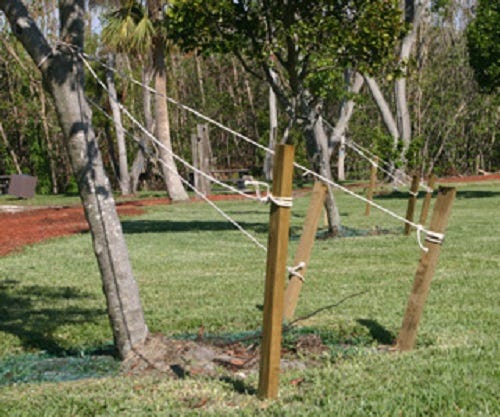
This tree has been tied to stakes for support.

Once reset, trees should be secured. Two or three 4-foot long, 2×2 inch wood stakes can usually anchor trees with trunk diameters less than two inches. Stakes should be placed about a foot outside root ball and inserted eighteen inches into soil. Secure stakes to trunk with ties made from wide, smooth material or hose-covered wire.

Trees two inches or larger in diameter should be guyed with three or four wires or cables. Guy wires are secured to deeply driven short stakes evenly spaced outside the root ball. Guy wires should be run through rubber hose and secured to trunk at only one level. Mark support wires with bright materials to prevent accidents.

Guy wires should be adjusted several times during growing season to minimize trunk injury. Support stakes and wires should stay in place for one year.

Soil should be filled around root area once tree is staked into position. Firm around roots to eliminate air pockets and provide support. Excess soil over the normal root area can be damaging. Only replace soil that has been washed or worked away from roots.

In cases where all branches were destroyed, remove the tree, especially trees such as pine that do not normally regain their natural form. You may be able to keep other trees such as oaks, where strong bottom limbs still exist. However, emerging sprouts from ends of large, cut limbs will be poorly secured to the tree and are likely to fall from the tree during a storm. In addition, decay organisms usually enter these large wounds. Trees and shrubs that lost their leaves from high winds can usually be saved and should resume growth.

Any tree work, including tree removal should be done by a professional arborist, preferably a certified arborist. To find a certified arborist in your area contact the International Society of Arboriculture (ISA) at 217-355-9411 or at www.isa-arbor.com. You also may contact the Florida Chapter of ISA at 941-342-0153 or at www.floridaisa.org.

Reset plants should be watered twice a week and fertilizer should not be applied. Until re-established, fertilizer will be of no benefit and may injure new roots.

For additional information, visit http://sfyl.ifas.ufl.edu/disaster-prep-and-recovery or contact the UF/IFAS Extension Office in your county.

Larry Williams is a UF/IFAS Extension Agent in Okaloosa County.

This article originally appeared on Crestview News Bulletin: EXTENSION CONNECTION: Learn how to save storm-damaged trees

EXTENSION CONNECTION: 4 ways to prevent food spoilage after a power outage

Just a few days ago, Hurricane Sally made her presence be known in Okaloosa County. Although she was not as strong as her predecessors Ivan and Opal, she took her time and did her fair share of damage to homes and left thousands flooded and without power.

One primary concern during a storm or flood is power outages. Without power, we lose access to many amenities, including air conditioning, hot water, and refrigeration for our food. I am often asked how do we know food is safe after a power outage. Like most things, your best defense to prevent foodborne illness and food waste is a good offense.

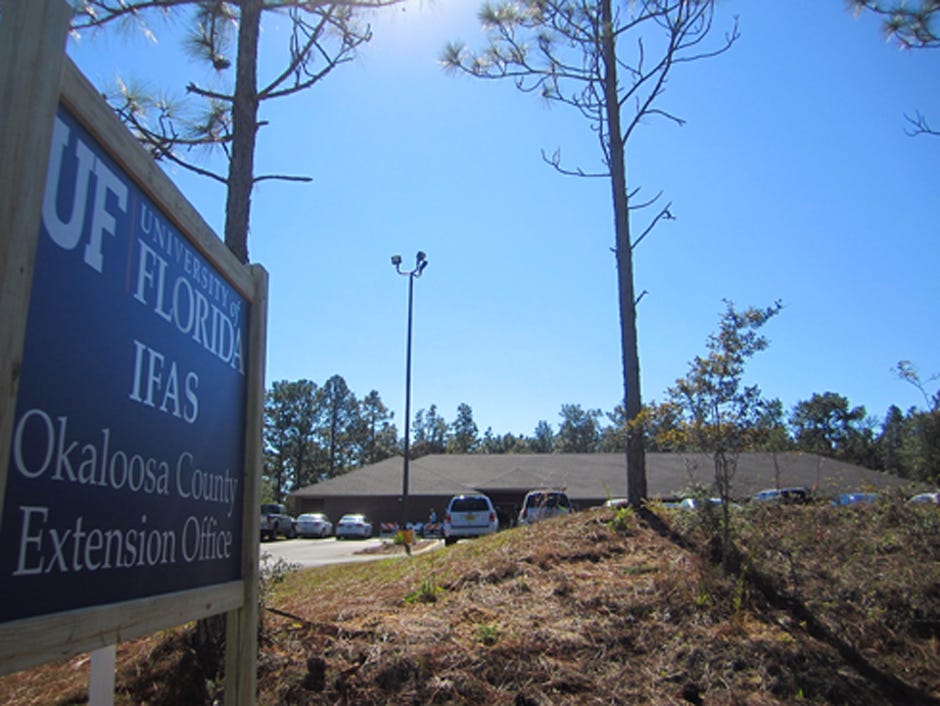
The University of Florida Institute of Food and Agricultural Sciences Extension Office for Okaloosa County is located in Crestview.

 Here are a few ways to prevent food spoilage after a power outage:

1) Keep your freezer at 0 degrees Fahrenheit and your refrigerator at 40 degrees or below. You can ensure these temperatures by purchasing appliance thermometers and monitoring them. These are generally available at local grocery or retail stores for around $5. 

2) Keep frozen items grouped together so that they keep themselves cold. Put containers of frozen water or gel packs in the refrigerator to maintain a cold temperature.

3) Minimize how many times you open the refrigerator or freezer; cold air can be lost quickly and can not be replaced in a power outage. A full freezer can hold its temperature for 48 hours and a fridge for four hours.

4) When in doubt, throw it out. Never taste food to help determine if it is safe; you cannot see or taste some types of severe foodborne causing bacteria, spores, or toxins. Tasting spoiled food can cause serious health issues leading to hospitalization or even death.

According to foodsafety.gov, in the case of flooding, move nonperishable foods onto higher shelves to avoid wet floors and water. Discard any damaged food, i.e., wet food, food on the floor, food that hasn’t been stored in waterproof containers, food kept in cardboard containers, home-canned foods, and any food stored in containers with holes, denting, swelling, or leakage.

Remember to sanitize cooking and serving utensils such as pots and pans and silverware. Also, sanitize any undamaged metal cans after you remove the labels. Mark the type of food on these cans and the expiration dates; this can be done with a permanent marker.

Making your own sanitizing solution can be done by mixing 1 tablespoon of household bleach to 1 gallon of water. Be sure to label any container you use to store this solution.

Food waste and food spoilage can be a costly effect of a power outage or flood. Make sure food safety is in your future storm plan so that you minimize the cost of food loss and prevent foodborne illness.

Jill Breslawski

For more information, please contact Family and Consumer Science Agent Jill Breslawski, with the UF/IFAS Okaloosa County Extension, at 850-612-9700 or jbreslawski@ufl.edu.

Jill Breslawski is an agent at the University of Florida's Institute of Food and Agricultural Sciences Extension office in Crestview.

This article originally appeared on Crestview News Bulletin: EXTENSION CONNECTION: 4 ways to prevent food spoilage after a power outage

HAPPENINGS: Potential careers for high school grads and others

There are many careers these days that pay well and need people to choose them. With all of the attention on a college degree, the trades and the skills required for those trades have been left behind.

Our country has a shortage of electricians, plumbers, qualified air conditioner and heater repairmen, auto mechanics, machinists, pharmacy technicians, security managers, warehouse managers, and medical billing specialists, as well as handy persons.

Janice Lynn Crose

While all of these jobs require training and specific knowledge — and in some cases, working as a journeyman to get experience — they pay well and won't cost tens of thousands of dollars to get started.

For instance, a good car mechanic can learn some needed skills by helping others work on their vehicle, changing the oil, brakes and so on. Classes can be taken at a trade school. Then Automobile Service Excellence (ASE) offers many certifications for mechanics, from engine repair, suspension, transmission, brakes and so on.

Once the classes are completed, the mechanic must pass a test on what was learned. Each specialty has its own test to receive certification. A beginning auto mechanic can start between $15 to $18 per hour. The median income for a mechanic is $60,000 per year. This all varies with years of experience, certifications, the shop and so forth. Some of the top mechanics make $90,000-plus per year. An auto shop owner can make more than that.

Electricians are very much needed. Basic requirements are a high school education and then enrollment in a trade/technical school to learn the basics of the electrician's job. Then one applies to become an apprentice electrician, with a master electrician teaching all the needed skills.

An apprenticeship is basically on-the-job training. It takes four to five years of being an apprentice before you can become a fully licensed electrician. In most states an exam is required before the electrician's license is granted. There are many skills required to be an electrician, particularly an aptitude for math, as well as how to read blueprints.

A beginning apprentice starts at around $11.77 per hour, with the median salary being $27.01 per hour. Top electricians can make over $46 per hour, which translates to $95,680 per year. Obviously if one becomes an electrical contractor and owns their own company, the sky could be the limit.

Plumbers also make good money. As with electricians, one would need to enroll in a trade/technical school for about a year, then become an apprentice plumber. The process takes about five years and then the plumber's exam will be required before the state or other government agency will grant your license.

Apprentice plumbers start at about $15.14 per hour, with the median salary for a licensed master plumber between $48,000 to $75,000 per year. If one opens their own business, then the amount of money that can be made is much higher. 

One doesn't need to go to college and incur a huge debt in order to make a good living. So think about these careers when deciding upon your future.

Janice Lynn Crose, a former accountant, lives in Crestview with her husband, Jim; her two rescue collies, Shane and Jasmine; and two cats, Kathryn and Prince Valiant.

This article originally appeared on Crestview News Bulletin: HAPPENINGS: Potential careers for high school grads and others

FROM THE PULPIT: Do justice, love kindness and walk humbly, Part 2

Micah 6:8 states, “He has told you, O mortal, what is good; and what does the Lord require of you but to do justice, and to love kindness, and to walk humbly with your God?” (New Revised Standard Version)“He has told you, O mortal, what is good; and what does the Lord require of you but to do justice, and to love kindness, and to walk humbly with your God?” (Micah 6:8 New Revised Standard Version)

In my last column I spoke about the first requirement of our Lord in this passage: to do justice. The second requirement is do love kindness.

DO NOT USE as of 02/15/21

Recently I have been hooked on watching short video clips online.  Which ones catch my eye the quickest?  Those that depict people helping one another in various types of trying circumstances, people rescuing cats or dogs from deplorable situations and helping resurrect the joyful, playful puppy or kitten they were intended to be, and those showing animals that are supposed to be natural enemies getting along and caring for and about one another.

Acts of kindness. Stopping what you are doing for just a brief moment to help make another’s difficulty easier with which to cope.

The videos of people rescuing animals and doing whatever it takes to rehabilitate them shows a kindness of heart.  These folks go above and beyond to help save the life of a helpless or fearful animal.

And those videos that show cats and owls playing together, adult dogs taking care of orphaned kittens and vice versa, a chicken who took care of kittens, a deer playing chase with a large dog.  What a joy to watch and ponder, “Why can’t people be more like that?”

The videos depicting people helping one another in difficult situations speak to me.  I find it moving that a large, athletic, scary looking man stops what he is doing to help the proverbial little old lady across the street, or the one showing a woman helping a tearful little girl find her lost mother in the large mall.

A picture I saw bears a mention. Two little girls, an African–American and a Caucasian, came across each other in a mall.  They were wearing the same little dress with the same cartoon hero on them.  With their arms around each other’s shoulders in a “this is my buddy” stance, one girl declared to her parent, “Look Mom!  We’re twins!”

I love that sentiment. Why?  Because both girls saw what made them the same, not what made them different.

Yes, we human beings could learn a thing or two from kind animals.  Differences that we allow to separate us need to be overlooked and ignored.  We need to look at a need and fill it, not at a person and try to determine if they are worthy enough of our involvement.

We are required by God to love kindness because it is good.  My next column will take a look at the third requirement – to walk humbly with your God.

The Rev. Mark Broadhead is pastor at Laurel Hill Presbyterian Church and First Presbyterian Church of Crestview.

This article originally appeared on Crestview News Bulletin: FROM THE PULPIT: Do justice, love kindness and walk humbly, Part 2

From the Pulpit: Do justice, love kindness and walk humbly, Part 3

Micah 6:8 states “He has told you, O mortal, what is good; and what does the Lord require of you but to do justice, and to love kindness, and to walk humbly with your God?” (New Revised Standard Version)

For the past couple of weeks I have been sharing some thoughts on what the prophet Micah has directed us to do in that scripture: do justice, love kindness, and today, to walk humbly with our God.

As challenging as the first two requirements are, this third one is even more challenging. This is because people want to serve God, but only in an advisory capacity.

For a moment, let’s try something in your imagination. Let’s imagine God has come to earth to walk with you in your favorite place. God has no agenda but to spend time with you.

DO NOT USE as of 02/15/21

Ask yourself how you feel in the presence of God. Do moments of silence cause you to feel ill at ease, so you prattle on to fill the silence? Do you tell God about all the great and wonderful things you have accomplished thus far in your life?

Or do you humble yourself, knowing that God knows all about your “terrific” accomplishments already? Do you realize God also knows about your failures as well, that he knows you better than you know yourself? Are you able to let yourself be real with God, not having to prove anything, not having to earn his love?

During your walk with God, are you able to let him know that you know you have had failures, but those failures have helped you grow in positive ways? Are you able to state unequivocally that you love God, and say it to his face? Are you able to thank God for the grace and mercy he has shown toward you throughout your whole life?

Humility is acknowledging you are not perfect; acknowledging you are the same as everyone else; acknowledging that God went above and beyond to secure for you a wonderful life worth living, and an afterlife that will be forever in his presence.

Yes, each of us is showered by God’s blessings. But this is reason for awe, not boasting. It is a reason for humility and not bragging. It is a reason for humbling yourself before the greatness and goodness of God.

Yes, we are called to do justice, to love kindness, and to walk humbly with God.

The Rev. Mark Broadhead is pastor at Laurel Hill Presbyterian Church and First Presbyterian Church of Crestview.

This article originally appeared on Crestview News Bulletin: From the Pulpit: Do justice, love kindness and walk humbly, Part 3

EXTENSION CONNECTION: WOLF program provides outdoor education, leadership

Environmental education can be a very broad topic. The study of how living organisms interact within their environment can be very complicated, especially when we factor in the human element. An Okaloosa County 4-H program called Wildlife Outdoor Leadership Focus (W.O.L.F.) was created to address the human dimension of natural resources.

Basically, this is a youth conservation program dedicated to making participants aware of the importance of natural resources recreation, and to apply the art and science of natural resource management. W.O.L.F. has three main objectives.

Objective 1 Learn the Importance of Natural Resources

Ronnie Cowan

The W.O.L.F. program starts by explaining why these natural resources are important. For example, outdoor activities such as hunting, fishing, boating and wildlife viewing contribute over $25 billion to the state of Florida. People are very passionate about their outdoor activities. Florida hunters average nearly $3,000 per person on hunting expenditures per year! Our state has a vast stakeholder interest. Nearly 6 million people participate in wildlife/fisheries activities every year in Florida. The L in W.O.L.F. stands for leadership. Local, state, and federal leaders make important decisions every year regarding natural resource management. Teddy Roosevelt, our 26th President of the United States, established 230 million acres of public land for all to enjoy. Government still protects many of our natural resources today. Florida is home to 175 state parks.

Objective 2 Apply Theory and Practice Conservation 

W.O.L.F. participants receive hands-on practice of being a conservationist. The program teaches 4-H members the science and art behind wildlife management. Florida 4-H has a virtual Wildlife Outdoor Leadership Focus (W.O.L.F.) Day Camp were youth can learn at their own pace. The camp has five sections: Woods and Fields, Freshwater, Saltwater, Survival, and Biologist life. Each day has videos and activities that offer up a daily challenge. W.O.L.F. campers learn about wildlife/plant identification, and what specific wildlife species need to survive. Furthermore, we show youth how our actions, intentional or unintentional, affect the environment we live in. the virtual day camp also covers basic biology of mammals, birds, fish, and reptile. Participants are encouraged to go out with adult supervision and see what’s going on in the great outdoors.

The University of Florida Institute of Food and Agricultural Sciences Extension Office for Okaloosa County is located in Crestview.

The final activity is the wildlife challenge where campers must be a wildlife biologist for a day. 4-H members are given a scenario with three wildlife species that the landowner wants to manage for on a piece of property. The camper must evaluate the property based on the requirements that the three wildlife species need in order to survive. The camper completes a wildlife management plan. They look at the best management practices given to them during the course and decide if the property is habitat for the desired wildlife species. If it is not, they must offer a solution. For example, the landowner wishes to have more northern bobwhite quail on the property, but the land is covered in mature hardwoods. The campers are expected to make a recommendation. They learned that quail need shrubs, native grasses, and forbs.

Objective 3 Career Development and Multi-Science Approach

The W.O.L.F. program is also intended to spark awareness about the professionals who work with our natural resources. Participants virtually meet biologists, wildlife officers, and other natural resource professionals. Each career video will explain how they help our environment. Campers will get to see what it would be like if they had their jobs. The program does not just stop with wildlife and fisheries science careers. The program explains many more sciences. 4-H members will learn about soil science, forestry, engineering, math, agriculture, and technology to name a few. The only thing your youth will need is a love for the outdoors. If you are interested in W.O.L.F. Camp please reach out to your local 4-H Agent. The W.O.L.F. Program will also be available as a virtual project In Okaloosa.

Ronnie Cowan is the 4-H Director at the University of Florida's Institute of Food and Agricultural Sciences Extension office in Crestview.

This article originally appeared on Crestview News Bulletin: EXTENSION CONNECTION: WOLF program provides outdoor education, leadership

EXTENSION CONNECTION: These are the 3 steps to successful food plots

When people put in food plots and are not successful, I normally see the following three problems as the causes. 

First, they didn’t consider soil pH or fertility. Second, they didn’t choose the right plant varieties for our area. Third, they didn’t manage weeds properly or at all. 

Following these three steps can help establish a successful food plot.

The University of Florida Institute of Food and Agricultural Sciences Extension Office for Okaloosa County is located in Crestview.

1. Soil pH and fertility

Often wildlife enthusiasts ignore soil pH and fertility. If the soil pH isn’t right, fertilization is a waste of time and money. 

Different plants have different needs. Some plants need more phosphorus than others. Some need more iron or zinc or copper. The availability of these elements not only depends on whether they are present in the soil but also on the soil pH. 

"Test, Don’t Guess!" It takes a week or two to get the full soil sample results back and costs only $10 per sample. That’s a pretty cheap investment to insure a successful food plot. 

This clover food plot has an exclusion cage added to show the amount of forage that has been eaten.

2. Variety selection

Cool season food plots are generally used as attractants for hunters. They do provide some nutrition for the wildlife as well. The goal is to select forages that are desirable to the animals, as well as use forages and varieties that grow well in our area. 

Some great choices include oats, triticale, clovers, daikon radish and Austrian winter peas. We recommend a blend, because it extends the length of time that forages are available to the animals, as well as decreased risk of food plot failure. 

For more information on recommended cool season forages, go to https://edis.ifas.ufl.edu/ag139.

3. Weed management

Often tilling the food plot prior to planting is enough to manage most weeds. This is OK when you have native weeds on relatively flat land. If erosion is an issue or if more problematic weeds such as cogongrass are present, a different weed management strategy is recommended. 

Glyphosate is a good choice as it is a broad spectrum herbicide that will not negatively affect the food plot. Spray the area with glyphosate 3-4 weeks prior to planting to give it time to kill the weeds. 

Also, remember that many herbicides are not effective during droughts, so we either need to wait until we have rainfall or work with your extension agent to find a solution that will work for your situation.

These three steps are crucial to successful food plots. 

First, get your soil pH right and then fertilize properly. Next, choose the right forages and varieties to plant. Then control the weeds so they don’t choke out your food plots. The next step is to enjoy this hunting season. 

For more information on wildlife food plots, you can contact your local county extension agent.

Jennifer Bearden

Jennifer Bearden is an agent at the University of Florida's Institute of Food and Agricultural Sciences Extension office in Crestview.

This article originally appeared on Crestview News Bulletin: EXTENSION CONNECTION: These are the 3 steps to successful food plots

HAPPENINGS: Stay safe, physically and financially

As if dealing with COVID-19 wasn't enough, we are dealing with the aftermath of hurricanes and watching for potential hurricanes.

Make sure you keep your gas tank full, have plenty of canned food, water and pet food on hand and keep your prescriptions filled in case we get a hurricane. Hurricane season runs through Nov. 30.

We are also dealing with criminals trying to perpetuate scams that take advantage of the vulnerable among us.

Now that Medicare has given different numbers out for medical insurance, don't provide your Social Security number unless there is a very good reason for it.

Your number is needed to open a bank account, get a loan, file your taxes, for employment and some other financial transactions.

It is not needed by your doctor, the hospital, pharmacy or other medical facility. If someone demands your Social Security number, ask them why they need it and it if isn't for a legitimate reason, don't give it to them.

Years ago, Jim took me to an urgent care in Fort Walton Beach as I needed a prescription for physical therapy. The women working the front desk were extremely rude and condescending. They told me that I wouldn't be seen unless I gave them my Social Security number.

When I asked why they needed it, their answer was, "We might need to sue you." We had good insurance and paid the co-pay at the time of service, so I knew they were doing something underhanded. Always be on your guard.

Remember, if an investment or arrangement seems too good to be true, it undoubtedly is a set-up to part you and your hard-earned money.

Before you invest in anything, talk over the details with your family and trusted friends, and ask for references from the person making the sale. Many times your family will bring needed information to the table — which may keep you from having your money stolen.

Janice Lynn Crose

While we have the desire to help those affected by Hurricane Laura, please give through your church or a reputable charity such as the Salvation Army, Samaritan's Purse or others.

Don't give out your credit card information to anyone that calls soliciting relief money for families affected by the hurricane.

Someone calling and claiming they are with a certain charity may be looking for a quick buck by stealing your credit card or banking information. Keep your personal information safe. Don't carry your Social Security card in your wallet.

Remember that the Social Security office doesn't call and claim that your number will expire if you don't verify it with them. The IRS doesn't call and ask for payment with iTunes gift cards or any other type of gift card.

Scammers can fake their caller ID, making it look as though they are legitimate.

If you are the victim of a crime such as these or any others, please call the Crestview Police Department at 850-682-2055 or the Okaloosa County Sheriff's Department at 850-689-5650.

Janice Lynn Crose, a former accountant, lives in Crestview with her husband, Jim; her two rescue collies, Shane and Jasmine; and two cats, Kathryn and Prince Valiant.

This article originally appeared on Crestview News Bulletin: HAPPENINGS: Stay safe, physically and financially

error: Content is protected !!