Please ensure Javascript is enabled for purposes of website accessibility
Skip to main content
Advertisement

Here's your chance to win Imagine Dragons tickets and support cancer research

CRESTVIEW — Last December, Lindsea Taylor won a prize any Imagine Dragons fan would love to have.

"The prize included free tickets for her to all of the concerts in their tour this year," her mother, Carissa Taylor, said. "We are not able to use them all, so with the permission of the band and the help of Shoal River Middle School, we are raffling two tickets to the Tampa concert."

The Tampa concert, part of the Las Vegas-based indie rock group's "Smoke + Mirrors" tour, is scheduled for 7 p.m. July 10 at the Amalie Arena, according to the band's website. 

The drawing — which runs through Wednesday, June 3 — is open to all Shoal River Middle students, parents and faculty.

Tickets are $5; proceeds benefit the American Cancer Society's Relay For Life and the Tyler Robinson Foundation.

"We'd love to see tons of donations come in for cancer!"  Carissa said.

Imagine Dragons — which includes Dan Reynolds, Daniel Wayne Sermon, Ben McKee and Daniel Platzman —perform chart-toppers including "Radioactive" and "Demons."

Tickets are available at Shoal River Middle School, 850-689-7229.

This article originally appeared on Crestview News Bulletin: Here's your chance to win Imagine Dragons tickets and support cancer research

Niceville park receives advisory for hazardous water

FORT WALTON BEACH — An Okaloosa County park may have potentially hazardous bathing water, the Florida Department of Health in Okaloosa County stated this week.

Fred Gannon Rocky Bayou State Park, Niceville, rated "poor," failed tests based on EPA-recommended enterococci standards.

Three parks,   WaysidePark, Okaloosa Island; Poquito Park, Shalimar; and Clement E. Taylor Park, Destin; rated "moderate" on the scale.

Enteric bacteria’s presence indicates fecal pollution from stormwater runoff, pets and wildlife or human sewage.

Call 689-7859 or 833-9247 for more information.

This article originally appeared on Crestview News Bulletin: Niceville park receives advisory for hazardous water

1 year later: Crestview's Drew Barefield is almost recovered

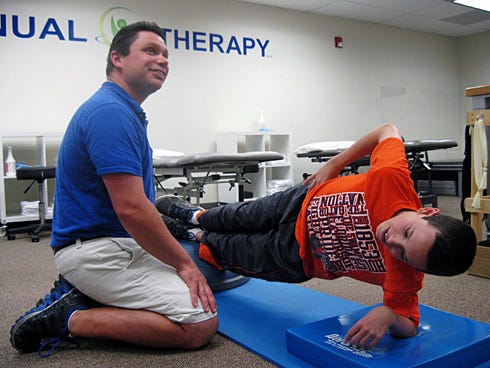
“I hate these,” Drew Barefield said of side plank exercises as his physical therapist, Dan Foradori, watched the clock. Drew had to hold the position for 30 seconds before switching sides.

CRESTVIEW — Last summer, signs around town asked passersby to “pray for Drew.”

This summer, the 13-year-old's family is seeing the power of those prayers, his mom, Wendy Barefield, said. “He’s a miracle, that’s for sure,” she said.

An errant boater struck Drew while he snorkeled June 28, 2014 in Choctawhatchee Bay. Recovery has been hard, but now he can run around and play.

Watch video of Drew Barefield during physical therapy>>

See photos from Drew's physical therapy session>>

Twice a week — now down from three times — he receives physical therapy to strengthen his limbs and muscles at Manual Therapy in Crestview.

“The thing about Drew is he just never gives up,” physical therapist Ruth Jenkins said. “He keeps pushing and pushing.”

It’s not always easy, nor fun.

“I hate these,” Drew said Tuesday as physical therapy assistant Dan Foradori positioned equipment for side planks. The teen kept his body rigidly off the floor, his elbow on a cushion and his legs raised on a flat-sided balance ball.

BEING A TEENAGER

Since Drew’s return home Sept. 23, he’s gained 20 pounds and grown an inch, his mom said. Through therapy he’s lost a limp.

“On days when his parents caught him limping, we’d give him extra stuff (exercises) he really hated doing to break him of it,” Foradori said.

Therapy now targets Drew’s endurance, and his efforts are paying off. After a day of bicycle and scooter riding last week with friends, he shared a welcome milestone with his mother. “He said, ‘Mom, it felt so good to just be outside and playing and not be tired,’” Wendy Barefield said.

ENCOURAGING OTHERS

Drew’s progress hasn’t just benefited his body and his family’s spirits. His therapists said he encourages other patients. “Especially when they come here right after surgery, they see him and they’re like, ‘Is that Drew? Well, I can do that, too!’” Jenkins said.

Drew set a goal to keep pushing himself through physical therapy. On his accident's anniversary, he wants to run a mile. “We were hoping that by the summer he’ll be back to normal, and it looks like he’s going to make it,” Wendy Barefield said. “He really wants to start running again.”

“He’s come a long way. He really has,” Foradori said. “It’s night and day from where he was. It’s nice to see it.”

Drew will be discharged from therapy “really soon. Then he’ll be ready to be a regular teenager,” Jenkins said. “He’s really worked hard,” she said. “It’s like he’s been given a super strength to persevere. Most other kids wouldn’t have done this well. God’s got him in his hands. It’s incredible.”

“It’s tough,” Drew said. “You’re tired when you leave (therapy) and you’re sweaty when you leave, but it’s worth it.”

Email News Bulletin Staff Writer Brian Hughes, follow him on Twitter or call 850-682-6524.

This article originally appeared on Crestview News Bulletin: 1 year later: Crestview's Drew Barefield is almost recovered

Crestview doctoral graduate analyzes low fertility rate findings

MANHATTAN — The number of childless women in the United States is at an all-time high, according to new research from Kansas State University, which suggests it may be due to the country's economic downturn.

Recent data from the U.S. Census Bureau's Current Population Survey found that nearly half of women between ages 15 and 44 are childless.

That's the highest percentage since the Census Bureau started measuring it in 1976.

Previous research has found that an individual's early environment is critical to defining their fertility intentions, but there is little research on how changes in the country's current environment affect those fertility intentions.

ENVIRONMENT'S ROLE

"There's a life history theory that suggests where you grew up plays a key role in defining your fertility intentions," said Lora Adair, a 2015 doctoral graduate in psychological sciences from Crestview. "Individuals who grow up in a relatively resource-poor, high-mortality environment tend to have more kids at an earlier age — and women in those environments even menstruate sooner.

"People who grow up in a relatively resource-rich, low-mortality environment tend to have fewer kids and at a later age so they can pursue other things like going to college and building an economic, career-based legacy before they have kids."

Adair's dissertation, "Family Planning in Context: Sensitivity of Fertility Desires and Intentions to Ecological Cues," sought to find out how these individuals respond to new information about their environment, and if women's changing economic status gives them more decision-making power when it comes to having children.

EXPERIMENT'S RESULTS

In her research, Adair exposed individuals from different socioeconomic backgrounds to information, suggesting a change in their current environment.

These changes included an increase in mortality rates — seemingly unmotivated homicides — and an increase in economic instability, or an economic downturn.

What she found was somewhat surprising.

"People raised in different environments tend to respond differently to that kind of information," Adair said. "People raised in relatively resource-poor environments indicated they would have more children and have them sooner when presented with information about an increase in mortality rates.

"Contrary to predictions, people raised in resource-poor environments indicated they would have fewer children and delay having children when presented with information that economic conditions have changed for the worse. Those raised in resource-rich environments didn't change their fertility intentions when provided new information."

EQUAL DECISION MAKING

Adair believes these different decision-making strategies may be based on different world perceptions, with those in a lower socioeconomic environment thinking bad conditions are unpredictable and persistent, whereas people in higher socioeconomic conditions recognize the new information as predictable and temporary.

Her research also found no gender difference in fertility decision-making power.

She evaluated 60 couples as they discussed their family planning intentions. She found both men and women equally use concessions, compromise, persuasion, agreement or disagreement when deciding to have children.

"There is a sociological perspective that suggests women's social, economic and political power changes in Western society are leading toward a more egalitarian society and as women gain in this power, the fertility decision moves from being male-dominated to female-dominated," Adair said.

"However, my study shows the power is not shifting hands, but becoming more equal. Men and women were weighing in equally to this big life decision."

INFORMATION MATTERS

As America's dynamics and social structures continue to change, Adair believes these environmental factors contribute to changing fertility desires, and could be contributing to the low fertility rates.

"The information you expose people to matters," she said. "Our fertility intentions aren't necessarily just something you're born with; it's a highly malleable thing that changes in response to whether you grow up in an environment seeing resources as something you can rely on, or in one that sees them as something that's highly variable.

"When you're confronted with new information suggesting your current environment is unreliable, that can completely change the way you see your future in terms of having children."

This article originally appeared on Crestview News Bulletin: Crestview doctoral graduate analyzes low fertility rate findings

Northwest Florida's Covenant Hospice gains $7,500 in support

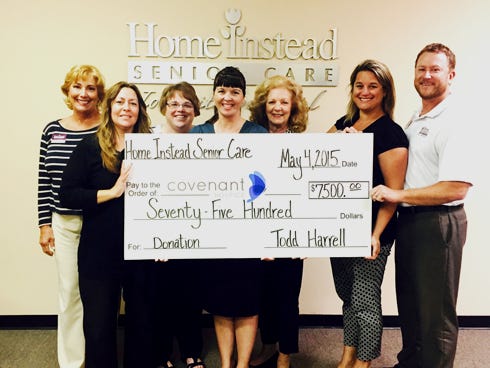
Rachel Mayew of Covenant Hospice, center, accepts a check from the team at Home Instead Senior Care. From the left: Elaine Gates, Tammy Feora, Pam Gemoules, Dee Bocchino, Carly and Todd Harrell.

FORT WALTON BEACH — Covenant Hospice has an extra $7,500 in support following Home Instead Senior Care's recent sponsorship.

Covenant holds several local events including the Cox Charity Auction, Thrive Music Fest, The Blue Jean Ball and Miles of Memories 5K Run/Walk.

“With support from organizations like Home Instead Senior Care and others in our community, we are able to raise funds through these events to offer vital services to patients in our community who are facing the final chapter of life,” development manager Rachel Mayew said.

“Further, we can extend care to anyone in need of our services, regardless of financial status, because of generous community partnerships. Gifts like this one from Home Instead extend well beyond a check, and truly become a precious gift of quality time for individuals with a terminal illness.”

Covenant Hospice is a not-for-profit organization dedicated to providing comprehensive, compassionate services to patients and loved ones during times of life-limiting illnesses.

This article originally appeared on Crestview News Bulletin: Northwest Florida's Covenant Hospice gains $7,500 in support

Crestview Health Center earns national recognition

WASHINGTON, D.C. — The National Committee for Quality Assurance announced that Crestview Health Center has received NCQA Patient-Centered Medical Home Recognition.

The center earned the recognition for using evidence-based, patient-centered processes that focus on highly coordinated care and long‐term relationships. 

The NCQA Patient-Centered Medical Home is a model of primary care that combines teamwork and information technology to improve care, improve patients’ experience of care and reduce costs.

Medical homes foster ongoing partnerships between patients and their personal clinicians, instead of approaching care as the sum of episodic office visits. Each patient’s care is overseen by clinician-led care teams that coordinate treatment across the health care system.

To earn NCQA recognition, which is valid for three years, Crestview Health Center demonstrated the ability to meet the program’s key elements, embodying characteristics of the medical home, according to a news release.

This article originally appeared on Crestview News Bulletin: Crestview Health Center earns national recognition

Free dental X-rays available at Northwest Florida State College

NICEVILLE — Students in the Dental Assisting Program at Northwest Florida State College would like to take X-rays of your teeth — free of charge.

Appointments are available from 8 a.m. to 4 p.m. Monday through Thursday, May 28 to July 2.

If you need dental X-rays, obtain a written request from your dentist. You can save time and have your dentist fax the prescription to 729-6460.

To schedule an appointment or for more information, call 729-6444.

This article originally appeared on Crestview News Bulletin: Free dental X-rays available at Northwest Florida State College

All Okaloosa parks pass water quality tests

FORT WALTON BEACH — No Okaloosa County parks have potentially hazardous bathing water, the Florida Department of Health in Okaloosa County stated today.

No parks failed tests based on EPA-recommended enterococci standards. Enteric bacteria’s presence would have indicated fecal pollution from stormwater runoff, pets and wildlife or human sewage.

Tests are regularly performed at Lincoln Park, Valparaiso; Poquito Park, Shalimar; Fred Gannon Rocky Bayou State Park, Niceville; Liza Jackson Park and Garniers Park, Fort Walton Beach; Gulf Islands National Seashore, East Pass, Emerald Promenade, Marler Park and Wayside Park, Okaloosa Island; and Clement E. Taylor Park, Henderson Beach and James Lee Park, Destin.

All parks had good water quality except for Liza Jackson, which rated at moderate, according to the health department. 

This article originally appeared on Crestview News Bulletin: All Okaloosa parks pass water quality tests

'NOT ONE WORD': Baker mom raises awareness for children's speech disorder

"He cannot speak — not even one word," Christina Sims says of her son, Bentley Lefevre. "I've never heard him say Mom, Dad, bye-bye — not one word. And it's a difficult thing to deal with."

CRESTVIEW — Many parents anticipate hearing their children say his or her first word.

Especially if it's "Mommy" or "Daddy."

Baby's first words usually come within 11 to 14 months after birth, according to Parenting magazine. But some parents, like Christina Sims, have to wait much longer.

The Baker woman's 3-year-old son, Bentley Lefevre, has childhood apraxia of speech, or CAS, a motor speech disorder.

It's not a muscular problem; there's no paralysis.

"The brain has problems planning to move the body parts (e.g., lips, jaw, tongue) needed for speech," the American Speech-Language-Hearing Association's website states about CAS. "The child knows what he or she wants to say, but his/her brain has difficulty coordinating the muscle movements necessary to say those words."

'A DIFFICULT THING'

Sims said her son tested positive for autism, and a Pensacola physician gave a referral for a Gulf Breeze neurologist.

"They read his brain waves while (he was) sleeping and (flashed) a light to see if he had epilepsy," Sims said. "Our test came out normal. He's had an MRI —  normal —  blood work, everything keeps coming back normal."

While medical tests show no abnormalities, Sims' own observations concern her. 

"He cannot speak — not even one word," she said. "I've never heard him say Mom, Dad, bye-bye — not one word. And it's a difficult thing to deal with.

"Then our family and people in our community pass judgment on others, when they should be educated about issues that may surround them, and realize things may go deeper then what they may see."

RAISING AWARENESS

Thursday, May 14 marks Apraxia Awareness Day, according to The Childhood Apraxia of Speech Association of North America, a nonprofit, publicly funded charity.

Sims wants local residents to know about what the Mayo Clinic's website refers to as an uncommon speech disorder.  

"I want to bring awareness to our community about this speech problem in children because it is still little known, very misunderstood, and has a huge impact on kids and families," she said. "These children must work and struggle so very hard just to learn a skill — speaking — that comes effortlessly to other children.

"We need to find ways of supporting children with apraxia and their families because speech therapy, the only proven treatment for apraxia, is quite costly and will extend over many years for these children."

'THE BEST THING FOR HIM'

Although Bentley can't speak, he has his own strengths.

"He can't talk but he can climb a 6-foot chain link fence in a matter of seconds, and I mean seconds," Sims said. "And we are teaching him with picture cards. If he wants something, he flips though a book and shows me what he wants.

"Sometimes, you have to be a mind reader, but I'm getting pretty good at that."

Bentley attends pre-kindergarten class at Southside Center in Crestview, his mother said.

Initially, it was difficult enrolling him there. 

"I was really nervous about sending him to school — how could I send my son away every day and he can't tell me anything, good or bad," Sims said. "But it has been the best thing for him. I love them there."

As time goes by, and as Sims finds resources like Apraxia-kids.org, which offers information and support, she's getting used to everything.

"I've never heard of CAS until last year," she said. "Who would have thought it had a day (dedicated to awareness?)"

Despite the struggles, which include regular doctor's appointments and speech therapy sessions, those resources have been invaluable, she said.

And now, she's coming around to the idea of CAS.  

"It's getting easier for me, too," Sims said.

MORE INFORMATION

Learn more about childhood apraxia of speech at http://www.asha.org/public/speech/disorders/ChildhoodApraxia/.

Email News Bulletin Editor Thomas Boni, follow him on Twitter or call 850-682-6524.

This article originally appeared on Crestview News Bulletin: 'NOT ONE WORD': Baker mom raises awareness for children's speech disorder

Okaloosa parks pass hazardous water tests Monday

FORT WALTON BEACH — No Okaloosa County parks have potentially hazardous bathing water, the Florida Department of Health in Okaloosa County stated this week.

The parks that passed testing include Lincoln Park, Valparaiso; Poquito Park, Shalimar; Fred Gannon Rocky Bayou State Park, Niceville; Liza Jackson and Garniers Parks, Fort Walton Beach; Gulf Islands National Seashore, East Pass, Emerald Promenade, Marler Park and Wayside Park, all of Okaloosa Island; Clement E. Taylor Park, Henderson Beach, and James Lee Park, all of Destin.

Enteric bacteria’s presence indicates fecal pollution from stormwater runoff, pets and wildlife or human sewage.

Call 689-7859 or 833-9247 for more information.

This article originally appeared on Crestview News Bulletin: Okaloosa parks pass hazardous water tests Monday

error: Content is protected !!