Please ensure Javascript is enabled for purposes of website accessibility
Skip to main content
Advertisement

3 ways to know if a bug bite is serious

CRESTVIEW — It's summertime, meaning cookouts, picnics, trips to the park and family vacations. All this extra time spent outdoors also means more exposure to bugs. From ants, ticks and spiders to bees and wasps, the potential to get bitten or stung by one of these outdoor pests also grows.

Most of the time, common over-the-counter medications can help relieve bug bite or sting symptoms. Acetaminophen can help with pain, and a 1 percent hydrocortisone cream can help relieve redness, itching or swelling. But sometimes, bug bites can require medical attention, especially if the bite causes an allergic reaction or becomes infected. Seek medical attention if any of these occur:

●a large rash around the bite

●pain or swelling that lasts longer than three days or extends beyond the original site of the bite or sting

●rapidly changing symptoms

Severe allergic reactions to bug bites and stings can be life-threatening. If you notice any of these signs, call 911 immediately:

●shortness of breath, wheezing or difficulty breathing

●chest pain

●bee or wasp sting in the mouth that causes severe swelling that could interfere with breathing

●dizziness or fainting

●facial swelling

●nausea or vomiting

If you think you've been bitten by a black widow or brown recluse spider, or stung by a scorpion, head to the ER, as these can be life-threatening — especially for children and seniors — and may require immediate medical attention.

For a non-emergency bug bite or sting that requires medical attention, or if you are looking for a primary care doctor, visit the North Okaloosa Medical Center website, NorthOkaloosa.com, or call 800-347-1733 to find a primary care doctor near you.

This article originally appeared on Crestview News Bulletin: 3 ways to know if a bug bite is serious

Okaloosa health department releases water quality results

FORT WALTON BEACH — The Florida Department of Health in Okaloosa County has announced water quality test results for local parks.

Two Okaloosa County parks have potentially hazardous bathing water, the FDOH stated July 5.

Fred Gannon Rocky Bayou State Park, Niceville, and Emerald Promenade, Okaloosa Island, failed tests based on EPA-recommended enterococci standards. Enteric bacteria's presence indicates fecal pollution from stormwater runoff, pets and wildlife or human sewage.

This article originally appeared on Crestview News Bulletin: Okaloosa health department releases water quality results

No Child Without Healthcare Fair to provide free exams

CRESTVIEW — The 9th Annual No Child Without Healthcare Fair will provide free exams for Northwest Florida children age 18 and under.

The fair is 10 a.m. to 2 p.m. July 30 at Crestview High School, 1304 Ferdon Blvd. N. Doors open 9:15 a.m.; registration to see a doctor ends at 1 p.m.; and children’s games are set for 11:30 a.m.

Parents or guardians must accompany children during the event, which will feature medical providers such as vision, dental and mental health specialists.

Free school and sports physicals, health screenings and lunch at noon will be available. In addition, physicians will discuss topics pertaining to children's health issues, and a blood mobile will be onsite for donations.

Booths will include Medicaid sign-ups for those without affordable health insurance, Head Start sign-ups and the West Florida Area Health Education Center.

Sponsors are the 3rd Masonic District PHA, Florida; Mt Zion A.M.E. Church; Crestview City Councilman Shannon Hayes; and the Kiwanis Club of Crestview, in association with Drs. Joseph Peter and Michael Neuland, of Allergy Partners.

Contact Bazine McDonald, 803-1569 or bworthy@cox.net, or Aisha Morris, 830-3843 or aishakmorris@gmail.com, for more details. 

This article originally appeared on Crestview News Bulletin: No Child Without Healthcare Fair to provide free exams

5,682 pounds of Florida salad products recalled

GHSE, LLC, a Green Cove Springs, Fla. establishment, is recalling approximately5,682 pounds of salad products containing chickendue to misbranding and an undeclared allergen, the U.S. Department of Agriculture’s Food Safety and Inspection Service (FSIS) announced today. The product contains wheatknown allergennot declared on the product label. 

The ready-to-eat salads with chili-seasoned chicken itemswere produced on various dates between May 11, 2016 and June 29, 2016. The following products are subject to recall:

  • 11-oz. plastic clam shellcontainers with “TRADER JOSE’S MEXICALI INSPIRED SALAD WITH CHILI SEASONED CHICKEN with BEST BY dates05/18/16 – 07/03/16.

The products subject to recall bear establishment number “EST. P-45781” inside the USDA mark of inspection. These items were shipped to retail locations in Alabama, Florida, Georgia, North Carolina, South Carolina, Tennessee,and Southern Virginia.

The problem was discovered by a plant quality assurance technician during a routine check of ingredients. The salads have the correct label on the top of the package, but exhibit an incorrect back label that does not include soy sauce as an ingredient; the source of the wheat. As a result, wheat is not sub-listed in the ingredients statement or in the“Contains” allergen declaration.

There have been no confirmed reports of adverse reactions due to consumption of these products. Anyone concerned about an injury or illness should contact a healthcare provider.  

Consumers who have purchased these products are urged not to consume them. These products should be thrown away or returned to the place of purchase.

FSIS routinely conducts recall effectiveness checks to verify recalling firms notify their customers of the recall and that steps are taken to make certain that the product is no longer available to consumers.

This article originally appeared on Crestview News Bulletin: 5,682 pounds of Florida salad products recalled

7 tips to avoid foodborne bacteria

avoid food.jpg

This Fourth of July, if you are not sure how long food has been sitting out, throw it out immediately.

Whether you’re enjoying a barbecue outdoors, traveling to see family or friends, or spending time at home, the U.S. Department of Agriculture’s Food Safety and Inspection Service urges everyone to take food safety precautions when planning their Fourth of July menu.

The U.S. Centers for Disease Control and Prevention estimates that 1 in 6 Americans — that’s 48 million people — annually acquire foodborne illness, resulting in roughly 128,000 hospitalizations and 3,000 deaths.

“Because foodborne bacteria thrive and multiply more quickly in warmer temperatures, foodborne illness can spike during summer,” said Deputy Under Secretary for Food Safety Al Almanza. “This is likely because people are spending more time outside — away from the sink and equipment in the kitchen that help consumers keep food safe.”

The Danger Zone is the temperature range between 40 and 140 degrees Fahrenheit in which foodborne bacteria can grow rapidly to dangerous levels that can cause illness.

Here’s how to steer clear of the Danger Zone:

●Without refrigeration or a heat source, perishables should not be left out more than two hours if the temperature is at or below 90 degrees Fahrenheit, and only one hour if the temperature is at or above 90 degrees Fahrenheit. Since the weather will likely be hot on July 4, food should be returned to the cooler within an hour. If you are not sure how long food has been sitting out, throw it out immediately.

●Always keep cold food cold, at or below 40 degrees Fahrenheit, in coolers or in containers with a cold source such as ice or frozen gel packs. Keep hot food hot, at or above 140 degrees Fahrenheit, on the grill or in insulated containers, heated chafing dishes, warming trays or slow cookers. If food needs to be reheated, reheat it to 165 degrees.

●Pack an appliance thermometer in your cooler to ensure food stays at or below 40 degrees. Divide large amounts of food into shallow containers for fast chilling and easier use.

●Packing drinks in a separate cooler is strongly recommended, so the food cooler isn’t opened frequently. Keep the cooler in the shade, and try to cover it with a blanket or tarp to keep it cool. Replenish the ice if it melts.

●Use the food thermometer to check internal temperature of meat, poultry and seafood. You cannot tell whether the meat is safely cooked by just looking.

●If you plan to marinate meat or poultry for several hours or overnight before the event, marinate it in the refrigerator — not on the counter. If you plan to reuse the marinade from raw meat or poultry, boil it first to destroy any harmful bacteria.

●To ensure safety, leftovers must be put in shallow containers for quick cooling and refrigerated to 40 degrees Fahrenheit or below within two hours.

This article originally appeared on Crestview News Bulletin: 7 tips to avoid foodborne bacteria

ALLEVA: Core strength is foundation for all other muscles

Marlo Alleva demonstrates a reverse elevated single knee tuck.

Core strength is truly the foundation for strength in every other muscle group of the body. Think about it — everything you do in fitness, you have to prepare your body for resistance. In other words, you need to brace yourself for any amount of resistance.

All of this starts in the midsection, otherwise known as the core. There are many different styles and positions you can use to build strength. Many of these moves can also be combination exercises to work numerous parts of your body all at one time.

Our move today is a reverse elevated knee tuck, and all you need is yourself and an elevated surface, such as a coffee table or fitness bench.

This move will be targeting your abdominals, but your triceps, glutes, and hamstrings will get their fair share of work as well.

Begin this move by sitting on the floor and placing the lower part of your legs on top of your elevated surface. Place your hands on the floor just behind you, palms down and elbows facing behind you. Now, lift your rear end up off of the floor and engage your core by rotating the hips upward. Lift the chest, and engage the glutes as well. Now you are ready to tuck.

Once your body is in position, proceed to pull one knee at a time in toward your chest. Then return it back to the starting position and proceed onto the next leg. Continue alternating between each knee tuck for either a determined number of tucks or for a desired amount of time.

Shoot for at least 10 tucks on both legs for one set. Giving yourself five sets. This move can be intensified by placing a hand weight or barbell plate on your tummy, although after one or two sets, your own body weight resistance may be more than enough.

This is a great at-home workout at your convenience or just as good at the gym, as part of your training session. Happy tucking!

Marlo Alleva, an instructor at Gold’s Gym and group fitness coordinator, can be reached at faluvzpa@msn.com.

This article originally appeared on Crestview News Bulletin: ALLEVA: Core strength is foundation for all other muscles

Florida university study: Teens' potential for trying marijuana peaks at 16, 18

GAINESVILLE — The likelihood adolescents will try marijuana rises steadily from age 11 to age 16, then decreases before hitting another peak at age 18, according to a new University of Florida study.

The study findings, which appear in the American Journal of Drug and Alcohol Abuse, may help experts develop new marijuana prevention strategies, says lead author Xinguang (Jim) Chen, M.D., Ph.D., a professor in the department of epidemiology in the UF College of Public Health and Health Professions and the UF College of Medicine, which are both part of UF Health.

“Many existing marijuana intervention programs target students age 15 and older,” Chen said. “Our findings demonstrate the need to start drug education much earlier, in the fourth or fifth grade. This gives us an opportunity to make a preemptive strike before they actually start using marijuana.”

As medical marijuana laws are passed in more states, there is concern among some experts that adolescents may view marijuana as a substance that can be used safely by anyone, regardless of whether it is part of a treatment plan under a physician’s supervision.

Using marijuana at a young age could put adolescents at risk for cognitive problems, according to the National Institute on Drug Abuse. Teens who use marijuana may have impaired brain development and lower IQ. They may receive lower grades and are more likely to drop out of high school.

The UF study was designed to learn when adolescents are most at risk for starting marijuana use. It is one of the first studies to examine the likelihood of marijuana initiation as a function of age and it used a study method called survival analysis that is more sensitive to fluctuations across age groups, Chen said.

The team analyzed data from the 2013 National Survey on Drug Use and Health, a nationwide cross-sectional survey including approximately 27,000 respondents ages 12 to 21, sponsored by the Substance Abuse and Mental Health Services Administration.

The researchers found the likelihood that adolescents would start using marijuana climbed steadily starting at age 11, reaching a first peak at age 16. But the researchers were surprised to discover that at age 17, there was a dip in the possibility that teens would start using marijuana.

The team theorizes that many 17-year-olds are focused on improving grades and preparing for college entrance exams, which could pull their attention away from experimenting with drugs. This finding may represent an additional approach for developing interventions, Chen said.

“Increasing adolescents’ academic responsibilities and placing more emphasis on education could be one way to postpone drug use initiation, ultimately preventing drug use,” he said.

The likelihood of marijuana initiation rebounded at age 18 for a second peak. This corresponds to another major milestone in the lives of many young adults, said Bin Yu, M.D., M.P.H., one of the study’s co-authors, and a research assistant in the UF department of epidemiology.

“At 18, many adolescents leave their parents’ homes to start college or enter the workforce,” Yu said. “They may be more susceptible to influence from peers and they have less monitoring by their parents and the community.”

The researchers found that by age 21, 54 percent of young adults will have used marijuana.

The research team, which also included Sonam Lasopa, Ph.D., a recent graduate of the UF doctoral program in epidemiology, and Linda B. Cottler, Ph.D., M.P.H., a dean’s professor, chair of the UF department of epidemiology and PHHP’s associate dean for research, noted a second surprise finding when they analyzed the likelihood of marijuana use by race. Adolescents who self-identified as having a multiracial background were significantly more likely to use marijuana than any other racial or ethnic group.

More research is needed to understand the reasons why adolescents from multiracial backgrounds may be at increased risk for initiating marijuana use, Chen said. With that knowledge, experts can develop prevention programs that take into account racial and ethnic differences, as well as age.

“This study finding supports the idea of precision intervention,” he said. “Intervention programs should be developed for both parents and adolescents, and delivered to the right target population at the right time for the best prevention effect.”

Jill Pease is the public relations director for the University of Florida College of Public Health and Health Professions.

This article originally appeared on Crestview News Bulletin: Florida university study: Teens' potential for trying marijuana peaks at 16, 18


Okaloosa health department releases water quality results

Six Okaloosa County parks have potentially hazardous bathing water, the Florida Department of Health in Okaloosa County stated June 27.

Garniers Park, Fort Walton Beach; Poquito Park, Shalimar; East Pass, Okaloosa Island; Henderson Beach and Clement E. Taylor Park, Destin; and Fred Gannon Rocky Bayou State Park, Niceville failed tests based on EPA-recommended enterococci standards. Enteric bacteria's presence indicates fecal pollution from stormwater runoff, pets and wildlife or human sewage.

This article originally appeared on Crestview News Bulletin: Okaloosa health department releases water quality results

North Okaloosa children learn about nutrition

Rebecca Catalena, from the University of Florida’s Institute of Food and Agricultural Sciences Extension office in Crestview, recently taught children at the Crestview library to fill half of their plate with a rainbow of healthy fruits and vegetables.

CRESTVIEW — Some Northwest Florida children know more about including healthy foods in their diet.

Rebecca Catalena, from the University of Florida’s Institute of Food and Agricultural Sciences Extension office in Crestview, recently taught children at the Crestview library to fill half of their plate with a rainbow of healthy fruits and vegetables.

This article originally appeared on Crestview News Bulletin: North Okaloosa children learn about nutrition

Crestview teen to campaign for children's health in nation's capital

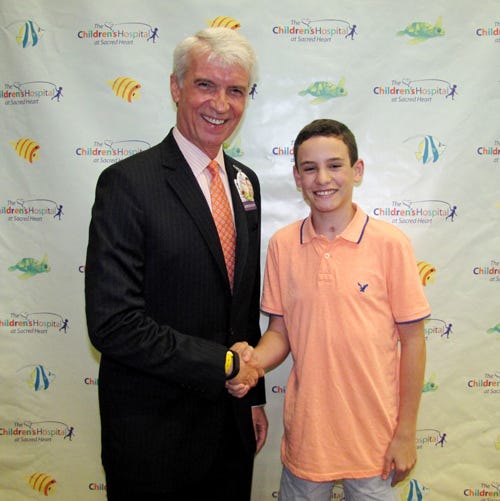
Drew Barefield is congratulated May 2 by Henry Stovall, president of Sacred Heart Hospital in Pensacola, upon being named this year’s Children’s Miracle Network Hospitals Florida Champion.

CRESTVIEW — Drew Barefield, the 2016-17 Children’s Miracle Network Hospitals Florida Champion, is embarking on his first “diplomatic” mission, an awareness campaign in Washington, D.C.

Drew, 14, serves as a fundraising and awareness ambassador for The Children’s Hospital at Sacred Heart Hospital in Pensacola, where he was treated following a June 28, 2014, accident in which he was struck by a boater while snorkeling.

During his recovery, Drew spent 75 days in The Children’s Hospital at Sacred Heart and received 13 surgeries. He continued with months of often painful physical therapy upon returning home to Crestview.

Upon being named Florida’s champion on May 2, Drew said the honor is, for him, a way “to repay the community and show them how much I’m thankful for supporting me through my recovery.”

BUSY ITINERARY

Drew and members of his family arrive Saturday in Washington. Through next week, Drew and Champions from the 49 other states will share their inspiring stories to encourage charitable support for children’s hospitals and provide inspiration for pediatric trauma patients undergoing treatment.

Drew’s itinerary will include:

●A celebratory reception at the JW Marriott hotel with Champion alumni and supporters

●Touring Marriott International headquarters to thank company employees for their continued support

●Attending Senate meetings on Capitol Hill

●Generating awareness at a Washington Nationals baseball game

●Participating in a satellite media tour with TV stations across the country

●Attending an address by  1996 Champion alumnus, best-selling author and Paralympic skier Josh Sundquist.

During their awareness tour, Miss America 2016 Betty Cantrell, the national goodwill ambassador for CMN Hospitals, will accompany Drew and his fellow champions. 

This article originally appeared on Crestview News Bulletin: Crestview teen to campaign for children's health in nation's capital

error: Content is protected !!