Please ensure Javascript is enabled for purposes of website accessibility
Skip to main content
Advertisement

BROADHEAD: Love your enemy — a radical concept
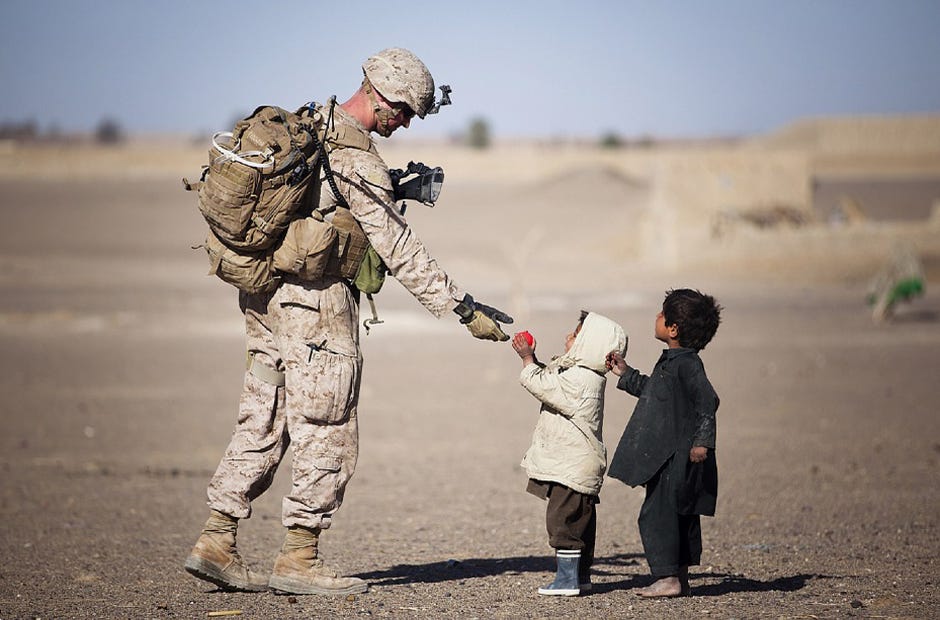
“Doing random acts of kindness, no matter how small, can turn an enemy into an ally. Sharing a smile can defuse a potentially hazardous situation.”

The other day, I was perusing a number of photos of U.S. military personnel serving overseas. The montage showed these men and women performing random acts of kindness toward local persons where they were stationed.

The interaction of soldiers and children showed laughter and smiles all around. There was pure enjoyment while large, fully equipped soldiers attempted to ride a child’s bicycle, or awkwardly dance in full uniform.

Soldiers were shown shaking hands with adults, providing supplies of water or bits of foodagain, with smiles and laughter all the way around.

Pictures showed soldiers helping elderly or wounded persons by carrying them, supporting them or providing medical treatment.

A couple of thoughts struck me about the photos.

One was, regardless of where these military persons were stationed and interacting, all human beings have the capability to smile. All have the ability to show gratitude for acts of kindness.

Another was, there was a sense of true joy or genuine concern on the part of the soldiers and those with whom they interacted. It didn’t matter that they didn’t speak the same language. It didn’t matter that they had different cultural backgrounds.

What mattered most was human interaction, generosity, kindness; a desire to interject a bit of happiness into otherwise difficult and fearful lives.

Doing random acts of kindness, no matter how small, can turn an enemy into an ally. Sharing a smile can defuse a potentially hazardous situation. Saying “I’m sorry I hurt you” can go a long way to healing festering anger, animosity or hatred.

The madness — literally and figuratively — that appears to be taking over the world destroys our ability to care for or about those who are different from us.

It is much easier for many to want to do away with someone who is different than it is to try to understand another’s point of view. It is much easier to want to destroy an enemy than it is to pray for one.

Still, Jesus tells us to love our enemy and to pray for those who persecute us. What a radical concept! This is difficult for many to do because it takes a great deal of internal strength and perseverance.

What would your life be like if you followed this teaching of Jesus to love your enemy and pray for those who persecute you?

I challenge you to find out.

The Rev. Mark Broadhead is pastor at Laurel Hill Presbyterian Church and First Presbyterian Church of Crestview.

This article originally appeared on Crestview News Bulletin: BROADHEAD: Love your enemy — a radical concept

HART: Issues absent from presidential campaign

Thankfully, football begins soon. Some don’t like filthy locker-room language, cheating, pay-for-play cash changing hands, weekly human violence, physical injuries, and money wasted on education, so we turn off the nightly election news and watch college football instead.

Absent from this presidential race has been one thing we might regret: discussion of the issues.

Obamacare has been a disaster, with health care exchanges closing, insurance companies pulling out, and our premiums “soaring 18 percent to 23 percent across the country” (per the Wall Street Journal). Hillary Clinton is running on this issue while Donald Trump spends his time insulting a mother and war heroes.

Then there’s the debt.

Obama came to office with $10 trillion in national debt. He will double it, adding more than all previous 43 presidents combined. No one talks about this. Our nation was founded on “Give me liberty, or give me death.” Now the mantra seems to be, “Give me free stuff or you’re a racist.”

Hillary says she want to “invest” more in infrastructure to create jobs. Wasn’t that Obama's “Stimulus Bill?” Most called it the “Porkulus Bill” because little was spent on infrastructure for purportedly “shovel-ready jobs.” In swing state Wisconsin, 80 percent was given to public sector unions. You know, the ones in the T-shirts standing behind Obama at his midday rallies — during the workweek.

Obama was “shoveling” something, but it wasn't infrastructure jobs. And now Hillary is campaigning on the same con. They use the word “invest,” which means "We tax you and we spend with our crony friends."

President Lyndon B. Johnson first used wordsmithing like this when he said he was going to “invest” in eliminating the 25 million Americans in poverty. Since his “War on Poverty” started, we have spent more than $22 trillion on anti-poverty programs. Now only 46.7 million Americans, about double from 1964, live in poverty — a success by Washington, D.C. standards.

At some point, we have to realize the only enduring anti-poverty program is a job. And if Democrats keep taxing and regulating good companies out of America, there will be fewer of them. Government cannot hire and pay by shaking down for money everyone whom they want to; it’s not the Clinton Crime Family Foundation.

Wars on poverty, drugs, Vietnam, Iraq, obesity, etc. never work. There is no “war on” black youth by cops, no "war on" Christmas. When someone tells you he is going to have a “war on” something, he is lying — and it will cost you a lot.

If Trump could fight his inclination to get into a Twitter fight with Meat Loaf and instead focus on the issues in this election, he’d win.

His instincts are Republican and Libertarian (except on trade), and he’s on the correct side of issues. Mike Pence is spending all his time getting Trump’s childish foot out of his mouth. Pence must feel like a firefighter living with a pyromaniac.

This presidential race is going down the home stretch. The horses are Foot in Mouth trailing Should’a Been Indicted by 10 lengths. Trump raised $80 million in small donations in July, almost matching the Clinton cash machine. I would not be surprised if Trump spends that money on attack ads against John McCain and Mitt Romney.

Clinton is so universally disliked, Tucker Carlson said, “that even Bill Clinton doesn’t want to have to vote for her.” Yet she is now winning, even in states where you can still buy a Confederate flag shot glass in a convenience store.

That’s not good.

A CBS poll has her up by 10 points, and a CNN newsroom poll has her already in her first 100 days as president.

The leading candidate is an accomplished liar. She even agreed with Obama that the $400 million in cash Obama clandestinely sent on an unmarked U.S. jet and gave to Iran the minute before our four hostages were released was not “ransom.”

One would think two Ivy League, self-professed “smartest president” and “most qualified person ever to run for president” would understand what the word "ransom" means.

Simple questions aren’t asked during this campaign, like how Hillary, a woman “who’s only a public servant, dedicating her life to helping children” made $28 million in 2014 and is worth over $245 million.

I think voters know what "ransom" means.

Ron Hart, a libertarian op-ed humorist and award-winning author, is a frequent guest on CNN. Contact him at Ron@RonaldHart.com or @RonaldHart on Twitter.

This article originally appeared on Crestview News Bulletin: HART: Issues absent from presidential campaign

BUSH: Donald Trump's campaign against the truth

In 2008, Barack Obama ran a campaign promising changes from the past eight years under George W. Bush. His slogan was, “Change we can believe in.”

Eight years later, Donald Trump is trying to convince voters that they need a change from the Obama regime.

The only thing the Trump campaign seems to be changing is history.

Thanks to his misstatements — and those of his surrogates — his slogan appears to be “Changing things you used to believe in.”

Trump hates the dishonest, liberal media because of their constant attacks on him.

The media point out that his third wife has appeared in nude photo sessions, and raises questions about his ability to claim the moral high ground. The media is bad like that.

The media also think that saying ‘Second Amendment people will take care of things when Hillary Clinton begins to nominate judges’ sounds a lot more plausible as a dog whistle threat against Clinton than a call for political action by those who value their right to keep and bear arms.

Some in the liberal media even believe that Trump’s Twitter rant Sunday morning came from a man who doesn’t have a strong grasp on constitutional law.

All of those things are at least potentially up for discussion, and liberal-minded folks will see one side and those who are from a more conservative political worldview might be able to excuse the Trumpisms as misunderstood or misreported.

But there are far too many instances in this campaign where facts are intentionally or ignorantly misstated by Trump or his supporters. Their lack of knowledge and respect for the truth is troubling.

Trump continued to falsely state that neighbors saw bombs all over the floor of the San Bernardino terrorists’ apartment before the attack. That has never been confirmed. In fact, authorities have dispelled this claim.

That hasn’t stopped Trump from stating it as fact.

There were some pipe bombs found in a search after the attack, but there is no evidence that anyone saw them, and they certainly weren’t covering the floor.

This is coming from the same guy who saw thousands of Muslims cheering in New Jersey after the Sept. 11 terrorist attacks.

Speaking of that attack, the biggest misstatement of the campaign so far happened Monday when Rudy Giuliani, who was the actual mayor of New York City when the World Trade Center was attacked and destroyed on Sept. 11, 2001, said there had been no radical Islamic terrorists attacks in America in the eight years before Barack Obama’s presidency.

“Under those eight years, before Obama came along, we didn’t have any successful radical Islamic terrorist attack in the United States,” Giuliani said Monday. “They all started when Clinton and Obama got into office.”

He didn’t mess up and fix it later. In fact, he reiterated his deception.

“We had no domestic attacks under Bush. We’ve had one under Obama,” he added.

That is the moral equivalent of forgetting your own birthday. There is a zero percent chance that Giuliani did not realize what he was saying was 100 percent false.

He could have said there were none after that tragic day.

He could have gone with a five-year period.

There were many ways to say it correctly.

He chose eight years because he was trying to say that Bill Clinton was plagued by attacks, and Obama has been, but nothing happened “in the eight years” in between. That is remarkable.

It is one thing to disagree. It is another to plainly misstate a fact.

And when this kind of comment comes from a campaign that calls the media, Ted Cruz, Clinton and many other liars, it has to be condemned.

But Giuliani isn’t the only Trump employee who struggles with recent history. The campaign’s national spokesperson, Katrina Pierson, called Afghanistan “Obama’s War.”

When the war in Afghanistan began in 2001, Obama was an Illinois senator. It is strange that we gave the power of commander in chief to a state senator. Pierson later said she meant to say Syria was Obama’s fault.

If she hadn’t been caught on video saying absolutely false things multiple times already, she might be forgiven.

She blamed that same state senator in Illinois for Capt. Humayun Khan’s death in 2004.

She also said there had been “tens of thousands” of soldiers lost in the war, and a million injured. The total number killed is under 5,000 — far too high, but far below her claims. The total number of injured is not even one-twentieth of her claim of 1 million.

Trump’s campaign is going so badly that pro-Clinton SuperPACs are pulling ads from would-be swing states because her lead is so large.

It will take real leadership to even make this presidential race close.

So far, leadership has been as foreign to this campaign as truth — and that’s no lie.

Contact Kent Bush, publisher of the Shawnee (Oklahoma) News-Star, at kent.bush@news-star.com.

This article originally appeared on Crestview News Bulletin: BUSH: Donald Trump's campaign against the truth

In-door vs. outdoor Florida water conservation

Respondents to a University of Florida water use survey were asked how often they engage in water-related behaviors. Among the results, 68 percent saved water when brushing their teeth, but only 29 percent reduced irrigating their lawns in the summer, according to the document, http://bit.ly/2bjQGSm.

GAINESVILLE — Apparently, it’s more convenient to Florida residents to save water while brushing their teeth than to cut back on lawn irrigation, according to a new University of Florida Institute of Food and Agricultural Sciences Extension report.

Alexa Lamm, a UF/IFAS assistant professor of agricultural education and communication and Extension specialist, surveyed 932 people deemed to be high-water users in Orlando, Tampa/Sarasota and Miami/Fort Lauderdale.

Respondents were asked how often they engage in water-related behaviors. Among the results, 68 percent saved water when brushing their teeth, but only 29 percent reduced irrigating their lawns in the summer, according to the document, http://bit.ly/2bjQGSm.

To put this data into context, about 50 percent of Floridians’ daily water use is for outdoor purposes, such as landscape irrigation, according to the South Florida Water Management District. The 50 percent figure is 20 percent more than the national average, according to the U.S. Environmental Protection Agency.

In Lamm’s opinion, homeowners’ association rules – which often require lush landscapes — are part of the reason homeowners won’t reduce their outdoor watering. But she said there’s probably more to it than that.

“It is easier to save water indoors,” Lamm said. “You can turn off the faucet easily when washing dishes or only run your dishwasher and laundry when they are full.”

But when it comes to their sprinkler system, some homeowners are more hesitant and will probably rely on either the installer to have done it correctly or the person that maintains their yard to manage it, she said.

“This puts their decision-making in the hands of others,” Lamm said. “The second reason is because I believe, and the literature says, many move to Florida for the lush, green lifestyle it represents. When homeowners move from another part of the U.S., where they had brown lawns a significant part of the year, they want a lawn that is pretty and green year-round because they can here. They are willing to pay to have it and may not be thinking about the environmental consequences.”

Homeowners can do a lot to become more environmentally friendly, Lamm said. They can:

•Learn more about their irrigation system to ensure it is working properly.

•Manage the amount of fertilizer they use to ensure it is applied appropriately.

•Make their outdoor systems don’t leak.

•Install moisture sensors.

•Get more engaged and be part of the decision-making process.

In addition to the data being useful for homeowners, Lamm hopes it helps UF/IFAS Extension educators.

They can work with water management districts, local governments and utility companies to develop sound policy that will assist in saving water while maintaining the lifestyle we all enjoy in Florida.

“Extension faculty can teach homeowner’s how to manage their technology and tell them it doesn’t have to be a scary, unknown thing that is outside and not thought about,” she said.

“They can also assist in developing incentive programs related to outdoor water use – installing sensors, rain barrels and replacing landscapes so they are Florida Friendly, just like we have done with indoor water use through water conserving appliances – toilets and showerheads.”

For more information, go to http://bit.ly/2bkt68j.

Brad Buck is a University of Florida Institute of Food and Agricultural Sciences science writer.

This article originally appeared on Crestview News Bulletin: In-door vs. outdoor Florida water conservation

SHANKLIN: Financial tips for college students

“The (financial) aid package you may have received as an incoming freshman doesn’t have to be the final word on financial assistance.”

If you’re a college student, you may already be back on campus. If not, you don’t have long to go before school starts again.

And this year, in addition to whatever courses you may be taking, try to master some financial lessons.

Of course, many students already have at least one foot in the “real world,” because, in addition to taking classes, they’re working many hours a week to help pay for school, rent and living expenses.

But even if you’re a full-time student, living on campus and paying for school through a combination of grants, loans, savings and help from your parents, you can learn some financial basics that can help you throughout your adult life.

Specifically, consider these suggestions:

Don’t overuse credit cards. Credit card marketers aggressively target college students, so you’ll need to be vigilant about all the offers that will bombard you. While it might not be a bad idea to carry a single credit card for use in emergencies, it’s very easy to over-use the “plastic” and rack up big debts. You’ll need to discipline yourself to save for the things you want, rather than charging them.

Shop around for financial services. You’ll find plenty of banks willing to give you a T-shirt or a frying pan for opening an account with them. But these places may not be offering you the best deal on checking or savings accounts or loans. It pays to shop around.

Keep track of your student loans. Make sure you understand all the terms of your student loans: how much you’re expected to pay each month, when payments are due, what interest rate you’re paying, what credits may be available for on-time repayment, etc. You might be able to achieve a more favorable repayment schedule by consolidating two or more loans. Once you start repaying your loans, do whatever you can to stay on track with your payments.

Never stop looking for financial aid. The aid package you may have received as an incoming freshman doesn’t have to be the final word on financial assistance. Colleges offer some scholarships based on college-level academic achievement or real-world experience — both of which you may have accumulated since your freshman year. Study your college’s scholarships and be aggressive in going after them.

Estimate your future income. You may not know exactly what you want to do when you graduate, but if you have a career path in mind, try to learn what sort of salary you can expect during your first few years out of college.

Once you have a realistic idea of how much you’re going to earn, you may have the motivation you need to avoid bad financial practices, such as accumulating big debts.

College should be a learning experience — in many ways. And if some of the knowledge you obtain during your college years can help you develop sound financial habits, so much the better.

This article was written by Edward Jones on behalf of your Edward Jones financial adviser.

This article originally appeared on Crestview News Bulletin: SHANKLIN: Financial tips for college students

CROSE: Athleticism, the Olympics and life lessons

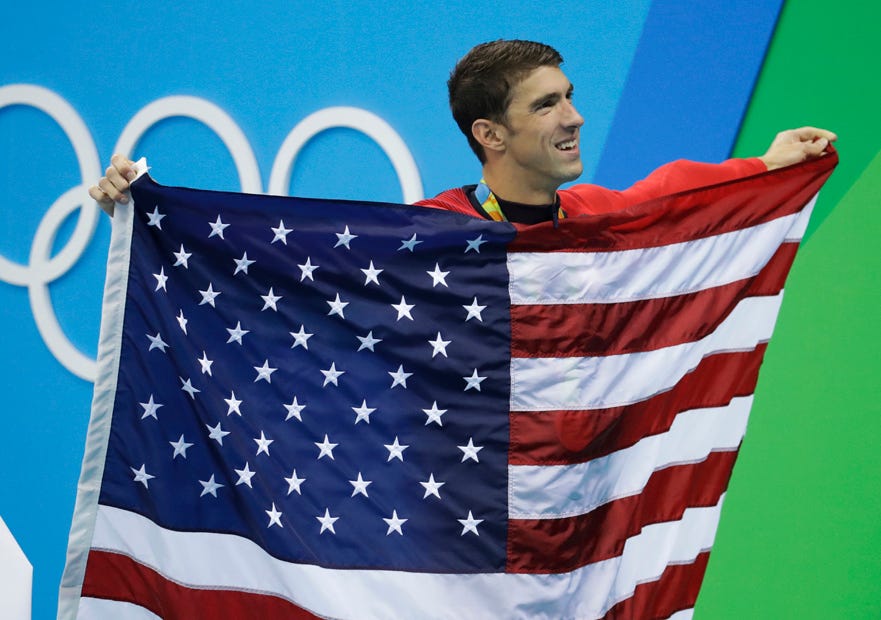
United States' Michael Phelps walks with his national flag during the medal ceremony for the men's 4- by 100-meter medley relay final during the swimming competitions at the 2016 Summer Olympics, Sunday, Aug. 14, 2016, in Rio de Janeiro, Brazil.

I love the Olympics: the excitement of competition, the cheering crowd — the winning. Every four years I immerse myself into a world in which young people from all over the globe compete at very high levels in their sport.

Some of these athletes go on to win gold, silver or bronze medals; others don't win, but all who participate will have the lifelong remembrance of having competed in the Olympics. What an achievement!

Watching these athletes compete is inspiring. They are competing for themselves, their team, and also for us, the citizens of the USA. There is a feeling of patriotic pride when they win and our flag is raised, and "The Star Spangled Banner" is played; my heart bursts with joy.

It is invigorating to watch the sheer determination of athletes like Michael Phelps, who has a strong desire to win his swimming competitions. Watching Katie Ledecky swim has been exciting; she is so fast.

Our gymnastics team this year was unbeatable. Their artistry and athleticism were breathtaking. What is refreshing is how many of our athletes have given glory to God for their success.

One of the things I admire about all the athletes participating in the Olympics is their dedication and hard work. The amount of time and effort they put into their sport is enormous.

I hope that our Olympic athletes will inspire confidence, determination and self-discipline, beginning with the knowledge that there are costs, personal as well as financial, to prepare to compete in a world event. There are years of training required, getting up at 4 a.m. to practice, continuing to make good grades, and still more training in order to qualify. Their parents deserve respect for the sacrifices they have made for their child to train to an Olympic level of skill.

The Olympics teach a difficult life lesson in that, no matter how hard athletes train and work toward a goal, they may or may not get the gold medal, but good sportsmanship is still expected.

This is a life lesson we all need to learn: we are not always going to excel at everything we attempt.

Wouldn't it be fantastic if we had an Olympic athlete from Crestview?

Janice Lynn Crose, a former accountant, lives in Crestview with her husband, Jim; her two rescue collies, Shane and Jasmine; and two cats, Kathryn and Prince Valiant.

This article originally appeared on Crestview News Bulletin: CROSE: Athleticism, the Olympics and life lessons

HOPKINS: Quick quips on the Olympics

Over the past couple of weeks, you may have heard all you ever wanted to know about the Olympics.

But in case you missed something, here are 10 things you always wanted to know about the Olympics but were afraid to ask.

1. The first Olympic Games were held in 776 B.C. as a religious festival. They were banned in 393 A.D. for being too “pagan”.

2. The Olympics were revived in 1896. Would you believe that the Greeks won the most medals that year?

3. The five interlocking rings that symbolize the Olympics represent the five continents of the world. I’ll bet they were arguing over whether or not Australia is a continent even then.

4. So far, Canada is the only country that did not win a gold medal while hosting the Olympics.

5. Perhaps the most unusual event in the history of the Olympics was simply called “Shin Kicking.” I won’t describe it to you. You can imagine for yourself. It ran for a few years before it was phased out.

6. Among the discontinued sports is Dueling Pistols. Presumably the silver medal was awarded posthumously.

7. Women’s boxing is a new sport this year. Would you believe that it was a demonstration sport as early as 1904?

8. The word “gymnastics” comes from the word “gymnos” meaning nude. All competitors at the ancient Olympic Games took part in the nude – no clothes. Noting that London seems to be a bastion of “streaking” the London Organizing Committee decreed that anyone planning to duplicate the ancient tradition of running in the buff this year would be fined up to $20,000.

9. Pierre de Coubertin of France is given credit for reviving the games in 1896. He was a stickler for authenticity. When he circulated the rules of the early games, the British team was astounded that they were to compete in the nude. Never the less, orders were orders. When they took the field for their first demonstration before the public, they created quiet a sensation in stogy old London. Yes, saner heads prevailed and the first Olympic uniforms were created.

10. In case you were wondering, women were not invited to watch the ancient games. In fact, if a woman was caught peeking she was sentenced to death.

Perhaps there is no spectacle in modern sport to compete with the summer Olympics held every four years.

The theme of each Olympics is the same: peace. It’s something we have too little of in this troubled world of ours.

Dr. Mark L. Hopkins writes for More Content Now and Scripps Newspapers. Contact him at presnet@presnet.net.

This article originally appeared on Crestview News Bulletin: HOPKINS: Quick quips on the Olympics

MANGINO: Feeling afraid trumps something to fear

The Trump campaign is exploiting crime and fear.

Trump’s campaign is not the first presidential campaign to do so, but to understand what’s different about the Trump campaign requires understanding the history of crime and politics.

In 1964, Barry Goldwater, the GOP nominee for president, introduced campaign operatives to the concept of crime as a divisive, hot-button issue.

At the time, violent crime rates were beginning to rise. When Richard Nixon was making his second bid for president in 1968, the Civil Rights Act had passed, riots had erupted in cities across the country after the murder of Martin Luther King, Jr., and murder rates had increased 50 percent since 1950.

Race relations were tenuous, at best, and Nixon knew it. Crime control became a surrogate for race control.

The conservative mantra of “tough on crime” worked for Ronald Reagan, and helped push another Republican to victory. In 1988, when crime rates were soaring, George H.W. Bush clobbered Michael Dukakis with Willie Horton.

During Bill Clinton’s tenure, violent crime was at its peak and easily exploited. During Clinton’s presidency, Loic Wacquant, as quoted by Michelle Alexander in “The New Jim Crow,” pointed out that “(Clinton) slashed funding for public housing 61 percent and boosted corrections 171 percent, ‘effectively making the construction of prisons the nation’s main housing program for the urban poor.’”

Today, according to The National Review, the national violent crime rate is about half of what it was at its height in 1991. Violent crime has fallen by 51 percent since 1991, and property crime by 43 percent.

In 2013, the violent crime rate was the lowest since 1970. Even though violent crime rates are at near record lows, Donald Trump and his surrogates are still exploiting crime and fear.

Nobody has done it better than former Speaker and short-lister for vice-president, Newt Gingrich. During a July 22 interview with CNN’s Alisyn Camerota — highlighted in a recent segment of John Oliver’s “Last Week Tonight” — Gingrich had this amazing exchange:

GINGRICH: The average American, I will bet you this morning, does not think crime is down, does not think they are safer.

CAMEROTA: But we are safer, and it is down.

GINGRICH: No, that’s your view.

CAMEROTA: It’s a fact … but hold on, Mr. Speaker, because you’re saying liberals use these numbers, they use this sort of magic math. This is the FBI statistics. They’re not a liberal organization.

GINGRICH: No, but what I said is equally true. People feel it.

CAMEROTA: They feel it, yes, but the facts don’t support it.

GINGRICH: As a political candidate, I’ll go with how people feel…

Apparently, for the Trump campaign, facts don’t matter, and that is the concern.

Regardless of what one might think about Goldwater, Nixon, Reagan, Bush and Clinton, their rhetoric was grounded in truth to some extent; crime rates were rising and some action was justified.

Now some will quarrel, justifiably, that Nixon’s efforts were more fixated on race than crime and that crime was code for African-American. However, crime was genuinely on the rise in 1968.

Today, it is not about the facts. The Trump campaign is not only exploiting fear; they are creating it. The campaign is pledging to protect all Americans from what are essentially the safest streets in more than 45 years.

President Franklin D. Roosevelt famously said, “There is nothing to fear but fear itself.” In today’s political environment, feeling afraid is more important than actually having something to fear.

Matthew T. Mangino is of counsel with Luxenberg, Garbett, Kelly & George P.C.

You can reach him at mattmangino.com and follow him on Twitter, at MatthewTMangino.

This article originally appeared on Crestview News Bulletin: MANGINO: Feeling afraid trumps something to fear

HEATH: 7 end-of-summer reads

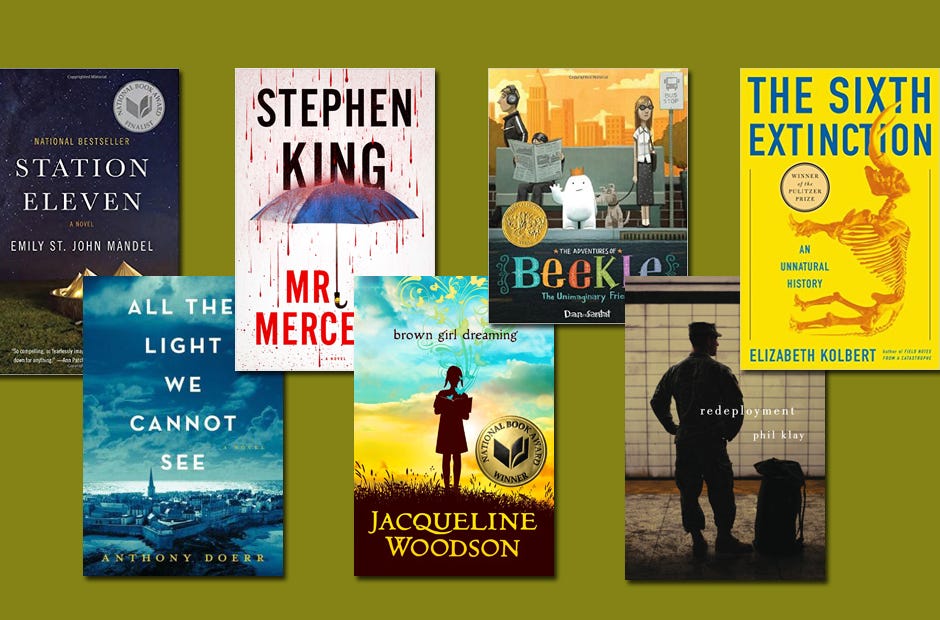
These seven books are some of the award winners available for check out at the Crestview Public Library.

Summer is a great time to catch up on all the books you’ve been wanting to read.

Here are some suggestions of quality, award-winning books available for checking out at the Crestview Public Library.

"All the Light We Cannot See" by Anthony Doerr. A blind French girl and a German boy have a chance encounter in occupied France during World War II. Doerr's book received the Alex Award (given to 10 books written for adults that also appeal to 12- through 18-year-olds.)

"Station Eleven" by Emily St. John Mandel. "An audacious, darkly glittering novel about art, fame and ambition set in the eerie days of civilization's collapse," the publisher states. St. John Mandel's novel won the Arthur C. Clarke Award, which recognizes the best science fiction novel published for the first time in the United Kingdom in the previous year.

"The Adventures of Beekle: The Unimaginary Friend" by Dan Santat. "This magical story begins on an island far away, where an imaginary friend is born," the publisher states. "He patiently waits his turn to be chosen by a real child, but when he is overlooked time and again, he sets off on an incredible journey to the bustling city, where he finally meets his perfect match." Santat's book won the Caldecott Medal, which recognizes the most distinguished American picture book for children.

"Brown Girl Dreaming" by Jacqueline Woodson. "In vivid poems, (the author) shares what it was like to grow up as an African American in the 1960s and 1970s, living with the remnants of Jim Crow and her growing awareness of the Civil Rights movement," the publisher states. Woodson's biography won the Coretta Scott King Author Award, which recognizes African-American authors’ outstanding contributions to children's literature, promoting a better understanding and appreciation of the culture and contribution to the realization of the American Dream.

"Mr. Mercedes" by Stephen King. " ‘Mr. Mercedes’ is a war between good and evil, from the master of suspense whose insight into the mind of this obsessed, insane killer is chilling and unforgettable," the publisher states. It won the Edgar Allan Poe Best Novel Award, which recognizes authors for outstanding contributions in mystery, crime and suspense writing.

"Redeployment" by Phil Klay. "Interwoven with themes of brutality and faith, guilt and fear, helplessness and survival, the characters in these stories (about the war in Afghanistan) struggle to make meaning out of chaos," the publisher states. Klay's novel won the National Book Foundation's Fiction Award, which honors American books of the highest literary merit.

"The Sixth Extinction: An Unnatural History" by Elizabeth Kolbert. This Pulitzer Prize winning fictional work tells the "future of the world, blending intellectual and natural history and field reporting into a powerful account of the mass extinction unfolding before our eyes," the publisher states.

Marie Heath is the Crestview Public Library's director.

This article originally appeared on Crestview News Bulletin: HEATH: 7 end-of-summer reads

CATALENA: 7 steps to tailgate food safety

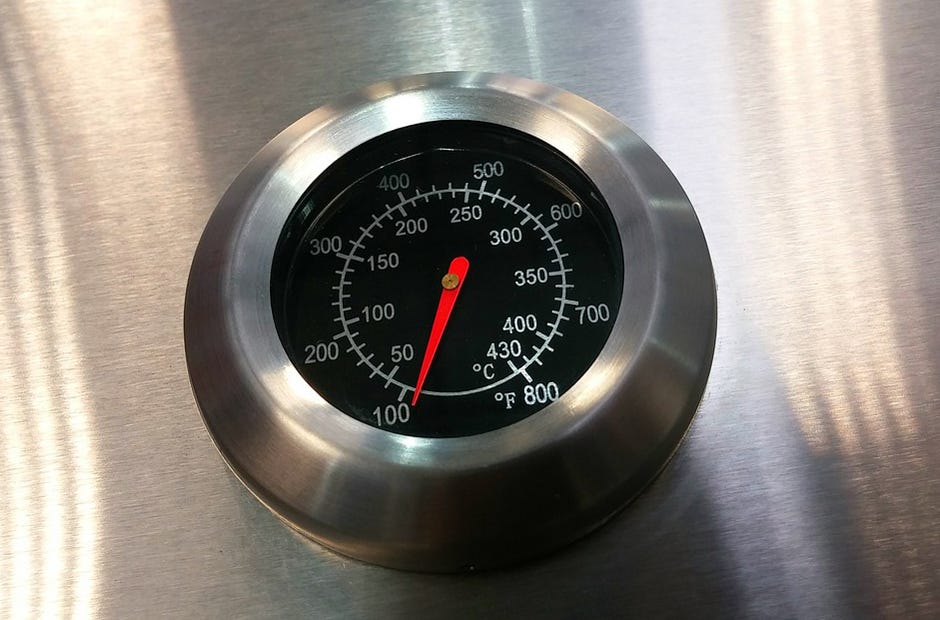
It's important to follow temperature guidelines for safety when preparing tailgate foods.

Tis the season! College football season that is. We are less than a month away and the college rivalry begins. Team flags will start to appear on the front lawn, casual Fridays in the office will change to a college polo and the best part of all…tailgating!

More on tailgating food safety>>

Tailgating is an American tradition where food is cooked and served on and around the tailgate of a vehicle.

While tailgating can be fun for the family and friends, let’s not forget food safety. Cooks have to take precautions to keep the food safe during those tailgating events, while refrigerators are not available.

Here's how to keep food safe while tailgating.

●Carry cold perishable food like raw hamburger patties, hotdogs, and chicken in an insulated cooler packed with ice or gel packs. Place an appliance thermometer in the cooler so you can check to be sure the food stays at 40F or below.

●Perishable cooked food such as lunch meat, potato or pasta salad must be kept cool too.

●If bringing hot take-out food, eat it within 2 hours of purchase (1 hour if the temperature is above 90F).

●Include lots of clean utensils for preparing and serving the safely cooked food.

●Pack clean, wet, disposable cloths or moist towelettes and paper towels for cleaning hands and surfaces.

●In addition to a grill and fuel for cooking food, pack a food thermometer so you can check and make sure the meat and poultry reach a high enough temperature to destroy harmful bacteria that may be present.

●When taking food off the grill, use a clean platter. Don’t put cooked food on the same platter that held raw meat or poultry. Any harmful bacteria present in the raw meat juices could contaminate safely cooked food.

These are the safe minimum internal temperatures for tailgating and other outdoor sporting events:

●All poultry, 165°F

●Ground meats, 160°F

●Beef, pork, lamb, and veal steaks, roasts, and chops, 145°F*

●Leftovers, 165°F

●Reheating, 165°F

*As measured with a food thermometer before removing meat from the heat source. For safety and quality, allow meat to rest for at least three minutes before carving or consuming. For reasons of personal preference, consumers may choose to cook meat to higher temperatures.

Rebecca Catalena is an agent at the University of Florida's Institute of Food and Agricultural Sciences Extension office in Crestview.

This article originally appeared on Crestview News Bulletin: CATALENA: 7 steps to tailgate food safety

error: Content is protected !!