Please ensure Javascript is enabled for purposes of website accessibility
Skip to main content
Advertisement

Seeking forgiveness requires wisdom

The Rev. Mark Broadhead is pastor at Laurel Hill Presbyterian Church and First Presbyterian Church of Crestview. [File photos | News Bulletin]

Richard Hoefler's book "Will Daylight Come" includes a little story.

In the story, a little boy visiting his grandparents used his first slingshot. He practiced in the woods, but he could never hit his target. As he came back to Grandma's backyard, he spied her pet duck. On impulse he took aim and let fly. The stone hit and the duck fell dead.

The boy panicked. Desperately he hid the dead duck in the woodpile, only to look up and see his sister Sally watching. Sally had seen it all, but said nothing.

After lunch that day, Grandma said, "Sally, let's wash the dishes." But Sally said, "Johnny told me he wanted to help in the kitchen today. Didn't you, Johnny?" She quickly whispered, "Remember the duck!"

So Johnny did the dishes.

Later Grandpa asked if the children wanted to go fishing. Grandma said, "I'm sorry, but I need Sally to help make supper." Sally smiled and said, "That's all taken care of. Johnny wants to do it." And again she whispered, "Remember the duck!"

Johnny stayed while Sally went fishing.

After several days of doing both his chores and Sally's, he couldn't stand it. He confessed to Grandma that he killed the duck.

"I know, Johnny," she said, giving him a hug. "I saw the whole thing. I was angry, but because I love you, I forgave you. I was just wondering how long you would let Sally make a slave of you."

How often do you allow someone to hold over your head an error committed in the past? How long will you continuously remind yourself of a past error and beat up yourself?

Freedom from past mistakes, no matter how difficult it may seem, comes from admitting before God what you have done. It takes wisdom to ask God's forgiveness and know you have been forgiven.

You see, we cannot hide our errors from God, nor from ourselves.

Very often God waits patiently for us to confess to him so his forgiveness can be freely lavished on us. The question is, how long will you allow those past wrongs make a slave of you?

Remember, God's grace is not earned, but it is given — freely, simply and abundantly.

The Rev. Mark Broadhead is pastor at Laurel Hill Presbyterian Church and First Presbyterian Church of Crestview.
This article originally appeared on Crestview News Bulletin: Seeking forgiveness requires wisdom

Crestview club offers local gardening information

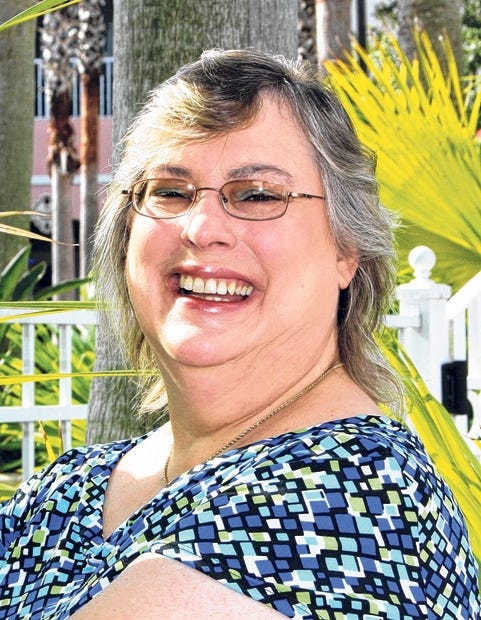
Janice Lynn Crose, a former accountant, lives in Crestview with her husband, Jim; her two rescue collies, Shane and Jasmine; and two cats, Kathryn and Prince Valiant.

I appreciate beautiful flowers and manicured yards as much as I like trees. I am not a terrific gardener, but I appreciate those who do marvelous things in their yards and I love to look at their creativity. I especially love to look at yards with a variety of colors and flowers.

If you are interested in learning more about gardening in this area of the country, the Dogwood Garden Club will have its first meeting of the 2017-2018 year 10:30 a.m. Sept. 11 at the Crestview Public Library, 1445 Commerce Drive.

Refreshments will be served at 10:15 a.m., with the meeting beginning at 10:30 a.m.

An Okaloosa Master Gardener will present this month's program topic, fall color in the garden. As one that loves the fall colors, different shades of oranges, reds, greens, golds and so on, I am looking forward to the program and I know that great gardening tips will be offered.

Subsequent meetings for the club are 10:30 a.m. the first Monday of each month in club members' homes. Dues are $25 per year, and the club meets September through May.

Call 683-0839 if you are interested in more information.

Dogwood Garden Club meetings focus on a different gardening topic each month. The topics range from subjects such as trees, to soil types and container gardening.

I enjoy using flowers in pots to brighten up our front yard. One of the many advantages to this type of gardening is that the plants can be brought in when it is cold. I have several hibiscus plants in pots; they go out for the warm weather and come in during the winter.

Mums, black-eyed Susans, pansies, phlox, asters and verbena and many of the flowers are plentiful at this time of year. They provide a variety of colors, are easy to put on the porch and really beautify the home.

Let's make Crestview the city of beautiful gardens and colorful yards.

Janice Lynn Crose, a former accountant, lives in Crestview with her husband, Jim; her two rescue collies, Shane and Jasmine; and two cats, Kathryn and Prince Valiant.

If you are interested in learning more about gardening in this area of the country, the Dogwood Garden Club will have its first meeting of the 2017-2018 year 10:30 a.m. Sept. 11 at the Crestview Public Library, 1445 Commerce Drive.

WANT TO GO?

This article originally appeared on Crestview News Bulletin: Crestview club offers local gardening information

Powerball — government is the real winner

A Massachusetts woman won the second largest Powerball payout in history, $758 million. She elected to receive a lump-sum payment of $480 million.

Lottery jackpots seem like staggering amounts of money. It is the most money anyone (if you don't count Prince Charles) has gotten for doing nothing.

The winner of any big Powerball gets hundreds of millions of dollars — and two hundred new relatives and friends.

One thing is clear: The real winner in the lottery is government.

If you think about it, government is like the Mafia. It runs numbers games (the lottery). It controls drugs (DEA/Customs/FDA). It controls guns (ATF). It has run guns via the Justice Department's "Fast and Furious" program. And, via the ATF and state excise taxes, it exerts influence over booze through taxes as high as $34 per gallon on whiskey. Pot is now dealt at the state level.

Government operates about the same as the Mafia but with less predictability and better pensions. A Mafia Internal Revenue Service would not target Tea Party groups that are paying their taxes.

Here are some rough numbers (rounded up) gleaned from this near-record jackpot that illustrate just how much money the government takes from citizens to allow them to gamble among themselves. To buy a $2 Powerball ticket, most people would have to earn about $3 before taxes. Much like cockfights, drug dealers and massage parlors, government accepts only cash for lottery tickets.

Government sold about $1 billion in Powerball tickets (bought with $1.2 billion pretax dollars) for a Powerball jackpot advertised at about $750 million. I hope you are sitting down — our government lied to you about this number. Top line numbers: About $1.2 billion of pretax dollars were taken from citizens to give them a $750 million up-front pot.

But that's just the beginning.

There are federal taxes of 39.6 percent on that amount won. Tack on a Tax-achusetts state tax of 5 or 12 percent percent (if you are lucky), and the government "only" takes half.

The jackpot now is down to $240 million — if you do not plan to die. Die in a few years, and government gets up to another 50 percent in total state and federal estate taxes, leaving the winner's family to split about $120 million in her estate.

To recap: The government gets $1.2 billion, less the winner's heirs' $120 million: a net of $1.08 billion. The winner's heirs get $120 million, or 10 percent of the jackpot, while government gets 90 percent.

A recent study concluded that 70 percent of folks who win the lottery are broke within seven years. Money does not come with instructions, and what the government does not get, hookers and family hangers-on often do.

Like Democrats, people always proclaim how magnanimous they would be if they won the lottery. But that's an empty, self-serving, meaningless gesture with money they don't have — just like a political promise. Few winners, if any, follow through.

Some say the lottery amounts to a tax on poor people who are not good at math. But just try to take it away. They love it. If you buy a ticket, the odds of winning are one in 300 million — and about the same if you do not.

Government tells us that Powerball profits go to education. With all the lottery playing in America, one would think we would have the smartest kids in the world by now.

Ron Hart is a libertarian op-ed humorist and award-winning author. Contact him at Ron@RonaldHart.com or @RonaldHart on Twitter.

What's your view? Write a letter to the editor.

"Government operates about the same as the Mafia but with less predictability and better pensions."

This article originally appeared on Crestview News Bulletin: Powerball — government is the real winner

Brighten your grandchildren's financial future

Yvonne Shanklin

Mother's Day and Father's Day may get more attention, but National Grandparents Day, observed on Sept. 10, has gained in popularity. If you're a grandparent, you might expect to receive some nice cards, but if you want to make the day especially meaningful, you may want to consider giving some long-lasting financial gifts to your grandchildren.

What might come to mind first, of course, is helping your grandchildren pay for college. You can choose from several college savings vehicles, but you may be especially interested in a 529 savings plan. With a 529 plan, your earnings accumulate tax free, provided they are used for qualified higher education expenses, such as tuition, books, and room and board. (Keep in mind that 529 plan distributions not used for qualified expenses may be subject to federal and state income taxes and a 10 percent IRS penalty on the earnings.)

You may be eligible for a state income tax incentive for contributing to a 529 plan. Check with your tax advisor regarding these incentives, as well as all tax-related issues pertaining to 529 plans.

One benefit of using a 529 plan is contribution limits are quite generous. Plus, a 529 plan is flexible: If your grandchild decides against college, you can transfer the plan to another beneficiary.

Generally, a 529 plan owned by a grandparent won't be reported as an asset on the Free Application For Federal Student Aid, but withdrawals from the plan are treated as untaxed income to the beneficiary (i.e., your grandchild) and that has a big impact on financial aid, a much bigger impact than if the plan was listed as a parental asset.

Beginning with the 2017-2018 academic year, however, FAFSA now requires families to report income from two years before the school year starts, rather than income from the prior calendar year. Consequently, it might be beneficial, from a financial aid standpoint, for you, as a grandparent, to start paying for college expenses from a 529 plan in the year in which your grandchild becomes a junior. Contact a financial aid professional about the potential financial aid impact of any gifts you're considering.

A 529 plan isn't the only financial gift you could give to your grandchildren. You might also consider giving them shares of stock, possibly held in a custodial account, usually known as an UTMA or UGMA account. One possible drawback: You only control a custodial account until your grandchildren reach the age of majority, at which time they can use the money for whatever they want, whereas distributions from a 529 savings plan must be used for qualified higher education expenses.

Still, your grandchildren might be particularly interested in owning the stocks contained in the custodial account — most young people enjoy owning shares of companies that make familiar products. And to further interest your grandchildren in a lifetime of investing, you may want to show them how a particular stock you've owned for decades has grown over time.

Naturally, you'll also want to let them know that stocks can move up and down in the short term, and there are no guarantees of profits — but the long-term growth potential of stocks is still a compelling story.

You'd probably do whatever you could for your grandchildren — and with a smart financial gift, you can make a big difference in their lives.

This article was written by Edward Jones on behalf of your Edward Jones financial adviser.

This article originally appeared on Crestview News Bulletin: Brighten your grandchildren's financial future

The great horseshoe crab roundup

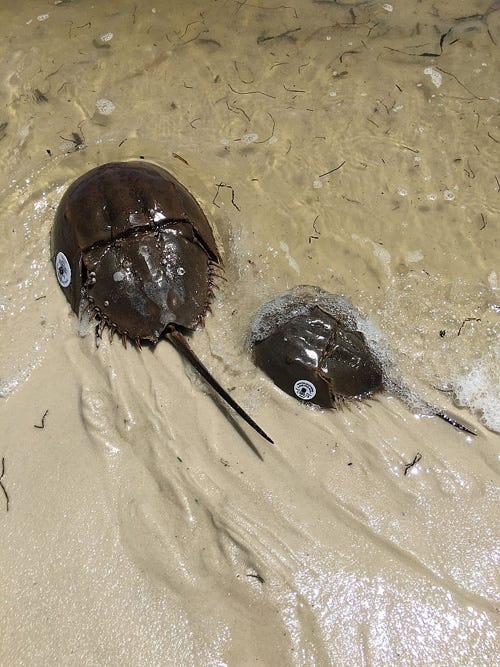
A horseshoe crab watch is underway in Northwest Florida. [Special to the News Bulletin]

The Florida Fish and Wildlife Commission and Florida Sea Grant scientists at the University of Florida Nature Coast Biological Station at Cedar Key have teamed up to assess the horseshoe crab population on Florida beaches.

The Florida Horseshoe Crab Watch survey is held twice a year, during full and new moons of the fall and spring months.

This year, the fall sampling season is Sept. 19-21, Oct. 4-7 and Oct. 18-21.

Horseshoe crabs are important in coastal areas, especially to the many shore birds and other creatures that eat their eggs. They are also used in medical testing. Their blood has a special ability to coagulate around bacteria and is used as an indicator of sterility. They typically live in the muddy sandy bottom, but head to the beaches during the spring and fall to find a mate.

The females are much larger than the males and you often find them cavorting in groups. This behavior provides an opportunity to monitor them. We don’t currently have good population numbers on these prehistoric-looking creatures, but it’s a common perception that numbers have been declining for years.

Simultaneous sampling across such a large geographic area in Florida would be impossible without the help of volunteer citizen scientists. The FWC is dedicated to collecting data on horseshoe crab nesting, but does not have anywhere near enough staff to achieve the high level of data collection the volunteers are able to complete. Information of this kind is extremely valuable for helping researchers understand population connectivity across nesting areas.

In an effort to initiate the program in Okaloosa and Walton counties, the UF Institute of Food and Agricultural Sciences Extension Marine Science program will participate in a preliminary sampling project this fall.

It will be a simple presence-absence study, with volunteers walking the shoreline on their own, noting GPS coordinates of sightings and submitting data and a picture via email to the Extension office.

If initial data warrants, the program will be expanded in the spring, collecting measurements, and perhaps doing some tagging. The long-term goal is to try and get an idea of the numbers of crabs in Choctawhatchee Bay or on our beaches. The sampling program has worked well in other areas of the state with all of the volunteers in the program agreeing to some degree that they considered themselves stewards of horseshoe crabs.

Send me an email at lgtiu@ufl.edu for more information about how to get involved in Florida Horseshoe Crab Watch. If you see a tagged horseshoe crab, please note the number on the tag and use the hotline, 1-888-546-8587 or www.fws.gov/crabtag, to report the number, sighting location and condition of the crab.

Laura Tiu is an agent at the University of Florida's Institute of Food and Agricultural Sciences Extension office in Crestview.

This article originally appeared on Crestview News Bulletin: The great horseshoe crab roundup

Are you a "hardworking" investor?

Yvonne Shanklin is an Edward Jones financial adviser. [Special to the News Bulletin]

Next week, we observe Labor Day, a celebration of the American worker. You work hard your whole life with the hope that your efforts will ultimately allow you to achieve your financial goals, such as a comfortable retirement. But for that to happen, you may need to apply some of the lessons of the workplace to your efforts as an investor.

So, what are these lessons? Here are a few to consider:

Be consistent. The most successful workers are the ones who show up, day after day, and strive to overcome the inevitable obstacles that crop up. As an investor, you, too, need to be consistent in your habits, which means you should keep investing in all types of markets. If you take a "time out" every time the market drops, you might end up missing opportunities when the next rally begins.

Be flexible. When good workers see that something is not going well, they change what they're doing. And when you invest, you also may need to make adjustments.

If an investment has consistently underperformed, or if you have too many others very similar to it, or if it just doesn't meet your needs anymore, you may be better off selling it and using the proceeds to invest elsewhere. This doesn't mean you should constantly be buying and selling. In fact, you'll likely be better off by purchasing quality investments and holding them for the long term. But you need to be flexible enough to make the appropriate moves at the appropriate times.

Be informed. The best workers are those who regularly update their skills and acquire knowledge that helps them do their jobs better. As an investor, you should also keep learning about the investment world in general and about new opportunities for you to explore. And you should always understand what you are investing in and why. Even if you work with a financial professional, you need to inform yourself about every aspect of your investment portfolio. After all, it's your money and your future.

Be farsighted. Good workers not only know what they're doing, but they also can visualize the desired outcome of each task.

And, of course, people who are in charge of a particular endeavor, or who are responsible for the fortunes of a business, have a clear view of what they want to accomplish, even if the achievement of that goal is many years in the future.

When you invest, you also need to see where you want to go. If you can constantly keep in mind your long-term goals, such as the type of retirement lifestyle you desire, you will likely find it easier to stick with an investment strategy that's appropriate for your needs and risk tolerance. Conversely, if you lose sight of your destination, you might be more prone to taking short-term detours, which could work against you.

Labor Day reminds us to appreciate the skills and dedication of all workers, and as an investor, you can put these same attributes to good use.

This article was written by Edward Jones on behalf of your Edward Jones financial adviser.

This article originally appeared on Crestview News Bulletin: Are you a "hardworking" investor?

The benefits of trees

Janice Lynn Crose, a former accountant, lives in Crestview with her husband, Jim; her two rescue collies, Shane and Jasmine; and two cats, Kathryn and Prince Valiant.

I love trees. They are aesthetically pleasing, they provide shade, they give the birds a place to live, the squirrels a place to nest, they keep water from running off into a storm drain, they help stop wind damage and clean the air. Another fun thing about trees, one that I can no longer do, is climb them.

I found this 1993 Mike McAliney quote from about the benefit of trees to be significant: "A single mature tree can absorb carbon dioxide at a rate of 48 lbs./year and release enough oxygen back into the atmosphere to support 2 human beings." (Source: Arguments for Land Conservation: Documentation and Information Sources for Land Resources Protection, Trust for Public Land, Sacramento, CA, December 1993.

At https://www.arborday.org/trees/benefits.cfm, I found this U.s. Department of Agriculture quote. "One acre of forest absorbs six tons of carbon dioxide and puts out four tons of oxygen. This is enough to meet the annual needs of 18 people." Another benefit of trees stated on the website is, "Trees properly placed around buildings can reduce air conditioning needs by 30 percent and can save 20–50 percent in energy used for heating."

Trees, as well as being beautiful, are good for our health, since we need oxygen to live. How interesting that the trees that beautify our yards have such an effect on the temperatures in our homes. It is certainly a benefit in Crestview and Northwest Florida. We all may need to plant more trees to shade our homes.

It frustrates me greatly when I see trees cut down for shopping centers and new homes. I realize that we need progress and growth, but must they cut down the majority of the trees? It is nice to park in the shade when one is shopping, as it helps keep the car cool during the summer.

Why can't developers do some strategic planning and keep many of the trees and work around them? It seems they want to do it the easy way and not be bothered with the planning it would take to keep the trees. My mother refuses to shop at Lowe's in her hometown as they cut down all the trees in the parking lot.

Please developers, keep more trees in shopping centers. We need them to park under, and we need them to clean the air of pollutants.

Janice Lynn Crose, a former accountant, lives in Crestview with her husband, Jim; her two rescue collies, Shane and Jasmine; and two cats, Kathryn and Prince Valiant.

This article originally appeared on Crestview News Bulletin: The benefits of trees

How I renew my hope

The Rev. Mark Broadhead is pastor at Laurel Hill Presbyterian Church and First Presbyterian Church of Crestview. [File photos | News Bulletin]

During times that I am tired or having an "Eeyore Day," I sometimes have a brief, negative outlook for our nation.

I sometimes ponder what is going on around the world with people engaged in war, genocide, human trafficking, or drug trafficking, and wonder why people treat others the way they do.

This causes me to stop and lift prayers to God for healing: for the ills of society, for the hatred and cruelty people express toward others, and for those who are beaten down by a sense of failure.

My time of pessimism is short-lived. Strength is renewed through prayer, and life comes back into focus once again. This happens because of the hope I place in God. It is a hope that continuously puts matters into proper perspective.

The kind of hope I am referring to is not the hope some have about winning the lottery, or gaining more power, or for their favorite team to make it all the way to the championships. I am referring to the kind of hope that is connected, not to worldly matters, but to God.

Hope has been defined as an optimistic attitude of mind that is based on an expectation of positive outcomes related to events and circumstances in one's life or the world at large.

Placing hope in our living God and in Jesus Christ provides the kind of perspective that makes life worth living. It enables us to look toward the future — not with dread, but with joyful anticipation.

We are called to put our hope in God. Psalm 37:7 says, "And so, Lord, where do I put my hope? My only hope is in you."

Our true yearning in life is deeply spiritual. When we trust and hope in God, we find happiness, as in Psalm 146:5: "Joyful are those who have the God of Israel as their helper, whose hope is in the Lord their God."

As Christians, our hope in God's activity, justice, grace, and love comes from our belief in the resurrection of Jesus Christ. 1 Peter 1:3 says, "Blessed be the God and Father of our Lord Jesus Christ! By his great mercy he has given us a new birth into a living hope through the resurrection of Jesus Christ from the dead."

We are called to look at life differently; not through eyes that dread tomorrow or fear what lies ahead. We are to place our trust in the Lord because he said he is with us, "even to the close of the age."

The Rev. Mark Broadhead is pastor at Laurel Hill Presbyterian Church and First Presbyterian Church of Crestview.

This article originally appeared on Crestview News Bulletin: How I renew my hope

Stop projecting racism — Southerners have moved on

ESPN, long the MSNBC of sports, made a bizarre executive decision to remove Asian-American football announcer Robert Lee from the William and Mary vs. Virginia game.

It looked like a headline from "The Onion." But no, ESPN continues to make a left-wing joke of itself. Northern liberal elites' hatred of the South has finally spilled over to South Korea.

ESPN’s premise: racists would make fun of poor Robert Lee and perhaps riot.

No one cared.

ESPN’s move mirrors the goal of fellow Traveler(s) on the left, which is to paint the right and the South as racist.

Since drifting to the left, the struggling sports quasi-monopoly has lost 10 million viewers. Yet its owner, Disney, continues to let it make stupid PC decisions. ESPN spun this decision as a courageous move and said that it was protecting poor Robert Lee. I smell the bestowing of an Arthur Ashe Award of Courage on themselves at the ESPYs.

And ESPN covering William and Mary? It’s our oldest college, so you know either William or Mary was up to no good. Find something racist to feign selective outrage; don’t be lazy journalists!

ESPN locks us up like slaves in those oppressive cable contracts so we don’t get no uppity ideas about escaping. So, in the spirit of the real Robert E. Lee, let’s organize a militia, flank the network from the South, break the cable cords to ESPN, and declare our sovereignty from its lobbyist-driven pricing oppression.

Let’s run the Statue of Libertarian play on ESPN: Get a TV antenna at Wal-Mart for $20 and you can get crystal-clear HD of the major broadcast stations (ABC, CBS, NBC, PBS and FOX) for free. Then try to unbundle and get Fox News on cable.

Cut the cable cord and save $1,000 after-tax dollars a year. Just go to a sports bar or a friend’s house to watch the occasional game you must see live on ESPN.

You know ESPN is way left if Keith Olbermann flourished there. He has been fired from other stations like MSNBC, NBC, Current TV and local KCBS. Had Confederate Civil War cannons been fired as much as Olbermann, our nation's capital would be Richmond, Va.

Let’s be clear on history. As mayor of Baltimore, Nancy Pelosi’s dad dedicated statues of Confederate soldiers. Almost all statues of Confederate generals were erected by Democrats. And more Republicans died from recent gunshot wounds in Chicago than fought for the South in the Civil War.

As a Southerner, I can tell you we have moved on. The only reason some want to display a Confederate flag anymore is because pious [people] in the northern media tell us we can’t. Houston, Texas, citizen rednecks in their bass boats, some with rebel flags, rescued blacks, whites and Hispanics — equally — from the flooding. We did not whine about government being the answer.

You Northerners in cities like Boston need to look at yourselves and ask, who are really more racist? Stop projecting on us.

One lesson we can learn from ESPN that our generals learned in the Civil War: If you find yourself sitting atop a dead horse, dismount as soon as you can.

Ron Hart is a libertarian op-ed humorist and award-winning author. Contact him at Ron@RonaldHart.com or @RonaldHart on Twitter.

What's your view? Write a letter to the editor.

This article originally appeared on Crestview News Bulletin: Stop projecting racism — Southerners have moved on

We will pull together for Houston, neighboring towns

Houston and the Texas Gulf Coast are devastated. Never has an area been so blasted by so much rainfall in such a short amount of time.

Houston has received more rainfall than any other city across the United States receives in one entire year. So far over 51 inches of rain has fallen, with more rainfall to come. Everyone in America and much of the world with a television or computer knows about the suffering of Houston. Our prayers go out to them as well as our financial support, our manpower and anything we can do to help the millions of people who are homeless and suffering.

Experts are predicting Hurricane Harvey will cost the economy $25-30 billion because of the rain. Most of Houston is closed down due to the storm. The oil and gas industry and thousands of jobs tied to other manufacturing such as the food service giant Sysco are closed. The Port of Houston, several hospitals and both major airports are closed.

Essentially the fifth largest economy in the United States is at a dead stop.

The infrastructure damage to Houston will be in the billions. Reports have come from all the national media outlets on the significant number of people in Houston who do not have flood insurance. Thousands of homes will either be impossible to salvage or will cost upward of $12-15 billion to repair, according to reports.

Oil refineries on the Gulf of Mexico make up nearly half of the nation's refining capacity. If these refineries are flooded they will be difficult to repair and there will be extensive gasoline shortages in our country. We are already seeing prices go up at the pump and thus our entire economy will be impacted.

Most of us will know of someone directly impacted by Hurricane Harvey. At this moment my wife's aunt and husband are still in their house in Houston and they are not flooded, which is a miracle I think. Several times a day we have text messaged or called to see how they are doing. Once her aunt Facetimed their neighborhood to prove to us that water had not gotten to them yet.

Most likely the number of dead bodies will not be really known until days and maybe even weeks after Houstonians are into their cleanup.

While the devastation of Houston is like a very scary movie, it's nothing like what we would face if one nuclear bomb fell on an American city similar to Houston. The loss of life, housing, industry and infrastructure would be far greater. Houston will be repaired and houses will be rebuilt. Rebuilding after a nuclear bomb would be a different story. Such a horrific act would create suffering across our nation like we have never felt before.

Houston is hurting and Americans are pulling together from non-profits, churches and helping hands from across America.

Once again it will be proven that the heart of America is helping each other. Americans do care about each other and want the best for our towns and our country.

Media lately has been highlighting all the tension between a few groups of people and hatred displayed by these groups. The vast majority of Americans may disagree and argue quite a bit. However, while Hurricane Harvey hurts our country, it will demonstrate once again that the majority of Americans want the very best for each other.

We will pull together for Houston and the other neighboring towns. This is one reason why we are still the United States of America — and the greatest country of all. 

Glenn Mollette is an American syndicated columnist and author.

What's your view? Write a letter to the editor.

This article originally appeared on Crestview News Bulletin: We will pull together for Houston, neighboring towns

error: Content is protected !!