







Over the past five to 10 years, robotic-assisted technology has moved from an emerging innovation to an increasingly important tool in modern orthopaedic surgery. The result is a changing landscape for joint replacement – one in which advanced technology does not replace the surgeon, but rather gives the surgeon more information, control and precision.
The word “robotic” can sometimes create the impression that a machine performs surgery on its own. That is not how robotic-assisted orthopaedic surgery works.
Instead, robotic technology serves as an advanced surgical tool. Before surgery, a patient’s CT imaging can be converted into a three-dimensional model, allowing the surgeon to study the patient’s unique anatomy and create a detailed, individualized surgical plan.
The American Academy of Orthopaedic Surgeons notes that robotic-assisted joint replacement combines three-dimensional planning before surgery with real-time computer navigation during the procedure, helping surgeons establish exact boundaries for bone preparation and precise implant positioning.
“The science tells us that this will result in increased patient satisfaction, better function and improved longevity of the results,” said Mark Tenholder, M.D., who performed the first robotic-assisted knee replacement at Fort Walton Beach Medical Center in 2017. Tenholder said robotic-arm assistance also allows him to perform surgery using less-invasive techniques and assists with precise implant placement and soft-tissue balancing.
Every patient is different. A hip or knee may have a different shape, alignment or degree of damage. Previous injuries, arthritis, bone structure and soft-tissue condition can all influence how a surgeon approaches a replacement. Robotic-assisted systems are designed to account for those differences.
At Orthopaedic Associates, robotic-assisted technology is part of a comprehensive approach to joint replacement that brings together advanced surgical technology with the expertise and experience of fellowship-trained and specialty-trained orthopaedic surgeons.
The practice has developed the region’s most comprehensive robotic joint replacement program, performing robotic-assisted procedures across four distinct applications. This breadth of experience allows Orthopaedic Associates to apply robotic technology across a range of joint replacement procedures while tailoring surgical planning and techniques to each patient’s individual needs.
Mark J. Tenholder, M.D., a fellowship-trained and board-certified joint replacement surgeon, began his career here in 2004 after leaving specialized training in New York City. Initially he focused on minimally invasive hip and knee replacement, including computer navigated and patient specific knee replacement, and muscle sparing approaches like the subvastus approach to the knee. He was the first adopter of robotic-assisted joint replacement in the region and now uses robotics for total knee, total hip, and partial knee replacement.
T. Jacob Seales, M.D., is a fellowship-trained and board-certified joint replacement and revision surgeon whose expertise includes anterior hip replacement, total knee replacement, revision hip and knee replacement and robotic-arm assisted procedures. His training in adult reconstruction at Cleveland Clinic Florida gives him a particular focus on complex hip and knee reconstruction.
Jake Hawkins, M.D., is a board-certified, fellowship-trained orthopaedic surgeon specializing in joint replacement and revision. His specialties includes minimally invasive anterior hip replacement, muscle-sparing knee replacement and robotic-assisted hip and knee replacement.
Dr. David Dean, D.O., is a board-certified orthopaedic surgeon who specializes in providing care for the elbow, hip, knee, shoulder, and wrist. This year, Dean became the first and currently the only surgeon in Northwest Florida and the surrounding Gulf Coast region to perform total shoulder replacement using specific shoulder robotics technology. The milestone brought robotic-assisted shoulder replacement to local patients who previously might have needed to travel outside the region to access the technology.
The shoulder presents unique challenges for joint replacement. Its anatomy is complex, and patients can have significant differences in bone structure, joint wear and alignment. The introduction of robotic-assisted shoulder replacement adds another layer of precision to the procedure.
Research into robotic-assisted hip and knee replacement has documented improvements in implant positioning and the ability to use real-time information about alignment and soft-tissue balance.
Patient benefits can include smaller or less invasive surgical approaches, preservation of healthy tissue, improved implant positioning, reduced postoperative discomfort and a quicker return to activity.
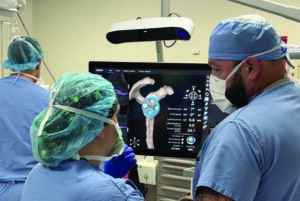
Perhaps just as important, robotic technology gives surgeons a level of planning and intraoperative information that was not previously available with many traditional approaches.
The surgeon is still the most important piece. Robotic-assisted surgery is best understood as an extension of the surgeon’s capabilities – a technology designed to provide detailed information, guidance and precision while allowing an experienced, expert orthopaedic surgeon to make the clinical decisions.
For surgeons such as Tenholder, Seales, Dean and Hawkins, that combination of experience and technology represents the direction in which joint replacement is moving: increasingly personalized, increasingly precise and increasingly focused on helping patients return to the lives they want to live.
Technology will continue to evolve. Imaging will become more detailed. Surgical planning will become more sophisticated. Robotic platforms will continue to expand into additional joints and procedures.
But the ultimate objective remains unchanged.
To relieve pain. Restore mobility. Preserve function. And help patients get back to the activities that matter most.
In Northwest Florida, the future of joint replacement is already taking shape – at Orthopaedic Associates – one precisely planned procedure at a time.
Orthopaedic Associates
850-863-2153