Please ensure Javascript is enabled for purposes of website accessibility
Skip to main content
Advertisement

Helene expected to become hurricane by Wednesday evening

Sept. 24, 2024 | 10:22 p.m.

The National Hurricane Center published its final update of the day at 10 p.m., with little change in the projected path for Tropical Storm Helene.

Here’s the quick notes, for anyone playing catch up at this point:

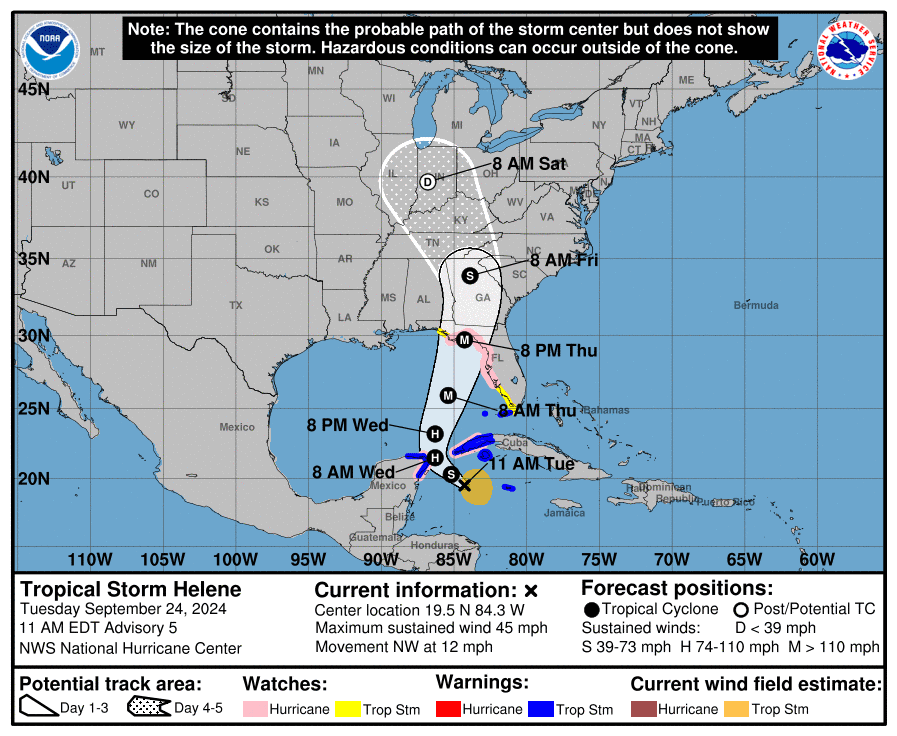
  • The storm is still just southeast of the Yucatan Peninsula, but it is expected to become a hurricane by Wednesday evening as it begins its movement into and through the Gulf of Mexico.
  • Helene’s eye is expected to hit Florida’s “big bend” area as a major hurricane.
  • Tropical Storm and Hurricane warnings have been issued for much of Florida’s coast, but Okaloosa County is not included.
  • For what it’s worth, the projected time of landfall has moved up to 6 p.m. CT on Thursday. Earlier today, it was 7 p.m. CT. However, it’s important to note that the exact timing is still up in the air at this point.
  • Helene is expected to move quickly after making landfall. By Friday at 6 a.m. CT, the eye is projected to be in northwest Georgia.

What it means for Okaloosa County:

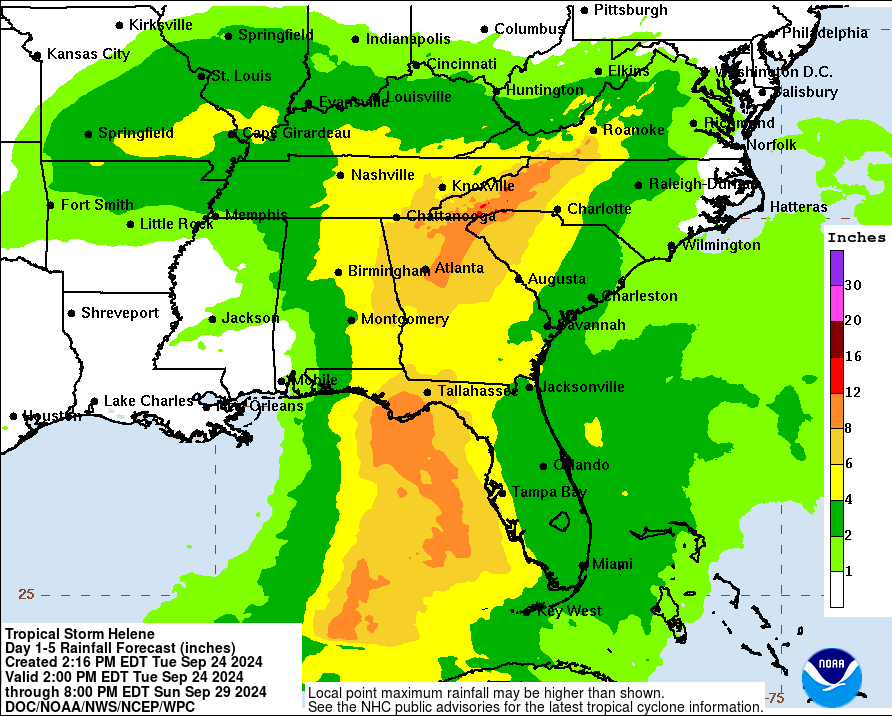
  • The storm remains to our east and current forecasting has Okaloosa County receiving 4 inches of rain.
  • If the current forecast remains intact, the worst of the conditions would be far east of Okaloosa County.
  • Stay weather aware, just in case of changes in the forecast in the final few days.

4 p.m. update: Helene’s path remains relatively unchanged as hurricane warnings issued to our east

Sept. 24, 2024 | 4 p.m.

The 4 p.m. update from the National Hurricane Center on Tropical Storm Helene showed little change in the expected path of the storm, which is still trending toward Florida’s “big bend.”

The storm’s eye remains east of Santa Rosa County. The storm is expected to make landfall Thursday night, with the exact timing still to be determined.

Here’s part of the latest advisory from the National Hurricane Center.

At 500 PM EDT (2100 UTC), the center of Tropical Storm Helene was
located near latitude 19.7 North, longitude 84.7 West.  Helene is
moving toward the west-northwest near 12 mph (19 km/h).  A turn 
toward the northwest is expected tonight, followed by a general 
northward motion beginning on Wednesday and continuing through 
Friday.  On the forecast track, the center of Helene will pass near 
the northeastern coast of the Yucatan Peninsula on Wednesday, move 
across the eastern Gulf of Mexico on Wednesday and Thursday, and 
reach the Big Bend coast of Florida late Thursday.

Maximum sustained winds have increased to near 50 mph (85 km/h) 
with higher gusts.  Additional strengthening is forecast, and 
Helene is expected to become a hurricane on Wednesday.  The storm 
is forecast to rapidly strengthen over the eastern Gulf of Mexico 
and become a major hurricane on Thursday.

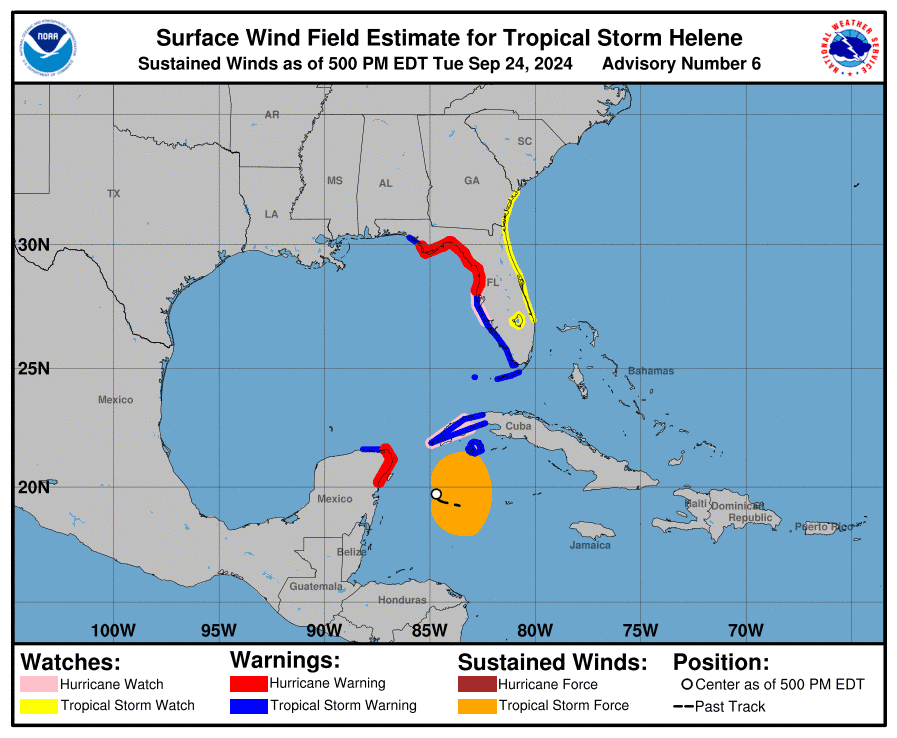
Tropical-storm-force winds extend outward up to 175 miles (280 km)
to the east of the center.


Hurricane warnings and tropical storm warnings have been issued for areas to our east.

SUMMARY OF WATCHES AND WARNINGS IN EFFECT:

A Storm Surge Warning is in effect for...
* Indian Pass southward to Flamingo
* Tampa Bay
* Charlotte Harbor

A Hurricane Warning is in effect for...
* Anclote River to Mexico Beach, Florida
* Cabo Catoche to Tulum, Mexico

A Hurricane Watch is in effect for...
* Cuban province of Pinar del Rio
* Englewood to Anclote River, including Tampa Bay

A Tropical Storm Warning is in effect for...
* Dry Tortugas
* Lower and Middle Florida Keys west of the Channel 5 Bridge
* Flamingo to Anclote River, including Tampa Bay
* Rio Lagartos to Tulum, Mexico
* Cuban provinces of Artemisa, Pinar del Rio, and the Isle of Youth

A Tropical Storm Watch is in effect for...
* Lake Okeechobee
* Palm Beach/Martin County Line northward to the Savannah River

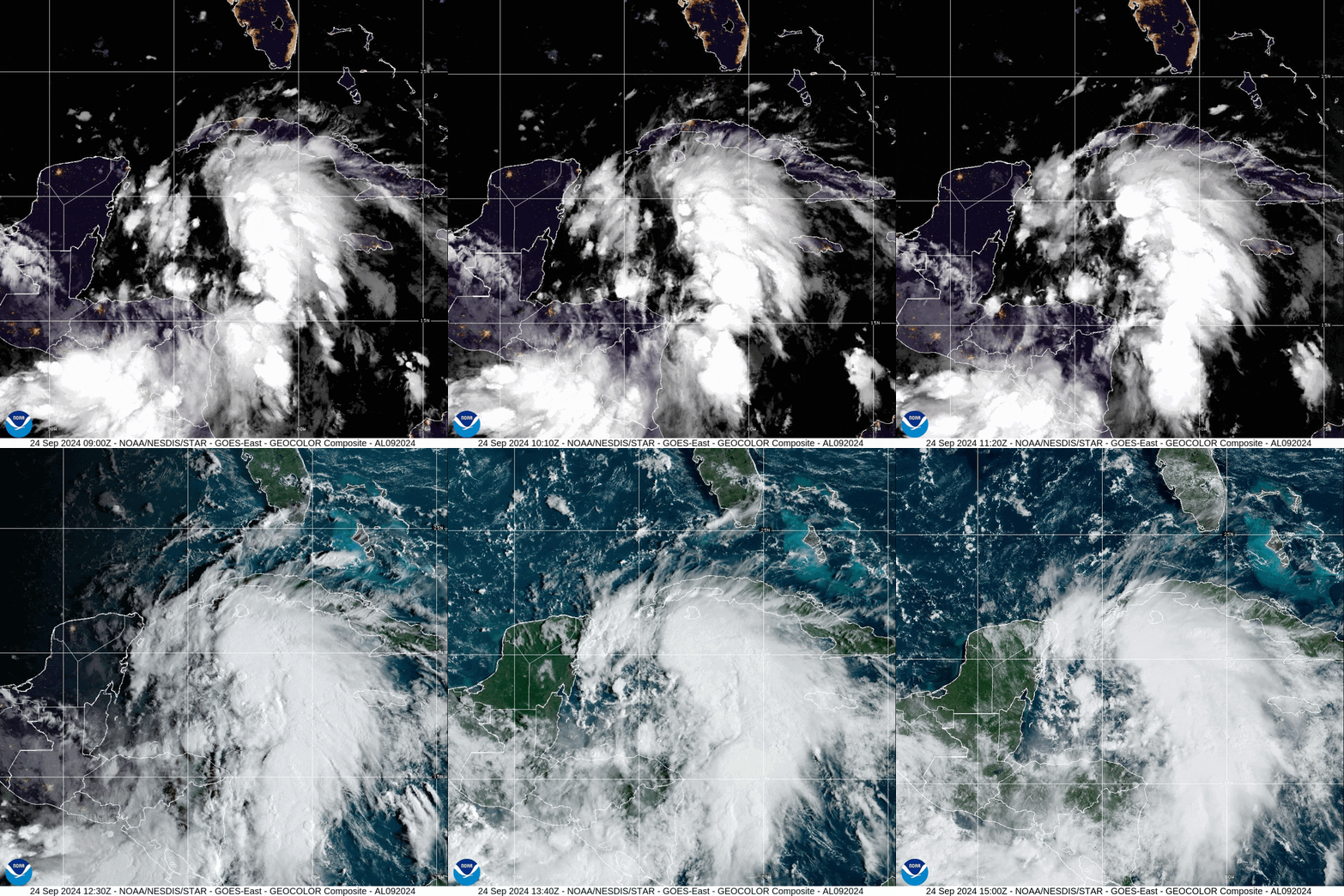
Tropical Storm Helene forms in the Caribbean Sea

Sept. 24, 2024 | 12:10 p.m.

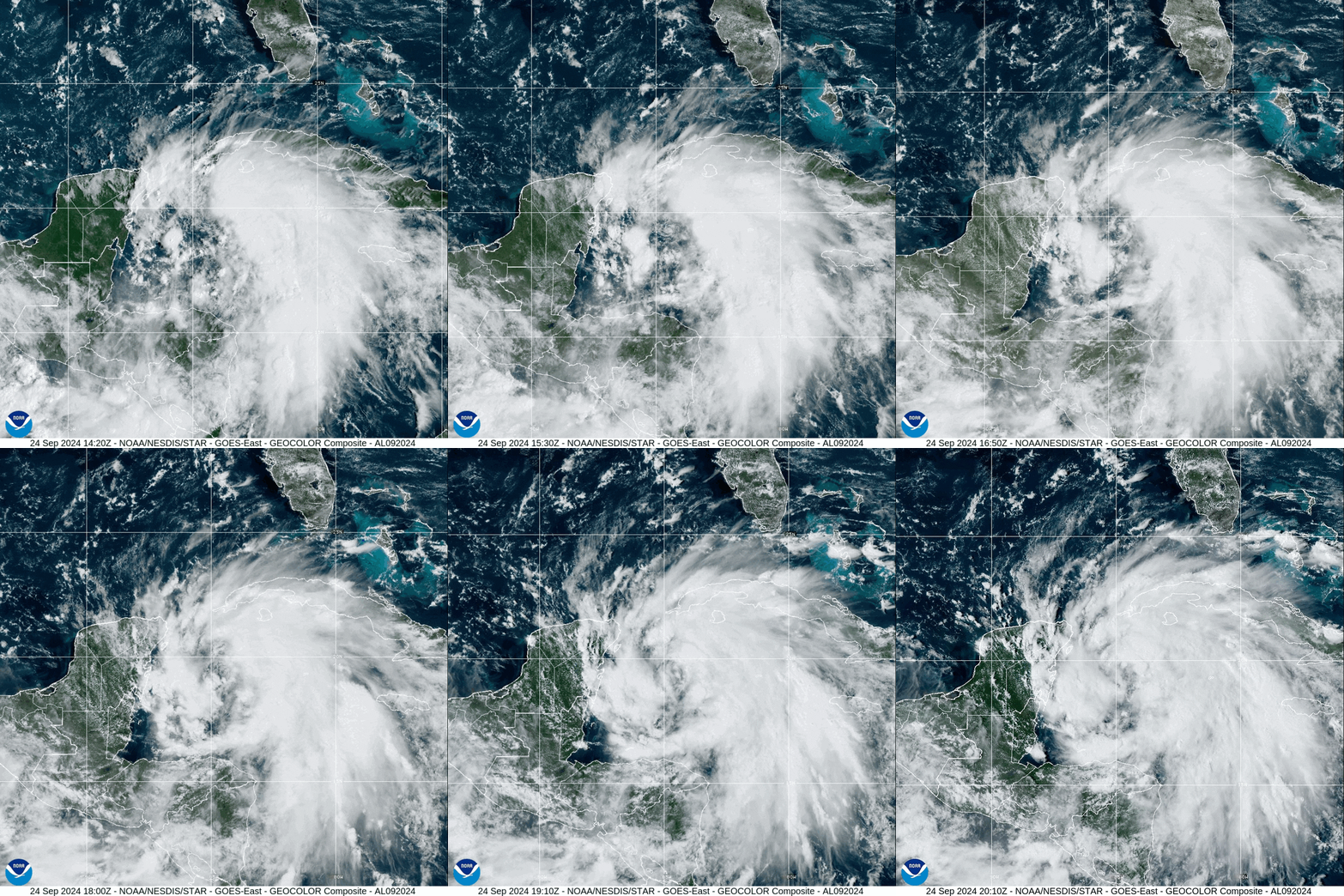
No longer Projected Tropical Cyclone Nine, Tropical Storm Helene has formed over the northwestern Caribbean Sea.

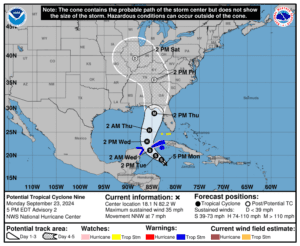
The projected path of the storm still shows it going east of Okaloosa County, hitting in Florida’s “big bend,” making landfall as a major hurricane at 7 p.m. CT on Thursday.

Current rainfall projections from the National Hurricane Center show Santa Rosa County receiving somewhere between 2 and 4 inches of rain.

The NHC expects the storm to strengthen as it makes its way through the Caribbean Sea. Here’s information from their latest advisory:

A northward to north-northeastward motion at a faster forward speed 
is expected on Wednesday and Thursday.  On the forecast track, the 
center of Helene will move across the far northwestern Caribbean 
Sea through tonight, and then move across the eastern Gulf of 
Mexico Wednesday and Thursday, potentially reaching the Gulf coast 
of Florida late Thursday.

Data from an Air Force Reserve Hurricane Hunter aircraft indicate 
that the system has acquired a well-defined center of circulation, 
and maximum sustained winds have increased to near 45 mph (75 km/h) 
with higher gusts.  Additional strengthening is forecast, and 
Helene is expected to become a hurricane on Wednesday.  Continued 
strengthening is anticipated after that time, and Helene could 
become a major hurricane on Thursday.


Early morning update shrinks cone of uncertainty, storm still east of Okaloosa County

The storm is expected to hit Florida’s big bend area, where it’s projected to be a major hurricane.

Here’s the latest information in the National Hurricane Center’s advisory, including where hurricane and tropical storm watches have been issued (which again doesn’t include Okaloosa County):

A Storm Surge Watch has been issued from Indian Pass Florida 
southward to Bonita Beach Florida, including Tampa Bay and 
Charlotte Harbor.

A Hurricane Watch has been issued for the Gulf Coast of Florida 
from Englewood northward and westward to Indian Pass, including 
Tampa Bay.

A Tropical Storm Watch has been issued for the Gulf Coast of 
Florida from Indian Pass to the Walton/Bay County Line and from 
north of Bonita Beach to south of Englewood.

SUMMARY OF WATCHES AND WARNINGS IN EFFECT:

A Storm Surge Watch is in effect for...
* Indian Pass southward to Flamingo
* Tampa Bay
* Charlotte Harbor

A Hurricane Watch is in effect for...
* Cabo Catoche to Tulum, Mexico
* Cuban province of Pinar del Rio
* Englewood to Indian Pass
* Tampa Bay

A Tropical Storm Warning is in effect for...
* Grand Cayman
* Rio Lagartos to Tulum, Mexico
* Cuban provinces of Artemisa, and Pinar del Rio, and the Isle of
Youth

A Tropical Storm Watch is in effect for...
* Dry Tortugas
* Lower Keys west of the Seven Mile Bridge
* Flamingo to south of Englewood
* West of Indian Pass to Walton Bay County line

A Storm Surge Watch means there is a possibility of life-
threatening inundation, from rising water moving inland from the
coastline, in the indicated locations during the next 48 hours.
For a depiction of areas at risk, please see the National Weather
Service Storm Surge Watch/Warning Graphic, available at
hurricanes.gov.

A Tropical Storm Warning means that tropical storm conditions are
expected somewhere within the warning area, in this case within
the next 24 to 36 hours.

A Hurricane Watch means that hurricane conditions are possible
within the watch area.  A watch is typically issued 48 hours
before the anticipated first occurrence of tropical-storm-force
winds, conditions that make outside preparations difficult or
dangerous.

A Tropical Storm Watch means that tropical storm conditions are
possible within the watch area, generally within 48 hours.

Interests elsewhere along the northeastern Gulf Coast, including the 
Florida Panhandle and the Florida west Gulf coast, should monitor 
the progress of this system.  Additional watches or warnings will 
likely be required today.


7 p.m. update: Latest advisory provides latest track of Potential Tropical Cyclone Nine

The path still takes it toward Florida’s “big bend,” meaning the eye is projected to land east of Okaloosa County.  However, much uncertainty remains about the storm’s future path. It’s projected landfall is Thursday afternoon.

The National Hurricane Center said the following as part of its advisory:

“Interests along the northeastern Gulf Coast, including the Florida Panhandle and the Florida west coast, should monitor the progress of this system. Additional watches or warnings will likely be required tonight and Tuesday.”

DeSantis declares emergency as hurricane looms

By Jim Turner and Tom Urban

The system, expected to be named Helene, was forecast Monday to reach northern Florida this week with life-threatening storm surge and winds that will cause widespread power outages.

“It’s going to be a hurricane, at least a Cat 1 (Category 1), possibly a Cat 2. Will it be stronger than that? That remains to be seen,” said Felecia Bowser, meteorologist in charge of the National Weather Service Tallahassee. “Those types of clarifications are going to be coming in the next day or two, where we can see if we are going to be faced with a major hurricane.”

The National Hurricane Center warned that while the most likely path of the system shows landfall in North Florida’s Big Bend region or in the Panhandle, storm surge, wind, and rain will affect areas well away from the center of the storm, particularly to the east of its eye.

“The hurricane regional models highlight the potential for strengthening to major hurricane intensity,” the hurricane center said in a mid-day update Monday.

A separate tracking map by the meteorology company AccuWeather had the storm rapidly intensifying while over the Gulf of Mexico to sustained winds topping 130 mph — Category 4 on the Saffir-Simpson Hurricane Wind Scale — and to make landfall with Category 3 strength of 111 mph to 129 mph sustained winds.

“The combination of deep warm water (ocean heat content) and low disruptive breezes (wind shear), should assist in rapid strengthening when over the Gulf of Mexico from Wednesday to Thursday,” AccuWeather Chief On-Air Meteorologist Bernie Rayno said in a statement. “Most likely, the storm will create its own environment and bring a surge in moisture to the currently dry air over the Gulf.”

AccuWeather noted that the storm could move into the Florida peninsula on Thursday, with a higher probability of landfall in the Panhandle late Thursday.

The area where the storm makes landfall could see 8 to 12 inches of rain. Parts of North Florida were battered last year by Hurricane Idalia and last month by Hurricane Debby — both of which made landfall in the Big Bend’s Taylor County.

DeSantis’ order placed Division of Emergency Management Executive Director Kevin Guthrie in charge of the state’s response, including coordinating efforts with utility companies, neighboring states and the federal government.

DeSantis’ order also activated the Florida National Guard and Florida State Guard.

The order included Alachua, Bay, Bradford, Calhoun, Charlotte, Citrus, Collier, Columbia, Dixie, Escambia, Franklin, Gadsden, Gilchrist, Gulf, Hamilton, Hernando, Hillsborough, Holmes, Jackson, Jefferson, Lafayette, Lee, Leon, Levy, Liberty, Madison, Manatee, Marion, Monroe, Okaloosa, Pasco, Pinellas, Santa Rosa, Sarasota, Sumter, Suwannee, Taylor, Union, Wakulla, Walton, and Washington counties.

The city of Tallahassee opened eight sandbag-distribution sites Monday, warning impacts were possible before daybreak Thursday.

The storm system is expected to make a gradual northwestern turn during the next day as the center passes through the Yucatan Channel and into the southern Gulf of Mexico.

From there, conditions in the Gulf of Mexico are favorable for significant strengthening, the hurricane center said.

In addition to Idalia and Debby making landfall in the Big Bend, Hurricane Michael brought 160 mph sustained winds near Mexico Beach in October 2018 and caused widespread damage in the Panhandle.


error: Content is protected !!