Please ensure Javascript is enabled for purposes of website accessibility
Skip to main content
Advertisement

Expert advice for surviving severe weather

“Every home should contain an emergency kit. The kit should include a weather radio, flashlights, batteries, first aid kit, money, medications, heavy clothes and five days of non-perishable food and water.”

(BPT) It’s out there — that next bout of severe weather is on its way.

No matter where you live in the United States, the potential for severe weather always exists, and sometimes it comes without much warning.

“None of us really knows what the weather holds,” says Lt. Gen. Russel L. Honore, U.S. Army (Ret). “That’s why it’s important to be prepared for any eventuality. You have to be able to be your own first responder if the situation calls for it.”

Few understand the power of severe weather and natural disasters better than Honore. The commander of Joint Task Force Katrina, Honore is now a nationally recognized emergency preparedness expert. Each day he dedicates himself to helping Americans prepare for serve weather or natural disasters to create a “Culture of Preparedness,” and help people be self-sufficient in instances of disaster.

WHY YOU SHOULD BE PREPARED

When Hurricane Katrina struck, 2.6 million people lost power, many for nearly a month. Today’s hurricanes, as well as winter ice storms and blizzards, can also cause extended outages that can leave the unprepared equally trapped and powerless in their home.

Honore says it’s essential all families develop an emergency plan. This plan should include a safe place in your home where you can find shelter and a safe location if you are away from home or you are forced to evacuate.

Each family member should also have a cell phone, so they can communicate with each other, and every home should contain an emergency kit. The kit should include a weather radio, flashlights, batteries, first aid kit, money, medications, heavy clothes and five days of non-perishable food and water.

THE IMPORTANCE OF POWER

“The number one issue you face in an emergency situation is access to reliable power,” Honore says. “When you lose power, it sets our society back at least 100 years."

In today’s world, many of the things people need to survive are tied to power. A loss of power cuts off communication, makes it difficult to attain food and water, creates sanitation issues and hinders temperature controls such as heating and air conditioning.

“Because power is so important, I recommend homeowners invest in a dependable standby generator,” Honore says.

Unlike portable generators, a standby generator automatically turns on when power is lost. A standby generator, which is permanently connected to your house like a central air conditioning unit, has the ability to power everything in your home including your heat and air conditioning systems, refrigerator, lights, computers, television and other technologies. Each of these modern-day necessities are indispensable during an emergency.

And, best of all, because the standby generator connects to your home’s existing fuel lines, you’ll never need to worry about refueling it to keep the power up and running.

“I’ve personally been through this process,” Honore says. “I have a Kohler standby generator connected to my home and I recommend everyone make having an automatic backup power supply part of their emergency preparedness plan.”

NEXT STEPS

To learn more about automatic standby generators, visit KohlerGenerators.com. You’ll have the chance to watch informative videos explaining standby power and how it works.

This article originally appeared on Crestview News Bulletin: Expert advice for surviving severe weather

CATALENA: How to get a food pantry ready for the storm season

Purchase foods that you like and would eat even without a storm. This allows you to reduce the cost of buying items for a hurricane kit at one time, and keeps the items fresh.

For many people, hurricane preparedness is not at the top of their to-do list. Most families have to juggle multiple, competing priorities.

But the Okaloosa County Extension office wants you to remember why preparedness matters  — it saves lives.

Now is the time for families and individuals in Okaloosa County to build an emergency kit and create a plan for their household.

One element of a hurricane emergency kit is establishing a food supply inventory. Each family member will need enough food and water to last for a minimum of three days.

And let’s not forget our furry family members! They will need food and water as well.

You should take in consideration that the power will most likely be out, and foods to include in your emergency kit should include shelf-stable items. These non-perishable items are foods that don’t need cooking and that are easily prepared. Try to pick food that appeals to more than one family member.

Foods that are calorie- and protein-rich will help household members maintain energy and strength.

Foods needed to meet special dietary needs, such as for babies, toddlers, the elderly, diabetic and sick need to be considered when making your kit.

Single serving or one-meal canned foods are good choices to avoid leftovers. Dried fruits, peanut butter and jelly, ready-to-eat canned meats, beans, fruits and vegetables are great items to store.

Avoid items that contain a lot of salt. Salty foods will increase your thirst during a time when water will most likely not be safe to drink.

Avoid glass jars and bottled foods that are heavy, bulky and breakable. Foods packaged in cans or solid plastic containers will be more secure.

Let’s not forget the most important ingredient of life — water. Each member of your family should have 1 gallon per day in an unbreakable container.

Consider that hurricane season usually occurs during the peak of hot weather, and water will most likely be consumed at a faster rate. Additional water will be needed for pets, food preparation and sanitation requirements.

Items most often forgotten are utensils. Make sure you have a non-electric can opener, plastic cups, plates, cutlery and a heating source for cooking.

Rebecca Catalena is an agent at the University of Florida's Institute of Food and Agricultural Sciences Extension office in Crestview.

This article originally appeared on Crestview News Bulletin: CATALENA: How to get a food pantry ready for the storm season

NITZEL: Libraries are for date night

One Friday or Saturday evening, a little too close to closing, a well-dressed couple came into the library and hit the catalog computers with a purpose. Then they split company and scurried through the library gathering their finds.

When they came to the front desk to check out, they explained that they were a married couple on a date. A babysitter was watching their children, and they were at the library looking for children’s books. Only a few were for their children. The goal of the activity was to find their favorite childhood books.

I know someone else whose date took her to a book store, and they each chose three books that represented themselves. What a great way to get to know someone! It happened to be their first date, but it wouldn’t have to be.

So, make the library your next date! If you’re single, and this works for you, we have books to help you plan your wedding!

Speaking of getting married, we’d like to congratulate our library director, now Marie Heath!

Heather Nitzel is the Crestview Public Library's youth services librarian.

This article originally appeared on Crestview News Bulletin: NITZEL: Libraries are for date night

Crestview teen to campaign for children's health in nation's capital

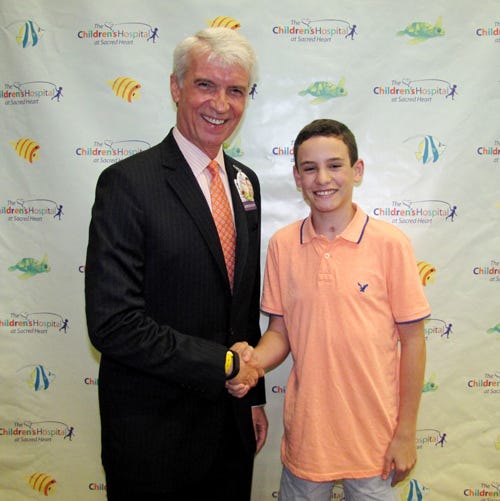
Drew Barefield is congratulated May 2 by Henry Stovall, president of Sacred Heart Hospital in Pensacola, upon being named this year’s Children’s Miracle Network Hospitals Florida Champion.

CRESTVIEW — Drew Barefield, the 2016-17 Children’s Miracle Network Hospitals Florida Champion, is embarking on his first “diplomatic” mission, an awareness campaign in Washington, D.C.

Drew, 14, serves as a fundraising and awareness ambassador for The Children’s Hospital at Sacred Heart Hospital in Pensacola, where he was treated following a June 28, 2014, accident in which he was struck by a boater while snorkeling.

During his recovery, Drew spent 75 days in The Children’s Hospital at Sacred Heart and received 13 surgeries. He continued with months of often painful physical therapy upon returning home to Crestview.

Upon being named Florida’s champion on May 2, Drew said the honor is, for him, a way “to repay the community and show them how much I’m thankful for supporting me through my recovery.”

BUSY ITINERARY

Drew and members of his family arrive Saturday in Washington. Through next week, Drew and Champions from the 49 other states will share their inspiring stories to encourage charitable support for children’s hospitals and provide inspiration for pediatric trauma patients undergoing treatment.

Drew’s itinerary will include:

●A celebratory reception at the JW Marriott hotel with Champion alumni and supporters

●Touring Marriott International headquarters to thank company employees for their continued support

●Attending Senate meetings on Capitol Hill

●Generating awareness at a Washington Nationals baseball game

●Participating in a satellite media tour with TV stations across the country

●Attending an address by  1996 Champion alumnus, best-selling author and Paralympic skier Josh Sundquist.

During their awareness tour, Miss America 2016 Betty Cantrell, the national goodwill ambassador for CMN Hospitals, will accompany Drew and his fellow champions. 

This article originally appeared on Crestview News Bulletin: Crestview teen to campaign for children's health in nation's capital

Crestview High, NWFSC alumnus preparing Gulf for tidal waves (VIDEOS)

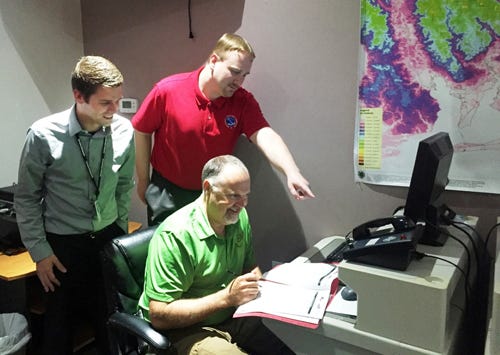
Crestview High School alumnus and Gulf Coast coordinator of the National Tsunami Hazard Mitigation Program Chayne Sparagowski reviews Santa Rosa County tsunami preparedness plans with Jason Beaman of the National Weather Service Mobile office, standing, and Brad Baker, Santa Rosa County Division of Emergency Management director.

CRESTVIEW — The chances of a tsunami hitting Destin or Fort Walton Beach are slim, but the potential exists.

And if it does, a Crestview High School and Northwest Florida State College alumnus wants his native Okaloosa County to be ready.

See video of Sparagowski discussing the Gulf Coast's tsunami risk>>

See part 2 of Sparagowski discussing the Gulf Coast's tsunami risk>>

In 2015, Chayne Sparagowski, now an emergency management specialist in Corpus Christi, Texas, was appointed the Gulf Coast’s coordinator of tsunami preparedness for the National Weather Service’s National Tsunami Hazard Mitigation Program.

Wednesday Sparagowski was back in the area, certifying Santa Rosa County as not just Florida’s first tsunami-ready Gulf Coast county, but the first in the entire five-state Gulf of Mexico region.

Sparagowski said several Atlantic coast Florida counties are also certified.

OKALOOSA, ESCAMBIA NEXT?

Okaloosa and Escambia Counties are currently considering certification, a process that took Santa Rosa about a year, Sparagowski said.

“Basically, there’s a set of requirements that they have to work towards, which include several components,” he said.

Per federal requirements, a county must have the ability to receive a tsunami warning, procedures to notify the public, and conduct public education and readiness exercises.

One of Santa Rosa’s the biggest hurdles, Sparagowski said, was convincing the Board of Commissioners to fund beachside informational signage.

“It is not an easy feat in a place where tsunamis are not usually heard of,” he said.

COMPUTER MODELING

Currently Texas A&M University in Galveston is preparing high-resolution tsunami inundation computer models to help Okaloosa and Escambia prepare for certification.

The results probably won’t be ready until the end of 2016 because of the complexity of programming multiple scenarios, Sparagowski said.

But already preliminary modeling is showing a higher risk than previously thought, he said.

“The risk is there,” he said. “The probability is low but it’s a very high-consequence hazard. Originally along the Gulf Coast, before the high resolution models, we were thinking in terms inches and it was something we wouldn’t have to worry about, but as we started researching we saw it was feet. The maximum possibility is 15 to 20 feet.”

LAND-SLIDE DRIVEN

The closest geological fault lies in the south Caribbean Sea. It generated an early 20th-century tsunami off the coast of Puerto Rico that struck Texas.

But a Gulf Coast tsunami would more likely be caused by underwater land slides, Sparagowski said.

“It’s not going to be an earthquake-driven event,” he said.

Unlike storm surges, tsunamis strike quickly and with more strength, Sparagowski said.

“Generally speaking, along the Gulf Coast, you’re not going to see any inundation very far inland. It’ll be along the immediate coast and the barrier islands,” he said.

“Most of Destin would probably be OK. Okaloosa Island would probably have inundation in the areas along (U.S. Highway) 98 that normally flood in a storm surge.”

Sparagowski emphasized the “probably.”

“Because there’s been no actual modeling done in this area, we won’t know for sure yet,” he said.

BE TSUNAMI AWARE

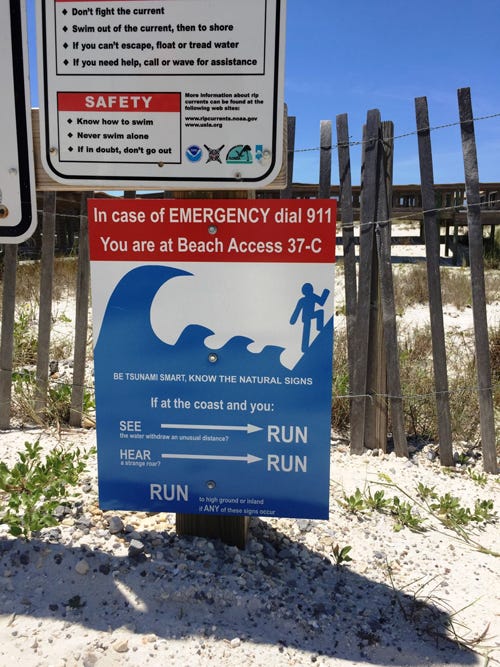
A tsunami, a tidal wave generated by offshore seismic activity such as an underwater earthquake or land slide, often gives advance warning. According to National Weather Service advisories, if on the coast and you:

●See the water withdraw an unusual distance out to sea, run to high ground or inland

●Hear a strange roar, run to high ground or inland

Source: Santa Rosa County Emergency Management

A tsunami, a tidal wave generated by offshore seismic activity such as an underwater earthquake or land slide, often gives advance warning. According to National Weather Service advisories, if on the coast and you:

●See the water withdraw an unusual distance out to sea, run to high ground or inland

●Hear a strange roar, run to high ground or inland

Source: Santa Rosa County Emergency Management

BE TSUNAMI AWARE

This article originally appeared on Crestview News Bulletin: Crestview High, NWFSC alumnus preparing Gulf for tidal waves (VIDEOS)


July 4 weekend blood donations wanted

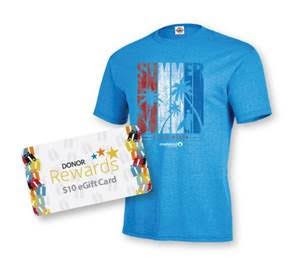
Donors who give blood at donor centers from July 1 to 5 will get a 4th of July Summer T-shirt a $10 gift card, and a buy-one-get-one-free admission to Crayola Experience.

CRESTVIEW — One Blood is accepting blood donations for the Independence Day weekend.

Donors who give blood at donor centers from July 1 to 5 will get a 4th of July Summer T-shirt and a $10 gift card.

Donors also get a wellness check-up of blood pressure, pulse, temperature and iron count, a cholesterol screening, and a buy-one-get-one-free admission to Crayola Experience.

The Crestview Donor Center, located at 2400 Ferdon Blvd. S, is open 8 a.m. to 5:30 p.m. July 1 and 5; noon to 5 p.m. July 3; and 10 a.m. to 5:30 p.m. July 4.

Generally healthy people age 16 or older who weigh at least 110 pounds can donate blood. Photo ID is required.

For more information go to oneblood.org or call 1-888-936-6283.

This article originally appeared on Crestview News Bulletin: July 4 weekend blood donations wanted

Okaloosa health department releases water quality results

FORT WALTON BEACH — The Florida Department of Health in Okaloosa County has announced water quality test results for local parks.

Four Okaloosa County parks have potentially hazardous bathing water, according to a June 22 FDOH media release.

Garniers Park, Fort Walton Beach; Wayside Park, Okaloosa Island; Fred Gannon Rocky Bayou State Park, Niceville; and James Lee Park, Destin failed tests based on EPA-recommended enterococci standards. Enteric bacteria's presence indicates fecal pollution from stormwater runoff, pets and wildlife or human sewage.

This article originally appeared on Crestview News Bulletin: Okaloosa health department releases water quality results

UPDATE: Health department reveals source of Okaloosa's first Zika case

CRESTVIEW — The Florida Department of Health announced today that a travel-related case of Zika virus was reported in Okaloosa County, making this our area's first known instance of Zika. 

However, that's all the department will say. 

"Due to patient confidentiality we cannot disclose where the person lives other than that they are an Okaloosa resident who acquired Zika in St. Lucia," Mara Gambineri, the state DOH's communication director, said.

PREVIOUS COVERAGE:

CRESTVIEW — One incident of travel-related Zika virus has been reported in Okaloosa County, according to the Florida Department of Public Health.

There are seven new travel-related cases today with three in Broward, one in Miami-Dade, one in Okaloosa, one in Osceola and one involving a pregnant woman, according to a DOH media release.

The declaration of Public Health Emergency has been amended to include Okaloosa County.

On Feb. 3, Gov. Rick Scott directed the State Surgeon General to issue a Declaration of Public Health Emergency for the counties of residents with travel-associated cases of Zika.

Okaloosa County is now included in that declaration.

Now, there are 23 counties included in the declaration – Alachua, Brevard, Broward, Clay, Collier, Duval, Escambia, Hillsborough, Highlands, Lee, Martin, Miami-Dade, Okaloosa, Orange, Osceola, Palm Beach, Pasco, Pinellas, Polk, Santa Rosa, Seminole, St. Johns and Volusia.

DOH encourages Florida residents and visitors to protect themselves from all mosquito-borne illnesses by draining standing water; covering their skin with repellent and clothing; and covering windows with screens.

DOH has a mosquito-borne illness surveillance system and is working with CDC, the Florida Department of Agriculture and Consumer Services and local county mosquito control boards to ensure that the proper precautions are being taken to protect Florida residents and visitors.

Of the cases confirmed in Florida, 19 are still exhibiting symptoms. According to CDC, symptoms associated with the Zika virus last between seven to 10 days.

CDC recommends that women who are pregnant or thinking of becoming pregnant postpone travel to Zika affected areas. According to CDC guidance, providers should consider testing all pregnant women with a history of travel to a Zika affected area for the virus. CDC recommends that a pregnant woman with a history of Zika virus and her provider should consider additional ultrasounds.

Florida has been monitoring pregnant women with evidence of Zika regardless of symptoms since January. The total number of pregnant women who have been monitored is 40, with 11 having met the previous CDC case definition.

This article originally appeared on Crestview News Bulletin: UPDATE: Health department reveals source of Okaloosa's first Zika case

ZIKA UPDATE: Okaloosa now included in Declaration of Public Health Emergency

CRESTVIEW — One incident of travel-related Zika virus has been reported in Okaloosa County, according to the Florida Department of Public Health.

There are seven new travel-related cases today with three in Broward, one in Miami-Dade, one in Okaloosa, one in Osceola and one involving a pregnant woman, according to a DOH media release.

The declaration of Public Health Emergency has been amended to include Okaloosa County.

On Feb. 3, Gov. Rick Scott directed the State Surgeon General to issue a Declaration of Public Health Emergency for the counties of residents with travel-associated cases of Zika.

Okaloosa County is now included in that declaration.

Now, there are 23 counties included in the declaration – Alachua, Brevard, Broward, Clay, Collier, Duval, Escambia, Hillsborough, Highlands, Lee, Martin, Miami-Dade, Okaloosa, Orange, Osceola, Palm Beach, Pasco, Pinellas, Polk, Santa Rosa, Seminole, St. Johns and Volusia.

DOH encourages Florida residents and visitors to protect themselves from all mosquito-borne illnesses by draining standing water; covering their skin with repellent and clothing; and covering windows with screens.

DOH has a mosquito-borne illness surveillance system and is working with CDC, the Florida Department of Agriculture and Consumer Services and local county mosquito control boards to ensure that the proper precautions are being taken to protect Florida residents and visitors.

Of the cases confirmed in Florida, 19 are still exhibiting symptoms. According to CDC, symptoms associated with the Zika virus last between seven to 10 days.

CDC recommends that women who are pregnant or thinking of becoming pregnant postpone travel to Zika affected areas. According to CDC guidance, providers should consider testing all pregnant women with a history of travel to a Zika affected area for the virus. CDC recommends that a pregnant woman with a history of Zika virus and her provider should consider additional ultrasounds.

Florida has been monitoring pregnant women with evidence of Zika regardless of symptoms since January. The total number of pregnant women who have been monitored is 40, with 11 having met the previous CDC case definition.

This is a developing story. Please check back for updates.

This article originally appeared on Crestview News Bulletin: ZIKA UPDATE: Okaloosa now included in Declaration of Public Health Emergency

error: Content is protected !!