Please ensure Javascript is enabled for purposes of website accessibility
Skip to main content
Advertisement

No Child Without Healthcare Fair to provide free exams

CRESTVIEW — The 9th Annual No Child Without Healthcare Fair will provide free exams for Northwest Florida children age 18 and under.

The fair is 10 a.m. to 2 p.m. July 30 at Crestview High School, 1304 Ferdon Blvd. N. Doors open 9:15 a.m.; registration to see a doctor ends at 1 p.m.; and children’s games are set for 11:30 a.m.

Parents or guardians must accompany children during the event, which will feature medical providers such as vision, dental and mental health specialists.

Free school and sports physicals, health screenings and lunch at noon will be available. In addition, physicians will discuss topics pertaining to children's health issues, and a blood mobile will be onsite for donations.

Booths will include Medicaid sign-ups for those without affordable health insurance, Head Start sign-ups and the West Florida Area Health Education Center.

Sponsors are the 3rd Masonic District PHA, Florida; Mt Zion A.M.E. Church; Crestview City Councilman Shannon Hayes; and the Kiwanis Club of Crestview, in association with Drs. Joseph Peter and Michael Neuland, of Allergy Partners.

Contact Bazine McDonald, 803-1569 or bworthy@cox.net, or Aisha Morris, 830-3843 or aishakmorris@gmail.com, for more details. 

This article originally appeared on Crestview News Bulletin: No Child Without Healthcare Fair to provide free exams

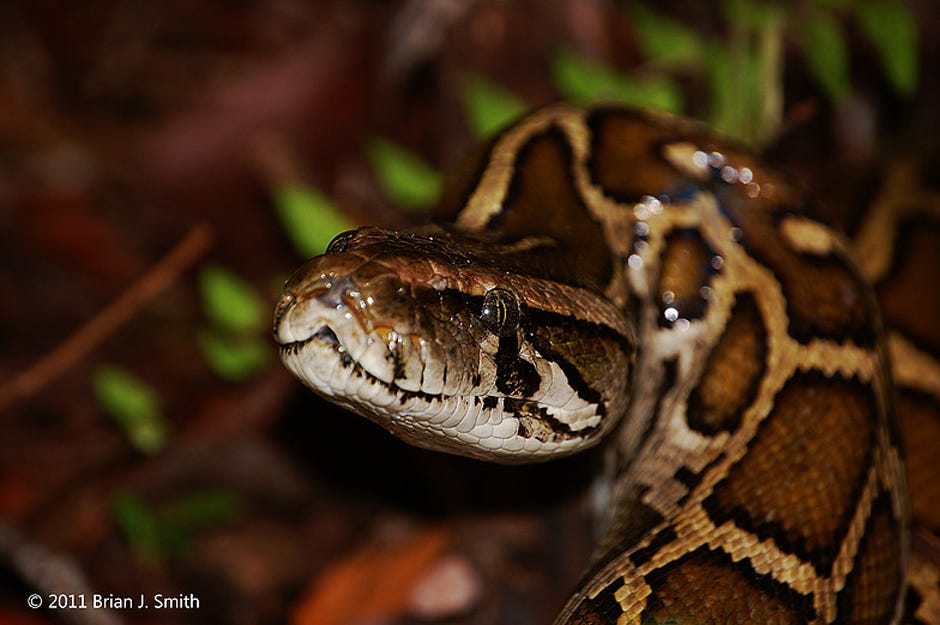
University of Florida: Radio tracking helps hunt Burmese pythons

When invasive Burmese pythons are breeding, radio-tracking one python can help find and capture more, a University of Florida Institute of Food and Agricultural Sciences researcher says. At that point, they become what scientists call "Judas pythons," because they betray their own kind. Scientists say this technique can help them remove the pythons.

GAINESVILLE — When invasive Burmese pythons are breeding, radio-tracking one python can help find and capture more, a University of Florida Institute of Food and Agricultural Sciences researcher says.

Thus, UF/IFAS scientists say this technique can help them remove the pythons.

“This is one more tool we can add to our tool box to help us combat this invasive species,” said Brian Smith, a graduate student in the UF/IFAS wildlife ecology and conservation department and lead author of a new study documenting the radio-tagging experiment. “It is also complementary to our current removal tool, in which we drive on roads and levees to capture moving pythons. It’s complementary because it’s effective at a time of year when we do not catch pythons on the road, and also because it provides more opportunities to catch the really big, breeding females.”

For the new study, UF/IFAS and U.S. Geological Survey (USGS) researchers tracked 25 pythons from 2007 to 2012. Some of the pythons were used in more than one year, so their research covered 33 tracking periods. In those periods, researchers encountered eight of what they call “betrayal events.” At that point, scientists call them “Judas pythons” because they betray their own kind. Those “Judas pythons” led scientists to 14 new pythons, said Smith.

In all, scientists captured 14 new pythons during 33 tracking periods, said Smith, who conducts research under the supervision of assistant professor Christina Romagosa, a faculty member in wildlife ecology and conservation. Smith is also advised by professor Frank Mazzotti, a faculty member at the UF/IFAS Fort Lauderdale Research and Education Center.

While scientists have a complementary tool to remove Burmese pythons, the downside to the radio telemetry technique is that it costs $11,000 per python caught, compared to $6,500 per python caught while cruising around in trucks along Everglades roads. The upside is that snakes help them find Burmese pythons when road surveys aren’t effective.

“Using ‘Judas’ pythons might seem like a wild idea to some, but, despite the cost, it has been the best method to help us find more, large, reproductive individuals during the breeding season,” said Kristen Hart, a USGS research ecologist, study co-author, and a graduate advisor to Smith. “Removal of these large breeders is essential if we are ever to make a dent in the python population.”

Burmese pythons live a normally solitary life, but from December through April in southern Florida, they gather in groups of up to eight, providing an opportunity to spy on them, the study says.

Pythons arrived in South Florida via the pet trade. They then either escaped or were intentionally released into the wild, where they’ve been thriving since at least the mid-1990s.

The Burmese python, whose range stretches from Eastern Indian through mainland Southeast Asia, is a nonvenomous constrictor but can overpower a human. Pythons suffocate their prey before swallowing it.

The new study is published online in the journal Biological Invasions.

Brad Buck is a University of Florida Institute of Food and Agricultural Sciences science writer.

This article originally appeared on Crestview News Bulletin: University of Florida: Radio tracking helps hunt Burmese pythons

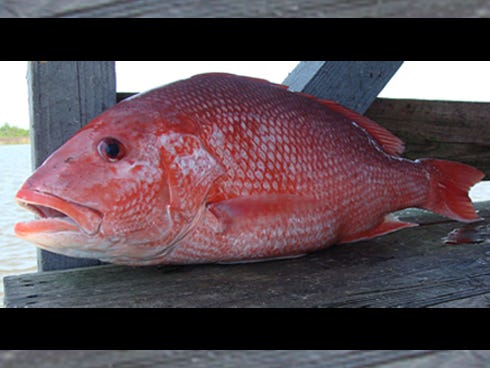
2016 Gulf recreational red snapper state season closes July 11

PANAMA CITY — The 2016 recreational red snapper season in Gulf of Mexico state waters closes July 11, with the last day of harvest being July 10. The season will reopen Fridays, Saturdays and Sundays in September and October, and on Labor Day.

This season will help maintain fishing opportunities for recreational anglers in state waters and provide additional fall weekend fishing days.

The private recreational angler red snapper season in Gulf federal waters ran June 1-9 and was extended two days due to Tropical Storm Colin, closing June 12. The federally-permitted charter boat and head ­boat season for federal waters will run June 1-July 16.

Learn more about red snapper at MyFWC.com/Fishing by clicking on “Saltwater,” “Recreational Regulations” and “Snappers.”

This article originally appeared on Crestview News Bulletin: 2016 Gulf recreational red snapper state season closes July 11

Vacation Bible School attendees study Noah's ark like never before

Benny Bears, Chase Nixon and Jessie Nixon admire an almost 7-foot-long ark model during Vacation Bible School at Joy Fellowship.

CRESTVIEW — Children attending Vacation Bible School at Joy Fellowship admired a 1:72 scale model of Noah's Ark as designed and built by artisan Wayne Sherwood.

Sherwood described his creation’s features to children during the science portion of a lesson.

So, how did this come about?

Well, he was driving by the church a few weeks ago and noticed signage about an upcoming VBS on Noah's Ark. He volunteered his services and his model to church VBS director Liz Bears.

Previously, children read the Genesis account of the ark’s size, as stated in the Bible. Then they designed cubit sticks and measured the ark’s length on the ground. Next, they watched videos on Earth science that support the Biblical View. 

Curriculum and materials for this year's VBS at Joy Fellowship were provided through the Kentucky-based Answers in Genesis Company.

This organization is currently engaged in a project to build a life-sized Noah's ark for the public to tour.

This article originally appeared on Crestview News Bulletin: Vacation Bible School attendees study Noah's ark like never before

SHANKLIN: Generation X'ers juggle a variety of financial issues

If you’re part of “Generation X” — the age cohort born between the mid-1960s and the early 1980s — you’re probably in one of the busiest phases of your life, as you’re well into your working years and, at the same time, busy raising a family.

But just as you’re “multi-tasking” in your life, you’ll also need to address multiple financial goals. In seeking to accomplish your key objectives, you may be asking yourself a variety of questions, including the following:

Should I contribute as much as possible to my IRA and 401(k)? In a word, yes. Your earnings on a traditional Individual Retirement Account (IRA) and a 401(k) grow on a tax-deferred basis, so your money can accumulate faster than it would if placed in an investment on which you paid taxes every year.

Plus, since you typically make 401(k) contributions with pretax dollars, the more you contribute, the lower your taxable income. And your traditional IRA contributions may be tax-deductible, depending on your income.

If you meet income guidelines, you can contribute to a Roth IRA, which provides tax-free earnings, provided you meet certain conditions.

Should I put away money for my kids’ college education? It’s not easy to fund your retirement accounts plus save money for your children’s college education.

Still, college is expensive, so if you feel strongly about helping to pay for the high costs of higher education, you may want to explore college funding vehicles, such as a 529 plan, which offers tax advantages.

Should I pay down my mortgage or invest those funds? Most of us dream of freeing ourselves from a mortgage someday. So, as your career advances and your income rises, you may wonder if you should make bigger mortgage payments.

On one hand, there’s no denying the psychological benefits you’d receive from paying off your mortgage. However, you may want to consider putting any extra money into your investment portfolio to help as you work toward your retirement goals.

Work with your financial adviser to determine what may be most appropriate for your portfolio.

Do I have enough insurance in place to protect my family? You may hear that you need seven or eight times your annual income in life insurance, but there’s really no “right” figure for everyone.

You may want to consult with a financial adviser to determine how much life insurance is appropriate for your needs.

Am I familiar with my parents’ financial situation and estate considerations? Now is the time to communicate with your parents about a variety of issues related to their financial situation and estate plans.

The more you know, the better positioned you’ll be to provide assistance and support if and when it’s needed.

Just to name one example, you should inquire of your parents if they’ve designated a durable power of attorney to make financial decisions for them in case they’re ever incapacitated.

By answering these questions, you can get a handle on all the financial issues you face at your stage of life. It may seem challenging, but taking the time now can help you better position yourself to reach your financial goals.

This article was written by Edward Jones for use by your local Edward Jones financial adviser.

This article originally appeared on Crestview News Bulletin: SHANKLIN: Generation X'ers juggle a variety of financial issues

HEATH: Musical resources abound at the library

Did you know there is an array of musical resources available to you at the Crestview Public Library?

Whether you are a novice wanting to learn how to play the piano, or you would just like to listen to local musicians perform, there is a bit of everything for music lovers.

We have CDs available for checkout as well as musician biographies in traditional and audio formats. There are DVDs of live musical concerts and books to instruct you as you learn to play piano, guitar, drums or even the banjo.

In our website’s electronic resources, you can access the Fine Arts & Music Collection with a valid library card. With hundreds of full-text magazines and journals covered in databases such as the Wilson Art Index and RILM, this collection will provide you with resources to support research in areas such as drama, music, art history and filmmaking.

In addition, local musicians can play in the main area of the library from 6-8 p.m. every Monday and Tuesday.

If you are ready to show off your musical abilities in front a small audience, please contact Sandra Dreaden, 682-4432 to book an appointment.

Acoustic guitarist Ian Gomez is our most recent local talent. His next performance at the library is July 25.

Marie Heath is the Crestview Public Library's director.

This article originally appeared on Crestview News Bulletin: HEATH: Musical resources abound at the library

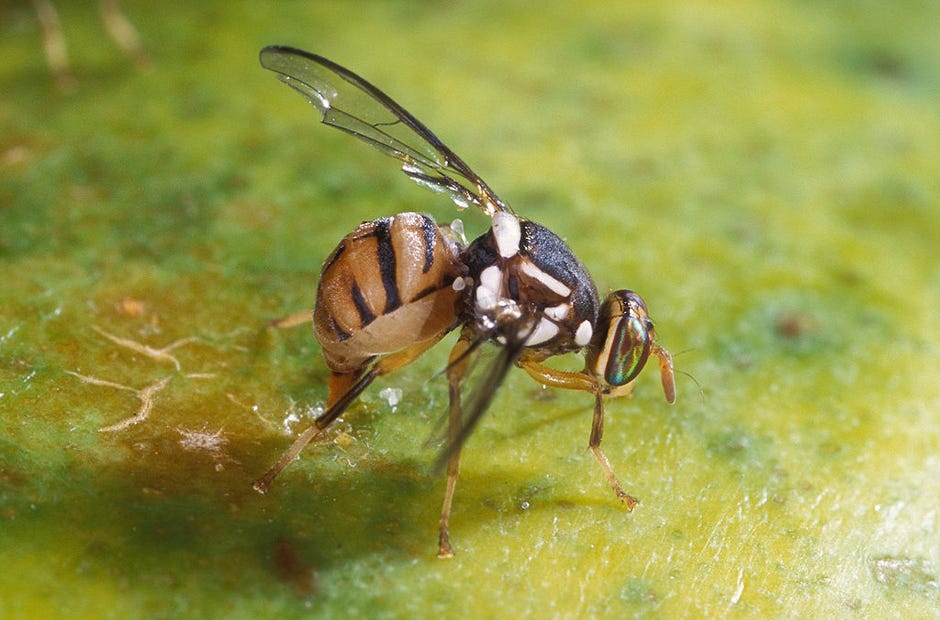
University of Florida: Fruit fly outbreak cost growers $4.1 million

Oriental fruit fly outbreak last year caused at least $4.1 million in direct crop damages in Miami-Dade County, but the damage could have been far worse, University of Florida researchers say.

GAINESVILLE — University of Florida Institute of Food and Agricultural Sciences economists estimate the Oriental fruit fly outbreak last year caused at least $4.1 million in direct crop damages in Miami-Dade County, but the damage could have been far worse, UF/IFAS researchers say.

In the new report, UF/IFAS researchers and the chief economist for the Florida Department of Agriculture and Consumer Services, compiled three scenarios for crop losses: optimistic, mid-range and pessimistic. So, although the optimistic scenario reports direct crop damage at $4.1 million, the pessimistic one shows that the loss could have been $23 million.

Edward “Gilly” Evans, a UF/IFAS professor of food and resource economics, said the $4.1 million loss that he and his colleagues estimated was a conservative one and does not reflect the full economic impact on the economy due to the multiplier effect. In addition to these costs, approximately $1.5 million was spent by state and local agencies in a joint effort to control the outbreak. 

The direct crop losses came as a result of the quarantine protocol and a potential non-planting response by growers in Miami-Dade County.

But UF/IFAS faculty credit quick, decisive actions by FDACS, UF/IFAS and the U.S. Department of Agriculture for limiting the reach of the fruit fly. Among other things, the UF/IFAS Tropical Research and Education Center provided logistics, acting as the hub for the entire operation, Evans said.

“Although there was certainly a cost to growers in the regulated area, all of Florida agriculture would have been negatively impacted if the pest had expanded its reach,” said Amanda Hodges, associate Extension scientist in the UF/IFAS entomology department. “Other states and countries would have stopped outgoing shipments of Florida’s agricultural products. At the very least, this pest would have cost millions if not billions of dollars if it had made a home here.

“Although many insects and diseases will not result in an eradication program, fruit flies generally will,” said Hodges, director of the UF/IFAS doctor of plant medicine program. “In fact, the state of Florida and the USDA have personnel who monitor fruit flies throughout the year. The state of Florida and USDA are the lead agencies for eradication programs in Florida, and fruit fly eradication efforts here are among the most successful in the world.”

In addition to the crop loss, the new UF/IFAS report says the fruit fly outbreak caused between $10.7 million and $58.5 million in overall economic losses. Evans, a faculty member at the UF/IFAS Tropical REC, in Homestead, Florida, outlines the findings in this new Extension document, http://bit.ly/28KHfcA.

Here’s how the damage occurs.

The fruit fly feeds on more than 400 crops, including many grown in Florida. Once established, the insect may cause 25 to 50 percent losses in food-crop harvests. In August 2015, fruit flies began to appear in south Miami-Dade County monitoring traps, prompting FDACS to impose a temporary quarantine on 99 square miles that include an agriculture-dependent area known as The Redland.

Altogether, the county’s agricultural activities generate $1.6 billion in revenues each year.

Blair Siegfried, professor and chair of the UF/IFAS entomology department, said there is little anyone can do to prevent another outbreak other than to be vigilant in detection efforts and prepare for an outbreak if it’s detected.

“Each potential invading species has a unique set of circumstances related to the pest biology and the environment where it is detected,” Siegfried said. “In some cases, eradication may be possible, while in others, learning to manage the pest may be the best we can do.”

Brad Buck is a University of Florida Institute of Food and Agricultural Sciences science writer.

This article originally appeared on Crestview News Bulletin: University of Florida: Fruit fly outbreak cost growers $4.1 million


BEARDEN: Are flies bugging your horses?

A horse fly feeds off a horse June 27 in Crestview.

There are many external parasites that affect horses. Some are just annoying, but some transmit deadly diseases.

The world’s deadliest creature is also a menace to horses. These creatures transmit Eastern Equine Encephalomyelitis, Western Equine Encephalomyelitis, Venezuelan Equine Encephalomyelitis and West Nile viruses. This deadly creature is the mosquito.

Our best defense against these deadly diseases is vaccination. The most effective mosquito control measure is reducing breeding sites (standing water). Clean water buckets and troughs regularly since mosquitoes will lay eggs in these water sources. Mosquito control sprays also help to decrease populations.

There are many biting flies that can also transmit diseases such as anthrax, equine infectious anemia, and anaplasmosis. Horse, deer and stable flies are vicious biters and strong flyers. Like mosquitoes, horse and deer fly females are the biters, while both stable fly sexes bite. The use of repellents can be effective for decreasing bites on horses but should be applied daily.

Another annoying pest is the biting midge also called the no-see-um. These pests cause horses to lose their hair where they are bit. Often this is on the neck, head, tail, and belly. There are no effective control measures for these pests. No-see-ums are most active dusk and dawn and prefer to be outdoors in calm winds. An effective strategy for horse owners is to stable horses before dusk until after dawn.

We have non-biting flies that are problems as well. These include house flies, eye gnats and blow flies. House flies can transmit diseases and internal parasites.

Control includes removing manure from the stable area and applying larvicide to the manure. Also, space sprays are effective but must be reapplied frequently.

Eye gnats are annoying and cannot be effectively controlled. Blow flies are problematic for open wounds and control focuses on proper wound care and disposal of soiled wound dressing.

Another fly that buzzes around your horse is the bot fly. This fly is an external and internal parasite. The adult bot fly lays its eggs on the hairs of the horse. The egg hatches and the larvae enters the horse when the horse licks or chews the area where the eggs are attached to hairs.

The larvae burrows into the lining of the mouth and lives there for 3-4 weeks. It then migrates to the stomach and intestine, where it remains until the next summer.

It then is passed in the manure and burrows into the soil. In one to two months, the adult fly emerges and begins immediately laying eggs.

Control of this pest involves breaking the life cycle. Use a warm water wash (110-120 degrees Fahrenheit) with an insecticide to remove bot eggs. The warm water signals the bot egg to hatch and the larvae is killed when it contacts the insecticide.

Only use insecticides that are labeled for external treatment of horses. Treatments should be applied weekly during August and September. Also, dewormers containing ivermectin and moxidectin are effective against internal bot larvae.

Controlling external parasites on horses can be a challenge but is important. They transmit diseases and internal parasites. They can also make horses sick or weak due to blood loss. They can cause horses to lose weight and hair due to irritation from the flies.

The use of repellents applied daily to your horse is helpful against horse, deer and stable flies. Proper manure management and the use of a larvicide will reduce house fly populations. Breaking the bot fly life cycle will help control this external and internal parasite.

For more information on these external parasites and others, see ENY-283, a University of Florida article on horse parasites at http://edis.ifas.ufl.edu/ig139.

Jennifer Bearden is an agent at the University of Florida's Institute of Food and Agricultural Sciences Extension office in Crestview.

This article originally appeared on Crestview News Bulletin: BEARDEN: Are flies bugging your horses?

5,682 pounds of Florida salad products recalled

GHSE, LLC, a Green Cove Springs, Fla. establishment, is recalling approximately5,682 pounds of salad products containing chickendue to misbranding and an undeclared allergen, the U.S. Department of Agriculture’s Food Safety and Inspection Service (FSIS) announced today. The product contains wheatknown allergennot declared on the product label. 

The ready-to-eat salads with chili-seasoned chicken itemswere produced on various dates between May 11, 2016 and June 29, 2016. The following products are subject to recall:

  • 11-oz. plastic clam shellcontainers with “TRADER JOSE’S MEXICALI INSPIRED SALAD WITH CHILI SEASONED CHICKEN with BEST BY dates05/18/16 – 07/03/16.

The products subject to recall bear establishment number “EST. P-45781” inside the USDA mark of inspection. These items were shipped to retail locations in Alabama, Florida, Georgia, North Carolina, South Carolina, Tennessee,and Southern Virginia.

The problem was discovered by a plant quality assurance technician during a routine check of ingredients. The salads have the correct label on the top of the package, but exhibit an incorrect back label that does not include soy sauce as an ingredient; the source of the wheat. As a result, wheat is not sub-listed in the ingredients statement or in the“Contains” allergen declaration.

There have been no confirmed reports of adverse reactions due to consumption of these products. Anyone concerned about an injury or illness should contact a healthcare provider.  

Consumers who have purchased these products are urged not to consume them. These products should be thrown away or returned to the place of purchase.

FSIS routinely conducts recall effectiveness checks to verify recalling firms notify their customers of the recall and that steps are taken to make certain that the product is no longer available to consumers.

This article originally appeared on Crestview News Bulletin: 5,682 pounds of Florida salad products recalled

7 tips to avoid foodborne bacteria

avoid food.jpg

This Fourth of July, if you are not sure how long food has been sitting out, throw it out immediately.

Whether you’re enjoying a barbecue outdoors, traveling to see family or friends, or spending time at home, the U.S. Department of Agriculture’s Food Safety and Inspection Service urges everyone to take food safety precautions when planning their Fourth of July menu.

The U.S. Centers for Disease Control and Prevention estimates that 1 in 6 Americans — that’s 48 million people — annually acquire foodborne illness, resulting in roughly 128,000 hospitalizations and 3,000 deaths.

“Because foodborne bacteria thrive and multiply more quickly in warmer temperatures, foodborne illness can spike during summer,” said Deputy Under Secretary for Food Safety Al Almanza. “This is likely because people are spending more time outside — away from the sink and equipment in the kitchen that help consumers keep food safe.”

The Danger Zone is the temperature range between 40 and 140 degrees Fahrenheit in which foodborne bacteria can grow rapidly to dangerous levels that can cause illness.

Here’s how to steer clear of the Danger Zone:

●Without refrigeration or a heat source, perishables should not be left out more than two hours if the temperature is at or below 90 degrees Fahrenheit, and only one hour if the temperature is at or above 90 degrees Fahrenheit. Since the weather will likely be hot on July 4, food should be returned to the cooler within an hour. If you are not sure how long food has been sitting out, throw it out immediately.

●Always keep cold food cold, at or below 40 degrees Fahrenheit, in coolers or in containers with a cold source such as ice or frozen gel packs. Keep hot food hot, at or above 140 degrees Fahrenheit, on the grill or in insulated containers, heated chafing dishes, warming trays or slow cookers. If food needs to be reheated, reheat it to 165 degrees.

●Pack an appliance thermometer in your cooler to ensure food stays at or below 40 degrees. Divide large amounts of food into shallow containers for fast chilling and easier use.

●Packing drinks in a separate cooler is strongly recommended, so the food cooler isn’t opened frequently. Keep the cooler in the shade, and try to cover it with a blanket or tarp to keep it cool. Replenish the ice if it melts.

●Use the food thermometer to check internal temperature of meat, poultry and seafood. You cannot tell whether the meat is safely cooked by just looking.

●If you plan to marinate meat or poultry for several hours or overnight before the event, marinate it in the refrigerator — not on the counter. If you plan to reuse the marinade from raw meat or poultry, boil it first to destroy any harmful bacteria.

●To ensure safety, leftovers must be put in shallow containers for quick cooling and refrigerated to 40 degrees Fahrenheit or below within two hours.

This article originally appeared on Crestview News Bulletin: 7 tips to avoid foodborne bacteria

error: Content is protected !!