Please ensure Javascript is enabled for purposes of website accessibility
Skip to main content
Advertisement

Baker church to present movie 'God's NOT Dead'

Shady Grove Assembly of God's free showing of "God's NOT Dead" is 10 a.m. Aug. 7 at the church, 1189 Shady Grove Road, Baker.

BAKER — A North Okaloosa church is hosting a free showing of the movie, "God's Not Dead.

The movie, rated PG for thematic material, brief violence and an accident scene, includes cast members Kevin Sorbo, David A.R. White, and Dean Cain.

Groups and individuals may attend the event, which is 10 a.m. Aug. 7 at Shady Grove Assembly of God, 1189 Shady Grove Road. Lunch will be served afterward in the fellowship hall.

For details, call 537-2774.

This article originally appeared on Crestview News Bulletin: Baker church to present movie 'God's NOT Dead'

A University of Florida guide to eating healthy foods at school

“Discussing the importance of fruits, vegetables, and proper nutrition with your child can help them understand the importance of eating their fruits and vegetables whether they are eating at home, school or somewhere else,” said Gail Kauwell, a UF/IFAS professor of food science and human nutrition.

GAINESVILLE — Children have lots of food and beverage choices when they return to school this fall. Parents can take an active role in ensuring their children eat healthy foods at school, says a University of Florida Institute of Food and Agricultural Sciences researcher.

Also, some parents may be reassured by standards established by the federal government four years ago — the first major changes to school nutrition standards in 15 years, said Gail Kauwell, a UF/IFAS professor of food science and human nutrition.

Parents can encourage their children to eat good food at school, instead of throwing it out.

“Discussing the importance of fruits, vegetables, and proper nutrition with your child can help them understand the importance of eating their fruits and vegetables whether they are eating at home, school or somewhere else,” Kauwell said.

“If you pack your child’s lunch, you can put a ‘fun twist’ on the fruits and vegetables. Making kabobs (place chunks of fruit and vegetables on skewers) or ‘bugs on a log’ (celery, cucumber, or carrot sticks (the ‘log’) topped with peanut butter and dried fruit (the ‘bugs’) are ways to make the fruits and vegetables more fun.”

If your child is eating school food, school lunch regulations are broken down by grade level, Kauwell said.

The regulations require students in kindergarten through fifth grades to be served 8 to 9 ounces of grains and 8 to 10 ounces of meat or meat alternatives per week, with at least 1 ounce of grains and 1 ounce of meat or meat alternatives per day. These lunches will provide 550 to 650 calories, with less than 10 percent of total calories coming from saturated fat.

Also in all grade levels, grains are required to be “whole grain rich,” which means that the product is at least 50 percent whole grain.

The milk varieties that are offered include fat-free (flavored or unflavored), 1 percent low-fat (unflavored), or a milk alternative.

The standards are expected to achieve the following:

●Increase fruits and vegetables served; emphasize whole-grain- rich foods; limit calories.

●Allow “Offer Versus Serve” fruit and vegetable options consistent with the Institute of Medicine recommendations. In this program, students must select at least three of the five food components offered to them (i.e., meat/meat alternative, grains, fruits, vegetables, and milk), and one of these five must include at least a one-half cup serving of a fruit or vegetable.

●Improve cultural food options, such as allowing tofu to qualify as a meat alternative.

Changes to school meals are based on the latest nutritional science and are intended to provide one-fourth of students’ daily calorie needs from breakfast and one-third for lunch, according to the USDA.

Possibly the biggest change with regard to fruits and vegetables is that the new standards set requirements for including a variety of vegetables from different subgroups (i.e., dark green, red/orange, beans/peas, and starchy vegetables), and fruits and vegetables are no longer placed together as a nutritional requirement. Instead, there are specific amounts of fruits and vegetables that must be served daily as part of school lunch meals, Kauwell said.

“Giving students options helps eliminate situations in which students take too much food and throw it away,” wrote Kauwell and her colleagues in an Extension paper. “The best strategy to reduce food waste may simply be to engage and educate students about the new standards to increase acceptance. This might include taste tests of unfamiliar foods or using creative marketing and presentation techniques.”

Brad Buck is a University of Florida Institute of Food and Agricultural Sciences science writer.

This article originally appeared on Crestview News Bulletin: A University of Florida guide to eating healthy foods at school

Northwest Florida companies support breastfeeding initiatives

The Florida Department of Health in Okaloosa County is observing World Breastfeeding Week and National Breastfeeding Month by celebrating the local businesses and hospitals that are working toward making Okaloosa County the breastfeeding-friendliest county in Florida.

FORT WALTON BEACH — The Florida Department of Health in Okaloosa County is observing World Breastfeeding Week and National Breastfeeding Month by celebrating the local businesses and hospitals that are working toward making Okaloosa County the breastfeeding-friendliest county in Florida.

“The diverse benefits of breastfeeding translate into hundreds of dollars of savings at the family level and billions of dollars at the national level through decreased hospitalizations and pediatric visits,” stated Dr. Karen A. Chapman, DOH-Okaloosa director. “Breastfeeding also means food security for infants. Breastfeeding significantly improves the health, development and survival of infants and children. It also contributes to improved health and well-being of mothers, both in the short and long term. This is why it is important that breastfeeding be supported in all aspects of a mother’s life.”

 Local employers currently participating in the DOH-Okaloosa initiative Healthy Okaloosa Worksites are taking steps in providing support in their workplace to their breastfeeding employees. Those that made environmental and policy changes in support of breastfeeding are encouraged to apply for the Florida Breastfeeding Friendly Employer Award given by the Florida Breastfeeding Coalition, Inc.

Local employers recognized in the past year include:

●Twin Cities Hospitals (Silver Recognition)

●Childcare Network #142 (Silver Recognition)

●Acentria Insurance (Silver Recognition)

●Northwest Florida State College – Child Development & Education Center (Silver Recognition)

Fort Walton Beach Medical Center has also taken strides in supporting new and expecting mothers in making the choice to breastfeed. This past year, FWBMC began their journey to earn the Florida Quest for Quality Maternity Care Award through the Florida Breastfeeding Coalition, Inc. The role of the designation is to assess birth facilities’ policies and practices. FWBMC is dedicated to improving the health of babies and is taking steps toward helping mothers initiate breastfeeding within an hour of birth and implementing rooming-in, allowing mothers and infants to remain together 24 hours a day.

To celebrate National Breastfeeding Month, DOH-Okaloosa WIC staff will participate in the first annual Central Panhandle Live, Love, Latch! event taking place at the Landing in Fort Walton Beach, Florida on Saturday, August 27 from 10 a.m. until 2 p.m. The event is hosted by La Leche League of the Navarre and the La Leche League of Central Panhandle.

Almost all mothers can breastfeed successfully, which includes initiating breastfeeding within the first hour of life, breastfeeding exclusively for the first 6 months, and continuing breastfeeding along with giving appropriate complimentary foods up to 2 years of age or beyond. Exclusive breastfeeding and continued breastfeeding for two years and beyond provide high quality nutrients and adequate energy and can help prevent hunger, undernutrition and obesity.

For more information on how to participate in the Healthy Okaloosa Worksite initiative, contact Chandra Williams, 833-9240, extension 2161 or HealthyOkaloosa5210@flhealth.gov.

This article originally appeared on Crestview News Bulletin: Northwest Florida companies support breastfeeding initiatives

OneBlood begins Zika virus testing

Effective immediately, all blood collections throughout OneBlood’s Florida, Georgia, Alabama and South Carolina service areas will be tested for the Zika virus using an investigational donor screening test.

OneBlood operations remain business as usual, and collections will continue throughout its service areas, uninterrupted.

The move follows the FDA requesting blood donations in Miami-Dade and Broward counties be tested for the Zika virus. The guidance was issued in light of the Florida Department of Health investigating four possible non-travel related cases of the Zika virus.

Upon learning of FDA’s recommendations, OneBlood moved swiftly to implement testing in the two South Florida counties, and decided to implement system-wide testing of all blood donations collected throughout its entire service area.

If testing reveals a unit of blood is reactive for the Zika virus, OneBlood will quarantine the unit, notify the donor and alert the Florida Department of Health, the FDA and the Centers for Disease Control.

This article originally appeared on Crestview News Bulletin: OneBlood begins Zika virus testing

University of Florida study: Few people know mushrooms’ health benefits

Relatively few people are aware of the health benefits of mushrooms, according to a new national survey by University of Florida Institute of Food and Agricultural Sciences researchers.

GAINESVILLE — Relatively few people are aware of the health benefits of mushrooms, according to a new national survey by University of Florida Institute of Food and Agricultural Sciences researchers.

Only 18.5 percent of survey respondents said they knew the health benefits of mushrooms, according to the online survey of 674 consumers.

“Potentially, increasing knowledge about health benefits would be useful to the mushroom industry,” said Lisa House, a UF/IFAS professor of food and resource economics and an investigator for the study.

Sue Percival, a UF/IFAS professor and chair of the department of food science and human nutrition and principal investigator for the study, published a study last year that documented how shiitake mushrooms can boost immunity.

They’re also low in calories, fat-free, cholesterol-free, low in sodium, and they’re the leading source of the antioxidant selenium in the produce aisle, according to the National Mushroom Council.

The study, to be presented at a national conference next week, revealed many other clues about consumers’ mushroom-buying habits.

For instance, consumers prefer fresh mushrooms over processed ones, but their choice to buy and eat mushrooms may also be a matter of taste, texture, price and nutritive values, said Yuan Jiang, a food and resource economics doctoral student who conducted the survey.

Jiang and her colleagues found about 20 percent of respondents said they had never bought fresh mushrooms, while 32 percent had never purchased processed mushrooms.

Among the non-consumers of mushrooms, 62.7 percent cited taste as one of the most important reasons, while 55.8 percent said they didn’t buy mushrooms because of its texture, and 40 percent said price deterred them.

“They thought the mushrooms were tough and chewy,” said Jiang, who will present the paper at the 2016 Agricultural & Applied Economics Association Annual Meeting in Boston.

For fresh mushroom consumers, the difference-makers were taste, convenience and health benefits.

Those buying processed mushrooms eat them mostly because they’re less expensive and they taste good. The study also showed that income level is related to fresh mushroom consumption.

With 16 percent of world output, the United States is second only to China in global mushroom production, according to the study. In 2014-2015, the United States produced 862 million pounds of fresh mushrooms and 90 million pounds of processed mushrooms. The U.S. exported 105 million pounds of fresh mushrooms and 263 pounds of processed mushrooms that year.

In fact, mushroom consumption has quadrupled in the U.S. since 1965, while consumption of processed – or canned – mushrooms, has steadily declined, the study says.

Brad Buck is a University of Florida Institute of Food and Agricultural Sciences science writer.

This article originally appeared on Crestview News Bulletin: University of Florida study: Few people know mushrooms’ health benefits

Crestview church schedules Emerald Coast Worship and Arts Encounter

CRESTVIEW — Kingdom Life Worship & Training Center and Rain Music Ministries will host a two-day event called Emerald Coast Worship and Arts Encounter in August.

The Rev. Hartense Haynes of Kingdom Life stated in a media release that goals for the Emerald Coast Worship and Arts Encounter are to worship God and reach the nations of the world by ministering via spoken word, music and dance.

Area residents may attend the night of worship, which is 7 p.m. Aug. 19 at the Crestview Community Center. Apostle Mel Ponder will open a night of worship including a prayer of unity and ministry by some of the workshop instructors.

The next day of the encounter is for seminars featuring the following instructors:

●Nick Coetzee, musician, psalmist, songwriter and producer

●Nikki Mathis, pastor, psalmist and worship leader

●Orlando Wright, psalmist and gospel recording artist

●Jimmie Black, musician, songwriter and psalmist worship leader

●Barbara Oxendine, praise dance minister

●Mel Ponder, apostle

●The Rev. Darlene Haynes-Scheuermann, worship leader and praise dancer

Seminars, also available to the public for registration, are 9 a.m. to 3 p.m. Aug. 20, and cost is $35 per person, or $30 per person for groups of 10 or more.

For more information or to register, call 417-7017 or 305-3016.

Online registration will be available after July 28 at http://ecworship.org.

This article originally appeared on Crestview News Bulletin: Crestview church schedules Emerald Coast Worship and Arts Encounter

WILLIAMS: Asian cockroach is abundant in North Florida landscapes

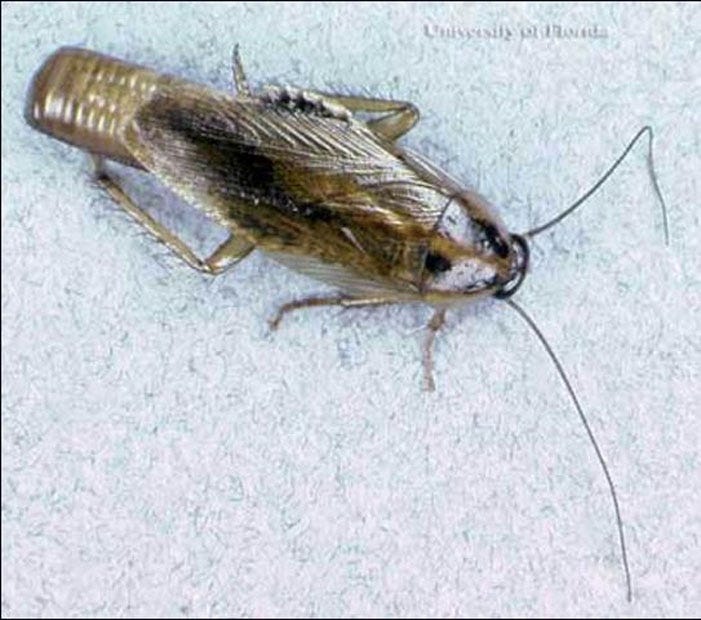
This adult female Asian cockroach (Blattella asahinai Mizukubo) carries an egg case (ootheca).

When people first see the Asian cockroach they may think they are seeing little flying moths. Or they may believe they are seeing the German cockroach because the two species look similar but there are differences.

Both German and Asian cockroach adults are about 5/8 inch long and are brown in color with two darker parallel bands running lengthwise just behind their head. But unlike German cockroaches, Asian cockroaches are strong fliers with sustained flights of at least 120 feet. As a person is hand watering a mulched plant bed, the roaches quickly fly out of the mulch, resembling little moths.

German cockroaches prefer to live indoors and are major household pests as a result. Asian cockroaches prefer to live outside in shaded mulched beds, compost piles and in lawns. Their populations are high, with 30,000 to 250,000 thousand roaches per acre reported.

Asian cockroaches become active at night and are attracted to lights. They often fly inside through any opening in a house such as a lighted doorway or window. Once inside, they fly to and crawl on illuminated television or computer screens and on walls while lights are on during the evening. This is when many people believe they are seeing a German cockroach invasion. But German cockroaches do not fly.

Most people become upset when they see Asian roaches inside their home. But indoor infestations are rare occurrences as this roach species requires more humid outdoor conditions to survive and breed. Once indoors, they usually die within hours.

Even though they are susceptible to insecticides, Asian cockroaches are difficult to control because of their abundant population and ability to fly great distances.

Because they can fly 120 feet or more in a single flight, large areas around a home require treatment. And roaches in nearby untreated areas may result in re-infestation.

Residual sprays around the perimeter of structures are usually unsuccessful because of numerous infested areas in adjacent lawns, mulched and wooded areas. Adults that enter homes immediately fly to walls, avoiding baseboards and other typical areas that are normally treated for German cockroaches.

Best control has been attained by using insecticide baits (labeled for roach control) in infested areas outdoors.

Additional information is available at the UF/IFAS Extension Office in your County or online at http://edis.ifas.ufl.edu/in277.

Larry Williams is an agent at the University of Florida's Institute of Food and Agricultural Sciences Extension office in Crestview.

This article originally appeared on Crestview News Bulletin: WILLIAMS: Asian cockroach is abundant in North Florida landscapes

HEATH: Job resources, resume help available in Crestview

Looking for a job or need resume help? The library is the place to find resources and people to assist with your job-search needs.

Our membership with the Okaloosa County Public Library Cooperative allows you free access, with your library card, to Brainfuse JobNow! a 24-7 electronic resource.

Feature include:

●Live, anytime, anywhere job assistance, including up-to-date nationwide and local job-search engines, professional resume critique and proven interview techniques.

Experience a personalized career center seamlessly integrated with advanced virtual technology to help job seekers of diverse backgrounds and needs.

●JobNow: Live job coaching, real-time interview practice, a full-service resume lab, and 24-7 access to local job resources.

●Adult Learning Center: Access a library of rich adult learning content (GED) and live, professional assistance in resume and cover letter writing, U.S. citizenship preparation and an MS Office Essential Skills Series.

●Personalized eLearning Tools: My File Sharing, My Session Replay, My Tutoring Archive and My Tests Archive.

●24-Hour Writing Lab: Submit essays and other forms of writing for constructive feedback.

●Homework Send Question: Submit homework questions for expert guidance.

●Live Assistance: Interact with live tutors in math, science, reading, writing and history, along with GED and college placement tests.

●Skills Building: Choose your topic to receive real-time help.

●Foreign Language Center /Spanish-Speaking Support

Brainfuse JobNow! is available under our electronic resources link at cityofcrestview.org/178/Library or through readokaloosa.org.

Questions or comments? Visit us at 1445 Commerce Drive, Crestview, call 682-4432 or email me, mgarcia@okaloosa.lib.fl.us

Marie Heath is the Crestview Public Library's director.

This article originally appeared on Crestview News Bulletin: HEATH: Job resources, resume help available in Crestview

SHANKLIN: What should you do with an inheritance?

Will you ever receive a sizable inheritance? You can’t plan on it. But if you do get one, you can plan on using it to help achieve some of your key financial goals.

Once you get word of an inheritance, what steps should you take?

Above all, don’t rush to act. If you are in the midst of the grieving process, it’s hard to make good decisions about money.

Consequently, you may want to consider “parking” your inheritance temporarily in a liquid vehicle, such as a cash or cash alternative investment. Don’t fret if your inheritance isn’t growing much for a few months — you’ll have time to put it to work later.

After you’ve parked your money and some time has passed, you can think about what to do with your inheritance.

Here are a few ideas:

Get rid of debts. Use your inheritance to pay off as many debts as you can, especially those consumer loans that are not tax-deductible and that carry high interest rates.

Establish an emergency fund. This fund should contain six to 12 months’ worth of living expenses. Without it, you may be forced to dip into your investments to pay for unexpected costs, such as an expensive car repair or a hefty medical bill.

Review and adjust your financial strategies. If your inheritance is large enough, it may be a “game changer” in terms of how you pursue your financial strategies.

For example, you may now be able to speed up your timetable toward retirement, if that’s what you want. Or you may be able to pay more of your children’s college education, thus freeing up more funds for your own retirement savings.

In fact, by investing your inheritance in certain ways, you can influence many desired outcomes that you’ve identified in your overall financial strategy.

Your financial adviser can help you make those moves that are most appropriate for your individual needs.

Plan for taxes. Unless you are “inheriting” your spouse’s assets, you may be subject to some type of taxes when you receive an inheritance.

Some types of inheritance, such as proceeds from a life insurance policy, are tax-free. On the other hand, if you inherit a non-spousal 401(k) plan and are forced to take the money as a lump sum, which is likely because most 401(k) providers would prefer to remove the account from their books, your inheritance will be subject to federal, state and local income taxes.

However, thanks to recent tax law changes, as a non-spouse beneficiary you can now transfer an inherited 401(k) to an IRA, which allows you to avoid immediately paying taxes on your inheritance. You’ll still be required to take annual withdrawals, which are taxable, but the amount will be based on your life expectancy, so you can spread out your tax burden.

To make sure you’re making the right moves with an inherited 401(k), consult with your tax adviser.

You may get only one inheritance in your life — so do whatever you can to make the most of it.

This article was written by Edward Jones for use by your local Edward Jones financial adviser.

This article originally appeared on Crestview News Bulletin: SHANKLIN: What should you do with an inheritance?

BRESLAWSKI: Here are 5 tips to save money on school supplies

One of the ways parents can save money on school supplies is to take inventory of supplies they already have. Items like unfilled notebooks, and even used pencils are still able to be used the next year. There may be no need to buy brand new supplies, says Jill Breslawski.

The first day of the new school year is a few short weeks away; all you have left to do is back-to-school shopping.

No problem, right?

But then you take a look at that long list of school supplies and realize all your kid needs is … everything!

Heading to the store with a long list of school supplies can hit a wallet hard.

Here are tips to avoid spending beyond your budget:

●Take inventory of supplies you have. Items like unfilled notebooks and used pencils can be used the next year. There may be no need to buy new supplies.

●Check with the teacher to see if any items are not needed until later in the school year. You may be able to put off that purchase until you have a chance to save.

●Shop on the tax-free weekend to save on paying sales tax. This year, Florida’s tax-free day is the weekend of Aug. 5.

●For back-to-school clothes, arrange a clothing swap party with other parents. Trade clothes your child has outgrown for clothes from another growing youngster.

●Teach your child to save by setting a budget; they will learn how to compare prices, use coupons and shop for-sale items.

Want to take another step to saving money? Visit Okaloosasaves.org to pledge to save.

Throughout July, children can still make a deposit to a new or existing bank account, at participating financial partners, and complete an entry form for the Okaloosa Saves Teach a Child to Save campaign. Participants will be entered into a drawing to win a $50 deposit. Visit Okaloosasaves.org for additional details.

For more tips or help saving money, feel free to contact me at the extension office, 689-5850 or jbreslawski@ufl.edu, and check out www.okaloosasaves.org to take the America Saves Pledge and also follow Okaloosa Saves on Facebook and Twitter. 

Jill Breslawski is an agent at the University of Florida's Institute of Food and Agricultural Sciences Extension office in Crestview.

This article originally appeared on Crestview News Bulletin: BRESLAWSKI: Here are 5 tips to save money on school supplies

error: Content is protected !!