Please ensure Javascript is enabled for purposes of website accessibility
Skip to main content
Advertisement

Health advisory set for Okaloosa beach

An Okaloosa beach is under a health advisory. [Pixabay.com]

CRESTVIEW — The Florida Department of Health in Okaloosa County has issued a health advisory for a county beach.

A health advisory is issued for Liza Jackson Park of Fort Walton Beach. The health advisory is based on the U.S. Environmental Protection Agency’s recommended standards for enterococci. This should be considered a potential health risk to the bathing public.

The FDOH conducts bi-weekly saltwater beach water quality monitoring at 11 sites through the Healthy Beaches Monitoring Program.

Samples are collected from March through the end of October. The water samples are analyzed for enteric bacteria (enterococci) that normally inhabit the intestinal tract of humans and animals and which may cause human disease, infections, or rashes. The presence of enteric bacteria is an indication of fecal pollution, which may come from stormwater runoff, pets and wildlife, and human sewage.

Call 833-9247 or 689-7859 for more information on healthy beaches. Visit www.HealthyOkaloosa.com and click the Healthy Beaches link for sampling results and maps.

The FDOH, nationally accredited by the Public Health Accreditation Board, works to protect, promote and improve the health of all people in Florida through integrated state, county and community efforts.

This article originally appeared on Crestview News Bulletin: Health advisory set for Okaloosa beach

Old Spanish Trail Rodeo gears up for 28th year

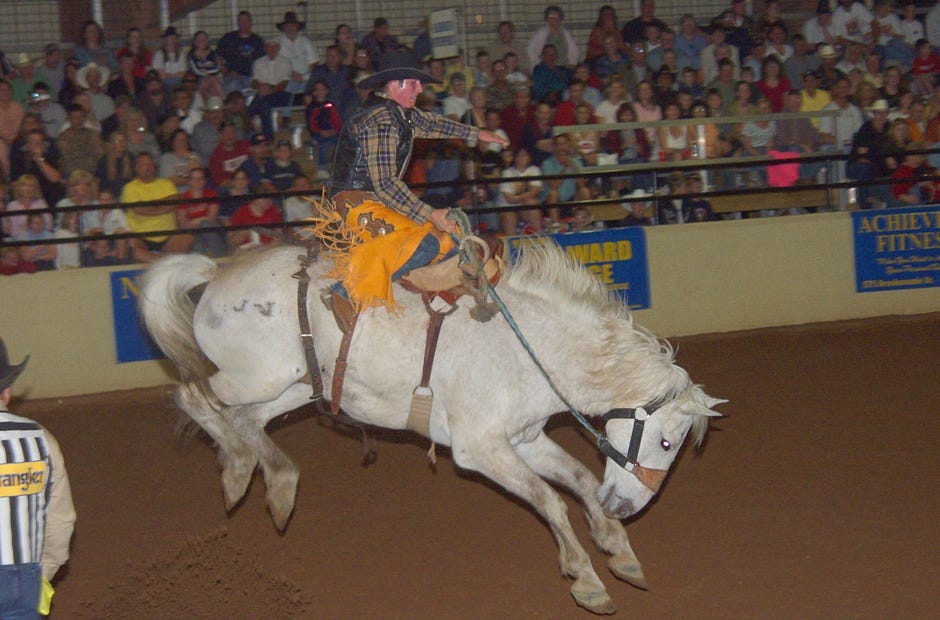
An All American Cowgirl Chick performs during the 2015 rodeo in Baker. [Special to the News Bulletin]

BAKER — The Old Spanish Trail Rodeo is returning to Baker for the 28th year and plans to bring family-friendly entertainment in addition to traditional rodeo events.

The rodeo — April 7-8 at the Barnhill Arena, 5503 Highway 4 — is the largest fundraiser for the Baker Area Recreation Association. BARA runs the Barnhill Arena and other amenities focused on an equestrian lifestyle.

The rodeo will feature over 200 riders from across the southeast United States performing events such as roping, barrel racing, bull riding and bulldogging.

The event, part of the National Cowboy Pro Rodeo Association circuit, allows participants to compete for a spot in the regional finals — and a purse exceeding $50,000.

The rodeo will include two groups known as the Hurricane Hookers and the All-American Cowgirl Chicks.

The Hurricane Hookers pit three riders against Mexican fighting bulls, according to BARA President Mark Todd. These bulls are aggressive and take aim to whatever is in front of them, he added. The riders will compete for over $2,000 in prize money.

The All-American Cowgirl Chicks are a Texas group of experienced riders who perform trick riding and stunts.

“They do everything at a very high rate and high pace,” Todd said.

The Cowgirl Chicks will also host a meet-and-greet from noon to 2 p.m. April 8 at the Ace Hardware, 702 N. Ferdon Blvd.

The rodeo aims to engage children by offering two scramble events each night for different age groups. Children aged 5 to 8 get their chance to catch chickens in the main arena while those aged 9 to 12 can catch pigs.

For the sixth year, the rodeo has collaborated with Baker School to encourage youth reading with a program called “Reading for the Rodeo” for kindergartners through fifth-graders. Students reading a set number of books independently receive a voucher for entry, popcorn and a drink. Over 225 students received a voucher last year, according to Todd.

Attendees on Saturday, April 8, can wear pink to support breast cancer awareness. Each year, BARA donates $1,000 to a local breast cancer awareness chapter.

The event’s organizer said there’s something for everyone to enjoy.

“We want people to go away enjoying it as a family event that was more than just a traditional rodeo,” Todd said.

Admission gates open 5 p.m. April 7 and 8, with the show starting at 7:30 p.m. Todd encourages people to arrive early as seating is first-come, first-serve and some have to view from a standing-room-only area.

Adult tickets cost $12 in advance and $15 at the gate. Children 5 to 12 pay $7 in advance and $10 at the gate. Children under 5 get in free.

Advanced tickets can be purchased at these locations:

  • Baker Parts and Supply
  • Gator Cafe
  • Days Tire
  • Baker Feed and Country Store
  • Tractor Supply
  • Blackman Country Store
  • Farm World (Laurel Hill)
  • Taco Town (Baker)
  • Baker Farm Center
  • Ace Hardware (Crestview, DeFuniak Springs, Bluewater Bay, Fort Walton Beach, Niceville)
  • Samuel’s Roadhouse
  • Azteca Mexican Restaurant
  • Horse Around Feed and Tack (Mossy Head)
  • Wooten Lumber
  • Pic N Sav (Baker)
  • Coastal Bank and Trust (1139 Industrial Drive in north Crestview)

This article originally appeared on Crestview News Bulletin: Old Spanish Trail Rodeo gears up for 28th year

School gardening promotes healthy eating

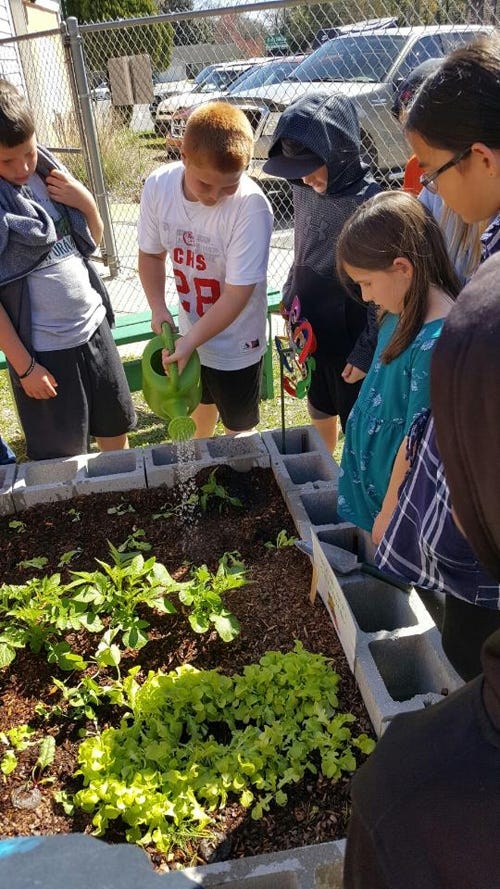
Bob Sikes Elementary fourth-graders in Jordan Appelberg's fourth grade class enjoy planting and working in their raised bed garden. [Special to the News Bulletin]

Children learn best when they are actively involved, doing something. Gardening is a great way to include children in experiential learning that promotes hands-on activities in an outdoor classroom.

This year, our Okaloosa County Master Gardener volunteers, 4-H and the Family Nutrition Program have teamed up to reach several local schools and provide the expertise and resources to use gardening and teach youths about science, biology and nutrition.

At Bob Sikes Elementary School, teams built six raised beds so that each fourth-grade class could plan and prepare, and then care for their class garden. The enthusiasm is evident each week as youths get to plant, weed and water plants.

Lessons for the week center on science and biology; students learn how plants grow, and receive education on nutrients needed for plants and problems like good bugs and bad bugs.

As students learn and take care of their garden, nutrition lessons center on vegetables they will soon harvest. Tasting sessions and basic nutrition are taught in hands-on activities that allow students to experience new food and learn about healthy eating.

Introducing children to gardening lets them see where their food comes from, and helps them understand the importance of eating whole foods locally grown and harvested.

Teachers who participate also use the garden as a place for other enrichment activities like sitting in the garden and writing a paper or using the ambience to create artwork.

If you have children at home and want to try an easy planting activity, grow potatoes in a laundry basket or other large container.

You will need one laundry basket, which can be purchased at a local dollar store.

Here’s what to do:

  • Fill the baskets with about 2 inches of soil and compost.
  • Put two to three seed potatoes into each basket. Cut each potato into three pieces with two to three eyes each. Only use certified seed potatoes. Certification ensures that the seed tubers are free of disease. You can buy certified seed from local garden centers.
  • Cover the potato pieces with soil just barely to the top. Keep doing this until you have half the basket full of growing potatoes and soil.
  • As the potatoes grow, add soil to the basket to keep the tops just above the soil; this simulates "hilling" the potatoes in a garden.
  • Water the basket slowly; holes on the sides can make it challenging if you get in a hurry.

Potatoes are ready within 100-110 days, depending on the variety. One of the most common varieties, Red Pontiac, can be found locally.

Pamela H. Allen is an agent at the University of Florida's Institute of Food and Agricultural Sciences Extension office in Crestview.

Children can help prepare these simple recipes in the kitchen featuring commonly grown vegetables.

Crispy Potato Wedges

Ingredients

  • 4 potatoes, scrubbed clean
  • 1/4 cup extra virgin olive oil
  • 1/4 teaspoon salt
  • 1/4 teaspoon garlic powder
  • 1/2 teaspoon paprika
  • 1/4 teaspoon black pepper
  • 2 tablespoons chopped fresh parsley leaves
  • 1/4 cup grated parmesan cheese

Directions

  • Cut potatoes into wedges by cutting lengthwise in half then slice each half into three slices.
  • Place the salt, garlic powder, paprika and black pepper in a mixing bowl. Add potatoes and toss them in the spices. Next, add the olive oil to the bowl and toss until potatoes are coated.
  • Place coated potato wedges so they are in a single layer on a nonstick baking pan.
  • Bake at 450 degrees for 30 to 35 minutes until the potatoes are cooked through, browned and crispy.
  • While potatoes bake, chop the parsley and grate the parmesan cheese. Place both into a large mixing bowl.
  • After baking and while still hot, toss potato wedges in the mixing bowl with parsley and cheese.

Serves 4–6.

Raw Veggies with Yogurt Dip

Ingredients

  • 1 cup nonfat plain yogurt
  • 1 package ranch dressing
  • Veggies (may use any raw vegetable grown in the garden)
  • Carrots
  • Broccoli
  • Green or red bell peppers
  • Cucumbers — washed and thinly sliced

Directions

  • Wash hands and surfaces.
  • Wash vegetables using a vegetable brush. Pat dry and cut vegetables into bite-size pieces.
  • Mix yogurt with ranch dressing mix in a medium bowl.
  • Place vegetables and dip on a tray and enjoy.
  • Immediately refrigerate leftovers.

Serves 6–8.

Do try this at home

This article originally appeared on Crestview News Bulletin: School gardening promotes healthy eating

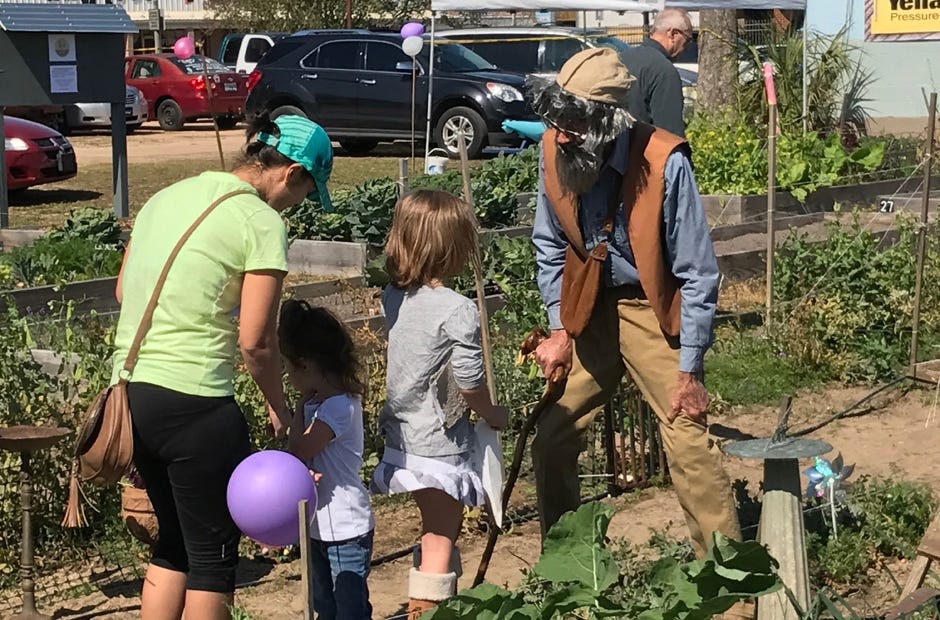
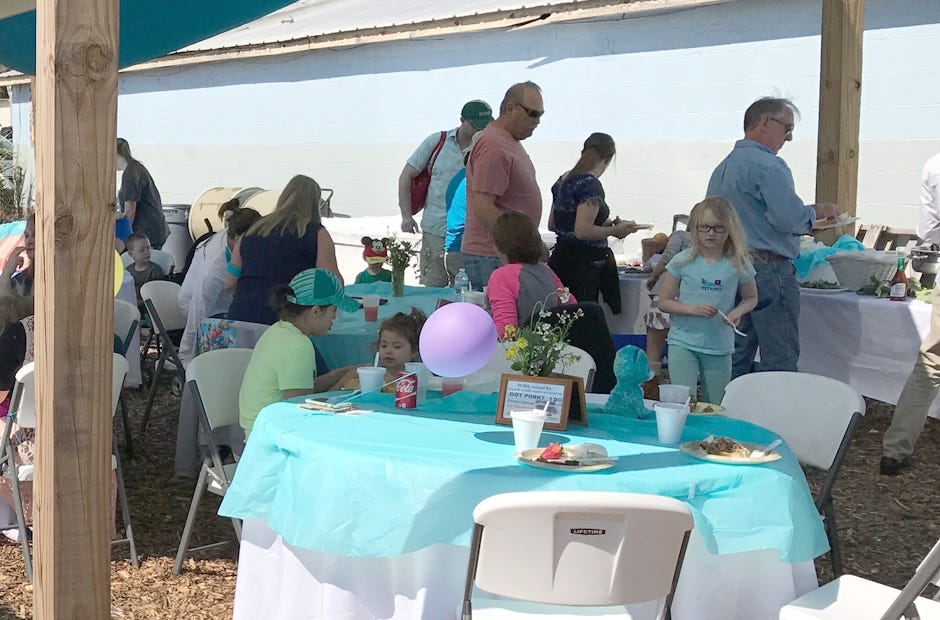
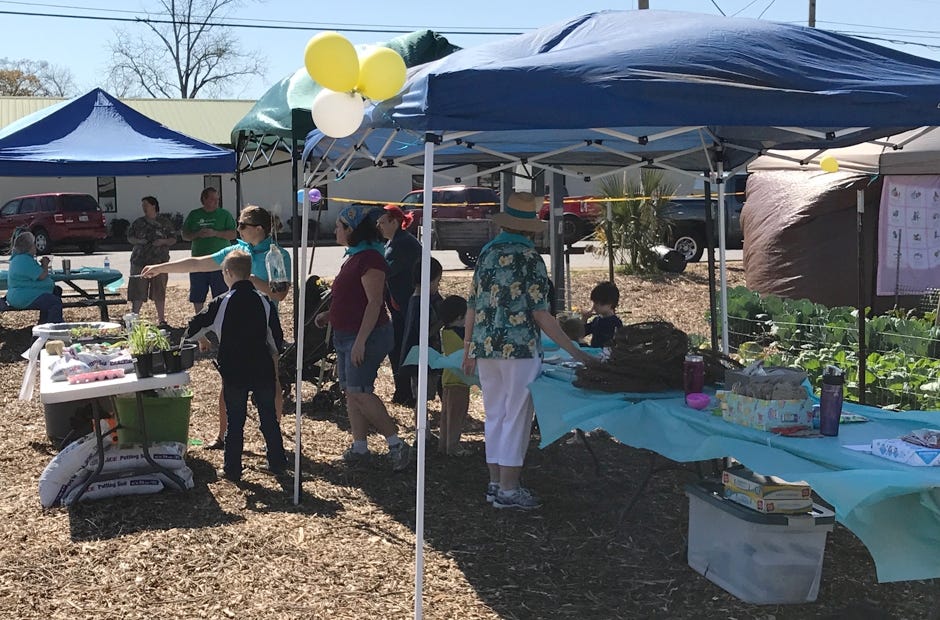
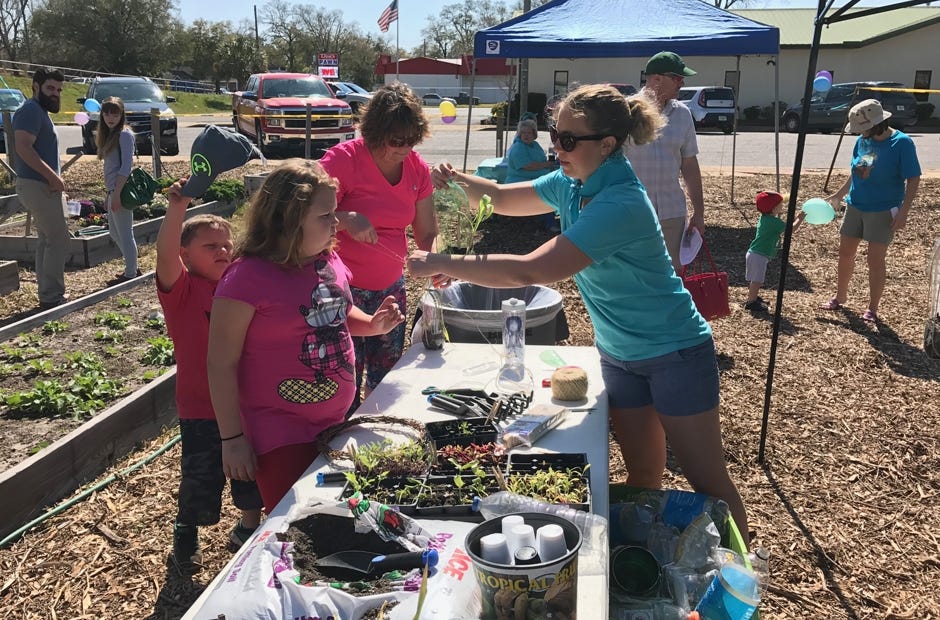
A garden for everyone

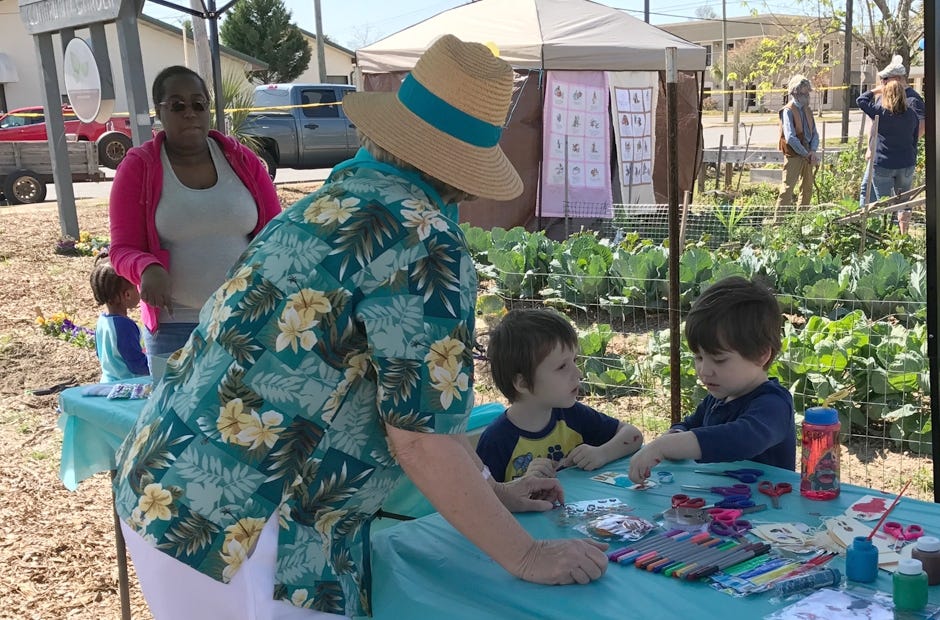
Volunteers at the Common Ground Community Garden walk through rows of garden plots. [MARK JUDSON/NEWS BULLETIN]

Editor’s Note: This continues our Celebrate Community series on nonprofit organizations that improve North Okaloosa County residents’ quality of life.

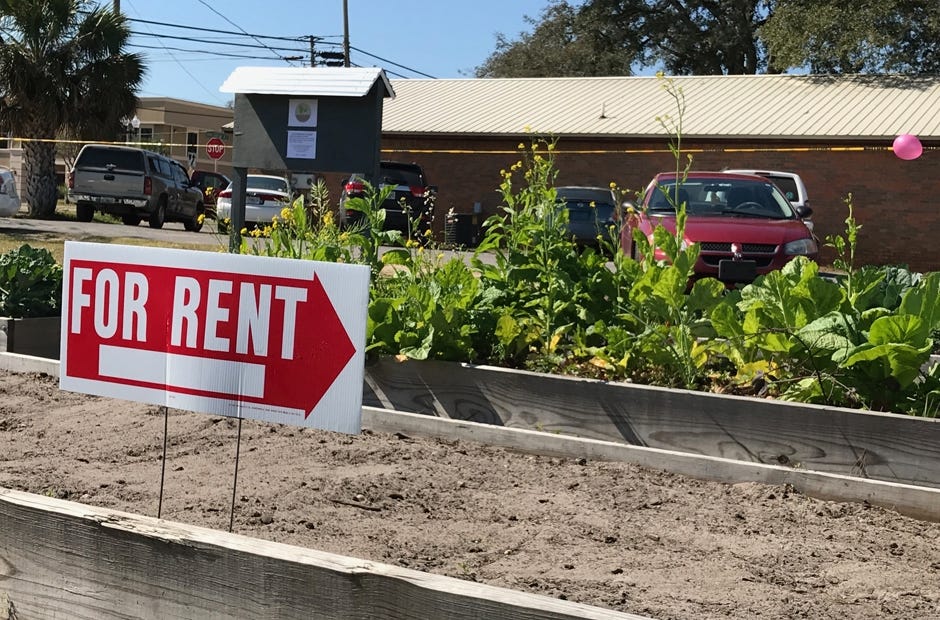
CRESTVIEW — Colorful rows of cabbage, kale, swiss chard and carrot tops line a patch of land nestled downtown between Main Street and Ferdon Boulevard.

Common Ground Community Garden, as the name suggests, serves as an area to unite people of all gardening backgrounds. Since January 2013, the space has allowed residents to rent a garden bed and grow as they please using organic practices.

THE CROP LAYOUT

“Gardening together is fun and provides support for people of all gardening levels,” said Cathy Ward, director of the non-profit organization that operates Common Ground.

The garden has 36 plots measuring 4 feet in width and 12 feet in length. There’s also a pair of plots raised to waist level for people who have difficulty bending or stooping.

While most occupied plots are filled with vegetables, fruits and herbs, others are lined with ornamental flowers. One unoccupied plot houses nitrogen-rich plants intended to fertilize the soil; others sit waiting for a gardener to rent them.

Cutting through the middle of the two sections of plots are several rows of community-grown crops. These vegetables are maintained by everyone in the garden and, thus, available to be picked by anyone contributing to their growth.

“There’s almost always something available for members to take home,” Ward said, speaking of the row crops.

RESOURCES FOR NOVICES

Common Ground members and the garden’s website offer less-experienced gardeners resources on growing their own food.

Several members are master gardeners or have years of experience. Workdays are 9 a.m. to noon each Tuesday — new members or learners are encouraged to attend.

Tending one’s garden isn’t limited to Tuesday mornings. Plot owners can visit the garden at their leisure and keep whatever they grow, although it’s recommended to do so at least two or three times each week during the growing season.

Not sure when the growing season is for Crestview? Common Ground’s website, www.crestviewcommunitygarden.org, offers calendar and climate resources to aid new gardeners.

Using data from the National Oceanic and Atmospheric Administration, the website details average dates for freezes, a 10-day forecast and current radar.

Information for neighboring areas such as Destin, Laurel Hill, Escambia Farms, Niceville and several others is also available on the site.

With a readied plot and knowledge of area weather, planting is the next step.

The website breaks down monthly plans to use as guidelines for growers. During March, for example, begin planting melons, squash or cucumbers inside to prepare for an outside transplant. Certain leafy greens and peas can also be planted directly in the plot during this time.

The site also offers tips and advice for gardeners during each month. Additionally, links to information on several common fruits and vegetables can be found.

Similar information is available on the Common Ground Facebook page, one of the organization’s most active means of communication, according to Ward.

LESSONS IN THE GARDEN

Another chief goal of the garden is to serve as a place for outdoor mentorship to youth, Ward said.

She encourages parents, guardians and educators to bring children to the garden and teach them about the practice, or conduct other learning in a green environment.

“We want to see more kids coming in here and learning,” she said.

Interested parties can rent a plot for $50 per year and the money is recycled back into the garden for electricity, water and supplies.

Alternatively, individuals with financial need can exchange work in the garden for a rental plot.

“Most people also don’t realize you can purchase seeds using EBT,” Ward said. Electronic Benefit Transfer, or EBT, is a form of welfare subsidy used for purchasing food.

That means anyone can become more self-sufficient — and that’s the point.  

“We don’t want lack of funds to prevent anyone from having a part in the garden,” Ward said. 

Common Ground Community Garden is located at 157 S. Main St., adjacent to the Ferdon Boulevard overpass, in Crestview.

Visit www.crestviewcommunitygarden.org for more information on the garden.

Interested residents may visit the garden during a Tuesday workday, 9 a.m. to noon, to explore the grounds and speak with members.

This article originally appeared on Crestview News Bulletin: A garden for everyone

RECALLED: Beef products contain metal objects

KING’S COMMAND FOODS, LLC. RECALLS BEEF PRODUCTS

DUE TO POSSIBLE FOREIGN MATTER CONTAMINATION

WASHINGTON, March 17, 2017 – King’s Command Foods, LLC., a Kent, Wash. establishment, is recalling approximately 63,252 pounds of ground beef products that may be contaminated with extraneous materials, the U.S. Department of Agriculture’s Food Safety and Inspection Service (FSIS) announced today.

The scope of this recall expansion now includes 37,114 pounds of Ready-to-Eat (RTE) beef products associated with extraneous material contamination. The meatballs were produced on May 16 and 24, 2016, Aug. 11, 2016 and Oct. 5, 2016. The following products are subject to recall:

28-lb. case bulk packages of “FULLY COOKED MEATBALLS” bearing case code 72355 with packaging dates of 5-16-16, 5-24-16, 8-11-16 and 10-05-16.

10-lb. case bulk packages of “FULLY COOKED Certified Angus Beef Brand MEATBALLS” bearing case code 72090.

10-lb. case bulk packages of “FULLY COOKED Certified Angus Beef Brand MEATBALLS” bearing case code 72092.

On March 9, 2017, King’s Command Foods, LLC. recalled approximately 26,138 pounds of ground beef products produced on Oct. 13 and 24, 2016. The following products are subject to recall:

28-lb. case bulk packages of “FULLY COOKED MEATBALLS” bearing case code 72354.

28-lb. case bulk packages of “FULLY COOKED MEATBALLS” bearing case code 72355.

15-lb. case packages containing 96 pieces of 2.5 oz. “FULLY COOKED SOUTHERN FRIED Beef Steak Fritter for Chicken Fried Steak” bearing case code 72559.

15-lb. case packages containing 240 pieces of “FULLY COOKED COUNTRY FRIED BREADED BEEF FINGERS” bearing case code 72208.

15-lb. case packages containing 60 pieces of “FULLY COOKED SOUTHERN FRIED BEEF STEAK FRITTER” bearing case code 72568.

15-lb. case packages containing 80 pieces of “FULLY COOKED CHICKEN FRIED BEEF FRITTERS” bearing case code 72564.

10-lb. case packages containing 40 pieces of “FULLY COOKED SOUTHERN FRIED BEEF STEAK FRITTER FOR CHICKEN FRIED STEAK” bearing case code 72206.

10-lb. case packages containing 64 pieces of 2.5 oz. “FULLY COOKED Southern Style Breaded Beef Steakettes” bearing case code 74917.

10-lb. case packages containing 160 pieces of 1.0 oz. “B-E-K-O FULLY COOKED COUNTRY FRIED BEEF FINGERS” bearing case code 72374.

The products subject to recall bear establishment number “EST. M1515A” inside the USDA mark of inspection. Some items were shipped to Department of Defense facilities and institutions nationwide.

The problem was discovered when company officials received several consumer complaints stating that metal objects were found in the beef products.

There have been no confirmed reports of injuries or adverse reactions due to consumption of these products. Anyone concerned about an injury or illness should contact a healthcare provider.

Consumers who have purchased these products are urged not to consume them. These products should be thrown away or returned to the place of purchase.

This article originally appeared on Crestview News Bulletin: RECALLED: Beef products contain metal objects

Dentist helps orphans 9,000 miles away

Jennifer Wayer visits a family wiith a child who has special needs in Swaziland. Wayer has spent years advocating for families, like this one, in the African nation. [PHOTO COURTESY OF JENNIFER WAYER]

CRESTVIEW — When Jennifer Wayer arrives at her Crestview Family Dentistry office, she is ready to ensure people have healthy teeth, gums and mouths.

When she’s not assisting patients, she’s helping children and families nearly 9,000 miles away in the south African nation of Swaziland.

ORPHAN TO HEIR

Wayer’s involvement with Swaziland began five years ago while volunteering with World Vision International, a Christian-based humanitarian group. She contributed to a pipe-building project that brought drinking water to the community of Mpolonjeni and its 30,000 citizens.

Wayer saw an opportunity to help even more people through a project she’s named Orphan to Heir. The soon-to-be non-profit organization focuses on the nation’s 200,000 orphans and aims to provide them medical and theological support.

“We live in a bubble of privilege [in America],” Wayer said.

Swaziland is not as fortunate. The nation has the world’s highest HIV/AIDS rate, about 28 percent infected, according to the World Health Organization and several health watchdog agencies.

The disease’s effects leave a large number of children orphaned, according to Wayer.

“This disease is taking away an entire generation,” she said.

Orphan to Heir brings training and resources to these children, caregivers and local pastors. Providing bibles in the country’s native language, siSwati, has been one of Wayer’s primary goals. Religion is currently passed down using oral tradition, Wayer said.

Pastors and religious leaders had no formal training, Wayer discovered on a previous mission. Orphan to Heir sponsored those leaders to receive that education at the University of South Africa.

Wayer has also used her own educational background and work experience to teach Swazi children proper dental hygiene. These dental and medical skills have also been passed to area leaders so they can continue to care for their citizens.

“We can’t police the world and always put Band-Aids on problems but [Swazi leaders] can be those individuals,” Wayer said. “They just don’t have the resources.”

She has also partnered with the New Hope Centre, an orphanage and school founded in 2002, in Swaziland.

A WIN-WIN SITUATION

A WVI display with statistics, information and pictures sits just inside the Crestview dental office’s entrance, flanked by a woodcarving of Africa reading, “from orphan to heir.”

Not everyone in the office has embraced Wayer’s causes, but overall it’s been a supportive environment, she said.

She’s also found a win-win situation: a way to benefit the local community while assisting the Swazi children. Some patients over the years have been unable to afford their dental care procedures.

Wayer compromises with what those individuals can afford and accepts it as a donation to Orphan for Heir.

“It benefits our community because it allows us to provide care to those that couldn’t afford it otherwise and still raise donations to help the [Swazi] children,” she said.

Wayer hosts other fundraisers for Orphan to Heir, such as a recent Boston Butt sale.

Wayer, often accompanied by her daughter Sarah, will take her sixth trip to Swaziland in May.

“We’ve been very organic with the growth and direction of [Orphan to Heir],” Wayer said.

She’s currently converting the group to a 501(c)(3) organization, which would deem it a non-profit.

Email Wayer at jwayer629@gmail.com for more information on Orphan to Heir, including ways to make donations.

This article originally appeared on Crestview News Bulletin: Dentist helps orphans 9,000 miles away

United we stand, untied we fall

The Rev. Mark Broadhead is pastor at Laurel Hill Presbyterian Church and First Presbyterian Church of Crestview. [File photos | News Bulletin]

There is a song known in many Christian circles that says in part, “We are one in the Spirit, we are one in the Lord … and we pray that all unity will one day be restored. And they’ll know we are Christians by our love … Yes, they’ll know we are Christians by our love.”

Did you know there are over 40,000 Christian denominations around the world? And yet, when Jesus established his church there wasn’t even one denomination. It was one church, one body.

The word we use for “church” is “ecclesia,” which means “called” or “body of people.”

When Jesus told Peter that he would be the foundation on which Christ’s church — his “ecclesia” — would be built, I am quite sure Jesus intended for there to be one body, just as there is “one Lord, one faith, one baptism, one God and Father of all.”

So, why over 40,000 different denominations? 

Pride. 

Over the past 2 millennia, men and women have argued over scriptural interpretations and theological understandings. When an impasse was reached, the tendency has been to say, “I’m correct, you are wrong.”

The result? People were either kicked out, or they broke off from the other side and started their own group of like-minded people. 

Eventually, dissension would arise within that group, and another split would ensue.  The dominoes then kept falling.

It doesn’t seem that Christians are known by their love. Instead, a great many are known for their sniping, bickering, splits, being judgmental, and their inability to get along with those of differing thoughts.

I’m sure the Evil One — aka Devil —is in his glory. He knows the truth behind the phrase “divide and conquer.” What better way to destroy the Body of Christ than by getting us to argue with and condemn other Christians?

I wonder if Christ’s church will ever agree to disagree without condemning others of differing thoughts. 

I wonder if Christ’s church will ever be able to live in unity in spite of our diversity. 

I wonder if we will ever truly realize that what binds us together is not our compatibility but our commonality: we are all sinners in need of God’s grace. 

Period.

United we stand, untied we fall.

The Rev. Mark Broadhead is pastor at Laurel Hill Presbyterian Church and First Presbyterian Church of Crestview.

This article originally appeared on Crestview News Bulletin: United we stand, untied we fall

What health insurance can — and can't — buy

Janice Lynn Crose, a former accountant, lives in Crestview with her husband, Jim; her two rescue collies, Shane and Jasmine; and two cats, Kathryn and Prince Valiant.

Medical insurance is getting lots of attention right now in the media, and there are many viewpoints.

I shared some of mine a few weeks ago about both doctors and hospitals posting their prices for service. I think a free-market fee for services would work in many instances, with a high-deductible insurance plan for a catastrophic occurrence such as cancer.

I enjoyed the article in the Crestview News Bulletin about Dr. J.D. Bailey opening a medical practice here in Crestview, where one pays a membership fee and belongs to this practice.

Dr. Bailey is limiting the number of patients, which should be great for his patients. I love innovative solutions, and this is a great idea. One would have access to medical care when it is needed, and wouldn't have to wait for the insurance company to approve it or wait weeks for an appointment.

The other end of the fee-for-services spectrum is the idea that government should provide insurance for everyone, a system that is financially and logistically unworkable.

An insurance card doesn't mean one will have access to health care, especially if we don't dramatically increase medical professionals.

We have a shortage of medical professionals now, and as more doctors and nurses are retiring, they aren't necessarily being replaced.

Americans, as a nation, are kind, and although we would like to see those with pre-existing conditions get insurance for the same cost as those who are healthy, financially, it can't work.

Would a car insurance company insure a safe, accident-free driver for the same price as a driver that has had three or four accidents?

No, so we need to use our financial sense, not just our emotions.

Another big issue is people buying insurance after they are sick. Would you try to buy auto insurance after you had an accident and expect the insurance to pay for a brand, new car?

We, as consumers, need to take responsibility for our health, not wait until we are ill to exercise and eat right.

We need to allow families to choose insurance or not and allow them to make their own health care decisions, even if we disagree with their decision.

This is what freedom is all about.

Janice Lynn Crose, a former accountant, lives in Crestview with her husband, Jim; her two rescue collies, Shane and Jasmine; and two cats, Kathryn and Prince Valiant.

This article originally appeared on Crestview News Bulletin: What health insurance can — and can't — buy

Greg Iles book concludes his Natchez Burning trilogy

The book, "Mississippi Blood," by Greg Iles, will soon be available for check-out at the Crestview Public Library. [Special to the News Bulletin]

The upcoming book, "Mississippi Blood," by Greg Iles, will soon be available for check-out at the Crestview Public Library.

In this last installment of the Natchez Burning Trilogy, the story of Penn Cage and his father are concluded, according to Publishers Weekly. 

"Both unwieldy and tightly controlled, bestseller Iles' terrific conclusion to his 'Natchez Burning' trilogy (after 2015's 'The Bone Tree') is a sweeping story that remains intimate," Publishers Weekly states.

"The Double Eagles, a savage KKK splinter group, have declared a personal war on Penn Cage, a former prosecutor who's now the mayor of Natchez, Miss., necessitating 24-hour security protection for him and his family. The toxic bigotry escalates as Penn's father, Tom, once a respected physician, goes on trial for the murder of his former nurse and one-time lover, Viola Turner, an African-American who was suffering from terminal cancer.

"Penn teams with Serenity Butler, a famous black author who plans to write about Tom's case. Together, they look into the secrets of the Cage family, the Double Eagles, and the South. Though a side plot about J.F.K.'s assassination stretches credibility, relentless pacing keeps the story churning, with unexpected brutality erupting on nearly every page. The trial scenes are among the most exciting ever written in the genre," Publishers Weekly states.

Be sure to read "Natchez Burning" and "The Bone Tree" first.

This article originally appeared on Crestview News Bulletin: Greg Iles book concludes his Natchez Burning trilogy

Put your tax refund to work

Yvonne Shanklin is an Edward Jones financial adviser. [Special to the News Bulletin]

In 2014, the average tax refund was about $2,700. If you got that much this year, what would you do with it?

You can probably think of a lot of things you might do with $2,700. You might decide to splurge and buy some big-ticket item you’ve been eyeing, or you could use the money to pay down some bills, which might be a good idea, especially if it helps improve your cash flow. As an alternative, though, you might want to consider investing the money.

You might not think $2,700 would make that big a difference to your investment portfolio, but if you invested that $2,700 in a tax-advantaged account, such as an IRA, and you left the money alone, what might you earn? After 30 years, your $2,700 would have grown to more than $20,500, assuming no further contributions and a hypothetical 7 percent annual return. That’s not a fortune, of course, but it would help boost your retirement savings somewhat — and since it originated from a tax refund, it was accumulated pretty effortlessly from your point of view.

Now suppose you put in the same amount — $2,700 — to your IRA each year for 30 years. Again assuming that same hypothetical 7 percent annual return, your money would have grown to more than $272,000. And that amount can indeed make a rather big difference in your retirement lifestyle.

Keep in mind that you’d eventually have to pay taxes on that $272,000 if you had been investing in a traditional IRA, which is tax-deferred but not tax-free. It is possible, however, that if you start taking withdrawals when you retire, you’ll be in a lower tax bracket.

If you meet the income guidelines for contributing to a Roth IRA, though, you could avoid the tax issue altogether on your $272,000. That’s because Roth IRA earnings grow tax-free, provided you don’t start withdrawals until you’re 59½ and you’ve had your account for at least five years.

Thus far, we’ve only talked about putting your tax refund to work in your IRA — which, as we’ve seen, can be a very good idea. But suppose you’ve already developed the excellent habit of “maxing out” on your IRA each year by contributing a set amount each month? You can currently only put in up to $5,500 per year to your IRA, or $6,500 if you’re 50 or older. So you could fully fund your IRA by putting in about $458 per month (or $541 per month if you’re 50 or older). Those amounts are not unreasonable, especially as you move deeper into your career and your salary increases. If you do reach these limits each month, what could you do with your tax refund?

You can start by looking closely at your portfolio to see if any gaps exist. Could you, for example, use your tax refund to further diversify your holdings? While diversification can’t guarantee profits or prevent losses, it can reduce the impact of volatility on your portfolio — and the less you feel the effects of volatility, the more likely you may be to stick with your long-term strategy rather than overreacting to short-term price drops.

So when Uncle Sam sends you that refund, consider investing it one way or another. You’ll be putting it to good use.

Edward Jones wrote this article for use by your local Edward Jones Financial Advisor.

This article originally appeared on Crestview News Bulletin: Put your tax refund to work

error: Content is protected !!