Please ensure Javascript is enabled for purposes of website accessibility
Skip to main content
Advertisement

Thoughts before Father's Day
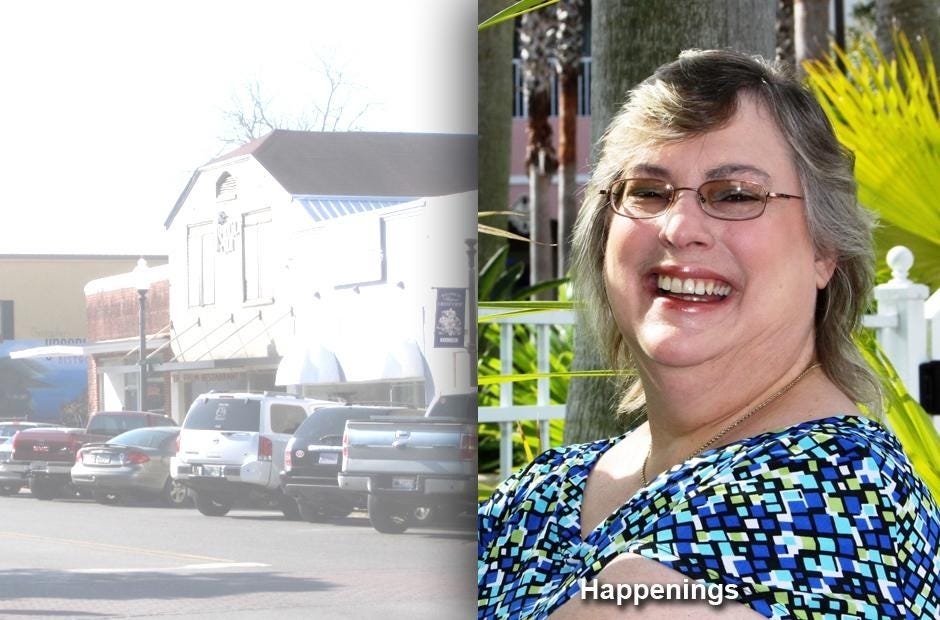
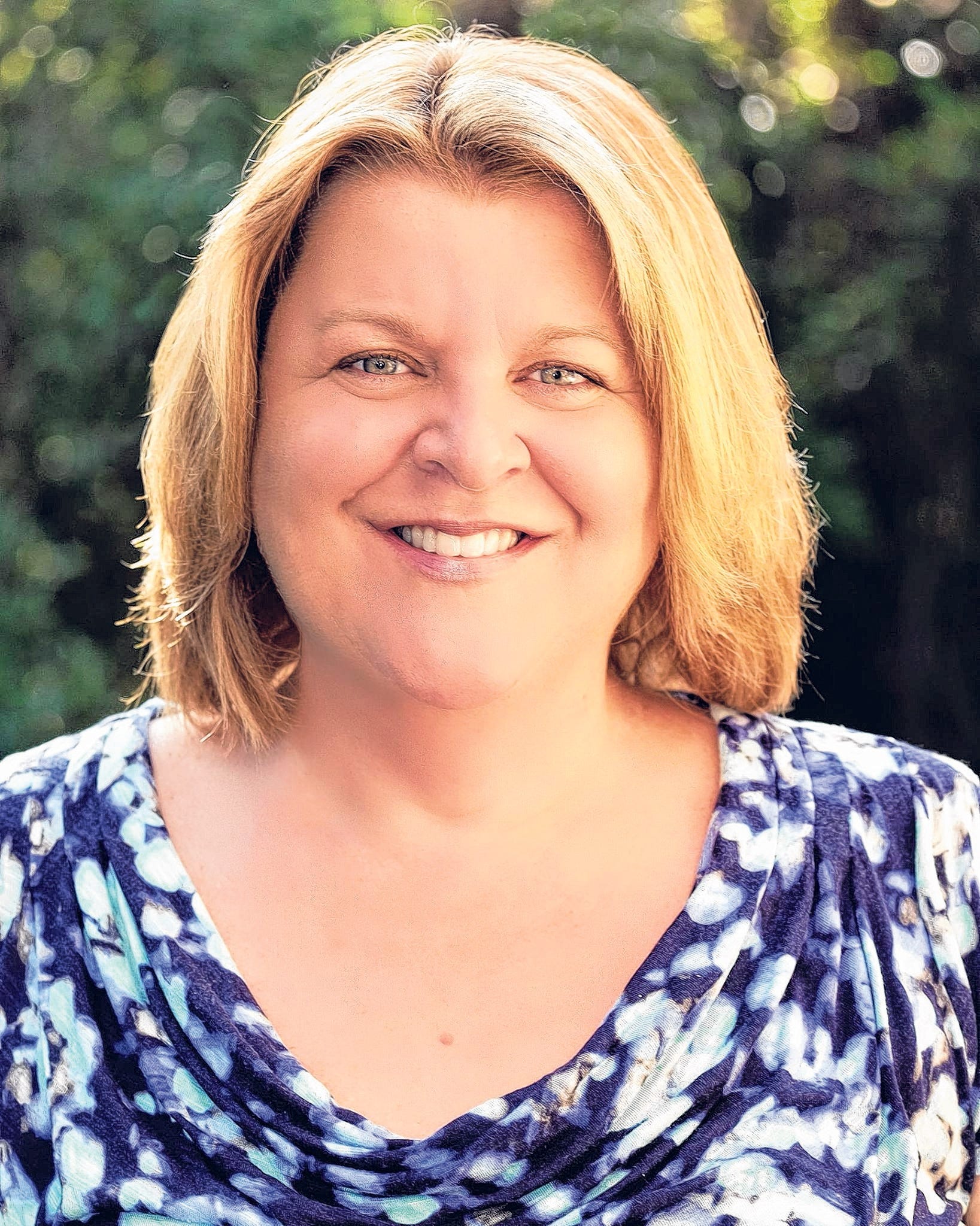
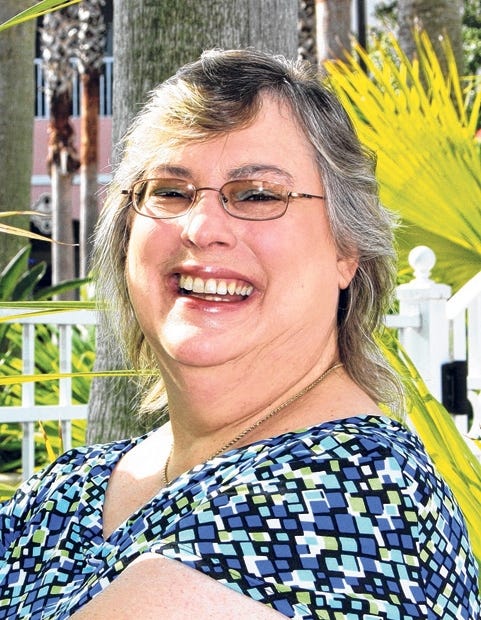
Janice Lynn Crose, a former accountant, lives in Crestview with her husband, Jim; her two rescue collies, Shane and Jasmine; and two cats, Kathryn and Prince Valiant.
We often remember and honor our mothers, but what about our fathers? Dads play an important role in their children's lives. While some dads aren't as visible as mothers in families, nevertheless they provide a very important role.

Did you know that on Mother's Day most families go out to lunch or dinner, and for Father's Day most families have a family barbecue? A barbecue certainly makes wonderful family memories and allows children to run around and play.

What role did your father play in your life while growing up?

Did he foster your dreams, encourage you by telling you that anything you desired could be accomplished if you worked for it?

Did he teach you the difference in right and wrong? 

Did he teach you the skills you needed to achieve your dream? 

Did he teach you how to ride a bike and play sports?

My father taught his children to always tell the truth, honor our family name, how to handle our money, and how to take care of tools and equipment so that they would last for many years. He also taught all of his children management skills and all four of us have used those skills in a variety of ways.

The "dreaded" Father's Day tie seems to be a joke each year. This year, why not just ask Dad what he'd like for Father's Day? My husband, Jim, loves ties. My dad, not so much. One year he wanted ping pong equipment for the table and other years he wanted a particular tool. Asking is so much easier than guessing, and then Dad will get what he really desires.

One day, your father will no longer be with you. How will you honor his legacy? Will you carry on the life lessons he taught, virtue, how a good name is to be sought, honesty and righteousness?

Of course, all glory ultimately goes to our Heavenly Father and we thank Him for our earthly fathers, our wonderful world, and the gift of salvation.

To my Dad and all of the awesome fathers in Crestview, Happy Father's Day.

Janice Lynn Crose, a former accountant, lives in Crestview with her husband, Jim; her two rescue collies, Shane and Jasmine; and two cats, Kathryn and Prince Valiant.

This article originally appeared on Crestview News Bulletin: Thoughts before Father's Day

How to preserve fruit

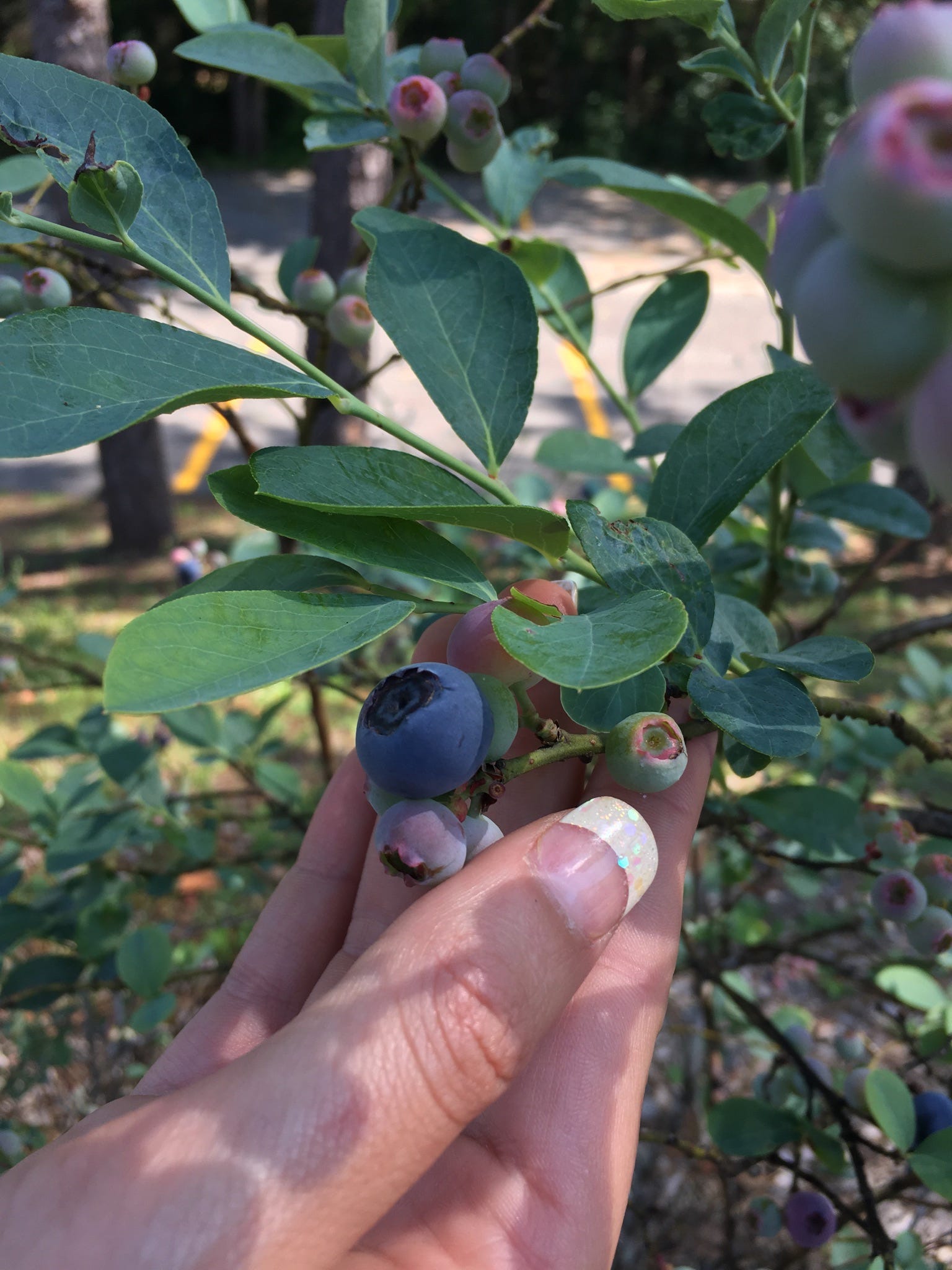
Fruits like blueberries and figs can be canned or made into fruit leathers. [Special to the News Bulletin]

All sorts of delicious treats are coming into the season, including blueberries, blackberries and figs galore. It seems as though all of this tasty, nutritious, low-fat produce comes and goes so quickly we barely get a chance to enjoy it properly.

If you are wondering how to preserve your bounty, there are plenty of ways.

Freezing

Berries and figs freeze well. Sort berries and throw away any fruit that has gone bad. Simply rinse under cool running water and drain well. Freeze on a tray and then pour frozen fruit directly into a freezer bag or container.

To prevent figs from turning dark, sprinkle with an ascorbic acid like Ball-Fruit Fresh (found in the canning section of stores), and follow the freezing instructions.

Canning

Figs and berries can both be canned whole in syrup using the water bath canning method. Jams, jellies, preserves and purees can also be made out of these fantastic fruits. Be sure to follow your canning recipe instructions exactly to lower the risk of food-borne illness.

Drying

Figs are excellent for drying or making a fruit leather. You may have less success drying whole berries, but do try a fruit leather.

For drying figs, select ripe fruit and clean it. Small figs can be left whole. Large figs may be cut in half. Blanch whole figs in boiling water for 30 seconds until the skins split. This will ensure faster drying. Dip figs directly into an ice-water bath to prevent cooking. Figs will take about six to 12 hours in a dehydrator, possibly less if cut in half.

Here is a jam recipe courtesy of the National Center for Home Food Preservation:

Berry Jams (without added pectin)

9 cups crushed berries

6 cups sugar

Yield: About 7 or 8 half-pint jars

Please read Using Boiling Water Canners (http://nchfp.uga.edu/publications/uga/using_bw_canners.html) before beginning. If this is your first time canning, it is recommended that you read Principles of Home Canning (http://nchfp.uga.edu/publications/usda/GUIDE01_HomeCan_rev0715.pdf).

Procedure:

Sterilize canning jars (http://nchfp.uga.edu/how/can_01/sterile_jars.html).

Wash berries before crushing. Combine berries and sugar. Bring slowly to a boil, stirring occasionally until sugar dissolves. Once sugar is dissolved, cook rapidly to, or almost to, the jellying point (http://nchfp.uga.edu/how/can_07/jelly_point.html) depending upon whether a firm or soft jam is desired. As mixture thickens, stir frequently to prevent sticking.

Remove from heat and fill hot, sterile jars with the hot jam, leaving a one-fourth-inch headspace. Wipe rims of jars with a dampened clean paper towel; adjust two-piece metal canning lids. Process in a boiling water canner.

Note: If seedless jam is preferred, crushed berries may be heated until soft and pressed through a sieve or food mill; then add sugar and proceed as above.

Recommended processing time for hot packing half-pints or pints of the jams in a boiling water canner is five minutes at altitudes of 0 to 1,000 feet; 10 minutes at 1,001 to 6,000 feet; and 15 minutes above 6,000 feet.

Contact me at 689-5850 or jbreslawski@ufl.edu for more recipes or information about preserving foods.

You may also register for the extension office's cheese making workshop, set for 6:30-8 p.m. June 20 at 3098 Airport Road, Crestview. The cost is $25 per person. RSVP by June 18 at https://okaloosacheesemaking.eventbrite.com.

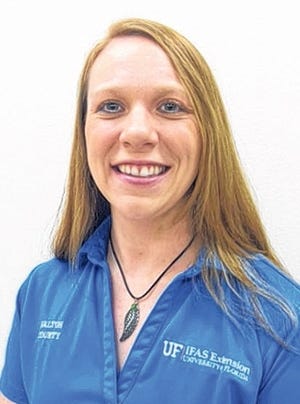
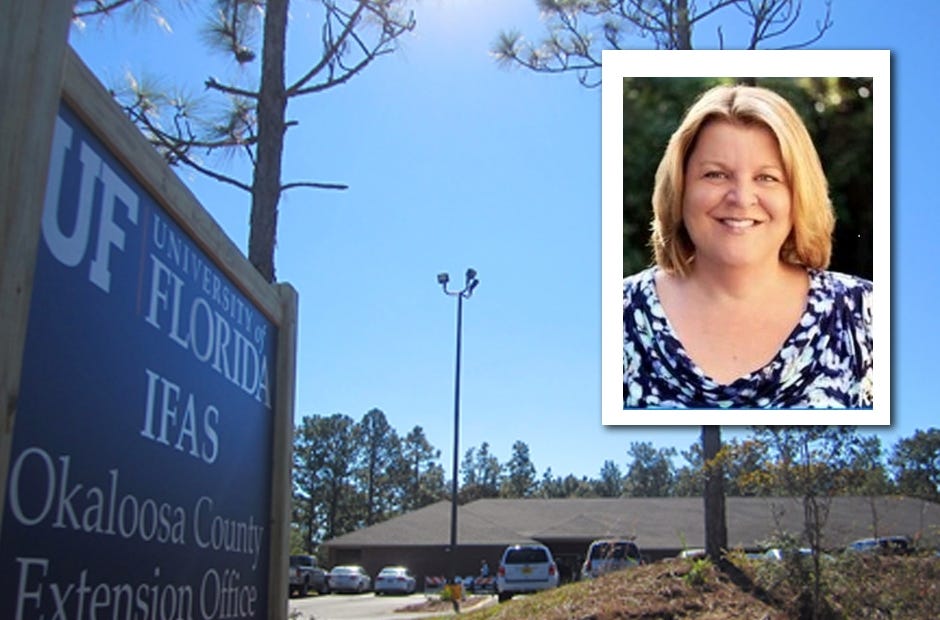
Jill Breslawski is an agent at the University of Florida's Institute of Food and Agricultural Sciences Extension office in Crestview.

This article originally appeared on Crestview News Bulletin: How to preserve fruit

FOOD SAFETY: Spaghetti and meatball products recalled

Conagra Brands, Inc., a Milton, Pa. establishment, is recalling approximately 700,125 pounds of spaghetti and meatball products due to misbranding and undeclared allergens, the U.S. Department of Agriculture’s Food Safety and Inspection Service (FSIS) announced today. The product(s) contains milk, a known allergen which is not declared on the product label.

The spaghetti and meatball products were produced on Jan. 5, 2017 and Jan. 12, 2017. The following products are subject to recall:

131,718 lbs. of 14.75-oz. cans with “Libby’s Spaghetti and Meatballs MADE WITH PORK, CHICKEN AND BEEF IN TOMATO SAUCE” on the label with package code 2100701200 and Use By Date 01/02/19.

71,614 lbs. of 14.75-oz. cans with “Del Pino’s SPAGHETTI & MEATBALLS MADE WITH PORK, CHICKEN AND BEEF IN TOMATO SAUCE” on the label with package code 2100701200 and Use By Date 01/02/19.

38,330 lbs. of 14.75-oz. cans with “Hy-Top Spaghetti and Meatballs Made with Pork, Chicken and Beef in Tomato Sauce” on the label with package code 2100701200 and Use By Date 01/02/19.

22,064 lbs. of 14.75-oz. cans with “Food Hold Spaghetti & Meatballs MADE WITH PORK, CHICKEN AND BEEF IN TOMATO SAUCE” on the label with package code 2100701200 and Use By Date 01/02/19.

21,975 lbs. of 14.75-oz. cans with “Essential EVERYDAY Spaghetti with Meatballs Made With Pork, Chicken and Beef in Tomato Sauce” on the label with package code 2100701200 and Use By Date 01/02/19.

414,424 lbs. of 14.75-oz. cans with “Chef BOYARDEE Mini pasta shells & meatballs, Pasta and Meatballs made with Pork, Chicken and Beef in Tomato Sauce” on the label with package code 2100700500 and Use By Date 12/26/18.

The products subject to recall bear establishment number “EST. 794M” inside the USDA mark of inspection. These items were shipped nationwide to warehouses for distribution and retail locations.

The problem was discovered on June 6, 2017, when the company received notification from an ingredient supplier that the bread crumbs the company received and used in the recalled products potentially contained undeclared milk.

There have been no confirmed reports of adverse reactions due to consumption of these products. Anyone concerned about an injury or illness should contact a healthcare provider.

Consumers who have purchased these products are urged not to consume them. These products should be thrown away or returned to the place of purchase.

FSIS routinely conducts recall effectiveness checks to verify recalling firms notify theircustomers of the recall and that steps are taken to make certain that the product is no longer available to consumers. When available, the retail distribution list(s) will be posted on the FSIS website at www.fsis.usda.gov/recalls.

This article originally appeared on Crestview News Bulletin: FOOD SAFETY: Spaghetti and meatball products recalled

FOOD SAFETY: Breaded chicken products recalled

Gourmet Boutique LLC, with establishments in Jamaica, N.Y. and Phoenix, Ariz., is recalling approximately 294,744 pounds of ready-to-eat (RTE) chicken products due to misbranding and undeclared allergens, the U.S. Department of Agriculture’s Food Safety and Inspection Service (FSIS) announced today. The products could contain milk, a known allergen, which is not declared on the product label.

The RTE breaded chicken products were produced on various dates from February 3 to June 2, 2017. The following products are subject to recall:

3.125-lb. frozen packages of “Breaded Chicken Cutlet” with lot codes J34 through J150 (for Est. number P-18799) and J53 through J153 (for Est. number P-32107).

3.125-lb. frozen packages of “All Natural Breaded Chicken Cutlet” with lot code J34 through J150 (for Est. number P-18799).

5-lb. frozen packages of “Diced Breaded Chicken Cutlet” with lot code J34 through J150 (for Est. number P-18799).

The products subject to recall bear establishment number “P-18799 or P-32107” inside the USDA mark of inspection. These items were shipped to institutional locations nationwide.

The problem was discovered on June 6, 2017, when the company received notification from an ingredient supplier that the bread crumbs the company received and used in the recalled products potentially contained undeclared milk.

There have been no confirmed reports of adverse reactions due to consumption of these products. Anyone concerned about an injury or illness should contact a healthcare provider. These products should be thrown away or returned to the place of purchase.

FSIS routinely conducts recall effectiveness checks to verify recalling firms notify their customers of the recall and that steps are taken to make certain that the product is no longer available to consumers.

This article originally appeared on Crestview News Bulletin: FOOD SAFETY: Breaded chicken products recalled

Svea Assembly hosts gospel concert

The Southland Singers have an upcoming Crestview concert. Members are (back row, from left) Jack Cunningham, Ken Hawkins, Ed White, Mike Cunningham, and (front, from left) Mary Earl, Betty Gibson and Sherryl Hardy. [Special to the News Bulletin]

LAUREL HILL — The Southland Singers, a Pensacola gospel group with a 16-year history, will have a local concert.

They will perform 6:30 p.m. June 10 at Svea Assembly of God, 4638 Grimes Road, Laurel Hill.

Southland's members are Mary Earl, Betty Gipson, Michael Cunningham, Jack Cunningham, Ed White, Ken Hawkins and Sherryl Hardy.

This article originally appeared on Crestview News Bulletin: Svea Assembly hosts gospel concert

Build relationships instead of tearing them down

The Rev. Mark Broadhead is pastor at Laurel Hill Presbyterian Church and First Presbyterian Church of Crestview. [File photos | News Bulletin]

Editor's Note: This is the first of two columns discussing the boundaries between people.

There is much in this society that divides us – like politics, ideologies, and theologies. There is much in this world that seeks to take us away from God – like pride, ego, and arrogance among other things.

The gap between individuals and groups of people continues to widen. Individuals gravitate toward those who are of like mind. They solidify their opinions and become like cement – thoroughly mixed up and set in stone.

There is a tendency in human nature for people to be drawn to those of like-minded thoughts and beliefs. This is one reason for so much division in the world. Different nationalities, different allegiances, different systems of government, different political parties and ideologies, different Christian denominations, different religions.

Conflicts start because of conflicting stances on various matters. If two or more do not agree – they tend to become enemies. Walls are erected – whether physical or emotional. And if the differences are great enough, there is a desire to destroy that which is different.

Human nature rarely puts up with disunity or differing points of view. It upsets the equilibrium. People crave a sense of unity, of belonging – as long as it’s in line with “my” personally held beliefs. If you don’t agree with “me” you are not only wrong – you are less of a human being. And there is a good chance you are now my enemy.

I firmly believe we need to learn to agree to disagree and live together in such a way that will build relationships instead of tear them down. But that is a pretty tall order and difficult to achieve because there is another part of human nature that gets in the way. I will write about that next week.

It is essential to remember that God’s Holy Spirit has the ability to cross any boundaries that people erect between each other. His Holy Spirit is the unifying presence among his creation – if and when people will stop to listen and comprehend, if and when we will realize God is to be the main focus in life. God brings unity even among diversity.

Our unity in Jesus Christ is what matters most in this life. The clubs you might belong to, the organizations of which you are a part, your political affiliation, are nowhere near the importance of your faithfulness to Jesus Christ.

When everything else in life is stripped away, the only thing left will be your relationship with God through Jesus. He is the one that gives life, and wholeness, and purpose. He is the one who unites us – even when we may not wholly agree on everything.

Let us learn to agree to disagree without belittling, without condemning. Let us learn to agree to disagree with an attitude of learning and growing.

Let us lean on the ways of Jesus Christ.

The Rev. Mark Broadhead is pastor at Laurel Hill Presbyterian Church and First Presbyterian Church of Crestview.

This article originally appeared on Crestview News Bulletin: Build relationships instead of tearing them down

'I consider it as a blessing'

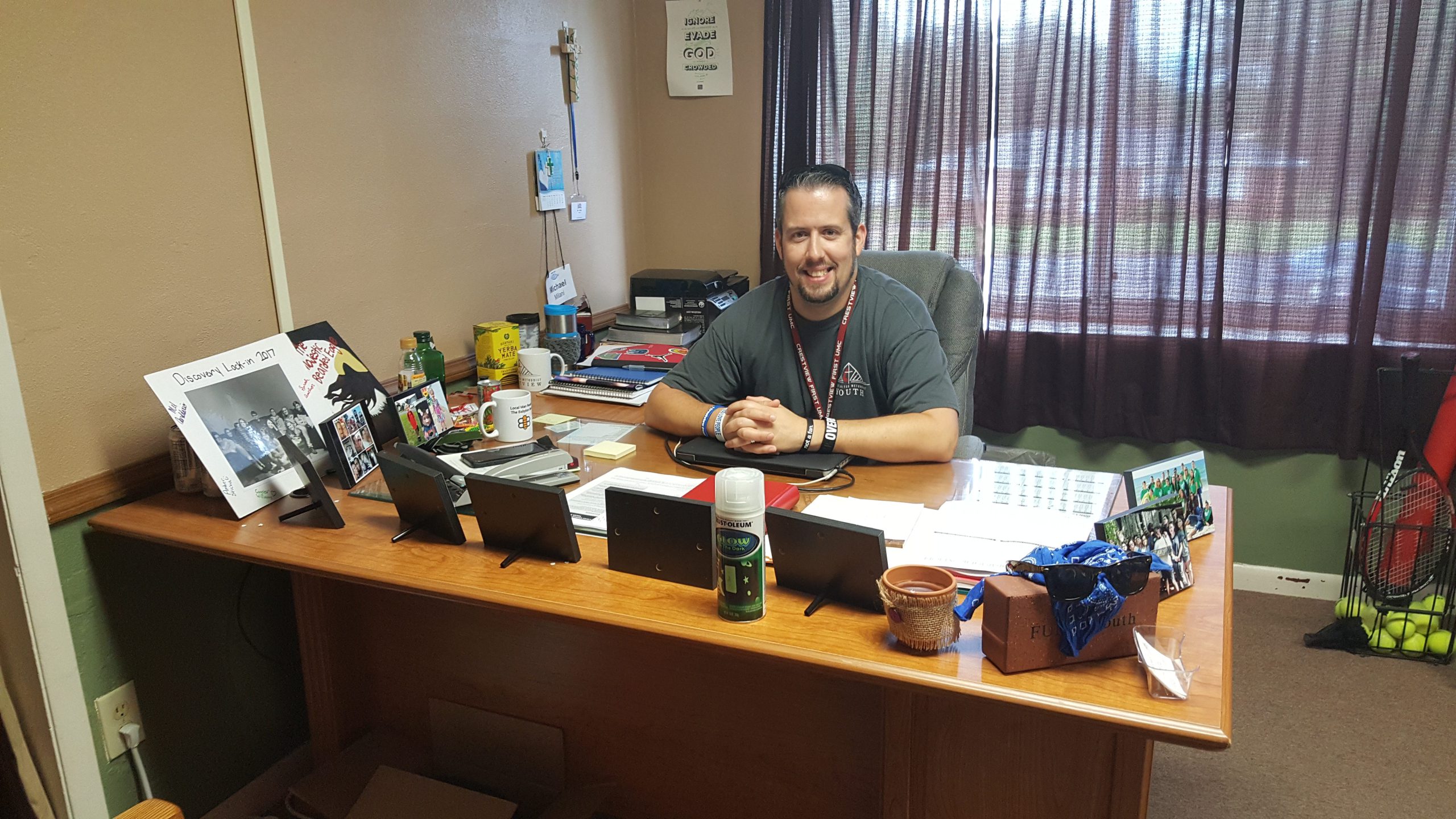
First United Methodist Church’s youth pastor, Mike Milani, will donate a kidney to Kenzie, his 14-year-old niece from North Carolina in end-stage renal failure. [Special to the News Bulletin]

CRESTVIEW — First United Methodist Church’s youth pastor, Mike Milani, is taking some time off this summer for a special reason. 

On June 29, Milani will travel to New York, where he will undergo surgery to give his 14-year-old niece, Kenzie, one of his kidneys. 

Kenzie lives in North Carolina with her mother, Lindsey, who is Milani’s sister. She has been through several surgeries since birth and is currently in renal failure. 

“It’s been such a long time coming,” Milani said. They kept changing the dates, and then my niece, bless her heart, being that she is in end-stage kidney failure now, any infection is a hospitalization… so this should have been done on May 30.” 

Kenzie was born with an extremely small bladder, according to Milani. Three teams of surgeons from North Carolina and New York will do perform surgery at Columbia University Medical Center in New York. One of the surgery teams created a larger bladder for Kenzie and will place it during the kidney transplant. The other team includes the surgeon who invented laparoscopic kidney removal, Lloyd Ratner, who will remove Milani’s kidney and place it in Kenzie. 

Lindsey was originally supposed to be the organ donor. 

“That felt really wrong to me,” Milani said. “So I said, ‘Let me finish getting tested.’” 

As it turned out, Milani was also a perfect match for a transplant. 

“Lindsey has always been right there at (Kenzie's) side the whole time,” Milani said. “I said to her, ‘I can’t imagine you sitting in a hospital room recovering from your surgery, and you can’t get up and go see your baby girl.’ 

“She was being tough, I could tell, so I said, 'Let me do it.'” 

The recovery period for Milani will include a two-day stay in the hospital, followed by a follow-up appointment after a week; he will not be able to lift anything for about six weeks but should be mostly back to normal. 

Kenzie’s recovery period will be much longer – a six-week stay in the hospital, followed by 12 more weeks staying in New York for twice a week follow-up appointments with the doctors. 

“This is the new frustration for her; she’s fixing to start high school,” Milani said. “She’s had physical limitations her whole life… and it finally got to where most of that was gone. Now that’s going to be off the table for a little while. 

“She’s really kind of down about it.” 

The family has a GoFundMe page set up with more than $20,000 raised and a $50,000 goal. 

According to Milani, $20,000 is just the tip of the iceberg in this situation. With the travel expenses, Lindsey has already spent more than $12,000. Their stay alone in New York will be more than $10,000. 

"… I consider it as a blessing that I can do this for [her]," Milani said.  

“She’ll get a regular kidney and feel like a normal kid again.”

Visit www.gofundme.com/kidneyforkenzie to donate to the Milani family for Kenzie’s surgery and travel expenses

HOW TO HELP

This article originally appeared on Crestview News Bulletin: 'I consider it as a blessing'

Life insurance needs will change over time — so be prepared

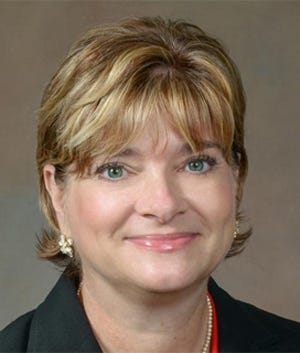
Yvonne Shanklin is an Edward Jones financial adviser. [Special to the News Bulletin]

If you’re going to achieve all your goals, such as sending your kids to college, retiring in comfort, and leaving a legacy, you will need to save and invest throughout your lifetime. But to really complete your financial picture, you’ll also need to add one more element: protection. And that means you’ll require adequate life insurance for your situation.

However, your need for insurance will vary at different times of your life — so you’ll want to recognize these changing needs and be prepared to act.

When you’re a young adult, and you’re single, life insurance probably will not be that big of a priority. And even married couples without children typically have little need for life insurance; if both spouses contribute equally to household finances, and you don’t own a home, the death of one spouse generally will not be financially catastrophic for the other.

But once you buy a home, things change. Even if you and your spouse are both working, the financial burden of a mortgage may be too much for the surviving spouse. So, to enable the survivor to continue living in the home, you might consider purchasing enough life insurance at least to cover the mortgage.

When you have children, your life insurance needs typically will increase greatly. It’s a good idea for both parents to carry enough life insurance to pay off a mortgage and raise and educate the children, because the surviving parent’s income may be insufficient for these needs. How much insurance do you need?

You might hear of a “formula,” such as buying an amount equal to seven to 10 times your annual income, but this is a rough guideline, at best. You might want to work with a financial professional to weigh various factors – number and ages of children, size of mortgage, current income of you and your spouse, and so on – to determine the amount of coverage and the type of insurance (“term” or “permanent”) appropriate for your situation.

Once you’ve reached the empty nest stage, and your kids are grown and living on their own, you may need to re-evaluate your insurance needs. You might be able to lower your coverage, but if you still have a mortgage, you probably would want to keep enough insurance to pay it off.

After you retire, you may have either paid off your mortgage or moved into a condominium or apartment, so you may require even less life insurance than before. But it’s also possible that your need for life insurance will remain strong. For example, the proceeds of a life insurance policy can be used to pay your final expenses or to replace any income lost to your spouse as a result of your death (e.g., from a pension or Social Security.) Life insurance also can be used in your estate plans to help leave the legacy you desire.

As we’ve seen, insurance can be important at every stage of your life. You’ll help yourself – and your loved ones – by getting the coverage you need when you need it.

This article was written by Edward Jones on behalf of your Edward Jones financial adviser.

This article originally appeared on Crestview News Bulletin: Life insurance needs will change over time — so be prepared

Pitcher plants evolved to survive

Florida Master Naturalist Program participants viewed a field with rare pitcher plants recently in Northwest Florida. [Eric Tiu]

The mission of the Florida Master Naturalist Program, which is taught through the local Extension office, is to promote awareness, understanding, and respect of Florida's natural world among Florida's citizens. The program whets the appetite of students for information on local flora and fauna and often leads to additional research outside the class.

In spring 2017, students took the Freshwater Systems Module in Okaloosa and Walton counties. One student mentioned that she had a large patch of yellow trumpet-leaf pitcher plants growing on her farm, and as many in the class were interested in seeing pitcher plants in bloom in the wetland areas that they were studying; they took an impromptu field trip.

Florida is home to six species of pitcher plants (family: Sarraceniaceae). Five can be found in Okaloosa and Walton counties in the Florida Panhandle: these include the Yellow trumpet, Whitetop, Parrot, Gulf Purple and Gulf Coast Redflower.

Pitcher plants are native perennials that have adapted to living in a habitat that is nitrogen poor, acidic and at least seasonally saturated. These plants are rare and definitely worth seeking out to get a good look.

Pitcher plants have evolved with several adaptations to survive in their sometimes harsh habitats. They are carnivorous and trap insects to compensate for the nitrogen limiting soils where they live. The plants have modified hollow leaves that form tubes. The tubes are open at the top and often completely or partially covered by a specialized flap or hood, helping to reduce the amount of rain entering the tube.

The brightly colored hoods and tubes help attract prey, and often have a strong odor as well. The tubes are slick on the inside, with downward facing hairs, resulting in curious insects sliding to the bottom of the leaf where a small pool of water traps and drowns them. As the insect decomposes, the resulting nitrogen becomes available to the plant. You will often see ants, flies, wasps and bees caught in the pitcher traps.

The yellow trumpet-leaf pitcher plant is one of the largest species, with a yellowish-green tube and hood streaked with dark maroon splotches. The flowers have a musty smell. In Florida, this species is found in the northwest region from Leon County, west to Escambia County. Often, multiple species of pitcher plants can be found growing in the same area.

Protection of the pitcher plants and their habitats is important due to increasing loss of their unique habitats. Baseline surveys and continuing monitoring can help detect changes in pitcher plant populations. 

Restoration efforts often include frequent prescribed burning in order to reduce surrounding hardwood species. Restoration of local hydrology may also help maintain and grow populations. Other threats include feral hogs and humans, as they both have negative impacts on pitcher plant populations. It is also important for the general public to be educated about these unique plants. Collecting pitcher plants in the wild is prohibited by law; however, plants can be purchased from reputable retailers. Following these recommendations will help to conserve these remarkable plants and their habitats.

Other threats include feral hogs and humans, as they both have negative impacts on pitcher plant populations. It is also important for the general public to be educated about these unique plants. Collecting pitcher plants in the wild is prohibited by law; however, plants can be purchased from reputable retailers.

Following these recommendations will help to conserve these remarkable plants and their habitats.

For more information, visit http://www.masternaturalist.ifas.ufl.edu or contact your local Extension office.

Laura Tiu is an agent at the University of Florida's Institute of Food and Agricultural Sciences Extension office in Crestview.

This article originally appeared on Crestview News Bulletin: Pitcher plants evolved to survive

God-fearing girls

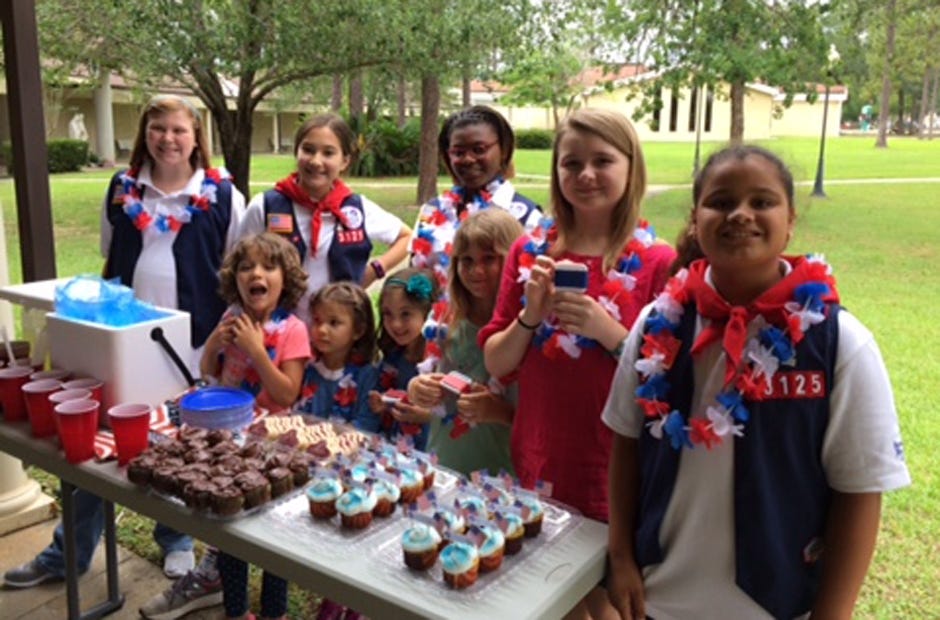
These American Heritage Girls Crestview troop members earned awards and badges May 21. Taylor Smith, Miriam Ho and Alyssa Smith (back row, from left) each won a Lewis & Clark award for the highest level of skill and service at the Explorer (fourth through sixth grade) level. Faith Mayor and Sarah Ho (front, from left) received AHG Pathfinder level archery patches. [Special to the News Bulletin]

Editor’s Note: This continues our Celebrate Community series on nonprofit organizations that improve North Okaloosa County residents’ quality of life.

CRESTVIEW — American Heritage Girls is a national Christ-centered organization for 5- to 18-year-olds. The nonprofit promotes community service and patriotism, and has a Crestview component in AHG Troop FL 3125.

The local troop has about 12 members who meet twice a month at Our Lady of Victory, a Catholic church. Sue Ho, the group's vice coordinator, credited a military spouse and former Northwest Florida resident, Danni Barker, with forming Crestview's AHG.

"She spearheaded the whole thing and got all the things going for that," Ho said.

In chartering a troop, Barker had to find a local ministry organization, referred to as a charter organization on the AHG website; connect with a troop development coach; find a ministry representative for the charter organization; and form a troop board of five adults for representation, coordination, treasurer and shepherd.

The Crestview troop became official after visiting with a sister troop in Pensacola.

"We got together with them two years ago and stayed overnight on the USS Alabama. They helped us get going," Ho said.

Since then, the troop has been active in the Crestview community.

"We promote a lot of going out there and helping your fellow man and growing into a great citizen with respect and God fearing," Troop Coordinator Lisa Fisher said. "They don't start earning badges until that first year (age 5), but there are necklaces and beads they can earn.”

"As they start to get older and progress up through the higher levels, that helps them start taking leadership roles … They start maturing and being able to talk to adults and start making plans," she said.

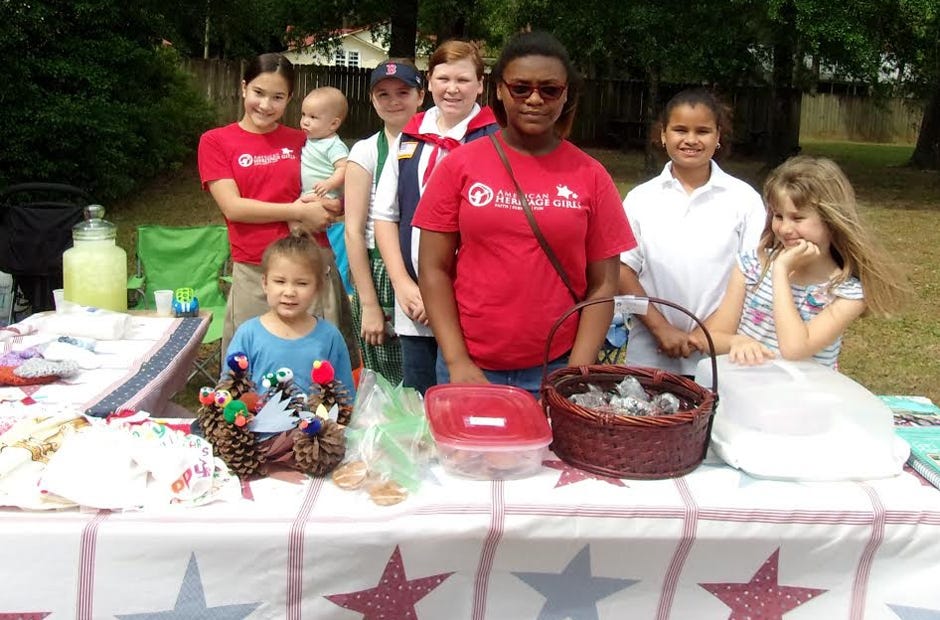
The most recent leadership process for the troop was arranging a craft and bake sale fundraiser. Older troop members took the responsibility of contacting Walmart and Publix, making a schedule for who would be at the fundraiser and when. Younger members focused on creating crafts for the sale, according to Fisher. The troop raised $150 for its activities and charter fees.

Three members, Alyssa Smith, Miriam Ho and Taylor Smith, have finished requirements for an AHG Lewis & Clark Award, which they each received May 21. To qualify, Explorers in fourth through sixth grades must complete three years of badge activities and community service hours. They also have to create, implement and execute a community service project of their own making.

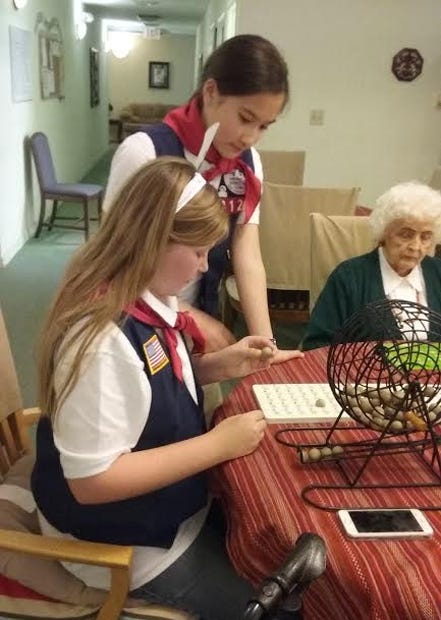
Alyssa's project was the organization of a St. Patrick's Day-themed bingo event at an assisted living facility. She collected prizes for participating residents and had the troop members call bingo numbers.

Miriam led a ministry that crocheted baby blankets for new moms. She created the pattern used for the ministry and taught people how to crochet for the effort.

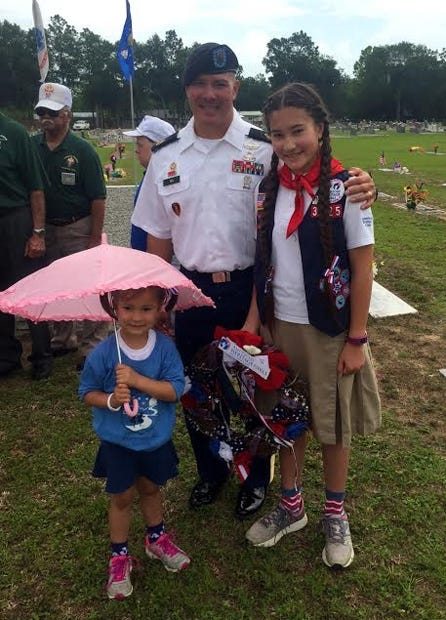
Taylor's project involved contacting Disabled American Veterans to secure the troop's participation in the wreath laying ceremony on soldiers' graves for Memorial Day. She created the wreaths used by the troop as well.

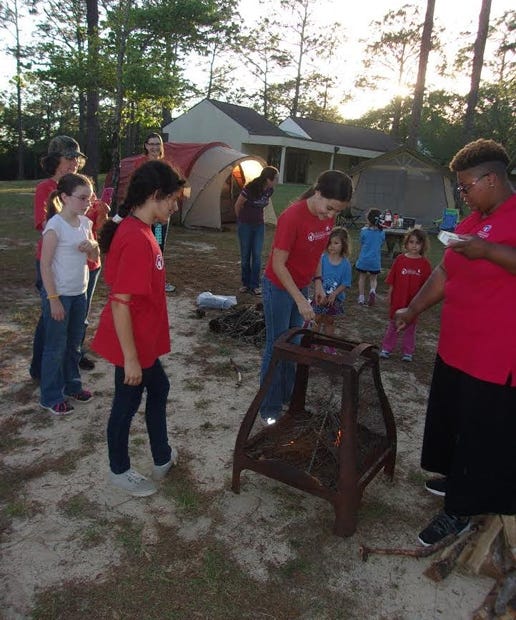
Lisa Fisher, who has been with the troop over three years and now serves as its coordinator, discussed its plans for the year, which include walking in the Veterans Day parade, pro-life activities such as collecting diapers and other necessities for the Crestview Pregnancy Center, and visiting assisted living facility and nursing home residents.

They are also considering a possible return trip the USS Alabama.

As a faith-based organization, the troop always tries to include something that’s of service to God, Fisher said.

"One of the badges we're trying to work on is the Fatima badge as a troop. They're learning about St. Justina at Our Lady of Fatima. It's just an extra badge for the year," she said.

The AHG National Catholic Committee created the limited edition badge to mark the 100th anniversary of Our Lady of Fatima's appearance to three Portuguese children in the early 1900s.

American Heritage Girls membership costs $26 a year, with additional fees for a handbook and uniform. Call the church, 682-4622, or visit https://www.americanheritagegirls.org/ to learn more about membership in AHG, or the boys' AHG counterpart, Trail Life USA.

HOW TO JOIN

This article originally appeared on Crestview News Bulletin: God-fearing girls

error: Content is protected !!