Please ensure Javascript is enabled for purposes of website accessibility
Skip to main content
Advertisement

Give blood in Crestview, get a T-shirt

CRESTVIEW — Residents who give blood at OneBlood Donor Center locations between Oct. 1 and Oct. 21 will receive a limited edition T-shirt.

"People who have A+, B+, AB+, AB- and O+ are perfect candidates to donate platelets," a OneBlood spokesperson said.

People with O-, B- and A- blood are encouraged to donate whole blood or double red blood cells. 

Learn about platelets' importance at www.oneblood.org/learn/donation-methods/platelet-donation.stml.  

Learn more about blood types at www.oneblood.org/target-your-type.

Crestview's location is 2400 S. Ferdon Blvd. Call 306-2455 for details. 

This article originally appeared on Crestview News Bulletin: Give blood in Crestview, get a T-shirt

From Hub City to Old Datca: Couple experiences Turkey's luxury, tradition

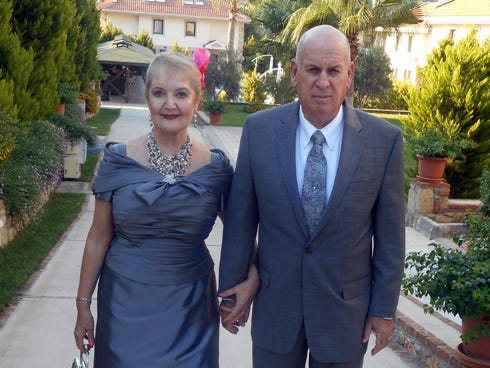
Crestview residents Esin Gershaw and her husband, Stephen, witnessed the wedding of Esin's niece at the newly constructed Palm Bay Beach Hotel in Kara Incir Koyu, Datca.

Crestview residents Esin and Stephen Gershaw have returned from Datca, Turkey, where they attended a family wedding.

The couple visited Old Datca, on the Mediterranean Sea, for the ceremony of  Esin's niece, Zeynep.

The Datca Peninsula's bays and coves are among the region's tourist attractions, and the Gershaws found others, Esin said.

"We were busy with the wedding preparations and were able to find time to drive … to Datca town and the outstanding Olive Farm of Datca … where they also produce a variety of olive oil," she said.

This article originally appeared on Crestview News Bulletin: From Hub City to Old Datca: Couple experiences Turkey's luxury, tradition

FINANCIAL FOCUS: Here are cash's 4 key uses

Stocks and bonds seem to draw the most attention in an investment portfolio.

After all, these investment vehicles, and others derived from them, provide potential growth and income opportunities — which is why you invest in the first place.

Yet, you also may find significant value in a more humble financial asset: cash. You might be surprised by the various ways that cash, and cash equivalents, can help complete your financial picture.

Consider cash's uses:

• Unexpected expenses and emergencies: You’ll need sufficient cash for situations such as a job loss, a home repair or an unplanned medical expense.

During your working years, keep three to six months’ living expenses in a cash account designed to meet unexpected expenses. Once retired, you may be able to get by on a smaller emergency fund — up to three months’ living expenses, although you will need more for everyday spending.

• Specific short-term savings goal: Are you anticipating a big expense —a wedding, vacation or down payment on a new home — within the next few years? If so, set aside sufficient cash, with the exact amount depending on your specific short-term goal.

• Everyday spending: You’ll need adequate cash for everyday spending needs such as groceries, utilities, entertainment and mortgage or debt payments. While working, you will probably handle most of these costs with paychecks, but you may still need to set aside one or two months’ living expenses.

Once retired, though, it’s a somewhat different story.

While your expenses may go down in some areas (such as costs associated with employment), they are likely to go up in others (such as health care). So your overall cost of living may not drop much, if at all.

It may be a good idea to set aside 12 months’ living expenses, after incorporating other sources of income, such as Social Security and outside employment.

In addition, decide on the most efficient way of drawing other income sources, including Social Security and investment accounts such as an IRA, a 401(k), etc.

It’s especially important to create a sustainable withdrawal strategy for your investment portfolio because you don’t want to run the risk of outliving your money.

• Source of investment: You’ll want to have some cash available in your portfolio — perhaps 2-3 percent of the portfolio’s value — to take advantage of investment opportunities as they arise. Having even a small percentage of your portfolio devoted to cash can modestly improve overall diversification — and a diversified portfolio is your best defense against market volatility. (Remember, though: Diversification can’t guarantee a profit or protect against loss.)

So, there you have it: four key uses of cash. They provide some good reasons to keep at least a modest “stream” of liquid assets in your portfolio.

Joe Faulk is a Crestview financial adviser.

This article originally appeared on Crestview News Bulletin: FINANCIAL FOCUS: Here are cash's 4 key uses

CHECK IT OUT: Spanish-English books abound at the library

National Hispanic Heritage Month — Sept. 15 to Oct. 15 — allows us to celebrate "the cultures and contributions of American citizens whose ancestors came from Spain, Mexico, the Caribbean and Central and South America," HispanicHeritageMonth.gov states.

This month, visit the Crestview Public Library and become familiar with our growing collection. Children can learn words in Spanish or English as they read stories. Most titles — which range from easy to third-grade reading levels — have illustrations that help the child understand the words.

Check out these titles:

•“The Gingerbread Man: El Hombre de Pan De Jengibre,” retold by Caterine McCafferty (grade level 1)

•“My Day: A Book in Two Languages: Mi Dia: Un Libro en Dos Lenguas,” Rebecca Emberley  (grade level 1)

•“Sundays on Fourth Street: Los domingos en la calle Cuatro,” Amy Costales (grade level 3.7)

Titles for adult readers vary from all you want to know about the guitar to diet books and romance novels.

Check out these titles:

•“Gran Libro de Guitarra,” edited by Ana Doblado

•“La Dieta South Beach,” Dr. Arthur Agatston

•“Misterios,” Nora Roberts

Looking for biographies about Hispanic Americans who greatly contributed to our nation? Check out: “The Crusades of Cesar Chavez,” Miriam Pawel, and “Hispanic First: 500 Years of Extraordinary Achievement,” Nicolas Kanellos.

Do you enjoy a book that we don't have? We welcome suggestions for purchase.

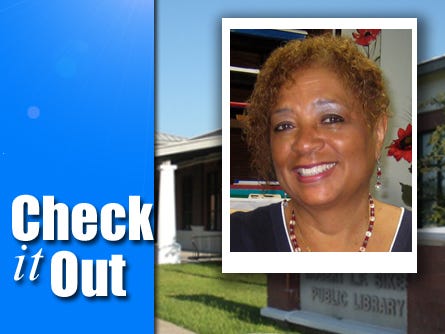
Jean Lewis is the Crestview Public Library's director.

This article originally appeared on Crestview News Bulletin: CHECK IT OUT: Spanish-English books abound at the library

Pink Main Street raises breast cancer awareness (VIDEO)

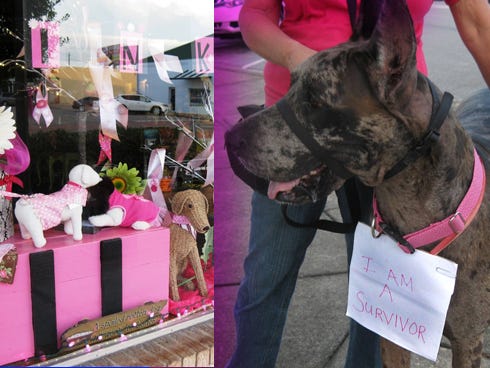
LEFT: Main Street businesses’ display windows, including this one at Pawsitively Scrumptious, feature pink motifs for Breast Cancer Awareness Month. RIGHT: Daisy, a Great Dane, is a canine breast cancer survivor.

CRESTVIEW — Pink is the fashionable color on Main Street this month as businesses observe Breast Cancer Awareness Month.

Pink ribbons grace lampposts, pink dominates shops and eateries’ window décor and, Thursday evening, pink-clad residents strolled the street in a carnival-like defiance of the deadly disease.

Breast cancer survivors — on four legs as well as two — drew cheers from onlookers when, after enjoying a party in the courtyard of attorney Nathan Boyles and his family’s Yellow River Winery, they paraded to the courthouse gazebo to share stories and be recognized.

The event, sponsored by North Okaloosa Medical Center’s Healthy Women program and the Main Street Crestview Association,  was a fun way to address a serious concern, NOMC Healthy Woman and community programs coordinator Alicia Booker said.

“The best way to slip in an important message is to mix it with a little fun, a little music and door prizes,” Booker said. “It’s a good way to draw people to downtown Crestview for a worthy cause.”

In addition to pink-wrapped cupcakes, pink punch, pink lemonade and pink-wrapped candies, there was a serious side to the event.

NOMC surgeons and medical technicians, American Cancer Society representatives and Emerald Coast Hospice staffers answered questions and provided information on topics such as self-examinations.

“We’re not just raising awareness but also raising education,” Booker said.

NOT JUST FOR HUMANS

Humans aren't the only species who can have breast cancer.

Daisy, a Great Dane, wears an “I am a survivor" sign at Thursday's Pink Street Part in downtown Crestview. attention to the importance of checking pets for breast cancer.

“She’s a big girl and likes to stand on the coffee table,” Angie Nousiainen, the dog's owner, said. “When she does, her nipples are at eye level. One day I noticed one seemed different than the other. Just like a human should, we examined her and a found a lump.”

Daisy received a canine mastectomy and now is cancer free, Nousiainen said.

Email News Bulletin Staff Writer Brian Hughes, follow him on Twitter or call 850-682-6524.

This article originally appeared on Crestview News Bulletin: Pink Main Street raises breast cancer awareness (VIDEO)

Tri-County Horticultural Studies group to tour Crestview environmental center

CRESTVIEW — Tri-County Horticulture Studies Group will meet at 10 a.m. Oct. 16 at the McMahon Environmental Education Center, 132 Butler Circle, Crestview.

John McMahon, retired forester, has spent many years planting over 100 trees indigenous to Florida in the park. Okaloosa County Forester Maria Wilson will identify trees at the center and tell participants about them.

Afterwards the group will visit Oliver’s Nursery, 4550 Kelly Mill Road, Holt. This nursery goes all out for a fall festival, so it will be all decked out in fall finery.

Participants are invited to bring a sack lunch and drink and join the group for a picnic at the nursery. Picnic tables are on site.

The Tri-County Horticulture Studies Group is sponsored by Valparaiso Garden Club. All who are interested in learning more about gardening in Okaloosa, Walton, Santa Rosa, or neighboring counties are welcome.

For details, contact Marie Harrison, marieharrison@valp.net or 850-678-2842. Additional information is available at www.mariesgardenanddesign.com.

This article originally appeared on Crestview News Bulletin: Tri-County Horticultural Studies group to tour Crestview environmental center

FINANCIAL FOCUS: Think twice before taking out 401(k) loans

Your car could break down. You might need a new furnace. You must pay for one last term of college for your child.

One day, you may need a large sum of money fast. As you look around for a source of funds, your eyes might come to rest on your 401(k) plan. It’s there, it’s yours — why not tap into it?

Actually, there are good reasons for not dipping into your 401(k). But before we get to those, let’s see how you might access money in your plan.

Some employers allow 401(k) loans only in cases of financial hardship, although the definition of “hardship” can be flexible. But many employers allow these loans for just about any purpose. To learn your particular plan's borrowing requirements, contact the plan administrator.

Generally, you can borrow up to $50,000, or one-half of your vested plan benefits, whichever is less. You have up to five years to repay your loan, although the repayment period can be longer if you use the funds to buy a primary residence.

So you have some time to repay the loan, you’re paying yourself back with interest, and repayments are probably just deducted from your paycheck.

Sounds pretty good, right? What could be the problem?

Well, here's a few of them:

• You’ll likely reduce your retirement savings. Your 401(k) plan is designed to help you build funds for one purpose: retirement. To encourage you to take advantage of your 401(k), the government defers taxes on earnings and allows you to make contributions with pre-tax dollars. But when you take out a loan from your 401(k), you are removing resources earmarked for your retirement. And even though you’ll repay the loan, you can never get that time back when your money could have potentially grown.

• You’ll be taxed twice on the loan amount. As mentioned, you typically contribute pre-tax dollars to your 401(k).  But when you repay the loan, you’re doing so with after-tax dollars.  When you withdraw the money at retirement, it will be taxed again.

• You’ll have to quickly repay the loan if you leave your job. If you leave your job, whether voluntarily or involuntarily, you’ll generally be required to repay the loan in full within 60 days. If you don’t repay it by then, the outstanding balance will be taxable — and if you’re under 59-1/2, you’ll also have to pay a 10 percent penalty tax.

To avoid the position of having to someday borrow from your 401(k), try to build an emergency fund containing six to 12 months’ worth of living expenses. Keep the money in a liquid account so that you can tap into it quickly.

It can be tempting to borrow from your 401(k) today — but if you can resist this temptation, you’ll almost certainly be glad tomorrow.

Joe Faulk is a Crestview financial adviser.

This article originally appeared on Crestview News Bulletin: FINANCIAL FOCUS: Think twice before taking out 401(k) loans

Camellia Show and Plant Sale coming in November

FORT WALTON BEACH — The Greater Fort Walton Beach Camellia Society will host the 51st Annual Camellia Show and Plant Sale.

The free event is open to the public 1-4 p.m. Saturday, Nov. 8 in the atrium of Westwood Retirement Resort, 1001 Mar Walt Drive, Fort Walton Beach.

Awards will be given in several divisions and categories. No entries will be accepted for competition after 10:30 a.m. Nov. 8.

Judging will be done by local and out-of-town judges, all of whom are accredited by the American Camellia Society. Volunteers are needed to help with the show; previous experience is not required.

For more information email camelliafwb@cox.net.

This article originally appeared on Crestview News Bulletin: Camellia Show and Plant Sale coming in November

Quit Smoking Now program, classes available

Have you often thought that you need to quit using tobacco products but are not sure just how to go about it?

There are ways to assist you so you’re not alone in your quest for a healthier and longer life. Bridgeway Center, Inc., in partnership with FSU’s College of Medicine, offers the Area Health Education Center Tobacco Cessation Program called Quit Smoking NOW to patients, clients, patient/client caregivers, staff, and staff families free of charge. Patients/clients who have a substance abuse diagnosis or a mental illness diagnosis will find the benefit of the smoking cessation program improves their chance for sustained recovery.

When you stop smoking changes happen immediately! The air around you is no longer dangerous to children and other adults. After 20 minutes your blood pressure drops to normal, pulse rate drops to normal, temperature in hands and feet increase to normal. After 2-12 weeks circulation improves, breathing improves, and walking becomes easier. As your smoke free time increases so does your increase in a healthy life. Find ways to re-direct your cravings such as changing your daily routine, drinking more water, and increasing your exercise. If you work in a building with an elevator, or have access to one, take a break and ride it, you can’t smoke in elevators.

Nicotine replacement therapy is also a way to help with cravings. These can be purchased over-the-counter and don’t require a prescription. NRT comes in the form of patches, gum, and lozenges. NRT slowly provides a small amount of nicotine through your mouth or skin. The patch is a long-acting NRT and the gum and lozenges are short-acting. The use of gum or lozenges is one of the keys to your success.

Some tips to help you succeed in your attempt to stop smoking are: if you feel anxious, try going for a walk, working out, or any activity you would normally do to relax. Does your not smoking making you hungry? Try eating veggies, make a salad or have some of your favorite raw veggies to replace your smoking. Do you have coffee and a cigarette first thing in the morning? Changing this habit is as easy as switching to tea, or having your first cup of coffee an hour after waking. Ice water is also a good way to help with cravings. Find what works for you and stick to it…you can beat this!

The public is made aware of the dangers of second hand smoke, but not many people are aware of third hand smoke. This is the smoke residue that is deposited on walls, furniture, carpets, etc. It affects animals and children by contact. When a child or animal crawls or walks on the floor and then puts their hand or paw in their mouth they are being affected by third hand smoke. The nicotine is entering their system by physical contact, not by breathing in the smoke. Be mindful of the dangers smoking has not only on you but on those you love.

There are resources available to help you quit smoking and using tobacco products. Don’t do it alone. Some resources are free to the public as well as the availability of NRT products.

To talk to a “Quit Coach” call 1-877-U-CAN-NOW (1-877-822-6669). Online help is available at www.quitnow.net/florida, or if face-to-face meetings work best for you, find local classes at www.ahectobacco.com.

Remember, with the determination to quit, the support of friends and family, and the help of available resources, you can enjoy and happy and healthy life.

WANT TO GO?

QUIT SMOKING CLASSES: open to the public. For more local classes, see the calendar at http://www.ahectobacco.com/calendar/.

•5-6 p.m. Oct. 8 and 15, Crestview Health Center, 4100 S. Ferdon Blvd., Crestview, 682-1164.

•10-11 a.m. Oct. 9 and 16, Okaloosa Dept. of Health, 810 E. James Lee Blvd., Crestview, 689-7808.

•5:30-6:30 p.m. Oct. 13, North Okaloosa Medical Center, 151 E. Redstone Ave., Crestview, 689-8100.

Mary Cox is a tobacco treatment specialist for Bridgeway Center, Inc.

This article originally appeared on Crestview News Bulletin: Quit Smoking Now program, classes available

Why your kid shouldn’t be guzzling ‘energy’ drinks

Anxiety, hypertension, elevated heart rates, interrupted sleep patterns and headaches are just some of the side effects commonly associated with energy drinks, and those problems are more pronounced in children, according to a recent University of Miami study.

But that’s just the tip of the iceberg. These drinks have also been linked to heart palpitations, strokes and sudden death.

The term “energy” drink is an unfortunate misnomer, says food science expert Budge Collinson. They don’t give your body energy; they stimulate you with brief jolts of caffeine and unregulated herbal stimulants, he says.

“Soccer moms and dads buy these ‘stimulant’ drinks for their kids before matches because both kids and parents want that competitive advantage,” says Collinson, founder of Infusion Sciences and creator Youth Infusion, a natural multivitamin beverage that helps people maintain consistent and healthy higher energy levels. 

“For a few moments, you’ll get that spike, but it’s a short-term experience with a heavy long-term toll.”

So, what are some ways kids can get a healthy energy boost? Collinson offers the following tips.

•  Go for a speedy bike ride together, take a brisk walk or hold foot-races in the yard.Numerous studies demonstrate the power of vigorous exercise in boosting energy. Exercise pumps more oxygen – pure, healthy fuel — into the bloodstream and to the brain and muscles for a short-term energy boost. Exercising regularly will increase lung capacity, so the body will gets more oxygen on a sustained level for the long term. Exercise also releases endorphins, the body’s natural feel-good chemical, which makes us feel happy. And happy people are energized people.

•  Seek nutrition from a variety of sources. As humans, we need more than 40 different vitamins and minerals to keep our bodies functioning optimally. Since there is no single food that contains them all, it is important for children and adults to eat a variety, including as many different vegetables and fruits as possible. Adding a daily multivitamin supplement with essentials such as CoQ10, arginine, theanine, resveratrol and magnesium can help ensure bodies young and old are running at top speed.

Even mild dehydration can leave children (and adults) feeling listless, so encourage children to make a habit of drinking plenty of water. Kids need more water than adults because they expend more energy, and they may not recognize when they’re slightly thirsty. Parents, too, often don’t recognize the signs of dehydration; a national survey of more than 800 parents of kids ages of one month to 10 years found that more than half feel they don’t know enough about dehydration. A quick, light pinch of the skin on the child’s hand or arm is an easy check. If the skin is slow to resume a smooth appearance, the child is likely at least mildly dehydrated.

Budge Collinson founded Infusion Sciences. Collinson earned a bachelor’s degree in food and resource economics from the University of Florida and certification from the National Academy of Sports Medicine. Recently, he became a member of the American Academy of Anti-Aging Medicine and consistently attends the Natural Products Expo, where he learns the latest science and news about nutritious ingredients. Collinson is also a go-to source for media outlets across the country for healthy lifestyle and food source discussions.

This article originally appeared on Crestview News Bulletin: Why your kid shouldn’t be guzzling ‘energy’ drinks

error: Content is protected !!