Please ensure Javascript is enabled for purposes of website accessibility
Skip to main content
Advertisement

FINANCIAL FOCUS: Put your tax refund to work

In 2014, the average tax refund was about $2,700. If you got that much this year, what would you do with it?

You can probably think of a lot of things you might do with $2,700. You might decide to splurge and buy some big-ticket item you’ve been eyeing. Or you could use the money to pay down some bills, which might be a good idea, especially if it helps improve your cash flow.

As an alternative, you might want to consider investing the money.

You might not think $2,700 would make that big a difference to your investment portfolio. But if you invested that $2,700 in a tax-advantaged account, such as an IRA, and you left the money alone, what might you earn? After 30 years, your $2,700 would have grown to more than $20,500, assuming no further contributions and a hypothetical 7 percent annual return.

That’s not a fortune, of course, but it would help boost your retirement savings somewhat — and since it originated from a tax refund, it was accumulated pretty effortlessly from your point of view.

Now suppose you put in the same amount — $2,700 — to your IRA each year for 30 years. Again, assuming that same hypothetical 7 percent annual return, your money would have grown to more than $272,000.

And that amount can indeed make a rather big difference in your retirement lifestyle.

Keep in mind that you’d eventually have to pay taxes on that $272,000 if you had been investing in a traditional IRA, which is tax-deferred but not tax-free. It is possible, however, that if you start taking withdrawals when you retire, you’ll be in a lower tax bracket.

If you meet income guidelines for contributing to a Roth IRA, though, you could avoid the tax issue altogether on your $272,000. That’s because Roth IRA earnings grow tax-free, provided you don’t start withdrawals until you’re 59½ and you’ve had your account at least five years.

Thus far, we’ve only talked about putting your tax refund to work in your IRA — which, as we’ve seen, can be a very good idea.

But suppose you’ve already developed the excellent habit of “maxing out” on your IRA each year by contributing a set amount each month?

You can currently only put in up to $5,500 per year to your IRA, or $6,500 if you’re 50 or older. So you could fully fund your IRA by putting in about $458 per month (or $541 per month if you’re 50 or older).

Those amounts are not unreasonable, especially as you move deeper into your career and your salary increases. If you do reach these limits each month, what could you do with your tax refund?

You can start by looking closely at your portfolio to see if any gaps exist. Could you, for example, use your tax refund to further diversify your holdings? While diversification can’t guarantee profits or prevent losses, it can reduce the impact of volatility on your portfolio — and the less you feel the effects of volatility, the more likely you may be to stick with your long-term strategy rather than overreacting to short-term price drops.

So when Uncle Sam sends you that refund, consider investing it one way or another. You’ll be putting it to good use.

Yvonne Shanklin is a Crestview financial adviser. This article was written by Edward Jones for use by your local Edward Jones financial adviser.  

This article originally appeared on Crestview News Bulletin: FINANCIAL FOCUS: Put your tax refund to work

With growing flock, Mount Zion Missionary Baptist Church expands (PHOTOS)

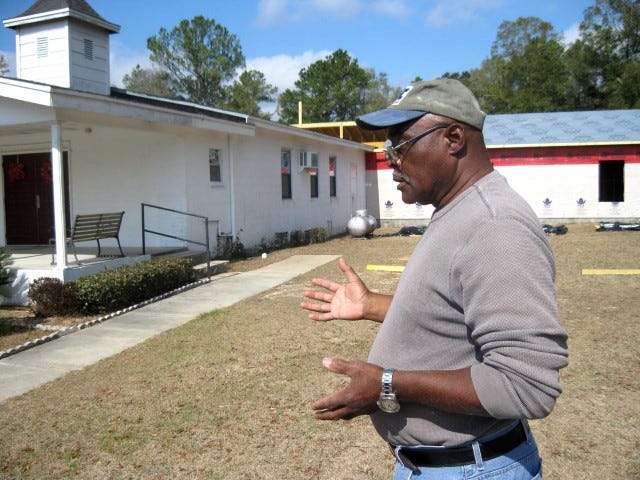
Pastor Tommie Lewis is overseeing Mount Zion Missionary Baptist Church’s growth. The addition rising behind the church will house three Sunday school rooms, Lewis’ study and a 700-square-foot expansion to the sanctuary.

LAUREL HILL — While some churches are seeing their congregations shrink, Mount Zion Missionary Baptist Church is making a $160,000 investment in its future.

An addition rising behind the church will house three Sunday school rooms, Pastor Tommie Lewis’ study and brings a 700-square-foot expansion to the sanctuary.

See photos of Mount Zion Church and its new addition under construction>>

But as the 56-member church grows, Lewis is already resigned to the fact that he may not get his study after all.

“It seems at this point I’m going to have to give it up to do what we need to do,” Lewis said. “We’re trying to prepare the hearts and minds of the people that are here for what God is sending us.”

And what — or rather, who — God has sent so far has required the 115-year-old church to expand.

“We have to get up and give visitors our seats to accommodate everybody,” Missionary Mary Bradberry said. “Sometimes we have to put chairs in the aisle.”

CHANGING MINDS, HEARTS

Mount Zion Church was organized Aug. 10, 1910, primarily by black families who worked on the Laurel Hill Goolsby Farm, elder Julius “J.W.” Robbins said.

With established, multi-generational families belonging to the church, gently nudging his flock to accept new ideas for growth has sometimes been a challenge, Lewis said.

“We had to fight that fight when we got here,” Lewis said. “It’s not about what Mama said or what Daddy said. It’s about what God said.

“This is going to be for the future. I’ve come from some churches where you have to fight about everything, but here, I only have to shout a little bit sometimes.”

Lewis established teams to help run the church, including twice-weekly worship, Sunday school classes, construction, finances and community mission work.

“I learned I have to back off a little,” he said. That’s the team aspect.”

IT’S ABOUT LEADERSHIP

Robbins and Bradberry praised their pastor’s leadership skills.

“If you’ve got a good leader, the people will follow,” Robbins said. “All the sheep follow a good shepherd.”

“He had to show the members some new ways,” Bradberry said. “I put in my two cents but I listen, too. It’s all about God and saving our souls. God has given him (Lewis) a vision. We need to follow.”

Among improvements, Lewis built a front porch on the church, which younger members promptly adopted as a great place to eat lunch, Bradberry said.

And after 66 years of leasing, last year Mount Zion acquired the land on which its buildings stand.

But building the addition took a leap of faith, Lewis said.

“Going into debt was very frightening for me,” Lewis said. “We are very blessed and happy that the people can trust us on that.”

FOR YOUTHS

On some Sundays, children outnumber adult worshipers, Robbins said, adding, “The old generation is going out and the new generation starts.”

“That’s where we’re growing: those kids,” Bradberry said.

“We teach from birth to grave,” Lewis said, adding the church’s philosophy includes “preaching, teaching, praying and singing.”

“For the kids, we’re trying to do something that’ll keep their minds on the church and their bodies in the church,” he said.

As he walked through the warm, wood-paneled sanctuary, its walls festooned by Bradberry with materials celebrating Black History Month, Lewis visualized the day when seating will expand beyond the 14, five- or six-person pews.

“I believe the Holy Spirit resides here,” Lewis said. “It excites me to see stuff come together. We believe God and we trust God for what he has in mind for us.”

WANT TO GO?

WHAT:Black History Tea

WHEN:7 p.m. Feb. 26

WHERE:Mount Zion Missionary Baptist Church, 3831 New Ebenezer Road, Laurel Hill

COST:Free

NOTES:Features Mount Zion Missionary Baptist Church first lady Geraldine Williams-Lewis as guest speaker.

CONTACT: Missionary Mary Bradberry, 652-1936.

Email News Bulletin Staff Writer Brian Hughes, follow him on Twitter or call 850-682-6524.

This article originally appeared on Crestview News Bulletin: With growing flock, Mount Zion Missionary Baptist Church expands (PHOTOS)


FINANCIAL FOCUS: Tax diversification can help you manage retirement income

You need to save and invest as much as possible to pay for the retirement lifestyle you’ve envisioned.

But your retirement income also depends, to a certain degree, on how your retirement funds are taxed.

And that’s why you may be interested in tax diversification. To understand the concept, you need to be familiar with how two of the most important retirement-savings vehicles — an IRA and a 401(k) — are taxed. Essentially, these accounts can be classified as “traditional” or “Roth.”

When you invest in a traditional IRA or 401(k), your contributions may be tax deductible and your earnings can grow tax deferred. With a Roth IRA or 401(k), your contributions are not deductible, but your distributions can potentially be tax-free if you meet certain conditions.

(Keep in mind, though, that to contribute to a Roth IRA, you can’t exceed designated income limits. Also, not all employers offer the Roth option for 401(k) plans.)

Of course, “tax free” sounds better than “tax deferred,” so you might think that a Roth option is always going to be preferable.

But that’s not necessarily the case.

If you think your tax bracket will be lower in retirement than when you were working, a traditional IRA or 401(k) might be a better choice, due to the cumulative tax deductions you took at a higher tax rate.

But if your tax bracket will be the same, or higher, during retirement, the value of tax-free distributions from a Roth IRA or 401(k) may outweigh the benefits of tax deductions you’d get from a traditional IRA or 401(k).

So, making the choice between “traditional” and “Roth” could be tricky.

But here’s the good news: You don’t necessarily have to choose, at least not with your IRA. That’s because you may be able to contribute to a traditional IRA and a Roth IRA, assuming you meet the Roth’s income guidelines. This allows you to benefit from both the tax deductions of the traditional IRA and the Roth IRA's potential tax-free distributions.

And once you retire, this “tax diversification” can be especially valuable.

Why?

Because when you have money in different types of accounts, you gain flexibility in how you structure your withdrawals — and this flexibility can help you potentially increase the amount of your after-tax disposable income.

If you have a variety of accounts, with different tax treatments, you could decide to first make your required withdrawals (from a traditional IRA and 401(k) or other employer-sponsored plan), followed, in order, by withdrawals from your taxable investment accounts, your tax-deferred accounts and, finally, your tax-free accounts.

Keep in mind, though, that you may need to vary your actual sequence of withdrawals from year to year, depending on your tax situation.

For example, it might make sense to change the order of withdrawals, or take withdrawals from multiple accounts, to help reduce taxes and avoid moving into a different tax bracket.

Clearly, tax diversification can be beneficial. So after consulting with your tax and financial advisors, consider ways of allocating your retirement plan contributions to provide the flexibility you need to maximize your income during your retirement years.

This article was written by Edward Jones on behalf of your Edward Jones financial adviser. 

This article originally appeared on Crestview News Bulletin: FINANCIAL FOCUS: Tax diversification can help you manage retirement income

EXTENSION CONNECTION: Do homework before planting fruit trees

Not every fruit tree will grow and reliably produce fruit in our area.

Most fruits grown in northern Florida are deciduous, which means the trees shed their leaves during winter and go into a period of dormancy or rest.

During this rest, the tree must be exposed to chilling temperatures. This exposure to cold prepares the plant to resume active growth in spring.

Temperatures below 45 degrees Fahrenheit accumulated throughout the winter determine the total hours of chilling. Species differ in the amount of chilling they need to completely rest and resume growth; this is known as a plant's chilling requirement. Lack of sufficient chill hours will result in sparse foliage, few to no flowers and poor fruit production. 

Our area receives between 400 to 650 hours of temperatures below 45 degrees Fahrenheit during the average winter. This provides enough chill hours for certain apple cultivars such as Anna, Ein Shemer, Dorsett Golden and Tropic Sweet.

However, it does not provide the chill hours required for many of the more common varieties such as Red Delicious and Golden Delicious.

This same environmental factor holds true for most deciduous fruit trees. Some of the better known peach varieties, such as Elberta, perform poorly here. Most, if not all, of our winters will not provide the chill hours they require. There are peach varieties that perform okay in our area.

Even when the correct variety is selected, many fruit enthusiasts are disappointed to see insects eating their fruit, diseases causing their fruit to rot or possibly all their fruit falling to the ground before it’s ready to be eaten.

It is wise to do your homework before purchasing and planting just any old fruit tree in North Florida.

HOW IT'S DONE

To be successful producing fruit in northern Florida, ask these questions before planting:

•Which varieties grow well here?

•How much care is needed to grow this type of fruit?

•Do I have time to devote to pruning, spraying, fertilizing and watering?

If you don’t know the answers to these questions, talk to a knowledgeable employee at a local nursery, contact your county University of Florida/Institute of Food and Agricultural Sciences Extension Office or visit http://edis.ifas.ufl.edu/TOPIC_Fruit_and_Nuts before planting fruit trees. 

Larry Williams is an agent at the Okaloosa County Extension office in Crestview.

This article originally appeared on Crestview News Bulletin: EXTENSION CONNECTION: Do homework before planting fruit trees

Women's 'The Amazing Collection' Bible study begins in March

CRESTVIEW — The Women of Joy group is starting a women's Bible study called The Amazing Collection next month.

The collection is a Bible study of God’s Word, filled with powerful testimonies, inspiring music and easily understandable summaries of each of the 66 books of the Bible.

The classes, which start March 3, are from 10 a.m. to noon Tuesdays at Joy Fellowship, 5978 Old Bethel Road, Crestview. There is a small fee of $12 for the workbook.

To sign up, contact Robin Bryant at 682-6219. 

This article originally appeared on Crestview News Bulletin: Women's 'The Amazing Collection' Bible study begins in March

HAPPENINGS: Dental health benefits more than the mouth

When was your last trip to the dentist, and how did it go? Did you receive a great checkup?

Why is it that so many of us don’t like to see the dentist? 

Since it is a new year, it’s time to make those appointments and get a dental checkup, as dental health is vital to our overall health. 

I am not afraid of the dentist, having had years of orthodontia; however, I don’t seem to make enough appointments for cleaning and checkups.

Then there's the insecurity factor. None of us likes the idea that we may have dental problems like a cavity, so it may seem like ignorance is bliss.

And that may be the case — until we're in pain and quickly call the dentist's office.  

It's simple: If you don't brush your teeth every day with fluoride toothpaste, floss, limit sugary snacks and see the dentist regularly, problems including cavities and even tooth loss could occur, according to the National Institute of Dental and Craniofacial Research.

And dental problems don't discriminate with age. Children and adults need to be seen regularly to avoid gum disease, a major cause of tooth loss.

So, why wouldn't you see the dentist, especially when the benefits extend beyond your mouth?

Yes, brushing your teeth regularly may help you avoid heart disease, according to the Mayo Clinic.

Considering all these factors, I took my parents and myself to see the dentist and finally got my teeth checked — no problems, despite my delay in getting to his office.

My parents got their dental needs addressed and we were all sent on our way with clean teeth — what a great feeling!

I also got new, clear retainers that can’t be seen when they are worn.  Technology is wonderful! 

There's no reason to fear the dentist — especially for me: he is my brother.

And there's no reason to stay at home when you could be attending all these great North Okaloosa and regional events and activities, volunteering and serving your community!

I hope to see you on my jaunts around our fair city. Please say “hi” if you see me.

Janice Lynn Crose lives in Crestview with her husband, Jim; her brother, Robb; her two rescue collies, Shane and Jasmine; and two cats, Kathryn and Prince Valiant.

Email listings of upcoming events to NorthOkaloosaHappenings@gmail.com.                                                              

This article originally appeared on Crestview News Bulletin: HAPPENINGS: Dental health benefits more than the mouth

EXTENSION CONNECTION: 6 questions to decide 'Who gets the farm?'

Farming involves so much planning, implementing and evaluating of farming methods that farmers sometimes overlook the retirement and succession planning part of the job.

Farm assets such as land, equipment and livestock will need to be considered if a farmer retires or unexpectedly dies.

CONVERSATION STARTERS

The first — and, sometimes, hardest — step to building a success plan is to talk with family members about the process.

Here are a few questions from the Farm Journal Legacy Project to get the conversation started:

•Are you interested in participating in the family operation? How?

•Are you prepared to assume that responsibility? If no, what would it take to prepare?

•Should family members not active in the operation attain or retain an ownership interest? If no, how should family assets be distributed?

•If you want to be included in the operation, are you willing to invest in an ownership interest?

•What is your biggest question, or unanswered concern, regarding succession intentions?

•Are there any other succession-related topics you would like to add to the agenda for an upcoming meeting?

EDUCATE YOURSELF

The University of Florida's Institute of Food and Agricultural Sciences Northwest Extension District is offering new personal finance educational programs to farmers.

Anyone in the agriculture industry can attend the Extension's AgSave$ Summit, 9 am. to 1 p.m. Feb. 23 in Marianna, which focuses on retirement planning and succession planning. Lunch is provided free, thanks to our generous sponsors, Farm Credit of Northwest Florida. 

Our AgSave$ Workshop Series, which focuses on securing your farm's future, begins March 24. The series costs $55 and will include a Farm Journal Legacy Project Workbook.

Contact me at 689-5850 or bearden@ufl.edu for more information.

Jennifer Bearden is an agent at the Okaloosa County Extension office in Crestview.

This article originally appeared on Crestview News Bulletin: EXTENSION CONNECTION: 6 questions to decide 'Who gets the farm?'

Niceville UMC, St. Mark UMC become Crosspoint

CRESTVIEW — Niceville UMC and St. Mark UMC, 2250 P.J. Adams Parkway, have officially changed to the name Crosspoint.

“Our mission is to connect people to Christ,” the Rev. Rurel Ausley, pastor of the Niceville campus, said. “We have been one church with two campuses for several years now. The name Crosspoint better represents our identity as a multi-campus church and the church we have morphed into over the last five to 10 years.

"A common, non-geographical name is more representative of one church, offering the same excellent worship and ministries on multiple campuses.”

For 10 years, Crosspoint has averaged 2,900 attendees each weekend on its Niceville and South Crestview campuses.

Construction is underway for an additional campus — on Old Bethel Road in North Crestview — to open in the fall.

Crosspoint offers multiple Sunday services on each campus with varied styles of worship; from modern or contemporary to traditional. There are optional “café” services on the South Crestview campus, where worshippers sit around small tables and enjoy coffee during worship, and a Saturday evening modern service on the Niceville campus.

“In our efforts to connect more people to Christ, we offer multiple styles of worship so that anyone can feel at home here,” Ausley said. “The new Crosspoint name reflects the changes we will continue to make to connect more people to Christ.”

Ausley said the church took input from its membership on the new name. Crosspoint was put forth by one of the members at the Niceville campus, and was then voted upon by the entire membership on both campuses.

This article originally appeared on Crestview News Bulletin: Niceville UMC, St. Mark UMC become Crosspoint

Goal: collect 5,000 pounds of canned foods

CRESTVIEW — The Joy Fellowship youth group is "Saving Lives One Can/Jar at a Time" with a food drive that kicked off Jan. 1.

The goal is to collect 5,000 pounds of canned, nonperishable items for local food pantries and the Crestview Pregnancy Center.

If you would like to help the Joy Fellowship youth group reach their goal, drop off your donations at Joy Fellowship (5978 Old Bethel Road) in Crestview from 10 a.m. to noon Monday through Friday. 

This article originally appeared on Crestview News Bulletin: Goal: collect 5,000 pounds of canned foods

'Incredible legacy': First Baptist's music minister retires

Paul Conrad sits amid the clutter of 25 years of service to First Baptist Church of Crestview as he packs his office upon retirement. “I’m trying to decide what needs to go and what needs to stay,” he said.

CRESTVIEW — If the future is anything like Paul Conrad’s past, the beloved First Baptist Church of Crestview’s music minister won’t be retired long.

Though Conrad officially retired after Sunday’s services, his fellow ministers say he’s threatened to retire before and just never does it.

“My ‘last Sunday’ was the last Sunday in December, but we had a revival coming up and they asked me to stay on for that, so then we thought I might as well stay through the month,” he said.

Conrad and his wife, Phyllis, plan to retire to their small farm in Georgia, where he’ll offer his service to local churches on a part-time or interim supply basis, he said.

RENOWNED CHOIR

Among his accomplishments, Conrad points to First Baptist's youth choir as one of his favorite achievements.

“We had a good adult choir, and we had kids, but they were nowhere as strong as they’ve become,” he said. “Our youth choir sings every Sunday night.”

The Rev. Randall Jenkins, education minister, said the youth choir’s summer performance tours are renowned, especially at a time when few youth choirs tour anymore.

“It’s just something we’ve morphed into over the years,” Conrad said. “They’re strong kids. They’re dedicated.”

For many of the kids, the tours have been their only opportunity to venture out of the Florida Panhandle, senior pastor the Rev. Alan Kilgore said.

“Through the choir ministry, the kids have seen a lot of national landmarks,” he said.

Some of the trips have left indelible memories, Conrad said.

“When we were in New York, we sang in Times Square,” he said. “It was spontaneous. I asked a policeman if we could sing and he said, ‘I’m not going to tell you you can’t.’ We got our pitch and we sang the spiritual, ‘Shut de Do’.’ We had about 500 people all around us cheering us on.”

GOOD PEOPLE

Conrad has been the church's longest-tenured minister in recent memory, Jenkins said.

“He’s stayed here longer than most pastors,” Jenkins said.

Conrad said the reality of retirement still hasn’t quite sunk in.

“I’ve caught myself saying, ‘I’ve got to get ready for Easter,’ then, oh, no I don’t,” he said. “I’ve got to do this or that. Oh, no I don’t. Sometimes I wonder if I’m really ready for this.”

Fellow pastors shared funny stories about their music minister.

“He has a habit of leaving the office with the lights on,” Kilgore said. “I started locking his door and turning up his thermostat. So he got even with me and took the lock out. It fell apart in his hand. We only just got it fixed.”

Kilgore and Jenkins said Conrad refuses to change his watch from standard time.

“If Jesus came back, Paul would be an hour late to the Rapture,” Kilgore said.

“Unless he came back on Daylight Savings Time,” Conrad responded.

Conrad said in retirement, he will miss the people of First Baptist most.

“This is the best church I’ve ever served, and the best choirs,” he said.

“He’s a good guy,” Jenkins said. “That’s an incredible legacy he’s leaving after a quarter-century.”

“It sounds like a long time if you say it that way,” Conrad said.

Then, as he left his office, he paused at the door and switched off the light.

Email News Bulletin Staff Writer Brian Hughes, follow him on Twitter or call 850-682-6524.

This article originally appeared on Crestview News Bulletin: 'Incredible legacy': First Baptist's music minister retires

error: Content is protected !!