Please ensure Javascript is enabled for purposes of website accessibility
Skip to main content
Advertisement

STAYIN' ALIVE: Florida researchers reveal why some butterflies survive in fire-prone areas
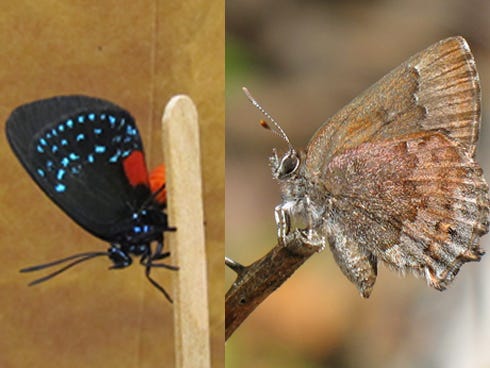
To find out how and why some butterfly species survive fires, University of Florida scientists tested pupae in two North Florida forests typically managed with prescribed burns. They studied atala hairstreak (left) and frosted elfin (right), two butterfly species that frequent fire-prone habitats.

Deciding how often and when to use prescribed fire can be difficult, especially when managing for rare butterflies, University of Florida scientists say.

That realization stems from a UF Institute of Food and Agricultural Sciences study in which researchers experimented with pupae — insects between larvae and adult stage — of butterflies that frequent Florida's fire-prone habitats.

Prescribed burns and wildfires can damage animals and plants in their paths. But they can also promote species and create habitat, maintaining the ecological balance of the forest and the region’s most frequent natural disturbance over the long term.

Immature butterflies may die immediately after controlled burns, but populations can recover over time.

Still, scientists are concerned that butterflies with small, isolated populations may be in severe peril if their habitats are burned too frequently and in large blocks at a time, which can mean that butterfly refugia — unburned areas that provide refuge — are limited. 

BURNING QUESTIONS

In the UF/IFAS study, scientists wanted to know how and why some butterflies survive wildfires and prescribed burns, particularly where the insect feeds and lays eggs on fire-adapted plants.

To date, most studies on the impact of fires on insects have been done in the Midwest, said Jaret Daniels, a UF/IFAS associate professor in entomology, who supervised the study as part of a dissertation by former UF doctoral student Matt Thom.

“We are increasingly faced with developing appropriate strategies to help conserve a growing list of rare organisms, including many insects,” Daniels said. “Understanding how prescribed fire and other land- management techniques impact these populations is critical to ensure their long-term survival.”

Thom also worked on the study with Leda Kobziar, a UF/IFAS associate professor in forest resources and conservation. The study appeared online May 27 in the journal Plos One.

“Although we have a fairly robust understanding of how fire affects plant communities, the relationships between fire and insects is a greater mystery,” Kobziar said.

“How is it that some organisms sensitive to fire also depend on specific plants that requirefire to persist in a given environment?

"This research helps provide answers to this question, while revealing how much more we need to know to conserve the full spectrum of species through science-based fire management.”

EXPERIMENTS AND RESULTS

To find out how and why some butterfly species survive fires, UF/IFAS scientists tested pupae in two North Florida forests typically managed with prescribed burns.

Thom and his colleagues studied atala hairstreak and frosted elfin, two butterfly species that frequent fire-prone habitats.

Researchers collected data on burial depth of the frosted elfin at the Ralph E. Simmons Memorial State Forest in Nassau County. They conducted burn experiments with the atala hairstreak at the UF/IFAS Ordway Swisher Biological Station in Putnam County. They also put the pupae in laboratory baths at the UF Gainesville campus.

The atala hairstreak butterflies develop into pupae within or at the base of its host plant, while the frosted elfin sometimes goes down into the soil to pupate, Thom said.

In the experiment, scientists placed atala pupae at the soil surface and at different depths. The pupae died at the soil surface and in very shallow depths below ground, Thom said.

However, when buried at 1.1 inch or more below ground, butterflies survived 75 to 100 percent of the time, as the temperature and the amount of heat they were exposed to decreased, Thom said.

Scientists saw a similar pattern in their lab experiments. “Butterfly pupae that bury themselves deep enough in the soil can protect themselves from fire,” said Thom.

But there are caveats.

For example, if a non-adult atala lives in an area that’s burned, it will probably die, said Thom, now a post-doctoral scientist with the Agricultural Research Service of the U.S. Department of Agriculture. The situation also isn’t very promising for the frosted elfin.

But there’s hope.

“The patchiness of fires increases where fires occur more frequently, because there’s less leaf litter.  “Less material burning translates to decreased heating of the soil,” Thom said.  “A more patchy fire probably means pupae on the ground have a better chance for survival, and there are more refugia for escaping adults.”

Brad Buck is an agent for the University of Florida Institute of Food and Agricultural Sciences.

This article originally appeared on Crestview News Bulletin: STAYIN' ALIVE: Florida researchers reveal why some butterflies survive in fire-prone areas


DUNNING: Share your property with pollinators

In the U.S., pollination by honey bees, native bees and other insects annually produces $40 billion worth of products. So it's important to reserve areas for pollinators because that caters to the economy, Sheila Dunning says.

Anyone with a landscape can make a difference for pollinators.

Simply Having Areas Reserved for the Environment — see what I did there? — enables homeowners, land managers, farmers, individuals, corporations, schools, roadside managers, and golf courses to increase the number of area pollinators.

Making conscious choices about plants can provide essential habitat for bees,bats, birds, butterflies, moths, beetles and hummingbirds.

And what better time can you do this than during National Pollinator Week, June 15-21, 2015?

National Pollinator Week, initiated and managed by the North American Pollinator Protection Campaign, was unanimously approved and designated by the U.S. Senate in 2007.

Each year since, the U.S. Secretary of Agriculture has signed the proclamation in an effort to address the issue of declining pollinator populations.

Worldwide, there is evidence that shows pollinating animals have suffered from loss of habitat, pesticide misuse, competition from invasive species, disease and parasites.

Many pollinators are federally “listed species," meaning there is documentation confirming the disappearance or significant population reduction in natural areas.

The United States has lost over 50 percent of its managed honeybee colonies over the past 10 years. The European Union has been so concerned that they invested over $20 million investigating the status of pollinators in Europe.

Pollinator health affects everyone. Worldwide, roughly 1,000 plants grown for food, beverages, fibers, spices and medicines need to be pollinated by animals in order to produce the goods on which we depend.

Food and beverages produced with pollinators' help include: apples, blueberries, chocolate, coffee, melons, peaches, potatoes, pumpkins, vanilla, almonds and tequila.

In the U.S., pollination by honey bees, native bees and other insects annually produces $40 billion worth of products.

Native plants that can be identified and preserved or introduced include trees, shrubs, vines and perennials.

Some of them include: eastern redbud, highbush blueberry, passionflower, coreopsis, goldenrod, black-eyed Susan and butterfly milkweed.

Simply identifying and avoiding damaging many of the existing native plants will allow anyone to provide important homes and food for many different pollinating animals.

During National Pollinator Week, S.H.A.R.E. your space.

Sheila Dunning is a commercial horticulture agentat the University of Florida's Institute of Food and Agricultural Sciences Extension office in Crestview.

This article originally appeared on Crestview News Bulletin: DUNNING: Share your property with pollinators

Sons of Italy Crestview lodge supports Covenant Hospice's mission

Pictured from left: Crestview Mayor David Cadle; Martha and Tom Hughes, Sons of Italy Richard A. Capozzola Lodge 2865; Rachel Mayew, Covenant Hospice development manager; Joy Browne; and Karen Boisjolie.

CRESTVIEW — Covenant Hospice's programs have extra support with the Sons of Italy Richard A. Capozzola Lodge 2865's $500 donation.

The contribution will help fund the nonprofit's bereavement and spiritual support services, children's support programs and charity care in Okaloosa and Walton counties.

Covenant accepts patients regardless of their ability to play. Learn more at www.choosecovenant.org.

This article originally appeared on Crestview News Bulletin: Sons of Italy Crestview lodge supports Covenant Hospice's mission

Crestview's Surgery Center offers outpatient procedures — but not for everyone (VIDEO)

Surgery Center clinical coordinator Corry Wellman shows the pre-operation room where patients are prepared for their surgeries.

CRESTVIEW — In the shadow of the medical center familiarly known as “the Four-Story” lies what North Okaloosa Medical Center physician liaison Alicia Booker calls the community’s “best-kept secret.”

NOMC’s Surgery Center — an ambulatory surgery center — is an alternative to having procedures in the north county’s hospital, Booker said.

“I think a lot of times the community is not aware we have surgeries there as well as at the main hospital,” she said.

Watch a video tour of North Okaloosa Medical Center's Surgery Center>>

Because medical technology has advanced rapidly, many procedures that just a few years ago required an overnight hospital stay are now done on an outpatient basis, she said.

“That’s how the majority of surgeries are done these days,” Director of Surgical Services Stephanie Martin said.

GENERAL SURGERIES

The center’s four surgical suites share staffers with the main hospital’s operating room to perform general surgeries, such as gynecological procedures, orthopedics, knee and shoulder scopes, and eyes, nose and throat surgeries.

Treatment rooms accommodate routine procedures such as colonoscopies and similar probes.

Martin said because the Surgery Center is designed for one purpose, “the process is more streamlined and convenient,” and that, Booker said, helps make procedures less expensive for patients.

Since emergency operations are only done at the main hospital, a scheduled procedure at the Surgery Center is unlikely to be cancelled for an emergency case, Booker said.

NOT FOR EVERYONE

The facility isn’t suitable for every patient, Surgery Center clinical coordinator Corry Wellman said.

“If you are a higher-risk patient, you may have to have your procedure at the hospital,” she said. “We don’t do patients that are really ill. We want you to be able to walk in and walk out.”

The decision is generally up to the surgeon and the anesthesiologist, she said.

For the surgeon, an outpatient surgery center, like North Okaloosa Medical Center’s, “is often more convenient, more efficient, and customizable to their needs,” Booker said.

And for the patient, “they are able to provide lower-priced procedures because they have a lower cost structure than a traditional hospital setting, along with a ‘focused factory’ approach which creates efficiencies,” she said.

“It’s an alternative for outpatient surgery,” Booker said. “We hope it becomes a less-kept secret.”

Email News Bulletin Staff Writer Brian Hughes, follow him on Twitter or call 850-682-6524.

This article originally appeared on Crestview News Bulletin: Crestview's Surgery Center offers outpatient procedures — but not for everyone (VIDEO)

CROSE: Downtown not lone option for Crestview's business expansion

What constitutes a "vibrant downtown" as imagined by Crestview's planning department and their consultant? 

Perhaps it means bars, nightclubs, restaurants, high-end boutiques, tattoo parlors and novelty stores.  But do we want to fashion the downtown area after the Destin Commons, Universal City Walk or Downtown Disney?

Apparently, the city wants valuable downtown real estate for establishments other than the kinds of 9-to-5 businesses that comprise most of Main Street. These include law offices, title companies, medical offices, clothing stores and so forth.

Most of these businesses close at 5 p.m. and wouldn't be considered fun or vibrant, but they are valuable services needed by our community. 

Would these businesses be expected to relocate if they don't meet the criteria for downtown?  Are they, like churches, locked into their existing footprint should they desire to renovate or expand?

I am concerned about downtown. We drove down Main Street last week at 6 p.m. and it was deserted, other than a few cars at Hideaway Pizza.

Several businesses have closed on Main Street. I don't know whether it was due to lack of customers, high rent, under-capitalization, limited parking or other issues. 

However, if I were opening a new business, I am not sure I would take the risk of being on Main Street. It doesn't appear that there is enough foot or vehicle traffic to warrant businesses being open after 5 p.m. 

The way to revitalize an area is to offer lots of choices.  How does a city entice new businesses? With sales and property tax breaks.

But are such incentives enough to bring several new businesses to the downtown corridor?

Perhaps for the time being, new businesses need to locate farther north on State Road 85 or at the south end of town in the empty area next to Lowe's.

There is a definite need for more restaurants and places to shop in Crestview.

There is also a great need to solve the traffic problem here, which hinders any revitalization plan.

I am sure there is a solution; we just need to keep working on it.

And we need to remember that the city of Crestview should not copy another city's business model.

Janice Lynn Crose lives in Crestview with her husband, Jim; her two rescue collies, Shane and Jasmine; and two cats, Kathryn and Prince Valiant.

This article originally appeared on Crestview News Bulletin: CROSE: Downtown not lone option for Crestview's business expansion

Institute of Food and Agricultural Sciences study cautions parents about arsenic from wet wood

GAINESVILLE — Wet wood treated with the pesticide chromated copper arsenate (CCA) loses arsenic three times more than dry wood, so if it rains, you can expect more arsenic on your wood deck surface, a new University of Florida study shows.

That may pose a potential danger to anyone who plays or walks on the deck, and that most often means children or pets, said Julia “Ky” Gress, a doctoral student in soil and water sciences at the UF Institute of Food and Agricultural Sciences.

Gress led an experiment in which she and her colleagues used standard wipe methods to collect arsenic from the surface of wood from a 25-year-old South Florida deck. Although the CCA wood came from only one deck, it is representative of wood decks constructed before 2004, Gress said.

Before wiping the wood, researchers put water on it, then wiped it to see how much arsenic was present. They then cleaned different pieces of the decking with either tap water or a bleach-water solution, followed by pressure washing. 

Results showed water alone caused three times more arsenic to form on the surface of wet wood than dry wood, and the use of bleach caused formation of chromate, another carcinogen. They also found that these chemicals remained on the wood surface for an hour after it was cleaned.

“The levels of arsenic and chromate coming off these boards are much higher than allowable levels and show the potential for soil and water contamination and public health impacts,” Gress said.

Her study, performed under the supervision of soil and water science Professor Lena Ma, is published in the current issue of the journal Environment International.

Wood treated with CCA was used on many residential decks built before 2004 because it is highly resistant to termites. But in 2003, the U.S. Environmental Protection Agency pressured industry to stop using CCA to treat wood intended for use around homes, including outdoor decks, after finding arsenic, a carcinogen, leaches out of wood.

Wood decks, picnic tables, fences and children’s playsets built before 2004 are likely constructed from CCA-treated wood, which can last for 20-40 years, Gress said.

In fact, about 10 years ago, the wood industry estimated half of single-family homes nationwide had a deck of porch made from CCA-treated wood. The results of this study show the importance of avoiding skin contact with wet decking, particularly right after cleaning with bleach, Gress said.

CCA wood continually leaches arsenic into the environment from normal rainfall and contaminates the soil around decks, Ma said. Because of this health hazard, the Consumer Product Safety Commission recommends that parents make sure children wash their hands after contact with the wood and avoid letting children or pets play in soil around CCA-wood decks.

This article originally appeared on Crestview News Bulletin: Institute of Food and Agricultural Sciences study cautions parents about arsenic from wet wood

Registration deadline approaching for Healthy Okaloosa Family Challenge

OKALOOSA COUNTY — This summer, the Florida Department of Health in Okaloosa County invites families to make healthy lifestyle choices.

The 10-week, Healthy Okaloosa Family Challenge — which every two weeks offers fun ideas to promote physical activity and healthy eating — uses these 5-2-1-0 health messages to help guide families:

5: Eat five or more fruits and vegetables each day (babies younger than 1 breastfeed)

2: Limit recreational screen time to two hours or less each day

1: Get at least one hour of physical activity each day

0: Limit sugary drinks; limit exposure to tobacco and nicotine

Families will keep track of their activities and submit scorecards each two weeks. Families who finish the challenge will receive a certificate for making healthy lifestyle choices. The first 100 families who complete the challenge will receive free healthy prizes.

To register for the Healthy Okaloosa Family Challenge, visit okaloosa.floridahealth.gov or call 833-9240 ext. 2161. Online registration closes June 14. 

This article originally appeared on Crestview News Bulletin: Registration deadline approaching for Healthy Okaloosa Family Challenge

Michael Allman Band sets Crestview performance dates

CRESTVIEW — The Michael Allman Band  will perform in July at Split Oaks Saloon.

Performances — for patrons ages 21 and up — are 10 p.m. July 3 and 5 at 892 James Lee Blvd. W., Crestview. Cost is $10 per person.

The blues and rock band — led by Michael Allman, of Daytona Beach — performs songs such as "What's the World Coming to?"; "Mule Named Whiskey"; and "Livin' on the Open Road."

This article originally appeared on Crestview News Bulletin: Michael Allman Band sets Crestview performance dates

SHANKLIN: Take steps to protect your family business

There’s nothing more important to you than your family. However, your family-owned business probably helps support your family. So, when it comes to protecting your family and your business, you need to carefully consider your moves.

As you know, you face plenty of challenges to keep your business running smoothly — but it can be even more difficult to pass the family business on to your children or other relatives.

In fact, according to the Small Business Administration, only 33 percent of family-owned businesses survive the transition from first generation ownership to the next generation.

Why is it so hard to keep a family business intact?

Sometimes, it’s because no one in the family is interested in running the business — but family businesses frequently disintegrate because of the lack of a succession plan.

To create a succession plan, your first step — and possibly the most important one — is to collect the thoughts and preferences of family members on their future involvement with your business.

It’s essential that you know who wants to really do the day-to-day work and who is capable.

During these conversations, you’ll also want to discuss other key business succession issues, such as the retirement goals and cash flow needs of retiring family owners, and the personal and financial goals of the next generation of management.

In developing a plan for the future of your business, you will need to determine who will control and manage the business, and who will eventually own it.

These decisions will depend on a variety of factors, such as the time horizon, goals and financial needs of family members involved.

Your succession plan could be based on a family limited partnership. Under this arrangement, you, as general partner, would maintain control over the day-to-day operation of your business, but, over time, you could gift or sell limited partnership shares to your family members.

Eventually, you would also relinquish control of the business to whoever is going to run it.

Another component of your succession plan might be a “buy-sell” agreement, which allows you to name the buyer for your business — such as one of your children — and establish methods to determine the sale price.

Your child could then purchase a life insurance policy on your life and eventually use the proceeds to buy the business, according to the terms established in the buy-sell agreement.

We’ve just skimmed the surface of techniques that might be used alone or in combination to carry out your business succession.

The transfer can be complex, so you will certainly need to consult with your legal and financial professionals.

It’s important that you fully understand the business and tax implications of any succession plan as well as the financial impacts of a plan on all your family members.

In any case, once you’ve created your succession plan, you’ll need to work with your legal adviser to put it in writing and communicate it clearly to all family members.

Surprises are welcome in many parts of life — but not when it comes to transferring a family business.

You want to leave your family a legacy. And if that legacy is the family business, do whatever it takes to pass it on in a manner that benefits everyone involved.

This will take time and planning — but it can be well worth the effort.

This article was written by Edward Jones for use by your local Edward Jones Financial Advisor.

This article originally appeared on Crestview News Bulletin: SHANKLIN: Take steps to protect your family business

Okaloosa beaches get 'all clear' for hazardous water

FORT WALTON BEACH — All Okaloosa County parks have passed hazardous bathing tests, the Florida Department of Health in Okaloosa County stated this week.

All waters achieved good quality ratings except three rated "moderate": Lincoln Park, Valparaiso; Henderson Beach and James Lee Park, both in Destin.

The tests are based on EPA-recommended enterococci standards.

Enteric bacteria’s presence indicates fecal pollution from stormwater runoff, pets and wildlife or human sewage.

Call689-7859 or 833-9247 for more information.

This article originally appeared on Crestview News Bulletin: Okaloosa beaches get 'all clear' for hazardous water

error: Content is protected !!