Please ensure Javascript is enabled for purposes of website accessibility
Skip to main content
Advertisement

Free HIV testing available June 24-26 in Crestview

CRESTVIEW — The Florida Department of Health in Okaloosa County is observing National HIV Testing Day by providing a free promotional gift to individuals who take a free confidential HIV test June 24-26 in Crestview.

The Centers for Disease Control and Prevention state that “about 1.2 million people in the United States were living with HIV at the end of 2011, the most recent year this information was available. Of those people, about 14 percent do not know they are infected.”

HIV-infected persons who do not know that they are infected do not avoid unsafe behaviors. Persons who know they have HIV can get medical care and take antiviral medications that can reduce HIV spread by as much as 96 percent. 

This article originally appeared on Crestview News Bulletin: Free HIV testing available June 24-26 in Crestview

Covenant Hospice reimburses $10.1 million, corrects billing process

CRESTVIEW — Covenant Hospice Inc. has paid $10.1 million to reimburse the government for alleged overbilling of Medicare, Tricare and Medicaid.

The non-profit operates in Southern Alabama and Northwest Florida, including offices in Crestview, Fort Walton Beach, Milton and Panama City.

The settlement resolves allegations that between Jan. 1, 2009 and Dec. 31, 2010, the nonprofit improperly submitted hospice claims for general inpatient care that should have been billed at the routine home care level for Medicare, Tricare and Medicaid patients. The government alleged that Covenant's medical records did not support the medical necessity of the general inpatient care.

"During recent days, the reputation of Covenant Hospice has come under scrutiny after news of billing errors were released," the nonprofit's development office said in a statement. "These errors, which upon discovery were immediately self-reported by Covenant Hospice to the Department of Justice, have not and will not affect the care provided to patients and families at the end of life. Covenant Hospice remains steadfast to its promise to provide the highest standard of care to its patients and is committed to doing what is right."

"We initiated extensive staff training on proper medical record documentation to ensure compliance while continuing to provide the highest quality of care for our patients and families,” said Liz Kuehn, vice president of organizational excellence and corporate compliance.

This article originally appeared on Crestview News Bulletin: Covenant Hospice reimburses $10.1 million, corrects billing process

Crestview church's ministry surpasses city, national boundaries

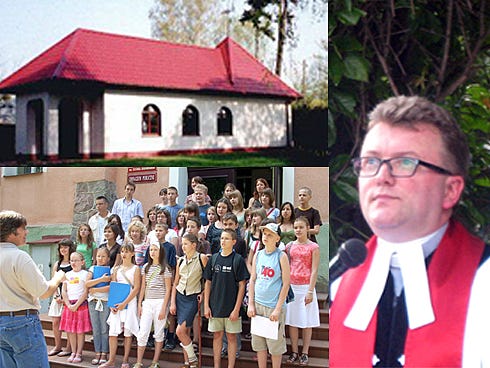
For more than 12 years, First United Methodist Church of Crestview has supported First UMC in Ilawa, Poland. The Rev. Kristof Kopacz, of Ilawa, Poland (right), says First United Methodist Church of Crestview’s help has been invaluable. Bottom left: Crestview High School choral director Kevin Lusk helped teach Ilawa, Poland children
English. “Kevin Lusk was a very good teacher and choir conductor,” Kopacz said.

CRESTVIEW — First United Methodist Church of Crestview provides a homeless shelter during the day and on cold nights.

It operates a food pantry, helps needy residents pay their power bills and sends members to other states for inner city and rural missions.

The 800-member church's influence even reaches to Africa, with its "Imagine No Malaria" campaign support; Lima, Peru, with ministry to street children; and Ilawa, Poland, teaching conversational English for the Rev. Krzysztof "Kris" Kopacz's 30-member church.

Actually, for that Polish pastor who would face unexpected physical challenges, the support grew more beneficial than he could have imagined.

SISTER CHURCHES

Kopacz, pastor of Ilawa's First UMC since 1992, learned about Crestview's First UMC some 13 years ago during a pastoral conference.

In 2002, in Warsaw, Poland, Kopacz was offered American volunteers whose mission was to teach English for Kopacz's church.

Lincoln Sayger, from FUMC of Crestview, lived at the parish with Kopacz for about 10 months and tutored Iława's youths.

"The schools already had an English class," LincolnSayger said. "I was there to teach them conversational English. Like pronunciations, idioms and syntax.

"We prayed for them; they prayed for us. We had three teams of summer school over there," said Marion Sayger, Lincoln's mother.

As Ilawans' English speaking abilities grew, so did the sister churches' relationship. In 2007, Kopacz — with help from Crestview church members, who paid for his 16-hour flight — visited the Hub City for two weeks and stayed in a member's home.

After the trip, he slipped and broke his kneecap, and that's when the Crestview church's support turned personal.

'A DIFFICULT REHABILITATION'

After surgery, Kopacz stayed for two weeks in Carolina Medical Center in Warsaw. After removing his cast, he realized his leg became ill.

Kopacz learned he has Sudeck's atrophy, which damaged his nervous system and bone structure. "The bone in my leg is very soft and every day, since 2007, I have been feeling the pain," he said.

Since then, his leg has broken twice — due to the bone being so weak and prone to fractures — and he's had five operations.

"My knee at the moment is bending badly, my leg still has pain and I walk (poorly)," he said. "Every day for the last eight years I have been having a difficult rehabilitation."

Still, through the pain, he leads two churches — including one 12 miles from Ilawa in the village of Siemiany, Poland.

But not without some financial assistance to ease the burden.

'IMMENSE HELP'

Since Kopacz's fall, the Crestview church has supported him several ways. For instance, on Mother's Day, FUMC held a tea to raise money for him.

Each of 15 hosts set their round table with fine china, Depression-era glass dishes, hand-painted porcelain dishes and crystal pieces over 100 years old.

The menu included chicken salad in a croissant; ham, cheese and lettuce roll-ups; white chocolate and raspberry scones; cucumber dip with Ritz crackers; chocolate-dipped strawberries; brownies; lemon and orange muffins with lemon glaze; water; and hot tea.

But for all its local extravagance, the sold-out event's benefit, much like the Crestview church's other efforts, touched Kopacz, he said.

"I would like to emphasize … that FUMC in Crestview, for me and my church, is a great support,” he said. "All the pastors in FUMC Crestview — Marion and Lincoln Sayger, Anne Campbell — have big hearts for me and my parishes.

"Also I, along with my wife Sofia and daughters Victoria and Julia, would like, once again, to express sincere thanks for their immense help."

This article originally appeared on Crestview News Bulletin: Crestview church's ministry surpasses city, national boundaries

CROSE: Children follow their dads' example

Sometimes, we overlook our fathers and grandfathers' importance, but think of all the ways they have enriched our lives.

In many cases, they taught us how to ride a bike, swing a baseball bat, roller skate, throw a football and play other sports.

They may have helped us solve pesky math problems that never made sense and assisted us with other homework.

Sure, they may have missed some of our school programs because of their work schedules, but their financial and emotional support proved their love for us.

My Dad was a CPA, and I always said I would never go into accounting —but I was an accountant for many years, so he obviously influenced my choice of profession. 

Dads have great influence in their children's lives — they model; we follow. 

My father always talked about business and business ethics with us, and I think all his children have very good business sense because of those dinner discussions. 

My eldest brother is a dentist and runs his own dental practice; another brother is the director of information technology and oversees other aspects of the company; and our youngest brother was a manager at McDonald's who went on to manage fine dining restaurants in California.

I believe our business accomplishments were all due to our father's influence.

Dads are important, and I think it only appropriate that we give them a huge thank you this Sunday and every day. 

And of course, don't forget to thank our Heavenly Father for all the blessings He has bestowed upon us. He is the ultimate Father who loves us unconditionally.

Happy Father's Day.

How has your father affected your life? What decisions have you made because of his influence?

Join the conversation>>

Janice Lynn Crose lives in Crestview with her husband, Jim; her two rescue collies, Shane and Jasmine; and two cats, Kathryn and Prince Valiant.

This article originally appeared on Crestview News Bulletin: CROSE: Children follow their dads' example

Crestview church in prayer, soon 'fully armed' following Charleston shooting

CRESTVIEW — Pastor Sinclair Forbes of Mt. Zion AME Church says the Charleston, S.C., shooting hits close to home.

"Two pastors, a high school track coach, a longtime librarian and an aspiring rapper were among the nine victims of the Emanuel African Methodist Episcopal Church massacre late Wednesday," USA Today reports.

The shooting — which Lexington, S.C., 21-year-old Dylann Roof, now in custody, is accused of — took place during a Bible study.

That's familiar to Forbes.

"I normally do Bible studies on Wednesday nights," he said. "I've had people come in the church and sit for a while. It's open. We don't lock the doors.

"That could have been any of us … it happened in Charleston, S.C., but it could have happened anywhere."

But Forbes isn't taking his chances, he said.

Going forward, Mt. Zion's services, which have 50 to 75 faithful on any given Sunday, will have more than spiritual protection. 

"I'll have my staff fully armed," Forbes said. "I will probably have someone who will be packing … starting Sunday."

But that goal, shared earlier on Facebook, drew some concern.

"You cant just 'carry a gun' and be able to use it effectively," Justin Lindsey said. "It takes a lot of training to be able to shoot a person.

"Like most vets, I've lived with a gun for a long time. I'm really curious about the training regiments."

"Agreed," Wes Wolfe said. "Lots of folks shoot at each other … and barely connect with anything. Which is a silver lining."

But for Forbes, the attacks particularly hit close to home.

The pastor said he knew some of the Charleston victims, including state Sen. Clementa Pinckney, Emanuel's senior pastor; and Daniel L. Simmons Sr., a retired pastor.

"All the pastors in the South Carolina areas I'm pretty acquainted with, through our denomination," he said.

Through the AME church family, he said, he heard of the shooting before media outlets did.

"I had people on the ground last night," he said. "I kinda new firsthand … before CNN and MSNBC had called it."

Since then, Mt. Zion has remained in prayer, and he invites the public to join them from 10 a.m. to 3 p.m. tomorrow at 502 McDonald St.

Forbes also plans to speak with Crestview Police Chief Tony Taylor, Okaloosa Sheriff Larry Ashley, and Crestview's clergy members who belong to a coalition that addresses national and local race-related issues.

The idea began after a series of protests, demonstrations and riots sparked last August in Ferguson, Mo., following the death of Michael Brown, a black 18-year-old who was killed by a white police officer who wasn't indicted by a grand jury.

For now, Forbes is reflecting on Wednesday's shooting.

"That could have been me," he said. "So I put myself in a 41-year-old black man's shoes who was a state senator … nine families who are being affected by (one man's) particular behavior.

"It's a tragedy for all people."  

FURTHER READING: As nation mourns, gun control, 'hate crime' talk emerge>>

This article originally appeared on Crestview News Bulletin: Crestview church in prayer, soon 'fully armed' following Charleston shooting

SHANKLIN: Think twice before taking out a 401(k) loan

Your car could break down. You might need a new furnace. You have to pay for one last term of college for your child.

Whatever the reason, you may someday need a large sum of money in a hurry. And as you look around for funds, your eyes might come to rest on your 401(k) plan. It’s there, it’s yours — why not tap into it?

Actually, there are some pretty good reasons for not dipping into your 401(k).

But before we get to those, let’s see how you might access the money in your plan.

Some employers allow 401(k) loans only in cases of financial hardship, although the definition of “hardship” can be flexible. But many employers allow these loans for just about any purpose. To learn the borrowing requirements for your particular plan, you’ll need to contact your plan administrator.

Generally, you can borrow up to $50,000, or one-half of your vested plan benefits, whichever is less. You’ve got up to five years to repay your loan, although the repayment period can be longer if you use the funds to buy a primary residence.

So you’ve got some time to repay the loan, you’re paying yourself back with interest, and the repayments are probably just deducted from your paycheck. Sounds pretty good, right?

What could be the problem with taking out a 401(k) loan?

Since you asked, here are a few of them:

• You’ll likely reduce your retirement savings. Your 401(k) plan is designed to help you build funds for one purpose: retirement. To encourage you to take advantage of your 401(k), the government defers taxes on your earnings and allows you to make contributions with pre-tax dollars. But when you take out a loan from your 401(k), you are removing resources earmarked for your retirement. And even though you’ll repay the loan, you can never get that time back when your money could have potentially grown.

• You’ll be taxed twice on the loan amount.As mentioned, you typically contribute pre-tax dollars to your 401(k). But when you repay the loan, you’re doing so with after-tax dollars. When you withdraw the money at retirement, it will be taxed again.

• You’ll have to quickly repay the loan if you leave your job. If you leave your job, whether voluntarily or involuntarily, you’ll generally be required to repay the loan in full within 60 days. If you don’t repay it by then, the outstanding balance will be taxable — and if you’re under 591⁄2 years old, you’ll also have to pay a 10 percent penalty tax.

To avoid putting yourself in the position of having to someday borrow from your 401(k), try to build an emergency fund containing six to 12 months’ worth of living expenses. Keep the money in a liquid account so that you can tap into it quickly.

It can be tempting to borrow from your 401(k) today — but if you can resist this temptation, you’ll almost certainly be glad tomorrow.

This article was written by Edward Jones for use by your local Edward Jones financial adviser.

This article originally appeared on Crestview News Bulletin: SHANKLIN: Think twice before taking out a 401(k) loan

Okaloosa parks pass water quality tests for second week in a row

FORT WALTON BEACH — All Okaloosa County parks have passed tests measuring potentially hazardous bathing water, the Florida Department of Health in Okaloosa County stated this week.

None failed tests based on EPA-recommended enterococci standards, and only three parks were listed as having moderate (instead of good) water quality. They are Wayside Park, Okaloosa Island; Poquito Park, Shalimar; and Fred Gannon Rocky Bayou State Park, Niceville.

Enteric bacteria’s presence indicates fecal pollution from stormwater runoff, pets and wildlife or human sewage.

Call 689-7859 or 833-9247 for more information.

This article originally appeared on Crestview News Bulletin: Okaloosa parks pass water quality tests for second week in a row

STAYIN' ALIVE: Florida researchers reveal why some butterflies survive in fire-prone areas

To find out how and why some butterfly species survive fires, University of Florida scientists tested pupae in two North Florida forests typically managed with prescribed burns. They studied atala hairstreak (left) and frosted elfin (right), two butterfly species that frequent fire-prone habitats.

Deciding how often and when to use prescribed fire can be difficult, especially when managing for rare butterflies, University of Florida scientists say.

That realization stems from a UF Institute of Food and Agricultural Sciences study in which researchers experimented with pupae — insects between larvae and adult stage — of butterflies that frequent Florida's fire-prone habitats.

Prescribed burns and wildfires can damage animals and plants in their paths. But they can also promote species and create habitat, maintaining the ecological balance of the forest and the region’s most frequent natural disturbance over the long term.

Immature butterflies may die immediately after controlled burns, but populations can recover over time.

Still, scientists are concerned that butterflies with small, isolated populations may be in severe peril if their habitats are burned too frequently and in large blocks at a time, which can mean that butterfly refugia — unburned areas that provide refuge — are limited. 

BURNING QUESTIONS

In the UF/IFAS study, scientists wanted to know how and why some butterflies survive wildfires and prescribed burns, particularly where the insect feeds and lays eggs on fire-adapted plants.

To date, most studies on the impact of fires on insects have been done in the Midwest, said Jaret Daniels, a UF/IFAS associate professor in entomology, who supervised the study as part of a dissertation by former UF doctoral student Matt Thom.

“We are increasingly faced with developing appropriate strategies to help conserve a growing list of rare organisms, including many insects,” Daniels said. “Understanding how prescribed fire and other land- management techniques impact these populations is critical to ensure their long-term survival.”

Thom also worked on the study with Leda Kobziar, a UF/IFAS associate professor in forest resources and conservation. The study appeared online May 27 in the journal Plos One.

“Although we have a fairly robust understanding of how fire affects plant communities, the relationships between fire and insects is a greater mystery,” Kobziar said.

“How is it that some organisms sensitive to fire also depend on specific plants that requirefire to persist in a given environment?

"This research helps provide answers to this question, while revealing how much more we need to know to conserve the full spectrum of species through science-based fire management.”

EXPERIMENTS AND RESULTS

To find out how and why some butterfly species survive fires, UF/IFAS scientists tested pupae in two North Florida forests typically managed with prescribed burns.

Thom and his colleagues studied atala hairstreak and frosted elfin, two butterfly species that frequent fire-prone habitats.

Researchers collected data on burial depth of the frosted elfin at the Ralph E. Simmons Memorial State Forest in Nassau County. They conducted burn experiments with the atala hairstreak at the UF/IFAS Ordway Swisher Biological Station in Putnam County. They also put the pupae in laboratory baths at the UF Gainesville campus.

The atala hairstreak butterflies develop into pupae within or at the base of its host plant, while the frosted elfin sometimes goes down into the soil to pupate, Thom said.

In the experiment, scientists placed atala pupae at the soil surface and at different depths. The pupae died at the soil surface and in very shallow depths below ground, Thom said.

However, when buried at 1.1 inch or more below ground, butterflies survived 75 to 100 percent of the time, as the temperature and the amount of heat they were exposed to decreased, Thom said.

Scientists saw a similar pattern in their lab experiments. “Butterfly pupae that bury themselves deep enough in the soil can protect themselves from fire,” said Thom.

But there are caveats.

For example, if a non-adult atala lives in an area that’s burned, it will probably die, said Thom, now a post-doctoral scientist with the Agricultural Research Service of the U.S. Department of Agriculture. The situation also isn’t very promising for the frosted elfin.

But there’s hope.

“The patchiness of fires increases where fires occur more frequently, because there’s less leaf litter.  “Less material burning translates to decreased heating of the soil,” Thom said.  “A more patchy fire probably means pupae on the ground have a better chance for survival, and there are more refugia for escaping adults.”

Brad Buck is an agent for the University of Florida Institute of Food and Agricultural Sciences.

This article originally appeared on Crestview News Bulletin: STAYIN' ALIVE: Florida researchers reveal why some butterflies survive in fire-prone areas

DUNNING: Share your property with pollinators

In the U.S., pollination by honey bees, native bees and other insects annually produces $40 billion worth of products. So it's important to reserve areas for pollinators because that caters to the economy, Sheila Dunning says.

Anyone with a landscape can make a difference for pollinators.

Simply Having Areas Reserved for the Environment — see what I did there? — enables homeowners, land managers, farmers, individuals, corporations, schools, roadside managers, and golf courses to increase the number of area pollinators.

Making conscious choices about plants can provide essential habitat for bees,bats, birds, butterflies, moths, beetles and hummingbirds.

And what better time can you do this than during National Pollinator Week, June 15-21, 2015?

National Pollinator Week, initiated and managed by the North American Pollinator Protection Campaign, was unanimously approved and designated by the U.S. Senate in 2007.

Each year since, the U.S. Secretary of Agriculture has signed the proclamation in an effort to address the issue of declining pollinator populations.

Worldwide, there is evidence that shows pollinating animals have suffered from loss of habitat, pesticide misuse, competition from invasive species, disease and parasites.

Many pollinators are federally “listed species," meaning there is documentation confirming the disappearance or significant population reduction in natural areas.

The United States has lost over 50 percent of its managed honeybee colonies over the past 10 years. The European Union has been so concerned that they invested over $20 million investigating the status of pollinators in Europe.

Pollinator health affects everyone. Worldwide, roughly 1,000 plants grown for food, beverages, fibers, spices and medicines need to be pollinated by animals in order to produce the goods on which we depend.

Food and beverages produced with pollinators' help include: apples, blueberries, chocolate, coffee, melons, peaches, potatoes, pumpkins, vanilla, almonds and tequila.

In the U.S., pollination by honey bees, native bees and other insects annually produces $40 billion worth of products.

Native plants that can be identified and preserved or introduced include trees, shrubs, vines and perennials.

Some of them include: eastern redbud, highbush blueberry, passionflower, coreopsis, goldenrod, black-eyed Susan and butterfly milkweed.

Simply identifying and avoiding damaging many of the existing native plants will allow anyone to provide important homes and food for many different pollinating animals.

During National Pollinator Week, S.H.A.R.E. your space.

Sheila Dunning is a commercial horticulture agentat the University of Florida's Institute of Food and Agricultural Sciences Extension office in Crestview.

This article originally appeared on Crestview News Bulletin: DUNNING: Share your property with pollinators

Sons of Italy Crestview lodge supports Covenant Hospice's mission

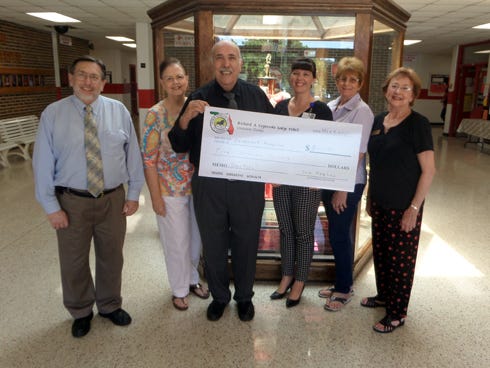
Pictured from left: Crestview Mayor David Cadle; Martha and Tom Hughes, Sons of Italy Richard A. Capozzola Lodge 2865; Rachel Mayew, Covenant Hospice development manager; Joy Browne; and Karen Boisjolie.

CRESTVIEW — Covenant Hospice's programs have extra support with the Sons of Italy Richard A. Capozzola Lodge 2865's $500 donation.

The contribution will help fund the nonprofit's bereavement and spiritual support services, children's support programs and charity care in Okaloosa and Walton counties.

Covenant accepts patients regardless of their ability to play. Learn more at www.choosecovenant.org.

This article originally appeared on Crestview News Bulletin: Sons of Italy Crestview lodge supports Covenant Hospice's mission

error: Content is protected !!