Please ensure Javascript is enabled for purposes of website accessibility
Skip to main content
Advertisement

3 Okaloosa parks receive advisories for hazardous water

FORT WALTON BEACH — Three Okaloosa County parks have potentially hazardous bathing water, the Florida Department of Health in Okaloosa County stated this week.

WaysidePark, Okaloosa Island; Lincoln Park, Valparaiso; and Fred Gannon Rocky Bayou State Park, Niceville failed tests based on EPA-recommended enterococci standards.

Enteric bacteria’s presence indicates fecal pollution from stormwater runoff, pets and wildlife or human sewage.

Call689-7859 or 833-9247 for more information.

This article originally appeared on Crestview News Bulletin: 3 Okaloosa parks receive advisories for hazardous water

BEARDEN: Debunking 3 myths about GMOs

Genetically modified organisms include genes from another plant or bacteria that add a desired trait, like the golden rice grains, right, compared to regular rice.

I’ve started writing this article many times over the past few years. I always pitch the idea since it is so controversial, but it is my job to pass along unbiased scientific knowledge to our county and state's citizens.

So, here I go! All I ask is that you keep an open mind about the subject. 

GMOs, or genetically modified organisms, are plants genetically altered through an unnatural process. Through genetic engineering, one plant or bacteria's genes can be moved into a plant so that it exhibits a desired trait. GMOs' common traits include herbicide resistance and pest resistance.

Many myths surround GMOs — and let’s face it, even the name sounds somewhat sci-fi and scary.Let's talk about those.

Myth: Most fruits and vegetables are GMOs

Actually, there are just eight commercially available GMO crops. Two more genetically modified crops — apples and potatoes — have been approved but aren’t in grocery stores yet. 

GMO crops available now:

•Field and sweet corn

•Soybeans

•Cotton

•Canola

•Sugar beets

•Papaya

•Squash

•Alfalfa

Myth: GMO crops require more pesticides

Actually, herbicide-resistant GMO crops allow farmers to spray certain herbicides on the crop without harming the crop.

Herbicides used on these crops were chosen for this purpose because they are less toxic to humans and animals. They are not very persistent in the environment;  they break down into benign compounds relatively quickly. This has allowed farmers to stop using very toxic chemicals for weed control. 

In the case of pest-resistant GMOs, pesticide sprays have been decreased or eliminated completely. In either case, the goal of genetically modified crops is to reduce the amount of pesticides sprayed and to use less toxic pesticides to control pests such as weeds, insects and fungi.

Myth: GMO crops are linked to disorders and diseases

Actually, no rigorous scientific studies link GMO crops to any disorder or disease. On the contrary, over 1,785 independent health studies on GMO crops demonstrate the opposite.

In addition, each new GMO goes through a rigorous approval process that takes many years. Development of the new genetically modified apple began in 1997 and test orchards were planted in 2003-2005. This new apple was just approved for growers to purchase and plant. 

MORE ON GMOs

See www.biofortified.org, www.geneticliteracyproject.org or www.gmoanswers.com for more information about genetically modified foods.

Jennifer Bearden is an agent at the University of Florida's Institute of Food and Agricultural Sciences Extension office in Crestview.

This article originally appeared on Crestview News Bulletin: BEARDEN: Debunking 3 myths about GMOs

SHANKLIN: Are you prepared for the unexpected?

When you’re working to achieve your financial objectives, you will encounter obstacles.

Some of these can be anticipated — for example, you won’t be able to invest as much as you want for retirement because you have to pay your mortgage.

Other challenges can’t be easily anticipated, but you can still plan for them — and you should.

Obviously, the word “unexpected,” by definition, implies an unlimited number of possibilities. However, at different stages of life, you may want to watch for some “expected” unexpected developments.

For example, during your working years, be prepared for:

•Emergency expenses — If you needed a major car or home repair, could you handle it? What about a temporary job loss?

These events are costly — especially if you are forced to dip into your long-term investments to pay for them.

To help guard against these threats, try to build an emergency fund containing six to 12 months’ living expenses, held in a liquid, low-risk account.

•Investment risk and market volatility — Extreme price swings are unpredictable, and they can affect your investment success.

To defend yourself against wild gyrations in the market, build a diversified portfolio containing quality investments.

While diversification, by itself, can’t protect against loss or guarantee profits, it can help reduce the effect of volatility on your portfolio.

And here’s one more thing you can do to cope with the ups and downs of investing: Maintain a long-term perspective. By doing so, you won’t be tempted to overreact to short-term downturns.

•Long-term disability — One-third of all people between ages 30 and 64 will become disabled at some point, according to the Health Insurance Association of America.

Disabilities can be economically devastating.

As part of your benefits package, your employer may offer some disability insurance, but you may need to supplement it with private coverage.

•Premature death — None of us can really predict our longevity. If something happens to you, would your family be able to stay in your home? Could your children still attend college?

To protect these goals, you need adequate life insurance.

As you approach retirement, and during your retirement years, you may want to focus on these challenges:

•Living longer than expected — You probably don’t think that “living longer than expected” is necessarily a bad thing.

However, a longer-than-anticipated life span also carries with it the risk of outliving your money.

Consequently, you may want to consider investment solutions that can provide you with an income stream that you can’t outlive.

Also, you’ll need to be careful about how much you withdraw each year from your various retirement and investment accounts.

•Need for long-term care — If you had to stay a few years in a nursing home, the cost could mount to hundreds of thousands of dollars.

These expenses could jeopardize your financial security, so you’ll need to protect yourself.

You could “self-insure,” but as that would be extremely costly, you may want to “transfer the risk” to an insurance company. A financial professional can help explain your choices.

None of us can foresee all the events in our lives. But in your role as an investor, you can at least take positive steps to prepare for the unexpected — and those steps should lead you in the right direction as you move toward your important goals.

This article was written by Edward Jones for use by your local Edward Jones financial adviser.

This article originally appeared on Crestview News Bulletin: SHANKLIN: Are you prepared for the unexpected?


Okaloosa County Master Gardeners celebrate 20th birthday (VIDEO)

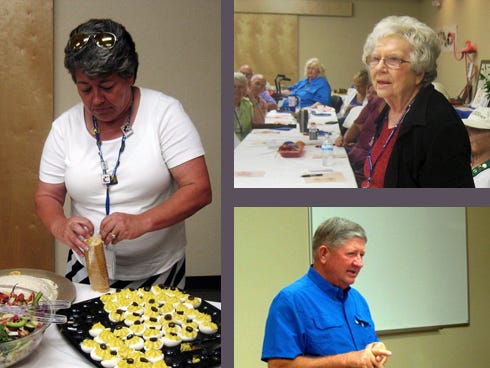
Clockwise from left: Former president Marge Stewart prepares treats for the Okaloosa County Master Gardeners’ 20th Anniversary celebration. Frances Crissman was among members of the first Master Gardeners class, graduating in April 1995. Former Okaloosa County Extension director Gerald Edmondson praised Master Gardeners for their volunteer work in the community.

CRESTVIEW — For 20 years, whenever an Okaloosa County homeowner encounters an unidentifiable fungus, plant or bug, free advice has been a phone call away.

Volunteer Master Gardeners man phones, analyze plant samples and perform community outreach — including speaking to schools and organizations — and do landscaping projects. The program is part of the Okaloosa County Extension office under the University of Florida Institute of Food and Agricultural Sciences.

Retired former extension director Gerald Edmondson says helping establish the program was one of the highlights of his career. “I love the Master Gardeners for what they do and how many people they reach,” he said.

His successor, Director Larry Williams, said since the Okaloosa Master Gardeners program was established in January 1995, its members “have provided 118,212 hours of volunteer service teaching Okaloosa County residents Florida-friendly practices formaintaining their lawns, landscapes and gardens.”

Volunteers annually perform an average of 6,000 hours of service, Williams said Wednesday during a 20th anniversary celebration. “Using the accepted $21.24 per hour value of volunteer time, Okaloosa Master Gardeners contributed a net in-kind donation of $2,510,023 to Okaloosa County residents,” he said.

Members themselves don't see their efforts as “work,” nor in monetary terms. “It’s all a matter of perspective,” former president Ed Smith said. “It doesn’t seem like 20 years if you enjoy what you’re doing.”

Besides, said member Laurie Mackey, the Master Gardeners aren’t alone in their efforts to help homeowners and gardeners. “We’re very fortunate to have the University of Florida researchers behind us, because if we don’t have the answer, they will,” she said.

WANT TO KNOW MORE?

Contact the Okaloosa County Extension office of the University of Florida Institute of Food and Agricultural Sciences for information about home gardening and horticultural practices, or volunteer opportunities. Call 869-5850 or visit the 3098 Airport Road office.

Email News Bulletin Staff Writer Brian Hughes, follow him on Twitter or call 850-682-6524.

This article originally appeared on Crestview News Bulletin: Okaloosa County Master Gardeners celebrate 20th birthday (VIDEO)

CROSE: A suggestion to keep Northwest Florida traffic moving

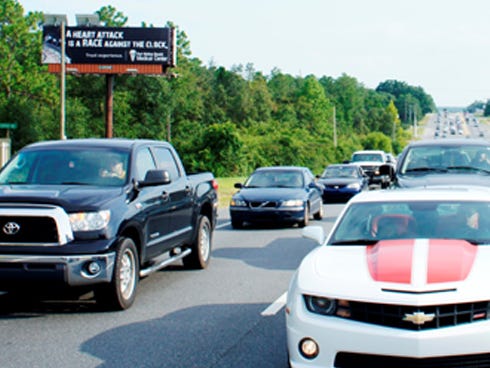
This photo shows a typical afternoon on State Road 85 just past PJ Adams Parkway. "Driving back from Fort Walton Beach, Destin or Niceville, traffic backs up around Duke Field, which causes an inordinate amount of problems once you hit Crestview," Janice Lynn Crose says.

Traffic seems to be an unending topic here in Crestview. I am no traffic expert; however, I did come from the greater Los Angeles basin and lived with bumper-to-bumper traffic for years.

When my husband Jim and I lived in the high desert, he worked 62 miles away and had to allow two to two-and-a-half hours commute time each way to work. He worked flex hours so he could drive when traffic was lighter; this made for long days, and many times he didn't get home until 9 or 10 p.m. 

Yes, those were trying circumstances for a newly married couple.

Now, we live near Old Bethel Road, Airport Road and State Road 85. When Robb, my brother, worked at Cracker Barrel, I had to allot 30 minutes to get him to work on time at 5 p.m. and it is only a little over 8 miles, but traffic was always piled up.

Driving back from Fort Walton Beach, Destin or Niceville, traffic backs up around Duke Field, which causes an inordinate amount of problems once you hit Crestview. Additionally, there are numerous accidents at PJ Adams Parkway because of the traffic light and people over-driving for congested conditions.

I realize that people make fun of California for requiring environmental impact and traffic studies; however, they don't allow for overgrowth to an area without adequate infrastructure.

Traffic studies are usually done by counting cars with hoses stretched out on the road, accident records justify stop signs and traffic lights, and speed surveys justify speed limits. 

A traffic engineer's job is to get traffic through a city as efficiently and safely as possible; this keeps emissions down.

We desperately need some alternative routes through Crestview. An experienced traffic engineering consultant could suggest routes to keep traffic flowing efficiently.

Several traffic studies have been done in our area and at one time there was the suggestion for a bypass east of town and routing traffic through an alternate route.  I am not sure what happened with that suggestion or the other traffic studies that have been made, but something needs to be done to keep traffic moving in an efficient manner.

One suggestion would be to calibrate the lights along SR 85 to one speed to keep traffic flowing and post a sign stating that signals are set for 42 mph, rather than having the lights on timers.

Whatever happens, I know there is a good solution for our traffic problems.

Janice Lynn Crose lives in Crestview with her husband, Jim; her two rescue collies, Shane and Jasmine; and two cats, Kathryn and Prince Valiant.

This article originally appeared on Crestview News Bulletin: CROSE: A suggestion to keep Northwest Florida traffic moving

Gaither Vocal Band brings Homecoming Tour to Pensacola

The Gaither Vocal Band will share timeless gospel classics and inspiring new favorites during their July 16 concert at East Brent Baptist Church in Pensacola.

CRESTVIEW — Multi-Grammy Award winner Bill Gaither will host an evening featuring the Gaither Vocal Band next month in Northwest Florida.

Folks seeking spiritual entertainment can travel less than an hour from Crestview for a concert that begins 7 p.m. July 16 at East Brent Baptist Church, 4801 N. Davis Highway, Pensacola. Call 1-855-484-1991 for tickets, which range from $25 to $35 each.

The band — featuring David Phelps, Wes Hampton, Adam Crabb, Todd Suttles and Bill Gaither — will share timeless gospel classics and inspiring new favorites embraced by audiences of all ages and backgrounds. Vocalists Charlotte Ritchie and Gene McDonald, as well as guitarist and comedian Kevin Williams, will join the band.

Bill and Gloria Gaither have written more than 700 gospel songs throughout their career, including standards "He Touched Me," "Because He Lives" and "There's Just Something About That Name."

"I've always said it all starts with a great song, and we are  fortunate that each concert includes great songs that have stood the test of time," Gaither said. "With all the musical choices that are available now, there is still a special place for the joy and optimism that reside in gospel music.

"Good news never gets old."

This article originally appeared on Crestview News Bulletin: Gaither Vocal Band brings Homecoming Tour to Pensacola

6 ways to prevent heat-related illness

CRESTVIEW — The National Weather Service has issued a Hazardous Weather Outlook for Northwest Florida, including Okaloosa County, for the upcoming days.

Isolated scattered showers and thunderstorms, along with heat index values that may range from 103 to 108 degrees Fahrenheit, will make local weather increasingly unstable and can cause hazardous conditions.

The Florida Department of Health in Okaloosa County offers these tips to stay safe:  

•Drink plenty of water; avoid sugary and alcoholic beverages.

•Wear lightweight, light-colored and loose-fitting clothing.

•Stay cool in an air conditioned area.

•Avoid engaging in strenuous activities during peak hours.

•Take a cool shower or bath.

•Stay tuned to local weather reports.

Know the warning signs of heat-related illness:

•Extremely high body temperature (above 103 degrees Fahrenheit)

•Weakness, dizziness or fainting

•Unusually elevated heart rate

•Fast and shallow breathing

•Nausea or vomiting

•Muscle cramps

This article originally appeared on Crestview News Bulletin: 6 ways to prevent heat-related illness

North Okaloosa Medical Center board member: CEO's resignation 'a surprise'

CRESTVIEW — North Okaloosa Medical Center Chief Executive Officer David Fuller resigned Tuesday. No reason was given for his departure.

A brief statement from Alicia Booker, the hospital’s director of Marketing and Community Relations, said Fuller will be replaced by Jeff Reece, who will serve as interim CEO.

Reece was most recently CEO of Chesterfield General Hospital in Cheraw, S.C., Booker’s statement said.

Reece will assume his new duties on Monday. A search committee is being constituted to seek a permanent CEO.

“Members of the board, medical staff and administration will be involved in the selection of the right candidate to serve the needs of our patients and community,” Booker stated.

“We appreciate (Fuller's) contributions to our organization and wish him well with his future endeavors,” Booker’s statement read.

Mayor David Cadle, a member of the hospital board, said he was unaware of Fuller’s impending resignation, which took hospital staffers and city leaders by surprise.

“The news came as a surprise to me,” Cadle said. “We appreciated Mr. Fuller and his service to our community.”

Cadle said he learned of Fuller’s resignation Tuesday afternoon in a conference call with senior officials at Community Health Systems, NOMC’s Franklin, Tenn.-based parent company.

He said CHS officials told him Fuller’s resignation was not related to recent news reports of high NOMC billing rates.

Fuller assumed the helm of the community hospital upon the reassignment of former CEO David Sanders to Fannin Regional Hospital in Blue Ridge, Ga., in August 2010.

Before moving to Crestview in December 2010, Fuller was CEO at Southampton Memorial Hospital in Franklin, Va.

Several calls to Fuller’s office and mobile phone seeking comment were not returned.

This article originally appeared on Crestview News Bulletin: North Okaloosa Medical Center board member: CEO's resignation 'a surprise'

LDS church announces Northwest Florida seminary graduates

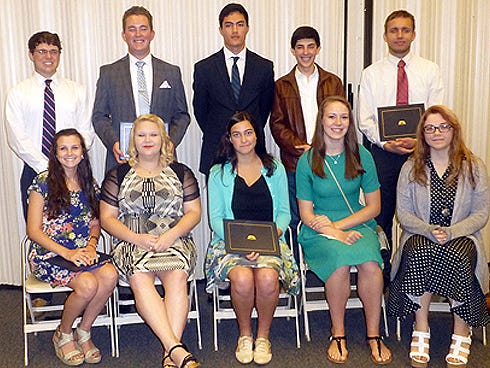
Early Morning Seminary graduates include Lori Lee Allen, Tamara Madden, Natalie Harris and Jacob Orse, Fort Walton Beach Wards; Chapman Tew, Crestview Ward; Tatiana Hancock, Aaron Peart and Matthew Simpson, Niceville Wards; and Stetson Cole Miller and Thomas Smartt, Sandestin Ward.

NICEVILLE — The Church of Jesus Christ of Latter-day Saints announces its Early Morning Seminary graduates.

Graduates — celebrated during a May 31 ceremony at the LDS's Niceville chapel — are as follows: Lori Lee Allen, Tamara Madden, Natalie Harris and Jacob Orse, Fort Walton Beach Wards; Chapman Tew, Crestview Ward; Tatiana Hancock, Aaron Peart and Matthew Simpson, Niceville Wards; and  Stetson Cole Miller and Thomas Smartt, Sandestin Ward.

Students from eight area congregations, their teachers, church leaders and hundreds of family members and friends attended the seminary graduation ceremony.

Daily scripture study class was held at 5:45 a.m. before high school begins. The curriculum began with a year of study of the Old Testament, followed by the New Testament, the Book of Mormon and then Church History. Through games and various drills, students mastered 100 scriptures — 25 from each discipline.

These classes seek to provide a spiritual and social climate and to prepare young people for effective service and missions.

This article originally appeared on Crestview News Bulletin: LDS church announces Northwest Florida seminary graduates

ANDERSON: Mites can be helpful or harmful

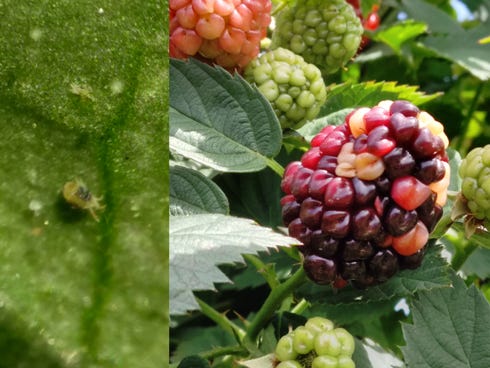
LEFT: Two-spotted spider mites like this one feed by sucking fluid from plants, and they leave tiny marks on the leaves that show up as yellowed areas, which look mottled or stippled. Large infestations also leave fine webbing on the leaves and stems they inhabit. RIGHT: This blackberry shows signs of mite damage.

Plenty of insects and their relatives can damage our crops and landscape plants, but few are tinier than mites.

Mites are actually arachnids, closely related to spiders and scorpions. While insects are characterized by having six legs and two pairs of wings, arachnids have eight legs and no wings (thank goodness — I’d rather not have spiders flying around, thank you very much).

There are many kinds of mites, some of which can be helpful and some of which are harmful.

The helpful ones are predators that hunt and kill the harmful ones for food. Some of these species can be purchased to release as biological controls for pest problems.

Some of the most common harmful mites are spider mites, such as the two-spotted spider mite. They like hot, dry weather, feed on a wide variety of plants, and often hang around the underside of leaves, which (along with their small size) can make them difficult to spot.

It’s easier to find the damage the mites cause than looking for mites themselves. Two-spotted spider mites feed by sucking fluid from plants, and they leave tiny marks on the leaves that show up as yellowed areas, which look mottled or stippled. Largeinfestations also leave fine webbing on the leaves and stems they inhabit.

Another variety of harmful mite is the redberry mite, which also can leave damage. The mites themselves can be difficult to find, as they are quick and hide in  fruit's cracks and crevices.

These pests can be controlled with predacious species of mites, or with chemical treatments. Miticides are available that target pest mites, and horticultural oils such as neem can be applied to most plants to get rid of mite problems.

Evan Anderson is an agent at the University of Florida's Institute of Food and Agricultural Sciences Extension office in Crestview.

This article originally appeared on Crestview News Bulletin: ANDERSON: Mites can be helpful or harmful

error: Content is protected !!