Please ensure Javascript is enabled for purposes of website accessibility
Skip to main content
Advertisement

Northwest Florida LDS conference focuses on keeping the Sabbath holy

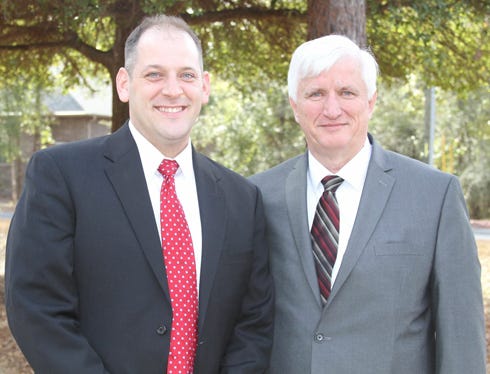
Fort Walton Beach Stake President Mike Roberts, left, is pictured with visiting General Authority and Elder J. Vaun McArthur of the Church of Jesus Christ of Latter-day Saints. The stake includes both Crestview congregations.

FORT WALTON BEACH — A weekend conference for Northwest Florida stakes is addressing how Church of Jesus Christ of Latter-day Saints members can keep the Sabbath holy.

This has been a recurring theme throughout the past year: Bringing families closer together and observing the Sabbath by engaging in wholesome activities is the ultimate goal. This will raise the spiritual level of all.

Newly called General Authority, Vaun J. McArthur of Aiken, S.C., was the keynote speaker at the conference. The LDS elder's church callings include positions as bishop, branch president, stake president and a member of the Stake High Council (one of 12 advisors to the stake president).

The adult session was 5 p.m. Saturday, March 5 at the Fort Walton Beach stake center.

The highlight of the evening was a panel discussion on how various families spend their Sundays. McArthur questioned them and received a list of wonderful activities to do on a Sunday, according to an LDS media release.

So that all the wards and branches throughout the stake could be seated comfortably, the Sunday part of the conference was at the Crestview Community Center. McArthur shook hands with a multitude of attendees while entering the Crestview center.

This article originally appeared on Crestview News Bulletin: Northwest Florida LDS conference focuses on keeping the Sabbath holy

North Okaloosa Medical Center implements two employee recognition programs

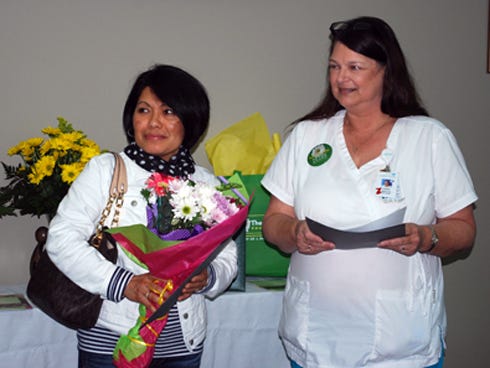
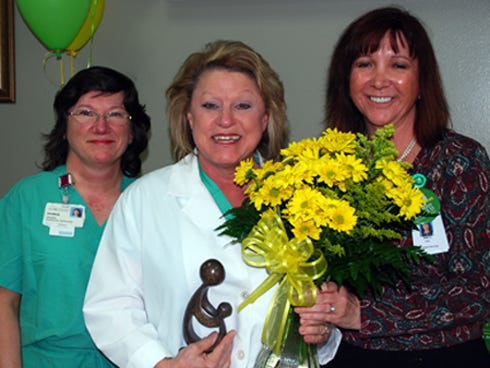
Caring Hands Award Winner: From left are Caring Hands Award recipient CNA Dee Wells and Carrie Bryant, RN - nursing director, Step Down Unit.

NOMC implements two recognition programs

CRESTVIEW — North Okaloosa Medical Center has implemented programs to regularly recognize an outstanding nurse and a certified nursing assistant. 

“Each quarter, a nurse will be selected by NOMC’s DAISY committee to receive the DAISY Award,” said Patti Gilliano, chief nursing officer. “Each honoree will be recognized at a public ceremony in her/his unit and will receive a beautiful certificate, a DAISY Award pin, and a stone sculpture titled ‘A Healer’s Touch,’ hand-carved by the artist of the Shona Tribe in Africa.”

The not-for-profit DAISY — diseases attacking the immune system — Foundation, based in Glen Elle, Calif., was established by family members in memory of J. Patrick Barnes. He died at age 33 in late 1999 from complications of idiopathic thrombocytopenic purpura, a little-known auto-immune-disease.

In addition to the DAISY Award Program, the hospital has implemented the Caring Hands Award, which recognizes outstanding certified nursing assistants.

“Implementation of these recognition programs was a great way to celebrate the clinical skill and compassion given by our nurses every day, and serves as a reminder that what we do does make an impact in the lives of others,” Gilliano said.

This article originally appeared on Crestview News Bulletin: North Okaloosa Medical Center implements two employee recognition programs

SHANKLIN: Do you have a financial umbrella in place?

SHANKLIN UMBRELLA.jpg

National Umbrella Month can inspire us to extend the observance's definition and protect our financial goals.

April showers may bring May flowers, but March is National Umbrella Month.

While ranking high on the list of truly obscure celebrations, this “month” can still teach us a few things — especially if we think about “umbrellas” that can help us protect our financial goals.

Consider these key areas:

Your vulnerability to emergencies. It’s a good idea to maintain an emergency fund containing three to six months’ worth of living expenses.

Without such a fund, you may need to dip into your long-term investments to pay for unexpected, and unexpectedly large, expenses such as a new furnace or a big bill from the doctor.

You’ll want to keep your emergency fund in a liquid, low-risk account.

Your family’s financial situation. If something happened to you, how would your loved ones be affected?

Would your family be able to stay in your house? Could your children eventually go to college? Would your surviving spouse have enough retirement income to maintain the lifestyle he or she has envisioned?

Having adequate life insurance in place can help ensure all your hopes and plans don’t fall apart upon your passing. Different types of life insurance offer different features.

For example, “term” insurance, as its name suggests, is designed to provide a death benefit for a certain number of years.

On the other hand, “permanent” insurance, such as whole life or universal life, can be kept in force indefinitely. This type of coverage may also offer a cash value component.

Your current income. If an illness or injury keeps you out of work, even for a little while, the loss of income could disrupt your family’s ability to pay its bills, leading to potentially big problems down the road.

Your employer may offer some type of disability insurance as an employee benefit, but the coverage may be insufficient. So you may want to consider purchasing an individual disability policy.

Your ability to live independently. If you’re fortunate, you may never need to spend time in a nursing home or require any other type of long-term care. But no one can predict the future — and it pays to be prepared, because long-term care costs can be catastrophic.

In fact, the annual average cost for a private room in a nursing home is more than $90,000, according to the 2015 Cost of Care Survey produced by Genworth, a financial services company.

A financial professional can help you find an appropriate way of paying for these types of costs.

Your capacity to protect your biggest assets. Your home is probably going to be the biggest asset you ever own — so you need to protect it properly, with adequate homeowners insurance.

It’s also important to have sufficient insurance for your other major assets, such as your car, boat and so on.

Your exposure to property loss or liability. You may someday face costs associated with repairing or replacing your home, auto or boat, or even liability-related expenses.

Additional liability insurance — known as an “umbrella” policy — is designed to kick in when your standard coverage on other policies, such as home or auto, has been exhausted.

The sun may be shining in your life today, but it’s always wise to be prepared for the proverbial “rainy day.” So have your umbrellas ready.

This article was written by Edward Jones for use by your local Edward Jones financial adviser.

This article originally appeared on Crestview News Bulletin: SHANKLIN: Do you have a financial umbrella in place?

WILLIAMS: The plan to save the bobwhite quail

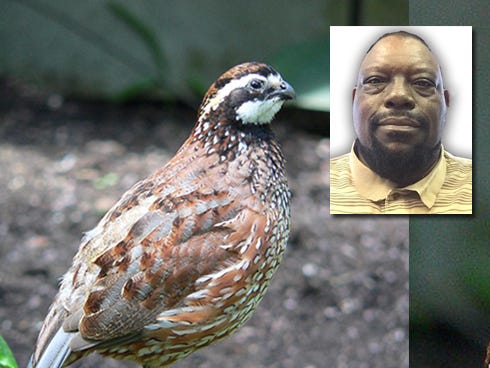
Quail photo by BS Thurner Hof | WikiCommons. Inset: Darryl Williams | Special to the News Bulletin

There may be no game bird more enjoyed or more studied than the bobwhite quail.

Hunters, bird watchers, farmers, suburbanites — it seems everyone likes to see a covey of quail and hear the distinctive “bob…white” call.

But the bobwhite population has been on a downward spiral. In the past 35 years, the northern bobwhite quail population has plummeted 70-90 percent in some areas, according to the United States Department of Agriculture’s Natural Resources Conservation Service Wildlife Habitat Management Institute.

What happened?

Wildlife experts point to degradation and loss of quail habitat as major factors.

Farming methods changed rapidly after World War II — fences and hedgerows were eliminated as fields grew larger. Pastures that had been choice quail habitat were cleared of brush and resulted in crops that don’t provide the food or cover quail need.

Herbicides and insecticides became widespread control methods for weed and insect pests on agricultural lands. But those same insects and weeds are essential to quail’s diet.

So, for the past 40 to 50 years, as brush was cleared and weeds were controlled, fields became larger, pasture makeup changed, forest became denser and quail lost much of their prime habitat. Gone was much of the diversity of “early successional” (grasses and herbs, shrubs and young forest), and once-common fringe or “edge” habitat.

But this bird’s revival is promising.

A southeast study group has developed a habitat restoration plan to restore populations to 1980 levels, with a goal of improved habitat on millions of acres to help produce 2.7 million new quail coveys.

Congress included in the previous and current, 2014 Farm Bill provisions to improve northern bobwhite quail habitat on privately owned working lands.

The Natural Resources Conservation Service has locally awarded cost-share contracts over the years to qualified landowners to install conservation practices on cropland, forest and pasture lands.

In addition, conservation practices such as prescribed burn, fire-breaks, brush management, planting native, warm-season grasses and reducing agriculture pesticides and herbicide use help with quail habitat management.

Darryl L. Williams is a district conservationist with the United States Department of Agriculture’s Natural Resources Conservation Service, 938 N. Ferdon Blvd., Crestview. Call him at 682-3714, extension 109.

Male and female bobwhites select a nest site and build a nest together. Both sexes are known to incubate eggs and brood young chicks.

UPCOMING

The United States Department of Agriculture’s Natural Resources Conservation Service and partnering agencies will host a free quail management workshop.

Registration starts 8 a.m. March 31 at Gum Creek Lodge, 5899 Buckward Road, Baker, and the workshop ends at 3 p.m.

Lunch will be served, free of charge, to those who register by March 25. Call Billie Clayton, 767-3634, to sign up.

DID YOU KNOW?

This article originally appeared on Crestview News Bulletin: WILLIAMS: The plan to save the bobwhite quail

Create a garden anywhere with straw bales

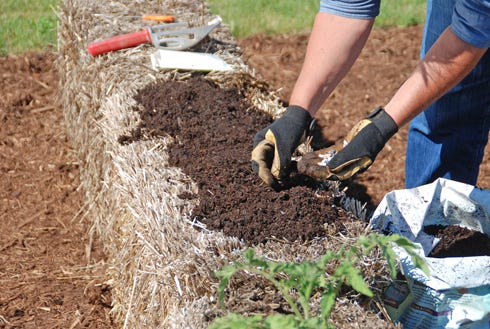
Create a planting bed for seeds by covering the straw bale with a one- to two-inch layer of planting mix.

Add productive garden space and raise your planting bed with straw bale gardening. This technique allows gardeners to create raised bed gardens on a patio, lawn or any area with poor compacted soil. Straw bale gardening has been around for centuries, but thanks to Joel Karsten’s book “Straw Bale Gardens” it has gained new popularity.

All that is needed are a few straw bales, fertilizer, a bit of compost and time to condition, plant and water the garden.

Be sure to purchase straw bales made from alfalfa, wheat, oats, rye or other cereal grain that have less weed seeds than hay. Start a few weeks before the designated planting date.

Place the bales in their permanent location with the cut sides up and twine parallel to the ground. Once you start the condition process, the bales will be very heavy and hard to move. When the bales are in place you are ready to start the conditioning process. This is done to start the inside of the straw bales composting, so they’ll support plant growth.

On day one, spread fertilizer over the top of the bale.  Use a 1/2 cup of a complete garden fertilizer or three cups of an organic fertilizer like Milorganite (milorganite.com). Then completely moisten the bale. The organic fertilizers feed the microorganisms that help decompose the straw into a nutrient rich planting medium.

Thoroughly soak the bale everyday. On days three and five you will add more fertilizer at the same rate used on day one.

Days seven through nine use half the rate used on day one. This would be 1/4 cup of a complete garden fertilizer or 1 1/2 cups of an organic fertilizer. Thoroughly water the bale each time.

On day 10 you will add one cup of 10-10-10 or three cups of an organic fertilizer rich in phosphorous and potassium.  This completes the conditioning process.

Bales treated with a complete fertilizer should be ready to plant. You may need to wait a few more days when using an organic fertilizer.  The inside of the bale should be the temperature of warm bath water or cooler for planting. If it is hotter than this, wait for the bale to cool a bit before you plant.

Use a trowel to pry open a hole in the bale. Place the plant in the hole and cover the roots with potting mix or compost.

Create a planting bed for seeds by covering the bale with a one- to two-inch thick layer of planting mix. Follow the planting directions on the back of the seed packet.

Regular watering is critical for success with this method. Soaker hoses or drip irrigation make this an easier task. You can also use gallon milk jugs with holes in the bottom or inverted two-liter soda bottles placed near the base of each plant to provide water where it is needed.

Give your straw bale garden a nutrient boost about once a month or as needed throughout the growing season.

Follow these steps and you’ll be well on your way to growing a productive straw bale garden to enjoy throughout the season.

Gardening expert Melinda Myers has more than 30 years of horticulture experience and has written over 20 gardening books, including "Small Space Gardening" and the "Midwest Gardener’s Handbook." She is a columnist and contributing editor for Birds & Blooms magazine and spokesperson for Milorganite. Myers’ website is www.melindamyers.com.

This article originally appeared on Crestview News Bulletin: Create a garden anywhere with straw bales

Expert: Aquaculture, not fisheries, will meet needs of exploding population

GAINESVILLE — The world’s fisheries are a great source of protein, but even with the best management they won’t be able to meet the needs of a global population expected to exceed nine billion by 2050, a University of Florida Institute of Food and Agricultural Sciences resource economics expert said.

Aquaculture must grow, said James Anderson, a UF/IFAS food and resource economics professor.

Aquaculture production is expected increase by more than 60 percent and account for nearly two-thirds of all seafood supplied for human consumption by 2030, said Anderson, who’s also director of the UF/IFAS Institute for Sustainable Food Systems.

Anderson made his remarks at the opening plenary of the Aquaculture 2016 Conference in Las Vegas, Feb. 23.

Despite global growth, surprisingly the United States has seen almost no growth in seafood consumption on a per capita basis, he said.  "In fact, domestic per capita consumption of seafood has declined by about 10 percent since the late 1980s, despite the federally recommended dietary guidelines to substantially increase seafood consumption," Anderson said.

 However, consumption of some species, notably shrimp, salmon, tilapia and pangasius catfish, have all grow rapidly. They are all mostly imported and farm-raised. 

Additionally, U.S. production of marine and coastal aquaculture has been stagnant for 30 years, he said. By comparison, Norway produced about the same volume of aquaculture as the U.S. in the early 1990s; now, it produces more than 500 percent more than the U.S. in its marine and coastal areas.

Anderson urged those in the aquaculture industry to continue to adopt best management practices and to do more to explain fish farming to the consumer.

"The aquaculture sector must communicate the value of its products to consumers and investors better," Anderson said.

For instance, aquaculture is highly efficient in feed conversion, water use and is relatively low in effluent and greenhouse gas emissions, he said.

"The sector has made great strides in developing sustainable practices to produce a highly nutritious food that tastes good and can be good for the environment," Anderson said. "The industry must do a better job to manage disease, improve feed formulations, control fraud, mislabeling and unsustainable practices. It must do more to work with the environmental community, traditional fisheries and to encourage regulatory reform."

Brad Buck is a science writer for the University of Florida IFAS Communications department.

This article originally appeared on Crestview News Bulletin: Expert: Aquaculture, not fisheries, will meet needs of exploding population

The sweet rewards of gardening start with strawberries

One of the first food plants you’ll see at garden centers are strawberries, and there’s lots of good reasons to get them growing in your garden.

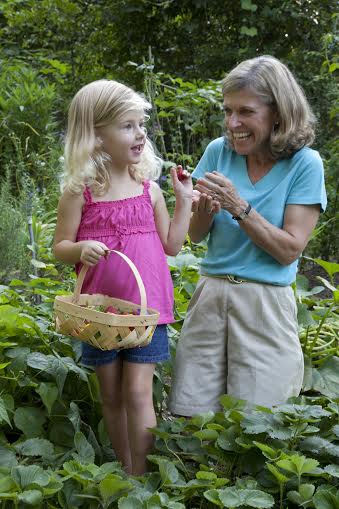
Kids are likely to enjoy the sweetness of strawberries even more if they're involved in the planting, growing, and harvesting.

Planting strawberries offers a healthy way for children to learn about natural sweetness, and kids love watching them grow, seeing the flowers and bees and then seeing the fruit develop and turn color. After developing a sense of ownership of their strawberry plants, they’ll love eating the fruits of their labor.

Getting kids in the garden will provide good, healthy exercise and an opportunity for them to nurture nature and see, first hand, just where food comes from!

Plus homegrown strawberries just plain taste better than store bought. Strawberries are cold-hardy and very adaptable, so they’re really easy to grow. You can grow them in containers, hanging baskets, raised beds or in-ground, making them accessible to everyone, no matter how much space you have –or don’t have. Growing “Ever-bearing” strawberries, like Bonnie Plants’ “Ever Sweet”, “Quinalt”, “Tristan” or “Loran” varieties will keep you well supplied throughout the entire season and into fall.

If you want to keep it really simple, or you just don’t have in-ground garden space, plant strawberries in a container, or you can buy them already planted in a hanging basket.

Just remember that container plantings need more water than in-ground plantings, usually once a day, and if it’s hot, twice a day. Planting in a “strawberry pot” is easy too and you can fit several plants in just one pot; just make sure whatever type of garden pot you use has good drainage.

There are two main types of strawberries, “June-bearing” and “Ever-bearing”. June bearing varieties, like Bonnie Plants’ “All-Star”, bear all at once, usually over a period of about 3 weeks, they’re high yield and produce very large, juicy, sweet berries in late mid-season. “Ever Bearing Strawberries like Bonnie Plants’ “Ever Sweet”, “Quinault”, “Tristan” and “Loran” will set fruit through late spring and then bloom and bear again in late summer and fall. When you grow your own Ever Bearing strawberries, you’ll get a good, steady crop of sweet, ripe strawberries all season long. Pick a strawberry variety that suits your geographic region for best results.

Tips: 

●When planting strawberries, be sure the crown is above soil level and the upper most roots are 1/4 inch beneath soil level. Buried crowns rot and exposed roots dry out.

●Plant approximately 14 to 18 inches apart in neat rows that are separated by 2-3 feet each.  Let runners fill in until plants are 7-10 inches apart.

●Use mulch to keep berries clean, conserve moisture and control weeds.

●Strawberries like well drained, fairly rich soil, so be sure to add compost or other organic matter when preparing the pot or patch.

●Strawberries need full sun, 6-8 hours per day, and frequent, deep soakings. You’ll need to feed them a plant food like Bonnie Plant Food that has nutrients that your strawberry plants will love. Just follow label directions.

●Control slugs and snails by handpicking them off plants and prevent theft from birds by covering your patch with netting as the first berries ripen.

●Pick strawberries in the morning, when the fruit is cool, and immediately put them in the refrigerator. Wait until just before you eat or cook them to rinse the berries thoroughly with cool water.

●Harvest when berries turn red. Avoid leaving ripe berries on the vine, as they’ll rot quickly.

Strawberries are one of the easiest and most delicious home garden fruits to grow. Try growing them with kids. Plants produce fruit throughout the summer and children will love to pick them right off the plant, wash and eat.

If your kids have yet to get growing in the garden, strawberries are a perfect first choice. Kick off this gardening season — with your kids — and get growing strawberries!

For more info on growing strawberries, vegetables and herbs visit www.bonnieplants.com.

This article originally appeared on Crestview News Bulletin: The sweet rewards of gardening start with strawberries

Tri-county horticulture studies group plans Alys Beach trip

The Tri County Horticulture Study Group will meet at Alys Beach for a garden tour led by landscape coordinator Kendall Horne.

The event is 10 a.m. March 24 at Alys Beach, 9581 E. County Highway 30A, Panama City Beach.

The location is a traditional neighborhood development whose architectural vision has its roots in the style of Bermuda architecture and in the courtyards of Antigua, Guatemala, the colonial capital of Central America.

The town, which is committed to sustainability, is sandwiched by its scenic beach and dunes to the south and 22 acres of preserved wetlands to the north. Winding trails, outdoor sculptures, elegant landscapes and many community green spaces adorn the area.

Attendees should park at the amphitheater on the north side of 30A at the west entrance. Participants can enjoy the self-guided nature trail following the tour. Lunch afterward will be at “Shades” on the corner of 30A and 98 east of Alys Beach.

The meeting is free and open to the public. Local participants can join an 8:30 a.m. carpool at Publix on John Sims Parkway in Niceville.

Contact Mary Lutz (850-622-5680, arnmar@gnt.net) or Gaye Baltz (225-252-1423, gbaltz47@yahoo.com) for lunch reservations or additional information.

This article originally appeared on Crestview News Bulletin: Tri-county horticulture studies group plans Alys Beach trip

CROSE: Changes are coming in Crestview; keep an open mind

Change is inevitable; some embrace it while others reject it. We don't live our lives at a standstill, so change occurs.

Families, businesses and government entities must change to keep up with the times. Families must plan ahead so they are prepared for changes that could occur; generally that means having savings for emergencies. 

Businesses that stagnate and don't keep on top of industry changes and innovations will lose market share and potentially go out of business.

Public entities must focus on what their residents’ (taxpayers’) needs and wants, and assess if these are feasible and affordable.

We have experienced first-hand what happened when the Crestview area built up so quickly and no plans were in place for effective traffic flow. The county and the city are working together on addressing the issues concerning traffic congestion.

The proposed Interstate 10 off ramp at Antioch Road will be a welcome change and hopefully ease traffic burdens. So negative online comments, certain that an off ramp won't work and is a waste of money, are interesting.

Having grown up in a suburb of Los Angeles that grew as we children grew, there are many issues facing a fast-growing community. Having another off ramp will ease traffic congestion; let's hope that it won't take years to come to fruition. A new off ramp is a needed change, and one embraced by this writer.

Another change is the proposed shopping center at State Road 85 and Live Oak Church Road. While many residents are happy to have new stores and restaurants, there are plenty of others unhappy to see this center, as it could potentially make traffic worse.

I am certain the developer is aware of the traffic problems we face and wouldn't have drawn up plans and enlisted businesses to commit to leases if they didn't think the location was right for success. 

I am excited to see what stores and restaurants we get here in Crestview. This is a great change for our area.

If we can't embrace change, then let's at least keep an open mind about the changes coming to our wonderful town.

Janice Lynn Crose, a retired accountant, lives in Crestview with her husband, Jim; her two rescue collies, Shane and Jasmine; and two cats, Kathryn and Prince Valiant.

This article originally appeared on Crestview News Bulletin: CROSE: Changes are coming in Crestview; keep an open mind

DREADEN: Author recommends these 9 business management books

Some of the management books recommended by author Daniel H. Pink.

Daniel H. Pink is the author of five business-related books that have sold 2 million copies worldwide and have been translated into 34 languages.

In his best-selling book, "Drive: The Surprising Truth about What Motivates Us," Pink explains why, contrary to popular belief, extrinsic incentives like money aren't the best way to motivate high performance.  

Instead, employers should focus on cultivating in their workers a sense of autonomy, mastery and purpose to help them succeed. Using real-life anecdotes and research, Pink walks readers through each of these three concepts, and why they're crucial in the business world.

Other management books that Pink highly recommends include:

●"The One Thing You Need to Know" by Marcus Buckingham

●"Thinking, Fast and Slow" by Daniel Kahneman

●"Act Like a Leader, Think Like a Leader" by Herminia Ibarra

●"How to Win Friends and Influence People" by Dale Carnegie

●"Mindset: How We Can Learn to Fulfill our Potential — Parenting, Business, School, Relationships" by Carol Dweck

●"Meditations" by Marcus Aurelius and Gregory Hays

●"Things Fall Apart" by Chinua Achebe

●"Now, Discover Your Strengths" by Marcus Buckingham and Donald O. Clifton

●"Good to Great" by Jim Collins

This article originally appeared on Crestview News Bulletin: DREADEN: Author recommends these 9 business management books

error: Content is protected !!