Please ensure Javascript is enabled for purposes of website accessibility
Skip to main content
Advertisement

One time left for Mother's Day tea at NWF museum

VALPARAISO — The 2 p.m. Victorian tea times for Mother's Day at the Heritage Museum of Northwest Florida are sold out.

There are some 10:30 a.m. openings left for May 7 at the museum, 115 Westview Ave.

Men, women, and children age 6 and up will enjoy hot tea and light refreshments as they learn about etiquette and customs of taking tea in Victorian England.

Cost: $16 per person, or $13 for museum members. Reservations are required. Call 678-2615.

This article originally appeared on Crestview News Bulletin: One time left for Mother's Day tea at NWF museum

Northwest Florida gallery show starts June 7

FORT WALTON BEACH — The Arts & Design Society is planning the "Just Say It!” Calendar Show Opening Reception and Gallery Show.

Both events are free and open to the public.

The reception is 6-8 p.m. June 10. The gallery starts a few days earlier. Gallery hours are noon to 4 p.m. Tuesday through Friday and 1-4 p.m. Saturdays from June 7 through July 1.

For details, go to www.artsdesignsociety.org, or call 244-1271 during office hours, noon to 4 p.m.  Tuesday through Friday.

This article originally appeared on Crestview News Bulletin: Northwest Florida gallery show starts June 7

SHANKLIN: How to keep your portfolio healthy

If you have a medical appointment this week, you might want to wish your nurse a happy National Nurses Week (May 6-12). This annual event is designed to celebrate the important role nurses play in health care. Of course, while nurses and doctors can help you in many ways, you can do a lot of good for yourself by adopting healthy living habits, such as eating right, exercising frequently, and so on. But you can also do much to help your financial health.

Here are a few suggestions:

Stay invested. During times of market volatility, it can be temping to head to the investment "sidelines" until things "cool off." Going to the sidelines can mean a few different things – you could simply not invest anything for a while, or you could move a substantial portion of your portfolio to "cash" instruments, which are safe in the sense of preserving your principal but offer almost nothing in the way of return or protecting against inflation. If you're not investing during a market downturn, or if you've moved heavily into cash, you might well miss out on the beginning of the next market rally.

Rebalance your portfolio. It's a good idea to periodically rebalance your portfolio to make sure it still reflects your goals and your comfort level with risk. Over time, and without any effort on your part, your portfolio can become unbalanced. For example, following a long "bull" market, the value of your stocks could have risen to the point where they make up a greater percentage of your portfolio than you had intended. When that happens, you may need to rebalance by adding bonds and other fixed-income vehicles.

Diversify. Rebalancing is important. But a balanced portfolio should also be a diversified portfolio. If you only owned one type of financial asset, such as U.S. growth stocks, you could take a big hit during a market downturn. But different types of financial assets don't always move in the same direction at the same time, so by owning a wide variety of investments – U.S. stocks, international stocks, government securities, corporate bonds, real estate, certificates of deposit (CDs) and so on – you may help reduce the effects of market volatility on your portfolio. Keep in mind, though, that diversification by itself can't guarantee profits or protect against loss.

Maintain realistic expectations. If you expect the financial markets to always move upward, you will be disappointed many times. Market downturns are a normal part of the investment process, and they will always be with us. Once you accept this reality, you will be less likely to make questionable decisions, such as abandoning a long-term strategy. If you've designed an appropriate strategy, possibly with the help of a financial professional, you can stick with it through all market environments.

By following the suggestions mentioned above – staying invested, rebalancing your portfolio as needed, diversifying your holdings and maintaining realistic expectations, you can go a long way toward maintaining the fitness of your financial situation.

This article was written by Edward Jones for use by your local Edward Jones financial adviser.

This article originally appeared on Crestview News Bulletin: SHANKLIN: How to keep your portfolio healthy

Okaloosa health department releases water quality results

FORT WALTON BEACH — The Florida Department of Health in Okaloosa County has announced water quality test results for local parks.

No Okaloosa County parks have potentially hazardous bathing water, the FDOH stated May 4.

No parks failed tests based on EPA-recommended enterococci standards. Enteric bacteria's presence indicates fecal pollution from stormwater runoff, pets and wildlife or human sewage.

Only one, Liza Jackson Park, Fort Walton Beach, had a moderate (instead of good) rating.

This article originally appeared on Crestview News Bulletin: Okaloosa health department releases water quality results

Florida university study: Pain can cause inflammation in older adults

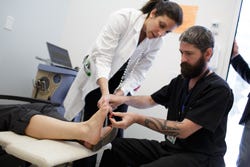
With a thermode — a device that looks like a microphone with a copper tip — Yenisel Cruz-Almeida, Ph.D., left, and another University of Florida researcher apply heat to the feet of participants in a study that tested the inflammatory response to pain of older adults versus younger adults.

GAINESVILLE — When older relatives complain about their pains, show a little empathy, because new research suggests that as we age, we may all become more sensitive to pain. A small, preliminary University of Florida Health study has suggested for the first time that inflammation may occur more quickly and at a higher magnitude — and stays around longer — when older adults experience pain versus when younger adults experience pain.

 This could mean that older adults could be at risk for developing chronic pain and may benefit from taking anti-inflammatories soon after an injury or procedure, according to the researchers.

Older adults often have a certain level of chronic inflammation in their bodies. But UF researchers found that when they induced pain in older adults, proteins associated with inflammation increased more than they did in younger participants and stayed in the bodies of older adults longer. The researchers also found that anti-inflammatory cytokines, proteins that soothe inflammation, peaked later for older adults than younger adults. They published their results were published in a previous issue of Experimental Gerontology.

“Older people go through painful procedures more often, and we wanted to research whether this accumulation of painful procedures or more acute pain episodes that older people encounter is bad,” said Yenisel Cruz-Almeida, Ph.D., MSPH, an assistant professor in the UF College of Medicine’s department of aging and geriatric research who also is affiliated with the UF Institute on Aging. “If you have enough of those in a shorter period of time, does this predispose you to have chronic pain?”

When older adults have this kind of elevated inflammatory response, they’re more likely to have pain generated in the periphery of the body — their tissue and limbs outside of the spinal cord and brain, said the study’s senior author Joseph Riley, Ph.D., director of the pain clinical research unit in the UF Pain Research and Intervention Center of Excellence.

“If older adults are more likely to have these pain messages sent through the spinal cord to the brain, and the nervous system is being adapted to go through these changes, they may become more pain prone,” said Riley, also a professor in the UF College of Dentistry’s department of community dentistry and the UF College of Public Health and Health Professions’ department of clinical and health psychology.

While the study does not establish whether accumulation of acute pain predisposes older adults to chronic pain, the researchers say their findings suggest this is a possibility, and it’s the first step in pain research to further understand the relationship between pain and aging. The researchers said the study’s sample size, though small, was more than adequate to demonstrate large differences between the older and younger adults they tested. The differences in inflammation within each group varied very little compared with the overall difference between the two groups, which suggests the populations they sampled were very different and there was little chance of sampling error, Riley said.

Cruz-Almeida and Riley studied eight healthy older adults, whose average age was 68, and nine healthy younger adults, whose average age was 21. None of the participants had illnesses such as diabetes or hypertension. During an initial visit, researchers induced pain in the participants in two ways, either using heat applied to the feet or a cold ice bath.

The first session determined how sensitive the participants were to pain. Determining a tolerable temperature allowed the researchers to recreate the same amount of pain for each participant in the subsequent sessions.

Participants rated their pain on a scale from 1 to 10. The researchers were aiming to induce pain to a Level 4 — a level that created the painful stimuli the researchers needed, but didn’t dissuade the participants from returning for the other visits required in the study.

To study inflammation in the blood, the scientists inserted a catheter into each participant before inducing pain. That allowed them to collect the participant’s blood before the pain stimulus and then at three, 15, 30, 45, 60 and 90 minutes after the stimulus. These blood samples allowed the researchers to study inflammatory markers in the blood, finding that older adults had higher levels of inflammation when pain was induced than the younger adults.

Riley said activation of the immune system and increased inflammation are not necessarily harmful, but it’s important to understand how the length of time the immune system is activated affects the body.

“We think that the longer you have the immune system activated, having these elevated inflammatory cytokines, the more this activation can alter the homeostasis of the body. Usually an imbalance like that can be associated with autoimmune disorders, which also increase with age,” Cruz-Almeida said. “But the truth is we don’t know what the direct implications would be. We think low-grade inflammation is related to endocrine abnormalities such as diabetes and the development of heart problems. … We need to keep looking and doing future research.”

Riley said immediate implications of the research for patients could be to attack pain quickly with anti-inflammatory medication.

“Early treatment of an injury even with over-the-counter anti-inflammatories may be a good idea,” Riley said. “It’s those first few days of bombarding the central nervous system with pain signals that has a bigger effect (on the body).”

Morgan Sherburne is a science writer for University of Florida Health.

This article originally appeared on Crestview News Bulletin: Florida university study: Pain can cause inflammation in older adults

Tri-county group to study 'Insects, Arthropods, and Other Animals of Importance…' May 26

VALPARAISO — The next Tri-County Horticulture Studies Group meeting May 26 features a presentation on “Insects, Arthropods, and Other Animals of Importance in Gardens.”

Escambia County Horticulture Extension Agent Beth Bolles is speaker at the meeting, which is 10 a.m. May 26 at the Valparaiso library, Room 3, 459 Valparaiso Parkway. 

Afterward, a field trip is scheduled to the award-winning Paradise Gardens at the Heritage Museum, 115 Westview Ave.

The Tri-County Horticulture Studies Group is sponsored by garden clubs in Santa Rosa, Okaloosa and Escambia counties and is spearheaded by a steering committee of supporting groups and individuals.

All programs are free and open to the public.

For details, contact marieharrison166@yahoo.com.

This article originally appeared on Crestview News Bulletin: Tri-county group to study 'Insects, Arthropods, and Other Animals of Importance…' May 26

Valparaiso club sets May 14 gala, May 21 plant sale

VALPARAISO — Valparaiso Garden Club invites the public to a Gala in Paradise Gardens.

A tour through the award-winning garden is 2-4 p.m. May 14 at the Heritage Museum, 115 Westview Ave., Valparaiso.

Activities include a presentation in the blue room at 2:15 by Marie Harrison entitled “Pollinators in Peril.”

Harrison will expound on the problems faced by pollinators and will suggest ways that residents can help at home. Following the presentation, members of the club’s educational committee will conduct tours and discuss plants included in the garden. Plants and seeds will be available for purchase to help you get started with your own pollinator garden. Refreshments will be served.

Paradise Gardens is designed to attract and support pollinators. Within it are many pollen and nectar producing plants. Host plants that support butterfly caterpillars encourage a healthy population of these beautiful pollinators. Interpretive signs identify butterfly host plants and include a picture of the butterfly attracted.

The club is also planning its annual plant and garage sale, which is 7 a.m. to 1 p.m. May 21 in the Palm Plaza parking lot on John Sims Parkway, Niceville. Many plants to purchase will be available, as well as interesting garage sale finds. All proceeds support club projects.

This article originally appeared on Crestview News Bulletin: Valparaiso club sets May 14 gala, May 21 plant sale

Laurel Hill woman's 'match made in heaven' includes a kidney donor

Andrew Twitty will donate a kidney to his wife, Jessica. The couple is shown with their children Neal, 11, and Hannah, 9.

LAUREL HILL — Many couples say theirs is a “match made in heaven.” There’s no doubt in Andrew and Jessica Twitty’s minds that God matched them up — heart, soul and now, a kidney.

Jessica was diagnosed with chronic kidney disease five years ago. Four years later she started dialysis.

At the University of Florida Health Shands Hospital, she was placed on the kidney transplant list, facing a potential wait as long as five years unless a donor could be found just for her.

“They have about 120,000 patients waiting for organ transplants today,” Jessica said. “It is shocking how the numbers keep rising.”

Soon it looked like her brother would be a perfect match.

“It turned out he wasn’t,” Jessica said. “It turned out Andrew was a match. He was shocked, but was glad he turned out to be the donor.”

Andrew’s tests will be complete this week. Soon Jessica can end her daily home dialysis, which their children, Neal, 11, and Hannah, 9, take in stride.

“It becomes a basic routine every day of your life,” Jessica said. “It makes it very adjustable for your children when you can do it at home and work it around their schedule.”

Having family members nearby has been a big help, she said.

“It has been a wonderful blessing to have family around to help and help manage things and be very supportive of what we’re going through,” Jessica said.

But above all, it is their faith that sustains the family. For Hannah, learning her dad was giving her mom one of his kidneys was no big surprise. She already knew.

“What amazed us was, when we were going through the process, Hannah said her dad was going to be the match because Jesus had told her,” Jessica said. “It was amazing to us that this little girl had more confidence than Mommy and Daddy, whose nerves were wracked.”

There’s a good reason, the family’s pastor at Hopewell United Methodist Church, told them.

“Sometimes God will talk to little kids and they’ll listen more than adults do,” Jessica said. “Like Andrew said, it’s kind of funny how God works sometimes. We don’t understand them, but he has his ways.”

This article originally appeared on Crestview News Bulletin: Laurel Hill woman's 'match made in heaven' includes a kidney donor

Crestview's Drew Barefield, Children's Miracle Network state champion, sets $1 million goal

Drew Barefield is surrounded by his family after being named this year's Children's Miracle Network Hospitals Florida Champion Monday night at Sacred Heart Hospital in Pensacola. Included are (top row) Bubba Barefield grandpa and aunt, Beverly Barefield. Bottom row: Trey Barefield, dad; Wendy Barefield, mom; Marie Wilkerson; Jan Barefield, aunt; Drew; Jessie Barefield, uncle; Jil Barefield, grandma; Jorah Barefield, cousin; Brandy, aunt; and Jace, cousin.

CRESTVIEW — After more than a year of often painful surgeries and physical therapy, Davidson Middle School student Drew Barefield will share his positive attitude to encourage other kids who also face long-term recoveries from traumatic mishaps.

Drew, now 14, was struck by a boat while snorkeling on June 28, 2014. Monday night at Sacred Heart Hospital in Pensacola, he was named this year’s Children’s Miracle Network Hospitals Florida Champion.

“Drew spent 75 days in The Children’s Hospital at Sacred Heart and underwent 13 surgeries,” hospital spokesman Mike Burke stated in a media release. “During his treatment, he showed a positive, ‘can-do’ attitude and genuine concern for other pediatric patients.”

As a Children’s Miracle Network champion, Drew will serve as a fundraising and awareness ambassador for The Children’s Hospital at Sacred Heart and all children treated at the charity’s 170 member hospitals, the release stated.

“I was very excited and surprised,” Drew said of his appointment. “For me, doing this is just to repay the community and show them how much I’m thankful for the community supporting me through my recovery.”

Drew and his family will travel to Washington, D.C., and Orlando to meet with media and highlight the work taking place at Children’s Hospitals.

“I’ll be going to Washington, D.C., in June, and while I’m there it’s going to be the two-year anniversary of my accident,” Drew said. “I can’t believe it’s almost been two years. It feels like it’s been five years.”

Drew will also represent The Children’s Hospital at Sacred Heart at various as-yet unspecified events throughout the year.

“My goal is to raise a million dollars for the Children’s Miracle Network Hospital,” Drew said.

With his therapy and seemingly endless rounds of medications behind him, Drew is focused on his future. He is currently taking weekly avionics courses taught by Embry-Riddle Aeronautics University faculty at Crestview High School.

“I want to be in the naval aviation field, like an air traffic controller,” he said.

Drew said he’s looking forward to sharing his experiences — especially the importance of a positive mental attitude — with other kids facing long recoveries from trauma.

“I would advise people to stay positive and think of the bright side of things,” Drew said. “I know they’re hurting now but they’re going to make it.”

This article originally appeared on Crestview News Bulletin: Crestview's Drew Barefield, Children's Miracle Network state champion, sets $1 million goal

Sons of Italy donates $1,000 to Crestview soup kitchen

Thomas Hughes, president of the Richard A. Capozzola Lodge, presents a $1,000 check to Kathryn and Bill Beck and Ginny Esmond, accepting on behalf of First United Methodist Church of Crestview. The donation will benefit FUMC’s soup kitchen, which serves the homeless Saturdays at noon.

This article originally appeared on Crestview News Bulletin: Sons of Italy donates $1,000 to Crestview soup kitchen

error: Content is protected !!