Please ensure Javascript is enabled for purposes of website accessibility
Skip to main content
Advertisement

Mental Health Presentation to be given at Crestview Library

Learn about achieving balance while avoiding or changing destructive behaviors that lead to chronic diseases June 3 at 10:30 a.m., at the Crestview Public Library, 1445 Commerce Drive, Crestview.

Ginny Barr, the Mental Health Association of Okaloosa/Walton Counties' executive director, will discuss wellness' impact on the mind and body, building on life experiences and positive change.

Coffee and cookies will be served at 10 a.m.

This article originally appeared on Crestview News Bulletin: Mental Health Presentation to be given at Crestview Library

Corporate sponsorships, underwriters sought for Covenant Hospice fundraiser

Thrive Music Fest, benefiting Covenant Hospice, will feature live music on two outdoor stages from 11 a.m. to midnight June 21 at KC’s Sandbar and Grille, 190 Miracle Strip Parkway, Fort Walton Beach.

Organizers seek artists interested in performing at the charity event, and volunteers for the planning committee and event day. Preference will be given to artists performing original rock music.

Corporate sponsorships and underwriting opportunities are available, ranging from $250 to $2,500. Participating organizations will receive a variety of benefits including promotional recognition, complimentary admission and preferred seating at the event.

Call Jenni Perkins or Rachel Mayew, 729-1800, and jenni.perkins@covenanthospice.org or rachel.mayew@covenanthospice.org.

Covenant Hospice is a not-for-profit organization that provides comprehensive, compassionate services to patients and loved ones with life-limiting illnesses.

Visit www.covenanthospice.org for more information.

This article originally appeared on Crestview News Bulletin: Corporate sponsorships, underwriters sought for Covenant Hospice fundraiser

FEMA, Bridgeway Center partner for behavioral health support

The Florida Department of Children and Families has selected Bridgeway Center Inc. to provide behavioral health support to the FEMA Disaster Recovery Center in Okaloosa County.

Bridgeway Center is providing paraprofessional behavioral health staff for the DRC and will continue to assist Okaloosa residents adversely affected by the recent flood as long as the DRC remain open.

The DRC — in the Senior Service Center, 205 Stillwell Blvd., Crestview — is open 8 a.m. to 7 p.m. Monday through Saturday and 11 a.m. to 7 p.m. Sunday. 

This article originally appeared on Crestview News Bulletin: FEMA, Bridgeway Center partner for behavioral health support

All Okaloosa parks pass Florida Department of Health water testing

All Okaloosa County parks passed water testing, with six parks receiving moderate quality ratings, the Florida Department of Health in Okaloosa County stated this week.

Tests are based on EPA-recommended enterococci standards.

Enteric bacteria’s presence indicates fecal pollution from stormwater runoff, pets and wildlife or human sewage.

Call 689-7859 or 833-9247 for more information. 

This article originally appeared on Crestview News Bulletin: All Okaloosa parks pass Florida Department of Health water testing

Community Health & Fitness Fair May 28

The annual Community Health & Fitness Fair is 8:30 a.m. to noon May 28 at Santa Rosa Mall's Main entrance, 300 Mary Esther Blvd., Mary Esther.

More than 30 vendors will provide free blood pressure, BMI and other screenings, as well as information on healthcare options available in  Northwest Florida.

Call 855-614-7274 for more information.

This article originally appeared on Crestview News Bulletin: Community Health & Fitness Fair May 28

A better bedbug trap: made from household items for about $1

GAINESVILLE— The contraption seems so simple, yet so clever, like something The Professor might have concocted on “Gilligan’s Island.”

Researchers at the University of Florida’s Institute of Food and Agricultural Sciences have devised a bedbug trap that can be built with household items.

All you need are two disposable plastic containers, masking tape and glue, said Phil Koehler, UF/IFAS urban entomology professor. The traps catch and collect the bugs when they try to travel between people and the places where bedbugs hide, he said.

“This concept of trapping works for places where people sleep and need to be protected at those locations,” Koehler said.

The traps rely on the bugs’ poor ability to climb on smooth surfaces, he said. Instead, the traps have rough areas to let bedbugs enter easily, and a smooth-surfaced moat that keeps them from escaping.

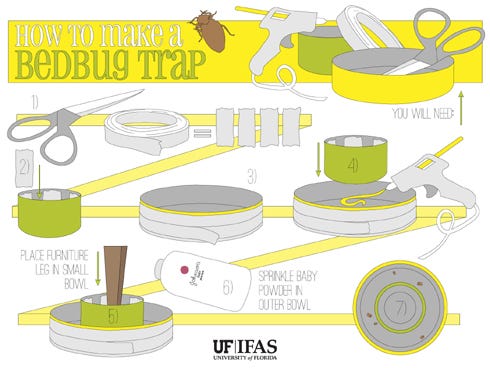
Here’s how to make one:

•Cut four pieces of rough-surfaced tape. Each piece should be at least as long as the wall of smaller container is tall.

•Evenly space and firmly press the four pieces of tape vertically on the inside surface of the smaller container. The tape allows the bugs to escape the small container easily and fall into the space between the small and the large container wall, where they are trapped.

•Wrap tape around the exterior of the larger container from the base to its upper edge so the bedbugs can enter the trap easily.

•Glue the smaller container onto the center of the bottom of the larger container.

The traps work best if you apply talc, including baby powder, to the space between the small and large container walls to make it harder for the bugs to escape. Many people use incorrect methods to treat bedbugs. Koehler advises against using flammable liquids, mothballs, treating mattresses with pesticides and using bug bombs.

Koehler said the bedbug device is pretty foolproof and effective.

“It’s really hard to mess this up to the point that you’d hurt anything,” he said.

The trap is a stunningly easy solution for a vexing national problem.

An April 2013 survey by the National Pest Management Association showed that nearly every pest management professional, 99.6 percent, had encountered a bedbug infestation during the prior 12 months. Nearly half, 49 percent, said infestations occur mostly in the summer. Because more people tend to travel and relocate during the summer, it’s possible more of them unknowingly bring bugs home or discover them soon after moving, according to the pest management group.

Entomologists say bedbugs are becoming more resistant to pesticides, exacerbating what is also an expensive problem.

Bedbug treatments can run $3,000 for a single-family home or $1,200 for a low-income apartment – something many can ill-afford.

So Koehler and his colleagues created their trap from about $1 worth of household items. The number of traps needed for any given dwelling depends on the number of places people sleep. Researchers estimate one would need about 50 traps for a typical three-bedroom home, enough to place one under each leg of furniture, including chairs, sofas and beds.

The bedbug trap is the brainchild of Koehler; Benjamin Hottel, an entomology doctoral student; Rebecca Baldwin, assistant urban entomology professor; and Roberto Pereira, an associate research scientist in the UF entomology and nematology department. Their Extension paper on the subject is available online.

See a UF/IFAS video on the bedbug trap.

This article originally appeared on Crestview News Bulletin: A better bedbug trap: made from household items for about $1

Health department: beware of mold in water-damaged buildings

Take precautions when cleaning and repairing flood-damaged homes and buildings, the Florida Department of Health in Okaloosa County advises.  

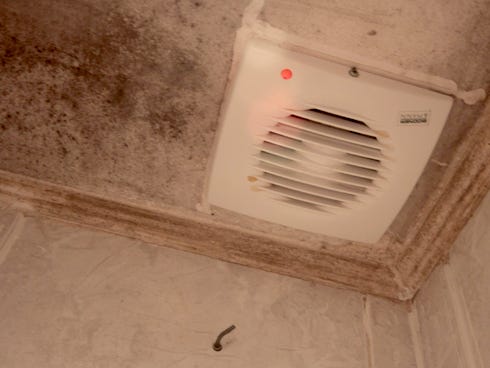
Moisture that enters buildings accelerates mold growth, which can present short and long-term health risks.

Mold often appears as a staining or fuzzy growth on furniture or building materials and may look cottony, velvety, rough or leathery. It may have different colors like white, gray, brown, black, yellow or green.

WHAT TO DO

If you spot mold in your home, the health department advises taking these actions:

•Remove standing water from your home or office.

•Remove wet materials. If mold growth has appeared, carefully remove or clean the moldy material.

•Consider using personal protective equipment — like cleaning gloves and safety goggles — when cleaning or removing mold. Individuals with known mold allergies or asthma should not clean or remove moldy materials.

This article originally appeared on Crestview News Bulletin: Health department: beware of mold in water-damaged buildings

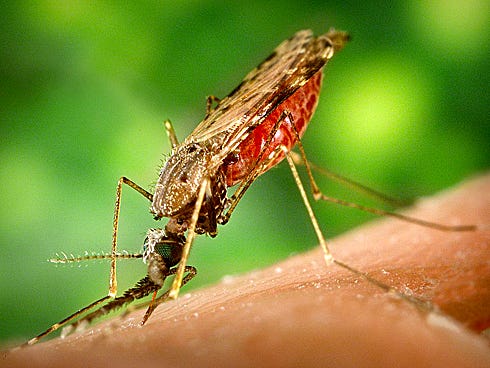
Okaloosa County's evening mosquito control begins next week

The Okaloosa County Division of Environmental Services began spot spraying in May.  On Monday, May 19, the standard evening broadcast spray schedule will begin, weather permitting. 

MONDAYS:

John Riley Barnhill Road to Escambia Farms

Beaver Creek to Baker

Crestview: Rattlesnake Bluff and Little Silver Road, Live Oak Church Road to John King, Hwy. 90 East to county line Road and north to Poverty Creek Road

Destin, FWB( Brooks street going west)

Mary Esther, Wynn Haven Beach, and Valparaiso.

TUESDAYS:

Vinson Ray Road east side of Hwy 189 to Laurel Hill

Wilkerson Bluff Road to Log Lake (Holt) west to County Line Road

Crestview: John King to Hwy 90 East to Shoal River ridge, Old Antioch to Hwy 90 West

Destin, Fort Walton Beach, Wynnehaven Beach, Bluewater Bay and Cinco Bayou.

WEDNESDAYS:

Galliver Cut Off to Milligan and back to Baker

Garden City to Laurel Hill

Crestview: Old Bethel Road to Airport Road, south of Hwy 90 west to Duggan Street. Fairchild Road to Hwy 85 to Airport Road

Shalimar, Streets off of Lewis Turner Blvd. and Niceville

THURSDAYS:

Poverty Creek Road, Hwy 393 to Campton, Old River Road to Vinson Ray Road (from Milligan to Baker)

Crestview: Lake Silver Road to Airport Road to Auburn area

Poquito Bayou area, Ocean City, Mooney Road area, and Niceville.

Okaloosa County Mosquito Control and the Florida Department of Health urge the public to remain diligent in their personal mosquito protection efforts. These should include remembering to “SWAT.”

§  Stay inside with screened doors and windows when mosquitoes are biting (dusk and dawn).

§  When outside, wear clothing that covers skin.

§  Apply mosquito repellant that includes DEET  [N, N diethyl-m-toluamide] on your skin when you are outside

§  Turn over standing water where mosquitoes lay eggs or better yet – rid your outdoor area of standing water in which mosquitoes can lay their eggs. 

Remember to apply all mosquito repellants in accordance with the recommended frequency and methods suggested by the manufacturer.

The Florida Department of Health now recommends the following mosquito-borne illness recommendations:

DRAIN standing water to stop mosquitoes from multiplying:

•     Drain water from garbage cans, house gutters, buckets, pool covers, coolers, toys, flower pots or any other containers where sprinkler or rain water has collected.

•     Discard old tires, drums, bottles, cans, pots and pans, broken appliances and other items that aren't being used.

•     Empty and clean birdbaths and pets water bowls at least once or twice a week.

•     Protect boats and vehicles from rain with tarps that don’t accumulate water.

•     Maintain swimming pools in good condition and appropriately chlorinated. Empty plastic swimming pools when not in use.

COVER skin with clothing or repellent:

Clothing: Wear shoes, socks, and long pants and long-sleeves. This type of protection may be necessary for people who must work in areas where mosquitoes are present.

Repellent: Apply mosquito repellent to bare skin and clothing. Always use repellents according to the label. Repellents with DEET, picaridin, oil of lemon eucalyptus, and IR3535 are effective. Use mosquito netting to protect children younger than 2 months old.

COVER doors and windows with screens to keep mosquitoes out of your house:

• Repair broken screening on windows, doors, porches, and patios.

The County Mosquito Control Program sprays for mosquitoes county-wide excluding federal and state-owned land and entities who have contacted the MC Program for inclusion on the no-spray list.  Mosquito spray trucks generally operate from 7 p.m. until 12 p.m. but could also operate in the early morning hours.  Surveillance activities may indicate  certain types of mosquitoes known to be disease vectors being active during other time periods than noted.  If this is the case, the County will respond appropriately. The following is the Okaloosa County spray route schedule and justification of mosquito populations.

Areas of Concern:

§  Wetlands;properties bordering Eglin A.F.B., which are not treated; and property owners unaware that they are creating mosquito breeding sites.

§  Standing water; eliminating should be at the top of everyone’s ‘to do list’ right now!

§  Children’s pools, plant pots, old tires*, leaf piles, pet watering bowl and gutters should be checked daily for standing water.  Even something as simple as a soda lid can literally breed hundreds of mosquitoes.

*     Waste tires can be disposed of FREE at the South Okaloosa County Transfer Station and the Baker Landfill. – this applies only to local households and not businesses. Tire sizes are limited to passenger car and light truck tires.

Quantities limited – 5 tires per household/month.-more-

In addition to spraying, the county has an aggressive larvaciding program in place that includes more than 1,670 sites treated and are checked on a regular basis.  Additionally, more than 750 ponds and areas with standing water are treated with gambusia fish, which eat mosquito larva and reproduce at incredible rates.

Residents are also reminded to have outdoor animals vaccinated against disease.  Horses should be vaccinated against Eastern Equine Encephalitis (EEE).  Although West Nile and EEE can occur throughout the year, peak season is August, September and October.  Horses must receive two vaccine injections 3 to 6 weeks apart and then it is recommended every 3 to 6 months.  Dog owners are also reminded to have pets treated for heartworms, as mosquitoes carry the disease as well.

The Mosquito Control Division of Public Works is open Monday through Friday from 8 a.m. until 4:30 p.m. and may be reached at 651-7394 or 689-5772.  Mosquito spray schedule, preventative tips and other related information is available on the county’s web site at www.co.okaloosa.fl.us.

This article originally appeared on Crestview News Bulletin: Okaloosa County's evening mosquito control begins next week

Free training on domestic violence, mental health next week

Shelter House and the Florida Coalition Against Domestic Violence will offer free training later this month.

The session, titled, “Exploring the Intersection of Family Violence, Trauma and Mental Health," will take place 8:30 a.m. to 5:30 p.m. May 20 at Embassy Suites in Destin.

Cathy Cave from the National Center on Domestic Violence, Trauma and Mental Health, and Olga Trujillo, an attorney, author and national trainer and speaker, will speak for advocates, case workers, law enforcement personnel and therapists.

Participants will examine a lived experience of violence, trauma and mental health concerns that may arise. Attendees will learn trauma's impact on the brain and how they can respond to survivors in more effective ways.

Click here to pre-register.

This article originally appeared on Crestview News Bulletin: Free training on domestic violence, mental health next week

error: Content is protected !!