Please ensure Javascript is enabled for purposes of website accessibility
Skip to main content
Advertisement

Make the most of your summer vacation

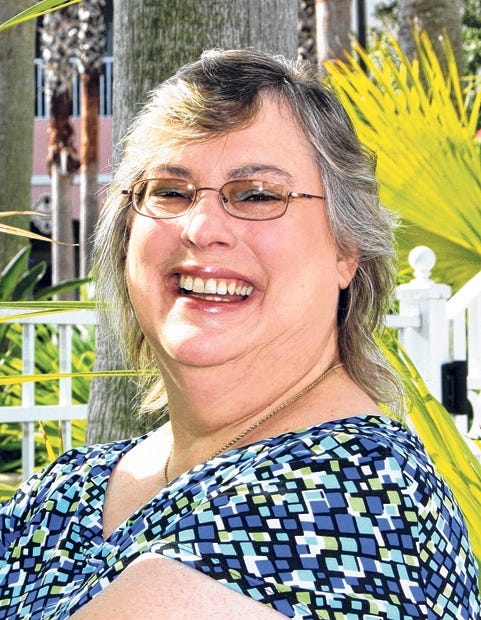
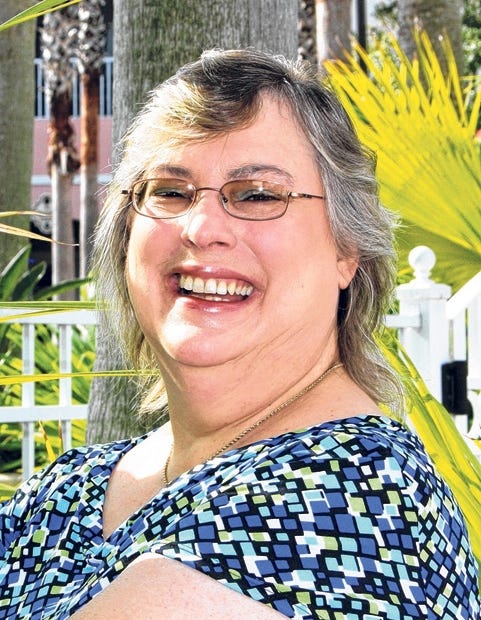
Janice Lynn Crose, a former accountant, lives in Crestview with her husband, Jim; her two rescue collies, Shane and Jasmine; and two cats, Kathryn and Prince Valiant.

Summer vacation for many families is almost over. In just a few short weeks, school will be back in session for another year.

Did your family go on a memorable destination vacation, such as a cruise, overseas, or to a theme park; or did you stay close to home and take day and weekend trips to our wonderful beaches and parks? We are fortunate to live in such a beautiful area where we can drive short distances to terrific places of interest.

How much reading did you and your family accomplish? Did you finally read that special book you've been wanting to read? We are so fortunate that we have such a well-stocked library in Crestview with such a helpful staff. They are always a pleasure to be around.

Was there a list of partially finished projects you wanted to tackle this summer? Like me, did you try and catch up on your hobbies, finish up some sewing projects or scrapbooking? Many of you spend hours in your yards and gardens — did you accomplish what you set out to do? 

While I love plants in my garden, I seem to do better with potted plants on my porch. I have some beautiful hibiscus plants that are happily blooming, even in this heat. My begonias are still in bloom, although I need to transplant them to a larger pot and the petunias haven't done well with all the rain we have had. I think I need to buy some new ones and put them on the porch where they won't get so much rain. 

What are you proud of that you completed this summer? Perhaps it is a room that you redecorated, painted or rearranged. Perhaps you got a closet or cupboard cleared out and organized.

There are always many tasks on my to-do list. While I didn't finish everything, there were a few items I checked off the list. I read the book of Romans in the Bible in anticipation of my fall bible study. I rehearsed music that I will be singing for church, and picked out some new pieces to learn. 

I also began two new books on the history of our country and hope to finish them soon. I have closets that need to be cleaned out and organized. I hope I can finish them before September.

Another summer goal area residents may have is purchasing items for the upcoming school year. The back-to-school sales tax holiday is the weekend of Aug. 4-6.

Clothing and shoes that are less than $100 each will be sales tax free, as well as school supplies that are less than $15 each and computers that are less than $750. If you need to invest in a new computer, this would be the weekend to purchase. Start making your lists now, so that you can take advantage of the savings.

Make the most of these final days before school is back in session and your schedule gets crowded.

Janice Lynn Crose, a former accountant, lives in Crestview with her husband, Jim; her two rescue collies, Shane and Jasmine; and two cats, Kathryn and Prince Valiant.

This article originally appeared on Crestview News Bulletin: Make the most of your summer vacation

Okaloosa 'Teach Children to Save' contest promotes financial responsibility

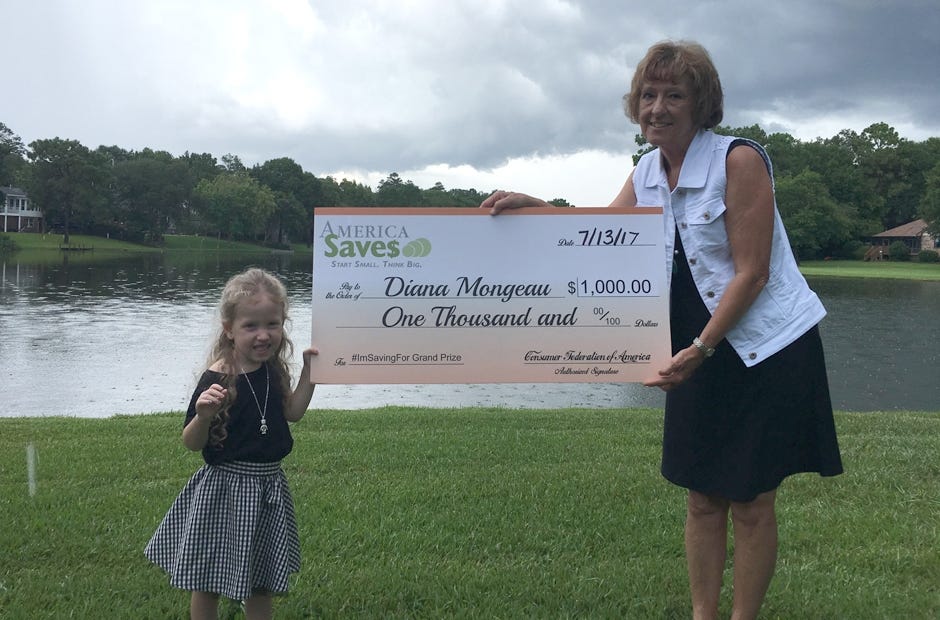
Jill Breslawski, left, presents the Okaloosa Saves #imsavingfor grand prize, a $1,000 check, to Diana Mongeau of Niceville July 13. Mongeau was accompanied by her granddaughter, Jazzy. [Special to the News Bulletin]

As a representative of Okaloosa Saves and the University of Florida Institute of Food and Agricultural Sciences, I was delighted to present a check for $1,000 from America Saves to local resident Diana Mongeau, of Niceville.

Diana entered the national #imsavingfor contest at the Okaloosa Saves Eco-Nomic Living Expo held at the Santa Rosa Mall in February. She made a short video at the mall, with her granddaughter Jazzy, explaining her savings tips.

The same day the check was presented Diana explained that she was heading out to deposit the check in a new savings account for her granddaughter and entering the Teach A Child To Save contest in hopes that Jazzy would be a $50 winner.

The 2017 Teach A Child To Save campaign runs from April 24 to July 31. Any youth (17 years and younger) who sets a savings goal is eligible to win $50.

Enter the drawing by making a deposit into your account and registering as an Okaloosa Saver (one entry per day allowed).

Six children's names will be randomly drawn from all entries, and each will win a $50 cash award to add to their savings accounts. David Money of First Bank provided funds for the prizes.

The 2017 participating banks and credit unions are:

•Bancorp South, Miramar Beach

•Beach Community Bank

•Eglin Federal Credit Union

•First City Bank

Since Okaloosa Saves introduced Teach a Child to Save in 2004, a total of 2,969 children has saved over $300,000.

If you would like to start saving, take a small step and pledge to save at Okaloosasaves.org.

To view Diana’s winning video visit the Okaloosa Saves Facebook page.

Contact me at jbreslawski@ufl.edu if you have questions or want more information.

Jill Breslawski is an agent at the University of Florida's Institute of Food and Agricultural Sciences Extension office in Crestview.

This article originally appeared on Crestview News Bulletin: Okaloosa 'Teach Children to Save' contest promotes financial responsibility

Diversify your investment risk

Yvonne Shanklin is an Edward Jones financial adviser. [Special to the News Bulletin]

All investments carry risk. But, as an investor, one of the biggest risks you face is that of not achieving your long-term goals, such as enjoying a comfortable retirement and remaining financially independent throughout your life. 

To help reach your objectives, you need to own a variety of investment vehicles — and each carries its own type of risk.

If you spread your investment dollars among vehicles that carry different types of risk, you may increase your chances of owning some investments that do well, even if, at the same time, you own others that don't. As a result, you may be able to reduce the overall level of volatility in your portfolio. (Keep in mind, though, that diversification can't guarantee a profit or protect against all losses.)

To diversify your risk factors, you first need to recognize them. Here are some of the most common types of investment risk:

Market risk — This is the type of risk that everyone thinks about — the risk that you could lose principal if the value of your investment drops and does not recover before you sell it. All investments are subject to market risk. You can help lessen this risk by owning a wide variety of investments from different industries and even different countries.

Inflation (purchasing power) risk — If you own a fixed-rate investment, such as a Certificate of Deposit (CD), that pays an interest rate below the current rate of inflation, you are incurring purchasing power risk. Fixed-income investments can help provide reliable income streams, but you also need to consider investments with growth potential to help work toward your long-term goals.

Interest-rate risk — Bonds and other fixed-income investments are subject to interest rate risk. If you own a bond that pays 4 percent interest, and newly issued bonds pay 5 percent, it would be difficult to sell your bond for full price. So if you wanted to sell it prior to maturity, you might have to offer it at a discount to the original price. However, if you hold your bonds to maturity, you can expect to receive return of your principal provided the bond does not default.

Default risk — Bonds, along with some more complex investments, such as options, are subject to default risk. If a company issues a bond that you've bought and that company runs into severe financial difficulties, or even goes bankrupt, it may default on its bonds, leaving you holding the bag. You can help protect against this risk by sticking with "investment-grade" bonds — those that receive high ratings from independent rating agencies such as Standard & Poor's or Moody's.

Liquidity risk — Some investments, like real estate, are harder to sell than others. Thus, real estate is considered more "illiquid" than many common investments.

Make sure you understand what type of risk is associated with every investment you own. And try to avoid "overloading" your portfolio with too many investments with the same type of risks. Doing so will not result in a totally smooth journey through the investment world — but it may help eliminate some of the "bumps" along the way.

This article was written by Edward Jones on behalf of your Edward Jones financial adviser.

This article originally appeared on Crestview News Bulletin: Diversify your investment risk

Make kindness, patience a way of life

The Rev. Mark Broadhead is pastor at Laurel Hill Presbyterian Church and First Presbyterian Church of Crestview. [File photos | News Bulletin]

A train was filled with tired people. Most of them had spent the day traveling through the hot, dusty plains. At last, evening had come and they all tried to settle down to a sound sleep.

However, at one end of the car a man was holding a tiny baby, and as night came on the baby became restless and cried more and more. Unable to take it any longer, a big brawny man spoke for the rest of the group. "Why don't you take that baby to its mother?"

There was a moment's pause and then came the reply. "I'm sorry. I'm doin' my best. The baby's mother is in her casket in the baggage car ahead."

Again there was an awful silence for a moment. Then the big man who asked the cruel question was out of his seat and moved toward the man with the motherless child. He apologized for his impatience and unkind remark.

He took the tiny baby in his own arms and told the tired father to get some sleep. Then in loving patience he cared for the little child all through the night.

How often do you stop to think about what another person is going through when you become agitated? Think about the driver of a vehicle who is speeding and weaving in and out of traffic. Instead of cursing such a person, do you ever offer a prayer? Perhaps there is a medical emergency, or a friend or loved one who needs serious help.

So many people's reactions today show a lack of patience or an attempt to understand, including the immediate reaction that takes another's actions like they were an intentional personal affront. So, retaliation or harsh words are engaged.

Do you have what it takes to give someone the benefit of the doubt when something unpleasant happens? Do you have what it takes to realize that not everything that happens to you was done intentionally? Do you have what it takes to offer a prayer instead of a curse?

Disciples of Jesus Christ should take Paul's admonition seriously: "And the Lord's servant must not be quarrelsome but kindly to everyone, an apt teacher, patient, correcting opponents with gentleness." (2 Timothy 2:24)

It's not always easy to do, but with time and a great deal of practice, kindness and patience will become a way of life. Harsh and rash assumptions will disappear. And relationships will grow.

The Rev. Mark Broadhead is pastor at Laurel Hill Presbyterian Church and First Presbyterian Church of Crestview.

This article originally appeared on Crestview News Bulletin: Make kindness, patience a way of life

Film poster exhibit is at the library

Janice Lynn Crose, a former accountant, lives in Crestview with her husband, Jim; her two rescue collies, Shane and Jasmine; and two cats, Kathryn and Prince Valiant.

The Robert L. F. Sikes Public Library in Crestview is wonderful. It has an amazing collection of books on many different subjects, from technical information to history to science fiction. Whatever one may be looking for is available.

The library also hosts an open microphone night for musicians, writers and poets as well as exhibits of different types, all to enrich our learning.

The exhibit currently on display is "1967: A pivotal year in American film" and displays some film posters from movies made that year. Brian Hughes and his friend Clyde Ponder have graciously put their movie posters on display from now until the end of August.

It is hard to believe that 1967 was 50 years ago, and a big year for movies of all types. Here are a few titles you may have heard of or remember:

•"40 Guns to Apache Pass"

•"Barefoot in the Park"

•"Bonnie and Clyde"

•"Camelot"

•"Cool Hand Luke"

•"The Dirty Dozen"

•"Doctor Doolittle"

•"El Dorado"

•"The Gnome-Mobile"

•"Guess Who's Coming to Dinner"

•"Jungle Book" (animated)

•"The Taming of the Shrew"

•"Wait Until Dark"

•"The War Wagon"

•"Thoroughly Modern Millie"

•"You Only Live Twice"

There were many more films that year. Some were memorable, and some were not.

Library patrons can see an interesting variety of film poster types, including rare "three-sheet" posters for "The Good, The Bad and The Ugly" and the year's Best Picture Oscar winner, "In the Heat of the Night," according to Brian Hughes. There are more film posters exhibited and a plethora of information. He has done a wonderful job with this exhibit.

Dr. David Simmons, Film and Humanities professor at Northwest Florida State College, will give a presentation on the significance of 1967 in American film at 6:30 p.m. Aug. 14 at the library, 1445 Commerce Drive, Crestview. It promises to be fascinating as well as informative. There will be a reception afterward. I hope to see you there.

Janice Lynn Crose, a former accountant, lives in Crestview with her husband, Jim; her two rescue collies, Shane and Jasmine; and two cats, Kathryn and Prince Valiant.

This article originally appeared on Crestview News Bulletin: Film poster exhibit is at the library

Citizen science is a growing hobby

Master Naturalist and citizen scientist Diana Moore, left, assists with outreach at a local event. [Laura Tiu | News Bulletin]

Many people are fascinated by my job as a marine scientist. I often hear wistful comments like, "I wish I had chosen an exciting career like that." I'm here to tell you it's not too late. A phenomenon called citizen science is gaining in popularity, particularly in our coastal communities.

Citizen science is public participation in scientific research by volunteers or amateur scientists. It often involves monitoring or research activities capable of being accomplished by non-professional scientists. These programs are designed to engage community members as collaborators throughout the research process including identifying research topics, monitoring and data collection, or information dissemination.

Citizen science is a fun and interesting way for people to understand and learn about what is taking place in their own neighborhoods.

Citizen scientists report joining research projects for a variety of reasons. Some want to make a difference and contribute to society. Others love science, are curious about their communities and want to ensure that local research projects include a layperson's perspective. CS projects can build trust, as scientists recognize the value of public outreach, while participants see how science can advance their understanding of the world they live in.

The University of Florida has a long history of recruiting and utilizing citizen scientists in a host of research projects. Researchers have long relied on citizen scientists to report the spread of the invasive Cuban treefrog by documenting and submitting frog sightings. The first Cuban treefrog in Okaloosa County was caught and reported by a local citizen scientist. Participating can be as simple as taking photos of the frogs (http://ufwildlife.ifas.ufl.edu/citizen_sci.shtml).

The Choctawhatchee Basin Alliance and the University of Florida Lake Watch Program have partnered for years with local citizens to monitor over 130 sampling sites within the Choctawhatchee Bay, Choctawhatchee River, all the coastal dune lakes in Walton County, and even in the Gulf of Mexico, just off shore in Okaloosa and Walton counties (http://www.basinalliance.org/page.cfm?articleID=4). They frequently recruit citizen scientists for many of their other local research projects including building living shorelines and a new oyster gardening initiative.

The Florida Fish and Wildlife Conservation Commission lists citizen science as a smart, cost-effective strategy to enhance the FWC's ability to conserve Florida's diversity of fish and wildlife species and habitats, according to its website. See http://myfwc.com/get-involved/citizen-science/ for more information.

The FWC is currently seeking volunteers and college students to assist with the 2017 Seagrass Integrated Monitoring and Mapping program in Franklin County (http://myfwc.com/research/habitat/seagrasses/projects/active/simm/). This is a statewide collaborative effort which facilitates the collection and publication of monitoring and mapping data for Florida seagrasses in order to assess the status and trends of this vital ecosystem. This would be a great opportunity for those students wanting to gain some field experiences to add to their resume.

If being a citizen scientist sounds like a fun activity for you or your family, take a look at the links provided in this article, or contact me at lgtiu@ufl.edu for additional suggestions.

Laura Tiu is an agent at the University of Florida's Institute of Food and Agricultural Sciences Extension office in Crestview.

This article originally appeared on Crestview News Bulletin: Citizen science is a growing hobby

Financial moves for 'empty nesters'

Yvonne Shanklin is an Edward Jones financial adviser. [Special to the News Bulletin]

When your children leave home and you become an "empty nester," you'll probably make several adjustments in your lifestyle. But how will your empty nest status affect your financial situation?

Everyone's story is different, involving a range of variables. But here are a few issues to consider:

Insurance. If your kids are through school, your mortgage is nearly paid off and your spouse has accumulated a reasonable amount of money in an employer-sponsored retirement plan, you may not need life insurance to replace income or pay off debts.

However, you might start thinking about other goals, such as ensuring your savings will last your lifetime or leaving a legacy to your loved ones or a charity. Life insurance may be able to help in these areas.

Downsizing. Deciding whether to downsize your living space isn't just a financial decision — it's also a highly personal one. Still, downsizing can offer you some potential economic benefits.

For one thing, if you still are paying off your mortgage, a move to a smaller place could free up some of your monthly cash flow, which, again, you could use to boost your retirement accounts. Furthermore, if your home has greatly appreciated in value, you might make a sizable profit by selling.

If you are single, you may be able to exclude $250,000 of the gain on the sale of your home; married couples may have a $500,000 exemption. Some restrictions exist on this exemption, though, so you'll need to consult with your tax advisor before selling.

Estate plans. Years ago, you might have made various arrangements in a will or a living trust that dealt with taking care of your children if something should happen to you and your spouse.

For example, you might have established a trust and directed it to make payments to your children at certain times and for certain purposes, such as education. But once your children are grown and have left your home, you may need to review and update your estate plans.

Keep in mind, though, that "empty nester" status is not always permanent. You've no doubt heard about "boomerang" kids who return home after college and stay until they can afford a place of their own.

If your children become "boomerangers," even for a short while, will it greatly affect your financial situation? Probably not. However, if your children are going to drive your car, you may want to be sure that they are listed on your car insurance.

Also, if they are going to bring guests to your home, you might want to consider an "umbrella" insurance policy, which typically provides you with significantly greater liability protection than your regular homeowners policy.

In fact, it may be a good idea to purchase an umbrella policy even if you don't have grown kids at home, as this coverage offers you wide-ranging protection from potentially devastating lawsuits that could arise from injuries on your property or through an auto accident in which you are involved.

You may have mixed feelings about becoming an empty nester, but like most people, you will adjust. And by making the right financial moves, you can get off to a good start on this new phase of your life. 

This article was written by Edward Jones on behalf of your Edward Jones financial adviser.

This article originally appeared on Crestview News Bulletin: Financial moves for 'empty nesters'

More on handling difficult situations

The Rev. Mark Broadhead is pastor at Laurel Hill Presbyterian Church and First Presbyterian Church of Crestview. [File photos | News Bulletin]

Here's the scenario from last week's Pulpit article.

Someone at work goes to the boss and declares that you are not pulling your weight. The boss then makes a declaration that because "everyone" is not doing as they should, everyone will be punished. The boss gives the employees more work, or changes around everyone's responsibilities.

Last week's article talked about how the "boss" could have reacted to prevent the situation getting worse.

Now let's look at how individuals who are the focus of such a complaint can respond.

If the allegations are true:

understand your emotional reaction. Anger may rise to the surface as a result of embarrassment for being called out for not fulfilling your responsibility.

own up to your failure. Don't make excuses for your lack of effort. This will only undermine your credibility and integrity.

offer to take measurable steps to improve your work habits. Then ask your boss to review your progress weekly for the next several weeks.

If the allegations are not true:

understand your emotional reaction. Anger may rise to the surface very quickly, which will be a symptom of being hurt emotionally.

do not lash out at your accuser or make any hasty decisions. Many harmful comments and decisions are made in the heat of anger, and once they are out, they cannot be taken back. Your grandmother was wise when she told you to "count to 10" (or even 10,000 if necessary) before reacting.

after calming down to a manageable level, the Bible says to go to your accuser and speak with him or her privately. Explain how their false accusation hurt you. Remain as calm as possible, not allowing your emotions to get hooked by their reaction.

•if the accuser denies their actions or attempts to make matters worse, simply walk away. Request a conversation with the next appropriate management level and the individual together. Again, this is very Biblical. You will have a witness to your attempts to rectify the situation.

then let the matter drop while at work. Do your utmost to not allow the hurt to interfere with your good, strong work ethic.

seek counsel from someone outside of work to vent your hurt and anger. Talking it through will work toward your healing and ease the pain and anger.

Ultimately, Jesus says to "love your enemies and pray for those who persecute you." You may not like them very much at the moment, but through prayer and the guidance of our Lord, healing will take place. Be open to how God provides for that to happen.

Christians are called to act and react responsibly — which often means going against what we would rather do. Give a good witness to the strength of your faith and the graciousness of God by seeking justice, not revenge. 

The Rev. Mark Broadhead is pastor at Laurel Hill Presbyterian Church and First Presbyterian Church of Crestview.

This article originally appeared on Crestview News Bulletin: More on handling difficult situations

Customer service 'is not what it used to be'

Janice Lynn Crose, a former accountant, lives in Crestview with her husband, Jim; her two rescue collies, Shane and Jasmine; and two cats, Kathryn and Prince Valiant.

Customer service is an important function of most businesses and most of them take it seriously, but there are some that just brush off their customers.

The statistic quoted when I was in college was that it takes 10 new customers to take the place of one lost customer. It is six to seven times more expensive to acquire a new customer than to keep a current one, according to the White House Office of Consumer Affairs (https://www.helpscout.net/75-customer-service-facts-quotes-statistics).

Telephone customer service is not what it used to be. A few years ago, one would call and get a pleasant-sounding person who wanted to help resolve the caller's issue. It seems these days that callers (often) reach a surly person who doesn't care whether the issue is resolved.

For example, my mother paid her Southern California Automobile Club dues for the coming year in early June. A week later, she received a letter stating that since she hadn't paid her membership that AAA would cover her car emergencies for 30 days but charge her for any services received.

She checked with the bank and the payment had cleared, so she went to the bank and got a copy of the electronic fund transfer, and mailed it per their request. The proof of payment from the bank still didn't clear up the matter. After numerous phone calls and hours on the phone, she finally got a young man who took the time to locate her payment; her AAA membership money had been applied to her homeowner's insurance.

Why did it take so long to locate her payment? Because no one else cared enough to take the time to really look.

If at all possible, it is better to go into the place of business and get the matter resolved face to face. If the only option is calling, be kind to the person on the phone as people (usually) try harder to help those who are kind. Also, if you get a rude person, thank them for their time and hang up. Call back later. You may get a nicer person.

We have two customer call service centers here in Crestview. I expect they provide outstanding service.

Janice Lynn Crose, a former accountant, lives in Crestview with her husband, Jim; her two rescue collies, Shane and Jasmine; and two cats, Kathryn and Prince Valiant.

This article originally appeared on Crestview News Bulletin: Customer service 'is not what it used to be'

Match short-and long-term goals with the right investments

Yvonne Shanklin

Not all investments are created equal. Some are better suited for short-term goals, while others can help you build resources for objectives far in the future. As an investor, then, one of your biggest challenges will be to match your short- and long-term goals with the appropriate investment vehicles.

How should you proceed?

For starters, identify your short- and long-term goals. Your short-term goals will change throughout your life. When you are starting out in your career, for example, you might aspire to purchase a home in the next three to five years. Later on, though, your biggest short-term objective might be to save enough money for a long tour of Europe without picking up credit card debt.

As for long-term goals, your biggest one likely will be to enjoy a comfortable retirement, but you may well have other long-term plans, too, such as sending your kids to college in 10 or 15 years.

After you have a clear sense of your short- and long-term goals, you can choose the right investments to help you meet them.

Let's start with the shorter-term ones. When you're saving for a down payment on a home or for an expensive European vacation, you want to make sure that a certain amount of money will be available to you at a certain time. Consequently, you may want to avoid stocks or stock-based vehicles, which will constantly fluctuate in price, because you don't want the value of your investment to be down at the moment you need the money.

Instead, for short-term goals, you may want to consider a fixed-income vehicle, such as a bond, which is designed to provide regular interest payments and return your principal upon the bond’s maturity (providing the issuer doesn't default, which, with investment-grade bonds is generally unlikely).

For longer-term goals, such as college for your kids and a comfortable retirement for yourself, it’s a different story. To achieve these goals — and especially for retirement — you generally need to accumulate as much as you can. As a result, you need investments with growth potential, which means you will need to consider stocks and stock-based instruments. As mentioned above, stocks will always fluctuate in value, and they may be worth more or less than your original investment when sold. However, building a portfolio with an investment mix that's appropriate for your risk tolerance, and that contains a reasonable amount of growth-oriented vehicles, can potentially help you overcome short-term volatility and continue making progress toward your long-term goals.

Plus, you have some attractive long-term options available. With a 529 college savings plan, you can save for college and possibly achieve tax benefits, too. And by contributing regularly to your IRA and 401(k) or similar employer-sponsored plan, you can defer taxes while spreading your dollars among a wide range of investments. But there's one thing all long-term investments have in common: You need patience and discipline to stick with them.

So, there you have some ideas on short and long-term investing. Keeping this distinction in mind when you invest can help boost your confidence that you're making appropriate moves for all your goals. 

This article was written by Edward Jones for use by your local Edward Jones financial adviser. 

This article originally appeared on Crestview News Bulletin: Match short-and long-term goals with the right investments

error: Content is protected !!