







Settle back with good friends and family and enjoy a traditional English multi-course afternoon tea, including a selection of teas, tempting pastries, delicious tea sandwiches and more, all in the historic ambiance of the Crestview History Museum in the Bush House, 198 S. Wilson St.
This year the Bush House, built in 1925-26 by the Louisville & Nashville Railroad for track supervisor Lorenza Bush and his family, celebrates its centennial. Throughout the year, events will carry the centennial theme.
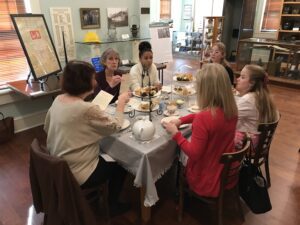
Up first is the reprise of a favorite event. “Tea With Mrs. Bush” never ceases to delight as visitors — including men, women and children — don their afternoon tea ensembles and amid a flutter of boa feathers, fancy hats and delighted chatter, sample teas and enjoy the accompanying finger food.
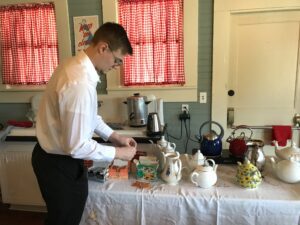
Guests won’t be required to raise pinkies or, for the ladies, wear afternoon-length gloves, organizer Mary Richard said, though everyone’s invited to dress up in what the English call “smart casual.” To quote AfternoonTea.co.uk, “Afternoon tea is a special occasion, so why not dress to impress!”
When it’s chilly outside, nothing beats a civilized cup of tea (a “cuppa,” if you’re visiting England), lots of lovely little nibblies, and good conversation to warm the heart and soul. The Crestview History Museum invites the community to do just that on Jan. 24.
Seatings are at noon and 1:30 p.m. The suggested admission of $25 per person benefits the Crestview History Museum. Tickets are available at the Bush House or online at bit.ly/4btykyK. There is no service fee for booking online.
Reserve your tickets soon as seats are limited. For more information, call the Crestview History Museum at (850) 398-5459 or email hughesb@cityofcrestview.org.
Editor’s note: Brian Hughes is the city of Crestview’s cultural services specialist.
AFTERNOON TEA VS. HIGH TEA
• Afternoon Tea: Introduced in Britain in the early 1840s, it evolved as a light meal to stem the hunger and anticipation of dinner, which was usually served at 8 p.m. It was initially developed as a private social event for society ladies. It was only when Queen Victoria engaged in the Afternoon Tea ritual that it became a formal occasion on a larger scale.
• High Tea: A wearied factory worker wouldn’t arrive home until six in the evening. Thus, in the industrial areas of the UK (northern England and southern Scotland), high tea became the working classes’ evening meal. It usually involved a mug of tea, bread, vegetables, cheese and occasionally meat. Variations could include the addition of meat pies, potatoes and crackers.
While Afternoon Tea was largely a social event for the upper class, high tea for workers was a necessary meal. A possible explanation why this type of meal was called high tea is the fact that it was eaten at a table.
In comparison, Afternoon Tea was taken whilst seating in low, comfortable chairs or sofas.
Of course, soon after, the upper classes developed their own variation and also called it “high tea.” It was a meal that could be eaten when their servants were away, as it was so easy to prepare. The upper class “high tea” involved the amalgamation of Afternoon Tea and high tea, with the addition of pigeon, veal, salmon and fruit.
• High Tea in London: The Afternoon Tea menu served in the UK today is often referred to as high tea in many other parts of the world. Because of this, some hotels, such as The Ritz in London, use the term “High Tea in London” to advertise their Afternoon Tea because a large proportion of their customers are from overseas.
Source: AfternoonTea.co.uk